


Erhalten Sie Zugang zu diesem und mehr als 300000 Büchern ab EUR 5,99 monatlich.
- Herausgeber: The History Press
- Kategorie: Geisteswissenschaft
- Sprache: Englisch
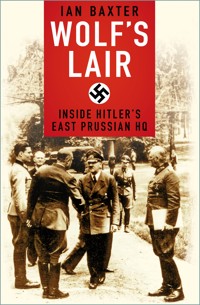
The Wolf's Lair was the most important German command post building during the Second World War. Orders sent from these secret headquarters would play a massive part in the outcome of the War. Ian Baxter looks in to the inner workings of Hitler's headquarters, highlighting the decisions that were made and analysing how they came about. Baxter not only utilises published works, unpublished records, military documents and archives on the subject, but also digs deep into the contemporary writings of Hitler's closest personal staff, seeking to disentangle the truth through letters written by wives, friends, adjutants, private secretaries, physicians, and of course his military staff. Baxter extensively examines life within the Fuhrerhauptquartiere, where from behind closed doors, inside the claustrophobic atmosphere of the bunkers Hitler planned and gossiped with his associates. However, as defeat loomed, Hitler surrounded himself not with his intimate circle of friends, but what he considered were illiterate soldiers. Baxter shows how Hitler's contempt for his war staff grew. It describes, during the onset of the traumatic German military reverses in Russia, how Hitler stood unbowed in the face of the enemy, and how he tried to infuse determination into his generals and friends, despite his rapid deterioration in health.
Sie lesen das E-Book in den Legimi-Apps auf:
Seitenzahl: 271
Veröffentlichungsjahr: 2009
Das E-Book (TTS) können Sie hören im Abo „Legimi Premium” in Legimi-Apps auf:
Ähnliche



















First published 2009
This papaerback edition first published 2021
The History Press
97 St George’s Place, Cheltenham,
Gloucestershire, GL50 3QB
www.thehistorypress.co.uk
© Ian Baxter, 2009, 2021
The right of Ian Baxter to be identified as the Author of this work has been asserted in accordance with the Copyright, Designs and Patents Act 1988.
All rights reserved. No part of this book may be reprinted or reproduced or utilised in any form or by any electronic, mechanical or other means, now known or hereafter invented, including photocopying and recording, or in any information storage or retrieval system, without the permission in writing from the Publishers.
British Library Cataloguing in Publication Data.
A catalogue record for this book is available from the British Library.
ISBN 978 0 7509 7933 7
Typesetting and origination by The History Press
Printed and bound in Great Britain by TJ Books Limited, Padstow, Cornwall.
eBook converted by Geethik Technologies
‘Men and wars come and go, but what is left, are the buildings.’
Adolf Hitler
Contents
About the Author
Acknowledgements
Preface
Chapter I Historical Background
Chapter II ‘And so to the East’
Chapter III ‘Triumph or Die’
Chapter IV Lost Victories
Chapter V Unshakeable Allegiance
End Notes
Appendix A: Russian NVKD Investigative Report on the Wolf’s Lair and Surrounding Area
Appendix B: Prominent Military and Party Officials Appointed to the Wolf’s Lair 1941–1944
Appendix C: Composition of the FBB at the Wolf’s Lair Late 1944
Appendix D: Wolf’s Lair Security 1941–1944
Appendix E: SS Weaponry at the Wolf’s Lair
Appendix F: Hitler’s Military Headquarters Movements 1941–1944
Appendix G: Abbreviations and Equivalent Ranks
Bibliography
About the Author
Ian Baxter is a military historian who specialises in German twentieth-century military history. He has written more than twenty books including Poland – The Eighteen Day Victory March, Panzers In North Africa, The Ardennes Offensive, The Western Campaign, The 12th SS Panzer-Division Hitlerjugend, The Waffen-SS on the Western Front, The Waffen-SS on the Eastern Front, The Red Army At Stalingrad, Elite German Forces of World War II, Armoured Warfare, German Tanks of War, Blitzkrieg, Panzer-Divisions At War, Hitler’s Panzers, German Armoured Vehicles of World War Two, Last Two Years of the Waffen-SS At War, German Soldier Uniforms and Insignia, German Guns of the Third Reich, Defeat to Retreat: The Last Years of the German Army At War 1944–1945, Operation Bagration – the destruction of Army Group Centre, German Guns of the Third Reich, Rommel and the Afrika Korps, U-Boat War, and most recently The Sixth Army and the Road to Stalingrad. The SS of Treblinka is a forthcoming History Press title. He has written over one hundred journal articles including ‘Last days of Hitler’, ‘Wolf’s Lair’, ‘Story of the V1 and V2 rocket programme’, ‘Secret Aircraft of World War Two’, ‘Rommel at Tobruk’, ‘Hitler’s War with his Generals’, ‘Secret British Plans to Assassinate Hitler’, ‘SS at Arnhem’, ‘Hitlerjugend, Battle Of Caen 1944’, ‘Gebirgsjäger at War’, ‘Panzer Crews’, ‘Hitlerjugend Guerrillas’, ‘Last Battles in the East’, ‘Battle of Berlin’, and many more. He has also reviewed numerous military studies for publication, supplied thousands of photographs and important documents to various publishers and film production companies worldwide, and lectures to various schools, colleges and universities throughout the United Kingdom and Ireland.
Acknowledgements
Those of us who write the histories of war know what an arduous task it is to put them together, and without help this project would have been impossible. So I will endeavour to first thank those who shared my research, to briefly name the historians and archivists who guided me, and the friends whose help went beyond the bounds of professional assistance. I first wish to thank my Polish expert and translator Bartlomiej Zoborski. He not only found vital contacts, but revealed valuable information that became an asset in completing my research.
During my ten years of research into Hitler’s headquarters, I must also acknowledge David Irving for his help and expert advice. A special debt is due to Dr Hans-Jurgen Kuhn, Professor Peter Hoffmann of McGill University, Montreal, Canada, whose advice and book, Hitler’s Personal Security, helped me throughout my research. I wish to thank Dr Andrzei Paczkowski, Fritz T. Stol, and of course Dr Richard Raiber of Hockessin, Delaware, USA, whose diligent and expert advice clarified many issues and diverse opinions.
Thanks also go to Linda Mcfeddon, my German historical diary translator for deciphering many illegible handwritten diaries. As ever, I am much in debt to the staff of the Imperial War Museum in London, archivist Robin Edward Cookson for captured German records at the National Archives USA, Ulrike Talay and Michael Volk at the Intitut fur Zeigeschichte Archiv Munchen, Bundesarchiv Koblenz, and Dr Ritter at the Bundesarchiv Berlin, for their help, advice, access to documents and other important information.
My thanks go to Mr Boguslaw Wrobel of ‘EXPLORATOR’ in Poland, Michelle Mortimer who was Publishing Manager at the MicroForm in West Yorkshire, England, Professor Dr Hartmut Lehmann of the Max-Planck-Institut Für Geschichte (since 2007 the Max-Planck-Institut zur Erforschung multireligiöser und multiethnischer Gesellschaften), The German Historical Institute in London and the staff at the Colchester Library in England.
I must especially record my appreciation of the kindness of the staff at the Ilford Park residential home in Devon, England, and to W. Jaworski who generously gave his time to translate Polish and Russian documents for me.
To many individuals I owe thanks for their help, personal reminiscence and unfailing encouragement. I have spoken briefly of all those who had some association with my research on this book, but not yet those that actually ventured with me to Poland to see the ruins of the Wolf’s Lair. It is with the greatest pleasure that I would like to thank my dear friends Kevin Bowden and Chandran Sivaneson for coming to Poland with me over a three-day period. It was a cold and snowy morning in January 2008 when we arrived in Gdansk airport. Our Polish guide and taxi driver, Elzbieta Giste, took us across northern Poland, and after travelling more than five hours across treacherous roads to the east of the country, we finally arrived safely in the town of Ketzryn (formerly Rastenburg) to begin our research into Hitler’s infamous East Prussian headquarters. To both Kevin and Chandran I would like to say a big thank you. Not only were they extremely helpful with their support and advice but they were infinitely patient as they waited for me in the snow, examining each ruined building. My gratitude also goes to Elzbieta Giste who helped us tirelessly with translation and driving us around the Polish countryside.
Preface
This is the special and wonderful property of architecture: when the work has been done, a monument remains. That endures; it is something different from a pair of boots, which can also be made, but which the wearer wears out in a year or two and then throws away. This remains, and through the centuries will bear witness to all those who helped to create it.
Adolf Hitler, following the construction of the Reich Chancellery in January 1939.
I held this ardent belief when I embarked on this study of Hitler’s largest wartime headquarters, the Wolf’s Lair. Throughout my years of research I saw myself not as an architect concerned with building towering structures, but an historian eager to construct in words a lasting monument to Hitler’s Eastern Front headquarters.
The Wolf’s Lair (Wolfschanze) was the most important German command post built during the Second World War, and the orders that were sent from these secret headquarters inevitably changed the course of the War. Still to this day, many people persistently cloak these headquarters in an atmosphere of gloom to reinforce the image of the frightening Führer who lived there. However, it is my opinion that the legacy left by Hitler at his headquarters is self-evident and requires no exaggerated portrayal. In order to remedy this unnecessary obfuscation I decided to burrow deep and describe events from behind the barbed-wire entanglements of the Wolf’s Lair and analyse each unfolding episode through the eyes of Hitler and his staff.
In writing this study of one of the most interesting military headquarters of the twentieth century, I found the results of my research astonishing, for there was no single comprehensive document which I could consult. I therefore approached the research as a giant puzzle. In order to piece it together I sought not only the printed text of military books, unpublished records, documents, archives, and the advice of military experts in the field, but I dug deep into the contemporary writings of his closest personal staff, seeking to disentangle the truth through letters written by wives, friends, adjutants, private secretaries, physicians, and of course his military staff. I waded through many hundreds of pages of microfilm, scrutinising information on those that lived and worked at the headquarters. I even went further by advertising in the Gazeta – a Polish national newspaper – appealing for persons that had worked constructing the headquarters site, and at the same time, in Germany, advertised in the paper, Der Freiwillige.
I am aware that some readers may find such a study far from complete, or may even take it as granting a kind of undue recognition to a number of people described in it. But we must know about the motives of those that were present when the momentous decisions were taken if we are to understand those decisions.
The purpose of this volume is to examine life within the Führerhauptquartiere (Führer’s headquarters), where, from behind closed doors inside the wooden hutments and the claustrophobic atmosphere of bunkers, Hitler planned and gossiped with his associates. He was regularly seen taking strolls around the perimeter of what was known as his ‘inner sanctum’, Security Zone I, even stopping to chat familiarly with the Organisation Todt workmen that were labouring night and day, building and re-strengthening the many dozens of bunkers and buildings that made up the Wolf’s Lair. As setbacks rapidly turned into catastrophe, Hitler surrounded himself not with his intimate circle of friends, but what he considered were illiterate soldiers. Conversation became confined to the barracks and mess.
Consequently, the pages of this text investigate the manner in which Hitler’s contempt for his war staff grew. It describes how, during the onset of the traumatic German military reverses in Russia, Hitler stood unbowed in the face of the enemy, and how he tried to infuse determination into his generals and friends, despite his rapid deterioration in health.
Chapter I
Historical Background
The Führer’s headquarters or Führerhauptquartiere – officially abbreviated FHQu – were the various command posts from which the supreme commander directed military operations during the Second World War. They ranged widely from the rather simple array of railway coaches, nicknamed the Führersonderzug (Führer’s special train), to an extensive, reinforced, heavily guarded concrete complex called the Wolf’s Lair or Wolfschanze, built deep in the countryside of East Prussia.
From the very beginning, it is necessary to note that the Führerhauptquartiere never bore any relationship to the General Headquarters or Obersteheersleitung, the highest German military command centre in the First World War. In 1914 Kaiser Wilhelm II was the commander-in-chief and was expected to take advice from his General Staff of the field army at all times, the German Army’s highest general. Generally, the Kaiser interfered very little in military matters, leaving the General Staff to preside over the War, whilst the Kaiser was scarcely more than an invited guest.
Adolf Hitler, however, was certainly no Kaiser Wilhelm II. He had recognised the Kaiser’s weakness, and by 4 February 1938 had personally taken command of the armed forces, replaced the War Ministry with the High Command of the armed forces or Oberkommando der Wehrmacht (OKW) and acquired for himself the instruments needed for the administration and supply of the armed forces. The chief of the General Staff of the Army no longer functioned as the Army’s top general. Instead, he was now an advisor to the Commander-in-Chief of the Army, or what was known as the High Command of the Army or the Oberkommando des Heeres (OKH).
Between OKH and Hitler, was the OKW. It was an independent military authority, the nerve centre of the German hierarchy. It was commanded by General Wilhelm Keitel. In Keitel, Hitler had found exactly the type of officer he was seeking. He was someone who would carry out his commands to the letter without question, a ‘yes-man’ who would be content to receive orders from the Führer without any independent command. With such a responsibility a tremendous workload now rested upon Keitel, and Hitler soon grew accustomed to having this ever conscientious and exceedingly hard-working administrator in charge.
Keitel organised his new command into four sections: the Armed Forces Operations Staff (Fuhrungstab/WFA, later Wehrmacht Fuhrungsstab/WFSt (Armed Forces Operations Office)), the Intelligence and Counterespionage Office (Abwehr, the Armed Forces Central Office), and the Armed Forces Economic Office. The Operations staff was regarded as the most important section, and Keitel chose one of the most suitable military experts for the job, Major-General Alfred Jodl, as Chief of the OKW Operations Office.
The Operations Office, existing alongside OKW, acted as an administrative office for the receipt and processing of reports from the front. It also received orders from Hitler and issued them accordingly. Although both Keitel and Jodl had become part of Hitler’s military hierarchy, they actually worked without any real defined responsibilities and command authority. Together, they headed OKW to correlate and supervise individual strategies as conceived and initiated by the three services, the OKH, the Oberkommando der Marine (High Command of the Navy), and the Oberkommando der Luftwaffe (OKL, the High Command of the Airforce).
Alongside OKW stood the OKH, which was commanded by Colonel-General Walter von Brauchitsch. In Keitel’s opinion, he was a gentleman of the old school with sound judgement in military matters who possessed the talent necessary for conducting strategy along classical lines. Brauchitsch’s Chief of Staff was Colonel-General Franz Halder, who was the most controversial of all the generals in Hitler’s military elite. Halder was a devoted general of the highest competence and his main responsibilities were to form strong planning teams within the General Staff that could challenge the authority of Keitel and Jodl in the OKW.
The first real test of the higher organisation of the Wehrmacht began with the planned invasion of Poland, code-named ‘Case White’. It was here that the new Führerhauptquartiere was first established on board a special train code-named the Führersonderzug, the Führer Special. In the days leading to the war, it was not possible to say what made Hitler reject all proposals for the organisation of the Army War Headquarters. Though we do know that when Keitel had put forward a semi-complete plan to house it in a newly completed barracks in the Potsdam area of Berlin, Hitler remarked that, as supreme commander, he could not move out of Berlin westwards when the Wehrmacht was marching east into Poland. To the public, that would look like deserting his post. So it was that Hitler decided to use his special train as his first headquarters of the war. Only this mobile headquarters could provide the means for him to shuttle back and forth from east to west as the occasion might demand, and more easily visit sectors of the front he was interested in.
On 3 September 1939, Hitler’s new mobile headquarters left Berlin’s Anhalt station bound for Poland. Among the coaches, there were two baggage and one power-engine cars, the Führer’s Pullman, and one press car with a communication centre including a 700-watt short wave transmitter. There was Hitler’s extensive guest, dining and personal staff accommodation, including a bathing car. In his personal coach was a drawing room, and attached to these quarters was his communication centre, equipped with radio-telephone and several teletype machines. There was the escort car for the Reichssicheerheitsdienst (RSD), Reich Security Service and Führer-Begleit-Battaillon (FBB) or Führer Escort Battalion. The remaining coaches consisted of two cars for personnel such as secretaries, cooks, aides, signal corps men, and two sleeping cars for entourage and guests.
In the train, as at the Reich Chancellery, the brown Nazi party uniform dominated the scene. On board there were nine or more adjutants and aides, Keitel and Jodl of the OKW (later, each had his own Sonderzug), the Führer’s army adjutant Gerhard Engel, two personal physicians for the Führer, two secretaries and three or more press officers, including the Reich press chief Otto Dietrich, who was soon to write a short book about the journey. There were several radio operators, guests such as the chief photographer Heinrich Hoffmann, a liaison officer, Heinrich Himmler, Karl Wolff, Martin Bormann’s younger brother Albert, a representative of the Foreign Office, three valets, the driver and deputy, ten SS Begleit-Kommando men or Führer Escort Battalion (FBB), ten RSD men, fourteen officials and employees of the Reich Railway Catering Service including waiters, cooks, kitchen maids and two silver cleaners, five railway police officers, and three inspectors of the Reich mail. Later, Theodor Eicke also operated his command headquarters for the brutal Death’s Head regiments from Hitler’s special train.
For the next two weeks, Hitler was to spend most of his waking hours in the claustrophobic atmosphere of his command coach. Here, Keitel introduced the Führer to his Chief of Operations, Alfred Jodl. This tall, balding officer impressed Hitler immediately. Jodl was to be his principal strategic advisor until the end of the War.
From the train Hitler was able to devote his attention entirely to operations in Poland; this was only the first of several journeys the train made. In spite of the advantages in mobility from the very first day it left Berlin for Poland the train had obvious disadvantages as a military headquarters. In fact, on 14 September 1939, in the swaying carriage of the ‘command coach’, Hitler discussed at length with his chief engineer Fritz Todt the need for a permanent headquarters in the West. Jodl instructed his deputy General Walther Warlimont to reconnoitre for a field headquarters for the OKW to the west of central Germany, from which the later phases of a war against the West could be conducted.
For the next few months, the search was on for the first ground headquarters. As usual, Hitler took up residence in the Chancellery, using it temporarily, as he did throughout the war as supreme headquarters. By April 1940, with the war poised against the West, a new location for the headquarters had been found near the town of Munstereifel, code-named Felsennest, Rocky Nest. Hitler had instructed that OKH should be located in a neighbouring hunting lodge, whilst the Luftwaffe chiefs of staff were left to choose their own headquarters.
Hitler’s underground command post at Felsennest was very small and claustrophobic. But in spite of the gloomy surroundings in which he worked and lived he was able to undertake detailed discussions with his service professionals and execute orders quickly and effectively. From behind the barbed-wire entanglements the military leadership were able to plan and order various operations. Commanders fighting on the front lines were influenced daily by the Führerhauptquartiere. Many of them were regularly summoned to make a presentation or report, which gave Hitler and his operations staff a more detailed insight into operations being conducted on the frontlines.
For the second phase of the war in the West, Hitler and his headquarters staff moved to the small deserted Belgian village of Bruly-de-Pesche, near the border with France. It was promptly sited in a forest clearing code-named ‘Forest Meadow’. However, by the time Hitler arrived on 6 June 1940 he wanted to give these peaceful surroundings a war-like name, Wolfschlucht (Wolf’s Gorge).
Hitler never felt at home here as he did at Felsennest. Whether it was the swarms of mosquitoes that plagued all around or his burning desire to win the war quickly, nobody could tell. Despite his agitation he was supremely confident. The Wehrmacht had achieved rapid success and swept forward almost unimpeded on a 400-mile front, heading for Paris.
When victory had finally been attained during the last week of June OKW and OKH collected themselves from the Wolf’s Gorge and surrounding areas and moved deep into the Black Forest in one of the headquarters prepared before the outbreak of the War. Its nickname was Tannenberg. Here, Hitler had decided on a short stay before returning to the Chancellery, primarily so that he could visit the great forts of the French Maginot Line. Tannenberg was not one of Hitler’s most attractively sited headquarters. The tall pine trees swayed with alarming momentum, and it rained heavily for most of his week’s stay. When there was sunshine, he could be seen walking through the dripping forest of the restricted part of the headquarters known as HQ Area I, flanked either by guests, party dignitaries or adjutants.
On 6 July, just two months after he had set forth to conquer France, Hitler left the bleak surroundings of Tannenberg and boarded his train for Berlin. For the next nine months he spent his time either at the Reich’s Chancellery, his mountain retreat in the Berghof, or on board his train, now code-named Amerika.
During this period Hitler began preparing the military machine against the one target that he had never lost sight of – the Soviet Union. By September 1940, he was discussing his decision to attack Russia in the spring the following year. By special order of the Führer, chief engineer Fritz Todt, his army adjutant Lieutenant Colonel Engel and other headquarter staff officers and construction specialists were sent out to look for a suitable site for Hitler to direct his campaign against Russia. In November Todt had found a location and was instructed to build a huge fortress, bigger than anything else yet built.
It was emphasised, however, because of its size and remarkable construction, it would take many months to complete. The site itself, known only by a handful of the Führer’s closest staff, was situated deep inside the East Prussian forest of Gorlitz, a few miles east of a town called Rastenburg (now Ketrzyn in Poland). Before the area had been sealed off for a military barracks, it had been a place to relax for the people of the nearby town. The task of sending thousands of construction workers to build the new headquarters was left in the capable hands of the Konstrukionsburo with engineer Peter Behrens heading the construction team of Organisation Todt workers.
During the initial construction phase, the identity of the headquarters was camouflaged under the code name Anlage Nord (Camp North), and also Chemische Werke Askania (Askania Chemical Works). When building first began at Anlage Nord, two other headquarter sites were also chosen in Poland and underwent construction. They were known as Anlage Mitte (Installation Centre) near Tomaszow, and Anlage Süd (Installation South), near Krosno. The building of these two installations was not designed as a permanent headquarters for Hitler’s forthcoming campaign, consequently they were never to match the huge concrete fortress of Anlage Nord. Instead they were purely as tunnels of reinforced concrete for Hitler’s special headquarters train, Führersonderzug Amerika, with platforms and a few wooden huts scattered about.
A few hundred miles to the north, work continued on Anage Nord. For seven solid months, Organisation Todt labourers laid out a network of roads through the swampy malarial East Prussian landscape. They turned forest paths into a huge complex of wood and concrete bunkers and other buildings. Dormitory barracks for thousands of construction workers covered the area, with many teams working in shifts around the clock. Massive excavation machines dug out thousands of tons of earth, and huge amounts of steel and concrete filled the holes. At night the various buildings sites glowed with light, and occasionally detonations thundered through the forest.
In total, an area of 154,501 square metres was developed, with only four per cent of the area comprised bunkers. Hitler’s headquarters covered 41,720 square metres. Of the 173,260 cubic metres of concrete laid, three-quarters of it was poured into Hitler’s headquarters sites, whilst the remainder was laid in OKH and the Luftwaffe Command centres. On average, some 4,600 German OT workers and foreign labourers, which were all thoroughly vetted by the RSD, worked on the vast construction programme at any time. The peak period before Hitler’s arrival was between September 1940 and June 1941.
Every day a stream of workers entered the construction site, labourers, builders, plumbers, electricians, telecommunication engineers, air conditioning specialists and architects. Miles of cables were laid and telecommunication installations were connected through a small telephone/telex exchange building. In total, three exchanges were set up and an independent telegraphy unit was installed at Heligenlinde, about fifteen miles to the west of Hitler’s new headquarters.
Various barrack-type huts with mantels of brickwork and concrete were constructed, and plans were drawn up to reinforce their ceilings for protection against bomb splinters. Originally there were ten bunker constructed, each had been reinforced with two metres of concrete. The floor in the rear part of the bunker was sunk over two metres deep and was to be used for sleeping quarters. Inside the work bunkers a narrow corridor led to what was known as the workroom door. This door led to a small room which could house two desks, chairs and filing cabinets. The windows to these bunkers had steel shutters attached and could only be closed and bolted from the outside. The windowless dormitory bunkers had two entrances. Inside the cabins were panelled with light wood and the sleeping compartments were furnished with a bed, wash basin, fitted wardrobe and later connected by telephone. Near the entrance of the bunker, plumbers installed a small bathroom complete with waste pipe and running water.
Air ducting engineers installed ventilation machinery which drew fresh air through the ceiling. Air conditioning units were installed.
All the rooms also had electrical heating, and warm air could be circulated through the ventilation shafts. The ventilator proved to be noisy, but engineers found that if it was turned off the bunker became unbearably hot and stuffy. Those that were to occupy the bunkers were instructed to ensure that the ventilators remained on at all times, in spite of the terrible shrieking noise they made.
Elsewhere around the headquarters builders assembled the small guard houses, which were positioned at the three entrances to the installation, North, South and East. Barbed-wire fencing surrounded the entire headquarters and blockhouses for guard personnel were built.
By the end of May, a full inspection was made of the new headquarters site, and on 6 June 1941 the 1st Battalion Flak Regiment 604 was moved to the Gorlizt Forest. The flak unit which was to protect Hitler’s headquarters from possible aerial attack consisted of five batteries, three of which were equipped with 10.5cm guns and one each with 2cm and 3.7cm guns.
By the time the Russian invasion was unleashed on 22 June 1941, work on the headquarters still had not been completed. With word that the Führer might arrive any day, frantic measures were immediately undertaken to complete the finishing touches to the Führerbunker, and other important bunkers and buildings that were to house Hitler’s staff during the conquest of Russia.
Chapter II
‘And so to the East’
On 23 June 1941, just before midday Adolf Hitler and his headquarters entourage made their way through the sprawling streets of Berlin to Hitler’s Führersonderzug Amerika. At half-past noon in the sweltering heat the twin locomotives consisting of fifteen or more coaches, guarded by two flak wagons, left for East Prussia hauling the Führer and his staff.
Throughout the night the various echelons of Supreme Headquarters followed Amerika either by rail or air. Just after midnight Amerika halted on a local line a few hundred yards from the headquarters perimeter fence. Boarding a column of waiting field vehicles Hitler was driven up to a forest and inside this forbidding, heavily guarded wood stood his new headquarters. During the train journey Hitler had decided to call it Wolf’s Lair. When Hitler’s secretary, Fraulein Christa Schroder inquired, ‘Why Wolf again – just like the other headquarters?’ Hitler replied, ‘That was my code name in the years of struggle.’1
The Wolf’s Lair installation was laid out on both sides of an asphalt road which passed west/east through the Gorlitz forest from Rastenburg and then on north-east to Angerburg. The forest was less than 2,000 metres across, and because there were so many meadows and open spaces scattered among the tall pine trees, it was essential to hang camouflage netting to hide the installation from aerial observation. Just north of the road was the railway line which passed through Rastenburg. For a number of years there had been a railway station in the small town of Gorlitz, south of the forest. For some time, tourists had visited the area using the rail network, but now this had been stopped. A rail siding was added to the original rail line at the station, and its building was added to throughout the summer of 1941. A longer ramp was built to accommodate the arrival and departure of Amerika.
It was 1.30 am when Hitler and staff entered the enclosure. Passing cordons of sentries of the FBB guarding the Gorlitz forest, they moved through the outer perimeter barrier known as Sperrkreis IV (Security Zone IV), which was a high barbed-wire fence enclosing an area of about 2.5 square kilometres and well hidden from the road. Installed menacingly along the fence were blockhouses, flak and machine-gun towers, and other defensive emplacements including a small minefield surrounding the compound. Again sentries patrolled the barrier here, as well as posts within the compound. Beyond the outer perimeter was an extensive number of concrete gun emplacements strategically emplaced at road junctions and covering access roads.
Security at the installation was multi-layered. There were essentially one outer and three inner security zones known as Security Zone I, Security Zone II, Security Zone III, and Security Zone IV, each complete with checkpoints and guards. A visitor entering Wolf’s Lair passed through at least two, three or even four checkpoints on his way through to Hitler’s Security Zone I, the inner sanctum of the headquarters. It was situated north of the Rastenburg/Angerburg tracks and road in the eastern part of Security Zone II. As one approached this well guarded enclosure, it too was surrounded by a fence and topped with barbed wire. Here, sentries manned the western and eastern entrance gates with a barrier, scrutinising every person that wanted access.
Security Zone I consisted of huge concrete bunkers that loomed over an assortment of wooden huts. The bunkers were concealed from the air by painted designs on walls, foliage between buildings on poles and camouflage netting suspended from the tree tops. A Stuggart landscaping firm had been hired to install artificial trees, camouflage nets and artificial moss on top of buildings, over the concrete roads inside the installation, and wherever man-made structures might be visible from the air. The Führersonderzug too, was kept under cover of camouflage trees and nets when it stopped at Gorlitz, the Wolf’s Lair station. Chief of the OKW, General Wilhelm Keitel wrote in his memoirs:
I have often flown over the site at various altitudes, but despite my precise knowledge of its location was never able to pin-point it from the air, except perhaps by the virtue of the lane leading through the forest and a single-track railway spur which had been closed to public traffic.2
Despite serious efforts to keep the headquarters secret, close observation of the area using aerial photography could locate the installation. But the German security authorities could not know if the Russians would be able to determine that the buildings hidden among the trees were Hitler’s Eastern Front headquarters. Nevertheless great efforts were made throughout the War to conceal it from enemy aerial reconnaissance.




