


Erhalten Sie Zugang zu diesem und mehr als 300000 Büchern ab EUR 5,99 monatlich.
- Herausgeber: The History Press
- Kategorie: Geisteswissenschaft
- Sprache: Englisch
During the Second World War over 1.5 million of women found themselves thrust into a male working world, having to learn new skills within a matter of weeks. Their contribution to the war effort often remains unheralded, but it is without doubt that these women played a central role in an Allied victory. Kathleen Church-Bliss and Elsie Whiteman were two such women, who volunteered for war work and after a training course in engineering found themselves in an aircraft components factory. Thrown into a whole new world of industrial work, they kept a joint diary providing a unique insight into life in a wartime factory. It tells the tale of the poor conditions suffered on the factory floor, as well as the general disorganisation and bad management of this essential part of the war effort. They also describe how war work opened up a whole new world of social freedom for many women. This diary, tragic and humorous, brings women's war work vividly to life.
Sie lesen das E-Book in den Legimi-Apps auf:
Seitenzahl: 634
Veröffentlichungsjahr: 2011
Das E-Book (TTS) können Sie hören im Abo „Legimi Premium” in Legimi-Apps auf:
Ähnliche




















A DIARY OF LIFE IN A SECOND WORLD WAR FACTORY
EDITED BYSUE BRULEY
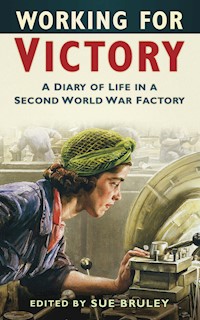
Cover illustration: Ruby Loftus screwing a breech ring, by Dame Laura Knight (courtesy of The Imperial War Museum, London).
First published in 2001This edition published in 2010
The History PressThe Mill, Brimscombe PortStroud, Gloucestershire, GL5 2QGwww.thehistorypress.co.uk
This ebook edition first published in 2011
All rights reserved© Sue Bruley, 2001, 2002, 2010, 2011
The right of Sue Bruley, to be identified as the Author of this work has been asserted in accordance with the Copyrights, Designs and Patents Act 1988.
This ebook is copyright material and must not be copied, reproduced, transferred, distributed, leased, licensed or publicly performed or used in any way except as specifically permitted in writing by the publishers, as allowed under the terms and conditions under which it was purchased or as strictly permitted by applicable copyright law. Any unauthorised distribution or use of this text may be a direct infringement of the author’s and publisher’s rights, and those responsible may be liable in law accordingly.
EPUB ISBN 978 0 7524 6824 2 MOBI ISBN 978 0 7524 6825 9
Original typesetting by The History Press
In memory of Kathleen Church-Bliss and Elsie Whiteman, centre lathe turners at Morrisons 1942–45,who wrote this diary.
Contents
Acknowledgements
People, Places and ‘Things’: Explanatory Notes
Plan of No. 1 Factory
Introduction
ONE
Training
TWO
Morrisons
THREE
The Works Council
FOUR
Doodle-bug Alley
Epilogue
Notes
List of Illustrations
Plan of Morrisons’ No. 1 Factory.
Acknowledgements
Many people have made a contribution towards the publication of this diary, and generally sustaining me through the period of this research. As I cannot mention everyone by name I would like to start by thanking everyone collectively for their kindness and co-operation. Of the people I need to name specifically Alison Speirs must come at the top of the list, as she gave permission to publish the diaries and gave me a great deal of practical help, including supplying several of the photographs. Jocelyn Hemming produced a first rate typescript from the original handwritten diaries. This work was funded by the Imperial War Museum and the University of Portsmouth. Ligia Kasanin and Gail Stewart Bye helped to proof-read the typescript and spurred me on to finish the book.
My oral respondents: Ken Peters, Audrey Clark, Gordon ‘Bing’ Crosby and Ken Thoroughgood gave me other views of Morrisons in wartime and helped to put names to the photographs; Jane Salusbury and Alison Speirs illuminated me on the family lives of Kathleen and Elsie. Audrey Clark and Ken Peters also supplied several photographs and Ken Thoroughgood produced a plan of the factory floor which has been reproduced in the book. I have also benefitted from the letters and visual material kindly sent into the Croydon Guardian in response to my appeal for information, particularly Joe Askew who wrote at great length from New Zealand, and phone conversations from members of the Whiteman and Church-Bliss families.
My grateful thanks are also due to Roderick Suddaby and other staff in the Documents Department at the Imperial War Museum; Malcom Taylor of the Vaughan Williams Memorial Library; the English Folk Dance and Song Society; Gary Ransom of Janes Publications Image Library; Tom Sansum and other members of the Croydon Airport Society; Steve Roud, Local Studies, Croydon Central Library and Fred Milsom for help with the technical terms.
My colleagues at the University of Portsmouth have been very supportive throughout this project. I am particularly grateful to Brad Beaven, with whom I had fruitful discussions on the Home Front, and James Thomas, who proof-read the edited manuscript and gave valuable advice on the final shape of the book. Thanks must also go to Christopher Feeney and Sutton Publishing for having confidence in this book.
I would like to mention several members of my family. My brother Steve helped with the art work in the factory plan and produced some of the photographs. My mother started my interest in women’s war work by telling me about her wartime experiences in a radio factory. She is one of the many unsung heroines of the Second World War. My children, Eric, Charlotte and Rowan, have been a constant reminder to me that there is life outside of work. I hope now that they will see that there was a point to all those hours at the word processor.
People, Places and ‘Things’: Explanatory Notes
Hundreds of people are mentioned in the diary. This list only includes those who are mentioned several times or who have some overall significance. (Public figures who appear incidentally are given a brief note in the text, if known.) Within each thematic group the list has been compiled alphabetically using the first name most commonly applied.
THE DIARISTS
Elsie Whiteman/E/Els
Kathleen Church-Bliss/K/Kat
Both originally lived in a house called ‘Benacre’ in Milford, Surrey. Moved to
15 Duppas Hill Road, Croydon, February 1942, and later moved to 25 Duppas Hill Road.
FAMILY, FRIENDS AND DUPPAS HILL ROAD PEOPLE
‘Auntie’ – elderly folk dance friend of Elsie, rents Elsie’s house next door to Benacre
Mrs Bellwood – landlady, 15 Duppas Hill Road
Mr Bellwood/Norman/Papa Bellwood – landlord, also fire watch warden
Mrs Brookes – landlady, 25 Duppas Hill Road
Billy Brown – young boy from Morrisons, uses Duppas Hill Road shelter
Eric – Elsie’s brother, lives in the Midlands
Mum/Ma/Mother – Kathleen’s well-connected mother
Millie and Ronald – Elsie’s sister and brother-in-law. Ronald is a senior civil servant
Madge – Elsie’s sister
Phyl (Phyliss) and Phillip – Elsie’s sister and brother-in-law
Tommy Adkins – old friend (see epilogue)
TRAINING CENTRE, CROYDON
Teachers:
Mr Dalton
Mr Lloyd/‘Bacchus’
Mr King/‘Poppa King’
Trainees:
‘James Harcourt’
John Bailey, also at Waddon
‘Margery Kahn’
Nelly Vivian/‘Greasy Locks’/‘N.’
‘Marlene Dietrich’
Perce Harvey
TRAINING CENTRE, WADDON
Teachers/Instructors:
Mr Evans
Mr Hyde/Gestapo Hyde/may also be Tony
Mr Powney/Old Powney/Old P./Old Beast/Old B./Lazy Old Bugger
Mr Williams/George/‘Gawge’
Trainees:
Andre
Bert
‘Drummond Sutherland’
Fred Feeley
Tubby Davey/Ronny
MORRISONS
Above the shop floor:
Miss Barr – probably liaison officer between Morrisons and the National Service Office/on Lateness and Absentee Committee, takes minutes at works council
Mr Biffo – conducts/compères factory orchestra
Miss Corney – women’s welfare supervisor
Mr Davies – personnel manager, on Lateness and Absentee Committee
Mr Heseltine – deputy works manager
Mr Hurst – works manager, on works council
Captain Lines – manager/director
Mr McGiveney – sometimes described as managing director, on works council
Mr Overton – production manager
Mr Payne – in charge of welfare, also responsible for the orchestra
Mr Proctor – also described as Managing Director/the ‘Well Scrubbed Pig’/Captain of the Factory Home Guard
Mr Young – director, chairman of works council
On the shop floor:
Anne Smith – shop stewardess, No. 2 Factory
Mrs Barford – Nellie, worker in No. 2 Factory, elected to works council
Bradford – George/Gentle George/Pussy/Assistant Foreman
Bert Runacres – on works council
Catford – Peter, young machine shop worker, shares canteen table with K and E, affair with Peccadillo
Cayzer – inspector, active in AEU
Costello – Bernard, on works council
Dennis Ellis – young helper to Fred in machine shop, same table as K and E in canteen
Eddie Cook – chargehand in automatics
Eddie Wratten – shares canteen table with K and E, marries Ivy Barney
Fred Lundy – setter and chargehand in machine shop/‘Sir Hubert Stanley’
George Baker – chargehand
George Ross – on Sick Benefit Committee/Communist
‘Godfrey Tearle’ – Harry May/inspector on nights
Grace Dobson – ‘Details’ department, on works council
Graham – Welby/inspector
Mrs Hazelgrove – Peggy/Old Mother Riley/OMR/machine shop worker
Hilda Greenwood – machine shop worker/‘moaning Minnie’/affair with Rapley
Hilda Carter – Mrs Carter/machine shop worker
The ‘Hippo’ – ‘hippopotamus’/elderly worker on milling machines
Mrs Israel – machine shop worker
Jock – Jock Ure/elderly sweeper/factory poet
Joe Phillips – elderly worker/dinnertime friend
Jim Sawyer – Head of Inspection Bench (AID)
Jimmy Dale – shop steward/communist/on works council
Ivy Barney – inspector/machine shop/shares canteen table with K and E/marries Eddie Wratten
Ken Peters – young worker in machine shop/on works council
Kilby – Manchester Kilby/Little Kilby/machine shop worker/becomes third nurse
Lancashire – young man/tool room worker/on works council
Laurie Charman – machine shop worker/Laurie and husband Ron become friends with E and K
Lavender – chargehand
Len Quirk – chargehand/capstan lathes
The Lizard – Inspector/Holliday
Lou – Fat Cooky/miller/shares canteen table with E and K
Mrs Margetson – middle-aged machine-shop worker
Mrs Marley – ‘Parachute Marley’/‘Gaudy Image’/becomes lady surpervisor at Waddon
May Nolan – miller/union activist
Moroney – Joe/inspector No. 2 Factory/AEU branch chairman/ on works council
Muriel Young – machine shop worker/girlfriend of Reg Green
Nancy Deacon – machine shop worker
N. Graham – probably machine shop worker, shares canteen table with K and E
Peccadillo – Blondie Avery/Audrey/works on drills/affair with Catford
Peter Joseph – inspector
Pierrot – Jim the Pierrot/inspector
Rachel Thurgood – machine shop worker Mr Rapley – foreman/machine shop
Reg Green – machine shop worker/boyfriend of Muriel Young
Sally Fillingham – young woman worker/factory talent show performer
Stan Wallace – setter and chargehand/machine shop/becomes friend of E and K
Mr Tickle – rate-fixer
Wax Doll – young woman worker in tool making/the Pierette/Glamour Girl/affair with Pierrot
Webster – nurse/becomes women’s welfare supervisor
Wolatile – young woman worker/Eileen/probably machine shop
ENGINEERING TERMS/TOOLS USED IN THE TEXT
aileron – movable control surface on the wing of an aircraft
capstan lathe – a multi-operational lathe, capable of high rates of production
centre lathe – produces small numbers of parts to high standards of accuracy, hence ‘centre lathe turning’
chuck – the part of a machine tool that holds either the work piece or a cutting tool. Found on lathes and drilling machines
chuck key – tool used to tighten the chuck so that it holds either the work piece or a tool tightly to prevent it moving
Idle Time – hourly pay only, no bonus
micrometer – hand tool for accurate measurement of parts down to a thousandth of an inch
millers – semi-skilled operators for metal cutting machines
millwrights – skilled workers who erect and maintain machines and plant (fitters are similar, usually working on smaller machines)
reamer – hand tool for finishing holes to an exact size, after drilling
scribing block – used by fitters and toolmakers to mark out the desired shape on a piece of metal
setter – sets up machines for capstan and centre lathe workers and supervises them tin bashers – workers who use hand tools, rollers and wheels to shape flat sheets of metal into complex three dimensional shapes
MONEY AND MEASUREMENTS
ABBREVIATIONS USED IN THE TEXT
AEU
Amalgamated Engineering Union
AID
Aircraft Inspection Department (run by MAP)
ATS
Auxiliary Territorial Service
ARP
Air Raid Precautions
CI
Chief instructor (ACI – probably a different version of same)
EFDS
English Folk Dance Society (later became English Folk Dance and Song Society, EFDSS)
ENSA
Entertainments National Service Association
FAP
First Aid Post
NFS
National Fire Service
NSO
National Service Office/Officer
MAP
Ministry of Aircraft Production
m/c
machine shop
MO
Medical Officer
OMR
Old Mother Riley (see above)
P-Planes
pilotless aircraft carrying ‘buzz bombs’ or ‘flying bombs’/V1s.
REME
Royal Electrical and Mechanical Engineers
Plan of Morrisons’ No. 1 Factory. (Drawn by Stephen Bruley from a sketch by Ken Thoroughgood)
Introduction
As the collective memory of the Second World War recedes, written documents, particularly diaries and other memoirs, will be increasingly used by historians for evidence of life on the Home Front. Diaries are an especially important source for their detailed recall and immediate response to events. The joint diary of Elsie Whiteman and Kathleen Church-Bliss, from February 1942 to November 1944, is undoubtedly one of the best examples of the war diary genre. It is written by two middle-aged women of considerable means who exchanged a comfortable and pleasant life in the Surrey countryside for the grime and exhaustion of factory labour in Croydon. Their diary, recounting first life at the government training centre and then at Morrisons, bursts with wit and humour and the minutiae of wartime tragedies and hardships. This introduction aims to place it in a war setting, provide some background detail on Morrisons and some biographical information on the two women diarists, and to outline the key historiographical aspects of the diary.
The demands of modern warfare produced far-reaching effects on British society during the Second World War. Unprecedented state intervention touched the lives of every citizen, particularly the working population. From March 1941 labour was effectively controlled by the state through the Essential Work Order and other government initiatives. Men of military age were conscripted into the services, with the exception of those deemed to be in essential war industries, or ‘reserved’ occu-pations. Engineering, particularly aircraft manufacture which was crucial to the war effort, fell within this category. Female labour was also regulated, so adult women were required to register for some sort of war service, although women with dependents were exempt. Through their labour organisations, workers formally surrendered the right to withhold their labour (though unofficial strikes did still occur, though rarely). Employers, in turn, lost the right to dismiss labour, which gave workers a sense of security that they had never experienced during the lean years between the wars. Consequently, the deferential attitude towards management evaporated as workers gained a new confidence in the war years. The downside of this was that once in industry workers could not leave unless they obtained official release (rarely granted until close to the end of the war), and shifts were often exhausting with extensive overtime routinely demanded. Government, realising that ‘happy workers are productive workers’ promoted welfare reform. Issues such as safety, lighting, ventilation, canteens, nurseries and ‘shopping time’ for mothers began to be addressed. The government also encouraged the formation of ‘Joint Production Committees’ or similar bodies where workers and managers could discuss ways of enhancing output, although the effectiveness of these committees is questionable.1
The expansion of war industries was facilitated by the extensive use of female labour. This was especially so in aircraft manufacture where women’s labour rose from 7 per cent to 40 per cent between 1935 and 1944, representing nearly ¾ million women.2 This was made possible by a series of ‘dilution’ agreements between the Associated Engineering union (AEU, traditionally for skilled men only, but which had already accepted semi-skilled men as members), engineering employers and the government. Women were allowed to undertake work previously thought of as ‘boys’ or ‘youth’ labour, and could, in theory, progress to performing work graded as skilled or semi-skilled male labour for equal pay rates, if they could work at the stipulated pace and not require extra supervision. In practice, however, such work was usually regraded and labelled ‘women’s work’ so that women were very rarely in a position to be able to claim equal pay.3 In any case, these agreements were defined as temporary and for the duration of the war only, so women had no permanent claim to the posts they held. One of the ways in which the government promoted female labour was through the opening up of the Government Training Centres to women (previously only domestic service training had been available to them). Although specialist training courses were almost impossible to obtain, many women did gain access to sixteen-week basic engineering courses. However, once in industry women were denied opportunities available to male trainees, as managers did not expect to employ semi-skilled women.4 As a result, the sixteen-week courses for women were curtailed to four or eight weeks in 1942. In practice, the majority of female entrants to industry went straight from the labour exchange to a firm and were assigned to low grade, unskilled labour with little or no opportunity to progress.
Morrisons Engineering Works was situated on the Purley Way, Croydon, close to Waddon Station.5 At this time the most significant local feature was Croydon airport, which was situated close to Morrisons, and is referred to as ‘the aerodrome’ in the diary (it closed in 1959). Morrisons was only one of many light engineering firms in the area at this time. A photograph of the new factory (see plate section) dated 1938, places its origins in the pre-war boom in aircraft manufacture. Morrisons produced components for aircraft built by Vickers in Weybridge, Surrey. The company worked on parts for Lancasters, Hurricanes, Wellingtons and Spitfires. The striking rise in engineering trades in the late 1930s was accompanied by technological change and the erosion of skilled labour.6 The aircraft industry was no exception to this and most of the new firms connected with the industry, such as Morrisons, employed large numbers of semi-skilled men and very few skilled engineers. Increasingly, mass production techniques were utilised and labour was employed on a timed bonus system. Women were very much part of this fast-expanding workforce, although mainly employed on unskilled assembly work before the outbreak of war in 1939.7 Morrisons’ management did not officially recognise trade unions in the factory, but there is much evidence of union activity among both men and women.
Morrisons grew at a spectacular rate during the war years. Its workforce expanded from about 150 to nearly 500 by 1942 and about 600 in 1944.8 The Croydon factory took over the neighbouring site and the two buildings became known as No. 1 and No. 2 Factories. In addition, Morrisons established factories in Preston and Peterborough. Most of Morrisons’ male workers were not enlisted as they were in reserved occupations, but it was impossible to recruit extra male labour, so it was women who made up the shortfall, making the firm’s rapid growth possible. At its peak more than half of Morrisons’ workforce were women.9 According to the diary, the great majority of these women were married. The women entered areas of the factory, such as the drilling and tapping centre, a capstan lathes and the tool room, which had all previously been the exclusive provinces of men.
Our mirror into the Morrison factory was created by the writing of two of these new women workers. Kathleen Church-Bliss and Elsie Whiteman were both mature women of some means from affluent London families. Kathleen, a direct descendant of Sir Charles Barry, architect of the Houses of Parliament, was born in 1900 and brought up in Tite Street, Chelsea.10 She had no siblings and enjoyed a close and affectionate relationship with her lawyer father. At thirteen she became a boarder at Wycombe Abbey School, Buckinghamshire, where her grandfather was chairman of the governors. Despite being extremely bright she did not go to university and appears to have been destined to stay at home with her demanding mother, particularly after her father’s death in 1923. She found an outlet, however, in the folk dance and song movement; ‘All these lovely new friends and the glorious music became my life.’11
Elsie Whiteman was five years older than Kathleen and came from a large, prosperous family based in west London, in Elgin Crescent, Notting Hill.12 Her mother died while Elsie was still a child. Her father made his money in milk distribution and retired early. After being privately educated Elsie trained as a teacher, specialising in Physical Training. Her great passion was dancing and she, too, was drawn into the folk dance and song movement in the early 1920s. This movement centred around the English Folk Dance Society (EFDS), which had its headquarters at Cecil Sharp House, in Camden, north London. Both Kathleen and Elsie became involved as teachers and organisers for the society, and in 1927 they met and became close friends. Both women enjoyed a wide circle of friends in the EFDS, including men. There is no evidence that either of them had any romantic involvements with men. This does not necessarily mean that they chose not to form relationships with the opposite sex, as the young men of their generation were scarce as a direct result of the First World War. In social activities of the 1920s, it was common for women to greatly outnumber men, so EFDS events would normally feature women dancing with women, as well as men and women dancing together. While attempts to categorise the sexuality of Kathleen and Elsie should be resisted, readers of the diary will not fail to notice the intensity of the relationship between the two. This is very much in the tradition of a ‘romantic friendship.’
In 1935 Kathleen bought a Tudor farmhouse, ‘Benacre’, in Milford, Surrey and moved in with Elsie. At a later date Elsie bought the house next door, but she never lived there and rented the house out to an older folk dance friend who is referred to as ‘Auntie’ in the diary. The house was on the old A3 from London to Portsmouth and was opened by the two women as a cafe/restaurant for passing motorists and cyclists. Elsie Whiteman’s niece remembers visiting Benacre as a small child and thought it was a ‘lovely place’.13 Kathleen did not entirely escape from her mother, as at some point she appears to have established herself at the Undershaw Hotel in Hindhead, not far from Milford. Kathleen and Elsie ran the business successfully for six years. Then, in August 1941 they made a decision to close the teashop and volunteer for war work in engineering. It took several months for the two women to complete arrangements for letting out the house and moving to Croydon, where they embarked on a government training course in machine operating in February 1942. From there they entered Morrisons’ No. 1 Factory as centre lathe operators in June 1942.
Undoubtedly, patriotism played a part in this decision. It is clear from the diary itself and interviews with surviving relatives that both women were keen to support the war effort, and munitions work would be a very visible expression of this. The outcome of the war was by no means certain at this point, and Britain stood alone to face a hostile, Nazi-dominated Europe. The fact that they left it so late to volunteer, however, indicates that there were other influences at work. With so many men enlisted and petrol only available to those on legitimate war work, it is likely that the business was in decline, as there cannot have been much passing trade from day trippers. More significantly, the compulsory registration of women for war work meant that at regular intervals a new and older cohort of women were called into service. In less than a year Kathleen’s age group would be included and later Elsie would also have to register, as, eventually, the scheme covered women up to fifty years old. By volunteering for munitions and stipulating that they wished to stay together Kathleen and Elsie avoided the separation which would ensue if they waited for events to take their course. There were also, however, plenty of women of their social standing and age who avoided arduous factory labour. A regular commitment to the Women’s Voluntary Service (WVS), for example, would have almost certainly given them exemption from registration and enabled them to remain at home. The decision to enter a munitions factory was partly taken in a spirit of adventure. The idea to keep a diary and make a detailed account of their experiences in the training centre and later at Morrisons has to be seen in this light. They thought of themselves as social explorers, not unlike the great social investigators of the late Victorian and Edwardian eras. It seems likely that the two women hoped that one day the diary would reach a wider audience. This was, however, a very hazy notion as they were aware that, due to the sensitive nature of the material, publication would be impossible for many years. As the diary reveals, they did circulate early volumes privately, while still at Morrisons, and were eager to hear reactions to their factory experiences from family and friends.
Unlike the Land Army, service women or housewives, very few women in war industries recorded their experiences. Considering the hours that they worked, and the fact that many of them had family responsibilities, this is hardly surprising. There is a large volume of Mass Observation material relating to industry, but mostly this is the work of middle-class observers rather than of the workers themselves.14 Kathleen and Elsie, although not working class, lived and worked as industrial workers during this time and felt all the pressures of factory life in wartime. We have tended to look to oral history for evidence of industrial women’s conscientiousness. This has led to a generalisation of the younger women’s experiences and a relative neglect of the older woman worker.15 This category was, in fact, incredibly important to the war effort. The largest group of new women workers in wartime were aged thirty-five to forty-five.16 At the time of their entry into industry Kathleen was forty-two and Elsie forty-seven.17 As a record of the experiences of older, single women the diary provides a unique insight into the perspective of a hitherto marginalised group.18
What appears in this volume is an edited version of the diaries. Substantial cuts have had to be made to create a readable book of manageable length. The full manuscript is available to researchers at the Imperial War Museum. The essence of factory life has been retained as its central focus. Peripheral activities, such as domestic events, lengthy descriptions of weekend or evening excursions, or routine contact with family and friends outside the factory have been reduced or eliminated. The two women were energetically social and maintained contact with a very wide network of friends and family throughout this period, despite their work commitments. Much of the details of these encounters has been edited out. Elsie and Kathleen took it in turns to write the diary and never wrote directly in the first person. Sometimes it is obvious which one has written a particular entry, but this is by no means always the case. As the main aim of publishing the diary is historical rather than literary, a decision was made to leave the diary as it stands and not to attempt to identify individual contributions.
The observations which Kathleen and Elsie made about the people around them are extremely colourful and vivid. Many of the factory and training-centre characters were given nicknames: ‘Lizard’, ‘Pussy’, ‘Wax Doll’, ‘Greasy Locks’, ‘Hippo’. Sometimes these names correspond to film stars: Marlene Dietrich, Godfrey Tearle. Readers will have to appreciate that unrecognisable words or words detached from their usual context are just part of Kathleen’s style and not typing errors. The words ‘fradged’, ‘fubsy’, ‘rorty’, ‘argufy’, ‘chy-iked’, ‘gubation’ and ‘distrait’ are among those which appear to be invented. Someone was said to be ‘very piano’. Management, at the training centre and Morrisons, received some of the harshest descriptions; ‘a well scrubbed pig’, ‘dried up little horror’, ‘group of vultures’. We can be reasonably sure that the more imaginative language in the diary was the work of Kathleen as it corresponds to some earlier writing of hers.19 There are a few references which are frankly anti-semitic such as ‘jew-boy’. While this must be acknowledged, it should be seen as typical of the class background of the two women at this time. Other terms are used which would not be regarded as acceptable today, for example, ‘bitch’ and ‘bastard’. The diary also reflects Kathleen and Elsie’s volatile moods. Their ‘setter’, Stan, for instance, is praised to the hilt when things are going well, but on ‘off’ days he is subjected to vitriolic condemnation.
The diary provides a remarkable insight into wartime factory life. The immediacy of the diary format and the wonderfully expressive and detailed writing creates a powerful evocation of the feelings and atmosphere of the period. The nightly outpourings of Kathleen and Elsie overflow with detailed accounts of gender divisions at work and the firm’s stumbling attempts at workplace democracy. The range of their observations also takes in factory culture, wartime bureaucracy, morale and reaction to official propaganda, factory welfare, ‘social mixing’, intrusions into personal life and the effects of mass bombing.20 Efforts have been made to contact other workers at Morrisons during the war. Several oral history interviews have been conducted and much of the factual material contained in the diary has been verified.21 Something of what Kathleen and Elsie’s work colleagues thought of them is known. Ken Thoroughgood, a young man in the press shop at the time, thought they were a ‘toffee nosed pair’ and didn’t have much to do with them.22 Another young worker, Ken Peters, kept his distance at first, but got to know and appreciate Kathleen through her promotion of welfare inside the factory.23 It is evident from the diary that both women earned a great deal of respect from other workers and that many colleagues genuinely warmed to them during their time in the factory. This was particularly so of Kathleen who became an effective spokesperson for the workers’ interests on the factory works council.
Ultimately, the diary must be read as the work of the two women concerned and written from their perspective: following Elsie and Kathleen through the ups and downs of wartime life. They eagerly recounted all the comings and goings in the machine shop and took a surprising amount of interest in factory gossip. The diary followed the progress of the war closely. Elsie and Kathleen took immense pride in seeing photographs of aircraft, especially if components were visible which they had had some experience of working on. Sometimes their accounts are deliberately meant to be humorous, and lively encounters and situations were relayed in a strikingly funny and light-hearted manner. At other times there are powerful and emotional descriptions, particularly around the time of the V1 bombs (known as Doodle-bugs or flying bombs) in the summer of 1944, which are enthralling and exciting. The factory characters and incidents depicted in the diary are described so graphically that the images almost leap from the page. By connecting with real people in real situations the war becomes an overwhelmingly human experience.
Postwar British society has grown accustomed to the notion of the Second World War as a ‘people’s war’, with implications of social levelling and equality of sacrifice. The government deliberately fostered this idea during the war to enhance social cohesion and to boost morale.24 Reading the diary, it is clear that such rosy and simplistic notions of the war are only part of the picture. In particular, it is apparent that the idea of ‘working for victory’ is much more complex than the popular image of the war implies. Similarly, the descriptions of life under sustained bomb attacks are infinitely more nuanced than the stereotypical images of cockneys cheerfully putting up with all manner of horrors. The diary has a great deal to say, some of which exemplifies the ‘people’s war’ spirit and some of which sits very uncomfortably with this concept. Hopefully, publication of the diary will help to foster a more balanced and realistic view of the war. Scholars will quickly appreciate the journal of Kathleen Church-Bliss and Elsie Whiteman to be one of the most significant documents to emerge from the Home Front in Britain during the Second World War.
The diary comes to an abrupt halt in the autumn of 1944, reflecting both exhaustion with war work and disenchantment on the part of Kathleen and Elsie, who were, by this time, pressing for release from factory work. Once the tide had turned and victory was assured the idea of ‘working for the duration’ lost its moral force. The factory adventure had worn thin and both women lost motivation and interest in writing the diary. As far as possible, the story of Morrisons and the lives of the two women diarists from November 1944 has been pieced together for the epilogue.
Editor’s Note
Comments and explanations in parentheses are those of the diarists, and those in square brackets have been added by the editor.
CHAPTER ONE
Training
1942
Friday February 6
[K and E started looking for accommodation in Croydon. This proved very difficult as many houses were blitzed and no longer habitable. Also, K and E were hoping to find a landlady who would ‘keep house’ for them, but they soon found that the local landladies were unwilling to clean their rooms, wash the bedding, prepare fires etc. After a long search they accepted two ‘gloomy cells’ on the top floor of a house not far from the training centre.]
Sunday 15 February
Arrived at 15 Duppas Hill Road in car laden from floor to ceiling with bedding and suitcases. Many journeys up and down to bring in our unbelievable number of suitcases and when all at last were brought up we set to work to organise our arrangements. We found that the double bed in our second cell seemed to be entirely composed of bumps – with a lumpy feather ‘duvet’ atop. We did not fancy this so made up the large single divan in our sitting-room and shall see how two can manage on it. Nice electric hot-plate and griller and a wilting geranium plant and a large aspidistra, a nice little fire which burns the legs but doesn’t warm the room much. We tried the portable wireless and found it excellent, and after a picnic lunch stepped out to the Britannia Works to time the distance – about 20 minutes walk. After unpacking & tea we listened to Churchill. The fall of Singapore. And so to the smallest double bed in the world, but well enough with all our own bedding.
Monday 16 February
To get to work by 9 a.m. we rose at 7 a.m. and did our breakfast & one or two household jobs and then off by 8.30 to Industry. Here 7 others were added to us – all in their 20’s – and we were herded from here to there by the lady supervisor (‘Come along you girls’). We were interviewed by the assistant manager and K and E have been put to Machine Operating tho’ we asked for Fitting. After that we got our clocking cards and overalls and caps and schoolbooks and then returned to the lady supervisor who told us we could go home and must be ready by 7 a.m. tomorrow. The shifts are 7 a.m. – 2 p.m., lunch 11–11.30 – and alternate weeks 2.30 p.m. – 9.30 p.m., hot meal at 5 p.m. Saturdays 7–12 (early shift) and 12–5 (late shift). So that every other weekend is a long weekend from 12 Saturday till 12 p.m. the following Monday and the intervening weekend exceedingly brief.
One girl we like – Mrs Crisp, young and rather a naughty one we should suppose. Conscripted. Another pale one with greasy black hair we also like. Then there is ‘Margery Kahn’ [film star?] and ‘Marlene Dietrich’ [German/US film star] who are smart and hale from Clapham. Of these we shall only be with Greasy Locks, as she is a machine operator and the others are to be fitters – but perhaps we shall all be matey at lunch. We don’t like the look of the different forlorn bodies we see lying in the Rest Room each time we go in.
Tuesday 17 February
Rose at 5 a.m. and arrived at the G.T. [Government Training] school at 6.39. Found that we were the first but for the firewatchers and people trickled in till after 7 a.m. The lady supervisor walked about, calling out ineffectually at intervals: ‘Show willing, girls.’ Finally, she collected us new trainees and took us off to the chief instructor. He led us to a Machine Operating Room and left us there. At last a harassed-looking young pimp of a teacher came up, and mumbled at us in a language we didn’t understand & everybody couldn’t hear above the noise of the machines. He snatched up a bundle of drawings and we followed him to a lecture room, where he said we might as well copy some of the drawings as no machines were vacant and no one was free to teach us anything in our workroom. So we laboriously drew a capstan lathe for about an hour and also drew several small tools. Then another teacher came in and said he wanted our room, so rather cold & hungry we trailed back to our work room, casting envious eyes at the empty tea trolley which had never visited us in the lecture room. Finally someone told us to go to a capstan lathe and the lad there would tell us something and he did – a nice little jew-boy, a friendly alien we should think, very young and a born teacher. He told us quite a bit, but hadn’t got the metal material to show us very much practical. Then a bell rang and we tacked on to the back of a teacher’s lecturing group over our heads, but we understood some of it, and so back to our little jew-boy where we put a ½” thread on to both ends of a metal rod. E was in the middle of hers when the bell rang for lunch, and everyone charged off – from 11–11.30. to such a lunch! – a nice canteen and well organised, plentiful food, very badly cooked. E could not eat hers, in spite of only toast & tea at 6. o’c. – sausage patty with uncooked dough pastry, elastic mashed potatoes, burnt gravy and heaps of hard green peas, followed by a huge slab of uneatable white stodge pudding and sauce. Back to our little jew-boy, rather late, but nobody seemed to notice. The machine was now out of order, so to amuse us he took us along to the Store Room, and got out some tools and showed us how they worked. Still no sign of teacher. Then a little middle-aged man like James Harcourt [actor] wanted to use the lathe to cut some 2” lengths of steel, so we stood and watched him for some time. Still no teacher came near us, and at the stroke of 1.30 the machine went off and everyone started clearing up and clearing off. We remained wearily patient till we were given our cards and departed, having taken 7 hours to learn what we might have acquired in one.
Wednesday 18 February
We watched ‘James Harcourt’ set up the capstan lathe, which was helpful, and cut off bits of metal. After a bit he let us each have a go – but E unfortunately broke the tool – so went in search of teacher (Mr Dalton) who ground it and explained how it had happened.
So we began again, but by this time the band kept on coming off the roller and stopping the machine. Various trainees tried and failed to get it better and Miss Greasy Locks (Vivian) succeeded in getting her hand pinched between the band and the roller – but was not hurt much. Then Mr Douch (another teacher) came to help with the band and seemed to think it was a very derelict machine. By this time we had had lunch and returned. We only tried sandwiches today and they were quite good. Then someone else came round for the War Savings Prize sweep and then at 1.20 people began to tidy up because it was Pay Day. So we dismantled the tools and came away past queues of people waiting for their money.
The men trainees are all very kind and helpful and James Harcourt means well, but doesn’t know enough to be much use to us and is very slow. There is a strange looking elderly woman who seems to be rather a show piece. She walks and looks like a stage ‘char’, but seems a great character. She has just completed her 8-weeks course and is passing out to an aircraft factory on Monday. She says she has never wasted so much time in all her life!
Mrs Bellwood, our landlady, has been very kind in our rooms and now arranges to have the fire lit & the room done for us. She opines that tho’ K may stay the course, poor E looks too delicate. We are not typical trainees anyway she says and ought to be supervisors.
Thursday 19 February
Today was an altogether different thing. We again arrived very early and hadn’t long to wait before Mr Douch, after a chat with our pimp teacher, Mr Dalton, and a bit of head jerking in our direction, came and took us over as pupils. He sent Els to ‘that fellow at the “shaper” who would show her how to work it’ and K and Miss Vivian went off with himself. They spent the rest of the morning flushed & excited. He set them to work a hacksaw and saw through an inch rod of metal and then they played about with rules and calipers for a long time, and then went off with Mr Douch to the central lathe. Els was not quite so lucky, but learned a bit nevertheless. Her ‘fellow’ Geoff rapidly named the parts and controls of the ‘shape’ and then set to work to cut a small piece of metal in half and then make a sort of groove in one side of it. When he had finished he discovered he had made the groove in the wrong side of it and went off to another class leaving Els with a job of work to continue. But, unfortunately, the machine went wrong so she called another woman trainee to help and she spent a long time putting it right by trial & error, and it worked all right for a little and then went wrong again, and so on all the morning, but Elsie did learn something about the machine, so does not regard it as a wasted day. Kathleen & Miss Vivian and Mr Douch had a lovely time at the central lathe and seem to be quite at their ease with it. Mr Douch then gathered the new trainees round him and gave us some easy fractions and decimals which we were quite able to keep up with. Kathleen acquired great merit with Mr Douch by making a brush out of a bit of wire and a piece of cotton waste.
Friday 20 February
E & K both found that some parts of their machine seemed to be missing, so the early part of the morning was spent hunting for the missing parts and Els found that part of her machine was missing altogether and so tacked on to K and Mr Douch, who were assembling the lathe. At last E’s missing piece appeared so she set to work to try and assemble her shaper and with the aid of Geoff got a fresh metal (her yesterday’s work having completely disappeared) and started off ‘shaping’ again. K and Miss Vivian were messing about with their central lathe. We had no sooner got nicely to work when Mr Douch stopped and sent us off to the lecture room. Here quite a number of new trainees were gathered together and were addressed by one man on ARP and mumbled a welcome by the assistant manager, a dried up little horror. Then the education officer delivered a long jubation and we committed ourselves to knowing decimals, fractions and elementary geometry, but nothing of the metric system or square roots. By this time we had had 2 hours of talk and it was 11. o’c. so we went off to lunch. When we got back to our workroom we were sent off again to the lecture room where Mr Dalton took us for another two hours on tools and their uses – with many diagrams & explanations delivered so quickly that we wilted from exhaustion. It was after 1.30 by now (K & E had acquired merit by being able to decimalise 1⁄64 – the result of prep last night!) and K & E went off to get health cards from the office.
Saturday 21 February
Quite a good and busy morning and a new little teacher man came and peered at Els’ machine and we think he is the teacher who has been absent. On another visit Els nabbed him to explain about the intricacies of the machine. She has been wanting to know how the wheels go round every day, but no trainee seems capable of giving more than a monosyllabic reply to any question. However Mr Lloyd, the new teacher, explained very clearly and with thought, Els may master it in time.
Having been in ‘Industry’ one week we mentally review the situation. The work began pretty badly with hours of doing nothing, but since we have been set to work we have been enthralled and happy. We haven’t heard one educated voice, trainees, teachers or office staff and mercifully our own Kensington voices don’t seem to have excited comment. They think we are sisters because we speak alike. We think they are all an extraordinarily nice crowd and we are rapidly getting used to their abrupt and terse phraseology. If asked any question they reply in one word if possible and do not amplify at all. Looking round the groups of teacher and pupils they look exceedingly matey; for heads have to be brought close together for voices to be heard above the noise of the machines.
Mr Dalton, who seems to be the chief teacher in our room, is said to be exceedingly clever and can certainly draw diagrams quicker than a flash. He is, however, completely illiterate and can hardly talk at all. This perhaps accounts for his tremendously abrupt manner and he is certainly a man of few words.
We are shocked beyond measure at the dreadful food and think something should be done about it, because it is such a wicked waste and the trainees really need a good meal. We are surprised how little we notice the noise of the machines, and all our years of long standing have accustomed our legs to this sort of life. The other trainees moan about their feet. Our hands, unfortunately, at the end of only one week, look like the hands of mechanics, which we are sorry about.
Monday 23 February
Mr Douch was away but Mr Davies was very kind to K & Greasy Locks and taught them how to use the scriber’s gauge as the chuck of their machine had been damaged. Els continued with Mr Lloyd and spent hours shaping down a block of metal in order to learn to take sufficiently fine strokes. Kathleen did grand things fitting a metal rod into a ring, which she did not quite perfect.
Tuesday 24 February
A long & tiring day and we don’t like the afternoon shift. Els learnt some more from Mr Lloyd, but got very tired working the machine by hand to ‘get conversant’. K and Greasy Locks spent all day fitting rings onto metal rods to ”, not very successfully. Els had her machine all to herself all day. Moved into the large double bed, the small one being so cramped & hard.
Wednesday 25 February
Hateful late shift again. K was Mr Dalton’s ‘Golden Girl’ and he spent most of the day muttering incomprehensible instructions to her, while she smiled vaguely as she could neither hear nor understand. But he set her up a lovely ‘poker’ for her to ‘turn’ for him and he gave her a private lesson in the micrometer, which she elucidated afterwards by reference to the text book. Els continued her cutting exercise and then Mr Lloyd gave the beginners a lesson on the ‘mike’ which K had already mastered.
Thursday 26 February
Mr Lloyd put Els to work on her old shaper again and she had a quiet 4 hours with no interruption or interference from anyone. After lunch Mr Lloyd suddenly taught her to grind tools and also to use the hacksaw, at which task she was Prize Girl. Having made a successful tool she was sent off miles away to the blacksmith’s shop to have it hardened & tempered, and so finally back to work where E & Joyce Lillywhite went to work once more on the shaper. Meanwhile, K & Nelly Vivian had been underdogs on their lathe to Miss Francis, an advanced trainee, and spent the day turning Mr Dalton’s poker.
After lunch Miss Francis made an elaborate-shaped rod and K and Nelly were allowed to work the machine only occasionally so had rather a dull time. In the ‘lecturette’ we had an elementary lesson on decimals which were quite too much for Nelly. We left at 4.30 – Els to prepare supper and K to buy the rations, but nearly all the shops were shut. Industry and civil life don’t seem to combine.
K does not care very much for Miss Francis, who seems a rather self-centred and sulky young woman. When bored she sits down and reads a novel. However, she and Nelly are both passionately fond of music and both sing at concerts and both ‘like the classical’. At the end of the day there was a great exchange of snaps of fiancés.
Friday 27 February
Els and Joyce Lillywhite were set to work again when the damaged tool had been repaired, but they hadn’t been at it long before Mr King, an elderly Scottish teacher, took it away and set them to work on an angle iron. It was a rather slow day for Els, as the work progressed slowly, & Joyce seemed disinclined to take any intelligent interest, which was rather trying as Mr King took endless pains with them. When bored Joyce leans against the machine and smiles slowly & amiably in the direction of any man – so they, needs must, come & have a word with such a bonny milkmaid. Els didn’t learn much today of the engineering, but she can do Joyce’s accent and delivery quite a treat.
K and Nelly had a lovely day on the lathe, Miss Francis being out of the way on a test. They finished turning a most complicated affair and were complimented on it by teacher. They did a tremendous lot of ‘mike’ work to Elsie’s envy. They really felt they had accomplished something by the end of the day. In the afternoon in the ‘lecturette’ period, there was a reshuffle of teachers and pupils – and E & K found they belonged to Mr King. He’s a nice old thing and a very patient teacher tho’ not perhaps quite so clear & quick as Mr Lloyd. During the day Poppa King was visited by two lustrous Russian jewesses, blonde and brunette, who came to say ‘good-bye’ before departing to a new job. He told E that they were the best pupils he had ever had and had completed the course in 12 weeks. Nelly Vivian is good and quick at the work – but the decimals and fractions seem to her abracadabra.
Saturday 28 February
We both got quietly on with our respective jobs and Mr King told Els that if she and K want to keep together they must learn to work the same machine. E intimated that K would not care to change her lathe for E’s mangy shaper and he said it (the lathe) was the better thing to be thoroughly conversant with as it led to more, and he would see the chief instructor about it, to get us united to the same group. So E hopes to join K on Monday.
We forgot to mention that we were paid on Wednesday £2/3/- each plus 24s/-settling in allowance. We all assembled in clocking order in various workshops, and filed past 2 pay desks, where our numbers and names were called out and our pay envelopes handed to us. It felt like receiving the first earnings of one’s life. Today is the end of our second week, which has gone fast, and we have enjoyed it.
We have got to know a lot more about our fellow workers. Joyce Lillywhite was a housemaid near Horsham. Nelly Vivian considers her rather babyish, which she certainly is. Then there is Perce Harvey who doesn’t really like engineering at all and pines to be back as butler in Cadogan Square. He is a great snob and keeps telling us that he is not used to this sort of work. Mr King tells us that milling is the best paid and most skilled of the machine jobs and there is a large demand for them. He doesn’t in the least know whether the trainees who have just come in will have the opportunity of doing the 16-week course; as Croydon closes in 8 weeks. He thinks 8 weeks will be most unsatisfactory as it is impossible to make his pupils conversant with all the machines in that time. ‘James Harcourt’ has left us now and gone to London.
We see Mrs Crisp (the nice girl we liked the first day) sometimes in the canteen. She says that ‘Marlene Dietrich’ & ‘Marjorie Kahn’ are very cocky. They were both shop girls, Mrs Crisp was a dressmaker. These are all fitters and they seem to spend all their time filing.
Mr Dalton, our first teacher, has now passed on to Waddon, for which we are not sorry, as we couldn’t understand or hear a word he says. We did rather admire him in his lecture the other day. He was explaining at great length, the working of the micrometer and two girls at the back were chatting together. He continued through the hubbub for a second or two and then suddenly leaned over at them & said in a furious voice ‘Do you know how to read the micrometer?’ When they replied ‘yes’ he snapped at them ‘Then kindly allow me to read mine’ and continued the lecture in a deathly hush.
Monday 2 March
Infuriating day for both of us. Mr King has left us for another department and E and K are now both under Mr Lloyd who is so sick of all this chopping and changing that he seems unable to take any interest in anyone. Nothing has yet been said about E and K uniting on the same machine. E and Joyce went on with their shaper and K and Nelly finished their second ‘cottonreel’ – not very accurately. The whole work of the department was disorganised by a Tool Inspection at 1 p.m. when every tool in the place was called in for an inventory, and after being out of action for about an hour they were checked by the accountant. All the teachers seemed nearly demented rushing around for missing spanners and rulers and were very disinclined to pay any attention even to any of the trainees who had work they could get on with. K and E were pained to note that on their form ‘Short Course’ was written, so there seems no option of a longer one, which is rather disappointing. We feel we shall never learn anything nor get anyone to take any interest in any questions we want to ask about our future plans. Certainly the centre is not well organised.
Tuesday 3 March
K found that her machine which had been going queer the day before, was now incapable of being stopped and as it seemed extremely dangerous she reported it to Mr Lloyd who said he would put her on another machine where she spent the rest of the day. K had a beauty chorus of 4 pallid girls who did not seem to want to take turns on her lathe, and as no one gave them any work today they sat all day watching K and grumbling. Mr Lloyd was very much taken up with setting a laborious test for Perce Harvey. E and Joyce Lillywhite went on with their job, which they finished at about 3, and although it didn’t look a particularly good fit Mr Lloyd seemed to think it was quite alright for an exercise.
This morning the Undoubtedly Honourable Mrs Campbell [lady supervisor] came into our room, and as she was concerning herself with the unemployed position of the beauty chorus at K’s lathe, K thought that now was the time to tell her our troubles, so she told, and Mrs C. said she would see what she could do. She had a word with Mr Lloyd and then came over to Els and said that Mr Lloyd’s instructions were that we should all learn something about each machine. Those who were intelligent and showed ability might be recommended for an extended course so really ‘it is up to you girls’ [she said] and departed with a society smile. Mrs C. really is very nice and does seem to take an interest in everyone and we hope she will take action.
Wednesday 4 March
K and Nelly learnt to bore while Els was set to get conversant with a ‘planer’. This she found fairly similar to the old shaper and was soon allowed to go off to the central lathe. She was enthralled by a very good lesson on ‘centring’ from a little lame teacher and would have been happy to watch Gibbon working the lathe for hours. But she and K had to go to Education for 2 hours in the afternoon.
We received our 2nd week’s wages today and had a visit from ‘Tony’ – our Mr Hyde, the ACI. He wished to meet us both and asked if we would like to do the 16-week course. We both said we would, and he said it should be arranged. We think we have to thank Mr King and the Hon. Mrs C. for this.
Nelly Vivian is really rather shocked by Elsie’s little Joyce – whom she says is an outrageous little flirt. E has watched her for days, while she smiles ‘cowlikely’ at every man in range and gathers them all about her for a chat to relieve the tedium of industry. Nelly has vouchsafed that she considers no girl who is engaged, should ever go out with any other man and that any girl who does so must be a pretty low sort.
This was all à propos of the nice Irish girl, Miss O’Connor, in our room. She is engaged to a man who is now away, and goes out a good bit with ‘other fellows’. She has angled for an invitation to Nelly’s digs, as she has learnt that there is generally a good deal of fun going on there – with plenty of male companionship. Nelly’s young man has flatly refused to have her invited as he considers she can’t be a decent girl if she wants to meet other fellows when she already has one of her own. We are intrigued with these fine shades of morality and fear that few of us would pass muster. Perhaps there is something to be said for spinsterdom as it gives one a little latitude.
Perce Harvey has passed his test, which is not surprising, as Mr Lloyd did all the complicated calculations for him and all Perce had to do was to drill 6 holes.
Thursday 5 March
Met John Bailey on our way to work. He has also been promoted to the 16-week course, so we shall have a friend when we move on to Waddon. He said he had noticed that we were very keen and got on with the job.
When we got into our room there was no sign of Mr Lloyd who didn’t appear all day. K and Nelly got on with their work, and Els spent 2 hours watching Gibbon fail to centre his job which he learned so successfully. However, the little lame teacher took him off it and set him to work, which Els watched all day and began her repeat of it in the last 20 minutes, so was reluctant to stop at closing time.
K and Nelly were looked after by Mr Davies, who was very kind and helpful and even complimentary. He took them, and Els tacked on, to see the grinding room as they showed an intelligent interest.




