


68,99 €
Mehr erfahren.
- Herausgeber: John Wiley & Sons
- Kategorie: Geisteswissenschaft
- Serie: Wiley Series in Sustainable Design
- Sprache: Englisch
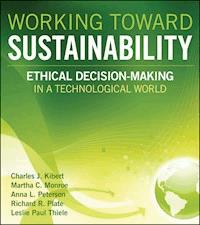
A comprehensive introduction to the ethics of sustainability for empowering professionals and practitioners in many different fields By building the framework for balancing technological developments with their social and environmental effects, sustainable practices have grounded the vision of the green movement for the past few decades. Now deeply rooted in the public conscience, sustainability has put its stamp on various institutions and sectors, from national to local governments, from agriculture to tourism, and from manufacturing to resource management. But until now, the technological sector has operated without a cohesive set of sustainability principles to guide its actions. Working Toward Sustainability fills this gap by empowering professionals in various fields with an understanding of the ethical foundations they need to promoting and achieving sustainable development. In addition, Working Toward Sustainability: * Offers a comprehensive introduction to the ethics of sustainability for those in the technical fields whether construction, engineering, resource management, the sciences, architecture, or design * Supports nine central principles using case studies, exercises, and instructor material * Includes illustrations throughout to help bring the concepts to life By demonstrating that sustainable solutions tart with ethical choices, this groundbreaking book helps professionals in virtually every sector and field of endeavor work toward sustainability.
Sie lesen das E-Book in den Legimi-Apps auf:
Seitenzahl: 725
Veröffentlichungsjahr: 2011
Ähnliche




















Contents
Cover
Title Page
Copyright
Preface
Acknowledgments
Introduction
MAKING CONNECTIONS
SHIFTING TOWARD SUSTAINABILITY
THE STRUCTURE OF THIS BOOK
REFERENCES
ENDNOTES
Chapter 1: A Context for Sustainability
THE RATIONALE FOR SUSTAINABILITY
CONTEMPORARY CHALLENGES
THE ETHICAL CONTEXT OF SUSTAINABILITY
THE THREE-LEG MODEL OF SUSTAINABILITY
CONCLUSION
REFERENCES
ENDNOTES
Chapter 2: The Technology Challenge
OVERVIEW OF TECHNOLOGY
THE TECHNOLOGY PARADOX
CONSEQUENCES OF TECHNOLOGY
ALTERNATIVE, APPROPRIATE, AND SUSTAINABLE TECHNOLOGY
THE ETHICAL IMPLICATIONS OF TECHNOLOGY
SUMMARY AND CONCLUSIONS
REFERENCES
ENDNOTES
Chapter 3: Introduction to Ethical Concepts
RELIGIOUS ETHICS
SECULAR AND PHILOSOPHICAL ETHICAL TRADITIONS
ETHICS AS A TOOL FOR MAKING DECISIONS
THE THREE LEGS OF SUSTAINABILITY
CONCLUSION
REFERENCES
ENDNOTES
Chapter 4: Social Dimensions of Sustainability Ethics
JUSTICE, FAIRNESS, AND RECIPROCITY
DISTRIBUTIONAL PRINCIPLES
EXPLORING INTERDEPENDENCE
OBLIGATIONS TO FUTURE GENERATIONS
CONCLUSION
REFERENCES
ENDNOTES
Chapter 5: Environmental Dimensions of Sustainability Ethics
THE EMERGENCE OF ENVIRONMENTAL ETHICS
RELIGION AND ENVIRONMENTAL ETHICS
ECOLOGICAL PRINCIPLES IN ENVIRONMENTAL ETHICS
CARICATURES OF NATURE
CONTEMPORARY APPROACHES IN ENVIRONMENTAL ETHICS
ENVIRONMENTAL ETHICS AND NONHUMAN ANIMALS
ENVIRONMENTAL ETHICS AND THE ETHICS OF SUSTAINABILITY
CONCLUSION
REFERENCES
ENDNOTES
Chapter 6: Economic Dimensions of Sustainability Ethics
FROM CLASSICAL ECONOMICS TO ECOLOGICAL ECONOMICS
THE ECOLOGICAL ECONOMIC MODEL
TOOLS OF ECOLOGICAL ECONOMICS
CONCLUSION
REFERENCES
ENDNOTES
Chapter 7: Integrating the Three Legs of Sustainability
THE PRECAUTIONARY PRINCIPLE
IRRECONCILABLE DIFFERENCES
POVERTY REDUCTION VERSUS ENVIRONMENTAL PRESERVATION
MANAGING THE GLOBAL COMMONS
TRANSCENDING THE THREE-LEGGED STOOL MODEL
THE DISTRIBUTION OF POWER IN DECISION MAKING
CONCLUSION
REFERENCES
ENDNOTES
Chapter 8: Improving Our Thinking about Sustainability
OBSTACLES TO MAKING GOOD DECISIONS
STRATEGIES FOR ADDRESSING LIMITS TO RATIONALITY
CONCLUSION
REFERENCES
ENDNOTES
Chapter 9: The Process of Changing Behavior
THEORY OF PLANNED BEHAVIOR
OBSTACLES TO SUSTAINABLE BEHAVIOR
HOW CHANGE HAPPENS
STRATEGIES FOR EFFECTING CHANGE
CONCLUSION
REFERENCES
ENDNOTES
Chapter 10: Creating Change with Groups
ADVANTAGES OF GROUP DECISION MAKING
TYPES OF COLLABORATIVE PROCESSES
MAKING THE MULTI-STAKEHOLDER PROCESS WORK
LEARNING ORGANIZATIONS
CONCLUSION
REFERENCES
ENDNOTES
Chapter 11: Applying an Ethic of Sustainability
MAKING ETHICAL DECISIONS FOR A SUSTAINABLE FUTURE: AN OVERVIEW
CONTEMPORARY SUSTAINABILITY-BASED FRAMEWORKS
PUTTING IT ALL TOGETHER
A FINAL CRITIQUE
REFERENCES
ENDNOTES
Index
Sustainable Design
Environmental Benefits Statement
This book is printed on acid-free paper.
Copyright © 2012 by John Wiley & Sons, Inc. All rights reserved.
Published by John Wiley & Sons, Inc., Hoboken, New Jersey.
Published simultaneously in Canada.
No part of this publication may be reproduced, stored in a retrieval system, or transmitted in any form or by any means, electronic, mechanical, photocopying, recording, scanning, or otherwise, except as permitted under Section 107 or 108 of the 1976 United States Copyright Act, without either the prior written permission of the Publisher, or authorization through payment of the appropriate per-copy fee to the Copyright Clearance Center, Inc., 222 Rosewood Drive, Danvers, MA 01923, 978-750-8400, fax 978-646-8600, or on the web at www.copyright.com. Requests to the Publisher for permission should be addressed to the Permissions Department, John Wiley & Sons, Inc., 111 River Street, Hoboken, NJ 07030, 201-748-6011, fax 201-748-6008, or online at http://www.wiley.com/go/permissions.
Limit of Liability/Disclaimer of Warranty: While the publisher and author have used their best efforts in preparing this book, they make no representations or warranties with respect to the accuracy or completeness of the contents of this book and specifically disclaim any implied warranties of merchantability or fitness for a particular purpose. No warranty may be created or extended by sales representatives or written sales materials. The advice and strategies contained herein may not be suitable for your situation. You should consult with a professional where appropriate. Neither the publisher nor author shall be liable for any loss of profit or any other commercial damages, including but not limited to special, incidental, consequential, or other damages.
For general information on our other products and services, or technical support, please contact our Customer Care Department within the United States at 800-762-2974, outside the United States at 317-572-3993 or fax 317-572-4002.
Wiley publishes in a variety of print and electronic formats and by print-on-demand. Some material included with standard print versions of this book may not be included in e-books or in print-on-demand. If this book refers to media such as a CD or DVD that is not included in the version you purchased, you may download this material at http://booksupport.wiley.com. For more information about Wiley products, visit www.wiley.com.
Library of Congress Cataloging-in-Publication Data:
Working toward sustainability / Charles Kibert . . . [et al.]. – 1st ed. p. cm. – (Wiley series in sustainable design ; 35) Includes index. ISBN 978-0-470-53972-9 (hardback), ISBN 978-1-118-10438-5 (ebk.); IBSN 978-1-118-10440-8 (ebk.); ISBN 978-1-118-10589-4 (ebk.); ISBN 978-1-118-10603-7 (ebk.); ISBN 978-1-118-10604-4 (ebk.) 1. Sustainable development. 2. Environmental ethics. 3. Environmental economics. 4. Sustainable development–Case studies. 5. Environmental ethics–Case studies. 6. Environmental economics–Case studies. I. Kibert, Charles J. HC79.E5W662 2011 338.9′27–dc23 2011026067
Preface
Sustainability balances economic, ecological, and social values in the principled pursuit of long-term welfare. It continues to gain importance and adherents 20 years after entering the lexicon with the publication of the 1987 Brundtland Report. Since then, nations, institutions, corporations, many other types of organizations, and individuals in both their professional and personal lives have adopted this framework for ethical decision making. As a result, for example, corporations are acknowledging that their social and environmental behavior, not just their financial bottom line, should be considered in judging their performance. Governments at all levels use the concept of sustainability to guide the allocation of resources, structuring of taxes and subsidies, and planning of cities and infrastructure.
Technology is an important arena for applying sustainability because the design and deployment of novel processes, materials, and products affect life on Earth in an ever more profound manner. Climate change, for example, is largely a by-product of transportation and power generation technologies that convert fossil fuels into other forms of energy and generate the enormous quantities of the atmospheric carbon dioxide that is increasing global temperatures. Developing and deploying other forms of energy, especially renewable ones, is now a global priority. We face similar challenges regarding emerging technologies such as genetic engineering, nanotechnology, robotics, and computer technology. Applying sustainability criteria to guide our choices—balancing potential benefits with risks and dangers—is both an ethical and practical task. The main purpose of this book is to provide principles and a process to ground sustainability-based decision making. Although this volume highlights technological concerns and developments, the general approach described here may be applied to a much wider variety of issues.
Acknowledgments
The authors would like to acknowledge the support of the National Science Foundation (NSF) in bringing this book from discussion to reality. The NSF kindly provided a grant to four of the authors (Charles Kibert, Martha Monroe, Anna Peterson, and Leslie Thiele) to develop teaching resources related to the ethics of sustainability for what the NSF refers to as the “STEM” professions (science, technology, engineering, and mathematics). We produced a course book and other materials for this purpose, which were then piloted and refined as part of a multidisciplinary graduate course at the University of Florida. When the opportunity arose to publish this work as a book, we were fortunate to have another colleague, Richard Plate, join us and take the lead in recasting the original materials into the present form.
The authors were assisted by a very capable and motivated group of graduate students, who not only performed many important tasks such as research and editing, but also pushed us by asking thoughtful and useful questions, challenging us to provide a consistent and clear message throughout the writing. We would like specifically to thank the following graduate students for their invaluable support: Kelly Biedenweg, Kristin Grey, Evgenia Ilieva, Chris Manick, Greg McElwain, Patricia McKetchey, Dana Shaut, and Deborah Wojcik, In addition, Kelly Biedenweg and Deb Wojcik authored the majority of the teaching activities that accompany this text in the Instructor’s Guide, and Annie Oxarart assisted with the pilot course evaluation.
Finally, we would like to express our appreciation to Paul Drougas, the John Wiley & Sons acquisition editor, who supported the idea of this book from the beginning, Nancy Cintron, the Production Editor, and Michael New, editorial assistant to Paul Drougas.
The AuthorsGainesville, Florida
Introduction
New technologies abound, and they are being developed at an ever-increasing pace. Rapid technological advances sweeping through society have become the norm. Much of the technology that has reshaped society in the last century has become so commonplace that many hardly recognize it as technology at all. Cars, computers, and cell phones have become such integral parts of day-to-day life that their absence in a given situation is often more remarkable than their presence. As a result, it is easy to overlook the profound impact technology has had on the global community. Through technology, human beings have reached a larger population size and had a greater impact on global environmental systems than could have been imagined just a mere century ago, when urban travel for the majority was limited to a horse-drawn carriage and communiqués between continents were sent by ship.
This book is about making good decisions about the development and use of technology. More specifically, it is about making decisions that promote sustainability, a concept that has achieved broad support, yet remains difficult to implement. In this book we define sustainability as the balanced pursuit of three goods: ecological health, social equity, and economic welfare. It is grounded in an ethical commitment to the welfare of contemporary populations as well as the well-being and enhanced opportunities of future generations. The scientific and technical professions have a special responsibility in this regard because the knowledge and technologies they develop and employ have immense impacts on natural environments, economies, and the empowerment of citizens and societies. Moreover, their efforts and achievements can continue to produce effects, for good or ill, well into the future.
Sustainability is inherently ethical, as it requires decisions to be rooted in moral principles, rather than based solely on economic calculation or convenience. Broadly speaking, sustainability requires that we do not undermine opportunities for others as we strive to meet our own needs. The others whom we must take into account include future human generations and the least well off contemporary citizens and societies, as well as natural creatures and place. This book provides natural and social scientists, engineers, architects, builders, and other professionals with a clear description of the meaning of sustainability and a practical guide to the ethical challenges involved in its promotion and achievement.
MAKING CONNECTIONS
The relations among ethics, sustainability, and technological development are complex and extremely varied. A number of important issues recur, however, including most significantly the problem of balancing different goods and values when not all can be maximized or prioritized equally. Sometimes, in fact, the pursuit of one good conflicts with or harms the possibility of pursuing another, also important, good. Environmental health or social justice, for example, may be compromised by the pursuit of economic security. In addition, differences in values, access to information, and available resources and technology can cause diverse constituencies—all of whom value sustainability—to approach the challenge in different ways. In order to explore some of these issues in more detail, we offer two examples that highlight some of the challenges facing professionals and policy makers in search of greater sustainability.
For the first example, we turn to the Democratic Republic of Congo (DRC), an African country with the second largest block of tropical forest in the world, covering 62 percent of the nation’s territory. Tropical forests are considered valuable ecologically because of their high biological diversity, and the forests in the eastern region of the DRC are particularly diverse. Currently, they provide habitat to a number of endangered species, including mountain and lowland gorillas and elephants, In addition, they are home to many of the 71 million Congolese, who are dependent on the forests for their livelihoods. All of these factors make the DRC a fitting subject for inquiry into environmental management and sustainability. What makes this topic particularly pertinent to this book is that the DRC also has some of the largest tantalum reserves in the world.
Coming in as number 73 on the periodic table, tantalum may not get a lot of attention in chemistry classes. However, it is a rare and vital resource in the production of a wide variety of electronics, including cellular phones and computers. As demand for electronic products soared in the 1990s, so did the demand for tantalum. The DRC has been mired in military conflict since the mid-1990s, including a civil war that involved troops from several African nations and a United Nations peace-keeping force 17,000 strong. The death toll has reached over four million. The presence of tantalum is central to the conflict.1
In addition to the tremendous hardships felt by the people of the Congo, the lack of governmental control over mining activities has resulted in significant ecological damage. The increase in prices produced a gold-rush mentality in the DRC, with people shifting from other activities—including gold mining and farming—in order to search for coltan, the dark gray ore that contains tantalum. The shift brought many people within the boundaries of the Kahuzi-Biega National Park, one of the five UNESCO Natural Heritage sites in the country. The process of coltan mining itself can have significant impacts to the landscape and streams. In addition, the people attracted to the coltan-rich area have hunted the wildlife, including thousands of lowland gorillas and elephants, for food and other uses, resulting in the loss of the vast majority of gorillas and all of the elephants in the park.2
Clearly this is an example of unsustainable development. From an economic perspective much of the local revenue that could be raised has been lost through black market trade of coltan through neighboring Rwanda and Uganda. From a social perspective, the presence of the valuable resource exacerbated existing tensions and contributed to the creation of a social climate characterized by fear and aggression. In this socioeconomic climate, ecological concern (which has historically been higher in DRC than other African countries) became a very low priority. This is not just a story about occurrences in a faraway place, however. Each of us may contain a small piece of this story in the cell phones, laptop computers, DVD players, and other electronics that we use every day.3
In 2010, the United States passed legislation requiring companies to demonstrate that their products are not fueling the conflict in the DRC.4 Certainly this is part of the solution, but tracking the source of tantalum can be difficult. Some have suggested a more comprehensive approach, namely regulating the coltan industry in the DRC in order to harness long-term economic gains, foster social improvements, and keep mining activity out of national parks and other ecologically sensitive areas.5 However, in the context of the current political instability of the region, such a solution presents daunting and long-term challenges.
The issue of tantalum in the DRC is an unfinished story. While some recent developments are positive, much of the challenge still lies ahead. This example illustrates the profound and unexpected effects that technological developments and our collective behavior as consumers can have. The point is not to stop using or developing electronics. The challenge is to develop sustainable alternatives to ecological, social, and economic relationships that jeopardize long-term welfare. One need not go to faraway lands to find examples of unsustainable practices and the ethical responsibilities that they demonstrate. At home and abroad, we are faced with the challenge of securing better ways to meet basic needs and pursue prosperity.
SHIFTING TOWARD SUSTAINABILITY
A second example illuminates further issues involved in pursuing sustainability, this time in the context of a particular business enterprise. In 1994, Ray Anderson, the founder of Interface, Inc., a company that produces carpets, was preparing a talk for his sales staff on the company’s approach to the environment. He realized two things: first, his company’s approach to the environment up to that time was focused merely on compliance with the law, and second, his company was in his words “plundering the earth.” More than that, he realized that this was the accepted way of doing business.
Anderson decided that he wanted to change the way his company did business in order to make it a “restorative enterprise” with zero waste and zero harm to the biosphere, and he wanted to do this by 2020. It was an ambitious goal. As a carpet company, Interface, Inc. was dependent on fossil fuels not only for its energy but also as a raw material in its carpets. Anderson developed what he called seven fronts of sustainability to guide his company towards its goal.6
Eliminate waste: Eliminate all forms of waste in every area of business.Benign emissions: Eliminate toxic emissions from products, vehicles, and facilities.Renewable energy: Operate facilities with renewable energy sources.Closing the loop: Redesign processes and products to close the technical loop using recovered and bio-based materials.Resource-efficient transportation: Transport people and products efficiently to eliminate waste emissions.Sensitizing stakeholders: Create a culture that uses sustainability principles to improve the lives and livelihoods of all our stakeholders—employees, partners, suppliers, customers, investors, and communitiesRedesign commerce: Create a new business model that demonstrates and supports the value of sustainability-based commerceAs of 2007, the changes implemented in Interface, Inc. resulted in a 45 percent reduction in fossil fuel use and an 80 percent reduction in the waste stream to landfills. Perhaps more importantly for stockholders, profits were up 49 percent. Anderson considered himself 45 percent of the way toward his goal for 2020.7 Interface employees attribute their successes to a combination of Anderson’s determination and consistent vision of sustainability, as well as a bottom-up approach that allowed all employees to play a role in determining specific approaches to the seven fronts.8 Clearly his answer to sustainability is not only what is accomplished but also how it happens.
As a result of this success, Anderson has become in much demand as a speaker on industrial sustainability, and he has opened up a separate consulting division of Interface, Inc. devoted specifically to assisting other companies make similar changes. Of course, the measures taken by Interface, Inc., while admirable, are far from achieving full-scale sustainability. Interface does not control what happens further up the supply chain. And even within the company, Anderson acknowledges that several of the changes are only temporary measures (e.g., offsetting carbon emissions by planting trees) undertaken until more sustainable processes can be implemented (e.g., a complete shift to renewable energy). Still, Interface has become an impressive example of how sustainability can be profitable for a company and spur innovation.
THE STRUCTURE OF THIS BOOK
The pursuit of sustainability is grounded in value judgments. Often discussions about sustainability neglect this important fact. It is tempting, particularly for those with a technological background, to view sustainability primarily as a technological issue. To be sure, technology will play a significant role in meeting the challenges that lie ahead, but technology addresses the question: What can we do? There is a prior question that goes to the issue of values: What should we do? This book explores the ethical foundations and concepts involved in answering this latter question. In turn, this book describes a number of the tools and skills involved in implementing decisions that reflect our values.
Chapters 1 through 3 provide the context for this discussion. Chapter 1, “A Context for Sustainability,” introduces basic concepts and provides an overview of some of the most pressing challenges we face today.
Chapter 2, “The Technology Challenge,” explores the role of technology as it shapes—and is shaped by—society. It provides an overview of the history of technology as well as discussion of the impacts—both positive and negative—that it has on society.
Chapter 3, “Introduction to Ethical Concepts,” provides an overview of the field of ethics. The ethics of sustainability is in many ways a continuation of conversations held over millennia regarding what it means to do good or lead a good life. This chapter explores some major themes in ethical thought from religious and philosophical traditions that are particularly relevant to a discussion of sustainability.
Chapters 4 through 7 explore the three pillars of the ethics of sustainability. Chapter 4, “The Social Dimensions of Sustainability Ethics,” focuses on ethical relationships and responsibilities between people and communities. It explores core principles and the challenge involved in concretely realizing these principles with regard to people around the globe and in future generations.
In Chapter 5, “The Ecological Dimensions of Sustainability Ethics,” we examine the relationships between people and the environmental systems that support them. Incorporating nonhumans and even ecosystems or biomes into an ethical framework has had a profound impact on the way people view ethics. In this chapter, we explore the ethical components of ecological relationships.
Chapter 6, “The Economic Dimensions of Sustainability Ethics,” explores the development, insights and shortcomings of the neoclassical economic model. We focus specifically on the development of the study and practice of ecological economics, where scholars are attempting to include biophysical aspects of natural resources in economic analyses.
Chapter 7, “Integrating the Dimensions of Sustainability Ethics,” discusses the challenge of combining the social, ecological, and economic facets of sustainability. It presents the concept of complex adaptive systems as a tool for developing a framework of sustainability that can integrate its various dimensions.
Chapters 8 through 10 turn to the more practical issue of applying the ethics of sustainability to decision making. In Chapter 8, “Improving Our Thinking about Sustainability,” we investigate how making good decisions requires changing the way that we think and learn. We identify a number of common patterns people fall into when processing information that can lead to misconceptions regarding sustainability, and we discuss how to change these patterns.
Chapter 9, “The Process of Changing Behavior,” grapples with the problem that a sound ethical foundation and a clear understanding of the issues are still not enough to bring about behavior that fosters sustainability. It identifies several other factors that influence people’s decisions, including structural barriers, attitudes, force of habit, and what other people think.
Chapter 10, “Creating Change with Groups,” describes the importance of collective action and institutional change. Whether working with a handful of employees or government leaders from around the globe, the dynamics of orchestrating change with groups follow similar patterns. Facilitating communication among people possessing different perspectives and goals is a daunting challenge central to the task of pursuing sustainability.
Chapter 11, “Applying an Ethic of Sustainability,” reviews the ideas and concepts addressed in earlier chapters. In addition it describes current approaches to putting concepts of sustainability into practice. Finally, it provides the Case Study of the Ford Corporation to illustrate how the ethics of sustainability have been (or could have been) applied.
In our attempts to move toward sustainability, there are myriad paths and directions that we might take. In order to succeed, we must approach the challenge thoughtfully, guided by both a sound ethical framework and a realistic understanding of human behavior. The goal of Working toward Sustainability is to provide readers with (1) an understanding of the meaning of sustainability, (2) a sound ethical foundation for navigating the difficult challenges associated with pursuing sustainability, and (3) a practical assessment of processes and problems associated with decision making and being agents of change. Throughout the book, we provide short case studies and examples that help us meet these goals by illustrating concepts, ideas, and practical issues.
REFERENCES
All Party Parliamentary Group on the Great Lakes and Genocide Prevention. 2002. Cursed by Riches: Who benefits from resource exploitation in the Democratic Republic of the Congo?www.savethechildren.org.uk/en/docs/cursed_by_riches.pdf.
Hayes, Karen and Richard Burge. 2003. Coltan Mining in the Democratic Republic of Congo: How tantalum-using industries can commit to the reconstruction of the DRC. Washington, DC: Flora and Fauna International. www.vodafone.com/etc/medialib/attachments/cr_downloads.Par.74638.File.dat/FFI_Coltan_report.pdf.
Dean, C. 2007. “Executive on a mission: Saving the planet.” New York Times on the Web May 22. www.nytimes.com/2007/05/22/science/earth/22ander.
Montague, D. 2002. “Stolen goods: Coltan and conflict in the Democratic Republic of the Congo.” SAIS Review XXII(1): 103–118.
Stubbs, W. and C. Cocklin. 2008. “An ecological modernist interpretation of sustainability: the case of Interface Inc.” Business Strategy and the Environment 17: 512–523.
United Nations. 2001. Report of the Panel of Experts on the Illegal Exploitation of Natural Resources and Other Forms of Wealth of the Democratic Republic of the Congo.
ENDNOTES
1. See United Nations (2001).
2. All Party Parliamentary Group on the Great Lakes and Genocide Prevention (2002).
3. A United Nations (2001) report discusses letters that link Rwandan companies that allegedly finance military operations in the Congo with illicit coltan to clients from the United States and Western Europe, but it is very difficult at this point for the consumers to know where the coltan came from in a particular electronic device. In this book we discuss changes at the individual level (e.g., making socially, ecologically, and economically responsible choices) and the institutional level (e.g., providing individuals with information necessary to make those choices).
4. See Dodd-Frank Wall Street Reform and Consumer Protection Act H.R. 4173.
5. Hayes and Burge (2003).
6. The following bullets are quoted from Interface’s website: www.interfaceglobal.com/Sustainability/Our-Journey/7-Fronts-of-Sustainability.aspx
7. Dean (2007).
8. Stubbs and Cocklin (2008).
Chapter 1
A Context for Sustainability
Sustainability is a concept that, over the past two decades, has continued to gain traction in a wide range of institutions and sectors, from national to local governments, from agriculture to tourism, and from manufacturing to construction. Domestically and internationally, sustainability is employed as a key criterion in governmental and business decisions, in consumer choices, and in individual lifestyles. As a concept and practice, sustainability is invoked to address issues as diverse as energy production, building design, waste disposal, urban planning, social welfare, and local and national economies. Universities and schools are applying sustainability to guide changes to their campuses, curriculum, governance, investments, procurement policies, and relationships to their local communities. In short, sustainability is a framework upon which increasing numbers of individuals and organizations ground their decisions and policies. In this chapter, we take a closer look at the concept of sustainability and the context in which it has developed.
THE RATIONALE FOR SUSTAINABILITY
There are at least 70 documented definitions of sustainable development or its sister term sustainability. Our goal here is neither to list all the contenders nor to add to their numbers. Rather, we provide a sense of the basic principles of sustainability, first through a series of hypothetical scenarios and second through a brief explanation of how the concept was developed.
Sustainability Interlude
At its most basic, the concept of sustainability is relatively straightforward. In our first scenario, our hero—call him Lucky—has been given a trust fund of one million dollars that receives 10 percent interest a year. This gives Lucky an annual income of $100,000 in interest. In order to use this trust fund sustainably, Lucky must take out no more than $100,000 from the fund each year. If he does that, then the fund will never diminish, and the original million dollars will continuously produce income for Lucky and his descendents. Thus, we have identified the essence of sustainability: using a resource no faster than the resource can replenish itself.
For our second scenario, suppose that the fund is no longer something as static and homogenous as a pile of cash. Instead, it is a mixture of resources each with different and varying growth rates, and those growth rates prove very difficult to predict. Some years the interest could be well over $100,000. Other years it could be much less. In this case, Lucky must watch the fund closely to be able to respond to any unforeseen changes. The added complexity of the fund makes the prospect of withdrawing beyond sustainable levels more likely when the needs for these resources are great.
Box 1.1 Sustainability Is Being Adopted by a Growing Number and Variety of Organizations
One can see increased focus on sustainability in political and corporate contexts. Several countries have articulated policies centered on sustainability, using it as a framework on which to base integrated strategies covering the environment, the economy, and quality of life. For example, the United Kingdom embraces sustainability as part of its national policy as articulated in “Securing the Future—The UK Sustainable Development Strategy.” Similarly the European Union Sustainable Development Strategy describes the EU’s approach to sustainable development and the seven key challenges facing its implementation.
Lesen Sie weiter in der vollständigen Ausgabe!
Lesen Sie weiter in der vollständigen Ausgabe!
Lesen Sie weiter in der vollständigen Ausgabe!
Lesen Sie weiter in der vollständigen Ausgabe!
Lesen Sie weiter in der vollständigen Ausgabe!
Lesen Sie weiter in der vollständigen Ausgabe!
Lesen Sie weiter in der vollständigen Ausgabe!
Lesen Sie weiter in der vollständigen Ausgabe!
Lesen Sie weiter in der vollständigen Ausgabe!
Lesen Sie weiter in der vollständigen Ausgabe!
Lesen Sie weiter in der vollständigen Ausgabe!
Lesen Sie weiter in der vollständigen Ausgabe!




