


37,99 €
Mehr erfahren.
- Herausgeber: John Wiley & Sons
- Kategorie: Fachliteratur
- Sprache: Englisch
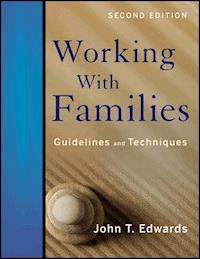
A complete guide for helping professionals, with tried-and-true techniques for practicing family counseling therapy
Now in its second edition, Working With Families: Guidelines and Techniques is filled with up-to-date, systems-oriented techniques focused on field-tested results. Outlining the dos and don'ts of working with different types of families and the various complications, nuances, and complexities that can occur, this practical guide provides a broad and proven selection of interventions, processes, and guidelines for working interactively, systematically, and compassionately with families.
Working With Families, Second Edition covers a range of topics including:
-
Family work in different settings
-
Session-by-session guidelines
-
Therapeutic themes by family type
-
Managing adolescents in family sessions
-
Dealing with fear of family work
-
Family mapping
-
Strategic child assessment
-
Chemical dependence and its impact on families
Informed by the author's many years of experience in the field, both as a clinician and as a trainer, Working With Families, Second Edition offers an invaluable systems-oriented, goal-directed, problem-solving approach to family counseling therapy for all mental health professionals.
Sie lesen das E-Book in den Legimi-Apps auf:
Seitenzahl: 407
Veröffentlichungsjahr: 2011
Ähnliche



















Table of Contents
Title Page
Copyright
Dedication
Preface
Acknowledgments
Chapter 1: Foundation Ideas
Introduction
Part 1: Concepts
Learning Family Counseling
Why Family Work?
Assumptions of a Family Systems Model
The Systems Orientation in Theory
The Systems Orientation in Practice
The Systems Orientation in Concepts
Levels of Systems Interventions
Cause and Effect in Systems
The Systems-Oriented Program Assessment
Code of Ethics
Cultural Sensitivity
Uses of Family Counseling
Forms of Family Work
Family Work in Different Settings
Suggestions for Family Work in Different Settings
Rationales for This Approach
Bedrock Beliefs About Families
A Theory of Change
Children Raise Adults
Neglected Relationships in Family Counseling
Getting a Grip on the Obvious
Experience Is Primary
Too Many Variables
Too-Brief Family Counseling
Traveling Pairs of Concepts
Research on Marital and Family Therapy*
Part 2: Procedures and Processes
Recruiting Families for Counseling
Conducting the Initial Family Interview
Initial Interview Summary
Tips for the First Family Interview
Four Basic Tools for Family Counseling
General Guidelines
If the Presenting Problem Is a Child or Young Person
If the Presenting Problem Is a Marital or Couples Issue
General Clinical Suggestions
Session-by-Session Guidelines
Session Checklist for Family Counseling
Chapter 2: Special Situations
Introduction
Therapeutic Themes by Family Type (Child Identified Patient)
Blended and Single-Parent Families
Blended Families: Tips for Two Common Scenarios
The Powerless Parent
The Parental Mind-Set
Parent-Child Enmeshment
“Split” Parenting
Parental Denial
Difficult Parents
Child Diagnosis in Plain English
The Three Worlds of the Adolescent
Managing Adolescents in Family Sessions
Couples Work
Couples Counseling: Additional Tips
Closed Families
Friends as Family
Family Resistance
Chapter 3: Counselor Ideas
Introduction
Fear of Family Work
Inexperienced vs. Experienced Family Counselors
A Novice's First Family Interview
Counseling Style
Counselor Mistakes
Counselor Successes
Counselor Self-Disclosure
Induction Worksheet
Whose Family Stuff Is It?
Use of Self
Counselor Centrality
Colleague Consultation
Supervising Family Work
Review Lists for Family Counselors
Questions and Answers
Chapter 4: Techniques
Introduction
Alter Ego
Brief Network Intervention (BNI)
Chair Work
Circular Questions
Colleague Teamwork
Drawings
Family Mapping
Family Questions in Individual Counseling
Guardrail
The MIGS Sheet
New Talk
Paradox
Parent's Childhood
Reflecting Team
Reframing
Relabeling
Safe Rebellion
Sculpting and Movement
Sibling Talk
Strategic Child Assessment
Strategic Predictions
Toybox
Worried Child
Summary of Systemic Techniques
Chapter 5: Multiple Family Groups
Introduction
Suggested Procedures for Multiple Family Groups
Family Recruitment for Multiple Family Groups
Clinical Tips
Therapeutic Activities
Chapter 6: Working With Chemical Dependency in Families
Introduction
A Working Definition of Chemical Dependency
Drugs of Abuse
Chemical Dependency
The Disease Concept
Indirect Signs of Chemical Dependency
Identification of Chemical Dependency in a Family
Questions for Family Assessment of Chemical Dependency
Treatment of Chemical Dependency
Recovery
Stages of Recovery
Recovery Plan
Families in Early Recovery
Relapse
Common Patterns in Chemically Dependent Families
Two Parent–CD Parent
Two-Parent–CD Adolescent
“Good” Kid/“Bad” Kid
CD Single Parent
Single-Parent–CD Adolescent
The Golden Years Trap
Adolescent Substance Abuse
Adolescent Substance Use Checklist
Co-Dependency
Couples Work for Chemical Dependency
Working With Chemical Dependency in Families: 21 Guidelines
Family Counseling for Chemical Dependency: Summary
Appendix A: Research References
Appendix B: Problems and Page Numbers
Glossary for Family Counseling
Recommended Readings
About the Author
Index
This book is printed on acid-free paper.
Copyright © 2011 by John Wiley & Sons, Inc. All rights reserved.
Published by John Wiley & Sons, Inc., Hoboken, New Jersey.
Published simultaneously in Canada.
No part of this publication may be reproduced, stored in a retrieval system, or transmitted in any form or by any means, electronic, mechanical, photocopying, recording, scanning, or otherwise, except as permitted under Section 107 or 108 of the 1976 United States Copyright Act, without either the prior written permission of the Publisher, or authorization through payment of the appropriate per-copy fee to the Copyright Clearance Center, Inc., 222 Rosewood Drive, Danvers, MA 01923 (978) 750-8400, fax (978) 646-8600, or on the web at www.copyright.com. Requests to the Publisher for permission should be addressed to the Permissions Department, John Wiley & Sons, Inc., 111 River Street, Hoboken, NJ 07030, (201) 748-6011, fax (201) 748-6008.
Limit of Liability/Disclaimer of Warranty: While the publisher and author have used their best efforts in preparing this book, they make no representations or warranties with respect to the accuracy or completeness of the contents of this book and specifically disclaim any implied warranties of merchantability or fitness for a particular purpose. No warranty may be created or extended by sales representatives or written sales materials. The advice and strategies contained herein may not be suitable for your situation. You should consult with a professional where appropriate. Neither the publisher nor author shall be liable for any loss of profit or any other commercial damages, including but not limited to special, incidental, consequential, or other damages.
This publication is designed to provide accurate and authoritative information in regard to the subject matter covered. It is sold with the understanding that the publisher is not engaged in rendering professional services. If legal, accounting, medical, psychological or any other expert assistance is required, the services of a competent professional person should be sought.
Designations used by companies to distinguish their products are often claimed as trademarks. In all instances where John Wiley & Sons, Inc. is aware of a claim, the product names appear in initial capital or all capital letters. Readers, however, should contact the appropriate companies for more complete information regarding trademarks and registration.
For general information on our other products and services please contact our Customer Care Department within the U.S. at (800) 762-2974, outside the United States at (317) 572-3993 or fax (317) 572-4002.
Wiley also publishes its books in a variety of electronic formats. Some content that appears in print may not be available in electronic books. For more information about Wiley products, visit our website at www.wiley.com.
Library of Congress Cataloging-in-Publication Data:
Edwards, John T.
Working with families : guidelines and techniques / John Edwards. — 2nd ed.
p. cm.
Includes bibliographical references and index.
ISBN 978-0-470-89047-9 (pbk. : acid-free paper)
ISBN 978-1-118-13880-9 (ebk)
ISBN 978-1-118-13881-6 (ebk)
ISBN 978-1-118-13879-3 (ebk)
1. Family psychotherapy. 2. Counseling. 3. Marital psychotherapy. I. Title.
RC488.5.E27 2012
616.89′1562—dc23
2011016590
To Vishvamitra (Sid Jordan, PhD)
I honor the life you've led and your many gifts to me and others. Most of all, I honor you.
Preface
This book is about applied family therapy. It is long on how-tos and short on theory and comes from my 30-plus years' experience as a practitioner and trainer in family therapy. I have field-tested virtually all the ideas and techniques in the book—many of which are original—and they rest on a systems-based foundation created by the Structural/Strategic schools of family therapy. All the ideas and techniques flow from the same theoretical foundation—a brief, systems-oriented, goal-directed, problem-solving approach to family counseling. I like this model because of its emphasis on results (rather than exploration) and practice (rather than theory) and because it has a time-proven track record in diverse settings with different problems and family types.
My intention is that both students and practicing therapists will find the book useful. Students should find a refreshing dose of practical knowledge in these pages to go with their voluminous dose of theory in their studies. Practicing therapists will find a wide assortment of interventions, ideas, procedures, and techniques to supplement their practice, something new to try when they are stalled in their therapeutic movement with a particular case. I have taught the contents of this book to many helping professionals in social work, mental health, substance abuse, education, child welfare, intensive in-home services, psychology, psychiatry, the ministry, hospitals, and private practice.
My suggestions to the reader for using the book, which grew from a series of handouts for my training workshops, are to browse through the book, reading here and there to get a feel for what it contains. Then use the contents as a guide for selecting topics that have relevance to the family work you are doing now or plan to do.
Brief and useful are the two criteria I used to include material in this book. Most of the content arose from experience in face-to-face encounters with families, so the book does not follow a neat beginning-middle-end format. In practice, experience and learning are not so easily organized in a linear fashion, nor are they readily categorized; they follow a more random path and have a variety of sources—family sessions, tapes of family sessions, discussions with colleagues, reading, workshop presentations (mine and others), and writing. Whatever their source, our experiences and learning must always, in my opinion, be grounded in actual encounters in the therapy room with families. It is only here that we can discover the value of what we know, or think we know.
The book is divided into six chapters:
Chapter 1—Foundation Ideas—discusses an assortment of useful ideas, procedures, and tips for any professional who does family work in any setting.
Chapter 2—Special Situations—addresses a variety of more specific conditions encountered by most counselors who work with families.
Chapter 3—Counselor Ideas—is an exploration in raising our awareness of ourselves as professionals and how the “use of self” is a critical—and easily overlooked—factor in therapeutic outcomes.
Chapter 4—Techniques—details some of the “tools of the trade,” including several old standbys that have been in use by family counselors for years. The major portion of this section consists of techniques that I created to manage particular problems that kept coming up in my family cases. (Note: Techniques are in boldfaced italic in the text of the book. If you want to read about the technique, please look it up in the index.)
Chapter 5—Multiple Family Groups—is an introduction to a powerful group format of several families together who, with a therapist facilitator, learn from and support each other in the uphill climb toward family change. This group format, which is often referred to simply as MFG, includes the identified patients with their families.
Chapter 6—Working With Chemical Dependency in Families—provides foundation knowledge for the single most frequently encountered dysfunction in a general caseload of families. Substance abuse is often a “hidden” problem in distressed families and may not be part of the presenting problems. All family workers need to be alert for, and familiar with, this all-too-common disorder and its devastating impact on family life.
Appendix A is for the research-minded student or professional; it provides a current and comprehensive list of references for the research on marital and family therapy in the text. Appendix B matches presenting family problems with ideas and techniques presented in the book. This section should help to narrow your search for something useful for particular cases. The glossary defines some of the terms used in systems-based family therapy. (Incidentally, the terms “family therapy,” “family counseling,” and “family work” are used interchangeably throughout the text.)
And finally, the index is more helpful than the table of contents in terms of finding a specific topic or technique if you know the name of the item you're looking for.
Some families are difficult to help. Even relatively well-functioning families lie in wait for anyone who sails in, flying the banners of change. I hope you will use this book to search for a specific technique to try with a particular family or to browse for general ideas to supplement your own approach to family work. Whatever your purpose, I wish you and the families you serve a productive and enriching voyage.
About the Second Edition
The original edition of this book was self-published from 1993 to 2010. About every three years during that period, I added new material from my experiences teaching and conducting family therapy. In this second edition, I have written an introduction to each chapter, added new material, removed dated or otherwise not useful topics, added a comprehensive and current research section, and made editorial changes throughout.
My active training practice in family therapy constantly teaches me that busy counselors value brief and useful chunks of field-tested ideas and interventions rather than long narratives on particular topics. They want a manual of practical ideas and techniques, something they can apply immediately to their caseloads or to a particular family. Hopefully, this second edition satisfies that need.
Acknowledgments
As in most enterprises, a completed project is a team effort. I am grateful to the hundreds of colleague trainees who over the years discovered with me how to approach the case in front of us and whose perceptions and insights always improved my own. A very partial list in this category would include Bev Kovach, Katherine Townsend, Larry Sharpe, Michael Budlong, Rob Young, Richard Martin, Michael McGuire, and Susan Mattox. I also want to acknowledge the invaluable guidance of Marquita Flemming, my Wiley editor, and Sherry Cormier, my developmental editor, who patiently guided me in the tedious process of making a book out of diverse ideas and experiences.
A special thanks also goes to Daphne S. Cain, PhD, LCSW, Chairperson, Department of Social Work, Louisiana State University, for her thorough work in assembling the latest research in family therapy. To Paul Nagy, Clinical Associate, Duke University Department of Psychiatry, a talented trainer and networker, I owe a debt of gratitude for putting the Wiley editors and myself in touch. And finally, my thanks go to my dear friend Mattie M. Decker, EdD, of Morehead State University, Morehead, Kentucky, who had the enthusiasm and patience to review parts of the manuscript and take the trouble to gently nudge me to consider certain ideas in another way.
It was never difficult to find someone who knew as much or more than I did about working with families. To the many unnamed sources in books, articles, workshop presentations, video sessions with families, and conversations about the topic, I offer my appreciation.
Chapter 1
Foundation Ideas
Introduction
This chapter presents some of the foundation ideas upon which the systems approach rests. It is divided into two parts: Part 1 is Concepts and Part 2 is Procedures and Processes. It is a potpourri of theory and guidelines, with a heavy sprinkling of practical tips and suggestions.
I like to think that theory develops as much from the feet up as it does from the head down. Theory and practice is a two-way exchange: theory provides a framework for thinking, a direction to go and what to look for, while face-to-face experience with families builds up our own personal knowledge about what works and what doesn't. Theoretical constructs are the most helpful in the early stages of learning family work, a period when we need guidance. Over time, however, our practice experience becomes primary and is likely to guide our actions more than textbook theory.
I've always believed that it is the application of our ideas that determines our effectiveness in helping families through their difficult periods. What we know—our body of knowledge, theoretical and otherwise—does not help families. The most knowledgeable person on the methods and theory of all the schools of family therapy will not necessarily be an effective family therapist. How the knowledge is applied in face-to-face interactions with families is the critical test.
The content described in this section gives us a place to start—how to convene a family for counseling and have an organized first session, the systems orientation, the assumptions and rationales behind the systems approach, various uses of family work, and a few guiding suggestions and tips about how to apply these ideas in interactions with families. Other ideas and issues in this section are included because they need a prominent place in our thinking about family counseling. Included in this category are ethics and cultural sensitivity, both of which can be overlooked in the myriad details of managing a particular case. Recent research on family therapy is presented for students and professionals who want to dig deeper into the empirical and evidenced-based underpinnings of the family approach to helping.
Lesen Sie weiter in der vollständigen Ausgabe!
Lesen Sie weiter in der vollständigen Ausgabe!
Lesen Sie weiter in der vollständigen Ausgabe!
Lesen Sie weiter in der vollständigen Ausgabe!
Lesen Sie weiter in der vollständigen Ausgabe!
Lesen Sie weiter in der vollständigen Ausgabe!
Lesen Sie weiter in der vollständigen Ausgabe!
Lesen Sie weiter in der vollständigen Ausgabe!
Lesen Sie weiter in der vollständigen Ausgabe!
Lesen Sie weiter in der vollständigen Ausgabe!
Lesen Sie weiter in der vollständigen Ausgabe!




