


9,99 €
Mehr erfahren.
- Herausgeber: 50Minutes.com
- Kategorie: Bildung
- Serie: History
- Sprache: Englisch
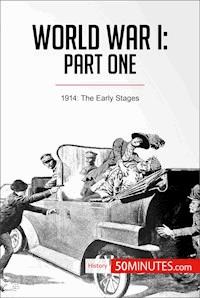
Keen to learn but short on time? Get to grips with the events of the beginning of World War I in next to no time with this concise guide.
50Minutes.com provides a clear and engaging analysis of the outbreak and early stages of World War I. In the summer of 1914, Europe’s main powers embarked on a bloody war which would last for four years and claim millions of lives. Tensions had been running high for some time previously, and a complex combination of alliances and territorial aspirations caused fighting to spread across the continent. The First World War was at the time the largest conflict in history, and its repercussions were felt long after it ended.
In just 50 minutes you will:
• Learn about the political situation in Europe in the early 20th century and the long-term causes of the First World War
• Understand the series of events that preceded the war and how they contributed to the outbreak of hostilities
• Analyse the major shortcomings of the military strategies of the countries at war
ABOUT 50MINUTES.COM | History & Culture
50MINUTES.COM will enable you to quickly understand the main events, people, conflicts and discoveries from world history that have shaped the world we live in today. Our publications present the key information on a wide variety of topics in a quick and accessible way that is guaranteed to save you time on your journey of discovery.
Das E-Book können Sie in Legimi-Apps oder einer beliebigen App lesen, die das folgende Format unterstützen:
Seitenzahl: 40
Veröffentlichungsjahr: 2017
Ähnliche
















WORLD WAR I, 1914: THE EARLY STAGES
KEY INFORMATION
When: 28 July 1914 – 11 November 1918.Where: Europe, Asia, Africa and Oceania.Countries involved:The Central Powers: Germany, Austria-Hungary, Bulgaria, the Ottoman Empire.The Allies and associated countries: the British Empire, France, Tsarist Russia, Italy, Serbia, the USA, Japan, China, Belgium, Romania, Portugal, Luxembourg, Greece, Albania, Montenegro and most of the South American countries.Outcome:Allied victory.Collapse of the German, Austro-Hungarian, Ottoman and Russian Empires.Establishment of new states.Victims: More than 9 million dead.INTRODUCTION
On 28 June 1914, Archduke Franz Ferdinand (1863-1914), the heir to the Austro-Hungarian throne, was on an official visit in Sarajevo. For the occasion, the city had been decked in Austrian colours and crowds lined the streets that the imperial convoy was to pass through. Among the crowd were seven assassins lying in wait for the archduke at different points along the route. The security measures were insufficient and there were not enough guards. That morning, Franz Ferdinand collapsed as he was struck by bullets fired by one of the conspirators, Gavrilo Princip (1894-1918), a young Bosnian student and member of a secret Serbian nationalist terrorist organisation called the Black Hand. This tragic and very serious event plunged Europe into a crisis that it would not recover from: one month later, most of the continent was at war. The war would last four years, and these seemingly endless years of terrible fighting would change the face of the world forever and shape the entire 20th century.
THE ORIGINS OF THE CONFLICT
How did the First World War come about? Since the war ended in 1918, this nagging question has continued to obsess historians, and countless books have been written to try and answer it. Dozens of interpretations have arisen to suit different schools and movements, or simply different needs. These interpretations may focus on the responsibility of one power or another, economic imperialism, the fatal tangle of alliances, or the role of military strategy in the outbreak of hostilities. They all put aside a simple, but essential, reality: wars break out, as the historians Robin Prior and Trevor Wilson remind us, because men believe that resorting to arms has become a legitimate approach. It is therefore above all because it seemed necessary, and even right, that war was on people’s minds in July 1914. Taking this as our starting point, we can begin to understand the reasons behind the war.
The continent of fear
At the start of 1914, Europe was under pressure, a time bomb that was ready to explode. Two opposing sides, bringing together the continent’s most powerful countries, had developed. The alliance between Germany and Austria-Hungary was countered by the Triple Entente, comprising the United Kingdom, France and Russia. All were ready for war, and some even considered it desirable. Over the course of a decade, the political differences between these two blocs had evolved into increasingly serious crises, and military budgets had skyrocketed. Fear is a bad counsellor, and all of Europe was afraid.
According to the French historian Jean-Yves Le Naour, Germany was responsible for this phenomenon. This new nation, which had been unified and established as the Second Reich by Prussia after its victory over France in 1870-1871, was one of the most powerful countries on the planet by 1914. It was the world’s second industrial power, just behind the United States, its military strength was unmatched and it exercised almost complete political hegemony over Europe. However, this triumphant Germany struggled with its position as leader. Paradoxically, it saw itself as vulnerable and under threat. When the Franco-Russian Alliance was signed in 1892, the feeling that Germany was trapped in a vice between two hostile countries became widespread across the Reich. Indeed, France dreamed of recovering Alsace and half of Lorraine, which Germany had annexed in 1871. Russia was also a serious worry, as the empire of the tsars had been enjoying an unprecedented economic upswing since the start of the century. Its industries and railways were developing at a sustained pace, and the railways were partly financed by French capital, which only added to the impression of encirclement. Russia appeared to be in a position to catch up with Germany. This source of anxiety was reinforced by another threat, this time in terms of demographics. With a total population of 170 million people and an annual increase of 3 million inhabitants in 1914, compared with 65 million and 750 000 respectively for Germany, Russia was viewed as an immense human tide that could submerge a Reich that was increasingly influenced by Pan-Germanist ideas about a racial battle for existence.




