


9,99 €
Mehr erfahren.
- Herausgeber: 50Minutes.com
- Kategorie: Bildung
- Serie: History
- Sprache: Englisch
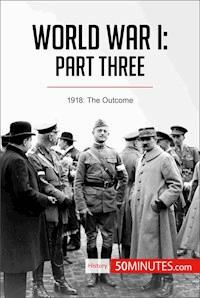
Keen to learn but short on time? Get to grips with the events of the final months of World War I in next to no time with this concise guide.
50Minutes.com provides a clear and engaging analysis of final months of World War I. At the start of 1918, war had been raging in Europe for four long years, and both sides were exhausted by the conflict. The German military leadership, believing that the Allies were weaker than the Kaiser’s army, launched a series of major offensives. However, they underestimated their opponents, who were able to turn the tables and put an end to the deadliest conflict the world had ever seen.
In just 50 minutes you will:
• Learn about the German army’s failed military operations in the final months of the war
• Analyse the events leading to Germany’s surrender, including the collapse of its allies and the Allied counter-offensive
• Understand the aftermath of the war, including the peace negotiations and the immense human and material cost
ABOUT 50MINUTES.COM | History & Culture
50MINUTES.COM will enable you to quickly understand the main events, people, conflicts and discoveries from world history that have shaped the world we live in today. Our publications present the key information on a wide variety of topics in a quick and accessible way that is guaranteed to save you time on your journey of discovery.
Das E-Book können Sie in Legimi-Apps oder einer beliebigen App lesen, die das folgende Format unterstützen:
Seitenzahl: 40
Veröffentlichungsjahr: 2017
Ähnliche

















WORLD WAR I, 1918: THE OUTCOME
KEY INFORMATION
When: 28 July 1914 – 11 November 1918.Where: Europe, Asia, Africa and Oceania.Countries involved:The Central Powers: Germany, Austria-Hungary, Bulgaria, the Ottoman Empire.The Allies and associated countries: the British Empire, France, Tsarist Russia, Italy, Serbia, the USA, Japan, China, Belgium, Romania, Portugal, Luxembourg, Greece, Albania, Montenegro and most of the South American countries.Outcome:Allied victory.Collapse of the German, Austro-Hungarian, Ottoman and Russian Empires. Establishment of new states.Victims: More than 9 million dead.INTRODUCTION
At the end of 1917, when the First World War had already been dragging on for almost four years, Germany could finally believe that victory was not far away. The French and British had been left weakened by their failures in the Second Battle of the Aisne and in Flanders Fields. The Italian army had been soundly beaten and lost some 300 000 men at the Battle of Caporetto in October. Finally, Russia, which had been forcing the Reich to fight a war on two fronts since 1914, had just succumbed to the Bolshevik Revolution.
However, Germany needed to act quickly. The national economies of its allies had been worn down by the war and the enemy blockade, and were on the verge of falling apart. Austria-Hungary and Bulgaria were on the verge of famine, while industrial and agricultural production was collapsing. In the Ottoman Empire, meanwhile, the difficulties were so severe that the central government was gradually losing all authority over its provinces. And that was not the worst of it: since joining the Allies in April 1917, the United States had been constantly sending troops, military equipment and capital to Europe, which risked definitively tipping the war in favour of the Allies. For Erich Ludendorff (1865-1937) and Paul von Hindenburg (1847-1934), the Chiefs of the General Staff since 1916, it was now double or nothing: the war needed to be ended as soon as possible, because over time defeat would be inevitable. The Great War was entering its final stages.
THE FINAL ROUND
On 11 November 1917, in Mons in occupied Belgium, Erich Ludendorff announced to the main leaders of the Westheer (the German army fighting on the Western Front) his intention to launch the decisive offensive in France in the spring. The task did not promise to be an easy one. In this part of Europe, the front, which stretched from the English Channel to Switzerland, formed a vast line of mud, trenches, barbed wire and concrete. This was practically impenetrable, as the Allies had learnt to their cost. Between 1915 and 1917, all their attempts had only enabled them to advance a few miles. However, Ludendorff was optimistic about his chances. The strategic context was in his favour, his army was strong, and his enemies were divided and greatly weakened. Furthermore, the Reich did not really have any other choice. Since the start of the conflict, the Western Front had been the main front, and consequently was the only way for Germany to secure a quick victory. However, exactly one year later, the country, completely broken, would sign the Armistice to put an end to the war. Ludendorff was largely responsible for this disaster.
THE FORMIDABLE YET FRAGILE KAISERHEER
On the eve of its gamble in the West, the OHL (Oberst Heeresleitung, Supreme Army Command) was relying heavily on the ability of the Kaiserheer, the imperial German army, to push through the enemy lines. The German army, which, according to the historian Jean-Claude Laparra, was already a formidable ‘winning machine’ at the start of the war, had continued to develop and improve, to the point that it had probably never been as fearsome as it was in the first few months of 1918. Nonetheless, it suffered from some major defects, which would jeopardise its performance in the campaign.
In terms of sheer size, the Westheer was a monster. At the start of April 1918, it lined up four million men against the Allies, twice as many troops as it had had in 1914 when the Schlieffen Plan was launched, for the same stakes. In order to reach such a number, Ludendorff and von Hindenburg had pulled soldiers away from all the other fronts where Germany was active. With Russia’s withdrawal, confirmed with the signing of the Treaty of Brest-Litovsk on 3 March 1918, 38 divisions were recalled from the Eastern Front. Others would follow, even though the Reich had to maintain substantial forces there, both to guard its Russian conquests and to contain the terrible civil war that was tearing apart the old tsarist empire. Smaller contingents had also been brought back from Macedonia and Italy.




