


16,99 €
Mehr erfahren.
- Herausgeber: John Wiley & Sons
- Kategorie: Fachliteratur
- Sprache: Englisch
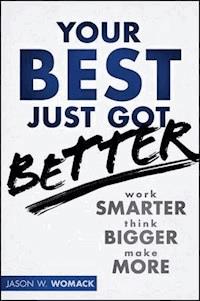
Imagine if your best just got better every single day In Your Best Just Got Better, productivity expert Jason Womack teaches readers that working longer hours doesn't make up for a flawed approach to productivity and performance. Workers need to clarify their habits, build mindset-based strategies, and be proactive. Womack's signature "workplace performance" techniques offer specific strategies to consistently and incrementally improve performance. Readers will: * Understand the fundamentals of workflow and the principles of human performance * Arm themselves with the tools and the processes to get more of their work done, on time, with fewer resources, and with less stress Making your best better won't happen overnight, but learning how to effectively manage just a few critical success factors lead to an effective workday and an overall successful professional career.
Sie lesen das E-Book in den Legimi-Apps auf:
Seitenzahl: 445
Veröffentlichungsjahr: 2012
Ähnliche


















Contents
Foreword
Prologue
Introduction
Part 1: Work Smarter
Chapter 1: Improvement and You
It All Starts with You
Focus on Making Your Best Better
Acknowledge the Process of Iterative Improvement
To Get Started, Just Get Started
Understand the Impact of Your Style of Working
Maximizing Your Limited Resources
Just Keep Moving
Chapter 2: Improvement and Pacing
Maintaining a Vision and Effort Over Time—That’s Pacing
Slow Down to Speed Up and Create Lasting Change
Reset Your Pace
Take Inventory
Chapter 3: Improvement and Time
How Valuable Is 1 Percent of Your Day?
Why Do You Manage Time the Way You Do?
Managing Your Time Better
Three Influences on Our Productivity
Part 2: Think Bigger
Chapter 4: Improvement and Self-Efficacy
It All Starts Where You Are
How Is Your Thinking “Talking”?
How Do You Build Self-Efficacy?
What Pulls You Off-Course?
How I Learned the Importance of Self-Efficacy and Vocabulary
What Are You Thinking?
What You Believe: That Is What Is Getting in the Way
The Truth Is What You Think It Is
What Builds Your Self-Efficacy?
Chapter 5: Improvement and the Social Network
It’s Not What You Know, It’s Who You Know
Building Team You
Who Is on Your Team?
You Are Your Network
The Next Questions
Who Got You Here May Not Take You There
Who Do You Know Who . . .?
Three Kinds of Conversations
Chapter 6: Improvement and Tracking
If You Can Track It, You Can Change It
Until You Notice What You Do, You Don’t Notice What You Do
Current Reality
What’s Your Normal?
Maximize Your Four Limited Resources
Track Your Limited Resources
Chapter 7: Improvement and Purpose
What Is the Point of All This Busyness?
The Night I Relied on My Own “So That . . .”
Do You Really Want to Make Your Best Better?
What’s Your “So That . . .”?
The Layering Process
What Purpose Is Not
The Freedom of Boundaries
Promote Your Own “So That . . .”
What to Do Now That You Know Your “So That . . .”: Three Steps To Success
Significant Aspects Influencing Your “So That . . .”
Your Stop-Doing List
Part 3: Make More
Chapter 8: Improvement and Feedback
Is Your Approach to Work Working?
Feedback Defined
Why This, Why Now?
From the Inside Out
Where Else Does Feedback Come From?
Is It Time to Ask for Feedback?
Creating Big-Impact Feedback, Quickly
Calendar Activity
What Kinds of Feedback Do You Get?
Mentor/Mentee Feedback and Review Program
Timing: When You Receive Feedback Is as Important as the Feedback You Receive
Key Ingredients of Effective Feedback
Chapter 9: Improvement and Focus
Decide What You’ll Do Then, Now
Focusing on Making More
Your Fleeting Focus
Implementing a Focus-To-Finish Mind-Set
Clear and Objective Goals
Stop “Should-ing” Yourself
Distract–ology: Studying What Gets in Your Way
The Significance of Perspective and Performance
Why a Short Memory Is Key to an Elevated Focus
Three Decisions That Change Your Focus
The Real Reason to Focus on Completion
Chapter 10: Improvement and Practice
When Do Most People Practice?
Start Where You Are and Grow from There
A Beginner’s Mind-Set
Practice Makes . . .
Practice on the Small Things to Perform on the Big Ones
When Do You Practice?
What Is Important to Practice?
Questions to Ask While You’re Practicing
Conclusion
Acknowledgments
Index
Praise for Your Best Just Got Better
“In these pages Jason Womack takes you through a process of assessing and reapplying the vital aspects of success and achievement in any field. Take the short road to improvement; let Jason Womack be your guide.”
—Jim Cathcart
Author of 16 books including the upcoming Make It Better
“Jason has a remarkable ability to get your attention—it’s like putting a mirror up in front of yourself and suddenly realizing you are due for a major makeover!”
—David Fink
Vice President, Human Resources EADS North America
“Jason Womack owns the personal productivity category in the training community. His workshops incorporate activities that create tangible learning by asking participants to make small changes that, when practiced over time, produce big results.”
—John Robinson
Federal Agency Field Training Consultant
“Your Best Just Got Better helps you work smarter so that you have the time and energy to live your optimal life. Jason Womack shows you how to get out of your own way, eliminating both external and internal roadblocks and illuminating a path forward with easy-to-implement actions that make big differences.”
—Michael Deutch
Product Director, Mindjet
“Jason Womack helps people realize their high productivity potential in Your Best Just Got Better.”
—Michael Guarnieri
Sr. Marketing Manager, Citrix Online
“Jason Womack is an inspired and visionary business leader. His concepts and ideas for creating best business practices are based on deep insight and understanding of the psychology of human performance. Your Best Just Got Better is exactly the kind of tool we need to help us work most effectively—in life and at work.”
—Frances Hesselbein
President and CEO, Leader to Leader Institute
Copyright © 2012 by Jason Womack. All rights reserved.
Published by John Wiley & Sons, Inc., Hoboken, New Jersey.
Published simultaneously in Canada.
No part of this publication may be reproduced, stored in a retrieval system, or transmitted in any form or by any means, electronic, mechanical, photocopying, recording, scanning, or otherwise, except as permitted under Section 107 or 108 of the 1976 United States Copyright Act, without either the prior written permission of the Publisher, or authorization through payment of the appropriate per-copy fee to the Copyright Clearance Center, Inc., 222 Rosewood Drive, Danvers, MA 01923, (978) 750-8400, fax (978) 646-8600, or on the web at www.copyright.com. Requests to the Publisher for permission should be addressed to the Permissions Department, John Wiley & Sons, Inc., 111 River Street, Hoboken, NJ 07030, (201) 748-6011, fax (201) 748-6008, or online at http://www.wiley.com/go/permissions.
Limit of Liability/Disclaimer of Warranty: While the publisher and author have used their best efforts in preparing this book, they make no representations or warranties with respect to the accuracy or completeness of the contents of this book and specifically disclaim any implied warranties of merchantability or fitness for a particular purpose. No warranty may be created or extended by sales representatives or written sales materials. The advice and strategies contained herein may not be suitable for your situation. You should consult with a professional where appropriate. Neither the publisher nor author shall be liable for any loss of profit or any other commercial damages, including but not limited to special, incidental, consequential, or other damages.
For general information on our other products and services or for technical support, please contact our Customer Care Department within the United States at (800) 762-2974, outside the United States at (317) 572-3993 or fax (317) 572-4002.
Wiley publishes in a variety of print and electronic formats and by print-on-demand. Some material included with standard print versions of this book may not be included in e-books or in print-on-demand. If this book refers to media such as a CD or DVD that is not included in the version you purchased, you may download this material at http://booksupport.wiley.com. For more information about Wiley products, visit www.wiley.com.
Library of Congress Cataloging-in-Publication Data:
Womack, Jason W., 1972-
Your best just got better : work smarter, think bigger, make more / Jason W. Womack.
p. cm.
Includes index.
ISBN 978-1-118-12198-6 (hardback)
ISBN: 978-1-118-22472-4 (ebk)
ISBN: 978-1-118-23003-9 (ebk)
ISBN: 978-1-118-23011-4 (ebk)
1. Success in business. 2. Success. 3. Change (Psychology) I. Title.
HF5386.W83 2012
650.1—dc23 2011037179
To you,
so you make your best even better
Foreword
Throughout my career as an executive coach, I have focused on helping successful people get even better. And, they do! They do get better but not without the help of extraordinary people like Jason Womack. Jason’s experience as a workplace performance expert and executive coach shines through in Your Best Just Got Better: Work Smarter, Think Bigger, Make More. Following his advice will make you more productive; using his techniques and tools will help you to significantly improve your performance.
If you have any doubts about taking the time to read Your Best Just Got Better, I want to make it very easy for you to make up your mind to keep reading!
Three (of the Many) Reasons Why I Like This Book
First, Jason begins with the biggest obstacle to success and change—“Me.” Most people, especially those who are already successful, believe that because they do a certain behavior that has led to success in the past, the same behavior will lead to success in the future. I call this the Success Delusion. Overcoming the delusion requires vigilance and introspection. It requires, as Jason puts it, “Identifying Our Individual Role in Making Our Best Better.”
Second, Jason’s chapter about the powers of positive and negative focus (Chapter 9) taps into a fundamental concept that is often overlooked. Dramatic performance improvement is not necessarily the byproduct of gaining new knowledge or doing more work; it is more often the result of getting rid of distractions and interruptions that take us away from working on our MITs (Most Important Things as Jason calls them).
And, finally, each chapter provides ideas you can begin experimenting with right away. Jason provides extraordinarily helpful tools for improving workplace performance. The exercises in each chapter help you focus on improving; that will help you maintain your momentum as you forge your path to more success.
The insight that Your Best Just Got Better: Work Smarter, Think Bigger, Make More is universally applicable. It provides a roadmap that any individual can use to improve performance. And, with Jason’s positive approach and upbeat writing style, this blend of simple, doable actions and pragmatic ideas will take you far down the road to peak Workplace Performance!
Life is good.
—Marshall Goldsmith
Million-selling author of the New York Times bestsellers, MOJO and What Got You Here Won’t Get You There
Prologue
I wake up before the alarm clock goes off—again. Here at home, unlike at my office in the city, it is serenely quiet outside—no noisy cars, airplanes, or sirens; just the gentle sound of water splashing into the fountain that sits on the patio. Across the room, embers glow through the window of the airtight stove, remnants of the fire I built the night before. I gently step out of bed onto the carpeted floor, which I manage to do without waking my wife. The dog looks at me as I leave the room, as if to say, “Go back to sleep; the day will start later.”
Moving down the short stairway, I make my way to my home office and review the list I wrote the day before of today’s MITs—the Most Important Things. I elect to work on the article that is due in two weeks to the business magazine editor for whom I write a monthly column on management development.
I sit down at my writing desk with pen in hand and notebook spread open to the next blank page. I set the timer for 80 minutes, during which time I fill up page after page after page with ideas. I spend the time thinking, connecting, writing, making lists, drawing, and organizing thoughts around the topics of engagement, productivity, and purpose. Soon, I’m lost in thought, and before I know it, my morning writing time is up!
Next, less than 90 minutes after waking up, I’m reviewing my notes for a conference call with a client in Asia; I generally talk with them early morning, my time, about twice a month. I stand up to face the large whiteboard, dial in, and present my idea: a customized management development learning program. The call goes well, and we make plans to co-develop a series of videos to teach basic and advanced leadership, workplace performance, and personal productivity methodologies to their global workforce. The videos will be hosted on their intranet, where more than 80,000 employees will have access to what we name the Productivity TouchPoint Learning Program.
I look over my desk out the eastern window. The glow from the computer monitor is losing its prominence as the first of the day’s sunshine begins to fill the room.
I get dressed in my late-spring running gear (which some would argue is enough for a winter run in Colorado), open the door, and step outside into the cool morning air. Since I’m running by myself, I decide to take the western route and chase my shadow for a while. It’s a beautiful five-mile, single-tracked trail along the river; I return to the property in just under 65 minutes, a good time for that course! I’m hungry, wide awake, and ready for the day to continue getting even better.
I’m sure that my wife is up by now, dressed in her robe and sitting in the family room reading a book, with a homemade latte within arm’s reach and our dog curled up at her feet. Walking up the last of the path to the deck, I look up and see her through the French doors, and for an instant my mind flashes back to the day we met . . .
Introduction
Hi! my name is Jason, and what you read in the Prologue is the beginning to what I call an “Ideal Day.”
Not the Ideal Day, of course, just one of the many that I’ve sat down to imagine. I’ve been writing these for years, and, as a result, life for me continues to get better. The one I wrote about in the Prologue, featuring the mountain property, writing, client calls, and trail running, first appeared as a draft journal entry in 1995. Some time after that, I typed it, saved it and reviewed it from time to time. I always thought it’d be an amazing way to start a day.
Your Best Just Got Better: Work Smarter, Think Bigger, Make More will show you how to make your best even better, how to achieve more in work and in life, and how to sustain those changes over time.
I encourage you, before you even start reading Chapter 1, to write a first draft of one of your Ideal Days. Sit down, set a timer for 15 minutes, and write. Begin by writing about that portion of the day when you know you have a lot of energy and do your best work. Do you have more energy in the morning? Or, would you consider yourself a “night owl”? Pick the time of day when you could be at your best. (You’ll notice I wrote about the early morning.)
The first time I wrote out an Ideal Day, I remember it was a challenge. Over the years, however, practicing this technique has gotten easier, and the time invested has paid huge dividends. For example, I couldn’t imagine (a) living in the mountains, (b) being a published author, (c) raising a dog, or (d) getting married. I wrote that Ideal Day you just read after a mentor, Ron Kok, challenged me to do so. Ron was a graduate advisor at the University of California–Santa Barbara and he asked me the following incredibly thought-provoking question: “Would you know a great day if you saw one?”
Since then I’ve stopped from time to time to script out another Ideal Day; and over the years, I’ve imagined quite a few of them. They evolve over time, just as I do.
Let me make it very clear that I don’t routinely experience Ideal Days exactly as I write them, nor do I expect to. I anticipate, however, that I will achieve parts of those days from time to time. And, over the past 15-plus years, I have! Since initiating the practice of imagining, designing, and anticipating Ideal Days, I’ve lived in the mountains, renting homes in Alaska and Lake Tahoe; and, I’ve taken off entire weeks from work, solely to write, in wonderful places like Costa Rica and Colorado. Thanks to these breaks, I’ve written dozens of speeches, many booklets and hundreds of articles. I’ve gone for trail runs in the morning, and I’ve read, sitting in the family room, sipping on a latte sitting next to my wife, Jodi, and our Labrador Retriever, Zuma.
For more than a decade, I have studied the mindset, skill-set and toolkits that global clients depend on to make their best even better as individual contributors, team members and managers. I’ve presented these principles in leadership development workshops in board rooms, conference rooms and via electronic means such as conference calls and webinars to audiences around the world. People from the Americas to China, from Argentina to Italy are using these practices, often new habits, to implement improved productivity behaviors and achieve more than they ever thought possible in their lives and their workplaces.
When you redirect your focus, your perspective changes, and when that happens, you have a significant option: You can begin to make things better. And, of course, if you change your direction, even a little bit, you could easily progress toward a new goal, achieve a big dream, or live a different life. Want to make your best even better? Focus on, write down, and review what that would look, sound, and feel like. That is, write out an Ideal Day scenario for yourself!
Look around and think about your work, life, community, family, and habits. The life you are currently experiencing is the result of accumulated thoughts, discussions, actions and experiences. If you would like your life to be different, then it’s very important to get started. You can begin right where you are—right here, right now—to make things better.
Think deeply about what an Ideal Day would look, sound, and feel like. Take some time—right now—to draft your detailed description of one. Put it somewhere you can review it, daily or weekly. Again, you’re not writing the Ideal Day; what you ultimately experience could be even better! Once you have that ready to go, you’re prepared to begin your journey of working smarter, thinking bigger, and making more.
Your Best Just Got Better shows you how to gain clarity, develop structure, and build momentum as the Architect of Your Experience. It will lead, inspire, and motivate you to walk the path of persistence, moving you toward a better you. I am confident these experiences will support you along the way.
Open to Part 1, Chapters 1-3, and get started using ideas, practices, and systems that make it easy to work smart. I’ll show you how to manage your ideas, think about your projects, and make the most out of the time you have so you can do more of what you’d like to do.
While reading Part 2, Chapters 4-7, you’ll learn how to practice specific ways to think bigger. Here, I will present the tools and techniques people use to build leadership skills and get the most from their business and personal networks. I also will show you how you can study your current routines in order to improve your approaches to personal productivity and workplace performance.
And when it’s time to assess your results at the end of a project, the end of the year, or when you retire (!), use the ideas and activities in Part 3, Chapters 8-10, to make more. What does “more” mean to you? While you’re reading this book I ask you to keep that question in mind.
A bit about me: I am a workplace performance expert and executive coach. I have worked with thousands of clients over the past 11 years, and I’ve always told them, “I study this stuff so you don’t have to!”
One more thing: I define productivity as: “Doing what I said I would do, within the time that I promised.” The “more” that I want is to keep more of those promises. With that in mind, let me share the promise I am making to you:
As a result of reading this book, you’ll know why, how and when you must make your best even better.
PART 1
Work Smarter
In the workplace, there is a constant feeling of pressure to do more and more. . .often with less. How many of you have less time and fewer resources while you’re managing bigger goals and more complexity? New projects arrive, team members move on, and the organization’s leadership sets bigger, or different, goals. Simultaneously, opportunities arise, surprises show up, and life changes on a personal level, as well. How smart you work depends on: how well you know yourself, how clear your next-level goals are, and how you’re using that all-too-limited resource, time. These are the topics of the first three chapters of this book.
Successful people set a clear direction to move in, and work effectively utilizing all their strengths. By applying just a little focus to when you’re at your best, you can improve the way you approach the things you need to get done, both on the job and off. Don’t just wish things were different; set yourself up to engage and make new things possible. As business philosopher Jim Rohn said, “Instead of wishing things were easier, wish you were better.”
Setting realistic goals does not mean you should understate what you think is possible. Instead, direct your focus toward the experience of completion and give ample attention to the next milestone of achievement. Build a series of bridges as you continually reach toward experiencing more of your Ideal Days.
With only 96 15-minute blocks in a 24-hour day, and more to do than we have time to do it in, we need to work smarter, getting more of the right things done. When you identify tasks that take too much time, and practice ways to work productively, effectively, and efficiently, you could easily net 1 to 3 extra 15-minute blocks of time each day. With 15 to 45 extra minutes tomorrow, and every day after that, imagine how you could make progress toward setting up and experiencing your own Ideal Days!
I promise, after reading and implementing the ideas in the next three chapters you’ll have more time, energy, and focus to make progress and achieve more of your Most Important Things!
Chapter 1
Improvement and You
Identifying Your Role in Making Your Best Better
In 1988, Nike launched its Just Do It advertising campaign. Ever since, those three words have been used to motivate, inspire, encourage, and even demand people to take on all kinds of goals and work harder to make things happen—personally and professionally. What have you ever tried to “just do”? Of course, that slogan may resonate for some people, some of the time, for some of the things they work to achieve. But if you’re anything like me (and I’m assuming you’re at least a little like me since you’re reading this book), you’ve occasionally found that “just doing it” can be hard.
When you take on something big, it can be daunting to think, “Okay, I’ll just do it.” How do you make it easier to achieve a goal, or even to move in a specific direction?
Lesen Sie weiter in der vollständigen Ausgabe!
Lesen Sie weiter in der vollständigen Ausgabe!
Lesen Sie weiter in der vollständigen Ausgabe!
Lesen Sie weiter in der vollständigen Ausgabe!
Lesen Sie weiter in der vollständigen Ausgabe!
Lesen Sie weiter in der vollständigen Ausgabe!
Lesen Sie weiter in der vollständigen Ausgabe!
Lesen Sie weiter in der vollständigen Ausgabe!
Lesen Sie weiter in der vollständigen Ausgabe!
Lesen Sie weiter in der vollständigen Ausgabe!
Lesen Sie weiter in der vollständigen Ausgabe!
Lesen Sie weiter in der vollständigen Ausgabe!
Lesen Sie weiter in der vollständigen Ausgabe!
Lesen Sie weiter in der vollständigen Ausgabe!




