


Erhalten Sie Zugang zu diesem und mehr als 300000 Büchern ab EUR 5,99 monatlich.
- Herausgeber: BoD - Books on Demand
- Kategorie: Gesellschafts- und Liebesromane
- Sprache: Englisch
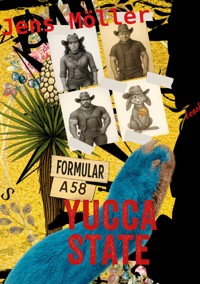
Yucca State - A Hare Goes South is a wild ride through a Western world that has long stopped taking itself seriously. In Loxlay, Alabama, an orchestrated fog settles over Hemster Street, a fog that swallows not only houses but also property rights, memories, and any sense of logic. Tracks are shifted overnight, ranches appear and vanish without warning, and anyone waking up in the morning may suddenly find themselves standing on someone else's land. Not through violence, but through forms, stamps, and decisions no one remembers making. At the center stands Miss Lyin MacLoxlay, a woman determined not to lose her mind, despite regularly seeing a blue hare named Pan, who never stops spouting political nonsense. Pan comments on everything, interferes in anything, and seems to know far more about the power structures of Yucca State than any hare reasonably should. Whether he is real or merely a symptom of a bureaucracy creeping into people's thoughts remains uncertain. Miss Lyin is accompanied by Nixon, a man so strong one might assume he fell into a cauldron of raw muscle power. Nixon prefers to solve problems with his fists, thoroughly and without hesitation. While Miss Lyin tries to uncover the truth behind the shifting borders and disappearing ranches, Nixon ensures that no one stands in their way. Together, they form an unlikely duo navigating fog, paperwork, and a landscape that reinvents itself at every turn. Yucca State itself feels like a living organism: a system of bureaucracy, arbitrariness, and absurd rules that constantly reshapes itself and owes no one an explanation. Every step south brings new riddles, new encounters, and new absurdities. And again and again, Pan appears, the blue hare whose commentary blurs the line between reality and madness once and for all. Yucca State - A Hare Goes South is a novel full of humor, satire, and unapologetically physical confrontations. A blend of quirky social critique, dusty Western flair, and exaggerated action, it is a literary road trip through a land where nothing stays as it was and where even a hare seems to understand more than the authorities.
Sie lesen das E-Book in den Legimi-Apps auf:
Seitenzahl: 860
Veröffentlichungsjahr: 2026
Das E-Book (TTS) können Sie hören im Abo „Legimi Premium” in Legimi-Apps auf:
Ähnliche
















Jens Möller
Yucca State
A Hare Heads West South
(post-cartographically correct – according to Pan)
“Buddy Goes West” was a film. This is a correction. With ink, defiance,and a hare who remeasures the world.
I say: This novel is not a Western. It's a geopolitical satire with fur. Aliterary counterstrike against the notion that progress always marcheswestward. Because sometimes you have to pull out the pen, correct thesign, and say: “No, thank you. I'm heading south. With conviction.With humor. And with a hare who speaks more truth than any pressconference.”
Novel
Footnote: The West is not everywhere, but it acts like it is. The South iseverywhere, but it's rarely heard.
For Mum and Dad — Thank you for your endless love, your unwavering support, and the strength you've given me every step of the way. I owe more to you than words can ever express.
Table of Contents
Yucca State
Shadow Over Loxley
Prologue
1.
2.
3.
4.
5.
6.
7.
8.
9.
10.
11.
12.
13.
14.
15.
16.
17.
18.
19.
20.
21.
22.
23.
Copyright
Yucca State
Maps are just opinions, too.
Pan stood at the edge of the map, his paws dust-gray from a long march through territories that had never belonged to him—and never should have belonged to anyone. “West,” he murmured, his ears twitching. He had crossed the West, counted the cacti, tested the promises, ignored the wind directions. He had seen how landscape became possession, how lines became power.
In front of him, a sign, scrawled and crooked: “WEST.” Pan pulled a pen from his pocket. A blue paw, smudged with ink from too many annotations, moved into place. With a steady hand, he wrote beneath it: “SOUTH.” Not as correction. As dissent. As disruption in the system.
Because Pan knew: The West is not a compass point. It’s a narrative. An export model with flag, contract—and the charming ability to sell itself as progress while stripping others of land rights.
And the South? The South is the answer no one wants to hear. Too hot, too proud, too busy counting cotton and owning people. In 1833, it hadn’t been defeated—just arrogant enough to believe it could go on forever. Pan liked to call it “the opera with a plantation backdrop”—lots of pathos, little future.
“The South will lose,” he often said. Not today. Not tomorrow. But someday—and with so much drama, even Shakespeare would blush.
I looked at him. “That’s exactly the kind of nonsense,” I said, “that holds more truth than any constitution.”
Mexico, 1833. The sun burns like a verdict over a land still undecided—whether to sell itself or defend itself. The railway—a promise of progress—exists only as a phantom. Its purpose? Not mobility, but the preservation of power. The politician G. Verren, guided by the moral compass of a wilted yucca palm, is trying to buy himself a state. With expropriated land, forged donations, and a planned route designed solely to smuggle his illegally hoarded gold out from the shadows of the republic.
It is the era of American expansionism. The United States, young and ravenous, reaches for anything that doesn't resist. Manifest Destiny has yet to be named, but is already in full practice: Land seizure as fate, ownership as virtue, violence as administrative routine. Democracy, loudly proclaimed, serves as camouflage for economic interests. The republic is a corporation, absorbing territories like stock portfolios—and treating people like inventory.
And then: Pan. A blue hare, invisible to all but Lyin. She hears him, whether she wants to or not. He is no animal, but a principle—the personified discomfort, the rebellious echo that refuses to fall silent. Pan is commentary, conscience, disruption. He speaks where others stay silent. He analyzes what others suppress. He is the literary interference in a world built on lies.
Lyin, a woman with a revolver and a shred of decency, stands between the plans of the powerful and the last patch of land not yet sold. Nixon, silent and massive, is both fist and question. Together, they traverse a country that has turned itself into merchandise. The tracks, not yet laid, are already ideologically drawn: Through Lyin's ranch, through her home, through what once were principles.
What follows is not a Western. It is a political parable dressed in genre tradition. A grotesque ballet of power beneath a scorching sun. A novel about ownership, truth, and the question of how much reality a society can endure before it declares itself fiction.
Pan comments. He is the chorus of history that refuses to be quiet. Because when truth becomes merchandise, when greed replaces law, and politics mutates into self-service, only one question remains: Who pulls the strings—and who gets run over in the end?
Shadow Over Loxley
It began in Loxley, Alabama—a town that on old maps was little more than a smudge, but in the memories of those who lived there, carried an echo that never quite faded. The fog came first. Not like weather, but like intent. Its origin was unclear—perhaps scientific, perhaps supernatural. But its effect was unmistakable: it changed everything. The tracks crept closer, the ranches retreated, and with them, certainty. People vanished. Rumors spread like weeds. And somewhere between telegraph poles, bloodstained shirts, and a snake-patterned bandana, the outlines of a case began to emerge—one larger than the town itself.
The roles were cast—willingly or not:
Galway Henglai
, a stranger without origin, whose eyes knew more than they revealed.
Judge Debgy
, whose rulings obscured more than they clarified.
Miss Hattie
, head cook with a memory like an archive.
Prof. Romberg Lenglon
, who didn't just study the fog—he might have understood it.
Amber, Ashford, and Nixon Scot
, residents with a past—or suspects with a future.
Pia Korton & Toke
, marshals searching for more than just evidence.
Victor Blackwood
, journalist with pen and fire.
Harvey Nikelson
, barkeep in a tavern where truth and lies drink the same whiskey.
Alexander Lambidge
, writer or chronicler—or both, or neither.
Percival Thromstone
, a nobleman with influence, whose hands were rarely seen.
Lord Laymord
, high-ranking but not high-minded—perhaps the antagonist, perhaps the puppeteer.
Sven Mc Olsen & Annika Smith
, sheriff and deputy, their loyalty under scrutiny.
Caldor
, cartographer whose maps held more than paths.
Mr. Green Eye
,
known as Sam—a witness, a shadow, a riddle.
My childhood friend the sheriff
,
forgotten, but not gone.
The places spoke their own language:
Loxlay
– the origin, the center, the heart.
San Miguel
– power, politics, influence.
Santa Versgal
– a mission, perhaps more.
San Ruthill
– printing press, letters to the editor, a voice from the dark.
Outback
– the end of the world, or its beginning.
Mexico City
– headquarters of the criminal G. Verren; center of control, correspondence, and plans others are meant to execute.
Tenochtitlán
– gold, gemstones, and criminals.
And the clues? Scattered like shards of a shattered mirror:
Fog, glass, blood.
A fragment of map from the northern slope.
A letter to the editor that knew more than it said.
A man in a black top hat who came and went without leaving a trace—except in the minds of those who saw him.
Control. Of a woman who refuses to be driven out—who challenges the system using its own tools. Lyin lives in a land that has turned itself into merchandise—where ownership triumphs over principles, and truth isn’t marked on maps but disappears between the lines. As the tracks inch closer and power casts its shadow, she realizes: Those who don’t help lay the rails will be run over.
She doesn’t choose escape—she chooses the Colt. Not out of vengeance, but necessity. Because in a world where the strings are pulled by those who can afford morality, only one thing remains: To draw your own line. To write your own story. And to take back control—rail by rail.




