


22,99 €
Mehr erfahren.
- Herausgeber: John Wiley & Sons
- Kategorie: Fachliteratur
- Serie: Bloomberg
- Sprache: Englisch
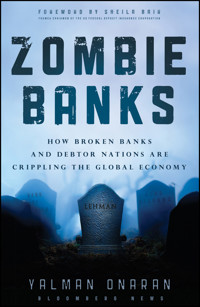
An in-depth look at the problems surrounding zombie banks and their dangerous effect on the global economy "The title is worthy of a B movie, but it's also apt. Bloomberg News reporter Yalman Onaran, supported by former U.S. Federal Deposit Insurance Corp. chief Sheila Bair - who provides a foreword and numerous interviews - urge that insolvent banks both small and too big to fail be allowed to do precisely that. Reading bank balance sheets is not everyone's idea of a good time. But Mr. Onaran, with support from Ms. Bair, does the chore and explains what it means. Mr. Onaran shows that the process of rescuing dead and dying banks is increasing systemic risk in the global banking system. And that is really more frightening than scream flicks from Tinseltown." -- Financial Post "Yalman Onaran knows of putrid financial institutions, having written about them in his native Turkey so successfully he brought down a few in Istanbul in the late '90's." -- Huffington Post "Do We Love Zombie Banks? The new book by Yalman Onaran of Bloomberg News, Zombie Banks: How Broken Banks and Debtor Nations Are Crippling the Global Economy, is a well-organized and clearly written discussion of the use of leverage to provide growth in many different economies. Onaran has carefully researched the zombie phenomenon and makes some important points in this concise volume about both public policy and the concerns of investors. One of the more interesting early threads in the book is the juxtaposition of the experience of the US in the S&L crisis and Japan in the 1980s and 1990s with the US today. Zombie Banks is a good review of the latest thinking about the ebb and flow of the political economy." -- R. Christopher Whalen, author of Inflated Zombie banking has become standard operating procedure for big debtor nations. They prop up failing institutions, print money, and avoid financial corrections. But in an attempt to prolong the inevitable, bigger problems are created. The approach used now has not, and will not, work. This timely book reveals why. Zombie Banks tells the story of how debtor nations and failing institutions are damaging the long-term prospects of the global economy. Author Yalman Onaran, a veteran Bloomberg News reporter and financial banking sector expert, examines exactly what a zombie bank is and why they are kept alive. He also discusses how they hurt economic recovery and what needs to be done in order to restore stability. Along the way, Onaran takes an honest look at how we arrived at this point and details the harsh realities that must be faced, and the serious steps that must be taken, in order to get things headed in the right direction. * Puts insolvent banks and debtor nations in the spotlight and examines how they are crippling the global economy * On the record sources include Paul Volcker, Joseph Stiglitz, Sheila Bair, and many more bank executives, regulators, politicians, and policymakers in the United States and abroad * Takes the complexity of the current situation and translates it in a way that makes it understandable While the short-term measures taken to stave off depression and rejuvenate economic growth may offer hope, they are unsustainable over the long term. Get a better look at what really lies ahead, and what it will take to improve our economic situation, with this book.
Sie lesen das E-Book in den Legimi-Apps auf:
Seitenzahl: 312
Veröffentlichungsjahr: 2011
Ähnliche



















Table of Contents
Cover
Additional Praise for Zombie Banks
Bloomberg Press
Title page
Copyright page
Dedication
Foreword
Preface
Cast of Characters
Chapter 1 Zombies in Our Midst
The Art of Keeping Zombies Alive
Kicking the Can Down the Road
Zombies and Lost Decades
Chapter 2 Lessons Not Learned
The U.S. Thrift Crisis
Japan’s Lost Decade
Delaying the Fix Increases Costs
Chapter 3 Europe’s Sovereign Blues
When PIGS Fly
Zombies in the Pigsty
Putting Lipstick on a Pig
Spain’s Zombies
When PIGS Stop Flying
Chapter 4 Germany’s Untouchable Zombies
Landesbanks in the Land of Banks
Politics and Banking
Cheap Money, One Last Time
Even the EU Can’t Shut Them Down
Irish Connection 2.0
Other German Zombies
Broken Models, Suffering PIGS
Chapter 5 Ireland’s Zombies Bring the House Down
The Celtic Tiger’s Final Sprint
The Guarantee from Hell
You Can’t Burn the Creditors
Not So Innocent EU
Zombies No More?
The Crippled Housing Market
Will the Tiger Make It?
Chapter 6 The Reincarnation of Iceland’s Banks
The Land of Fire and Ice Catches Fire
The Unheeded Fire Alarm
Devaluation No Panacea
Good Bank–Bad Bank, Sort of . . .
The Icesave Saga
Reincarnation and Recovery
Chapter 7 U.S. Zombies on IV Drip
Saving Citi—Again
A Snake Gobbling Up Poisoned Rats
“Pretend and Extend”
Turn a Blind Eye to Weak Capital
Bad Bank or Just an Administrative Concept?
Tenuous Existence
Chapter 8 The Fight to Rein in the Banks
Missed Opportunity
Volcker’s Friends and Enemies
Fear of Lincoln’s Amendment Helps Volcker
The Republican Toughie
Finding Ways to Skinny the Banks
The Farm Boy versus Goliath
Never-Ending Assault
Chapter 9 To Foreclose or Not to Foreclose?
Protecting Home Equity Loans
Banks Wave the Moral-Hazard Card
Principal Reduction: The Bogeyman
Servicing Costs Rise
Crappy Mortgages Returned
When the Levees Are Opened
Chapter 10 Bigger Banks, More Derivatives, Higher Risk
Banks Get Help in Their Derivatives Fight
Unaligned Interests of Bondholders
Too Interconnected to Fail
Chapter 11 Killing Zombies and Preventing Their Return
Who Bears the Cost?
The Fallacy Over Capital
Breaking Up the Big Boys
Coming to Terms with Reality
Epilogue
About the Author
Index
Additional Praise for Zombie Banks
“Yalman Onaran’s analysis is dead-on. So is his imagery of the dead banks walking among us, stalking and killing the wobbly post-2008 recovery. Zombie Banks clearly and scarily puts together all the pieces that explain a financial world again falling apart. Onaran calls out the culpable, from Wall Street’s toady Tim Geithner to Ireland’s clueless bankers, and writes so lucidly as to render a complex mess understandable.”
—John Helyar, co-author of Barbarians at the Gate
“This book does an excellent job of pointing out the administrative and political pressures that are rampant. I like the contrast used to make the point that Iceland avoided the major errors. I’ve always recommended more capital for the banks as the best way out; so does Onaran. The only way is to announce that we will not bail out any firm at any time; that will change their attitude toward more capital. Higher capital requirement puts the risk decision on management and stockholders, where it belongs.”
—Allan Meltzer, author, A History of the Federal Reserve, and professor, Carnegie Mellon University
“Zombie Banks, like the movie Zombieland, is a fun romp—until you realize this is not fiction. Onaran effectively expands Ed Kane’s thesis from the Thrift Crisis, when only a few U.S. institutions were ‘too big to fail,’ and shows how the program of declaring the end of insolvency by merely refusing to recognize its existence has grown popular, worldwide. Of course, Onaran can’t yet tell us the end of the story, but we can surmise that the longer the trend continues the worse the fallout will be.”
—Joseph Mason, professor, Louisiana State University
Since 1996, Bloomberg Press has published books for financial professionals, as well as books of general interest in investing, economics, current affairs, and policy affecting investors and business people. Titles are written by well-known practitioners, BLOOMBERG NEWS® reporters and columnists, and other leading authorities and journalists. Bloomberg Press books have been translated into more than 20 languages.
For a list of available titles, please visit our Web site at www.wiley.com/go/bloombergpress.
Copyright © 2012 by Yalman Onaran. All rights reserved.
Published by John Wiley & Sons, Inc., Hoboken, New Jersey.
Published simultaneously in Canada.
No part of this publication may be reproduced, stored in a retrieval system, or transmitted in any form or by any means, electronic, mechanical, photocopying, recording, scanning, or otherwise, except as permitted under Section 107 or 108 of the 1976 United States Copyright Act, without either the prior written permission of the Publisher, or authorization through payment of the appropriate per-copy fee to the Copyright Clearance Center, Inc., 222 Rosewood Drive, Danvers, MA 01923, (978) 750-8400, fax (978) 646-8600, or on the Web at www.copyright.com. Requests to the Publisher for permission should be addressed to the Permissions Department, John Wiley & Sons, Inc., 111 River Street, Hoboken, NJ 07030, (201) 748-6011, fax (201) 748-6008, or online at http://www.wiley.com/go/permissions.
Limit of Liability/Disclaimer of Warranty: While the publisher and author have used their best efforts in preparing this book, they make no representations or warranties with respect to the accuracy or completeness of the contents of this book and specifically disclaim any implied warranties of merchantability or fitness for a particular purpose. No warranty may be created or extended by sales representatives or written sales materials. The advice and strategies contained herein may not be suitable for your situation. You should consult with a professional where appropriate. Neither the publisher nor author shall be liable for any loss of profit or any other commercial damages, including but not limited to special, incidental, consequential, or other damages.
For general information on our other products and services or for technical support, please contact our Customer Care Department within the United States at (800) 762-2974, outside the United States at (317) 572-3993 or fax (317) 572-4002.
Wiley also publishes its books in a variety of electronic formats. Some content that appears in print may not be available in electronic books. For more information about Wiley products, visit our web site at www.wiley.com.
Library of Congress Cataloging-in-Publication Data:
Onaran, Yalman, 1969–
Zombie banks : how broken banks and debtor nations are crippling the global economy / Yalman Onaran.
p. cm. — (Bloomberg Press)
Includes index.
ISBN 978-1-118-09452-5 (cloth); ISBN 978-1-118-18533-9 (ebk);
ISBN 978-1-118-18532-2 (ebk); ISBN 978-1-118-18531-5 (ebk)
1. Debts, External—History—21st century. 2. Banks and banking—History—21st century. 3. Economic history—21st century. I. Title.
HG3891.5.O53 2011
332′.042—dc23
2011032158
To Dad, who said he bargained with the Grim Reaper to delay the day until this book’s publication, and
To Mom, whose habit of playing the devil’s advocate in debates taught me to consider opposing views more easily.
Foreword
Many books have been written about the financial crisis. They are, perhaps, getting better with age. Perspective improves as time passes. Economic truisms that were obfuscated in the informational fog that surrounded the financial crisis are coming back into focus as the fog clears.
In the years leading up to the crisis, we somehow lost our way. We confused “free markets” with “free-for-all” markets. We transitioned from a society that valued hard work and entrepreneurship to one that worshipped housing speculation and financial arbitrage.
In the fall of 2008, we got our comeuppance, as an economy based on over-leveraged consumers, inflated real estate prices, and artificial derivatives products finally collapsed.
The Great Recession was not the product of an inevitable business cycle. It was caused by the excessive risk taking of a number of large financial institutions. Investors and creditors supported them, notwithstanding their high flying ways, because of the perception that the government would not let them fail. The “smart money” played the system.
And the smart money was right.
Instead of using the crisis as an opportunity to clean out the system, we bailed out most of the inefficient institutions and left the bad assets to rot on their balance sheets. Within a year, those who had been bailed out were paying themselves bonuses while many of the bailers were losing their houses, their jobs, or both.
To be sure, some of the stabilization measures undertaken in the United States were dictated by limitations on the legal tools that were available to close down failing institutions in an orderly way. And notwithstanding the shortcomings of our efforts, we did force our banks to raise significant amounts of new capital and dramatically reduce reliance on short-term funding. As a consequence, U.S. banks are much more stable today than their European counterparts.
But as Yalman Onaran points out in this highly readable book, by bailing out mismanaged institutions, we repeated the mistakes of Japan’s “lost decade” and of our own savings-and-loan debacle.
By propping up failing firms, we penalized the well-managed institutions and interfered with the basic functioning of the market. We cannot rely on our capitalist system to allocate resources for their most productive use unless we let the inefficient or mismanaged fail.
We did not force our financial institutions to shed their bad assets and recognize the losses. And the lingering uncertainty about the true extent of those losses makes previously profligate management more risk averse in an economy where prudent risk taking and lending are most needed, particularly by small businesses.
Unfortunately, governments around the globe continue to nurture and support a bloated financial sector built around an unsustainable model. In the United States, we guarantee their mortgages and subsidize their leverage. So beholden is Washington to the big financial players that it can’t even make hedge fund managers pay the same tax rates as the rest of us.
To be sure, a healthy financial sector and recovering housing market are essential to our economic future, and not all financial institutions contributed to the crisis.
But we have to accept the fact that financial services and the housing bubble they fueled became a disproportionate part of our global economy and a disproportionate influence over governments throughout the world. Instead of their traditional role of supporting the credit needs of the real economy, financial services became an end to themselves.
The task at hand is to determine how, in defining our regulatory and fiscal priorities, we can downsize the financial sector over time and reallocate resources to areas that will generate lasting jobs and get us back onto a sustainable economic path.
It is essential that we maintain course on the Basel III agreements to substantially increase both the quality and quantity of capital held by internationally active financial institutions, as well as the agreement to impose an additional capital surcharge on the most systemically important. Stronger capital requirements for financial behemoths are the most direct way to constrain their size and imprudent risk taking. Yet, as this book documents, those hard won agreements are already under political attack.
Ironically, the political debate over how to restart the global economy is devoid of any acknowledgement of the role a bloated financial services industry plays in impeding growth. Until government policymakers come to grips with the basic economic truths reflected in this book, our road to recovery will be a very slow and costly one.
SHEILA BAIR
August 2011
Preface
The global financial crisis started much earlier for me than for most other people. I was a finance journalist covering Bear Stearns and Lehman Brothers for Bloomberg News. The problems at Bear Stearns surfaced in June 2007, and the bad news didn’t let up for one minute until the Wall Street firm’s demise in March 2008. Then, just as at a relay race, Bear Stearns handed off the baton to Lehman Brothers—the day Bear’s history ended, attention turned to Lehman as the next to go down. Without skipping a beat, I also turned my attention to the bigger investment bank as its final chapter unfolded in the next six months. Even though, for much of the world, the global financial crisis started in September 2008 with the collapse of Lehman Brothers, for me it had been going on for about 15 months by then, and I was already wiped out from working around the clock. However, because the two firms I was tasked with covering were both dead, I had a unique opportunity as well: When my colleagues reported on the global financial system freezing up, I could stop and look back at what had happened to two financial giants that had each been around for about a century.
As I delved into what had gone wrong at both firms, the biggest discovery I made was that nobody completely knew what was going on inside either bank. Every executive I talked to knew one chunk of the business really well and perhaps had some fleeting sense of a few other related departments, but none, including those at the very top, could connect all the dots. I felt as though I was talking to blind men trying to describe an elephant—each was holding a different part of the animal, so one described it as snakelike, another as a sturdy pillar, somebody else as flapping ears. Nobody saw the whole beast. This realization came back to haunt me as I started looking into the attempts at regulatory overhaul in the United States and globally. I kept discovering that bankers, analysts, investors, regulators, and politicians all held some part of the elephant, but there seemed to be nobody with the full picture. That made rewriting the rules of the game very difficult as it had made running Bear Stearns or Lehman Brothers successfully almost impossible. The financial system had become so complicated that no one had all the answers. The complexity had forced everyone—including journalists like me—to become experts in one small aspect of the system while forgetting the bigger picture.
This book is an attempt to connect the dots that are scattered all over the financial landscape—to bring the full animal to life. There are common threads running through the European and U.S. financial realms, and the unresolved troubles of the banking system affect everyone. Irish readers probably won’t be shocked to read the stories about their own country, but will be surprised to see the similarities with the other countries and how they all relate to one another.
While there’s a historical element throughout the book in explaining how we got into the situation we are in, it’s mostly about what the current predicament is and what should be done so we can get out of it. The book comes out as the European Union wrestles with its troubled periphery and the United States with its crippled housing market. It will help make sense of those issues and uncover the solutions. It would be great if I could guide some of the policymakers toward the right solutions. However, even if I can only get some of the public informed well about them, then I can count on the pressure they’ll exert on the politicians to do the right thing.
People with no finance background can pick up this book and read it without difficulty. I tried to emulate the way I explain these same issues to my closest friends during private conversations, and most of them don’t have any financial expertise. I tried to avoid technical terms and financial jargon, and explained even the most basic term if I had to use it. Yet there’s something for the finance professional in this book too. The trader reading Zombie Banks may already know the issues directly relating to his line of business but will benefit from seeing the correlations and similarities, just as the lay reader will.
The first two chapters explain the main concept of zombie banking and put it in historical context, especially how it led to Japan’s lost decade of the 1990s. The next four chapters are about Europe’s problems—its bankrupt states and broken banks, how they relate to each other. Chapter 3 looks at the debt problems of the European Union (EU) periphery—Greece, Portugal, Ireland, and Spain—and how that is connected to the banks’ weaknesses in other countries. Chapters 4 through 6 analyze the banking systems of Germany, Ireland, and Iceland one by one. You may be surprised to see the strongest and most powerful European country in the same list with the weakest and smallest, but you will be even more shocked to read about the similarities in their banks’ problems. Although I have focused on these three countries’ banks, that doesn’t mean they’re the only ones with zombie banks, or in Iceland’s case, the only example of how to get rid of them. I would have also liked to delve into the French and Italian banking systems, spend more time on Spain’s savings banks, and study Belgium’s largest bank, the most highly leveraged lender on the continent; I just ran out of time. Making sure this book remained topical and current meant I couldn’t spend many more months expanding my research into more troubled banks in other countries. Germany, Ireland, and Iceland provide the best examples to the phenomenon though.
The following three chapters are about the United States. Chapter 7 looks at the U.S. zombies; Chapter 8 highlights the political fights over how to prevent the next financial crisis; Chapter 9 builds a bridge between housing-market woes and the banks. In the last two chapters, the perspective is global. Chapter 10 zooms in on the dangers of derivatives and too-big-to-fail financial institutions, and Chapter 11 suggests solutions to the problems identified throughout the book. Each of these chapters is sprinkled with entertaining and telling stories of bankers, politicians, bureaucrats, firms, and nations.
To get to those stories and understand the national psyche of these different peoples, I traveled to Ireland, Iceland, and Germany in late 2010 and early 2011. I interviewed dozens of people in those countries, as well as many others in the rest of Europe and the United States. Almost everything in quotation marks comes from those interviews, except for a few cases in which I cite a newspaper column or research paper where the view was expressed. There are also dozens of people I talked to whose names aren’t mentioned in the book; they requested anonymity for various reasons, and I respected that, as all journalists do. Many of the behind-the-scenes stories come from those unidentified sources. In the spirit of Bloomberg News guidelines on such material, if I couldn’t reveal the source, I only used the stories that I heard from at least two different people.
Even though I talked to some 100 people for this book and cite many of their views throughout, when there’s no attribution, the views expressed are mine. When I interview people for Bloomberg News articles, I like to joke that as a reporter I have no views—I only parrot the views of others I’ve talked to. There’s a sliver of truth to that in the sense that the dozens and hundreds of perspectives I’m consistently exposed to as a reporter form my views. My views about zombie banks are derived from everything I’ve heard and read in the past 14 years as a financial journalist, covering multiple financial crises in various countries, in addition to the research I did specifically for the book. Although as a reporter I shy away from reflecting my own viewpoint in the articles I write, in this book I did not pull any punches. I hope you enjoy that too.
I would like to thank a few people who helped make this book better. Constantin Gurdgiev, Adriaan van der Knaap, Frederick Cannon and my editor at Bloomberg News, Robert Friedman, were kind enough to read the whole manuscript and provide valuable feedback. Evan Burton at John Wiley & Sons was instrumental in making it happen, and Meg Freeborn was a great editor to work with. I’m grateful to the dozens of editors I’ve worked with at Bloomberg in the past 14 years who’ve helped me become a better reporter and writer. Our editor-in-chief, Matthew A. Winkler, has inspired me to doggedly pursue the truth every time.
There have been many books about how the crisis unfolded and what caused it. This one is to show that despite their claims to the contrary, politicians worldwide have not tackled the structural problems in the financial system underlying that crisis. When you read this book, I hope you can connect the dots between the street protestors in Greece, strikers in Spain, the $4 gas at the pump, and your unemployed neighbor in Alabama. We haven’t fixed our banks, and that will prevent us from moving away from these troubles.
Cast of Characters
Lesen Sie weiter in der vollständigen Ausgabe!
Lesen Sie weiter in der vollständigen Ausgabe!
Lesen Sie weiter in der vollständigen Ausgabe!
Lesen Sie weiter in der vollständigen Ausgabe!
Lesen Sie weiter in der vollständigen Ausgabe!
Lesen Sie weiter in der vollständigen Ausgabe!
Lesen Sie weiter in der vollständigen Ausgabe!
Lesen Sie weiter in der vollständigen Ausgabe!
Lesen Sie weiter in der vollständigen Ausgabe!
Lesen Sie weiter in der vollständigen Ausgabe!
Lesen Sie weiter in der vollständigen Ausgabe!
Lesen Sie weiter in der vollständigen Ausgabe!
Lesen Sie weiter in der vollständigen Ausgabe!
Lesen Sie weiter in der vollständigen Ausgabe!




