


19,99 €
Mehr erfahren.
- Herausgeber: Pendragon
- Kategorie: Geisteswissenschaft
- Sprache: Englisch
Futuri possibili, ovvero l'idea di anticipare il tempo: questo il tema a cui viene dedicato il presente numero, riguardante le discipline a vocazione progettuale, come l'architettura e il design, senza escludere altri ambiti di pensiero e studio. Dai saggi qui raccolti la tecnologia sembra essere una chiave importante per comprendere come si configurerà il prossimo futuro, ma non l'unica. Viene infatti proposta anche una riflessione sugli archivi come stumento di innovazione e risorsa operativa per le realtà aziendali. Altri temi trattati sono: il rapporto tra cinema e moda, lingua inglese e nuove frontiere della multiculturalità, l'analisi di personaggi iconici dell moda e dell'arte, visti soprattutto nella loro dimensione performativa caratterizzata dall'utilizzo di nuove tecnologie.
Das E-Book können Sie in Legimi-Apps oder einer beliebigen App lesen, die das folgende Format unterstützen:
Veröffentlichungsjahr: 2017
Ähnliche




















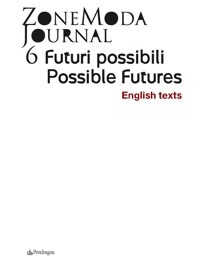
ZONEMODA JOURNAL
issue 6 (2016)
Futuri Possibili - Possible Future
Editor in Chief
Antonella Mascio
International Editorial Board
Pamela Church-Gibson
Paola Colaiacomo
Roberto Grandi
Yuniya Kawamura
Emanuela Mora
Enrica Morini
Roberta Paltrinieri
Eugenia Paulicelli
Adelheid Rasche
Giorgio Riello
Roberta Sassatelli
Junji Tsuchiya
Marcia Veneziani
Guest editors
Flaviano Celaschi
Elena Formia
Ines Tolic
Editorial Advisory Board
Daniela Baroncini
Nicoletta Giusti
Mariella Lorusso
Giovanni Matteucci
Roy Menarini
Federica Muzzarelli
Maria Giuseppina Muzzarelli
Giampaolo Proni
Simona Segre Reinach
Lucio Spaziante
Ines Tolic
Elisa Tosi Brandi
Editorial Assistants
Stefano Brilli
Maura Vecchietti
Graphic Design
Alessandro Gori
Translations and revisions
Stefano Brilli
Giulia Caffaro
Maura Vecchietti
ZoneModa Journal
Scuola di Lettere e Beni Culturali Università di Bologna
Dipartimento di Scienze per la Qualità della Vita di Rimini
via Santa Chiara 40 - 47900 Rimini (Italy)
con il contributo del Dipartimento di Scienze per la Qualità della Vita di Rimini e di UniRimini SpA
© 2016, Edizioni Pendragon
Via Borgonuovo, 21/A – 40125 Bologna
www.pendragon.it
ISBN: 9788865984802
No parts of this publication may be reproduced in any form or by any means without the written permission of Pendragon.
Printed in Bologna, December 2016
Note on translations - Mariella Lorusso translated from Italian to English the essay by F. Celaschi, E. Formia, I. Tolic and, with Stefano Zappi, the introduction. Maura Vecchietti translated from Italian to English: the editorial, essays by G. Cafarro, I. Letteriello and L. Ferrari. Stefano Brilli transleted from English into Italian the essay by P. Church-Gibson. Giulia Caffaro transleted from English into Italian the essay by B. Quinn.
Maura Vecchietti in charge for all the English revisions.
ZoneModa
Dall’Agenzia Nazionale di Valutazione della Ricerca Universitaria (ANVUR) ZoneModa Journal è collocata in fascia “A” per l’Area 10, settore disciplinare L1 – Lingue, Letterature e Culture Inglese e Anglo-Americana; la scientificità è inoltre riconosciuta per le seguenti aree: Area 8 – Ingegneria civile e architettura, Area 10 - Scienze dell'antichità, filologico-letterarie e storico-artistiche, Area 11 - Scienze storiche, filosofiche, pedagogiche e psicologiche.
Gli articoli pubblicati nella parte main di ZoneModa Journal sono sottoposti alla procedura del double blind peer review, a parte quelli ad invito (nel presente numero Bradley Quinn, Il futuro della moda/The future of fashion, Pamela Church-Gibson, Moda, cinema e la paura del futuro).
eBook Design
Letter from the Editor
Antonella Mascio
Possible Futures in other words the idea of “anticipating time”. This is the subject matter of the issue no. 6 of ZoneModa Journal, edited by Flaviano Celaschi, Elena Formia and Ines Tolic. A subject matter undoubtedly referring to project-based disciplines, like architecture and design, without however excluding other fields of analysis and study similarly focused on an interpretation of a time-based view encompassing both past and present. A view shared by the authors who have contributed to the book, and have expressed their ideas following diverse approaches and vantage points, thus further stressing - in our opinion - the richness coming from the traits of multiplicity coming to life within the framework of the journal. This is an essential element in the structure of ZoneModa Journal, and its current issue no. 6, in its continuity with the previous ones, where articles and essays presented different points of view all pertaining to a common theme.
Again in line with this project line, we are pleased to announce that the next issue of the journal will be edited by Pamela Church-Gibson and Sara Pesce and will be devoted to the topic of Fashion and Celebrity, whichseems an area open to plenty of diverse interpretations and many possible analyses.
Some changes should be mentioned here concerning the editorial development of the journal. The Editorial Commission will have to deal with several moves in the next few months. We are in effect working towards the transfer of ZoneModa Journal to the digital platform AlmaDLJournals, run by the University of Bologna, where several scientific journals published by the university are posted. In this way the journal will have an open access and be more readily available to our readers.
We would also like to mention here that the scientific value of the journal has been recognised by the Culture Fashion Communication, a research group recently established in the Rimini Campus of Bologna University, and composed of a network of scholars and experts who have long studied the phenomena linked to the system of fashion, consumption and lifestyles, through an innovative multidisciplinary approach.
We conclude this short editorial on a positive note: ANVUR - the National Agency assessing University and Research Systems - has confirmed its Class A for ZoneModa Journal in the sector L1 (English and Anglo-American Languages, Literatures and Cultures) and has attributed to it a scientific value also in Area 8 (Civil Engineering and Architecture), as well as in areas 10 (Philological-literary and Historical-artistic Sciences of Antiquity) and 11 (Historical, Philosophical, Pedagogical and Psychological Sciences), thus further consolidating the importance of the journal for several communities and disciplines.
POSSIBLE FUTURES
Flaviano Celaschi, Elena Formia and Ines Tolic
Towards the end of 1975, Richard Buckminster Fuller (1895-1983) gave a series of lectures in which he described his many projects: from the Dymaxion House to geodetic domes, from the projects for Manhattan to globally relevant research like the Inventory of World Resources, Human Trends and Needs. Believing that it was impossible to change by operating only on the present, throughout his life Fuller attempted to anticipate time, building better or at least alternative scenarios to the ones he was living in. With great conviction, he asserted the urgency to act looking always at what was yet to come. In this way he opened new paths towards possible futures.
However extraordinary, Buckminster Fuller's sensitivity towards the future is not unique. The need to anticipate, which may be found at the very foundations of design disciplines and creative cultures, recurs throughout history, manifesting itself vigorously in periods characterized by economic, social and political uncertainties – amongst which the present one can also be included. In these time spans, the need to prefigure the future seems to become relentless, thus stimulating the production of projects, works and visions which reveal latent possibilities or try to interpret weak signals.
Thinking to the essays in this issue of ZoneModa Journal, technology seems to be an important key to understand how the near future will be shaped. The relationship between fashion and wearable technologies is analyzed by Bradley Quinn, whose intervention browses emerging trends, innovative materials and new types of products capable of inspiring both producers and consumers. Vito De Biasi dedicates his reflection to the subject of the e-shop and new ways of consumption associated with it, while Laura Meraviglia takes into account the potential and dangers of new technologies for the made in Italy system and for the protection of trademarks.
Technology, however, is not the only way to explore the link between possible futures and cultures of the project. To illustrate the anticipatory possibilities of fashion products, Chiara Colombi and Federica Vacca propose a consideration about the archives and how they can be transformed into an operational resource in the design practice and in an innovation tool for companies. The value of temporality and the possible continuity between past-present-future are pointed out also in the contribution written by Fabio Cleto, exploring the nostalgia of the future as a paradigm of modern society and contemporary imagination.
With an interdisciplinary method, the essay by Pamela Church Gibson explores the possible futures between film and fashion, from the recent Met Gala, staged in New York to launch the exhibition Manus x Machina: Fashion in an Age of Technology. Piergiorgio Degli Esposti frames instead the evolution of the "prosumer" outlining their role in the global digital society. In the text by Mariella Lorusso the English language is interpreted as an added value for the fashion system and a new frontier for multiculturalism.
Finally, three essays address this theme starting with the iconic characters or events of fashion and art. The case of Vanessa Beecroft, for Valentina Rossi, is an opportunity to investigate the pioneering relationships that the artist has been able to establish between fashion and her own performances. Including both Loie Fuller and Lady Gaga, the article by Federica Muzzarelli and Gustavo Marfia examines female figures who based their own artistic celebrity on the performative and spectacular dimension of the stage through the use of advanced technologies. In opposition, Ambrogia Cereda tells us about a scenario with no gender connotations, born and spread following the Eurovision Song Contest in particular.
The 6th issue of ZoneModa Journal has thus become a meeting point both for disciplines characterized by a more or less strong necessity to project toward the future the results of their work (design, architecture, fashion), and for those fields of study which are capable of evoking future scenarios (cinema, media). The goal of this issue was particularly intended at studying possible futures of today or yesteryear in relation to body, city and media, considering these as places for experimentation capable of revealing both anticipatory methods and foresight tools, as well as cases of prediction which future has followed (or has to follow).
For this issue, curators have worked together to draft the summary, introduction, bibliography, and the essay Possible Futures and Design Cultures: Places, Objects and Bodies.
Essays by Vito De Biasi, Laura Meraviglia, Chiara Colombi and Federica Vacca, Fabio Cleto, and Valentina Rossi have been edited by Elena Formia.
Essays by Bradley Quinn, Pamela Church Gibson, Piergiorgio Degli Esposti, Mariella Lorusso, Gustavo Marfia and Federica Muzzarelli, and Ambrogia Cereda have been edited by Ines Tolic.
Lesen Sie weiter in der vollständigen Ausgabe!
Lesen Sie weiter in der vollständigen Ausgabe!
Lesen Sie weiter in der vollständigen Ausgabe!
Lesen Sie weiter in der vollständigen Ausgabe!
Lesen Sie weiter in der vollständigen Ausgabe!
Lesen Sie weiter in der vollständigen Ausgabe!
Lesen Sie weiter in der vollständigen Ausgabe!
Lesen Sie weiter in der vollständigen Ausgabe!
Lesen Sie weiter in der vollständigen Ausgabe!
Lesen Sie weiter in der vollständigen Ausgabe!
Lesen Sie weiter in der vollständigen Ausgabe!
Lesen Sie weiter in der vollständigen Ausgabe!
Lesen Sie weiter in der vollständigen Ausgabe!
Lesen Sie weiter in der vollständigen Ausgabe!
Lesen Sie weiter in der vollständigen Ausgabe!
Lesen Sie weiter in der vollständigen Ausgabe!
Lesen Sie weiter in der vollständigen Ausgabe!
Lesen Sie weiter in der vollständigen Ausgabe!
Lesen Sie weiter in der vollständigen Ausgabe!
Lesen Sie weiter in der vollständigen Ausgabe!
Lesen Sie weiter in der vollständigen Ausgabe!
Lesen Sie weiter in der vollständigen Ausgabe!
Lesen Sie weiter in der vollständigen Ausgabe!
Lesen Sie weiter in der vollständigen Ausgabe!
Lesen Sie weiter in der vollständigen Ausgabe!
Lesen Sie weiter in der vollständigen Ausgabe!
Lesen Sie weiter in der vollständigen Ausgabe!
Lesen Sie weiter in der vollständigen Ausgabe!
Lesen Sie weiter in der vollständigen Ausgabe!
Lesen Sie weiter in der vollständigen Ausgabe!




