


18,99 €
Mehr erfahren.
- Herausgeber: John Wiley & Sons
- Kategorie: Geisteswissenschaft
- Serie: Key Contemporary Thinkers
- Sprache: Englisch
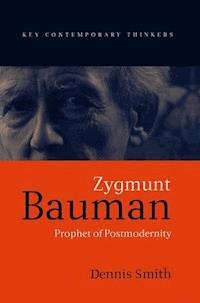
In this major new assessment of Zygmunt Bauman's work, Smith gives a clear introduction to this controversial and challenging sociologist.
Das E-Book Zygmunt Bauman wird angeboten von Polity und wurde mit folgenden Begriffen kategorisiert:
book; major new; dennis smith; work; bauman; agenda; zygmunt; introduction; future; clear; discussions; decade; last; distinctive; powerful; age; human; postmodern; condition; dilemmas; moral; political; us; vision; contribution
Sie lesen das E-Book in den Legimi-Apps auf:
Seitenzahl: 462
Veröffentlichungsjahr: 2013
Ähnliche




















Table of Contents
Cover
Title page
Copyright page
Key Contemporary Thinkers
Preface
Part I: Setting the Agenda
1 Living Without a Guidebook
Introduction
Critical perspectives
Sociology plus
What is modernity?
What is postmodernity?
Why Bauman is worth reading
The myth of the cage-dwellers
The rest of this book
2 No Easy Choices
Culture, choice and sociology
Bauman’s vision
Bauman’s career and intellectual influences: a brief overview
3 Who is Zygmunt Bauman?
Faith, hope and charity
The roots of wisdom
Bauman’s agenda
A brief biography
Transitions
Puzzles
Anti-Semitism and Bauman
Neither insider nor outsider
Marx and the art of motorcycle maintenance
4 The Power of the Past
Discovering postmodernity
From priest to prophet
Out of Poland
A sociology for strangers
Part II: The Road to Postmodernity
5 The Road to the West
Keeping on the road
An unexpected discovery
Intellectuals and innovation
Bauman, Galbraith and Mill
Modern times, modern Marxism
Between Class and Elite
Polish peasants and politics
Conclusion
6 The Road to Utopia
Mechanisms of social change
Culture as Praxis
Towards a Critical Sociology
Socialism: the active utopia
Hermeneutics and Social Science
Conclusion
7 The Road to the Berlin Wall
Switching routes
Solidarity
Memories of Class
Freedom
After communism
Conclusion
8 The Trilogy
Three narratives
Legislators and Interpreters
Cruelty, dehumanization and estrangement
Modernity and the Holocaust
Modernity and Ambivalence
Conclusion
9 Bauman’s Vision of Modernity and Postmodernity
Elaborating the vision
Tending the garden
Discipline and sacrifice
The costs of modernity
Contradictions of modernity
The postmodern perspective
The postmodern habitat
The broader context
Three aspects of postmodernity
Postmodernization
Globalization
Seduction and repression
Cognitive, aesthetic and moral space
The stranger
I and the Other
The role of the sociologist
Part III: Dialogue
10 Between Critical Theory and Poststructuralism
The ambivalence of criticism
The journey from modernity to postmodernity
Adorno and Habermas
Foucault and Lyotard
Enlightenment values
11 A Correspondence between Zygmunt Bauman and Dennis Smith
First letter
Second letter
Third letter
Fourth letter
Fifth letter
Bibliography
Index
Copyright © Dennis Smith 1999
The right of Dennis Smith to be identified as author of this work has been asserted in accordance with the Copyright, Designs and Patents Act 1988.
First published in 1999 by Polity Press in association with Blackwell Publishers Ltd.
Editorial office:
Polity Press
65 Bridge Street
Cambridge CB2 1UR, UK
Marketing and production:
Blackwell Publishers Ltd
108 Cowley Road
Oxford OX4 1JF, UK
Published in the USA by
Blackwell Publishers Inc.
Commerce Place
350 Main Street
Malden, MA 02148, USA
All rights reserved. Except for the quotation of short passages for the purposes of criticism and review, no part of this publication may be reproduced, stored in a retrieval system, or transmitted, in any form or by any means, electronic, mechanical, photocopying, recording or otherwise, without the prior permission of the publisher.
Except in the United States of America, this book is sold subject to the condition that it shall not, by way of trade or otherwise, be lent, re-sold, hired out, or otherwise circulated without the publisher’s prior consent in any form of binding or cover other than that in which it is published and without a similar condition including this condition being imposed on the subsequent purchaser.
ISBN 0-7456-1898-7
ISBN 0-7456-1899-5 (pbk)
ISBN 9780-7456-6884-0 (epub)
ISBN 9780-7456-6883-3 (mobi)
ISBN 9780-7456-7825-2 (epdf)
A catalogue record for this book is available from the British Library.
Library of Congress Cataloging-in-Publication Data
Smith, Dennis, 1945–
Zygmunt Bauman: prophet of postmodernity / Dennis Smith.
p. cm. — (Key contemporary thinkers)
Includes bibliographical references and index.
ISBN 0-7456-1898-7 (alk. paper). — ISBN 0-7456-1899-5 (pbk.: alk. paper)
1. Bauman, Zygmunt. 2. Postmodernism — Social aspects. 3. Civilization, Modern — 20th century. I. Title. II. Series: Key contemporary thinkers (Cambridge, England)
HM449. S55 2000
303.4 — dc21 99–27526
CIP
Key Contemporary Thinkers
Published
Jeremy Ahearne, Michel de Certeau: Interpretation and its Other
Peter Burke, The French Historical Revolution: The Annales School 1929–1989
Michael Caesar, Umberto Eco: Philosophy, Semiotics and the Work of Fiction
Colin Davis, Levinas: An Introduction
Simon Evnine, Donald Davidson
Edward Fullbrook and Kate Fullbrook, Simone de Beauvoir: A Critical Introduction
Andrew Gamble, Hayek: The Iron Cage of Liberty
Philip Hansen, Hannah Arendt: Politics, History and Citizenship
Sean Homer, Fredric Jameson: Marxism, Hermeneutics, Postmodernism
Christopher Hookway, Quine: Language, Experience and Reality
Christina Howells, Derrida: Deconstruction from Phenomenology to Ethics
Simon Jarvis, Adorno: A Critical Introduction
Douglas Kellner, Jean Baudrillard: From Marxism to Post-Modernism and Beyond
Chandran Kukathas and Philip Pettit, Rawls: A Theory of Justice and its Critics
James McGilvray, Chomsky: Language, Mind, and Politics
Lois McNay, Foucault: A Critical Introduction
Philip Manning, Erving Goffman and Modern Sociology
Michael Moriarty, Roland Barthes
William Outhwaite, Habermas: A Critical Introduction
John Preston, Feyerabend: Philosophy, Science and Society
Susan Sellers, Hélène Cixous: Authorship, Autobiography and Love
David Silverman, Harvey Sacks: Social Science and Conversation Analysis
Dennis Smith, Zygmunt Bauman: Prophet of Postmodernity
Geoffrey Stokes, Popper: Philosophy, Politics and Scientific Method
Georgia Warnke, Gadamer: Hermeneutics, Tradition and Reason
James Williams, Lyotard: Towards a Postmodern Philosophy
Jonathan Wolff, Robert Nozick: Property, Justice and the Minimal State
Forthcoming
Maria Baghramian, Hilary Putnam
Sara Beardsworth, Kristeva
James Carey, Innis and McLuhan
Thomas D’Andrea, Alasdair MacIntyre
Eric Dunning, Norbert Elias
Jocelyn Dunphy, Paul Ricoeur
Matthew Elton, Daniel Dennett
Nigel Gibson, Frantz Fanon
Graeme Gilloch, Walter Benjamin
Karen Green, Dummett: Philosophy of Language
Espen Hammer, Stanley Cavell
Fred Inglis, Clifford Geertz
Sarah Kay, Žižek: A Critical Introduction
Paul Kelly, Ronald Dworkin
Valerie Kennedy, Edward Said
Carl Levy, Antonio Gramsci
Dermot Moran, Edmund Husserl
Harold Noonan, Frege
Wes Sharrock and Rupert Read, Kuhn
Nick Smith, Charles Taylor
Nicholas Walker, Heidegger
Preface
This has been a very enjoyable book to write. Zygmunt Bauman’s sustained exploration of the nature of modernity and postmodernity is one of the great intellectual journeys of our times. Zygmunt Bauman was generous with his encouragement and made it clear from the beginning that he would not try to influence what I wrote, or offer approval or otherwise of the interpretations I might come up with. It cannot be a comfortable experience to be subjected to someone else’s interpretation of the meaning of your life and career. I want to thank Zygmunt Bauman for putting up with my impertinent attention.
While writing the book, I kept the following quotation by my desk as a constant reminder of the limits against which I was pressing:
The text the author has produced acquires its own life. True – the text derives its meaning from the setting in which it has been conceived. In this setting, however, the author’s intentions are just a factor among others; and surely the factor of which we know least. No less significant are those other constituents of the setting which the text absorbed, and those the text could absorb but did not: the absence is as vociferous as the presence.
On the other hand the reader is no more free than the author in determining the meaning of the text … He understands as much as his knowledge allows him … If the author sends his signals from an island whose interior he has not and could not explore in full, the reader is a passenger who walks the deck of a sailing ship he does not navigate. The meaning is the instant of their encounter. (Zygmunt Bauman, Hermeneutics and Social Science, p. 229)
I have gained a lot from conversations with Ulrich Bielefeld of the Hamburger Institut für Sozialforschung, with John Rex of the Centre for Research in Ethnic Relations at Warwick University and with Richard Kilminster and Ian Varcoe, both of the School of Sociology and Social Policy at Leeds University. I owe thanks to others also. Janina Bauman was kind and tolerant when I rang or came to call. Val Riddell suggested the theme of this book but, sadly, did not live to see it published. Evelin Lindner gave me detailed and valuable comments on several chapters and has made the book a better one. Caroline Baggaley at Keele University has been a good friend. Tanya Smith has provided insight, wit and a sense of proportion. Aston Business School has a long-standing tradition of encouraging research in the social sciences and it is a pleasure to have the support of colleagues such as Henry Miller, Reiner Grundmann, John Smith and Helen Higson. The ‘invisible college’ of social scientists at Aston University crosses departmental boundaries and includes Sue Wright and Dieter Haselbach of the School of Languages and European Studies.
Presentations drawing upon the book’s argument at various stages of its development were given at Leeds University, Sheffield University (at the kind invitation of Sharon Macdonald), Aston Business School and the British Sociological Association’s Annual Conference at Glasgow. I have benefited from the comments of many colleagues and hope they find the final result interesting and worthwhile. If not, I do not expect them to share the blame.
Part I
Setting the Agenda
1
Living Without a Guidebook
Introduction
If you are new to the hotly raging debate about modernity and postmodernity, start by reading Zygmunt Bauman. He is one of the most interesting and influential commentators on these aspects of our human condition.
Zygmunt Bauman has brilliantly described humankind’s trek through modernity during the past few centuries. He has also drawn a vivid map of the new world coming into being as modernity turns postmodern.
Bauman is part of the story he tells. He can be found on the map he draws. Born in 1925 in Poland and educated in Soviet Russia, Bauman fought with the Red Army against the Germans during World War II. He emigrated from Poland to the West in 1968. Since then he has published a new book every one or two years.
Critical perspectives
This book presents an overview of Bauman’s work between the 1960s and the late 1990s, and it also provides a critical perspective on that work. I have tried to get ‘behind’ the texts themselves in order to understand why they were produced and what they were intended to achieve.
Bauman wants to awaken people to their creative potential and to their moral responsibilities. That is not difficult to discover, since he is quite explicit about it. However, the way Bauman defines his objectives changes over the decades. So does the way he tries to achieve them. Bauman does not announce these alterations of definition and direction. They have to be reconstructed through the kind of critical analysis I have carried out in the first part of this book, where I trace the main outlines of Bauman’s life and career as a young refugee, a wartime soldier, a military bureaucrat, a revisionist intellectual and an émigré.
Analysis of this kind asks ‘why this agenda?’ and ‘why this change of agenda?’ Our response to a specific text is altered if we are able to see it as part of a larger constellation of writing, especially if that larger constellation tells its own story. I say ‘tells its own story’ as if the process were unproblematic, a matter of simply downloading a file. In fact, it requires a concentrated effort of interpretation, in the course of which one has to keep the imagination under tight control, avoid unwarranted assumptions, try to avoid going too far beyond the evidence, but, at the same time, not ignore the evidence that exists.
These are, I assume, the working practices of a good detective, although I must say straightaway that I am not looking for a ‘conviction’. I am in broad sympathy with Zygmunt Bauman’s objectives. My curiosity comes out of fascination, not suspicion.
This first part of the book, ‘Setting the Agenda’, sets out my understanding of the long process that led from Bauman’s search for a ‘modern Marxism’ in the 1960s (Bauman 1969: 1) to his evocation of ‘postmodernity and its discontents’ in the 1990s (Bauman 1997). In the second part of the book, entitled ‘The Road to Postmodernity’, I show how Bauman’s major works in English can be understood in the light of the interpretation developed in part I. In particular, I trace the genealogy of Bauman’s vision of modernity and postmodernity, and explore its intellectual content.
Lesen Sie weiter in der vollständigen Ausgabe!
Lesen Sie weiter in der vollständigen Ausgabe!
Lesen Sie weiter in der vollständigen Ausgabe!
Lesen Sie weiter in der vollständigen Ausgabe!
Lesen Sie weiter in der vollständigen Ausgabe!
Lesen Sie weiter in der vollständigen Ausgabe!
Lesen Sie weiter in der vollständigen Ausgabe!
Lesen Sie weiter in der vollständigen Ausgabe!
Lesen Sie weiter in der vollständigen Ausgabe!
Lesen Sie weiter in der vollständigen Ausgabe!
Lesen Sie weiter in der vollständigen Ausgabe!
Lesen Sie weiter in der vollständigen Ausgabe!




