


Erhalten Sie Zugang zu diesem und mehr als 300000 Büchern ab EUR 5,99 monatlich.
- Herausgeber: Crown House Publishing
- Kategorie: Ratgeber
- Sprache: Englisch
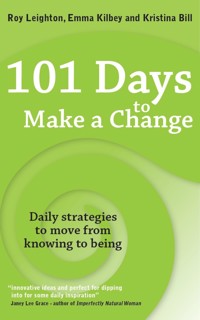
101 Days To Make a Change is a constructive and compassionate companion that will help get you back in the driving seat of your life - in just over three months. Its expansive ideology is grounded by an achievable process with a realistic timeframe to help chart progress and acknowledge results. This programme will give you rigorous tools in order to truly understand what makes you who you are, so you can plan for your best future, both personally and professionally. You'll be led by clear and practical steps to uncover your drives and motivation and identify your attitude to learning and change. Armed with these valuable insights your confidence will increase and your stress levels will be reduced while you develop new skills and start achieving firm goals.
Sie lesen das E-Book in den Legimi-Apps auf:
Seitenzahl: 251
Veröffentlichungsjahr: 2011
Das E-Book (TTS) können Sie hören im Abo „Legimi Premium” in Legimi-Apps auf:
Ähnliche



















Praise for101 Days to Make a Change
In this book there is a quotation from the actor Morgan Freeman which says: “Learning how to be still, to be really still and let life happen – that stillness becomes a radiance”.
I read this book in a day. I found myself unpicking and re-examining aspects of my life and behaviour. It was provocative and profound. If I read it and undertook the programme for 101 days, it would almost certainly be profoundly life-changing.
Are you content with your present? Are you content with what you perceive to be your future? If so, do not read this book: no need. If not, undertaking the programme over 101 days would help you clarify, at a level you perhaps have never done before, how you want to live and to be.
The programme requires commitment. Imagine yourself doing a twelve week summer school or training for the London Marathon. In a systematic way you are going to need to devote time and energy to it each day. So, before you start, make some decisions about what you may have to ‘cut out’ for that period. The programme also requires courage. Almost all, if not all, of us need a support mechanism in our lives. Tell your close friends and family that you are undertaking this course. They can offer you encouragement along the way: be your programme buddies.
This book is a tool. It is both a car and a bit of a navigator for the journey. You are the driver, ultimately deciding the nature of the journey through listening to your own inner compass. Each person who undertakes this programme will find themselves at the end at a destination that is unique and particular to them. The programme can help you to more clearly understand who you are and, specifically, what makes you happy. In your own particular way it can help you learn to be really still, let life happen, and enjoy every part of its rollercoaster ride. Ultimately, I think you may find the journey itself is the destination.
Dr. Raphael Jay Adjani F.R.S.A. Director, Center for Creative Development and academic at Goldsmiths, University of London
I have always found Roy’s approach to change inspiring and thought-provoking. His collaboration in this book made it a must try for me and I wasn’t disappointed. I’d recommend it if you want something different in your work or personal life but don’t know where to start – the answer as you will quickly see, is always “with yourself”!!!
Dawn Caswell, Human Alchemy, specialist in Transformational Management Team Development
A great resource with some innovative ideas and perfect for dipping into for some daily inspiration. I especially liked the idea of keeping a ‘Mood diary’ and it’s helpful that there is space for notes at the end of each day’s exercise. The quotations peppered throughout were thought-provoking too.
Janey Lee Grace – author ofImperfectly Natural Woman
101 days to Make a Change – a book? No. It’s more than that. This is our personal MOT manual exploring every part of our lives. It’s not a book just to read, it’s a brilliant manual with practical and profound exercises to complete so that we can live at our best and give our best. It’s brilliant – it’s to be used every year – and I highly recommend it.
Lindsey Reed, FInstLM, LCH Dip; Master NLP Practitioner, licensed career coach and confidence coach
Having led transformational change in busy, large and complex organisations most of my adult life, I struggle to find a book on personal development that inspires me to read it from cover to cover, never mind putting it into practice. Well. This did both!
Paul Barron, CBE, retired Chief Executive of National Air Traffic Services and now freelance business advisor and mentor
The authors invite us on a journey of personal growth and self-discovery. They offer practical down to earth support full of possibility and based upon sound reasoning. This book will really help you to transform your life if you let it allowing you to reach your goals both personal and professional. It is a tool for change at the deepest level.
Terri Broughton, Master Practitioner and Trainer of NLP, Director of Teaching and Learning Development at Kings Lynn Academy
101 Days to Make a Change
Daily Strategies to Move from Knowing to Being
Roy Leighton, Emma Kilbey and Kristina Bill
Roy would like to dedicate this book to Ben Frow for getting him on the path for which he will always be grateful
Emma would like to dedicate this book to Greg, Flo and Lynn
Kristina would like to dedicate this book to John Akayzar
Contents
Title Page
Dedication
Introduction
1. Survival
2. Tribal
3. Self
4. Order
5. Enterprise
6. Community
7. Complexity
8. Holistic
About the Coral Collective
Bibliography
Index of exercises
Copyright
Introduction
Thank you for picking up this book. We hope it will be of some use to you for the next 101 days and beyond. The minimum it will do is to give you food for thought, but if you apply yourself to the exercises suggested it might just change your life …
Don’t be put off by that outrageous claim. To suggest that a book may be life changing, particularly by the authors, may seem arrogant! But we know that our view is based on sound reasoning and empirical evidence. The years we have spent developing the exercises in this book and refining the thinking behind them, as well as seeing the tangible results of applying them, make us confident in our claim. It’s important to understand that this book has been designed with the primary purpose of building confidence, resilience and happiness in the reader. It would negate much of what we are suggesting if we were unable to put it into practice ourselves.
The underlying system that supports the journey of personal growth used in our work as a consultancy is based on the work of Dr Clare W. Graves. His ideas and research around the development of the mature and happy adult are adhered to in the progression of the 101 days. Graves came up with a model that charts and identifies the development of adult maturity via different stages of being. These phases are identified by our values and drives, which then dictate the way we see the world and how we relate to others. As each stage moves onto the next, it transcends but includes the previous one. As Graves said:
[W]hat I am proposing is that the psychology of the mature human being is an unfolding, emergent, oscillating, spiralling process marked by progressive subordination of older, lowerorder behaviour systems to newer, higher-order systems as man’s existential problems change. These systems alternate between focus upon the external world, and attempts to change it, and focus upon the inner world, and attempts to come to peace with it. (1971)
One thing that we can definitely rely on in life is change – whether it’s an internal shift or an external event that demands we adapt. Graves emphasised that if a person’s world changes they must adjust their thinking or behaviour, and vice versa. Effectively managing this constant problem-based reality is what drives the development of children to become healthy, balanced adults, and assists us all in reflecting on our own evolution. When we desire to keep things as they are, and not engage with the dynamic and ever-changing reality of evolution, we jeopardise the effectiveness and happiness of individuals and organisations.
A summary of the Gravesian levels of human existence is set out in the table below. The table reads from bottom to top.
Source: Bowkett et al., 2008
When all levels are healthy and open, then individuals – and the organisations they may be part of – share not only a vision but have a model for dialogue and understanding, which leads to progress. When any individual, organisation or culture becomes fixed and closed at one level, conflict will inevitably be generated by this suppression of the natural process of evolution. The question is not so much ‘Where am I?’ but rather ‘Am I open or closed?’ to each level.
To return to Graves:
I am not saying in this conception of adult behaviour that one style of being, one form of human existence is inevitably and in all circumstances superior to or better than another form of human existence, another style of being. What I am saying is that when one form of being is more congruent with the realities of existence, then it is the better form of living for those realities. (1971)
We hope that through the clear stages of development shown in this book you will be inspired to give energy and life-force to those around you as you grow in determination, confidence, competence and compassion.
How to approach this book
The book is broken down into eight sections which correspond to Graves’s levels of human existence. Within this structure each of the 101 days follows the same format: quote, text and exercise or question. There are two ways to approach it. The first is to follow the days in order. The second is just to dip into the book randomly whenever you get the urge. Both will be of use, but moving systematically through the levels, without skipping sections or running out of sequence, is the ideal option. The choice is yours.
The exercises vary in length; some are one-offs while others can be repeated – either for the remainder of the section or the duration of the book (and beyond). ‘Today’s exercise’ is the one we suggest you do on that day. At the end of each day there is also a reminder of the exercises that we suggest you keep doing throughout the thirteen days of that particular section, as well as the ones we recommend you keep up throughout the entire 101-day process. There is also space for notes. Again, the choice is yours as to how many of these exercises you do.
We have enjoyed the challenge of writing this book and hope that you find it a practical resource to help you on your travels. Wherever you are on your particular and very personal path, it’s always important to take some time to check out not just your direction but your reason for heading that way in the first place.
May your journey be surprising and rewarding – and we sincerely hope that these words are fuel for it!
Section 1
Survival
Getting the Basics Right Are You Waving or Drowning?
Day 1
Begin and end with gratitude
You don’t have to see the whole staircase – just take the first step.
Martin LutherKing
Perhaps the most fundamental element to get right in life is our ability to experience love and feel gratitude, so it seems appropriate to start right there. Why is gratitude so important? Feeling grateful for all that we are and have is deeply satisfying and enriching. It also reduces feelings such as inadequacy, envy and frustration which are the usual stumbling blocks to reaching our full potential. Plus it aids acceptance of other people and their situations, and thereby creates greater empathy.
We will introduce a simple but effective exercise that is designed to top and tail each day. This exercise will, over time, reduce negative thoughts, aid clarity, increase a sense of contentment and lead to greater inner peace.
Today’s exercise
Wake up with gratitude
Take a few moments, just as you wake up, to immediately ‘catch your mind’ and think about a person, a place, a song or an activity that you love. Stay with the thought, elaborate on the visualisation and really go into it until you experience a sensation of love; then set your intention to go into your day with that loving feeling. It may not last all day but the fact that you did it first thing becomes a habit and has an accumulative effect.
It is also important to round up the day’s events and experiences and to clear your mind for that all-important sleep to have its full regenerative effect. Before going to sleep, lie down flat on your back and relax (in bed or on the floor). Gently rest your hands by your side or on your chest, whichever feels right. Now start to run a list in your head of all the things you are grateful for. Start with yourself, including your body, mind, soul, achievements and so on. Move on to all your relationships, experiences, comforts and joys. Imagine that you gently hold all this gratitude in your heart and set your intention to wake up the next day and be even more grateful for all your gifts.
Day 2
Wake up your body
A healthy mind in a healthy body.
Buddhist proverb
We all know that it’s advisable to look after our bodies, yet it can seem impossible to prioritise the time and the space needed to do so. If we eat unhealthily and refrain from exercising or taking adequate rest there is a risk of a build-up of toxins in the system. In time this can lead to disease. Traditional Western ideas, both scientific and religious, have in some ways led to the belief of a separation between the physical body and mental and emotional activities. This can make it difficult to appreciate to what extent general mental and emotional health can impact the physical body, and vice versa.
The body is full of sensory centres that make it possible for us to experience feelings of love, contentment, ecstasy, pain and so on. Toxins left in the body can start to consume vital energy and clog the system. When our energy is low we may become less focused, attentive, open-minded or thoughtful – less aware of and in touch with our feelings. Furthermore, various additives in foods can create chemical imbalances in the body so that physical ailments as well as mood swings and depressive symptoms may ensue. The more toxins are eliminated, the greater our ability to feel energised, alert and relaxed.
As well as causing harm by neglecting our bodies physically, maintaining a negative body image can also be very destructive. This may stem from a variety of sources, such as pressure from popular culture, religious beliefs, traumatic personal experience and so on. An essential element of personal development is to fully accept who we are. A negative body image equates to a lack of self-acceptance which can hinder personal growth. These are extremely personal topics and can be very deep-seated.
The process of investigation and the consequent discovering and demystifying of those beliefs can be painful but ultimately hugely freeing and rewarding.
Today’s exercise
Exercise and eating diary
Do you accept the mind–body connection or are you rejecting it? If so, why? What are your reservations or fears? What is your body image? Are you dragging around negative ideas about your body? How can you celebrate and be grateful for the health and the body that you have?
Starting today, keep a food and exercise journal for the next ten days. Where are your blind spots? Are you getting adequate rest or are you always doing something? Do you eat a lot of junk food that is potentially clogging your system?
Commit to changing at least one bad habit regarding your diet, exercise and rest. Commit to working on gratitude for your body and an improved body image.
Day 3
Knowing a habit when you see one
Failure is an attitude, not an outcome.
Harvey Mackay
How do we recognise our habits? How do we determine if they are good or bad? Habits are repetitive behavioural patterns that can be useful if they cut the delivery time of a certain positive result, or they can be negative if they stop us from developing and growing by keeping us stuck in the same rut and leading to destructive behaviours towards ourselves and others.
A lot of people report that they simply don’t know why they react a certain way in a given situation. Indeed, they may not even be aware of how they are responding and how it affects those around them. Often the reason is a lack of understanding of the underlying emotion from which the behaviour stems. This is how bad habits are created. The emotion or impulse comes first, the behaviour second.
By observing our reactions and taking note of them we can start to explore what our emotional triggers are – the people, events and situations that create strong reactions in us. These powerful emotional responses lead to behavioural patterns or habits, so by understanding the trigger we are getting to the root of what is causing the habit and can thereby change it.
Today’s exercise
Mood diary
Make a list of all the bad habits you feel you currently have.
Start keeping a journal or make a note below on a daily basis for the duration of this section of what your moods are and how they shift during the day. Record if your emotions are fluctuating depending on what you eat and drink – especially in relation to red meat, refined sugar, lack of water, alcohol and prescription or street drugs.
Start to be observant of your body language. This will provide you with clues on how you might feel about a person or situation. Are you closing yourself off? Holding yourself back or tensing up? Covering your mouth and not speaking out? Getting a sinking feeling in the pit of your stomach? Are you lashing out, losing patience, reaching for the biscuit tin or engaging in some other deflective behaviour?
In the evening, take a few moments to reflect – retrace your steps and look at what situations you found yourself in when the mood set in. By doing this you will soon discover which situations, places and people affect you in particular ways. After a while you will start to see patterns.
Review your bad habits list and match it to your mood patterns. Try to see if there is any correlation between the people and situations you have identified as bothering you and any ensuing reactive, negative behaviour or bad habits.
Day 4
Choosing the habits that you want
We first make our habits, then our habits make us.
John Dryden
We define a ‘good habit’ as a behavioural response that gets the desired result quicker, more effortlessly and with a positive, constructive effect on ourselves and our environment. As discussed above, by understanding our emotional triggers we are getting to the root of what may be causing the habit and we can thereby change it or choose it.
The next step from yesterday’s exercise is therefore to remember how certain situations affect you and thus be prepared beforehand. The journal-keeping is essential in this process. Magic happens when the emotional states are no longer ‘surprises’ – they start to lose their power, thereby making it easier to control the ensuing behavioural reaction. Think of the old adage ‘forewarned is forearmed’. For example, if you know a certain colleague always rubs you up the wrong way in meetings, and if you are mindful of that before you go in, it won’t come as a surprise and you can control your response to that person.
Over time, situations and people will be easier to handle and eventually you might even be able to see something positive in a previously difficult situation. How? By experiencing the transition, you will have learnt how to neutralise a negative situation. Once you’ve done this in one instance you can replicate the process: analyse your emotional response, be prepared, diffuse the negative reaction, then choose a positive behavioural response. This will make you feel more empowered and less like a victim of circumstances that are seemingly beyond your control – a habit well worth developing!
Today’s exercise
Mood diary – negative and positive
Make a list of all the good habits you can think of that you would like to develop. Match them to any opposing bad habits that you currently feel you have. Review the mood patterns from Day 3 and your analysis of when the bad habits kicked in. Apply the ‘forewarned is forearmed’ approach and think about how you can turn the bad habit into a good one.
Start doing it, now, today – no more excuses!
Day 5
Manage your mind
Whether you think you can or whether you think you can’t, you’re right!
Henry Ford
Meditation is the activity of learning how to manage the mind so that incessant and negative thought patterns abate. Meditation is not about sitting still and doing nothing. It requires technique and practice but the rewards are immeasurable. In time, regular meditation practice can begin to permeate all areas of life and we start to feel more present, connected and peaceful – which can make acceptance, forgiveness and personal achievement easier to master. This is what Buddhists call meditation in action, or mindfulness.
Today’s exercise
Meditation
Prepare the space
Choose a space in your house where you will not be disturbed by anyone, including the phone. Ideally the space should be clean and clutter-free. Perhaps you would like to enhance the atmosphere with candles, incense, flowers or an inspiring picture – anything that encourages calm and connectedness in you.
The ritual of clearing the space and decorating it as you wish provides a preparation for the practice. It calms the mind and sets your intention, which is to focus actively on meditation. According to many Eastern philosophies (e.g. Buddhism, Feng Shui, Taoism) the energy of the space is very important and will have a direct impact on the depth of your practice.
Sitting posture
Once your space is ready, sit down in a cross-legged position, gently resting your hands on your knees. Make sure your shoulders and jaw are relaxed and your back is straight. Use a cushion under the buttocks to relieve tension in the knees and hips if necessary. Relax your face and gently close your eyes. Take a few deep breaths and become aware of your body. Put your focus on any areas of tension or aches and breathe deeply with the intention of relieving it.
Breathing
Once you have settled in more comfortably, bring your attention to your breath. Breathe in through the nose and out through the mouth (though the nose is OK too). Count to three on the inbreath and three on the out-breath. Continue for ten breaths, then relax and breathe normally for ten breaths.
Repeat the cycle four times. After that, sit quietly, breathe normally and focus on the breath. Your mind may wander off as thoughts pop into your head. Gently bring your attention back to the breath. Do not get frustrated if the mind keeps wandering – this is normal and will stop with time. As soon as you feel yourself getting tired of focusing on deep breathing, just breathe normally and observe each breath, in and out.
For the first week do this meditation as often as you like but ideally at least once a day in the morning. Try to sit for a minimum of twenty minutes. As the breathing exercise becomes more comfortable you can experiment with longer counts on the in- and out-breaths. Just make sure you don’t get light-headed – this is not an endurance test! The aim is to calm the mind, lower your blood pressure and relieve tensions.
Day 6
Just do it!
Genius is 1% inspiration and 99% perspiration.
Thomas Edison
For the past few days we have looked at how to develop and grow intuitively (gratitude), physically (wake up your body), emotionally (habits) and mentally (manage your mind). Carl Jung called these ideas the four basic intelligences or modes of interacting with the world. The most important thing of all is now to ‘walk the walk’, so today is all about just doing it! Go back and review the exercises from the last few days and make sure you are actually doing them. Reading about them will provide you with ideas and insights, but real change comes from taking action. Life is a constant spiral of opportunities, action and learning. Start twirling!
Today’s exercise
Take action
Today is all about action. Try not to think too long and hard – take action instead. How does it feel to leap into something? Do you do that often and then think about what you did afterwards? Or do you tend to ponder and perhaps arrive too late to the party? Make a note in your journal of what you feel is your default mode, but for today practise not thinking too much but taking action instead; always of course with a loving and considerate intention – we are not advocating rash and thoughtless behaviour. Just have the experience of being daring.
Day 7
Build confidence, not arrogance
To thine own self be true.
Hamlet, I, iii
Confidence is quiet, consistent, discerning and thoughtful; arrogance is loud, erratic, non-discriminatory and selfish. Confidence does not require praise or attention; arrogance screams ‘look at me’. Let’s not worry about confidence – it takes care of itself. Arrogance, on the other hand, needs some work.
Arrogance is a mask for underlying insecurity. Just as before when we suggested that habits emanate from deep-seated emotions, so too does arrogance. In order to deal with it and convert it into confidence it is therefore essential to locate the insecurities that underpin it.
Self-love can be one of the hardest qualities to develop but it’s an essential ingredient of confidence. Arrogance often comes from self-loathing or lack of self-respect. We love that which we look after and respect, including ourselves. The way to build true self-confidence is therefore to ask ‘Do I love myself or loathe myself?’
Today’s exercise
Self-love
Find a quiet moment, perhaps after your morning meditation or with your evening journal. Make a list using two columns: in the first one describe what you loathe about yourself (note: we are deliberately using a strong word here; this is about absolute honesty, not being politically correct with yourself) and in the second column, what you love about yourself.
Whatever feelings come up for you as you are doing this allow yourself to feel them – don’t censor yourself. Cry if you want to; laugh at yourself if that feels right. This can be a very cathartic experience. Once you have uncovered what is lurking in your mind you can deal with it.
Later on in the book we will look at the act of forgiveness (Day 72) and give you exercises to be used to revisit this list and deal with the ‘loathes’. For now, vow to start loving and respecting yourself. When you go to bed tonight make sure you revisit the gratitude exercise from Day 1 and include in your list all the things you love about yourself.
Day 8
Stopping is not quitting, you are just taking a breath
You can live for two months without food and two weeks without water but only a few minutes without air.
Hung Yi-hsiang
As far as our physical priorities go, breathing is one most people take for granted and don’t even think about. According to Daniel Reid (2003) regular, deep breathing gives an immediate boost to the circulation, parasympathetic nervous system, immune system and other vital functions; not least of all is lowering blood pressure. It is essential to breathe properly not only for survival but to ensure health and longevity.
Deep breathing comes from the diaphragm. Watch a baby or child sleeping and see how their bellies gently rise with every in-breath. That is correct diaphragmatic breathing. Most adults tend to carry tension in this area, so instead take shallower, higher breaths by raising their shoulders to their ears. During stress and emotional pressure, muscles tense up, thereby making breathing shallower still. The system thinks it is in fight-or-flight mode and releases stress hormones. The parasympathetic nervous system, which is the natural healing process, is taken out of action. Conversely, when we want to calm down, deepening our breath relaxes the system, taking us out of fight-or-flight mode.




