


17,99 €
Mehr erfahren.
- Herausgeber: John Wiley & Sons
- Kategorie: Geisteswissenschaft
- Sprache: Englisch
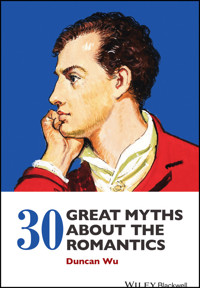
Brimming with the fascinating eccentricities of a complex and confusing movement whose influences continue to resonate deeply, 30 Great Myths About the Romantics adds great clarity to what we know – or think we know – about one of the most important periods in literary history.
- Explores the various misconceptions commonly associated with Romanticism, offering provocative insights that correct and clarify several of the commonly-held myths about the key figures of this era
- Corrects some of the biases and beliefs about the Romantics that have crept into the 21st-century zeitgeist – for example that they were a bunch of drug-addled atheists who believed in free love; that Blake was a madman; and that Wordsworth slept with his sister
- Celebrates several of the mythic objects, characters, and ideas that have passed down from the Romantics into contemporary culture – from Blake’s Jerusalem and Keats’s Ode on a Grecian Urn to the literary genre of the vampire
- Engagingly written to provide readers with a fun yet scholarly introduction to Romanticism and key writers of the period, applying the most up-to-date scholarship to the series of myths that continue to shape our appreciation of their work
Sie lesen das E-Book in den Legimi-Apps auf:
Seitenzahl: 607
Veröffentlichungsjahr: 2015
Ähnliche




















Table of Contents
Title Page
Copyright
Dedication
Acknowledgements
Introduction
Notes
A Note on Monetary Values
Notes
Myth 1: Romanticism began in 1798
Notes
Myth 2: English Romanticism was a reaction against the Enlightenment
2.1 New Forms of Sociability
2.2 The Language of Passion
2.3 The Poet as Prophet
Notes
Myth 3: The Romantics hated the sciences
Notes
Myth 4: The Romantics repudiated the Augustans, especially Pope and Dryden
Notes
Myth 5: The Romantic poets were misunderstood, solitary geniuses
Notes
Myth 6: Romantic poems were produced by spontaneous inspiration
Notes
Myth 7: Blake was mad
Notes
Myth 8: Blake wrote ‘Jerusalem’ as an anthem to Englishness
Notes
Myth 9: Lyrical Ballads (1798) was designed to illustrate ‘the two cardinal points of poetry’, using poems about everyday life and the supernatural
Notes
Myth 10: Wordsworth's Preface to Lyrical Ballads was a manifesto for the Romantic revolution
Notes
Myth 11: Wordsworth had an incestuous relationship with his sister
Notes
Myth 12: Tory Wordsworth
Notes
Myth 13: The person from Porlock
Notes
Myth 14: Jane Austen had an incestuous relationship with her sister
Notes
Myth 15: The Keswick rapist
Notes
Myth 16: Byron had an affair with his sister
Notes
Myth 17: Byron was a great lover of women
Notes
Myth 18: Byron was a champion of democracy
Notes
Myth 19: Byron was a ‘noble warrior’ who died fighting for Greek freedom
Notes
Myth 20: Shelley committed suicide by sailboat
Notes
Myth 21: Shelley's heart
Notes
Myth 22: Keats's ‘humble origins’
Notes
Myth 23: Keats was gay
Notes
Myth 24: Keats was killed by a review
Notes
Myth 25: Percy Bysshe Shelley wrote Frankenstein
Notes
Myth 26: Women writers were an exploited underclass – unknown, unloved, and unpaid
Notes
Myth 27: The Romantics were atheists
Notes
Myth 28: The Romantics were counter-cultural drug users
Notes
Myth 29: The Romantics practised free love on principle
Notes
Myth 30: The Romantics were the rock stars of their day
Notes
Coda
Notes
Further Reading
Index
End User License Agreement
Pages
i
iii
vii
xi
xii
xiii
xiv
xv
xvii
xix
xvi
xviii
xx
xxi
xxii
xxiii
xxiv
xxv
xxvii
xxviii
xxix
1
2
3
4
5
6
7
8
9
10
11
12
13
14
15
16
17
18
19
20
21
23
24
22
25
26
27
28
29
30
32
31
33
34
35
36
37
38
39
40
41
42
43
44
45
46
47
48
49
50
54
51
52
53
55
56
57
58
59
60
61
62
63
64
65
66
67
68
69
70
71
72
73
74
75
76
77
78
79
80
81
82
83
84
85
86
87
88
89
90
91
92
93
94
95
96
97
98
99
100
101
102
103
104
105
106
107
108
109
110
111
112
113
114
115
116
117
118
119
120
121
122
124
125
126
127
128
129
130
131
132
133
134
135
136
137
138
139
140
141
142
145
143
144
146
147
148
149
150
151
152
153
154
155
156
157
158
159
160
161
162
163
164
166
167
168
169
170
171
172
173
174
175
176
177
178
179
180
181
182
183
184
185
186
187
188
189
190
191
192
193
194
195
196
197
198
199
200
201
202
203
204
205
206
207
208
209
210
211
212
213
214
215
216
217
218
220
221
222
223
224
225
226
227
228
229
230
231
232
233
234
235
236
237
238
239
240
241
242
243
244
245
246
247
248
249
250
251
252
253
254
255
256
257
258
259
260
261
262
263
265
266
264
267
268
269
270
271
272
273
274
275
276
277
278
279
280
281
283
284
285
286
287
288
289
290
291
292
293
294
295
296
297
298
299
300
301
Guide
Table of Contents
List of Illustrations
Figure 1
Figure 2
Figure 3
Figure 4
Figure 5
Figure 6
Figure 7
Figure 8
Figure 9
Figure 10
Figure 11
Figure 12
Figure 13
Figure 14
Figure 15
Figure 16
Figure 17
Figure 18
Figure 19
Figure 20
Figure 21
Figure 22
Figure 23
Figure 24
Figure 25
ALSO AVAILABLE
30 Great Myths About Shakespeare
by Laurie Maguire and Emma Smith
OTHER BOOKS BY DUNCAN WU
Wordsworth's Reading 1770–1799
Wordsworth's Reading 1800–1815
Making Plays: Interviews with Contemporary British Dramatists and Directors
Wordsworth: An Inner Life
Wordsworth's Poets
Six Contemporary Dramatists: Bennett, Potter, Gray, Brenton, Hare, Ayckbourn
William Hazlitt: The First Modern Man
William Wordsworth: Selected Poems
(co-edited with Stephen Gill)
Romanticism: A Critical Reader
(editor)
William Wordsworth: The Five-Book Prelude
(editor)
Women Romantic Poets: An Anthology
(editor)
A Companion to Romanticism
(editor)
William Hazlitt, The Plain Speaker: Key Essays
(editor)
The Selected Writings of William Hazlitt
, nine volumes (editor)
British Romanticism and the Edinburgh Review
(co-edited with Massimiliano Demata)
William Wordsworth: The Earliest Poems 1785–1790
(editor)
Metaphysical Hazlitt
(co-edited with Uttara Natarajan and Tom Paulin)
New Writings of William Hazlitt
(editor)
Immortal Bird: Romantic Poems about Nightingales
(editor)
The Happy Fireside: Romantic Poems about Cats and Dogs
(editor)
Romanticism: An Anthology
, Fourth Edition (editor)
Poetry of Witness: The Tradition in English, 1500–2001
(co-edited with Carolyn Forché)
‘All that is worth remembering’: Selected Essays of William Hazlitt
(editor)
An early nineteenth-century cut-and-paste job. In 1825, after Byron's death, Pierre Louis Bouvier hijacked Thomas Phillips's 1813 portrait of Byron and superimposed on it an image of the plumed cavalry helmet the poet had designed himself, perpetuating the image of the archetypal Romantic who died on the battlefield in the cause of freedom (see Myth 19).
Source: Paul F. Betz Collection.
30 GREAT MYTHS ABOUT THE ROMANTICS
Duncan Wu
This edition first published 2015
© 2015 John Wiley & Sons Ltd
Registered Office
John Wiley & Sons Ltd, The Atrium, Southern Gate, Chichester, West Sussex, PO19 8SQ, UK
Editorial Offices
350 Main Street, Malden, MA 02148-5020, USA
9600 Garsington Road, Oxford, OX4 2DQ, UK
The Atrium, Southern Gate, Chichester, West Sussex, PO19 8SQ, UK
For details of our global editorial offices, for customer services, and for information about how to apply for permission to reuse the copyright material in this book please see our website at www.wiley.com/wiley-blackwell.
The right of Duncan Wu to be identified as the author of this work has been asserted in accordance with the UK Copyright, Designs and Patents Act 1988.
All rights reserved. No part of this publication may be reproduced, stored in a retrieval system, or transmitted, in any form or by any means, electronic, mechanical, photocopying, recording or otherwise, except as permitted by the UK Copyright, Designs and Patents Act 1988, without the prior permission of the publisher.
Wiley also publishes its books in a variety of electronic formats. Some content that appears in print may not be available in electronic books.
Designations used by companies to distinguish their products are often claimed as trademarks. All brand names and product names used in this book are trade names, service marks, trademarks or registered trademarks of their respective owners. The publisher is not associated with any product or vendor mentioned in this book.
Limit of Liability/Disclaimer of Warranty: While the publisher and author have used their best efforts in preparing this book, they make no representations or warranties with respect to the accuracy or completeness of the contents of this book and specifically disclaim any implied warranties of merchantability or fitness for a particular purpose. It is sold on the understanding that the publisher is not engaged in rendering professional services and neither the publisher nor the author shall be liable for damages arising herefrom. If professional advice or other expert assistance is required, the services of a competent professional should be sought.
Library of Congress Cataloging-in-Publication Data
Wu, Duncan.
30 great myths about the Romantics / Duncan Wu.
pages cm
Includes bibliographical references and index.
ISBN 978-1-118-84326-0 (cloth) — ISBN 978-1-118-84319-2 (pbk.) 1. English literature–19th century–History and criticism. 2. English literature–18th century–History and criticism. 3. Romanticism–Great Britain. 4. Literature and society–Great Britain–History. I. Title. II. Title: Thirty great myths about the Romantics.
PR457.W84 2015
820.9′145–dc23
2014046950
A catalogue record for this book is available from the British Library.
Cover image: Illustration of Lord Byron, Private Collection / © Look and Learn / The Bridgeman Art Library.
This book is dedicated to Catherine Payling and her companion,Poppy, the smooth fox terrier (1999–2013)
Acknowledgements
I pay tribute to those whose writings I consulted during work on this book, from those who played their part in the editing of scholarly texts to the many who have written short notes correcting errors of fact in such indispensable publications as Notes and Queries. I pay tribute also to those whose arguments and debates played their part in shaping my thoughts. I have not agreed with everyone – that would be impossible – but have striven to summarize them accurately and with respect for their views.
The reports of the seven anonymous readers who analyzed my initial proposal have been constantly to hand; I thank them for their comments. I have not hesitated to turn to friends and colleagues for points of information or opinions on parts of this book, usually in return for nothing other than a sincere thank you, or the cut and thrust of continuing debate: G. E. Bentley, Jr., John Gardner, Sarah Wootton, Glenn Skaggs, Richard Gravil, Peter Cochran, Mary O'Connell, Jane Stabler, Paul Miner, Robert Morrison, Cian Duffy, Seamus Perry, John B. Pierce, Shelley King, Michael O'Neill, Susan J. Wolfson, and Nicholas Roe. Harry Mattison deserves particular thanks for surveying this book from a reader's perspective, and providing a list of adjustments. Charles E. Robinson has been a friend to this volume from its inception; he read several drafts and offered numerous corrigenda. I am grateful to the three anonymous readers who examined the final typescript and proposed emendations of tone and emphasis. Ben Thatcher, Project Editor at Wiley, has been helpful on production matters, Janet Moth has been a scrupulous and eagle-eyed copy-editor, while Deirdre Ilkson and Emma Bennett have been wise and responsive editors; I am grateful for their guidance, and that of my agent, Charlie Viney.
Giuseppe Albano, Curator of the Keats-Shelley Memorial House in Rome, and his colleague Luca Caddia, gave me access to Trelawny's earliest manuscript account of Shelley's seaside cremation, and provided the coveted photograph of his jawbone, published here for the first time (by kind permission of David Leigh Hunt on behalf of the Leigh Hunt family). As a member of the English Department at Georgetown I have been fortunate in having among my colleagues Paul F. Betz and Carolyn Forché, both of whom have advised me at various points along the way. Professor Betz provided some illustrations for these myths from his personal collection. The Master and Fellows of Campion Hall gave this book a home in Oxford in the summer of 2013, while Chester L. Gillis and Robert M. Groves, the Dean and Provost of Georgetown University, granted me time in which to finish it in the spring and summer of 2014.
This book has sent me back to basics in a way that leads me to reflect on the privilege of having enjoyed, at various times during my early career, the supervision of Jonathan Wordsworth and D. F. McKenzie – both of whom, directly and indirectly, shaped my approach to these essays. In turn I have learned, and continue to learn, from my students at Georgetown University, without whose insights this book would be the poorer. All errors, flights of fancy, and missed tricks are attributable exclusively to me.
My greatest debt is to Catherine Payling, who has assisted my work in countless respects. The dedication of this book to her and her companion Poppy the smooth fox terrier, for many years occupants of Keats House in Rome, is a small acknowledgement of all their endeavours on my behalf.
Duncan WuGeorgetown UniversityJuly 2014
Introduction
Eternal Spirit! God of truth! to whom
All things seem as they are…
Robert Pollok, The Course of Time, Book I
This book aims to reassert the humanity of Romantic writers. That is to say, its objective is to replace misconception and speculation with truth – or, where it is unknown, the admonition to be ‘capable of being in uncertainties, Mysteries, doubts, without any irritable reaching after fact & reason’.1 For some reason, the lethal combination of being both dead and ‘Romantic’ has abstracted writers of the late Georgian period to the point at which they have been divorced from the reality of their own lives and translated into the mini-mart of fantasy: Blake the presumptive inmate of Bedlam in a cell adjacent to that occupied by the artist John Martin, Wordsworth the ravisher of his own sister, Byron the poet slaughtered on the battlefield, Shelley keeping his sails raised in bad weather so as to precipitate his own demise, and Keats born, Christ-like, in a stable. They were (we are told) hostile to the Enlightenment, the Augustans, and the world of science while being atheists, drug users, wife-swappers and rock stars. It is as if the truth were judged harmful to the literature and displaced by a dog's breakfast of conjecture and surmise.
Even the label by which they are invoked inflicts upon them a species of violence: Romanticism is a flashy but brazenly opaque term.2 None of the writers in this book would have used it to describe either themselves or the times in which they lived. From the vantage-point of an adult alive in 1805, when Wordsworth completed The Thirteen-Book Prelude, there was little romance to be found in recent history. The uprising of the United Irishmen was brutally suppressed in 1798 and again in 1803.3 Since 1793, Britain had been suffering the privations of war – and I refer not to minor skirmishes but to arduous and drawn-out battles, fought on sea and land. For more than two decades much of the world became a potential battleground, the main protagonists (Britain and France) being international trading nations: the first few years of the French Revolutionary War were marked by clashes in Pondicherry, Guadeloupe, St Lucia, the Windward and Leeward Islands, and Trinidad.4 No one grew up or came to maturity without being affected by it.5
What we call Romantic might more accurately be called Regency Wartime Literature were we to backdate the Regency, as some historians do, to 1788.6 Just as the optimism associated with revolution shaped the sensibilities of those who witnessed it, so the impoverishment of war chilled the national psyche. The defeat of Napoleon brought temporary jubilation but pitched the country into internal conflict, deepened by the Corn Laws of 1815 (which kept food prices artificially high), economic recession, widespread unemployment, and indirect taxation (weighing disproportionately on the poor), to the point at which the country approached something not far from insurrection. None of this would have struck anyone as Romantic, and it might be argued such a hopeful word could be attached to these years only as a misnomer.
Small wonder that a blowzy concept imposed retrospectively on the past has been a vector for misconception. But then, given the flamboyance of those involved, that might have happened anyway. The Romantics must be among the most mythologized figures in the canon, their lives recounted in print and on stage, television, and celluloid. Perhaps the explanation has less to do with the immediacy of their writings than with the eventfulness of their lives. I wonder whether that has been their undoing. To take one example, who could be blamed for assuming Keats and Shelley were among the most widely read poets of their day? But if sales are anything to go by, there were few people awaiting their next book at the time: less than half the print-run (1,000 copies) of Keats's Lamia, Isabella, The Eve of St Agnes, and Other Poems (1820) had sold by the time he died in 1821, while Shelley's , of which 250 copies were published in 1821, had sold roughly 90 copies by 1823. The point is that the contemporary perspective was different from our own. Today Jane Austen is one of the most popular novelists of all time but in 1814 no one thought she would occupy that status, nor did they suspect an obscure engraver named Blake would 150 years later be hailed as a literary and artistic genius.
Lesen Sie weiter in der vollständigen Ausgabe!
Lesen Sie weiter in der vollständigen Ausgabe!
Lesen Sie weiter in der vollständigen Ausgabe!
Lesen Sie weiter in der vollständigen Ausgabe!
Lesen Sie weiter in der vollständigen Ausgabe!
Lesen Sie weiter in der vollständigen Ausgabe!
Lesen Sie weiter in der vollständigen Ausgabe!
Lesen Sie weiter in der vollständigen Ausgabe!
Lesen Sie weiter in der vollständigen Ausgabe!
Lesen Sie weiter in der vollständigen Ausgabe!
Lesen Sie weiter in der vollständigen Ausgabe!
Lesen Sie weiter in der vollständigen Ausgabe!
Lesen Sie weiter in der vollständigen Ausgabe!
Lesen Sie weiter in der vollständigen Ausgabe!
Lesen Sie weiter in der vollständigen Ausgabe!
Lesen Sie weiter in der vollständigen Ausgabe!
Lesen Sie weiter in der vollständigen Ausgabe!
Lesen Sie weiter in der vollständigen Ausgabe!
Lesen Sie weiter in der vollständigen Ausgabe!
Lesen Sie weiter in der vollständigen Ausgabe!
Lesen Sie weiter in der vollständigen Ausgabe!
Lesen Sie weiter in der vollständigen Ausgabe!
Lesen Sie weiter in der vollständigen Ausgabe!
Lesen Sie weiter in der vollständigen Ausgabe!
Lesen Sie weiter in der vollständigen Ausgabe!
Lesen Sie weiter in der vollständigen Ausgabe!
Lesen Sie weiter in der vollständigen Ausgabe!
Lesen Sie weiter in der vollständigen Ausgabe!
Lesen Sie weiter in der vollständigen Ausgabe!
Lesen Sie weiter in der vollständigen Ausgabe!
Lesen Sie weiter in der vollständigen Ausgabe!
Lesen Sie weiter in der vollständigen Ausgabe!
Lesen Sie weiter in der vollständigen Ausgabe!
Lesen Sie weiter in der vollständigen Ausgabe!
Lesen Sie weiter in der vollständigen Ausgabe!




