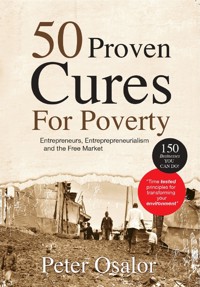
50 Proven Cures for Poverty
Be TransformedEntrepreneurs, Entrepreneurship, The Free Market System
Peter Osalor
Copyright©2012PeterOsalor
First published in Great Britain in 2012 by Peter Osalor All Rights Reserved.
No part of this book may be reprinted or utilised in any form or by any means, electronic ormechanical, including photocopying, recording, or by any information storage or retrievalsystem, withoutpermission in writing fromthe publisher.
Published by:
POSAG International Ltd 9 Greenwich QuayLondon
SE8 3EY
For comments or enquiries e-mail:
Designed & edited by: www.byjomedia.comProof-readby:www.byjomedia.comPrinted by: www.byjomedia.com
Contents
PREFACE
ENDORSEMENT
INTRODUCTION
CHAPTER ONE
"When you reach an obstacle, turn it into an opportunity.You have the choice. You can overcome and be a winner,or you can allow it to overcome you and be a loser. Thechoice is yours and yours alone. Refuse to throw in thetowel. Go that extra mile that failures refuse to travel. It is far better to be exhausted from success than to be restedfrom failure."
THIS CHAPTER COVERS:
WHAT IS POVERTY?
CAUSES OF POVERTY
WORLD STATISTICS ON POVERTY
THE POVERTY MENTALITY
REASONS WHY PEOPLE HAVE A POVERTY MENTALITY
CHARACTERISTICS OF A POOR PERSON
THE SPIRITUAL ASPECT OF POVERTY
CHAPTER TWO
"I have always found that my view of success has beeniconoclastic: success to me is not about money or statusor fame, it’s about finding a livelihood that brings me joy and self-sufficiency and a sense of contributing to theworld."
THIS CHAPTER COVERS:
DEFINING SUCCESS
Definitions of success
CHARACTERISTICS OF A RICH PERSON
1550THINGSRICH PEOPLE KNOW AND DO THAT POOR PEOPLE DON'T
CHAPTER THREE
“Hope is the dream of a waking man.”
THIS CHAPTER COVERS:
TRANSFORMATION MENTALITY
POVERTY AND PROSPERITY ARE A THING OF THE MIND
Action Exercises
LIFE IS IMPARTIAL
SUCCESS STORIES
CHAPTER FOUR
“The important thing is not being afraid to take a chance. Remember, the greatest failure is to not try. Once you find something you love todo, be the best at doing it.”
THIS CHAPTER COVERS:
50 PROVEN CURES FOR POVERTY
THE WAY OUT OF POVERTY AND THE KEYS TO WEALTH
CHAPTER FIVE
“The best reason to start an organisation is to makemeaning, to create a product or service to make the world a better place.”
THIS CHAPTER COVERS:
THE PANACEA IS ENTREPRENEURS,ENTREPRENEURSHIP AND THE FREE MARKET
THE ROLE OF GOVERNMENT ENTREPRENEURIALISM
HOW TO START A BUSINESS AND JOIN THE ENTREPRENEURIAL REVOLUTION
PITFALLS TO AVOID WHEN STARTING YOUR BUSINESS
CHAPTER SIX
“To any entrepreneur: if you want to do it, do it now. If you don’t, you’re going to regret it.”
THIS CHAPTER COVERS:
NATURAL RESOURCES AND WEALTH CREATION
Encouraging entrepreneurship in developing countries
CONCLUSION
Appendix 1:
Appendix 2:
Appendix 3:
Appendix 4:
Appendix 5:
PREFACE
My Life’s Journey and Motivation
Povertyisnotjustawordtome;itissomethingthatIhaveexperienced. I was born into a family of six in the mid-1950's inWarri, Delta State, Nigeria. We lived in a mud house where there was no electricity and it was difficult to access drinkable water. Poverty is a word that means many things depending on who you ask. It is aword that evokes the strongest opinions and the deepest emotions,especially amongst those that have experienced it or currently findthemselves living in a state of poverty. It is a word that holds manyunderlyingconnotationsandanarrayofstereotypicalimages.Poverty is not solely related to money, or a lack of it. Whilst povertyis a lack of finance, it is also the lack or absence of physiologicalneeds. Poverty is a sphere in which the power of choice is oftenremoved. Whilst poverty can be related to the tangible things we cansee, taste or experience it is also a state of mind. Hence why you canhaveabusinessmanwithlotsofmoneyyetheholdsan impoverished mindset. The poorest people in the world are not thosewithout money, nor are those without vision at the bottom of thepovertyheap.Moneycanbeacquired,withtheknow-how,andvision can be birthed. The poorest people in the world are those wholack, in any area of life (be it financial or otherwise) and hold apoverty mindset that continuously informs them that there is no wayout.
I started with very little in life. I went to work for Panalpina WorldTransportation Company in Kano, Nigeria, and was soon able to buya house for my mother and establish a hotel for her. Then I bought ataxi, started a taxi firm and began to buy more vehicles, however Iwanted to become a global entrepreneur, not merely a local one. I left for Britain in 1983, where I studied accountancy. While there, I tookexams to become an accountant and began to apply the knowledge Iacquired to various businesses. By 1991 I was a chartered accountant anda charteredtaxadvisor.Thisbookis not filledwithclichés noris itwrittenfromtheperspectiveofabusinessmanwhohasnever failed.As I was investing in my global education in Britain, my wife and I bought two shops in 1995 to further expand.We soon had tosell them in 1999 in order to fight bankruptcy and I found myselfstarting again. Failure is not the end, if you can make the decision tocontinue, your failures will always reveal a hidden strength. In 2000,we established East London ITEC an IT and accountancy traininginstitute.From 2001-3,I established branchesof Peter Osalor andCo. in Port Harcourt, Warri, Yenagoa, and Lagos.
We truly became a multinational global enterprise. Throughout myentirejourney,Ihavegainedextensiveexperienceinteaching,accounting,management,capacityandbusinessbuilding.Overtime, I began to notice the consistent, predictable patterns and principlesthat appear to accompany and govern all business and career success. The most important of these principles is having an entrepreneurialattitude and I ultimately believe that this entrepreneurial spirit is thesolution to poverty. Success is not partial, in fact success is akin to aballoon – as long as you fill it with air, itwill rise.
I intend to motivate people by making them realize that success is achoice they have to make and ANYBODY CAN BE SUCCESSFULif they choose to be and end the cycle of poverty. This book willdiscuss the differences that are so evident between the rich and thepoor. I will look at why the poor stay poor, why the rich get richerand the underlying parallel factors that are evidenced by those whoare able to transition from one state of wealth to another.
Throughout the duration of this book, I will refer to the poor and richdivide as ‘rich people’ and ‘poor people’. These titles are not used ina derogatory state or as a definition of class or hierarchy; they aremerelythere as subheadingsreferringtothe mindsets andassetsassociated with those that are wealthy and those that are not.
It is my desire that, as you read, your mind will be opened to thelimitlesspossibilitiesthatareoutthereintheworld.Wehavebeen taught for too long that there is one pie out there and as each business mogul takesa slice, less and less of the pieremains. That is andneverhasbeenthecase.Therearemanypiesoutthere,thinkofit this way: We each hold a pie and it is up to us as individuals howmuch of it we choose to take. Yes, poverty exists but it does not have to be evidenced through you! So read on and discover the keys onhow tocure povertyand ridit from your life.
Putting into practice my vision for entrepreneurial development inAfrica, Ihave establishedseveral initiatives:
•I have established Success in Your Business, a UKregistered charity working in partnership with the Federal Government of Nigeria, committed to eradicating povertyby empowering citizens with the right skills and throughthe development of an entrepreneurial spirit.
•I have an on-line TV program
•As part of my awareness creation strategy forentrepreneurship, I run a weekly TV program calledSuccess in Your Business on African IndependentTelevision, Abuja. A program formerly aired on Ben TV London, NTA Warri and Port-Harcourt.
•I am the CEO of Posag Consulting - a financialconsultancy and business advisory service provider with offices in Nigeria, the United States of America andEurope.
•I have a business blog site
•I am a regular columnist for the Vanguard Newspaper,commenting on the Nigerian economy and policy needs.
•I am a founding member of the African and Nigerian Entrepreneurs.com
•I am a regular and proactive author in enzinesarticles.com
Best Wishes.
ENDORSEMENT
The books – Youth Empowerment and Entrepreneurial Revolutionand Women Empowerment and Entrepreneurial Revolution by PeterOsalor – are indeed “the panacea for the youths and women who webelieve have the strength, potential as well as the ability to create achangeintheirenvironmentsthroughactiveinvolvementinentrepreneurship practices.” Peter Osalor, brought his experience and expertise to bear, as an Entrepreneurship Researcher, Educator andConsultant in the books, the books are practical guides towards being an entrepreneur. It is a clarion call for young men and women whowill change their generations from deadly the clutches of poverty and unemployment. The books envelope a bold, glossy and hand holdingeffort at stimulating the “I can do it” spirit in the Nigerian youth andwomen towards entrepreneurialism. That is the ability to make active positive use of their instincts, insights and perceptions to manipulateand manage them to propel them to being an entrepreneur – in spiteoftheobviousdangers.“Youdon'tmakeanomelettewithoutbreakinganegg”.Itisindeedthebarometertowardsbusinessownership andmanagement in a dynamicenvironment.
AstheDirector-GeneralofSmallandMediumEnterprisesDevelopmentAgencyofNigeria(SMEDAN),Ihavebeeninvolved inentrepreneurshipandenterprisedevelopmentinNigeria,I therefore,seethebooksas“ado-it-yourselfkit”thatshouldbewidely disseminated not only to youth and women, but to everybody. The book is largely an invitation to young men and women towards“beingtheirownboss”.ThebooksareintandemwiththetransformationagendaoftheMr.President,Dr.GoodluckEbele Jonathan, GCFR, which is geared towards employment generation,wealth creation, poverty reduction and general re-prioritisation andrefocusing onnational delivery.
The books reenergise the spirit of creativity and innovation whichdrive entrepreneurship. I would like nothing more than to see thesebooksbecomerequiredreadingtoallwhoareinterestedinowningand managinga business enterprise, as the books have all the toolsand techniques for managing a successful business enterprise. Thiswill provide the most natural and effective prescription against all the crises this country is witnessing today, be it militancy, boko haram,communal or religious.
Muhammad Nadada Umar Director-General/CEOSMEDAN
INTRODUCTION
All over the world one 'ailment' seems most prevalent. It appears tohavedefiedeveryremedyposedovercenturiesbymenofgreat minds and philosophies. This scourge has denied a huge chunk ofmankind the opportunity to thrive even in the midst of plenty. Forsome 'sufferers' it has deprived them of a chance at achievinggreatfeats in their lifetime neither has it allowed them the chance to take ashotattheirdreamsandgettingaheadinlife.This'scourge'mentioned above is noneother than poverty.
Povertyhassinglehandedlyheldbillionsofpeopleandevencountriesatransom.Despitetheincreaseinknowledgeinthisgeneration, theproblem of poverty seemsunwavering.
Fortunately, the cure for this plague has long been found. Scholarsand theorists have long pondered and proffered age long solutions tothis dilemma. These have all been capsulated and promptly delivered in this book. Age long solutions that have been handed down fromgeneration to generation.
From the ancient city of Babylon, to the worn-out desk of a highschooldropoutturnedbillionaire,wewillexaminetogether,thesecret to getting free from the clutches of the poverty disease.
CHAPTER ONE
"When you reach an obstacle, turn it into an opportunity.You have the choice. You can overcome and be a winner,or you can allow it to overcome you and be a loser. Thechoice is yours and yours alone. Refuse to throw in thetowel. Go that extra mile that failures refuse to travel. It is far better to be exhausted from success than to be restedfrom failure."
Mary Kay Ash, Founder of Mary Kay Cosmetics
THIS CHAPTER COVERS:
WHAT IS POVERTY?CAUSES OF POVERTY
WORLD STATISTICS ON POVERTY THE POVERTY MENTALITY
CHARACTERISTICS OF A POOR PERSON THE SPIRITUAL ASPECT OF POVERTY
WHAT IS POVERTY?
Poverty is synonymous with the following words; scarcity, shortage,insufficiency,scantinessandlack.Povertycanbedescribedaslackingsufficientmoneytomeetbasicphysicalneeds,alowstandard of living. The European Commission’sdefinition, adoptedin 1984, says: ‘the poor shall be taken to mean persons, Families andgroups of persons whose resources (material, Cultural and social) are so limited as to exclude them from the minimum acceptable way oflife in the member state in which they live.’
According to Wikipedia, poverty is defined as the lack of a certainamountofmaterialpossessionsormoney.Povertyhasbeenclassified into two major categories, Absolute poverty and Relativepoverty.
Absolute poverty or destitution is an inability to afford basic humanneeds, which commonly includes clean and fresh water, nutrition,health care, education, clothing and shelter. About 1.7 billion peopleare estimated to live in absolute poverty today.
Relativepovertyrefers tolackingausualor sociallyacceptablelevelofresourcesorincomeascomparedwithotherswithinasociety or country.
''A person is considered poor if his or her incomelevel falls below some minimum level necessary tomeetbasicneeds.Thisminimumlevelisusuallycalled the "poverty line". What is necessary to satisfy basicneedsvariesacrosstimeandsocieties.Therefore, poverty lines vary in time and place, andeach country uses lines which are appropriate to itslevel of development, societal norms and values."
- The World Bank Organisation
As much as there are various definitions of poverty, there are certaincircumstances that can portray the situations of poverty. Some ofthem are: