


37,99 €
Mehr erfahren.
- Herausgeber: John Wiley & Sons
- Kategorie: Geisteswissenschaft
- Sprache: Englisch
A BRONTË ENCYCLOPEDIA
“This lively, absorbing, meticulously researched compendium is a rich resource both for the general reader and for the specialist Brontë scholar. It contains much to enlighten and surprise even those who think they know the Brontës well.”
Heather Glen, University of Cambridge
“Aficionados of all things Brontë must have this encyclopedia on their desks. Even those with just a passing interest in Brontë or literary research can become trapped in this book for hours. Looking up one entry leads to looking up another, and then another. This book has references to the important and the arcane and the obscure, references to places the Brontës visited, people they knew; in short, everything.”
English Literature in Transition 1820–1920
A Brontë Encyclopedia is a complete guide to the life and work of the most notable literary family of the 19th century. Comprising approximately 2000 alphabetically arranged entries, this authoritative volume:
- Brings to light the significant people and places that influenced the Brontës’ lives
- Defines and describes the Brontës’ fictional characters and settings
- Incorporates original literary judgments and analyses of characters and motives
- Includes coverage of Charlotte’s unfinished novels and her and Branwell’s juvenile writings
- Features a full range of illustrations
A Brontë Encyclopedia is the most original and accessible work of its kind.
Sie lesen das E-Book in den Legimi-Apps auf:
Veröffentlichungsjahr: 2013
Ähnliche




















Contents
Illustrations
Abbreviations
Preface
Note on Spelling
Acknowledgments
A
B
C
D
E
F
G
H
I
J
K
L
M
N
O
P
Q
R
S
T
U
V
W
Y
Z
Bibliography
Supplemental Images
This paperback edition first published 2013 © 2013 Blackwell Publishing Ltd
Edition history: Blackwell Publishing Ltd (hardback, 2007)
Registered Office
John Wiley & Sons Ltd, The Atrium, Southern Gate, Chichester, West Sussex, PO19 8SQ, UK
Editorial Offices
350 Main Street, Malden, MA 02148-5020, USA
9600 Garsington Road, Oxford, OX4 2DQ, UK
The Atrium, Southern Gate, Chichester, West Sussex, PO19 8SQ, UK
For details of our global editorial offices, for customer services, and for information about how to apply for permission to reuse the copyright material in this book please see our website at www.wiley.com/wiley-blackwell.
The right of Robert Barnard and Louise Barnard to be identified as the authors of this work has been asserted in accordance with the UK Copyright, Designs and Patents Act 1988.
All rights reserved. No part of this publication may be reproduced, stored in a retrieval system, or transmitted, in any form or by any means, electronic, mechanical, photocopying, recording or otherwise, except as permitted by the UK Copyright, Designs and Patents Act 1988, without the prior permission of the publisher.
Wiley also publishes its books in a variety of electronic formats. Some content that appears in print may not be available in electronic books.
Designations used by companies to distinguish their products are often claimed as trademarks.
All brand names and product names used in this book are trade names, service marks, trademarks or registered trademarks of their respective owners. The publisher is not associated with any product or vendor mentioned in this book.
Limit of Liability/Disclaimer of Warranty: While the publisher and author(s) have used their best efforts in preparing this book, they make no representations or warranties with respect to the accuracy or completeness of the contents of this book and specifically disclaim any implied warranties of merchantability or fitness for a particular purpose. It is sold on the understanding that the publisher is not engaged in rendering professional services and neither the publisher nor the author shall be liable for damages arising herefrom. If professional advice or other expert assistance is required, the services of a competent professional should be sought.
Library of Congress Cataloging-in-Publication Data
Barnard, Robert.
A Brontë encyclopedia / Robert Barnard and Louise Barnard. p. cm.
Includes bibliographical references.
ISBN 978-1-4051-5119-1 (cloth) – ISBN 978-1-118-49206-2 (pbk.)
1. Brontë family—Encyclopedias. 2. Women and literature—England—History—19th century—Encyclopedias. 3. Novelists, English—19th century—Biography—Encyclopedias. 4. Yorkshire (England)—Intellectual life—Encyclopedias. 5. Women novelists, English—Biography—Encyclopedias. 6. Yorkshire (England)—In literature—Encyclopedias. 7. English fiction—Women authors—Encyclopedias. 8. English fiction—19th century—Encyclopedias.
I. Barnard, Louise II. Title.
PR4167.A3B76 2007
823′.809—dc22
2006036993
A catalogue record for this book is available from the British Library.
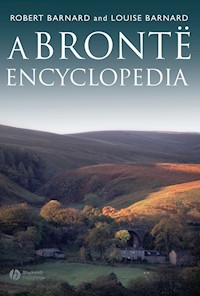
Cover image: Farmhouse near Haworth, West Yorkshire; photo © Patrick Ward/CORBIS Cover design by www.simonlevyassociates.co.uk
1 2013
Illustrations
Plates 1–35 fall between pp. 96–7
Plates 36–50 fall between pp. 288–9
Color plates – plates fall between pp. 192–3
Abbreviations
AB
Anne Brontë
ABN
Arthur Bell Nicholls
AOTB
Alexander & Sellers:
The Art of the Brontës
BB
Patrick Branwell Brontë
BE
Belgian Essays,
ed. and trans. by Sue Lonoff
BPM
Brontë Parsonage Museum
BS
Brontë Studies
BST
Brontë Society Transactions
BYMM
Blackwood’s Young Men’s Magazine
CB
Charlotte Brontë
CBL
The Letters of Charlotte Brontë
, ed. by Margaret Smith
EC
The Poems of Anne Brontë,
ed. by Edward Chitham
ECG
Elizabeth Cleghorn Gaskell
EJB
Emily Jane Brontë
EN
Ellen Nussey
EW
Early Writings of Charlotte Brontë
, ed. by Christine Alexander
FN
Charlotte Brontë:
Five Novelettes,
ed. by Winifred Gerin
GS
George Smith
HN
Henry Nussey
IWBB
Du Maurier:
The Infernal World of Branwell Brontë
LPB
Letters of Patrick Brontë
, ed. by Dudley Green
MT
Mary Taylor
MW
Margaret Wooler
PB
Patrick Brontë
PCB
Poems of Charlotte Brontë
, ed. by Tom Winnifrith
WPBB
The Works of Patrick Branwell Brontë
, ed. by Victor A. Neufeldt
W & S
The Brontës: Their Lives, Friendships and Correspondence
, ed. by Thomas J. Wise & John A. Symington
WSW
William Smith Williams
Preface
This encyclopedia of the Brontës concerns itself with the family, their writings, and their lives. It tries to cover their own characters and experiences; the people they met, corresponded with, or were influenced by; the places they went to; and their works from the juvenile and adolescent sagas to the finished fiction and poetry. We took therefore, when conceiving it, the period between the dates 1777 (the birth of Patrick) and 1861 (his death) as our chosen focus of interest, though inevitably there is the occasional peek backward or forward.
This means that we have not dealt with ups and downs in the fortunes of the Brontës’ writings after their deaths; the critical fashions which have promoted or demoted their literary status; the checkered fortunes of their manuscripts; the dramatic, musical, or film and television versions of their novels and even of their lives, and so on. These posthumous developments tell us more about the ages in which they occurred and the people that were involved in them than they do about the Brontës themselves, and their inclusion could only be justified if they were given a full social context – something out of the question in a work of comparatively modest size. It may well be, too, that early exposure to a television adaptation of WutheringHeights, with Yvonne Mitchell doing her mature best as Catherine, and Richard Todd hilarious as Heathcliff, put me off adaptations for life.
We early on took the decision that the early writings could not be allowed to overbalance the book. We include summaries of all the novels, and brief or extensive entries on virtually all the characters, but that breadth of treatment could not be given to the tales and characters in the early works. The progress of the sagas, with treatment of the most important stories, is therefore mainly covered in the entry called for convenience “Juvenilia” and about 20 characters are given an entry to themselves. Fascinating though this writing is, and quite as extensive as the mature novels, we believe that the average reader will be mainly interested in the novels that the Brontës’ reputation has been built on, and that can be read by an adult reader without the need to make allowances.
The last 20 years have seen “an abundant shower” of works of Brontë scholarship, and unlike the shower of curates in Shirley it has been scholarly, responsible, and wonderfully useful. Among many works I would name Juliet Barker’s authoritative and (almost a first among biographies of the Brontës) scholarly life of the whole family, Christine Alexander’s edition of Charlotte’s early writings (1829–35), Victor Neufeldt’s edition of Branwell’s complete writings, Alexander and Sellars’ The Art of the Brontës, Sue Lonoff’s masterly edition of Charlotte and Emily’s Brussels essays, Dudley Green’s edition of Patrick’s letters, and perhaps above all Margaret Smith’s wonderful and nourishing edition of Charlotte’s letters. Works such as these have undone the malign activities of Thomas J. Wise, the forger and literary con man, and his aide Clement Shorter. They have also made the writing of a book such as this immeasurably easier and more pleasant. We can only breathe fervent praise and thanks.
We are indebted to many people: three generations of curators and one of librarians (Ann Dinsdale, a constant help) at the Brontë Parsonage Museum, with special thanks to Linda Proctor-Mackley for help with the pictures; librarians and curatorial staff at the Bankside Museum in Halifax, the Keighley Public Library, the Brotherton Library at Leeds University, and the private Leeds Library, where one can still read the local papers of the first half of the nineteenth century in their original form, the National Portrait Gallery, and the Theatre Museum in (or once in) Covent Garden. Many individuals have been a great help and inspiration, including Dudley Green, Sarah Fermi, Ian and Catherine Emberson, Robin Greenwood, Steven Woods, and the late Chris Sumner. Our debts to Jenny Roberts, for pointing out errors, omissions, inconsistencies are legion. We are particularly indebted to Brian Wilks and to the Lambeth Palace Library for permission to quote from the recently discovered letter Patrick wrote to Bishop Longley shortly after Charlotte’s death.
One of the strangest things about the Brontës (a reclusive family, apart from Branwell) is that objects associated with them keep appearing and new connections continue to be made. For example, in the last 30 years three new pictures of the Brontë women have surfaced, as well as an early photograph of the “Gun Group,” which was later destroyed by Mr Nicholls, all but the portrait of Emily. After The Art of the Brontës was published many new pictures by them came to light. As I write, a hitherto unknown letter by Charlotte to W. S. Williams is coming up for sale at auction. All these discoveries feed the public interest in the family and their writings, and it has been a great joy during our years of connection with the Brontë Society to keep up with them and now to use some of them in this encyclopedia. We often wonder how many items of Brontëana remain hidden (deliberately or inadvertently) in Haworth.
The division of labor for this work has been as follows: Louise Barnard has trawled through years of local newspapers, particularly the Leeds ones, for items of interest about the Brontës and people known to them; she has kept an immense computer record of everything of interest about anyone whose life, however tangentially, touched the Brontës, and this record will be lodged in the Parsonage Library, where we hope it will be of use to scholars, genealogists, local historians, and so on. Robert Barnard is responsible for choosing which heads in her record would have an entry in the encyclopedia, and for writing all but one of those entries. We can therefore accept joint responsibility for any errors that have inevitably crept in.
Robert BarnardLouise Barnard
Note on Spelling
We have avoided the insertion of “[sic]” in quotations from the original nineteenth-century sources, particularly Charlotte Brontë’s letters. The reader can assume that spellings and punctuation that appear to be incorrect are reproduced as in the original manuscripts.
As Blackwell publications are marketed worldwide American spelling conventions have been followed.
Acknowledgments
The authors are grateful to the directors and staff at the following institutions for permission to use images in their collections:
The National Portrait Gallery, London for plates 16, 19, 34, 39 and colour plate 5.
The Brotherton Library, Leeds University for plates 25 and 28.
The Victoria and Albert Museum (Theatre Museum Collection) for plate 32.
Keighley Public Library for plate 21.
The Bankfield Museum, Calderdale MBC – Museums and Arts for colour plate 6.
The authors are also grateful to the following owners for permission to use material in their possession: Lord Shuttleworth for plate 20; Simon Warner, for colour plates 9 and 10; Monsieur Pechere for colour plate 7.
All other plates are from the Brontë Parsonage Museum, and our grateful thanks are due to the museum director for permission, and to the library staff, who were endlessly helpful.
A
A—: the “fashionable watering place” where the Greys set up their school in Agnes Grey. Anne mentions “the semi-circular barrier of craggy cliffs surmounted by green swelling hills” (ch. 24), and the town is almost certainly based on Scarborough.
A—: the river on which Millcote stands in Jane Eyre (v. 1, ch. 10). Millcote is probably Leeds, and A– therefore the river Aire, which may also have suggested Jane’s surname.
A—, Monsieur: French academician before whom Ginevra Fanshawe displays her vanity and empty-headedness in Villette, pointing a contrast with Paulina de Bassompierre (see chs. 26 & 27).
Abbey, The: one of the Lady’s Magazine novels that Charlotte ironically suggested she might have emulated if she had been writing 30 or 40 years earlier (to Hartley Coleridge, 10 Dec 1840). Margaret Smith tentatively identifies this as Grasville Abbey by G. M. (George Moore), published in the magazine in the 1790s.
Abbott, Joseph, Rev. (1789–1863): a man who knew Maria Branwell shortly before her marriage. He wrote to Charlotte in 1851 about Luddite activity in the Leeds area in 1812, and how frightened Maria was by his story of an encounter with a band of Luddites (Barker, 1994, pp. 53, 666). By then he was Registrar of McGill College in Montreal. He had heard the later story of the Brontë family from the loquacious Dr. Scoresby, and had been particularly delighted to read Shirley, covering as it did events in which he had played a small part.
See also Scoresby, Rev. William
Abbot, Martha: Mrs Reed’s personal maid in Jane Eyre. A bitter, censorious self-server who dislikes Jane, though she is sharp enough to notice that she “always looked as if she were watching everybody” (v. 1 ch. 3).
Abbotsford: the home of Sir Walter Scott, near the town and abbey of Melrose, in the Borders area of southern Scotland. He bought the farmhouse in 1811, and greatly expanded it in a romantic baronial style. It was here that most of his major fiction was written. Charlotte visited the house during her brief Scottish holiday in July 1850. “[A]s to Melrose and Abbotsford the very names possess music and magic,” she wrote to Laetitia Wheelwright (30 July 1850).
See also Melrose; Scott, Sir Walter
Abercromby, General Sir Ralph (1734–1801): Scottish soldier and MP. Served in Holland, the West Indies, and Ireland. In 1801 he was given command of the expedition to the Mediterranean. He led a successful expedition to effect a landing at Aboukir Bay (near Alexandria), but was mortally wounded there. Charlotte used his valor and death in her Brussels devoir “La Prière du Soir dans un camp”
Adelaide: one of the parsonage geese, named after the Queen Consort of William IV, and mentioned in Emily’s diary paper of 30 July 1841. In the next diary paper (30 July 1845) she records that the geese were “given away,” presumably during her stay in Brussels.
Adrianopolis: the capital of Zamorna’s newly bestowed kingdom of Angria, the building of which is described in sections of the juvenilia mainly dated 1834. The splendid (perhaps oversplendid) city attracts the new and would-be rich, and its combination of opulence and vulgarity is perhaps an image of its creator, Zamorna himself.
See also Juvenilia, 3. The rise of Angria
Adrienne Lecouvreur: play by Ernest Legouvé and Eugene Scribe which Charlotte saw in London (7 June 1851), with Rachel in the title role: “her acting was something apart from any other acting it has come in my way to witness – her soul was in it – and a strange soul she has” Charlotte wrote to Amelia Taylor (11 June 1851). Scribe’s play was at the time only three years old. Scribe is best remembered today as the creator of the “well-made play” – beautifully carpentered, but essentially trivial dramas for a fashionable audience. He also wrote many opera libretti, but Cilea’s opera on the subject dates from much later (1902).
See also Rachel; Vashti
“Advantages of Poverty in Religious Concerns, The”: essay by Maria Branwell, the mother of the Brontës, and the only non-personal writing we have from her. It is well-meaning but clichéd in thought and expression. It attempts to prove that “a wretched extremity of poverty is seldom experienced in this land of general benevolence,” and if it is, “the sufferers bring it on themselves.” The arguments paraded are familiar ones, though when she talks of “the pride and prejudices of learning and philosophy” one feels that Patrick would have seen a less Austenish and more positive side to mental and moral education. The essay was probably written during her married life for possible insertion in the Christian magazines, to which Patrick also contributed. No contemporary published version has been found.
Aeschylus: Greek dramatist mentioned in Charlotte’s early writings (e.g., “The Foundling”). Some fragmentary notes by Emily on his plays are in the Walpole Collection at The King’s School, Canterbury.
Aesop: Greek writer of fables of the sixth century bc. Referred to in The Professor and in various letters from Charlotte to Ellen Nussey. One of the Brontës’ earliest games, the play “Our Fellows,” was directly inspired by him: “The people we took out of Aesops Fables” wrote Charlotte. (“The origin of the O’Deans,” EW, v. 1, p. 6).
Agnes (no surname given): cantankerous old servant of Mme Walravens in Villette. She was formerly the servant of M. Paul’s father and his family, and is when we meet her the recipient of his charity.
Agnes Grey (1847): possibly the work entitled Passages in the Life of an Individual which Anne’s Diary Paper of July 1845 records herself as being engaged with. It is the archetypal “governess” novel as Jane Eyre is not, because it focuses mainly on the experience of teaching within a family unit. In its broad sweep the plan of the novel follows Anne’s own experience: cosseted girlhood, followed by a short first situation, which provides her with a sharp shock, and then a second, much longer, one, in which her ideals and her moral standards are subjected to a slow disillusionment, and can be preserved only by strong personal tenacity.
Lesen Sie weiter in der vollständigen Ausgabe!
Lesen Sie weiter in der vollständigen Ausgabe!
Lesen Sie weiter in der vollständigen Ausgabe!
Lesen Sie weiter in der vollständigen Ausgabe!
Lesen Sie weiter in der vollständigen Ausgabe!
Lesen Sie weiter in der vollständigen Ausgabe!
Lesen Sie weiter in der vollständigen Ausgabe!
Lesen Sie weiter in der vollständigen Ausgabe!
Lesen Sie weiter in der vollständigen Ausgabe!
Lesen Sie weiter in der vollständigen Ausgabe!
Lesen Sie weiter in der vollständigen Ausgabe!
Lesen Sie weiter in der vollständigen Ausgabe!
Lesen Sie weiter in der vollständigen Ausgabe!
Lesen Sie weiter in der vollständigen Ausgabe!
Lesen Sie weiter in der vollständigen Ausgabe!
Lesen Sie weiter in der vollständigen Ausgabe!
Lesen Sie weiter in der vollständigen Ausgabe!
Lesen Sie weiter in der vollständigen Ausgabe!
Lesen Sie weiter in der vollständigen Ausgabe!
Lesen Sie weiter in der vollständigen Ausgabe!
Lesen Sie weiter in der vollständigen Ausgabe!
Lesen Sie weiter in der vollständigen Ausgabe!
Lesen Sie weiter in der vollständigen Ausgabe!
Lesen Sie weiter in der vollständigen Ausgabe!
Lesen Sie weiter in der vollständigen Ausgabe!
Lesen Sie weiter in der vollständigen Ausgabe!
Lesen Sie weiter in der vollständigen Ausgabe!
Lesen Sie weiter in der vollständigen Ausgabe!




