


9,99 €
Mehr erfahren.
- Herausgeber: Atlantic Books
- Kategorie: Geisteswissenschaft
- Sprache: Englisch
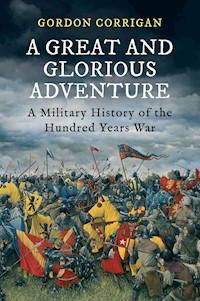
The Hundred Years War was fought between 1337 and 1453 over English claims to both the throne of France by right of inheritance and large parts of the country that had been at one time Norman or, later, English. The fighting ebbed and flowed, but despite their superior tactics and great victories at Crecy, Poitiers and Agincourt, the English could never hope to secure their claims in perpetuity: France was wealthier and far more populous, and while the English won the battles, they could not hope to hold forever the lands they conquered. The real and abiding significance of the war lies in the fact that, at its end, the English had become English, as opposed to Anglo-French, and France too had set out on the road to nationhood. (Both countries would subsequently become the very best of enemies.) The war also sparked a real revolution in the English way of waging war, with increasing professionalism and the use of technology to make up for lack of numbers - factors which remain relevant throughout the subsequent history of the English, and then the British, army and which are still critical to it today. Military historian Gordon Corrigan's new history of these epochal events is brisk, combative and refreshingly straightforward, and the great kings, men and battles of the period receive the full attention and reassessment they deserve.
Das E-Book können Sie in Legimi-Apps oder einer beliebigen App lesen, die das folgende Format unterstützen:
Veröffentlichungsjahr: 2013
Ähnliche


















A GREAT AND GLORIOUS ADVENTURE
Also by Gordon Corrigan
The Second World War
Blood, Sweat and Arrogance
Loos – The Unwanted Battle
Mud, Blood and Poppycock
Wellington – A Military Life
Sepoys in the Trenches
Published in Great Britain in 2013 by Atlantic Books, an imprint of Atlantic Books Ltd.
Copyright © Gordon Corrigan, 2013
The moral right of Gordon Corrigan to be identified as the author of this work has been asserted by him in accordance with the Copyright, Designs and Patents Act of 1988.
All rights reserved. No part of this publication may be reproduced, stored in a retrieval system, or transmitted in any form or by any means, electronic, mechanical, photocopying, recording, or otherwise, without the prior permission of both the copyright owner and the above publisher of this book.
Every effort has been made to trace or contact all copyright holders. The publishers will be pleased to make good any omissions or rectify any mistakes brought to their attention at the earliest opportunity.
10 9 8 7 6 5 4 3 2 1
A CIP catalogue record for this book is available from the British Library.
Hardback ISBN: 978-1-84887-926-3 Ebook ISBN: 978-1-78239-026-8 Paperback ISBN: 978-1-84887-927-0
Printed in Great Britain.
Atlantic Books An Imprint of Atlantic Books Ltd Ormond House 26–27 Boswell Street London WC1N 3JZ
www.atlantic-books.co.uk
CONTENTS
LIST OF ILLUSTRATIONS
LIST OF MAPS
INTRODUCTION
1 WHERE IT ALL BEGAN
2 STATING THE CLAIM
3 FROM OBLIGATION TO PROFESSION
4 CRÉCY
5 TRIUMPH AND DISASTER – CALAIS AND THE BLACK DEATH
6 THE CAPTURE OF A KING
7 THE FRENCH REVIVAL
8 REVOLTS AND RETRIBUTION
9 ONCE MORE UNTO THE BREACH...
10 THE PRIDE AND THE FALL
EPILOGUE
NOTES
SELECT BIBLIOGRAPHY
NOTE ON THE AUTHOR
ACKNOWLEDGEMENTS
INDEX
ILLUSTRATIONS
The Royal Coat of Arms (Public domain)
Battle of Sluys, 24 June 1340, from Froissart’s Chronicle (© Illustrated London News Ltd/Mary Evans Picture Library)
Sir Thomas Cawne (© Imogen Corrigan)
Battle of Crécy, 24 August 1346, from Froissart’s Chronicle (© Mary Evans Picture Library)
‘Blind’ King John of Bohemia (© Imogen Corrigan)
Edward the Black Prince (© Dean and Chapter of Canterbury Cathedral)
Sir John Hawkwood by Paolo Uccello (© Alinari Archive/Corbis)
Henry IV (© Imogen Corrigan)
Henry V by unknown artist, late 16th or early 17th century (© National Portrait Gallery, London)
Bertrand du Guesclin (© Imogen Corrigan)
MAPS
Great Britain in the Hundred Years War
France in the Hundred Years War
Area of Operations: Flanders, 1337–40
Area of Operations: The Crécy Campaign, 1346
The Battle of Crécy, 23 August 1346
Area of Operations: The Black Prince’s Chevauchée, 1355
Area of Operations: The Poitiers Campaign, 1356
The Battle of Poitiers, 19 September 1356
Brittany in the Hundred Years War
Area of Operations: The Black Prince’s Spanish Campaign, 1367
Area of Operations: The Azincourt Campaign, 1415
The Battle of Azincourt, 25 October 1415
Area of Operations: 1416–52, Map 1
Area of Operations: 1416–52, Map 2
Area of Operations: 1416–52, Map 3
INTRODUCTION
In 1801, George III, by the Grace of God king of Great Britain, France and Ireland, dropped the English claim to the throne of France. For 460 years, since the time of the great king Edward III, all nineteen of German George’s predecessors had borne the fleur-de-lys of France on the royal coat of arms along with the lions (or leopards1) of England and latterly the lion of Scotland and the Irish harp. The withdrawal of the claim, which had been prosecuted with varying degrees of enthusiasm, was purely pragmatic: France and England had been at war since 1793, and, if England opposed the French Republic and supported a restoration of the Bourbon monarchy, then she could not also claim the throne for herself. A year later, in the Treaty of Amiens, which ushered in a short break in the war with France, England recognized the French Republic, and in so doing negated her own claims. It was the end, at least in theory, of England’s, and then Britain’s, claim to be a European power by right of inheritance.
It was not, of course, the end of Anglo-French rivalry. For two great powers occupying opposite sides of a narrow sea, both looking outwards, both concerned with trade and trade routes, and both with imperial ambitions will inevitably clash. And if in the twenty-first century that rivalry is concerned more with the interpretation of regulations emanating from the European Union rather than the ownership of sugar islands, and if the weapons are words rather than swords and gunpowder, the inescapable fact is that on average England and then Britain has spent one year in every five since the Norman Conquest at war with France. One can, of course, twist statistics to suit one’s purpose, but the alliances with France in both the Crimean War and the First World War, pre-Vichy France’s brief participation in the Second World War, de Gaulle’s Free French activities, and more recent French participation in NATO operations are very much the exception, and many old soldiers cannot forget that the armed forces of Vichy France fought British troops in the Middle East, Madagascar and North Africa between 1940 and 1943. The relationship between the Common Agricultural Policy and Crécy is not as distant as might appear, and some of the effects of that centuries-old enmity are with us still: when president of France, General Charles de Gaulle had a standing order that while travelling around the country he was never to be within thirty kilometres of Agincourt.
While the English claim to the French throne was the major cause of what came to be called the Hundred Years War, there were other factors too: the sovereignty of parts of France that had become English by inheritance, the annoying habit of the Scots to ally themselves with France, and English mercantile activities and ambitions in Flanders. It was not, of course, a sustained period of fighting, nor was it called the Hundred Years War at the time or for many years afterwards. Rather, it was a series of campaigns punctuated by truces, some of them lasting many years. And if we take the beginning of the war as Edward III’s claim to the French throne in 1337, and its end as the withdrawal of all English troops from Europe except for Calais in 1453, then it lasted for rather more than a hundred years. No one who stood on the docks at Orwell and cheered as the soldiers of the first English expeditionary force of the war sailed for France under Edward III was alive to welcome the men returning from the last campaign, and anyone living at the end of the war who could remember the great battle of Agincourt would have been well into middle age. The period might more accurately be described as the series of events which transformed the English from being Anglo-French into pure Anglo. But in as much as the causes of the war and the English war aims remained more or less constant, even if alliances did not, it is reasonable – and convenient – to consider the series of struggles as one war.
It was a good time to be a soldier. If a billet under Edward III or Henry V or commanders such as Bedford or Talbot was not available because of yet another truce, then there were always the Wars of the Breton Succession, where experienced soldiers could be sure of employment. And if a warmer or more exotic clime was an attraction, then the armies of John of Gaunt and the Black Prince campaigning in Spain were always looking for good men. It was not, however, a good time to be a civilian, or at least a civilian in what is now northern France. Ever-increasing taxation to pay for the war; conscription into the armies; marauding soldiery trampling over crops; looting and plundering; atrocities by both sides; the deflowering of daughters and the commandeering of food and wine: all combined to ensure that the lot of the European commoner was not a happy one. No sooner had the rural population recovered from one period of hostilities than the whole dreadful cycle would be repeated all over again. Disease stalked medieval armies, and, if dysentery or typhus spread by the movement of troops did not bring down the hapless peasant, then a visit from the plague probably would.
The Hundred Years War was hugely significant in the political and military development of Europe, of Britain and of France. Politically, it implanted the notion of a French national identity that replaced more local loyalties – and in this sense one could argue that, for all the destruction and devastation, France came out of the war in a far better state than she entered it. The war reinforced English identity and implanted a dislike and suspicion of foreigners that have not yet entirely gone from our national psyche. Militarily, it saw a real revolution in the way of waging war, initially in England and then, belatedly and partially, in France. In England came the growth of military professionalism, with the beginnings of all the consequences that flow from having a professional – and thus expensive – army; the rejection of war as a form of knightly combat in favour of deploying trained foot-soldiers supported by a missile weapon; and the beginnings of military law and a command structure that depended more on ability than on noble birth.
To most of us, the war means three great battles – Crécy, Poitiers and Agincourt – and some of the finest prose in the English language, put into the mouth of Henry V by Shakespeare. And while Henry may not actually have said, ‘Once more unto the breach, dear friends...’ he will have said something, like any commander on the eve of battle, and his 1415 campaign is a study in leadership that is still relevant today. But the war was far more than three battles, and in the latter stages the English were pushed back and eventually, with the exception of Calais, abandoned Europe altogether. While the withdrawal of English troops by 1453 was as much to do with a shortage of money and political instability at home as it was with military factors, winning battles without the numbers to hold the ground thus captured could not guarantee success, and this too is a lesson as relevant now as it was then.
In this book I have tried to stick to what I know best and to look at the war from the military perspective. But no subclass of history can stand alone – social, political, economic and military history all impinge upon each other – and it is impossible to comprehend why things happened, as opposed to what happened, without understanding the way people lived at the time: their ambitions, their lifestyles and their beliefs, and the motivating factors of religion on the one hand and acquisitive greed on the other. While some medieval kings might have planned for the long term, the vast bulk of their subjects could think only of the immediate future, at least in this world: for the farmer was but one visitation of murrain from ruination, the magnate or pauper one flea jump from the Black Death.
Historians must, of course, present both sides of the argument, but they do not have to be neutral. I hope that I have treated the facts, as far as they can be determined with accuracy, as sacred, but I cannot hide my conviction that England’s demands on France were lawful and justified, and, even where they were not, I feel pride in the achievements of Edward III, the Black Prince and Henry V. For all the cruelty and bloodthirstiness exhibited by many English soldiers of the time, I would far rather have marched with Henry V, Calveley, Knollys, Dagworth et al than with Bertrand du Guesclin, the best-known French commander, or Joan of Arc.
Sources for the period exist in great number, but not all are reliable, often being after-the-event propaganda, an exercise in post hoc ergo propter hoc logic (or lack of it) or, particularly in tapestry and painting, fanciful flights of the imagination. Battle paintings are many, some painted not long after the event, but they are sanitized and stylized, not the trampled and horse manure-covered fields of blood, gore, agony, sweat and death of unwashed, unhealthy men that a medieval battlefield must have been. Instead, we see nice neat lines of opposing soldiers, armour all brightly polished, everyone shaved, horses beautifully groomed, and always the sun shining against an impossibly blue sky. It cannot have been like that.
Whatever their limitations, original sources have to be considered, partly because their authors were there or talked to people who were there, so at least some of what they describe will have a grain, or more, of truth in it, and partly because, even if not historically accurate, they at least reflect what some people thought at the time. Jean Froissart is generally accepted as being one of the best contemporary sources for the early part of the war. A contemporary of Chaucer, Froissart was born in Valenciennes and was a minor official in the court of Edward III’s queen and also in that of Richard II. He was born around 1337, so his account of the preparations for and conduct of the Crécy campaign can only have been hearsay, but for all that he did approach the happenings of his time in a manner that would stand up to at least a cursory assessment of his methodology today. He had an inside seat for much of what he describes, he interviewed people who were present where he was absent, he contrasted differing reports, and he gives due credit to other chroniclers from whose work he has borrowed. That said, there is a discernible French bias in his later writings which has to be balanced against the equally biased work of some English authors. There are numerous other reporters whose works have survived – the Paston letters are particularly valuable as a social comment on the time, albeit written rather later. The chronicles of Le Bel, Lanercost, Le Baker, Brut, Meaux, Knighton, Walsingham, Chandos and the anonymous author of the Gesta Henrici Quinti have also all been helpful, albeit that they are often very broad-brush indeed.
My own modern French is passable, and Norman French, the language of the English court for much of the period, is not that different. As my school Latin lessons were spent in the surreptitious study of racing form books and doodling on the corners of Kennedy’s Latin Primer, my understanding of that tongue, the diplomatic and ecclesiastical language of the time, is rudimentary, but I had assured myself that, armed with a decent dictionary, I could cope. That pious hope was shattered when I discovered that Medieval Latin uses many abbreviations not taught to English schoolboys, but fortunately modern translations exist.
Indeed, one of the major changes that took place in England over the period was linguistic: the shift from Norman French for the rulers and Old (moving to Middle) English for the ruled, to the use of English by all. Edward III learned English as part of his education, and it was in his reign, in 1362, that the official language of the courts became English rather than Norman French. The generation of his grandsons, Richard II and Henry IV, was probably the first to use English equally with French, and, by the time Henry V came to the throne, he wrote and spoke in English by preference, as did the English nobility – a change prompted by nationalism as much as by convenience.
English itself evolved over time. The English of the middle or late 1200s would be difficult to the modern ear, as one can see from these lines, written around 1250 by Saint Godric:
Sainte Marye Virgine
Moder Jesu Christes Nazarene
Onfo, schild, help thin Godric,
Onfang, bring heyilich with thee in Godes Riche.
The reference to St Mary the Virgin, mother of Jesus Christ the Nazarene, is straightforward enough, after which we would be stumped. ‘Onfo’ means ‘receive’, ‘schild’ is ‘defend’ (modern ‘shield’), ‘thin’ is ‘your’ (‘thine’), hence the second line reads, ‘Receive, defend and help your Godric’. In the last line, ‘onfang’ is the past participle of ‘onfo’, thus ‘having received’; ‘heyilich’ means ‘on high’; and ‘Riche’ means ‘kingdom’ (as in the German Reich), so the line reads: ‘Having received, bring (him) on high with you in God’s kingdom’.
Compare this with a similar verse written a hundred years later by Richard Rolle, concerning the holy sacrament:
Jesu, Lord, welcome thou be
In form of bred as I thee see
Jesu for thine holy name
Shild me today from sinne and shame.
Apart from the spelling, we would have little difficulty, and by the end of the war, around 1450, John Lydgate in a prayer to Mary says:
Blessed Mary moder virginal
Integrate maiden, sterre of the see
Have remembraunce at the day final
On thy poore servaunt now praying to thee.1
By this time, Chaucer’s English was spoken by all Englishmen, and, while the accent would seem strange and we in the twenty-first century would have to listen carefully, we would understand most of what was said, even if the emphases, the intonation, the stresses, the slang and the nuances would be quite different. The spelling is of course quaint and not consistent, even in the same document, but I have found that if Middle English is read quickly, without reference to the spelling, it is relatively easily understood. The original sources for the war are therefore a mix of Norman French, French French, Latin and Middle English. Most have, of course, been translated into modern English by eminent scholars, to whom I am grateful.
If the primary sources cannot be relied upon in their entirety, particularly when it comes to the minutiae of a particular battle, then other methods must be employed. The great Colonel Alfred Burne’s Theory of Inherent Military Probability may seem a little simplistic, stating as it does that, when the student of warfare has no idea what actually happened, he should put himself in the shoes of the commander at the time and decide what he would have done. In fact, an understanding of the assets available (equipment, weapon ranges, accepted tactics, methods of supply), allied to a thorough examination of the ground, can very often provide a good insight into how a particular engagement probably developed. Vital ground – that is, ground that must be taken by the attacker to achieve his aim, and ground that must be held by the defender to achieve his – is vital ground in any era, and, while marshes are drained, rivers change their courses and roads get built, the contours of the land generally do not change very much. Medieval man’s brain was the same size as ours. He was just as intelligent, or unintelligent, as we are, and just as capable of producing a sound military appreciation. The Black Prince would not have been out of place in Wellington’s army; John of Gaunt would have been just as capable (or incapable) of dealing with the wily Pathan (or Taliban) as he was with the obdurate Spaniard; Henry V could size up a situation just as well and probably as quickly as Bill Slim, Britain’s best general of the Second World War; and Sir John Hawkwood would doubtless have made as short work of the Irish as he did of squabbling Italians. There are no new military problems: only the means to tackle them have changed.
I have used New Style dating throughout, the conversion to which can be confusing. Until 1582, England and most of Europe used the Julian calendar – the Old Style – until Pope Gregory XIII introduced the far more accurate Gregorian version – the New Style – which was Julian plus eleven days. This was duly adopted in Europe, but, as Elizabeth I’s England had no intention of kow-towing to some foreigner in the Vatican, she stayed on the Julian calendar until 1752. It gets more complicated. Under both Old and New Styles the year started on Lady Day, 25 March, and did not switch to 1 January until 1752 – except in Scotland, which also retained the Julian calendar until 1752 but had switched New Year’s Day to January in 1600, just to be awkward. A difference of eleven days might not matter very much, but the date on which the year begins does, and, whereas we might describe an event as happening on 20 March 1377, people who recorded it at the time or before 1752 would date the same event as happening on 9 March 1376.
It is almost impossible to translate medieval prices into their modern-day equivalent, if only because things that were expensive then are not necessarily so now, and vice versa, and occupations that today would attract a living wage (like commander of an army) might then only receive an allowance towards expenses. Even comparing like with as near as possible like does not help very much. The medieval English pound sterling was divided into twenty shillings, each shilling into twelve pennies, a system expressed in writing as £sd; this lasted until decimalization in 1971, when the same pound became 100 (new) pence, so the old shilling equated to five new pence and the penny to 0.416 new pence. We know that in the year 1400 an ounce of gold was equivalent to £0.75, while if we take the average price of gold for the five years between 2000 and 2004 inclusive, before recession began to skew the market, the same amount of gold would cost £212, giving an inflation factor of 283 (for the five years between 2006 and 2010 the factor is 722). The same exercise for silver (£0.04 an ounce then, £3.30 now) gives a factor of 82.5. If we take wages, then a foot archer under Edward III, paid three pence (3d or 1.23p) a day, earned £4.48 per year, whereas today’s equivalent, the infantry private, is paid £17,500 per year, an inflation factor of 3,906. Admittedly, today’s soldier has to pay for his food and accommodation, but even so the two factors are not in the least comparable. One more example: a knight banneret of Edward III’s, who acted as a junior officer, was paid four shillings (£0.20) per day, £73.00 per year. A modern lieutenant earns £30,000, giving an inflation factor of 329. However, this is further complicated by a banneret’s pay being twelve times that of a foot archer, whereas today’s lieutenant gets but 1.7 times that of a private.
A possibly more helpful comparison could be taken from the tax rolls of 1436, where the tax was levied on all with an income of more than £20 per annum. These show that the average income of a nobleman (duke, earl or baron) was £865, that of a knight £208, of a lesser knight (possibly one risen by military service) £60, and of an esquire £24.2 If we translate that into chief executive of a FTSE 100 company, senior fund manager, upper-middle-class professional and white-collar worker, then we might arrive at an inflation factor of 1,000. Farther down the scale, a ploughman, say, might earn £4 per year in 1436, but this figure is skewed by the effects of the Black Death, which enabled those skilled labourers who survived to put a much higher price on their services (before 1348, he might only have earned an eighth of that). In conclusion, where I have translated prices into modern values, I have used the silver standard, as that appears to have been less volatile than any other comparator. But I would accept that it is probably impossible to arrive at any overall comparison of wages and prices that is more than a very rough approximation.
In the army, any army, it is the commander who gets the acclaim when things go well, although he could not have achieved anything at all without the willing cooperation of his soldiers, the often unnamed and usually unsung heroes of any war. So it is with writing a book. The author’s task is a relatively easy one, and once he has committed his scribbling to paper or disk, the real work begins: by the editor, copy-editor, graphics design team, indexer, cartographer and a whole myriad of humpers and dumpers, pushers and pullers, publicists and sales people all working towards the common goal of getting the book on the shelf. It is the author who will attend the book-signing, but he could not do it without all those people behind the scenes, and I am, as always, eternally grateful to them. My wife is also an historian, of the Anglo-Saxon and medieval persuasion, and so far our paths have not crossed: I steeped in blood and slaughter from the seventeenth to the twenty-first centuries, she in dynasties, art, society and culture from before the Conquest to Bosworth Field. In this book I have strayed into her territory, and I am grateful for her constructive comments, which have prevented me from going down divers blind alleys that would have led me to completely irrelevant conclusions. Any remaining errors are of course entirely mine.
A GREAT AND GLORIOUS ADVENTURE
From top to bottom: The coat of arms of Edward III adopted on claiming the French throne in 1337; the coat of arms of King George III prior to and after the abandonment of the claim to the French throne in 1801.
1
WHERE IT ALL BEGAN
The English ownership of lands in what is now France began with Stamping Billy, William the Conqueror, duke of Normandy and king of England, whose claim to the English throne by inheritance may have been thin he was a distant cousin of Edward the Confessor but was a lot stronger than that of Harold Godwinson, who had no blood claim at all but was merely a brother-in-law of the late king. William the Normans conquest of England was a lot easier than he may have expected: in one great battle, Hastings in 1066, Harold was killed and with him died Anglo-Saxon England. William was faced with opposition all over the country, particularly in the north and in East Anglia, but all these revolts were local and uncoordinated, and William was able to put them down, stripping the ringleaders of their lands and awarding them to his Norman vassals. By the 1070s, the old English aristocracy had been virtually wiped out, English churchmen were being replaced by Normans, castles had been built all over the country and, secure within their walls, French-speaking Normans ruled over Old English-speaking Saxons. By the time of the completion of the Domesday Book in 1086,2 only two Anglo-Saxons are named as having holdings of any significance. It was the greatest upheaval in English society, law and religion since the Roman withdrawal.
Now the ruling classes held lands on both sides of the Channel, which was fine as long as their feudal overlord was the same person in England as he was in Normandy, as was the case until William Is death in 1087. Then his eldest son Robert became duke of Normandy, while his third son the second had been killed in a hunting accident became king of England as William II.3 Now the great magnates had a problem, for when William and Robert were opposed, as they often were, cleaving to one lord meant alienating the other, a situation not resolved until Robert went crusading financed by money advanced by William against the stewardship of Normandy. William Rufus never married and nowhere in the chronicles is there any mention of mistresses or bastard children, but by the time he died in 1100, to be succeeded by his brother, the Conquerors fourth son, Henry I, he had added Maine and much of the Vexin that area between Rouen and Paris to his territories.
Lesen Sie weiter in der vollständigen Ausgabe!
Lesen Sie weiter in der vollständigen Ausgabe!
Lesen Sie weiter in der vollständigen Ausgabe!
Lesen Sie weiter in der vollständigen Ausgabe!
Lesen Sie weiter in der vollständigen Ausgabe!
Lesen Sie weiter in der vollständigen Ausgabe!
Lesen Sie weiter in der vollständigen Ausgabe!
Lesen Sie weiter in der vollständigen Ausgabe!
Lesen Sie weiter in der vollständigen Ausgabe!
Lesen Sie weiter in der vollständigen Ausgabe!
Lesen Sie weiter in der vollständigen Ausgabe!
Lesen Sie weiter in der vollständigen Ausgabe!
Lesen Sie weiter in der vollständigen Ausgabe!
Lesen Sie weiter in der vollständigen Ausgabe!
Lesen Sie weiter in der vollständigen Ausgabe!
Lesen Sie weiter in der vollständigen Ausgabe!
Lesen Sie weiter in der vollständigen Ausgabe!
Lesen Sie weiter in der vollständigen Ausgabe!
Lesen Sie weiter in der vollständigen Ausgabe!
Lesen Sie weiter in der vollständigen Ausgabe!
Lesen Sie weiter in der vollständigen Ausgabe!
Lesen Sie weiter in der vollständigen Ausgabe!
Lesen Sie weiter in der vollständigen Ausgabe!
Lesen Sie weiter in der vollständigen Ausgabe!
Lesen Sie weiter in der vollständigen Ausgabe!
Lesen Sie weiter in der vollständigen Ausgabe!




