


12,99 €
Mehr erfahren.
- Herausgeber: Atlantic Books
- Kategorie: Geisteswissenschaft
- Sprache: Englisch
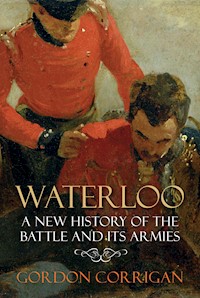
Fought on Sunday, 18 June 1815, by some 220,000 men over rain-sodden ground in what is now Belgium, the Battle of Waterloo brought an end to twenty-three years of almost continual war between revolutionary and later imperial France and her enemies. A decisive defeat for Napoleon and a hard-won victory for the Allied armies of the Duke of Wellington and the Prussians led by the stalwart Blücher, it brought about the French emperor's final exile to St Helena and cleared the way for Britain to become the dominant world power. A former soldier, Gordon Corrigan is the author of an acclaimed military biography of Wellington and has walked the battlefields of the Napoleonic era many times. He is perfectly placed to offer a robust, clear and gripping account of the campaign that surveys the wider military scene before moving on to the actions at Quatre Bras and Ligny and then the final, set-piece confrontation at Waterloo itself. He is also well qualified to explore, often in fascinating detail, the relative strengths and frailties of the very different armies involved - French, British, Dutch, Prussian and German - of their various arms - infantry, artillery and cavalry - and of their men, officers and, above all, their commanders. Wellington remarked that Waterloo was 'a damned nice thing', 'nice' meaning uncertain or finely balanced. He was right. For his part, Napoleon reckoned 'the English are bad troops and this affair is nothing more than eating breakfast'. He was wrong, and this splendid book proves just how wrong.
Das E-Book können Sie in Legimi-Apps oder einer beliebigen App lesen, die das folgende Format unterstützen:
Veröffentlichungsjahr: 2014
Ähnliche


















WATERLOO
Also by Gordon Corrigan
Sepoys in the TrenchesWellington: A Military LifeMud, Blood and PoppycockLoos: The Unwanted BattleBlood, Sweat and ArroganceThe Second World WarA Great and Glorious Adventure
First published in Great Britain in 2014 by Atlantic Books, an imprint of Atlantic Books Ltd.
Copyright © Gordon Corrigan, 2014
The moral right of Gordon Corrigan to be identified as the author of this work has been asserted by him in accordance with the Copyright, Designs and Patents Act of 1988.
All rights reserved. No part of this publication may be reproduced, stored in a retrieval system, or transmitted in any form or by any means, electronic, mechanical, photocopying, recording, or otherwise, without the prior permission of both the copyright owner and the above publisher of this book.
10 9 8 7 6 5 4 3 2 1
A CIP catalogue record for this book is available from the British Library.Hardback ISBN: 978-1-84887-928-7E-book ISBN: 978-1-78239-392-4Paperback ISBN: 978-1-84887-929-4
Printed in Great Britain.Atlantic BooksAn Imprint of Atlantic Books LtdOrmond House26–27 Boswell StreetLondonWC1N 3JZ
www.atlantic-books.co.uk
CONTENTS
LIST OF ILLUSTRATIONS
LIST OF MAPS
INTRODUCTION
1 HOW IT ALL BEGAN
2 THE SHEEP WORRIER OF EUROPE IS ON THE LOOSE
3 THE COMMANDERS
4 THE OFFICERS
5 THE SOLDIERS
6 BATTLE JOINED
7 THE CRISIS APPROACHES
8 THE BATTLE FOR EUROPE
9 THE DECISION
10 THE END
EPILOGUE
NOTES
SELECT BIBLIOGRAPHY
INDEX
ILLUSTRATIONS
SECTION ONE
Portrait of Arthur Wellesley, 1st Duke of Wellington by Thomas Heaphy, 1813 (© National Portrait Gallery, London)
Portrait of Napoleon Bonaparte by Thomas Heaphy, c.1813 (© National Portrait Gallery, London)
Portrait of Field Marshal Prince Gebhard von Blücher by Henry Alken, 1815 (Courtesy of the Anne S. K. Brown Military Archive, Brown University Library)
Ligny (© Imogen Corrigan)
Gemioncourt Farm (© Imogen Corrigan)
Tod des Herzog Friedrich Wilhelm von Braunschweig by Diterich Monten, 1815 (Courtesy of the Anne S. K. Brown Military Archive, Brown University Library)
Papelotte Farm (© Imogen Corrigan)
La Haie Sainte (© Imogen Corrigan)
The Battle of Waterloo, published by Richard Holmes Laurie, 1819 (Courtesy of the Anne S. K. Brown Military Archive, Brown University Library)
The Marquis of Anglesey wounded, leading the 7th Light Hussars by Charles Turner Warren, 1819 (Courtesy of the Anne S. K. Brown Military Archive, Brown University Library)
French cavalry charging British Highlanders at Waterloo by William Heath, 1836 (Courtesy of the Anne S. K. Brown Military Archive, Brown University Library)
Battle of Waterloo by W. T. Fry, after Denis Dighton, 1815 (Courtesy of the Anne S. K. Brown Military Archive, Brown University Library)
The Tree of Hougoumont (© Imogen Corrigan)
The French Right Flank (© Imogen Corrigan)
Schlacht bei Waterloo am 18 Juni 1815 by Dunkler, c.1816 (Courtesy of the Anne S. K. Brown Military Archive, Brown University Library)
SECTION TWO
Le Caillou (© Imogen Corrigan)
Wellington’s Headquarters (© Imogen Corrigan)
Battle of Waterloo, June 18th, 1815. The Life Guards charging the Imperial Guards by Franz Josef Manskirch, 1815 (Courtesy of the Anne S. K. Brown Military Archive, Brown University Library)
The Farm of Mont-Saint-Jean (© Imogen Corrigan)
The Battle of Waterloo by Aleksander Sauerveid, 1819 (Courtesy of the Anne S. K. Brown Military Archive, Brown University Library)
La Vielle Garde à Waterloo. 8 Juin 1815 by Hippolyte Bellangé, 1869 (Courtesy of the Anne S. K. Brown Military Archive, Brown University Library)
Ende der glorreichen Schlacht von la Belle Alliance den 18 Juny 1815 by Fredrich Campe, 1821 (Courtesy of the Anne S. K. Brown Military Archive, Brown University Library)
Meeting of the Duke of Wellington and Prince Blücher at La Belle Alliance after the Battle of Waterloo by Charles Turner Warren, 1818 (Courtesy of the Anne S. K. Brown Military Archive, Brown University Library)
Buonapartes feige Flucht nach der Schlacht von la Belle Alliance by Fredrich Campe, 1821 (Courtesy of the Anne S. K. Brown Military Archive, Brown University Library)
Pursuit of the Prussians by moonlight by Charles Turner Warren, 1818 (Courtesy of the Anne S. K. Brown Military Archive)
The field of Waterloo, as it appeared the morning after the memorable battle of the 18th June 1815 by John Heaviside Clark, 1817 (Courtesy of the Anne S. K. Brown Military Archive, Brown University Library)
Château de Hougoumont. Field of Waterloo, 1815 by Denis Dighton (Royal Collection Trust © Her Majesty Queen Elizabeth II, 2014)
The execution of the sentence on Marshal Ney, in the garden of the Luxemburgh at Paris, December 8th 1815 by Innocent-Louis Goubaud, 1816 (Courtesy of the Anne S. K. Brown Military Archive, Brown University Library)
MAPS
Europe in 1815
The German States, June 1815
France in 1815
Area of Operations: The Waterloo Campaign, 15–18 June 1815
The Field of Quatre Bras, 16 June 1815
The Field of Ligny, 16 June 1815
The Field of Waterloo, 1300 hrs, 18 June 1815
Area of Operations: Blücher and Grouchy, 18–19 June 1815
The Advance to Paris, 18 June–3 July 1815
The Duke of Wellington by Thomas Heaphy (1775–1835). Invited to accompany the army in the Peninsula from 1813, Heaphy painted most of the senior officers and many of the soldiers. Officers were charged according to the size of the painting – full length, three-quarters length, head and shoulders, head – and Heaphy did very well out of his commissions. His portraits are considered to be the most lifelike of contemporary artists, and this one was painted in 1813.
Napoleon Bonaparte. Also by Thomas Heaphy, although this time without a sitting by the subject and presumably unpaid. Painted in 1813, by Waterloo Napoleon had put on weight and looked much older.
Field Marshal Prince Gebhard von Blücher. Commander of the Prussian Army during the Waterloo campaign and seventy-three in 1815, his relationship with Wellington was crucial to the success of the battle. While he rarely appeared in full dress uniform and medals, that is how he was visualised by ally and enemy alike. (Henry Alken, 1815)
Ligny. Looking north towards the church at Ligny from La Tombe, the prehistoric burial mound used first by General Zeithen as he brought in the Prussian rearguard, and then by Napoleon who moved from Fleurus. The main Prussian position is beyond the church along the ridge on the skyline.
Gemioncourt Farm. Gemioncourt from the south. Built around the early 1600s, it was the headquarters of Bijlandt’s Brigade at Quatre Bras until it was captured early on. A brief attempt to recapture it failed and it remained in French hands until the end of the battle.
The Death of the Duke of Brunswick. Unusually for professional soldiers of the time, the Duke hated all things French in general and Napoleon in particular. He was hit trying to rally his cavalry at Quatre Bras, carried off the field and died shortly afterwards. (Diterich Monten, 1815)
Papelotte Farm. On the extreme left of Wellington’s position at Waterloo, it was held throughout the day by Saxe-Weimar’s Dutch-Belgians. Heavily damaged during the battle, it was largely rebuilt after it.
La Haie Sainte. A farmhouse forward of the Allied centre with a roadblock of upturned carts, it was held by a battalion of the King’s German Legion against repeated attacks until about 1800 hours, when, out of ammunition, they were forced to withdraw.
The Battle of Waterloo. One of the few contemporary paintings of which the artist might just possibly have seen the ground, rather than drawing from his imagination. La Haie Sainte is on the left and La Belle Alliance on the right, although the scene of Highlanders in the valley seeing off French cavalry is entirely allegorical, and may be due to the artist confusing the Waterloo and Quatre Bras battles. (Published by Richard Holmes Laurie, 1819)
The Marquess of Anglesey leading the 7th Hussars. Henry Paget, not the Marquess of Anglesey until after Waterloo, where he was Earl of Uxbridge, was in overall command of the allied cavalry but led his own regiment with great skill in the retreat from Quatre Bras to Waterloo, where in the closing stages of the latter battle he lost a leg. (Charles Turner Warren, 1819)
French cavalry charging Highlanders at Waterloo. Steady troops in square had little to fear from cavalry, and it is unlikely that the horsemen ever got as close to the square as is depicted here. The failure of the French command and control systems to support the cavalry with artillery and infantry cost them dear. (William Heath, 1836)
The Battle of Waterloo. The almost insatiable desire of press and public to be informed of the great battle led to all sorts of dubious artistic endeavour hastily employed to show what war was like, or what the artist thought it was like.(W. T. Fry, supposedly after Denis Dighton, 1815)
The Tree of Hougoumont. One of the very few surviving trees of the wood to the south of Hougoumont Farm. The bullet holes made by the Guards’ muskets can be seen clearly.
The French Right Flank. The area to the right of the French position at Waterloo was a maze of sunken roads. Infantry could have crossed them, cavalry could have got in but not out and guns could only be manhandled across with very great difficulty. This made any attempt by Napoleon to envelop Wellington’s left flank very unlikely.
The Battle of Waterloo. Prussian infantry on the right of the picture and French infantry on the left, probably somewhere in the vicinity of Plancenoit in the late afternoon. Artistic license shows the opposing forces far closer than they would actually have been. (Dunkler, 1816)
Le Caillou. The building in which Napoleon and his staff spent the night before Waterloo, and where he gave his final orders for the battle on the morning of 18 June. It is now a museum.
Wellington’s Headquarters. At the time of the battle, Waterloo was an insignificant hamlet on a dirt road some two miles north of the battlefield. The inn where Wellington spent the night after the battle, and where he penned the Waterloo Despatch, is now a museum in the main street of a sizeable town, which, due to ribbon development, is fast becoming a suburb of Brussels.
The Battle of Waterloo – the Life Guards charging the French Imperial Guard. There are lies, damned lies, and artists’ impressions. Both regiments of the Life Guards, seriously under-strength, were at Waterloo and they charged D’Erlon’s infantry and the French gun line as part of the Household Brigade, suffering considerable casualties as a result. It is unlikely that they ever charged the Imperial Guard, although they were charged by French lancers, which is probably what this picture actually represents, the title having been corrupted over the years. (Franz Josef Manskirch, 1815)
The Farm of Mont-Saint-Jean. Located a few hundred yards behind Wellington’s line it was the Allies’ main field hospital and also a stores depot. Piling large stocks of spare ammunition next to operating tables would probably be regarded as unwise today.
The Battle of Waterloo. Sometime near the close of the battle, Wellington is seen in the centre foreground with La Haie Sainte on the left. It would be some time before photographic evidence could show artists that horses do not canter or gallop as shown here, with both forelegs extended. It was fashionable at the time to show horses with small Arab-type heads and arched necks, which in reality few military chargers had. (Aleksander Sauerveid, 1819)
The Old Guard at Waterloo. The elite of the elite of the French army, the Guard were usually held back to pluck victory from defeat or to add a crushing blow to a battle already won. At Waterloo they were played as Napoleon’s final card, and failed, but fought a gallant rear-guard action to allow the Emperor to escape the field, thus creating a legend of French military valour that endures to this day. (Hippolyte Bellangé, 1869)
The End of the Glorious Battle of La Belle Alliance. Waterloo was La Belle Alliance to the Prussians. Here Prussian cavalry (identified by the initials ‘FW’ for Frederick William on the pistol holster of the mounted officer in the foreground) is seen chasing French infantry, including some bearskin-cap-wearing members of the Imperial Guard, away from Plancenoit, where the village church can be seen in the background. While the Prussian blue was much darker than that of the French, at a distance it was easy to mistake the two. (Fredrich Campe, 1821)
The Meeting of Wellington and Blücher. Most sources agree that the two commanders met at La Belle Alliance at the close of the battle. It is unclear what the mobile garden sheds in the foreground are – they may be intended to be French ambulances, but they had a sprung suspension, clearly lacking here. (Charles Turner Warren, 1818)
Napoleon takes Flight from the Battle of La Belle Alliance. A somewhat fanciful depiction of the Emperor and his immediate staff escaping from the battlefield. He left the area on horseback and then transferred to a coach for the journey to Paris, and an attempt to remain in control of the nation. (Friedrich Campe, 1821)
The Pursuit by the Prussians by Moonlight. With the French in full flight, it was vital to prevent them from consolidating and reorganising to the extent where they could force another battle. The pursuit, with the aim of giving the French no opportunity to halt and regroup, was undertaken by the Prussian cavalry, which was fresher than that of the Anglo-Dutch. All through the night the Prussians followed, harrying and keeping the French on the move. (Charles Turner Warren, 1818)
The Morning after the Battle. While perhaps not quite as closely crowded with wounded as is shown, the field next morning did present a ghastly sight. It took several days to bring in all the wounded, by which time many had been murdered after resisting being looted by local peasants. Looking at the carnage, Wellington is reported as remarking that next to a battle lost, nothing could be half so melancholy as a battle won. (John Heaviside Clark, 1817)
The Château of Hougoumont. Denis Dighton (1791–1827) was one of the few contemporary artists who painted realistic depictions of the aftermath of battle. He arrived at Waterloo a few days after the battle and painted what he saw. Here bodies of soldiers, stripped naked so that uniforms can be reissued, are being tipped into a grave-pit opposite Hougoumont Farm, while two Prussian officers look on.
The Execution of the Sentence on Marshal Ney. Most of the officers who had risen to prominence under Napoleon happily turned their coats on the Emperor’s first abdication, and turned them again when he returned in 1815, and most got away with it. One who didn’t was Marshal Ney. Due to a failure to understand the law by the officer members of the first court to try him (had they found him guilty and given him a lenient sentence of imprisonment or exile, he would have been rehabilitated after a few years), he ended up being tried by the royalists of the Chamber of Peers, and the end was inevitable. He faced death bravely, refused to wear a blindfold and insisted on giving the orders to the firing squad himself. (Innocent-Louis Goubaud, 1816)
INTRODUCTION
On 18 June 1965 the British army held a spectacular parade in the grounds of Hougoumont farm, south of Brussels in Belgium, to commemorate the 150th anniversary of the Battle of Waterloo. In those days the British army was twice the size that it is now and all the regiments that had fought there sent their regimental colour party, a guard of honour and their band. This author, then the tallest subaltern serving with the Gloucestershire Regiment, attended as the bearer of the regimental colour.
The 1965 influx of the largest number of British troops seen in Brussels since the liberation in September 1944 was not lost on the population. Contingents were billeted in Belgian army barracks, last refurbished in about 1880, and as the Belgians, with the possible exception of the Norwegians, are the only Europeans who actually like the British, any British soldier in uniform entering licensed premises in Brussels found he could quaff to his bladder’s content without having to pay. Inevitably cells in guardrooms were rapidly filled up with Scottish soldiers returning to barracks bare-bottomed, having sold their kilts to a local. On the battlefield, preserved in the main by the Belgian equivalent of green-belting, there was little, if any, sign that the British had ever been there. Memorials to French grenadiers, statues of Napoleon, plaques bearing eulogies penned by Victor Hugo and taverns with names reminiscent of the Armée du Nord there were aplenty, but not so much as a modest mention of the Great Duke. The Belgians have long lived through an identity crisis. In the past 300 years they have been subjects of Spain, of Austria, of France, of Holland, and only since 1831 have they lived in their own independent state, albeit one that is still riven by racial and linguistic tensions. In the eastern part of the country, regardless of who actually ruled them, the inhabitants have generally considered themselves to be French, or at least francophone. In 1815 they were pro-French, if only as a better alternative to being part of the Dutch Netherlands, and while today they have no quarrel with the British, who did, after all, create their nation, they still lean towards France. Now, largely thanks to comments arising from the 1965 affair and the efforts of the British Waterloo Committee, there are British memorials on the battlefield, but the shop in the (post-1965) visitor centre sells mainly Napoleonia and re-enactors prefer dressing as chasseurs à pied rather than as privates of the 33rd Foot. Even the premier British scholar of the French Revolutionary and Napoleonic Wars, the late Dr David Chandler, regularly appeared in the uniform of a colonel of the Imperial Guard.*
Whether the 200th anniversary of the great battle in 2015 will be commemorated with quite the flair, panache and effort that went into the 1965 event is a moot question: will political correctness disapprove of the glorification of blood and slaughter? Will the British government want to avoid offending the French? Can Britain afford it? What is certain is that, with the exception of the Guards and the Household Cavalry, there is not a single British regiment that retains the name it had in 1815, or in 1965, such has been the pace of run-down and amalgamations of the British infantry.
In 1965 the Allies of 1815 were invited and contingents from Austria, West Germany, Holland, Belgium, Spain and Portugal were on parade, as were the Russians, despite this being the height of the Cold War. As the occasion was officially, if not in reality, a commemoration rather than a celebration, the French too were invited. Not unnaturally they declined to attend, and the story doing the rounds was that their president, the Anglophobic General de Gaulle, had refused on the grounds that he was too busy preparing for the 900th anniversary of the Battle of Hastings the following year.* As de Gaulle was not known for his sense of humour, the tale is almost certainly apocryphal, but it combines the two occurrences in British history that are indelibly engraved on the minds of every schoolboy: 1066 and the Battle of Waterloo. They all know the date 1066 but are unsure of what happened then, and they all know there was a battle at Waterloo but don’t know the date.
In the long history of the British army there have been many battles that involved more men, lasted longer and had more casualties than the Battle of Waterloo, fought on one day in about two miles square of cramped farmland fifteen miles south of Brussels. Yet Waterloo creates more interest, claims more attention and has more words written about it than the Somme, Alamein and Normandy put together. It is not even that it was a purely British victory: the British were a minority of the Anglo-Dutch army, which was in turn smaller than the army of its ally, Prussia, and while the overall commander, the Duke of Wellington, was British, in truth it was not a battle in which great tactical acuity was a requirement. Rather, what was needed was the perceived British virtue of sticking it out until help arrived, a task that any number of available British generals would have been perfectly capable of overseeing.
Today Waterloo is seen as a stunning British victory against almost overwhelming odds. Perhaps in reality it was an Allied victory against odds that weren’t all that bad. True, Napoleon’s forces outnumbered those of Wellington, but not by anything like the three-to-one ratio generally considered necessary for a successful offensive. While much of Wellington’s army was indeed ‘infamous’ (by which he meant ‘not famous’), many of the British units had served in the Peninsula; and while he did not have the staff that he might have wanted to serve him, all of his divisional commanders and many of the brigade commanders had served under him at some stage in Portugal or Spain. They were well known to him and they knew and understood his methods.
When the contemporary accounts of the battle were written, most gave full credit to the Allied contribution – that of the Dutch-Belgians, the minor German states and of course Prussia – but very quickly fact began to be obscured by myth. In the case of the French, the result of the battle was supposedly decided not by Napoleon’s failures, but by incompetence and betrayal by others; in the case of the British, the contribution of other Allied nations was progressively belittled or ignored altogether. It took Colonel Charles Cornwallis Chesney, Royal Engineers, professor of military history at the Royal Military College Sandhurst, and later at the Staff College, Camberley, to restore the balance. On taking up his appointment in 1858, Chesney found the study of the history of their profession by army officers to be at best scanty and at worst seriously twisted. Most of the few recommended works for students were written by French authors in French, many had little basis in historical fact, and there was no attempt to encourage students to engage in a critical analysis of wars and campaigns. Chesney determined to change all that, and his examination of the American Civil War while it was still in progress stands out even today. He insisted on objective and unbiased examination of the history of warfare, and his essays on the Waterloo campaign, published in 1868, gave full credit to the Prussians (hitherto lacking in most accounts in English) and were the standard work on the subject for many years, having been translated into French and German.
Then, after the Franco-Prussian War of 1870–71, in which the French suffered humiliating defeat, British perception began to shift back to an Anglocentric view of Waterloo. While perhaps not becoming pro-French, opinion gradually became less pro-German: Napoleon III and his ex-empress were given sanctuary in England, their son was killed in the Zulu War serving with the British army, and the Kaiser’s vocal support for the Boers in the South African War all roused suspicion of German intentions in British minds. Later, the naval arms race and then the First World War squashed any concept of Germany having a share of the victory of Waterloo. Indeed, British soldiers on the Western Front were astonished to find themselves opposed by German infantrymen wearing the battle honour ‘Waterloo’ on their sleeves: what on earth, they asked, had Waterloo got to do with the Boche?
Between the world wars and both during and after the second, there was little incentive to credit the Germans with anything, and, although one or two books in the 1960s did try to depict the battle as having been won by a multinational coalition, most pandered to the heroic myth of the gallant British, outnumbered and outgunned, holding off the foe until at last defeating the mighty emperor and saving the world by their efforts. That perception has changed, at least among historians, but it is a pity that the leading proponent of putting the Prussian contribution in its proper perspective, who has delved into various German archives and produced a number of well-researched books as a result of his findings, has made himself a figure of fun by proposing all sorts of unlikely conspiracy theories and threatening to sue anyone who disagrees with him.
That Waterloo looms so large in British historiography cannot be due to its military value alone; rather, it is seen as the beginning of the ‘British Century’ and the last throw of a French imperial era – the last chance that the Bonapartists had of creating a unified Europe under French hegemony after twenty-two years of almost continual warfare. In the long years of the French Revolutionary and Napoleonic Wars the one unchanging factor was British resistance to French ambitions. All the other powers, and many states that were not powers in the contemporary sense, were at one time or another conquered by France, occupied by France or temporarily allied to France. Only England, protected by the Channel and her navy, stood in constant opposition, supporting the seven Allied coalitions that were formed between 1793 and 1815 with her money, her navy, her industrial capacity and, where she could, her troops. Had Napoleon won the Battle of Waterloo he would still have lost the war: the difference is that England would not then have had the influence that she did have in drawing up the post-war boundaries in Europe and in forming a system of checks and balances that kept the peace, more or less, for a century.
Waterloo does not stand in isolation but must be considered in the context of an age that began with the first attacks on what the revolutionaries later named l’ancien régime in 1770 and ended with Napoleon’s landing on the lonely Atlantic outpost of St Helena in 1815. The declaration of war by France on England in 1793 (and had she not done so England would eventually have declared war on her) began the most prolonged period of hostilities in modern British history, and until the events of 1914–18 when men talked about the ‘Great War’ they meant the war against France. In an age when, in the West at least, military operations that last for more than a year or so are increasingly subject to public suspicion, if not downright opposition, it is noteworthy that the great majority of the British public supported the French war for twenty-two long years. While Britain was not then a democracy in the modern sense – in that the idea of universal suffrage would have been regarded by most as an extraordinary aberration – she did have freedom of speech and the press, the rule of law, the absence of conscription and no restrictions on the free movement of labour, and she was probably nearer to the ideal of a free country than any other, with the possible exception of the fledgling United States of America – although, unlike in America, slavery in the home country was forbidden. British governments were unquestionably the king’s governments, but they had to take account of public opinion, with a plethora of highly critical newspapers, tracts and orators to ensure that they did. In no other European country could a member of parliament constantly and very publicly oppose the war, deride the government’s war aims, continually call for a negotiated peace, demand the exoneration of Napoleon and accuse the Secretary of the Navy of corruption, as Samuel Whitbread of the brewing family did.* It is inconceivable that in the midst of a war a Prussian, Spanish, Portuguese, Swedish or even Dutch prince of the blood could be put on trial accused of financial peculation in the sale of army commissions as the Duke of York, second son of King George III, was in 1809, albeit that he was acquitted (and probably rightly). It is perhaps because of these very freedoms to criticize that the British government could pursue a war that often looked like becoming a disaster, and had the broad backing of the people in so doing.
Most wars encourage technical progress – better weapons and medical advances being the obvious examples – but by 1815 there was very little in the hands of the army or the navy of any of the players that was not available in 1793, albeit that artillery had vastly improved, much other equipment had been refined and experience had produced more skilled usage of nearly everything. As far as the British were concerned, the war undoubtedly encouraged true professionalism in the pursuit of a military career, and while the British army of 1793 was not quite a mob of flogged criminals led by coffee-house fops, as its detractors alleged, it was certainly not the finely honed killing machine that it had become by the end of the war. By the first French surrender in 1814, British officers knew their business, all-arms coordination, with the infantry, the artillery and the cavalry all working together, was commonplace, and the army could rely on a logistic system that was the envy of the world.
That the British army was a victor on land was not necessarily to its advantage in the long term, however. Armies that are beaten ask why, as did the Prussians after Jena in 1806, reform themselves and produce something better. Armies on the winning side see no need to change the ways that brought them victory, and thus are in danger of stagnation. The initial British administrative disasters in the Crimea forty years after Waterloo must be laid at the door of complacent soldiers and uncaring politicians secure in the view that all was well and nothing needed altering. As for the French, who undoubtedly were beaten, the leadership of the army after 1815 remained in the hands of the same men who had led it for Napoleon, then briefly for the restored Louis XVIII, and then for Napoleon again until the final defeat of the Hundred Days. It is true that one marshal – Ney – was shot and a few others were exiled, but most simply turned their coats yet again and carried on as normal. There was thus little incentive to examine the reasons for defeat, or even to accept that military defeat, as opposed to political betrayal, had actually happened, and the French army of the Second Empire, organized, equipped and led in ways very similar to that of the First, went down to defeat yet again to the old enemy, the Prussians, in 1871.
Napoleon died on St Helena in 1821. His body was returned to France in 1840 and placed with great pomp and pageantry in the Chapelle Saint-Jérôme in Paris, and then reinterred in a magnificent specially built mausoleum in Les Invalides, where it still is. His tomb remains a place of pilgrimage for French army officers to this day, and it has to be asked whether the French army’s craven performance in 1870, its insistence on constant frontal attacks in the First World War and its lamentable performance in the Second are somehow related to its clinging to an outdated ideal of military élan – and Napoleon certainly gave them much glory – while at the same time ignoring the lessons of ignominious defeat.
The sources, meanwhile, for the examination of the Battle of Waterloo and what led up to it are many and varied. From the historian’s point of view these wars were fought – for the first time – by a literate soldiery. From previous wars we have the accounts of senior officers but little from the ranks. Now we have a multitude of letters and accounts penned by junior officers and Other Ranks, giving us a more complete picture of what life was like in the early nineteenth-century armies, on both sides. Secondary sources are almost inexhaustible and the National Archives at Kew, the British Library at St Pancras and the newspaper library at Colindale are invaluable research assets, with their ever helpful and long-suffering staffs. The French military archives at Vincennes and the national archives in Paris (currently on the move to a purpose-built building) are essential – if one can access them. An English historian wishing to research in the French archives is met by the presumption that the point of the search is to find something that will make the French look silly. There is thus a lack of cooperation other than that required by job description. I have tried claiming to be Canadian (not entirely a lie, as my mother was Canadian) but was then faced with a French-Canadian speaker, and while my modern French is reasonable, the Canadians speak a form of French little changed from the time of the Seven Years War. Currently, I claim to be Irish (again not entirely a lie: I was born there) and, as the assumption is that the Irish hate the English, willing assistance is instantly forthcoming.
It might be asked why there should be room on the bookshelves for yet another book on Waterloo. The answer is simple: the battle and those who took part in it continue to fascinate and the interpretations of it vary widely. Personally I do not subscribe to the oft-touted criticisms of British army officers of the time being a bunch of chinless wonders. In fact, apart from the Guards and some of the smarter cavalry regiments, most army officers came from stout middle-class backgrounds. The knighthoods held by so many colonels during the period were nearly always rewards for military service, rather than inherited, and the majority of ennobled generals were peers of first creation. Nor do I accept that the purchase of commissions and promotion was necessarily the iniquitous system that it would seem to modern eyes, for in fact it worked and it worked well once the abuses were removed by reformers like the Duke of York.
In the past some of my readers have questioned my use of the term ‘England’ when discussing the politics of the time – surely I should refer to Britain, or the United Kingdom? I make no apology for using England. The facts are that it was England where the government was, England where the industry was, and England where the money was. Napoleon did not order Marshal Masséna to ‘drive the mangy British leopards back into the sea’; rather, he referred to mangy English leopards. England, not Britain, was a nation of shopkeepers, and it was the English whom Napoleon said had been the most gallant of his enemies, not the citizens of Great Britain and Ireland. In global influence it was England that mattered, and while the Welsh, Scots and Irish unquestionably played a part, in politics and international relations it was England that directed. The army, however, was a different matter: it undoubtedly was British, with a large proportion of its soldiers of Irish extraction and around a quarter of its officers Scottish. Why this was so will be discussed later in this book.
I also make no apology for my frequent use of ‘may’, ‘seems’, ‘perhaps’, ‘around’, ‘probably’ and similar words in my account of the battles of 1815. Contemporary sources are legion and most disagree. This is hardly surprising: most people who were there knew what was happening to them and to those around them, but did not necessarily comprehend the bigger picture. Memoirs penned long after the event can be distorted, not necessarily deliberately, and in the case of at least some accounts what was published depended on cash on the table. In attempting to make sense of widely varying versions of events I have tried to describe what seems to me to be the most likely, although I accept that I may not always have got it right.
As ever, I have a great number of people to thank for their help in getting this book onto the shelves. Angus MacKinnon and Ben Dupré, who have once again been my editors and have saved me from prolonged litigation in the libel courts, and Lauren Finger, James Nightingale and Margaret Stead at Atlantic are all deserving of huge thanks, as are the staffs of the National Archives, the British Library and the Prince Consort’s Library. As always my wife has done her best to prevent me from getting too pompous, not always successfully.
Publishing is going through a revolution unimagined since the monkish calligrapher was replaced by Mr Caxton’s printing press. The power of Amazon, with its ability to massively undercut the traditional publisher, and the advent of the electronic reader, which eliminates the need for paper, are seen as a massive threat to the traditional printed book. We may browse in Waterstones, but we buy from Amazon; we no longer need an extra suitcase to carry our reading material on the move, but can take a whole library on our Kindle. But, I hear you cry, we like the feel of a book, the smell of a book, the thrill of opening a new book. Quite. So do I, but the digital generation is untrammelled by the conventions of the past, and no doubt there were many in ancient Rome who averred that the manipulation of a papyrus roll would never be overtaken by the new-fangled book. The digital book, the e-book, is here to stay. At present, however, while it is fine for fiction, it does not cope well with non-fiction. Footnotes and source notes are clumsy, plates and maps do not reproduce well, but this will improve and in a very short space of time the quality and ease of reading will surely bear favourable comparison with the conventional printed book. Will there still be a place for the book as we know it? Probably yes, but in libraries and places of reference rather than on the bookshelf at home. What of publishers? They will survive, but only if they come to terms with the digital revolution and embrace it. As for printers, they may, sooner rather than later, go the way of the typesetter and the printer’s devil, joining the crossing sweeper and the lamplighter in the list of professions that no longer exist. In practice, they will reduce their staff, move to smaller premises and concentrate on printing newspapers and magazines, visiting cards and wedding invitations, all of which are unlikely to be superseded, at least not just yet. Suffice it to say that I am grateful for the faith that my editors and my publisher have shown in me by their willingness to publish another book of mine in the traditional format – although doubtless as an e-book too.
As for Waterloo, it does not stand alone. Rather, it was the culmination of a long period of military development and political manoeuvring that made Britain a world power – indeed the only world power for a century to come – and while the war-making aspects of Waterloo are of interest, they cannot stand alone, but should be explained as part of a great global sweep of linked military, economic and political development that culminated in a muddy field in Belgium on a Sunday afternoon 200 years ago. That I have attempted to do.
* It has, of course, to be admitted that the French uniforms of the period were rather more glamorous than their British equivalents, lending weight to this author’s theory that the best-dressed army always loses.
* Although, perhaps surprisingly, a French naval contingent did turn up for the 200th anniversary of Trafalgar.
* When he committed suicide in July 1815, it was said, rather unkindly, that his heart had been broken by the victory at Waterloo.
WATERLOO
1
HOW IT ALL BEGAN
At nine o’clock precisely, on the morning of Sunday, 2 December 1804, the great wrought-iron gates of the Tuileries in Paris were flung open. From them emerged into the gardens the papal cross-bearer, one Signor Speroni, riding on a mule, which had been hired for sixty-seven francs and holding aloft a great silver cross with a curved crossbar on which hung an image of the crucified Christ. It was the Papal Crucifix, signifying the presence of no less a holy personage than Pope Pius VII himself, and, escorted by a squadron of dragoons, it led the papal procession to the cathedral of Notre Dame for the coronation of an emperor. It was to be a unique occasion. The French had been ruled by many kings, but never before by an emperor, and previous monarchs had undergone consecration, not coronation.
Lesen Sie weiter in der vollständigen Ausgabe!
Lesen Sie weiter in der vollständigen Ausgabe!
Lesen Sie weiter in der vollständigen Ausgabe!
Lesen Sie weiter in der vollständigen Ausgabe!
Lesen Sie weiter in der vollständigen Ausgabe!
Lesen Sie weiter in der vollständigen Ausgabe!
Lesen Sie weiter in der vollständigen Ausgabe!
Lesen Sie weiter in der vollständigen Ausgabe!
Lesen Sie weiter in der vollständigen Ausgabe!
Lesen Sie weiter in der vollständigen Ausgabe!
Lesen Sie weiter in der vollständigen Ausgabe!
Lesen Sie weiter in der vollständigen Ausgabe!
Lesen Sie weiter in der vollständigen Ausgabe!
Lesen Sie weiter in der vollständigen Ausgabe!




