


9,99 €
Mehr erfahren.
- Herausgeber: Bruno Editore
- Kategorie: Geisteswissenschaft
- Sprache: Englisch
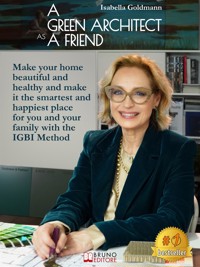
Have you ever thought of your home as a medicine, the most effective one possible, to achieve the highest state of well-being for you and your family? We’re talking about your whole house, every room, every corner, thought out in such a way that you can experience joy just by spending time there: that it conciliates calm in times of relaxation and stimulates concentration if you have to work. In short, a home that is finally the perfect den of your and your family’s body and soul. All this is possible, and this book guides you step by step to get to know better the place where you live, or where you would like to go to live. It accompanies you to learn more about your true needs and expectations with respect to this new den, and especially to solve its less performing aspects, with various solutions, both as simplicity and cost, following a very ancient and millenary discipline: bioarchitecture. This is a very scientific approach to living, which first and foremost merges beauty, which is indispensable and true care of the soul, with all the chemical, physical and ergonomic aspects that are involved in a serious and competent construction of a home. Nothing more is left to chance by the IGBI Method - Isabella Goldmann Bio Interiors, elaborated over years of profession and scientific research. Isabella Goldmann, a bioarchitect for more than 30 years, describes this method to you in this book in a simple and meticulous way, putting all the secrets at your disposal so that you can apply them immediately, without hesitation, to your home!
ABOUT THE AUTHOR
Isabella Goldmann was born in The Hague, but she is very Italian. Already at an early age she realizes that she wants to become an architect. She devotes much of her life to this discipline, orienting herself, from the beginning of her professional activity, to a very ancient practice that balances all the aspects necessary to build quality houses: bioclimatic architecture. He is managing partner of Goldmann & Partners srl SB, which has been certified among the best B Corp worldwide for years. Within it, he leads a permanent research center on sustainability applied to living space. She is a proboviro of the Italian Association of Women Engineers and Architects (Milan section) and a Board Member of the Milan Women’s Council. She holds courses, lectures and conferences in universities and public and private institutions. She has written professional books on architecture. This is the first text intended for the general public.
Das E-Book können Sie in Legimi-Apps oder einer beliebigen App lesen, die das folgende Format unterstützen:
Veröffentlichungsjahr: 2023
Ähnliche




















ISABELLA GOLDMANN
A GREEN ARCHITECT AS A FRIEND
Make your home beautiful and healthy and make it the smartest and happiest place for you and your family with the IGBI (Isabella Goldmann Bio Interiors) Method
Title
A GREEN ARCHITECT AS A FRIEND
Author
Isabella Goldmann
Translation
Janet Elizabeth Shelly, Opitrad srl, Milano
Editor
Bruno Editore
Web Site
http://www.brunoeditore.it
All rights are reserved pursuant to applicable law. No part of this book may be reproduced in any form or by any means without the prior written consent of the Author and Publisher. It is expressly prohibited to transmit this book, in either paper or electronic format, for remuneration or free of charge. The strategies described in this book have been developed over years of study and specialization, and the attainment of similar results in personal or professional growth cannot be guaranteed. The readers acknowledge to be fully responsible for their choices, and to be aware of the risks associated with any form of exercise. This book is intended for educational purposes only.
Summary
Praise for “A Green Architect for a Friend”
Introduction: My Story
Chapter one: The Home as an Investment
Why I chose to write this book
The home is an important economic and emotional investment
It affects our behaviour: mood, health, concentration, and growth of children
Yet the choice of the home is often random (near mother; near the underground, etc.)
The random choice of the style of the house (and the architect)
Thaler and the “nudge”
The need to have an approach that is "medical", scientific and informed
Who said a sustainable home costs more?
It all depends on us and on how much we know about ourselves
The risks you run if you don't do what is necessary
Chapter two: The Objectives for the "Right" home
No more standard or random choices
Think of a house that is "your" home, perfectly suited to your own and your family's needs
The concept is sacred: the CNMI (National Chamber of Italian Fashion) case
The sustainable home is a place of "treatment" for your body and mind
Make yourself and your family's physical and mental health your primary focus
Did you know that Italy is the cradle of the world for healthy architecture par excellence?
The pillars of a healthy home
Investing in wellness
New European Bauhaus
Sustainability at home: What does it mean?
“Circular economy" for the home: What does it mean?
Indoor pollution: What happens in your home that you don't know about - The case of the Veronesi Foundation
The "green" approach applied to the home: We use bioclimatic architecture
The basic rules: the "Mediterranean diet" for the home > the principle of the right mix
The IGBI – Isabella Goldmann Bio Interiors method in three steps: who – where – how
WHO
WHERE
HOW
Chapter Three: Who lives in the home
The house must be designed according to WHO lives there: children, the elderly, animals, the sick, or simply people who study, work, and relax
How our brain reacts to the surrounding environment
What habits you have – what the PBB – Preliminary Behaviour Brainstorming® – is
Emotion Mapping - Your “mental pictures”
What the spatial archetypes are
What the chromatic archetypes are
Chapter Four: Where Your Home Is and What It Is Like
Location and “genius loci” – the WHERE of your home is a very important thing
The importance of light, sun and wind
Which direction do the windows of which rooms face?
The concept of Harmony: The Golden Ratio, Fibonacci spiral and our protocols
The determinants of the atmosphere of a space and the biophilic design
Circadian rhythms, chronobioengineering and health
What thermo-hygrometric comfort is…
…and electromagnetic comfort
Chapter Five: How to Solve the Most Commonly-recurring Problems
How I deal with these everyday issues
First, a very nice house
Let's start with Ergonomics
The number one enemy of houses: The “Horror vacui”
The colours of your house
How to mix the colours together
Chemistry and physics of building materials
Bio-architecture on the construction site of your home
Furnishings
Odours and emissions
Thermal comfort: Systems, quality and air velocity
Designing the lighting
Radon
Acoustic comfort
Indoor greenery: what plants can do in the home
Environmental certifications
Green cleaning: The importance of cleaning
Conclusions
Thank you
Start right away. To do something new, you need a Mentor: You have me
Design a quality plan for your home: Follow the IGBI method
My courses and our services
Avoid the "do-it-yourself" way and don't settle for second-best
Purifying Plants for the Home
1. Effects on indoor air quality (IAQ)
2. Limiting energy consumption in buildings
3. The effect of limiting CO2 emissions in buildings
4. Improvement of environmental quality
5. Other advantages for health and well-being
6. Advantages of the use of indoor plants - improvement of air quality
7. Control of the indoor climate
Services
Acknowledgments
I dedicate this book to my children Brando and Urbano,
and to all young people, with the hope that they will lead the way towards a healthier and more intelligent way of living.
Isabella Goldmann
Praise for “A Green Architect for a Friend”
A Green Architect for a friend practically represents the biography of its author: a scenic encounter between creativity and improvisation in her television experiences and the accuracy of research and experimentation in her doing and thinking as an architect. A combination that becomes knowledge and critical and creative vision in the fundamental world of the home and living.
The bio is not an exercise or, worse, a fashion, but it is an original work of research on the fundamental questions that have to do with the essence of man's anthropological structure: the home, living not as the utmost banality regarding sustainability, but as research and scientific orientation on the very meaning of being "in". This research also becomes a handbook, an application tool for choosing what is fundamental in our lives: our home. Isabella takes us into the world of life choices, the non-trivial and the essential.
Mario Abis - Professor of Statistics and Psychosocial Research - IULM University of Milan
When Isabella told me about her book, my first thought went directly to the words of Zaha Hadid: “Architecture is true well-being. I think people want to feel good in a space."
I immediately find this principle permeating the book, linked to the concept of "Care" that green architecture exercises in life and in homes. The value of the care that living places exert on us is given precisely by the conception, which is the moment of synthesis between the complexity of an architect's education and his/her client’s experience.
Reading the brief but intense excursus that Isabella makes of her education full of ideas, new beginnings and moments of synthesis, one perceives how much her work is influenced by so much multidisciplinarity which, combined with the open, creative, and at the same time functional, gaze typical of women who work in the world of Architecture and Engineering, gives life to a careful and passionate story of the Architect's contribution in the construction of a healthy, intelligent house and built only for those who will live there. A story in which one rediscovers the correct approach to designing a house.
Maria Acrivoulis - National President of the Italian Association of Women Engineers and Architects
A book like this could only be written by Isabella Goldmann, because of who she is and because of her story. In addition to being objectively important, this work is a real handbook, usable by a large audience, and it is also pleasant to read. The episode mentioned in the third section of the second chapter, "The concept is sacred: The case of the National Chamber of Italian Fashion" dates back to 2010 when little or nothing was being discussed regarding the topic of sustainability. This proves that Isabella has always been ahead of her times, a true forerunner and visionary.
PS: "The manifesto for the sustainability of Italian fashion" was then published on June 13th, 2012, and the work of the “Retail sustainability table” was published on September 27th, 2017.
Mario Boselli, Knight of the Italian Republic – Honorary President of the National Chamber of Italian Fashion
Nossa casa é um lugar especial, de relaxamento, em meio às agitações do cotidiano, de fortalecimento das relações familiares, de congrassamento com amigos. Deve refletir a nossa essência e proporcionar bem estar. Captar a traduzir a essência de uma família para um projeto arquitetônico é algo que exige delicadeza e sensibilidades singulares, qualidades que encontramos em Isabella Goldmann desde o primeiro contato. Além da sua indiscutível excelência profissional e acadêmica, a aplicação personalizada dos preceitos deste livro em cada projeto leva a resultados únicos que, além de beleza, primam pela funcionalidade e sustentabilidade.
Seu constante trabalho de pesquisa e e os métodos criados para o fomento de uma arquiterura bioclimática são um legado de inestimável valor, refletidos nessa obra de leitura fluida, leve e esclarecedora. Tê-la como arquiteta e cara amiga, é um privilégio e uma honra.
Our home is a special place, a place for relaxation in the midst of the hustle and bustle of everyday life, for strengthening family relationships, and for meeting friends. It should reflect our essence and provide well-being. Capturing and translating the essence of a family into an architectural project is something that requires unique delicacy and sensitivity, qualities that we found in Isabella Goldmann from our very first contact with her.
In addition to her indisputable professional and academic excellence, the personalized application of the precepts of this book in each of her projects leads to unique results that, in addition to beauty, excel in functionality and sustainability.
Her constant research work and the methods created for the promotion of bioclimatic architecture are an invaluable legacy, which is reflected in this work of fluid, light, and enlightening reading. Having her as an architect and dear friend is a privilege and an honour.
Pietro Labriola and Simone Morais Labriola – clients and friends
The objective of Sustainability will not be achieved without the great involvement of citizens in many activities of everyday life.
Choosing a house and then furnishing it to make it sustainable is a project that can yield enormous results. A green architect for a friend (i.e. Isabella Goldmann) is a simple and complete guide to a third-millennium home where one can live happier than now. One way, she says, is to remind ourselves that we are animals. In any case, it is true: there is an incomprehensible carelessness in the way we choose a house today, while months are spent choosing a holiday destination. We are a strange species and in fact, we have quite a few problems.
Federico Pedrocchi – Science journalist
An enlightening book that offers clear and practical guidance on one of the most important choices in our lives. Times and generations change, but the choice of a home remains one of the first decisions that we make independently and responsibly.
As a digital nomad and a member of the so-called "iGeneration," stimulated by constant changes, I sense the need to have a safe and sustainable den not only for my emotions but also for my health. Indeed, the harmony of spaces reflects the harmony of our lives. Being guided by the experience of a "Doctor of spaces" has given me a whole new perspective, teaching me some concrete advice that can be applied even now when choosing a room or house.
An essential handbook for all of us young people, who are increasingly called upon to face the choice of a new nest from which to take flight, both personally and professionally.
Paola Vinci - Co-founder of The Sustainable Mag
Introduction: My Story
“When I grow up, I’m going to be an architect”. I was in kindergarten, I was three years old and I was in Holland. It was the first time I had stated it, in an authoritative way. I played only with Lego, and my dolls were all very small because they had to fit into the houses I built for them with those little coloured bricks.
I am Italian, but I was born in The Hague (Holland), following a father who worked in the field of industrial patents. The atmosphere was international and exciting, and even though I was then just a little girl, I can still remember it.
I only lived there for five years, but it struck my imagination and guided my instincts. Perhaps because the houses in Holland are very beautiful: they have high, sloping roofs, they overlook the canals, and they are elegant and a little mysterious.
And then there are the windmills, solitary and majestic, with their blades turning in the strong north wind, the fast clouds, the slanting rays of the sunshine, and the long afternoon shadows. These are my first mental pictures, to which all the subsequent ones would be added to create the puzzle of my destiny as an architect.
My Dad, from Vienna, was a nuclear physicist with a passion for classical guitar and philosophy, and my mother, from Urbino, the birthplace of Raphael, was an art historian with a passion for 16th-century Italian art. The thing I remember about the two of them is above all their conversations: lively, and visionary.
Science, music, poetry, painting, and all "the arts of man and for man" as they would say, enlivened the table, the car trips, the afternoons together walking on the dunes or around Flemish museums. I didn't understand much, of course, but by listening to them my memory unconsciously absorbed the key words that entered my language and later became the pillars of my life.
I was happy in Holland, I also got a little brother there, but we left suddenly. It was only the first of a series of twists and turns that, looking back on them now, seem to have been part of a perfect plan to accompany me on the journey that would make me who I am now.
Then Rome: I lived there until I was thirty. It is my city for all intents and purposes: when I get angry I do it in the Roman language, which certifies the fact that it is truly my language.
First of all, I was lucky because studying architecture in Rome is the apotheosis: I went to university during the years when hundreds of ruins and monuments were drawn from life, from Roman art to the Baroque. It was done like that because "the brain memorizes the shapes that enter it from the hand and not from the eyes" as one of my professors used to say, and what you draw once you never forget.
From classical art, we learn the balance of shapes, the project according to the proportions of the golden ratio, the elegance of the mark. I was especially fascinated by the play of shadows, perhaps because I was born in a country with long shadows, present everywhere.
Studying how the ancients dosed the work of light on things is, in my opinion, fundamental for an architect: it teaches how to choose perfect shapes and proportions, and how to use light as a material.
I didn't know yet that light would be one of my secret weapons, but somehow, deep down I must have sensed it.
I enjoyed learning. I had to know and learn everything. I've never had a mentor, but actually I've had many, they just never realized it. I was like a magpie: I always went on an unbridled search for the best and slipped into their work to steal the secrets of their trade.
I started out by becoming a voluntary assistant in two fundamental courses of the degree course, with two professors who were real "icons": History of Architecture II with Bruno Zevi and Restoration of Monuments with Paolo Marconi.
Almost as a flash of inspiration, Zevi made me understand the power of the architecture of F. L. Wright and A. Aalto (the two greatest exponents of the 20th century organic architecture as opposed to rationalist architecture), making me understand how Nature can and must be the first source of an architect's inspiration in order to create extraordinary living spaces. Marconi, on the other hand, opened the doors to some of the most important restoration sites in Rome at that time: I was just a nonentity, I carried his bags and drawings, but I followed him around like a shadow and I saw him up close, touching and repairing buildings by Michelangelo, Bramante, Raphael and Borromini, my favourite.
In that way I discovered something unimaginable: the great artists of the past created absolute masterpieces out of nothing. The budgets available to them were often very small, materials were poor, at zero kilometres.
The monuments that we have observed, for centuries, are still there thanks only to the extraordinary intelligence of the planners who knew how to dose the few resources they had with genius and creativity. An intelligence that in our houses nowadays is often absent or has been lost.
Later, this experience was to be decisive for my profession. I didn't know it at the time, but I felt I was witnessing something very strong. It was probably there and then that I decided I wanted to devote myself, simply by being inspired by them and their brilliant ideas, to making our homes of today smarter again.
But there was not only architecture in my life at that time. During my high school years, from the age of 17 onwards, I earned a little pocket money in the afternoon by working in the Vatican Museums as a guard in the exhibition halls. I remember entire afternoons walking up and down the halls, a different one every week (at the time I knew those Museums by heart, and with them the whole Vatican, its every step or pilaster strip, and all the works and paintings displayed there).
But I did it above all because of a little secret of mine: as a child I had a French R, that is I couldn’t pronounce my “Rs” correctly. I literally hated it, but it was family karma: for generations everyone in the family had had it, there was no escaping it for me. So I spent everything I earned to go to speech school.
It wasn't easy to learn the normal r, you don't know what a struggle, it was a long process, but in the end, I did it (except when I get angry: I still speak with a Roman accent with a French r, and there's nothing I can do about it).
One day, at the age of 19, for a laugh, with some friends I participated in a selection for an announcer on a private TV (at the time, they sprang up like mushrooms). Finally, I was pronouncing everything right and I was very proud of it, so I felt I could make a go for it, but never would I have thought they would choose me…!
This was not the real unexpected turn of events, however. That occurred a few months later when, while filming in the TV studio, a woman approached me: "I am here on behalf of Pippo Baudo: Would you like to be part of his hotbed?". Pippo Baudo was one of the most famous television presenters and one of the most sought-after talent scouts in all of Italian television. Me??? I was shocked. I didn't know that the great TV presenters had a breeding ground for young talents: with him the doors to the legendary, at the time, "audition" for the RAI (the national public broadcasting company of Italy) opened for me. This audition took place once a year in June: a closed-door audition, in Milan, in front of all the RAI executives of every discipline and from which all the new TV talents emerged. An obligatory passage, very hard training for months to take part in it.
For a year Pippo financed my singing, acting and dance school. Poor thing, he wasted his money on singing and dancing (he said that often), but I passed the audition as an actress. The very young Beppe Grillo and Tullio Solenghi, two Italian TV personalities who later became very famous, also passed it with me, just to place myself in time.
So I began a career in the RAI, at the same time as my university studies. I was in about 50 dramas (that's what the series were called at the time), very often starring, yet that wasn't what I really wanted.
As soon as I could, I went to spy on the work of the set designers, both of my own TV programs and those of others.
I spent the time I had free from rehearsals on sets putting together the backstages and choosing colour swatches. Thus, I learned how to build that famous "wow factor" of all TV sets, having very little on hand, only with ideas and a few well-chosen details.
Suddenly, however, the real twist of events arrived. As John Lennon said, "Life is what happens to you while you are making other plans". My father died, of fulminating cancer in the space of three months, at the age of 62. For me, it was as if Superman had taken a running start from another galaxy and with his forward fist, had landed in my face. Superman is a positive hero: In fact, in the absolute tragedy of my father’s death, I wanted to seize on an unequivocal signal: stop playing, get busy, you're alone now.
I was furious with Fate, I still had four exams to go plus my thesis and I was 28 years old: I was way behind schedule, and I also had to get out of the house right away so I wouldn’t be a burden on my mother. I only remember that on the day of my graduation, six months later, my family told me that they had hosted a party for me, with grandparents, aunts and uncles coming from far away.
I don't remember anything because I had collapsed on the living-room sofa from exhaustion and had slept for a whole day and night. In the pictures, you can see everyone toasting and there I was, sleeping in the background, behind everyone.
In any case, I was really behind if I wanted to become an architect right away. And at the beginning of my career, I wouldn't have earned enough to support myself anyway. I gave up television on the spot: even if I liked it, it gave me a very strong sense of temporariness (and that was not just a feeling I had: that is a dominant feature of the world of entertainment) while I wanted a real, continuous job.
In any case, I passed the state exam as an architect and in the meantime, I worked in a press office: I discovered that I liked the field of communication and so I made a crazy decision, a decision that went absolutely against the tide: I decided to change jobs.
I decided to take a break, to start over from scratch on another planet, taking nothing at all with me. I gambled away all my last savings and went to America to study Communication.
I remember leaving for Boston on the cheapest flight available, on a now-defunct airline: an overnight stopover in the Balkans was included in the price of the ticket. Never have I slept with so many cockroaches as I did that time.
I stayed in Cambridge (Mass.) for six months: studying at Harvard, the university of my dreams, was one of the best periods of my life. Classes beginning early in the morning, in the afternoon I studied on the campus lawns and went sailing on the river on the university team, and in the evening, I was back at the books studying almost until morning, like everyone else.
Only around midnight did we all take a break to go to Harvard Square to have a drink or, if it was really late at night, to eat the first hot croissants. This total detachment from my previous life was an absolute rebirth.
As if the new Isabella was preparing for a big leap and was just taking a run for it. Back in Italy I was wound up tight, and ready for what was my new turning point: not returning to Rome but doing an MBA (Master’s in Business Administration) at the Bocconi in Milan. What’s that got to do with architecture? Nothing. Apparently. I realized later that instead, it had a lot to do with it.
Meanwhile, in the master's class I met my husband. And that would already be enough to classify it as a lucky idea. Alessandro was my best "supporting partner" right from the start, along with our two children.
When you do an MBA, a career in a company presents itself right away. I had chosen marketing as a specialization. So, I worked in lots of multinational corporations as a communications director and, since I was an architect, fortunately I was always given projects related to visual communication, graphics, and Real Estate (management of corporate real estate).
At that point, however, I had a great desire, as a second job, to resume my contacts at the RAI and I switched to the other side of the camera. During my years in television, I had also become a journalist, and now I also wanted to impart knowledge of architecture (about which I had never stopped keeping up to date), and from there I started doing everything I could to get a chance to talk about it, especially documentaries.
It also helped me to get to know some of today's leading worldwide architects thanks to my activity as a documentary filmmaker, from Zaha Hadid to Norman Foster, from Mario Botta to Renzo Piano, to name just a few, and to learn directly from them the secrets of the best contemporary architecture.
However, I was missing the real, “applied” kind of architecture. Even if I kept up-to-date, I lacked contact with the construction site and with the project itself. As always in my life though, something important was about to happen that would make me change course again. It happened one day when, returning to the office after my second pregnancy, right in the middle of breastfeeding, I found my desk as manager out in the corridor, right next to a printer. I had only been away for the authorized five months, yet my place had been taken by someone else, and with it my room, my desk. Everything. Basically, I had to start all over again, from scratch.
I already knew that formaldehyde, emitted by printers, was poisonous enough to inhale. Imagine what it was for a mom who was breastfeeding. I had no choice, my protests had fallen on deaf ears. It was a long time ago, the sensitivity of companies towards these aspects related to the life of employees was low and so this happened regularly, unfortunately.
I made a radical decision: I quit. I was at home, with two small children to look after, a husband who was often away on trips; I was however, free.
That was my chance: to get back to being an architect, putting into practice everything I had learned up to that point. And everything resurfaced, this time fitting perfectly into the spaces of a puzzle that described my destiny: to be an architect who built houses that were not only beautiful, but above all intelligent, keeping an eye on costs and on people's health and well-being. And above all I wanted to make this discipline known as much as possible.
I told you all this to show you that often, in order to get to do what you feel you really want to do, the road is complicated. This is true for many people: the journey may be slow and tortuous, but in the end, you discover that it was for the best.
What kind of an architect am I? Bioclimatic and sustainable, in short, a green architect. I create a kind of architecture that comes from history and continually looks back at history. Once upon a time the ancients built well, with local materials and according to the territory they were building in.
That was a bioclimatic and sustainable kind of architecture. This has been lost since a short time ago, since the post-war period, with the arrival of oil and facilities, to compensate for the architectural defects that no longer had anything to do with the place where they were.
Before, even up until the 1940s, none of this existed and the houses were perfect. I really consider myself a champion of the return to intelligence in architecture, and of the intelligent recovery of the kind of architecture that already exists.
The architect (as Plato and then Vitruvius said) is just like a "doctor of the inhabited space", and is responsible for people's wellness and health, because the "where we live" conditions the "how we are”.
Many centuries later, Heidegger added that "to build you need to know how to inhabit, and the fundamental trait of inhabiting is caring for". I had already seen the kind of architecture which "cared for” people in real life, it was based on the harmony of all the design choices and on the calculations of the Golden Ratio, I had learned that from Roman and Renaissance ruins, and then from restoration sites.
Making beautiful homes was a natural goal for me after the years spent sharing and studying the most important TV set designs of the 80s, and the thousands of kilometres I had walked inside museums with my eyes glued to the paintings of every era, capturing the secrets of shapes and colours.
I could offer all this now also for our homes of today, and greatly improve the life of each one of us. How could this be done? By using what I learned in America, at the Bocconi and in subsequent jobs: communicating and controlling the costs of all the projects in the greatest detail.
Since many know how much I really want to talk about this, over the years I have slipped into a thousand associations, boards, councils: from the INARCH Lombardy Council to the Arbitrators of the Italian Association of Women Engineers and Architects (section of Milano), from the Council of the Milanese Women's Consulta to the Sustainability Topic in the Bocconi Alumni Association which I headed for nine years.
There are many more, but to mention all of them would be too much. To be honest, they absorbed a lot of my energy, but they did allow me to bring my voice a little closer to lots of different people and professional cultures, to which I may have contributed a few more bits of curiosity on the subject of better living. I really do hope so.
All this has often led me to teach so many different things at universities over the years: Documentary Technique but also Art and Design, Sustainable Architecture but also Corporate Social Responsibility. It led me to write books and articles, especially on the subject of sustainability, and to continue to be a journalist, obviously regarding architecture.
But to make a difference, there was still a missing piece that would differentiate me from all the other architects: a basis for constant updating on bioclimatic architecture.
So it was that I took the most "alternative" step of my entire journey: founding not only a sui generis architecture studio, which was a benefit company at the service of people but equipping it with an internal research centre on applied sustainability.
That was how Goldmann & Partners srl SB and IRCAS (Intl. Research Centre for Applied Sustainability) came about. The latter is my daily work tool. Because architecture is, as the ancients said, Venustas (Beauty) but also Firmitas (Durability) and Utilitas (Utility, Functionality).
I live among many young engineers and architects and many senior professionals with enormous experience in sustainable architecture, with whom we face new and interesting challenges every day and with whom I study something new every single day.
Over the years I have had the opportunity to gain significant experience: I have worked for large companies, I have designed directly and also guided, on a bioclimatic key, the designs of international architects on large projects. In the field I have understood that the beauty of a project is fundamental, but it cannot be the only characteristic. And I decided to bring all this experience as an architect into homes too, so that everyone can enjoy it.
So, I opened the Bio-Interiors department in which I apply our methods to homes too: even in our homes, in fact, we must be able to aspire to a project that is beautiful, but which is at the same time perfect, healthy, reassuring, suitable for us, and also inexpensive in its construction and maintenance. In addition to this, we hold live courses and create in-depth videos for those who want to know more.
This is why, as a result of my life journey, I decided to write this book: to share with anyone who wants it everything I know, and that I study every day, about how to design the perfect home for yourself and your family, a home where you can be healthy, happy, serene, and where you can always be sure that where you are living is the best place in the world for you.
Just as your general practitioner often becomes a friend, your architect should be your friend, too. But he/she must also be someone who keeps up-to-date on these specific issues, and also someone with a lot of experience. So, I thought that I could really be "a green architect as a friend”.
Friendship is a dimension that is very dear to me. In the moments when life has tested me and I have found myself at the bottom of the sea so to speak, I have never been alone: there has always been a helping hand that has found mine in the pitch black and has swum beside me until I reached the surface.
Perhaps this is why I am always ready and willing to do the same when I think I can be useful: that is the basis of the principle of the "treatment", and being an architect has this as its primary objective. Many of those I have met as clients have later become my friends, but I mean great, true friends, the kind of friend that makes you a witness at their weddings or a god-parent of a child at their baptism.
There is probably only one reason for this, and it is closely linked to this work, which is so extraordinarily beautiful and so singular, so technical and so immaterial: In order to build a home for someone and with someone, one enters mutually into full harmony with one's own stories and emotions. At the end of this journey, you get to know each other so deeply that often the relationship necessarily transforms itself into affection and esteem.
With this book I would like to become that friend for you, a friend who takes care of your own and your family's wellness by providing the right advice regarding your home, knowing that I’m not inventing what I'm telling you, that it doesn't follow my taste but, as for a doctor, it has a scientific foundation: I am giving you the right advice for you and for your specific case.
This is because building someone a home is like helping them make the den of their soul. It is an important, delicate activity, where one cannot and must not make mistakes.
If you let me do that, we can walk this path together.
Chapter one:The Home as an Investment
Why I chose to write this book
I owe this book to two people. The first is my husband, who has always believed in the importance of living well and has always enthusiastically welcomed every experiment I carried out in our homes before applying it to my clients' homes, allowing me to focus over the years on all the best designing and building techniques of a perfect home.
The other person was a true friend and a lawyer of gigantic authority, Maurizio De Tilla, the president of the European lawyers, who one day, after reading one of my books in one go in one night, said to me: "Perhaps you do not realize it, but you are sitting on a bomb that could make half the planet happy”. He told me that firmly, almost shaking my shoulders, almost making me feel crazy for not having done it yet.




