


Erhalten Sie Zugang zu diesem und mehr als 300000 Büchern ab EUR 5,99 monatlich.
- Herausgeber: The History Press
- Kategorie: Lebensstil
- Sprache: Englisch
Explore the history of ocean liners through the objects that bring them to life. Liners represented the ambitions of their nations in peace and war; their design, interiors and fittings incorporated the finest contemporary technological and artistic features. In peacetime they carried celebrities, vacationers and emigrants; while in war they carried thousands of troops – and then war brides seeking new lives. A History of Ocean Liners in 50 Objects takes in evolving technology, supreme luxury and fine cuisine, as well as hardship and the burning hope for a better life. There is peril, disaster and death, international pride and competition, glory and war. The objects tell a fascinating story, showing how the functional sea voyage has evolved from the late nineteenth and early twentieth century to the huge cruise industry we have today.
Sie lesen das E-Book in den Legimi-Apps auf:
Seitenzahl: 153
Veröffentlichungsjahr: 2020
Das E-Book (TTS) können Sie hören im Abo „Legimi Premium” in Legimi-Apps auf:
Ähnliche



















All of the objects in this book are from Mark Berry’s collection, unless otherwise stated.
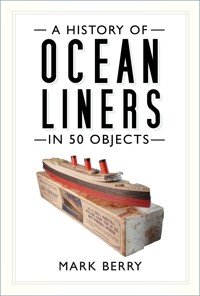
Cover illustrations:Front: Chad Valley cardboard model of RMS Queen Mary. Back: Bronze recreation of the mural in the first-class dining room of SS Normandie.
First published 2020
The History Press
97 St George’s Place, Cheltenham,
Gloucestershire, GL50 3QB
www.thehistorypress.co.uk
© Mark Berry, 2020
The right of Mark Berry to be identified as the Author of this work has been asserted in accordance with the Copyright, Designs and Patents Act 1988.
All rights reserved. No part of this book may be reprinted or reproduced or utilised in any form or by any electronic, mechanical or other means, now known or hereafter invented, including photocopying and recording, or in any information storage or retrieval system, without the permission in writing from the Publishers.
British Library Cataloguing in Publication Data.
A catalogue record for this book is available from the British Library.
ISBN 978 0 7509 9647 1
Typesetting and origination by The History Press
Printed in Turkey by Imak
eBook converted by Geethik Technologies
CONTENTS
Introduction
1 RMS Oceanic, Original Pen and Ink Drawing
2 SS Waratah, Card Posted at Sea
3 RMS Lusitania, Carved Plaque Commemorating Launch
4 RMS Mauretania, Phosphor Bronze Model of Propeller
5 Olympic-Class Liners, Souvenir Number of The Shipbuilder
6 SS Imperator, Maiden Voyage Medal and Brochure
7 RMS Aquitania, Brass Bell
8 RMS Berengaria, Saloon Chair
9 SS Île De France, Cutaway Rendering
10Bremen and Europa, Souvenir Cigar Box
11 MV Britannic, Lifeboat Plaque
12 SS L’Atlantique, First-Class Table Number
13 RMS Strathnaver, Launch Menu
14 SS Rex, Entertainment Programme
15Normandie, Lalique Water Goblet
16 RMS Queen Mary, Chad Valley Model
17 RMS Mauretania, Cigarette Case
18 RMS Queen Elizabeth, Model Bell
19 SS Liberté, Maiden Voyage Medal and Gala Ribbon
20 SS United States, Stateroom Key U-183
21Andrea Doria, Salvaged Currency
22 SS Canberra, Souvenir Painted Life Ring
23 SS France/Norway, Salvaged Nameplate
24Queen Elizabeth 2, Painting by Philippe Conrad
25Queen Mary 2, Maritime Replicas Model
26 Flags and Funnels, Ogden’s Cigarette Cards
27 RMS Rawalpindi, Painting by Norman Wilkinson
28Titanic Survivor, Jack Thayer’s Account
29 Aground, RMS China’s Evacuation Photographs
30 Lest We Forget, Lusitania Propaganda
31 Your Cabin, SS Normandie Telephone
32The Steerage by Eliza Putnam Heaton
33 Lost at Sea, SS Normandie Lifeboat Plaque
34 Fire! SS Morro Castle Aflame
35 Lost and Found, Lusitania Watch Mechanism
36 Passenger List, SS Cretic
37 Selling the Dream, Shipping Line Brochures
38The Soul of a Ship, French Line Booklet
39The Soul of a Ship Part 2, SS Normandie Cap
40 Cocktail, RMS Queen Mary Dry Martini
41 Souvenirs, SS Giulio Cesare Painting
42 Menus, SS Normandie Gala Dinner
43 Writing Home, Letter Card from TSS Geelong
44 The Hales Trophy, SS Normandie Blue Riband Card
45 Posted Missing, SS Waratah Letter
46 And the Winner is …, Île De France Trophy
47 Scrapping, RMS Olympic Model
48 Cruising, SS Normandie Brochure
49 On-Board Publications, Cunard Magazine
50 Bon Voyage, Line-Crossing Certificate
Bibliography
INTRODUCTION
WHAT IS AN OCEAN LINER?
The definition of an ocean liner is a vessel that runs on a set route to timetable between two or more ports, normally returning to the start point to resume the cycle. A cruise ship is a totally different entity, transporting passengers on a journey that may call at several destinations and which does not generally run to a regular recurring schedule. In this book, you will find that there are occasions where an ocean liner is also used for cruising, but the reverse is rarely the case.
So why is a liner so different? She doesn’t generally potter around ports in sunny climes, of course, but she sometimes might do so. Occasionally she might steam up and down fjords, allowing well-nourished passengers to take in stops ashore and to admire stunning scenery between excellent meals and copious amounts of reasonably priced beverages. However, these are diversions; she was designed and built for a purpose, to keep a schedule, to run line voyages.
Three words sum up the elements of a liner: power, design … and soul!
From the earliest days of ocean travel, the transport of goods was (apart from war, of course) the prime reason for crossing the oceans. As global transport became more vital to trading nations, the movement of commodities and goods from producers to consumers became of paramount importance. Commercial entities such as the East India Company and the Hanseatic League built or purchased fleets of sailing ships to move goods around Europe and the world. As empires grew, personnel and materials also had to travel around the globe, and as with any commercial enterprise, time was, and still is, money.
The tea clipper races from China to Britain in the 1860s showed how commercial advantage could drive the need for speed at sea. Ships such as Ariel and Taeping vied to be the first home over a 14,000-mile voyage, rounding the Cape of Good Hope and up through Biscay. Cutty Sark was late to the party in the 1870s, but she survives today. If you visit her at Greenwich, it is evident that she is the result, and indeed the personification, of the evolution of the sailing ship from a humble cargo carrier to a finely tuned commercial racing machine. We will return to this concept as applied to the ocean liner later in this book.
POWER
A liner needs to keep a schedule. The business or leisure traveller of today needs to be able to consult a timetable; board a train, ship or aeroplane; and know that there is a good chance that it will leave on time and arrive as expected. In the nineteenth and early twentieth centuries, voyage by sea was the only option for transcontinental travel, and the oceans paid little heed to the certainties of a timetable. When your vessel relied on sail or at best an early and inefficient steam engine, possibly linked to paddle wheels, there was no certainty of keeping to any kind of schedule, if indeed you arrived at your destination at all. It was not unheard of for a nineteenth-century liner to disappear without trace and, as we shall see, it was still quite possible for this to happen to a large, almost new steam-powered liner in the early twentieth century. Power increased as technology advanced, the Parsons steam turbine taking efficiency to a new level after the steam expansion engines that were fitted to most ships in the nineteenth and early twentieth centuries. Turbo electric, diesel engines and gas turbines have all been part of liner evolution. Coal gave way to oil and now concern for the environment pushes forward the development of greener power plants using liquefied natural gas (LNG).
DESIGN
From the earliest designs for ocean liners, it became evident that a streamlined hull with a keel for stability was essential. Crossing the Atlantic, for instance, can often put a ship in conflict with extreme weather and sea conditions. She needs to keep moving ahead, the luxury of running to a sheltered bay or port to ride out bad weather is not an option. She needs good sea-keeping abilities and the strength to cut through or forge over swells and troughs, and sometimes take on extreme waves and hurricane-force winds without damage or risk to life. Early twentieth-century liners such as Mauretania had a length to width ratio of around 9:1 and knife-like prows to cut through most sea conditions. Granted they tended to roll, but this was more an inconvenience to passengers than an impediment to progress. New hull designs were tried and led to the revolutionary Vladimir Yourkevitch design for the Normandie. Aids to stability developed, both gyro and extending stabilisers. A modern slab-sided cruise ship with a relatively flat bottom is not suited to speed in rough weather, or to having to keep a schedule week after week on long back-to-back crossings in all conditions.
SOUL
Yes, ships do have a soul and none more so than the ocean liner. She is not just a conveyance for passengers but also a home to her crew, who may have spent most of their careers on the same ship. The way the ships were designed and fitted gave individuality. The words luxury and ocean liner are synonymous, but the luxury did not necessarily extend to second- and certainly not to third-class accommodations. Each ship, however, had its own personality. The Mauretania, or ‘Maury’ to her crew, was built on the Tyne and had an interior style using a variety of darker woods, especially mahogany, which gave her more of a traditional feel, akin to a country house at sea. Her sister, Lusitania or ‘Lusi’, was built on the Clyde, had a different designer, James Miller, and had a lighter interior with extensive use of painted plaster. Ostensibly very similar ships but with very different personalities, and to their crews and those passengers who knew them, both had an individuality and a soul.
Some liners were known as ‘Happy Ships’, with a content, cohesive crew and passengers. A ship that attracted both to sail on her time and again or to stay with her, for some undefined reason. Other ships were less happy and might have a reputation for breaking down, accidents, or just not feel ‘right’. The word ‘jinxed’ could even be applied, though often with hindsight after a mishap or even loss … ‘I always said she was a wrong ’un!’
A liner is conceived on the drawing board; birthed on the slipway; and enjoys the exuberance of youth as she takes her place on the seas, maybe breaking records for speed or receiving accolades for her luxury. She reaches middle age, the wrinkles, aches and pains appear, and she starts to struggle to compete with the newer generation of ships. If she is allowed, she will grow old, often attracting love and loyalty from those who have known her. RMS Olympic was in service from 1911–35 and became known affectionately as ‘Old Reliable’. Aquitania sailed from 1914 to 1949, serving in both wars as both hospital and troopship. To those who knew them, these liners and their like had a soul, a life, and were loved, mourned and remembered.
The end, when it came, could be through accident or disaster, or the ship might become uneconomical and outmoded and end her days on the breaking grounds of Scotland, or more recently, run onto the beaches of Bangladesh, India and Pakistan for dismantling. In a very few cases, she would be sold and reborn into a new life. The liner Stockholm (1946), which collided with the gorgeous Italian liner Andrea Doria in 1956, leading to the latter sinking with the loss of forty-six lives, was still in service in 2020 as the cruise ship Astoria with CMV. The great Cunarder Queen Mary (1936) is preserved at Long Beach, California, as a museum, hotel and major tourist attraction. These are very much the exceptions, most of the great liners are now gone.
These ships leave their legacy, however, through the memory of passengers, crew, and builders; through anecdote; and, of course, through the objects that remain from their lives in service. From these we can examine these amazing ships and relive their triumphs, as well as the more routine yet no less fascinating aspects of their operation. We can also learn about the people who served on them, enjoyed them as passengers, or sailed aboard on their way to and from war. There are celebrities and emigrants, tourists, evacuees, war brides and babies. We will learn of privilege and poverty, hope and misfortune, triumph and disaster.
Only one true member of the breed still sails. Queen Mary 2, which entered service for Cunard in 2004, is an ocean liner in every sense of the word. She runs a regular transatlantic service between Southampton and New York. She also cruises, and both roles she fulfils to an exemplary standard. She was designed by naval architect Stephen Payne OBE and the prime directive was the ability to complete regular Atlantic liner crossings in all seasons. She has a liner hull that is strong and hydrodynamic, with marine diesel engines together with gas turbines driving electric generators linked to four electric motors housed in directional Azipod thrusters under the hull. A far cry from early steam engines and even the Parsons turbine, but I hope that this book will show the link between the present and the past.
How do you chart the history of ocean liners in fifty objects?
This recurring thought has been on my mind since I decided to produce this book. There are maritime historians, cruise lovers, memorabilia collectors and armchair travellers. Some people may pick up this book and wonder, why all the fuss about ocean liners anyway? They are just big ships that go here and there and sometimes sink, they will think, and put the book back where it came from. Others I hope may just be inspired by it to want to learn more.
The book is divided into two halves, the first being objects relating to specific ships, and the second exploring different aspects of the sea journey. One thing is certain: my choice of objects will not satisfy everyone, but being a glass half full kind of author, I hope that you will at least find the voyage worth taking, discover new things and hopefully enjoy some of the on-board entertainment.
Mark Berry2020
Detail from an RMS Aquitania menu of 1948.
RMS OCEANIC, ORIGINAL PEN AND INK DRAWING
GREAT BRITAIN, 1899
Oceanic was a revolutionary liner, in that she marked the beginning of a focus for the White Star Line on luxury and comfort over speed. This ethos would culminate in the Olympic-class liners of 1911. Oceanic was a one-off, there were no sister ships, although one had been planned. Built at Harland and Wolff, at over 17,000 tons, she was 704 × 68ft and powered by two triple expansion reciprocating steam engines. As usual, first-class accommodation was lavish for the 410 passengers who could afford it. The 1,300 people in second and third class enjoyed less salubrious but nevertheless comfortable facilities for the time.
She joined the Liverpool–New York service, making her maiden voyage on 6 September that year, crossing in six days, two hours thirty-seven minutes. She would subsequently transfer to the Southampton–New York run.
Original pen and ink drawing of RMS Oceanic.
Charles Lightoller, the surviving second officer on Titanic, had served on Oceanic for seven years, joining as third officer and rising to first. He commented on her luxury in his memoirs. The magnificent smoke room doors cost over £500, and there were eighteen carat gold-plated light fittings. In addition, there was a lot of hand-carved wood and specially commissioned art work. The first-class dining room featured a huge glass dome giving natural light and a feeling of space, while the smoke room had a huge mahogany frieze and two domes over.
Oceanic’s career was successful, and she gained quite a following among travellers, as often happened with a well-run, well-appointed liner. There was a collision with a much smaller steamer off Ireland in August 1901, which killed seven, but beyond this there were the usual mishaps and damage that could occur crossing the Atlantic in all seasons.
Oceanic was moored at Southampton on the morning of 10 April 1912. Outboard of her to starboard was the liner New York. Suction from the departing Titanic pulled New York entirely adrift and a collision between the ships was narrowly averted. Oceanic was partially pulled away from the dock and, according to Lightoller who was on Titanic, a 60ft gangway dropped into the water.
On the outbreak of war in 1914, RMS Oceanic became HMS Oceanic of the Royal Navy as an armed merchant cruiser. Lightoller was back on board as first officer and he became a navy lieutenant with the ships’ transfer to the Navy. HMS Oceanic now had two captains (never a good idea), RN Captain William Slater and Captain Henry Smith, her normal commander. Patrolling the waters around the Shetlands, for which her size made her totally unsuited, she ran aground on the island of Foula on 8 September 1914. Sitting high and intact on the reef, she was completely consumed during a storm two weeks later and by the following morning she had vanished.
The main image is an original pen and ink drawing by Richard Quiller Lane (1848–1902). He was a Belfast artist who drew for technical publications such as Engineering Magazine and The Shipbuilder, as well as contemporary postcards. Dated 1899, it shows the liner leaving Belfast for the first time.
RMS Oceanic menu, 26 January 1914.
SS WARATAH, CARD POSTED AT SEA
GREAT BRITAIN, 1908
Waratah still missing. Further list of passengers bound for London. The East Coast from Durban Southwards is still being vigorously searched for any trace of the missing liner Waratah.
London Evening Standard, Wednesday, 18 August 1909
A modern ocean liner, steam powered, brand new, vanishes without trace between Durban and Cape Town in July 1909. SS Waratah was launched on 12 September 1908 at the Barclay Curle shipyard on the Clyde. Her owners, Lund’s Blue Anchor Line, operated services between London Tilbury and Australian ports, via Las Palmas, Cape Town and Durban. Their business was based on the emigrant trade to Australia, with the ability to then adapt the ship’s carrying capacity to cargo and refrigerated goods for the return journey.
SS Waratah postcard from maiden voyage.
Lund’s Blue Anchor Line officer’s cap badge.




