


Erhalten Sie Zugang zu diesem und mehr als 300000 Büchern ab EUR 5,99 monatlich.
- Herausgeber: e-galáxia
- Kategorie: Fachliteratur
- Sprache: Englisch
Aikido has secrets paths. This is a book about a magical journey guided by the secret powers of the martial art Aikido. It tells the story of an encounter, brought about by a mysterious message delivered during a dream, eighteen years earlier. In rural Japan, where the sacred mountains tower over the Pacific Ocean, on the Kii peninsula, the student receives from the master the answers to questions about the meaning of her own life. She learns how to search in her soul for the answers that connect her to other individuals as human beings. The blows and the practices of Aikido training are revealed here in this book as teachings, also mysteriously transmitted, to be used on the tatami mat and far beyond.
Sie lesen das E-Book in den Legimi-Apps auf:
Seitenzahl: 208
Veröffentlichungsjahr: 2020
Das E-Book (TTS) können Sie hören im Abo „Legimi Premium” in Legimi-Apps auf:
Ähnliche



















For Motomichi Anno Sensei
Motomichi Anno Sensei and the author at the Funada Dojo, in Mie, Kumano, 26 April 2018.
Table of content
Acknowledgements
Preface
Introduction
PART I | The calling - The guardians protect the secret
Good evening, Aikido!
On edge
More messages
Dreams and enigmas
The circle closes
Part II | Initiation - Protectors and adventures. The transformation begins.
The fifth Kyu
Beyond the tatami mat
THE STRATEGY OF KI
A VERY SPECIAL VISIT
Ordeal
Hombu Dojô
More crisis
Summer retreat
PART III | The return - The point of arrival is the point of departure
The door opens
Mie, Shingu
Motomichi Anno Sensei
Iwato BIraki, The second opening
Merciful instructions
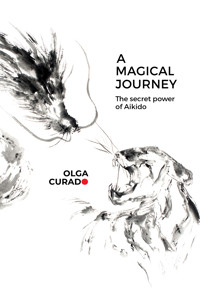
The tiger and the dragon
The celestial cave
Glossary
Acknowledgements
This book is the result of many people’s help.
Throughout the years of training on the tatami mats of Aikido, in the company of fellow practitioners and instructors, I have enjoyed many of the mysteries of this martial art. I am grateful to all those who have shared the training with me. I am particularly indebted to the women who have not given up the training: Maria Luiza Serzedello; Lila Sensei, for dedicating her life and her perseverance in sharing her knowledge; and Tica Lemos Sensei, for her fearlessness and coherence in the practice of Aikido beyond the tatami mat. Many thanks to Ioshico Fushimi Hannari ,Yoko Sensei, for her presence and conversations.
The apprenticeship that I glimpsed in my many daily practices made sense when the door of master Motomichi Anno’s Funada Dojo, in Kumano, Japan opened to me thanks to the generosity of Sensei Linda Holiday, to whom I am deeply grateful. Her gesture was decisive in bringing about an encounter that gave meaning to a long quest on my part. My good fortune would not, however, have been possible without the support of John Kepford, a disciple of Anno Sensei and tireless translator of the teachings that I have received from the master. John played a decisive role in helping me find the thread of my narrative.
I am also grateful for the time that Emerson Couto devoted to reading this book, as well as his shrewd observations, which helped to refine the manuscript. Any incorrect decisions that may come to light regarding the concept of the book or the final draft are entirely my own. The artistic sensitivity, attention, finesse and astute observations provided by Sandra Espilotro shaped the final draft and I am deeply grateful to her.
I have nothing but praise for the talent and creativity of Suely Shiba, an ink wash (sumi-e) artist, who translated into images moments in the text that required more than words.
I am grateful to my daughter Camila and my sister Maria Paula for their patience in accompanying me on this journey, listening to my stories and encouraging me not to stray from my aim.
I thank the Lama Padma Samten for his encouragement, attention, guidance and teachings.
I am immensely grateful to Motomichi Anno Sensei, to whom this book is dedicated, for maintaining and passing on with joy, immense lovingness and profound respect the teachings of the founder of Aikido, Morihei Ueshiba Sensei, whom he was a first-hand student of for almost fifteen years, preserving in the sacred mountains of Kumano, alongside Kiichi Hine Sensei Suzuki Sensei – and surrounded by students who make pilgrimage to the Funada Dojo, from all four corners of the globe −, the words, spirit and teachings of the art of Great Love.
Preface
I thoroughly enjoyed reading the author’s words about her experiences, visions and Aikido.
It is a very precious text. A living, breathing experience. The richest of content, with great depth, containing methods and knowledge for life.
There is complementarity between the various methods, the sum being even greater than the parts, even when they seem contradictory.
NOT RELIGIOUS, BUT RELIGIOUS – A PATH, DO.
I do not practise Aikido, but I can see how it can help practitioners.
The author manages to apply the profound nature of Aikido directly to life events, as a way of dealing with what life constantly throws at us. It enriches the path of the Buddhist practitioner. It offers direct challenges for the release of karmic regions at all levels. It offers an axis to cultivate a centredness that stands up to challenges.
Buddha invoked Mara to reach enlightenment, the practices of Aikido directly present the challenges of the six kingdoms and the six bardos and instructions about how to maintain the lucid mind as a reference point during all this. Enlightenment is not achieved via isolation, but by facing challenges at every level.
Presenting her work in three parts and twenty chapters, the author follows a chronological order, from her initial visionary experiences to her recognition of the depths of Aikido’s vision. She candidly reveals her life as a living laboratory of the lucidity of Aikido at work.
She reveals her fragilities, the search for the master in life, the immeasurable support of universal wisdom that protects our lineage, the convergence of unexpected situations, her intense training, the subtle and blatant challenges posed by her gender, examples of accidents, illnesses and cures, magical convergences, joys and disappointments, and her growing maturity. The book culminates with her meeting her master, Motomichi Anno Sensei, and her training in the Funada Dojo in Mie, Kumano, Japan, her recognition of the profound nature of what Aikido achieves, and the blessing she receives from her master to create her own Dojo at the CEBB – Caminho do Meio, the AME NO IWAYA DOJO – Celestial Cave Dojo.
“A magical journey led by the gods of Aikido and their surprising powers.” A magical vision and at the same time straightforward practical advice for dealing with life, energy, intense activity inseparable from fear, fearlessness, certainty without rigidity or a yoga guru.
“Aikido is a path. A way of life whose apprenticeship begins on the tatami mat in the form of waza and katas – a collection of techniques and blows. On the tatami mat, we invariably compare ourselves to each other (...). Aikido provides resources for us to confront another kind of battle. (...) a tool for removing barriers between people, helping them understand that we are all part of Kami (the divine force of the universe, nature).”
“Aikido (...) is the art of peace. Ai means harmony, ki, energy, and do, path. (...) It does not promote competition or harming one’s partner. (...) It is the art of communication and peaceful engagement, of exchange.”
“Women, in a traditionally masculine space, like that of martial arts - although in Aikido the presence of women is theoretically celebrated - are treated like second-class citizens. (...) Centuries of differentiating on the basis of gender can manifest themselves almost unconsciously, yet this does not diminish the scope for oppression. (...) It is important to note that even in the sacred spaces of self-development and of the quest for the divine there are political dimensions (...). Overcoming these abysses with art (...) and at the same time taking control of one’s own being with integrity is a huge challenge (...) but it is not acceptable to give up on this undertaking.”
“The path, Anno Sensei constantly repeats, to be achieved demands a Suano heart – simple, honest, pure, clear, transparent. Being open for understanding and receiving new things. This is satori – revelation, a state of awareness, for the acceptance of the mystery.”
“Aikido has secret powers. Gods have secret powers. Secrets are revealed only to those who are initiated into the mysteries and allow the gods to lead them on the journey.”
At the heart of the Sensei Olga Curado the journey continues, not the journey of a single person. It is the magical and mysterious journey in time beyond time, in space beyond space – without a beginning or an ending.
Lama Padma Samten – Cebb Caminho do Meio
Guavas falling to the ground, mimosa bimucronata trees and silk floss trees in flower
1 October 2019
Introduction
The man is waving his arms around in desperation, he is standing on the roof of a house almost totally submerged by the storm of the tropical cyclone. He is desperately shouting at the rescue team, who are flying over the devastated region in a helicopter, in search of survivors of this predicted catastrophe. Finally, a rope is thrown down to him with hooks on that he attaches himself to and he is hoisted into the air.
“Didn’t you hear the advice to leave your home?”
“Yes, yes”, the man repeats. “But I had a lot of faith in God that nothing would happen to me. I prayed a lot. But I don’t believe any more ... God has abandoned me...”
In disbelief the rescuer says:
“I don’t understand! God sent you many messages. There were constant warnings on the radio about the storm, with instructions to protect yourself, leave your house, barricade the windows... And you didn’t do that. Did you want him to come in person? Well here I am!”, he adds, smiling, while the man from the roof doubts how his great God can have appeared in such a simple way.
How is it possible that someone’s God is so simple and manifests himself as part of a routine civil defence operation? Inattentive or incredulous, we have the fantasy of the grandiose appearance, of the ritual miracle with pomp and circumstance, complete with soundtrack and twinkling lights. But miracles are, continually, manifestations of the Universe that happen every day and every night, and can be recognised when you look to see, when you listen to hear.
There is an invisible thread that runs through worlds and times weaving destinies and bringing answers for questions that lie hidden in our souls and that our mind unearths. Magic occurs in the movement between the hidden worlds of our own nature and banal everyday life.
A magical journey is a guided walk through events whose order and logic defy reason; it can be triggered by a casual touch. It is necessary to be alert as you follow the trail, paying constant attention.
Aikido can be the rope thrown in the middle of the storm, but paradoxically its support base lies somewhere we do not look – within ourselves.
What is Aikido? There are many answers to this question, on various levels. The simplest of them is that it is a martial art of Japanese origin. However, if we probe a little deeper, we will learn that it is a Budo – in other words, a path to self-development achieved by means of Ai – harmony, love; Ki – vital energy, the source of life; and Do – the path that is followed during continuous and committed practice.
Aikido is a path. A way of life, whose apprenticeship initially begins on the tatami mat by means of waza and katas – a collection of techniques and blows. For the pupil who arrives at the dojo – the name given to an Aikido academy and whose meaning is: place of development −, the explanation on the tip of the tongue of all the veteran pupils and trainers is that Aikido is a martial art that does not use the muscular strength of the person dealing the blow, that does not involve competition, and that absorbs the strength of the adversary by redirecting the attack. Yes, Aikido is a martial art, and its blows must be delivered with precision so that the training partner, called the uke, the one on the receiving end of the technique, is immobilised or falls to the ground, and so that the nage – the one applying the technique – remains safe. For those at the start of their Aikido journey, this is the simplest and most obvious reading. An apprenticeship in self-defence techniques.
The constant training allows for the perfecting of skills that improve motor coordination, spatial awareness, breathing capacity, and, with so much falling and getting back up again, it also helps strengthen muscles and joints. So, as a physical activity, Aikido is an exercise that promotes good health. Like running, cycling, and bodybuilding.
A person can choose to train in Aikido for several reasons: to become stronger, more agile; for self-defence; or to be an admired and admirable martial artist. Whatever the motivation, it is inevitable that at the beginning and after a few years of training we feel excited about our abilities as a martial artist – the agility of our movements, the precision of our blows, and even the beauty of our displays. Aikido demonstrations are often seen as a very well-choreographed ballet.
On the tatami mat, we invariably compare ourselves with each other and put ourselves on a higher level – we see ourselves as more effective, better prepared, and having a greater mastery of the art form. Vanity, pride and arrogance are part of human nature, even if we wish to give the impression that we do not belong to that group of pretentious human beings. But, in the end, there will always be someone who is beginning their training or that, despite the long periods of training, still cannot put the techniques into practice as well as we do! Well, that was my experience, until I learned that Aikido offers much more than blows to dominate the adversary who is physically threatening us. In the face of external confrontation, strength, speed and technique are the resources that undoubtedly offer the best solutions. When this is not the case, a stick, a gun or lungs full of breath and calf muscles ready to run away from danger.
Aikido offers resources for us to face another kind of battle.
Morihei Ueshiba Sensei, the founder of Aikido, developed throughout his life (14/12/1883-26/4/1969)this art form that, according to him, is the representation of love, what he called Dai-Ai, “Great Love”. A spiritual devotee of Omoto-kyu, a religion with its roots in Shintoism, a rigorous and disciplined practitioner, he gained mastery of several traditional Japanese martial arts before consolidating the rudiments of Aikido as a means of promoting peace in the world. Aikido, according to O’Sensei, was a tool for removing barriers between people, teaching them that we are all part of Kami – the divine force of the universe, nature.[1]
The spread of the principles of Aikido has contributed to defining methods used in processes of conflict resolution and corporate crises, and in the institutional political sphere, in the management of public and private businesses, as well as in leadership training. Its central tenets include the importance of seeking empathy as an initial basis for contact, an approach that facilitates the entire process of relationship building. Aikido therefore transcends, in its teachings, the delivery of blows on the tatami mat. These function as a concrete expression of those principles. You can look, deliver the blow and find the teachings in it. Looking to see.
When the concepts taught in the training are translated, they also serve all those who genuinely do not see in the other just a threat or an adversary, but who, when they admit their differences, give greater value to what they have in common.
There are many lessons that can be learned via reflection and the practice of the art passed on by O’Sensei. With regard to the techniques and the philosophical foundations, a great deal has been written of considerable benefit for many people all over the world.
But this is not a book about the techniques and concepts of Aikido. Yet some rudimentary knowledge of its fundamentals is necessary in order to make this journey.
On a magical journey lots of things happen. At each moment we should try to understand these events. But when we look for explanations confined to logic, there is no understanding. Our vision is reduced, limited to the parameters of experiences people have had and recounted, or the projections of interpretations given by those who are also resorting to what is already known. The unknown is greater. There is much more to be discovered than what we recognise.
It is not unusual for us to classify events from a narrow perspective, one that is conditioned by what we already know. A major challenge is to learn to read beyond the obvious. To try to translate what has not yet been explained, but only experienced, and to surrender yourself to the mystery without fear. It may be terrifying, but life is enriched when we allow ourselves not to know, and we marvel at finding ourselves at the limits of the comprehensible.
Tirelessly, and for millennia, man has striven to know who he is and what he hides in his own soul, in his spirit, what he is made of and what his destiny is. We do not always remain aware that we are all made from the dust of the stars, of the wind, of the void, of the fire of the spheres, of the waters of the rivers and the oceans, of the mud of the marshes and the sources of the oases, and that we fulfil the cycles of nature, moved by the energy of life in search of its self-preservation.
Impatient, we want to tame the future and life itself. We try to scrutinise and decipher the signs given by the eternal, in order to guard ourselves against losses and to ensure prosperity, to tame the skies and control the Earth. Throughout history we have explored worlds by reading numbers and maps of the stars, via codified decks of cards, stains produced by coffee grounds, in birds’ entrails or messages on stones. We are afraid of what might appear before us, the vast unknown ocean. We create rules to tame it, but the mystery prevails.
NATURE HOLDS ITS OWN MAGIC.
Only when our curiosity and attempts to control the future quieten down, because trying to tame life no longer matters, and we surrender ourselves to the unknown, do we understand the mystery that emerges and reveals itself of its own accord.
This is a book about how the mystery operates so that, if we follow our soul, the ecstasy is not only underpinned by reason – it is necessary for us to surrender ourselves to find the answers that constitute us, as individuals, as human beings, as a species. The mystery lies in the secret that only the soul nourishes and preserves. From there emerge the gods that walk with us and each day we become one of them, several of them throughout our lives. When we finally accept our divinity, its power installs itself within us and life proves to be boundless.
Aikido has secret powers. Gods possess secret powers. Secrets are revealed only to those who initiate themselves in the mysteries and allow the gods to lead them on their trajectory. This is a book about a magical journey led by the gods of Aikido and their secret powers.
[1] HOLIDAY, Linda. Journey to the heart of Aikido: the teachings of Motomichi Anno Sensei. Berkeley, California: Blue Snake Book, 2012 (e-book).
GOOD EVENING, AIKIDO!
Just after seven pm in the evening, Telma and I arrive at the meeting place. A small auditorium with ordinary wooden chairs, that can accommodate around fifty people. There are about twenty people there – men and women in their early forties. The vast majority are people who work with the soul – psychologists, therapists and psychiatrists. They meet there every two or three weeks to receive guidance about their patients, to discuss subjects that shed light on human behaviour. For two hours they ask questions and listen to answers and points of view about how to deal with relationship problems, how to make choices that have positive effects on the lives of everyone. Yes, that night I learned that there are no answers to the questions ‘why’ – at least no indisputable answers. Rather the whys are windows onto other whys, creating a never-ending, obscure and impenetrable sequence of inquiries, leading right back to the curious-minded themselves at the start of everything, in the face of the mystery, still with an unanswered question.
Why does the day dawn? Why does night fall? Why are we born, or why do we die? Regarding the simple demands of everyday life, why do we feel sleepy, hungry, afraid...? These questions are debated by philosophers, theologians, neuroscientists, physicists, psychologists and physicians of all specialisms. The answers change with every new scientific advance or the interpretations of new prophets.
It is a mild evening. It is July in the Brazilian city of Belo Horizonte, and it can get chilly at this time of year. I am all set to stay at home, but Telma insists that I go with her. It would prove to be an experience that I would not regret, she assured me. And who can resist Telma? Her loud, brazen laugh, her ample body with its open arms, ready to give you a hug, and that unmistakeable powerful voice always inviting you on some new adventure.
“Of course, Telma, I’ll leave early and we’ll go.”
At the time I am going through another of my professional challenges. There have already been a litany of them. Now in Belo Horizonte, as the head of television journalism, I have to contend with the barely disguised suspicion of the locals, who greet me with a sideways glance, at my arrogance for turning up on their turf giving orders left, right and centre, as if they did not know what they were doing. As luck would have it, despite this subtle rejection there is a group of friendly and generous people, among them Telma, who do their best to make me feel welcome, at home.
The small auditorium is dimly lit. Some people greet each other effusively before finding the best seat in the house, near the stage, a podium in front of which there are also another two chairs as if waiting for guests. Telma and I settle into our seats minutes before the medium arrives. A man enters the room, walking slowly towards the stage. He looks about forty years old, skinny, dark skinned, with black hair and stubble. Someone immediately hands him a lit cigarillo and he smokes it. With his eyes closed, his body sways forwards and backwards for a few seconds. He opens his eyes and looks in my direction:
“Good evening, Aikido!”
Telma nudges me to reply. Timidly I say:
“Good evening.”
He carries on saying hello to other people. I whisper to Telma:
“What did he call me?”
She replies:
“When someone comes here for the first time, he gives them a name.”
“Yes, but what does it mean?”, I persist.
“He gives people their true name. When I came here for the first time, he called me Desert. I didn’t understand, but later, talking to my dad about our family history, I discovered that our earliest ancestors were the offspring of nomadic desert tribes. I may have had a past life there...”, she says with a vague expression, neither believing or disbelieving.
I understood that, Telma was indisputably of Middle Eastern descent, and undoubtedly her roots lay in the desert sands of that part of the world. But what was Aikido?
“I don’t know”, she finally admitted, “I think it’s some kind of martial art”.
That night the medium, who incarnates an entity self-styled as Uou, talks about the pauses, not always perceived, but that always occur when a movement changes direction. It is interesting to think about this notion, that in the context of our lives, in the changes of direction necessary before we move on, there is a pause. “These pauses generate the impulse needed for the movement in another direction to occur”, the medium explains. He speaks for almost two hours without being interrupted, before answering the audience’s questions.
Intrigued by the medium and his words, I want to find out more. Curiosity, we could say, is in my journalist blood. The following day I volunteer to meet him, as he is willing to talk to a few people individually. He is waiting for me, sitting in an ordinary room, and I am advised that it will be a quick conversation. I was there to listen, not necessarily to speak.
“Does a peroba wood fence cease to be peroba wood?”, comes the abrupt question. He stares at me, and continues.
“A tree, after it is cut down, to make a gate, ceases to be a tree?”
I am speechless and he carries on.
“After being cut down, does the tree cease to be a tree?”
Without really knowing what to say, I reply:
“No. It carries on being a tree.”
“Good evening, Aikido”, he looks down, bringing the briefest of meetings to a close.
I still do not understand.




