


23,99 €
Mehr erfahren.
- Herausgeber: Robert Hale Non Fiction
- Kategorie: Geisteswissenschaft
- Sprache: Englisch
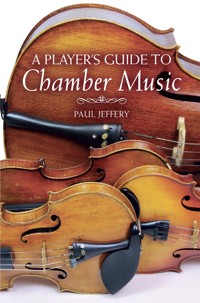
Chamber music includes some of the world's greatest music. It is widely played in homes, without an audience, by players who are mostly amateurs, and much of the repertoire is playable even by those of quite moderate ability. Player's Guide to Chamber Music gives advice on what music is available and helps the player to identify what is suitable. It covers chamber music from the seventeenth to the later twentieth century and all instrumental combinations including strings, piano, wind instruments, duet sonatas and baroque ensembles. All the significant composers and musical aspects of playing are covered along with works suitable for inexperienced players.
Das E-Book können Sie in Legimi-Apps oder einer beliebigen App lesen, die das folgende Format unterstützen:
Veröffentlichungsjahr: 2017
Ähnliche



















A PLAYER’S GUIDE TO
Chamber Music
PAUL JEFFERY
ROBERT HALE
First published in 2017 by
Robert Hale, an imprint of
The Crowood Press Ltd,
Ramsbury, Marlborough
Wiltshire SN8 2HR
www.crowood.com
This e-book first published in 2017
© Paul Jeffery 2017
All rights reserved. This e-book is copyright material and must not be copied, reproduced, transferred, distributed, leased, licensed or publicly performed or used in any way except as specifically permitted in writing by the publishers, as allowed under the terms and conditions under which it was purchased or as strictly permitted by applicable copyright law. Any unauthorised distribution or use of this text may be a direct infringement of the author’s and publisher’s rights, and those responsible may be liable in law accordingly.
British Library Cataloguing-in-Publication Data
A catalogue record for this book is available from the British Library.
ISBN 978 0 7198 2507 1
The right of Paul Jeffery to be identified as author of this work has been asserted by him in accordance with the Copyright, Designs and Patents Act 1988.
Contents
Preface
Introduction
Chapter 1. The Chamber-Music Art-Form
Chapter 2. Playing Chamber Music for Pleasure
Chapter 3. Aspects of the Music
Chapter 4. The Composers and Their Works
Arriaga
Bach
Barber
Bartók
Beethoven
Berg
Boccherini
Borodin
Brahms
Britten
Bruch
Bruckner
Chopin
Corelli
Danzi
Debussy
Dohnányi
Dvořák
Elgar
Fauré
Franck
Grieg
Handel
Haydn
Hummel
Janáček
Mendelssohn
Mozart
Poulenc
Prokofiev
Purcell
Rachmaninoff
Ravel
Reicha
Richter
Saint-Saëns
Schoenberg
Schubert
Schumann
Shostakovich
Sibelius
Smetana
Strauss
Stravinsky
Tchaikovsky
Vaughan Williams
Verdi
Vivaldi
Weber
Webern
Appendix I. Further Composers
Appendix II. Repertoire by Instrumental Combination
Glossary
Index
Preface
Playing chamber music for pleasure has been an absorbing interest for most of my life. In my teenage years I began playing the violin and later the viola, and was soon able to enjoy informal music-making. Musical experiences multiplied at university. Not until I was in my early twenties, however, did I discover the string quartet: and chamber music became a passion. I played with many different groups, attended courses and classes, and bought sheet music and books on the subject. One thing I sought but could not find was a comprehensive source of information about the repertoire that might be played. So, having access to an excellent music library, I put one together for myself. I have used it ever since. It is the germ that now, greatly magnified, has become this book.
My years of playing chamber music have given me many good memories. These are often of musical enjoyment: first experiences of playing and studying some of the greatest works; inspiring coaching sessions sometimes with prominent figures. But chamber music is also a social pleasure: a special form of friendship, and fun. I think of the string quartet that never stopped playing until after midnight, when a bottle of wine was opened; the ensemble mainly distinguished by the volume of laughter coming from the room. Memories of those with whom I have shared musical friendships over the past half-century remain warm; and with some, I still play today.
Immersing myself in the subject in order to write this book has been fascinating, indeed often a pleasurable indulgence. Every work has been studied; some works that hitherto had eluded me have at last been played. Events, incidents and advice from players of greater knowledge or experience than mine over many years remain in my mind and have often informed my writing. Present friends, too, have helped. My principal thanks, however, are to my wife Margy, who has read the text in draft and has helped me very much by making both broad and detailed comments and suggestions.
Introduction
Chamber music is a genre that is substantial in its character, yet executed by only small groups of players. Many of its composers wrote it at least partly for the enjoyment of its players, and though it is today widely enjoyed by listeners in concerts or recordings, it probably still gives the greatest pleasure to those who play it. Playing chamber music is a remarkable and delightful activity: a few instrumentalists of quite moderate proficiency can in their homes play some of the world’s greatest music.
This book is intended for all who play chamber music for pleasure, or are interested in doing so. It sets no requirement in terms of technical expertise: players can range from some of very moderate ability up to others of high or professional standard. Players are mostly amateurs but they may be professional musicians, especially those whose usual musical activity is in other areas. Indeed, even members of that small and exclusive élite who have a career as performers of chamber music are not immune from sometimes playing it for pleasure.
The principal content of the book is a list of the important chamber compositions that exist, with information about each work from the point of view of the prospective player. Chamber music is considered broadly. Coverage extends from the baroque period which began in the seventeenth century up to music composed in the later twentieth century. All chamber-music combinations are addressed: those of strings alone, of strings with piano, of or including wind instruments, baroque groupings, and duet sonatas. The criterion for inclusion is musical: the basis is the corpus of great chamber music as it is generally recognized. Technical difficulty, or lack of it, is not a factor. This means that some works appear that few players will be able to approach; but the nature of chamber music is that most of the repertoire is accessible to reasonably capable amateurs.
Works are listed by composer, but other lists by instrument or instrumental combination are provided to assist readers in identifying the works available. Also included are chapters discussing the nature of chamber music and considerations in playing it. An appendix lists some further composers of chamber music beyond those addressed in detail.
Many sources have been consulted for information and opinions about the compositions discussed. However, all judgements expressed concerning both their musical value and aspects of playing them are ultimately those of the author. Players will no doubt in some cases disagree!
Chapter 1
The Chamber-Music Art-Form
Chamber music is a major branch of Western ‘art music’ or ‘classical music’. Despite the small forces employed, the works are comparable in their character and importance to those written for a large symphony orchestra. Its repertoire includes some of the greatest musical works for any medium.
Perhaps surprisingly, there is no universally agreed definition of chamber music. Widely accepted, however, is the rather whimsical term ‘the music of friends’. This indeed captures its essence, especially as it is addressed in this book: chamber music is intended primarily for the pleasure of its players. Though it may be performed in concert halls to an audience, its true home is the domestic environment, where the players sharing the enjoyment of it are most frequently amateurs, usually with no audience at all. At least in the earlier periods, composers wrote it with this environment in mind. This did not mean that they made it deliberately easy to play, but chamber-music writing normally avoided virtuoso display or technical difficulties that could be mastered only by highly trained professionals. This definition of chamber music remains valid today: there continues to be a substantial body of music lovers – friends – who play it for pleasure. The music they play is taken widely from the chamber-music repertoire: though concentrated in the classical and romantic ages it extends as far back as the seventeenth century and forward into the second half of the twentieth century.
This definition has, however, come to have problems. By the mid-nineteenth century, chamber music was widely performed in the concert hall; some lovers of chamber music were only listeners and did not play. Nevertheless, most of the music performed in these concerts was also played domestically for pleasure: when Brahms in 1873 published his op. 51 string quartets, he dedicated them to Dr Theodor Billroth, a surgeon and amateur violinist, viola player and pianist. Though sometimes technically demanding, works of the period were still accessible to reasonably capable amateurs. But since the turn of the twentieth century some new chamber works have been so difficult that they are hardly playable by any other than dedicated professionals. This does not exclude the possibility of such professionals sometimes playing them for pleasure, but their main life is in the concert hall. These works are not just a few on the margins: they embrace much of the mainstream of the chamber music of this era. The string quartets of Bartók, widely considered the summit of the string quartet in the twentieth century, fall into this category. Such works are undoubtedly chamber music; but they have largely excluded themselves from this definition of the art-form.
More explicitly, it is usually agreed that chamber music is for between two and nine performers, with a single player to a part. Music for only one instrument (including that for piano) is not chamber music. The instruments of chamber music are normally just the violin family of string instruments, the woodwind family, the horn and the piano. They do not include the voice. However, a few cases break some of these bounds.
Further limitations are that chamber works are substantial in both character and duration, usually having multiple movements. Short pieces or works of light entertainment character are not true chamber music. Moreover, chamber music should be democratic, with all parts on equal terms. Although that statement requires some qualification, music consisting entirely of a solo for one instrument with accompaniment by one or more others is not chamber music.
In two areas, the boundaries of chamber music are subject to disparate views. Some authorities consider that true chamber music requires a minimum of three players: by this, duet sonatas for a melody instrument and keyboard would be excluded. However, this is a minority view. Duet sonatas, and some other duets, are a distinct form of chamber music, and they are much enjoyed in the domestic environment. However, the large body of music for one instrument with a piano purely in an accompanying role is not chamber music. Also (perhaps perversely), music for two pianos, or for two players at one piano, is not considered chamber music.
Lesen Sie weiter in der vollständigen Ausgabe!
Lesen Sie weiter in der vollständigen Ausgabe!
Lesen Sie weiter in der vollständigen Ausgabe!
Lesen Sie weiter in der vollständigen Ausgabe!
Lesen Sie weiter in der vollständigen Ausgabe!
Lesen Sie weiter in der vollständigen Ausgabe!
Lesen Sie weiter in der vollständigen Ausgabe!




