


20,99 €
Mehr erfahren.
- Herausgeber: The History Press
- Kategorie: Geisteswissenschaft
- Sprache: Englisch
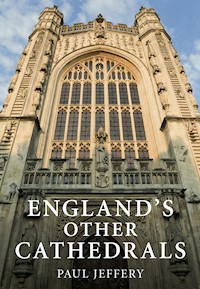
England's great cathedrals are widely considered to be the country's finest and most beautiful possessions. Few people realise, however, that in addition to these famous buildings there are many others that share, or once shared, some of that greatness. These 'other cathedrals' have very varied origins. There were cathedrals established in Anglo-Saxon times that subsequently lost that status. Further cathedrals founded after the Norman Conquest also later ceased. Henry VIII had plans to elevate many great monastic churches to cathedral status, but most were unfulfilled. From the nineteenth century onwards, many new cathedrals have been created, both by the Church of England and by other Churches. Altogether eight groups are discussed, containing in total well over a hundred buildings. Most are fine, and many are or were in their size and magnificence fully comparable with the great cathedrals themselves. Some today stand complete and glorious. Others are now mutilated or in ruin. Some have been completely destroyed, but even these may stir us by their lost glories. Paul Jeffery explores the often fascinating episodes of history that lie behind these groups of magnificent and frequently forgotten buildings. The spotlight is then turned on each one, revealing many architectural and historical treasures.
Das E-Book können Sie in Legimi-Apps oder einer beliebigen App lesen, die das folgende Format unterstützen:
Veröffentlichungsjahr: 2012
Ähnliche



















For my wife Margy, with love
CONTENTS
Title
Dedication
Preface
Introduction
1. Lost Pre-Conquest Sees
2. Lost Cathedrals of the Later Middle Ages
3. New Cathedrals Proposed under Henry VIII
4. Lost Predecessor Cathedrals
5. Post-Reformation Anglican Cathedrals
6. Cathedrals of Other Denominations
7. Churches with Cathedral Nicknames
8. Other Churches of Cathedral Stature
Glossary
Select Bibliography
Plates
By the Same Author
Copyright
PREFACE
The great cathedrals of England are our finest and best-loved buildings.
They are the background to this book. Its genesis came in part from my appreciating the broader meaning and significance possessed by the word ‘cathedral’ and the concept that it represents. As well as being used for those great churches, the word has come to be applied figuratively to almost anything exceptionally large and fine: St Pancras Station in London is the ‘Cathedral of the Railway Age’; the $8 billion Large Hadron Collider completed at Geneva in 2008–9 has been called a ‘cathedral of science’; and the symphonies of Anton Bruckner are sometimes described as cathedrals in sound. Moreover, cathedrals have inspired many forms of secular art: Constable and Turner both produced famous paintings of Salisbury Cathedral. Novels, too, have been written on the theme of a medieval cathedral construction project. The Whipsnade Tree Cathedral, planted in the 1930s, has trees, hedges and shrubs around grassy avenues in the shape of a cathedral and its cloisters.
With this came the realisation that around or related to the great cathedrals as we know them today, there are, or were, many more similarly remarkable churches. Some have, or had, true cathedral status, others not. We might call them ‘churches with cathedral connections’. They share many of the qualities of the great cathedrals: in varied ways they have much of the cathedrals’ splendour, excitement and fascination. They reveal much interesting history, and are a large and enthralling subject. England’s great cathedrals as generally considered may be numbered as twenty-six; discussed in this book are well over a hundred ‘other cathedrals’.
One such group is of cathedrals that with the march of history have lost their cathedral status. Some ceased in the Anglo-Saxon era; others ended in the later medieval centuries. A few began but were never completed. Another fascinating category comprises the churches that were identified to become new cathedrals under Henry VIII, but in the event did not or, after a brief existence, ceased.
Many of the existing great cathedrals had predecessors. It is well known that the present St Paul’s in London replaced a medieval cathedral; but even that had yet earlier ancestors, back into Anglo-Saxon times. So did many others.
The great cathedrals are all ancient (if we allow this of the seventeenth-century St Paul’s); but many relatively modern cathedrals also exist. Unlike the ancient cathedrals, they belong to multiple denominations: Anglican, Roman Catholic, and others too. A few are famous, notably Coventry’s, which came out of the destruction of war, and the two at Liverpool. But most are little known.
Two further groups have, instead of a historical connection to the true cathedrals, a different type of relationship. One is of churches that use the ‘cathedral’ name informally, while those of the other are defined by their cathedral-worthy size and splendour.
So addressed in this book are eight groups of ‘other cathedrals’. They are a very diverse set. In part this diversity applies to their size and character, but all groups contain churches that are large and splendid, and most include some that are fully comparable with the great cathedrals. They are varied in date too, ranging from the seventh century to the twenty-first. Most widely varied of all is their condition today. Among them are many, from all periods, that stand gloriously complete, while others, though themselves destroyed, have been replaced by a splendid successor. Yet others are mutilated or are roofless ruins: some of these are still fine and beautiful but others are only sad relics. Then there are those that are now no more than sites – empty or covered by later structures – though even these may have been fascinatingly illuminated by archaeology. A few have nothing more than their history, with even where they once stood being unknown.
Visiting these churches and sites all round the country has been a rewarding task. Equally fascinating has been the research into their background and history. Many people have helped me. First among these is Dr Charles Knighton, to whom I offer my warmest thanks for his assistance concerning the Henry VIII cathedral schemes. Others to whom I am particularly grateful are Lucy Beckett, Anthony Cornwell, Professor J.J. Scarisbrick, Dr Joanna Story and Professor Barbara Yorke. I also thank Derek Adlam, Keith Barker, James Bettley, Professor Martin Biddle, Professor Christopher Brooke, Richard Buckley, Dr John Crook, Philip Dearcy, the Revd Michael Dolan, Toria Forsyth-Moser, Bill Jerman, the Very Revd Peter Judd, Phil McGahan, Cath Moloney, Canon Barry Naylor, Fr Vassilios Papavassiliou, Dr Arthur Percival, Konstanze Rahn, Professor Warwick Rodwell, Graham Scobie, Gill Shrimpton, Tessa Smart, Mrs Barbara Solomon, Mrs Margaret Sparks, Peter Stretton, Jane Sumpter, Tim Tatton-Brown, Sally Thompson and Maureen Tooze. I express my appreciation of the services offered, without charge, by those excellent institutions, our libraries, particularly the Martial Rose Library of the University of Winchester, the Hartley Library of Southampton University, the Minster Library at York and the Public Record Office in Kew. Last but not least, I thank my wife for her encouragement and help. Photographs were taken by me except where otherwise indicated.
INTRODUCTION
Cathedrals are supreme works of art and architecture. Arguably, England’s ancient cathedrals are the country’s greatest treasures. Architectural historian Alec Clifton-Taylor called them ‘the master-works of English architecture’. Although created hundreds of years ago, their artistic achievement has hardly been matched by any creations of our age.
Cathedrals are also prodigies of engineering. Even by the standards of today’s buildings they are very large. Some are notably tall: the spire of Salisbury Cathedral was the country’s tallest building as recently as the 1960s. Cathedrals are also exceptional in the size of their continuous enclosed spaces. Although size is a technical rather than an artistic achievement, it is an essential component of their inspirational character, especially powerful when we consider the elementary technology available to their makers. We feel the cathedrals were made as the greatest and most beautiful things that their creators could conceive; they are often said to have been built to the glory of God, and in many ways this must be true.
Moreover, cathedrals are frequently of outstanding historical importance. Some go back to the early years of Christianity in England. They may be connected with major historical events and with figures prominent in the country’s history. Within them are to be found tombs of many great men and women of the past.
A measure of the importance of the cathedrals in our national culture is the number of visitors they receive. York and Canterbury have the highest numbers, each with over 2 million annually. Altogether, the cathedrals receive perhaps 15 million a year. As attractions, they rank high among the most popular.
The central value of a cathedral – its reason for existence – is religious. Cathedrals are the most spectacular physical manifestation of Christianity. A cathedral has a specific function: it contains a ‘cathedra’, the throne of a bishop, and it is this that gives it its name. A bishop has ecclesiastical jurisdiction over an area or territory known as a diocese. A few cathedrals, such as Canterbury, have the additional dignity of being the seat of an archbishop, who presides over a larger area known as a province.
The religious aspect stands beside their art, their engineering and their history as an essential part of their importance. Some who visit them are Christians visiting for religious reasons; but most probably are not. Yet for a large proportion of visitors the fact that cathedrals are religious buildings is part of their value. They inspire awe, reverence and wonderment. All the great cathedrals and many of the ‘other cathedrals’ are the property of a Church, which is responsible for their care and maintenance and for which they are working buildings. They are not museums.
Although the word ‘cathedral’ is now generally used for a bishop’s church at any stage of history, it would not have been recognised in Anglo-Saxon and Norman times. It appeared in the late thirteenth century, although only as an adjective: the term ‘cathedral church’ is still used today. Use as a noun began only in the sixteenth century. Even in the late medieval years and beyond, a building containing a bishop’s throne was usually referred to simply as a church. It is only relatively recently that such a church has come almost always to be called a cathedral.
WHICH ARE THE GREAT CATHEDRALS?
What might be called the ‘canon’ of the English cathedrals has as its basis the cathedrals of the medieval centuries. From 1133 to 1539, there were nineteen cathedrals in England. Two then ceased. The remaining seventeen (of which St Paul’s in London has since been completely rebuilt) are:
Canterbury
Carlisle
Chichester
Durham
Ely
Exeter
Hereford
Lichfield
Lincoln
London
Norwich
Rochester
Salisbury
Wells
Winchester
Worcester
York
Seven further cathedrals were created under Henry VIII in 1540–2 and 1546. All were previously monastic churches. Five are still cathedrals, and are always considered part of the canon. They are:
Bristol
Chester
Gloucester
Oxford
Peterborough
Between 1836 and 1927, twenty more dioceses were created. For most of these, an existing church was promoted to be the cathedral. This had usually been built as a parish church, but six had belonged to a medieval religious house: two monastic and four collegiate. Both monastic churches are large and of cathedral character, as are two of the collegiate churches. Many authorities1 include these four among the great cathedrals. They might be called the ‘extended canon’. They are:
Ripon
St Albans
Southwark
Southwell
This completes the canon. Addressed in this book are the cathedrals, interpreted widely, that are not part of the canon.
It has already been suggested that many of these ‘other cathedrals’ – some relatively modern, but others medieval – are or were of comparable size and splendour to the cathedrals of the canon. It might be asked whether any can match the very greatest of the cathedrals. Are any here the equal of (say) Canterbury, Durham, Lincoln, Wells or York? Of the cathedrals built in the past two centuries, probably not. Physically the greatest of these is Liverpool, which indeed is larger than any cathedral of the canon: but it would be rash to assert that it is their equal as a work of art, and it certainly cannot match them in historical value. When it comes to the medieval churches addressed here, however, the answer is probably yes. It can with good justification be claimed for Bury St Edmunds and Glastonbury, although both are now ruins. Also of this stature, though completely destroyed, is Old St Paul’s in London. Happily, one further church of this quality still stands complete: this is Westminster Abbey.
Many of the churches that appear in this book belonged to medieval religious houses, going, in some cases, back to early Anglo-Saxon years. Aspects of the history of religious houses in medieval England form the background to much of what is discussed later.
After a short Christian period in late Roman times, which was subsequently snuffed out, it was not until the seventh century that Christianity came to most of England. The first religious houses soon appeared. Though often referred to as monasteries, these early religious houses were different from monasteries as they became later. They were Christian centres, usually involved in evangelisation and preaching, containing mixed communities. Typically some of their members, perhaps both men and women, lived lives of monastic character, while others did not. The communities of the early cathedrals were similar.
It was only from about the tenth century that monasteries took the form that continued through the Middle Ages, mostly having only either monks or nuns, who were enclosed and bound by the vows of poverty, obedience and chastity. Alongside them, but quite different, were colleges. These too were religious houses; they had nothing to do with education. Their communities were of priests. The priests received a pecuniary reward for their work, and they were not enclosed: they can be called canons or secular priests. The church of a college is known as a collegiate church.
After the Norman Conquest, a vast programme of construction and reconstruction began. At almost all the cathedrals, major monasteries and colleges, the church and other buildings were rebuilt, usually larger, in the Norman style. Many more monasteries were founded. Until this time, all monasteries were of the Benedictine order, but there now appeared a series of new orders. The Benedictine order nevertheless remained the largest and most important (as it still is today).
The Cluniac order was a reformed version of the Benedictine, originating at Cluny in Burgundy. Its first English houses were established about 1080. They never became numerous, but some were large. Cluniac architecture was characterised by its richness.
A very different type of reformed Benedictine rule was the Cistercian order, named from Cîteaux in Burgundy. Cistercians were also known as the white monks. Their first monastery in England was founded in 1128; they spread widely and became numerous. Their aim was to return to the simplicity of the early days of Benedictine monasticism. They often chose sites in wilderness areas, remote from towns and villages. Their ideals were expressed in their buildings, which though on a large scale had an austere purity of architecture. In time they relaxed their standards, and by the thirteenth century their architecture was scarcely distinguishable from that of any other order.
Another newcomer that appears frequently in these pages was the Augustinian order, also known as the black canons. This was an order not of monks, but of priests or canons who adopted a rule attributed to St Augustine of Hippo, and led a monastic life. Their first houses appeared in England at the end of the eleventh century. Some were existing colleges in which the secular canons adopted this rule, and so became regular canons. In this way, a college would change into an Augustinian monastery: a notable example is Waltham. Other houses were newly founded. They were usually situated in towns, and they became very numerous. Several of the cathedrals of the canon were once Augustinian monasteries.
A second order of regular canons was the Premonstratensian order, named from their mother-house at Prémontré in France. They were comparable to the Augustinians, but were relatively few.
Almost every monastery was either an abbey or a priory. An abbey, although belonging to an order, was a self-governing institution, whereas most priories were subject to a mother-house. As a generalisation, abbeys were larger and more important than priories. However, there were many exceptions. Cluniac houses were all priories. The Augustinians had a few abbeys, but most were priories; nevertheless, some of their priories had very great churches, several of which appear in this book. Among the Benedictine houses, all of the most important were abbeys. All Cistercian and Premonstratensian houses were abbeys. The head of an abbey was an abbot or abbess; that of a priory was a prior or prioress.
In 1530 there were still well over 600 monasteries in England, though this number was considerably lower than it had been two centuries earlier.2 By this time, the esteem in which they were held by the lay population had declined, and it is clear that the life in some (though certainly not all) had become worldly and far from the ideals of their founders. So it was reasonable to consider that reform was needed; but it could not have been foreseen that monastic life was about to be extinguished altogether. The beginning of the end came with Henry VIII’s break with Rome in the early 1530s, which enabled him to achieve his divorce from Catherine of Aragon. The Act of Supremacy of 1534 made him the supreme head of the Church in England. In 1535 came the Valor Ecclesiasticus, an assessment of the entire income of the Church. This was followed in March 15363 by an Act of Parliament whereby all smaller monasteries, that is those with fewer than twelve monks or nuns and an annual income of less than £200, were to be dissolved. This was presented as a reform, and probably was not intended to be the first stage of a greater dissolution. However, at least in part as a result of the northern rebellion known as the Pilgrimage of Grace, which began in autumn 1536 and was put down in 1537, the position rapidly changed. Beginning in January 1538, groups of commissioners travelled round the country visiting the greater monasteries and by pressure bringing about what was ostensibly their voluntary surrender. Legal support for this process was not obtained until 1539, when it was well advanced. In the few cases of resistance, the result was a charge of treason and the execution of the abbot and perhaps others. The dissolution was complete by March 1540.
Probably the principal motivation for the dissolution of the monasteries was the Crown’s need for money. Money was required largely for military purposes: as in much of Henry’s reign, war threatened at this period with both Scotland and France. The endowment properties of the dissolved monasteries were an immense source of wealth. In addition, their churches and buildings, bells, roofing lead and contents would bring in much further cash. Valuables connected with monuments and shrines, often including gold and silver, were another rich source.
However, at least from 1537 onwards, there was a second major motive that is important to our understanding of what happened to the dissolved monasteries. This was both political and ideological. With their historic loyalty to a supranational movement and ultimately to the pope, the monasteries in Henry’s Church represented an imperium in imperio, an order within an order. Following the declaration of the royal supremacy, the members of the monasteries had been required to subscribe to it. Almost all did so; but this did not mean that their support was always wholehearted, and monasteries remained a potential source of opposition to the king. This was vividly illustrated by the Pilgrimage of Grace, in which some abbots and priors were involved, and moreover the rebels reinstated some suppressed houses. There was therefore reason not just for the dissolution of the monasteries but for their destruction such that they could not be restored.
Because of this, following the dissolution of a monastery, its church and perhaps its principal buildings were in some cases quickly demolished while still under Crown ownership. The purpose here was not primarily to recover the value of their materials; indeed, it involved considerable expense. Lewes Priory is a notable example, where detailed letters survive written by Giovanni Portinari, the leader of the team of twenty-five Italian engineers employed to do the job. He describes their progress as, over the course of a month in early 1538, they completely destroyed the huge church using gunpowder and undermining. To us, these letters may make painful reading; moreover it seems shocking that such a great building could so quickly be brought to naught. Yet, ironically, this and comparable reports elsewhere often represent our best documentary source of information about the lost building. Such radical demolition was only carried out in a few cases, no doubt because of its cost. However, the policy in the disposal of the monastic churches and buildings always leaned towards destruction rather than survival. Some monasteries were demolished in order to use their materials immediately for construction elsewhere. Much of the stone from Faversham Abbey went into the fortifications of Calais, while materials from Beaulieu and other south coast monasteries were used for the new coastal defence castles at Hurst and Calshot. In most cases, monastic sites were quickly sold or leased, but the demolition of specified buildings might be made a condition of the transaction. Sometimes when buildings were disposed of, the Crown retained ownership of the roofing lead, which the new owner was therefore required to remove immediately.
Once the church and the main buildings had been stripped of everything valuable, the remaining shell was often simply left, becoming a convenient quarry for the neighbourhood. Typically, the result of the dissolution of a monastery in a town was the complete disappearance of the church and cloister buildings, as at Abingdon and Colchester. Those far from centres of population, most famously Fountains, were more likely to survive as ruins. Quite often, even though the principal structures were soon destroyed, some ancillary buildings would remain in alternative uses.
In other cases, as at Vale Royal and Welbeck, a part of the monastery was converted into a mansion, with the parts not used being demolished. Often re-used in this way was the abbot’s or prior’s lodging, but sometimes part of the main cloister quadrangle or even the church itself would be made into a residence.
Certain circumstances could lead to different outcomes. In some monasteries, generally only Benedictine or Augustinian, the parish had the use of part of the church: typically the nave, or perhaps just an aisle. Accordingly, despite the destruction of the rest, this part would be preserved. It is this that led to the survival of the naves of Dunstable, Shrewsbury and others. In a few places, a local initiative might purchase much or all of the church for the use of the parish. This could be the philanthropic action of a wealthy individual or a fundraising effort among the townspeople. It was such moves that led to the largely complete survival of the churches of Dorchester, St Albans, Sherborne and Tewkesbury. However, these cases are the exceptions to an all too general story of destruction. The dissolution was an immense architectural and artistic disaster.
The position concerning colleges was different. Colleges had continued to grow in numbers through the Middle Ages, mainly because they were added to from about the thirteenth century onwards by new types, principally those with chantry or academic functions. Nevertheless, the colleges, too, were dissolved in a process begun under Henry VIII. This happened later than the dissolution of the monasteries, and was not completed until 1548 under Edward VI. The academic colleges were exempted. A major motivation for this dissolution was again the Crown’s need for money. The process was mostly one of voluntary surrender, comparable to that of the greater monasteries. Remarkably, however, there was a major difference in the effect the process had. There was no political aspect here: the colleges had no overseas allegiance, and so posed no threat to the Crown. Nor was there an ideological problem: indeed, just a few colleges survived the dissolution or were re-founded afterwards, and these continued to function in the Church of England through subsequent centuries. There was therefore no pressure for the dissolved colleges to be physically destroyed. Moreover, most collegiate churches were used by a parish as well as by their college. As a consequence, they usually survived the dissolution of the college, with the parish taking the entire church into its own use with no question of having to purchase it. In striking contrast to the monastic churches, with the exception of Chester St John, all the collegiate churches that appear in this book still stand complete.
The English cathedrals in the Middle Ages were divided almost equally into two types. Some were served by secular canons, akin to those of a college: these were the secular cathedrals. The others were monastic, served by monks; the monastery was called a cathedral priory.
After the period of the Reformation, relatively little building activity concerning cathedrals or ‘other cathedrals’ took place through the following three centuries. The rebuilding of St Paul’s Cathedral in London was the greatest exception. Matters changed dramatically in the nineteenth century, reflecting both a new vigour in the established Church, and the rapidly growing strength of other denominations. The Roman Catholic Church built churches, and then cathedrals. Rather later the Church of England, too, undertook much cathedral building. There was also widespread restoration of existing churches and cathedrals, often securing structures that had been long neglected, though sometimes involving regrettable destruction of ancient fabric. A feature for which we may feel gratitude was the re-creation of such lost limbs of major medieval churches as the naves of Bristol Cathedral and Hexham Priory and the eastern arm of Shrewsbury Abbey.
Most of what we know about churches or parts of churches that have been totally destroyed above ground often comes from archaeology. The achievements of modern archaeology are very impressive; it is remarkable how much detailed information can often be recovered by excavation even from sites where almost all foundation stonework has been robbed. The results are often shown in detailed phased plans, sometimes supplemented by evocative reconstruction drawings of the lost building. By contrast, as recently as the 1930s excavations were often crude. One problem sometimes affecting both recent and earlier archaeological investigations is the long delay, perhaps of decades, before full publication of the findings. Indeed, in some older cases, not only has publication never taken place, but the records have been lost; Leicester Abbey is an example. Modern archaeological examination of standing structures can also sometimes reveal important hitherto unknown information. On the other hand, the recent non-invasive techniques of resistivity survey and ground-penetrating radar are of more doubtful effectiveness.
Other information about lost buildings may come from old pictures or descriptions. While representations exist from the sixteenth century and earlier, it was not until the seventeenth century that the first reasonably reliable illustrations were produced. The cathedrals and major medieval churches have a large literature, in which the first substantial printed studies appeared in the seventeenth century.
The term ‘great church’ is sometimes used in this book, referring to the character as well as the size of major medieval churches. More will be said about this later.
Medieval churches were usually oriented close to east-west (though exceptions occur, usually caused by site constraints, notably at Rievaulx Abbey, which is almost south-north). In the cathedral construction of the nineteenth and twentieth centuries by the Church of England and the Roman Catholic Church, strict orientation was less usual. It was no longer seen as very important, and new sites in towns could rarely be chosen with freedom. Another interesting comparison concerns statuary. It is normal with medieval churches and cathedrals to see many internal and external image niches empty of statues. This is usually because of destruction by iconoclasts in the sixteenth and seventeenth centuries. Churches of the nineteenth and early twentieth centuries often appear similar. Here, however, the reason is usually financial stringency: provision of statuary was intended but often left until last, when funding or resolve then failed.
Dimensions of churches, especially lengths, are often mentioned in this book. Unless stated otherwise, lengths are measured externally. Sources often give lengths without specifying whether internal or external, yet the difference in a major church can be 30 feet or more, made up not only of the thickness of walls but of turrets and buttresses. Published plans and measurements are also sometimes disappointingly inaccurate. An effort has been made to ensure that figures quoted here are reliable; this has sometimes been assisted by the new internet availability of satellite views.
Architectural descriptions in this book use the well-known terms Early English, Decorated and Perpendicular for the styles and periods of medieval architecture, based on those devised in the early nineteenth century by Thomas Rickman. Geographical locations of places discussed are given as their traditional and, if different, their present ceremonial county. Unitary authorities and former metropolitan counties are not mentioned.
Some figures famous in Church history appear in this book. Among the Anglo-Saxons many, such as Augustine, Cedd, Chad, Dunstan, Felix and Wilfrid, were after their deaths elevated to sainthood. They are here, however, usually referred to in their lifetimes, and are not attributed as saints. This also applies to some who lived after the Norman Conquest, such as Wulfstan and Hugh.
Some towns or cities today have more than one cathedral or ‘other cathedral’. In several places with two, for example Portsmouth or Shrewsbury, one is Anglican and one Roman Catholic. Birmingham has three, belonging to the Anglicans, Roman Catholics and Greek Orthodox. London has many. Particularly interesting is Leicester, which has a lost Anglo-Saxon cathedral, an unfulfilled Henry VIII cathedral, and finally an Anglican cathedral established in 1927. Chester is distinctive for having, as well as its existing cathedral created under Henry VIII, another church that served as cathedral in Norman times. Most remarkable, though, is Coventry. It has the one medieval English cathedral physically destroyed in the Reformation; the only cathedral wrecked beyond repair by Hitler’s bombs; and what is arguably the finest and most moving cathedral created in the twentieth century.
Notes
1. Including Cannon (2007); Clifton-Taylor (1967); Cook (1957); Harvey (1974).
2. Knowles and Hadcock (1971), p.494.
3. Dates between 1 January and 25 March (Lady Day) before 1752 can be ambiguous, as years were often regarded as starting on the latter date. The modern form is intended in this book.
1
LOST PRE-CONQUEST SEES
England had its first bishops at a very early stage: three were sent to the Council of Arles in 314, only two years after the recognition of Christianity in the Roman Empire under Emperor Constantine I. Of these bishops, Eborius came from York and Restitutus from London; the location represented by Adelphius is uncertain. Presumably each of these bishops was associated with a church building, so these were the first English cathedrals. However, nothing is known of them, and no evidence has been established for any continuity between these early bishops or cathedrals and their successors of three centuries later. A series of pagan invasions followed the final departure of Roman forces from Britain in 410, and whatever organised Christianity there had been was extinguished in most of the country.
Only in the far west, in Wales, Cornwall and Ireland, did Christianity survive, at least sufficiently to leave records or traces. From these areas, and especially from Ireland via Scotland, leaders in the sixth century began to spread Christianity back into England. Meanwhile, Augustine landed in Kent in 597, sent by Pope Gregory I on a mission to evangelise the Anglo-Saxons. Augustine established the diocese and cathedral of Canterbury, and became its first archbishop. The sees of Rochester and London both followed in 604. Progress, however, was erratic and slow through the first half-century and more. The new see of London ceased after little over a decade. York was established in 625 as the see for the great kingdom of Northumbria, but only lasted until 633, after which it was vacant for thirty years. Honorius, archbishop of Canterbury from perhaps 627 to 653, was the last survivor of those who came with Augustine on his mission. Under him, two further sees were founded: in East Anglia, Felix established Dommoc in about 631; for the West Saxons, Birinus began Dorchester (in what is now Oxfordshire) in 635. The latter see moved to Winchester about thirty years later. A diocese for Mercia was created in 655. Meanwhile, following the failure of the attempt at York, a monastery and see were established in 635 at Lindisfarne in the northern part of Northumbria by Aidan, who came from Iona in Scotland. This monastery was of the Irish Celtic form of Christianity. The Roman religious forms practised by those from the mission in the south and east differed from the Celtic practices of those who were evangelising the country in the north and west. The Synod of Whitby met in 664 with the aim of reconciling the two, and concluded in favour of the Roman practices, which had been argued for by Wilfrid, a prominent and sometimes controversial figure.
In 668, Pope Vitalian chose and consecrated the Syrian Theodore of Tarsus as the new archbishop of Canterbury. Theodore arrived in England in 669, at the age of 68. He found a confused and unsatisfactory situation. Few dioceses were firmly established, and several had no bishop. Despite his age, Theodore was a dynamic figure who in the course of an archiepiscopate lasting twenty-two years transformed the English Church. His changes included the creation of a series of new dioceses, several of the existing dioceses, such as Dommoc, Lichfield and York, being broken into smaller units. This was a time when England was still divided into multiple kingdoms, at times at war with each other. Some of the new dioceses related to the kingdoms or sub-kingdoms as they existed at the time. The diocese of Lindsey was created for the kingdom of that name. Those of Worcester and Hereford corresponded with the areas respectively of the Hwicce and Magonsaete, sub-kingdoms within Mercia. York was reduced to the area of Deira, the southern sub-kingdom of Northumbria.
Theodore died in 690. At the beginning of the eighth century two further dioceses were established, at Sherborne and Selsey. By this time, Christianity had been established through almost all of England, with a firm organisation and dioceses of manageable size. As they now existed the dioceses were Canterbury, Dommoc, Elmham, Hereford, Hexham, Leicester, Lichfield, Lindisfarne, Lindsey, London, Rochester, Selsey, Sherborne, Winchester, Worcester and York. This total of sixteen compares with the seventeen that existed between 1133 and 1540. Not all of these early sees continued into the latter period; but Canterbury, Hereford, Lichfield, London, Rochester, Winchester, Worcester and York did, and they still exist today.
This first maturity of the Church in England in the eighth century brought relative stability, and no more new dioceses were created in the next century and a half. A continuous sequence of bishops is recorded in almost all the dioceses. The only organisational changes concerned the division of England into provinces. When Pope Gregory told Augustine in 596 that he was sending him on his mission, he had advised that the country should be divided into two provinces, of London and York, each with twelve dioceses. In the event, Augustine established his initial archbishopric at Canterbury, and it was never transferred to London. Following the establishment of the see of York in 625, Pope Honorius I had agreed that it should be created as an archbishopric. However, its first bishop, Paulinus, had not yet been made archbishop when in 633 he fled from York. Even after York was re-established in the 660s, its becoming an archbishopric remained in abeyance until 735. In 787 Lichfield, too, became an archbishopric. This was due to King Offa of Mercia, and was an expression of the ascendency of Mercia among the English kingdoms at that time. This third province of England covered all of the Midlands, containing as well as the diocese of Lichfield those of Dommoc, Elmham, Hereford, Leicester, Lindsey and Worcester. After Offa’s death, these dioceses were returned in 803 to the province of Canterbury, and Lichfield again became simply a bishopric.
This stability of the Church in the eighth century was not to last. The Anglo-Saxon history of England is in many ways divided into two parts by the pagan Viking or Danish raids and invasions that began in the late eighth century and were severe in their effects for more than a century. Much of the Christianity that had been established was weakened; monasteries and churches were pillaged or destroyed. Some of the sees, especially those in the east and in the Midlands, were at least temporarily extinguished. Those of Dommoc, Hexham, Leicester and Lindisfarne ceased and never resumed. Lindsey ceased, and though twice briefly re-established in the tenth century it ultimately disappeared. Elmham ceased for a time, but eventually recovered (possibly in a different location). By the mid-tenth century the worst was over, and the Church steadily regained its strength. This was also the period in which, under the leadership of Wessex, rapid progress was made towards the political unification of England.
During these years, some further sees were created. A revived see of Dorchester was established in replacement of Leicester. Chester-le-Street replaced Lindisfarne. However, even in the late tenth century Chester-le-Street came under threat of Viking raids and the see made its final move, to Durham. In Wessex in 909, the three new dioceses of Crediton, Ramsbury and Wells, each coinciding with a shire, were taken from the large diocese of Sherborne. Soon afterwards, Cornwall, in the far west, which had hitherto had a Celtic pattern of Christianity, became a further diocese within the English Church. In East Anglia, Hoxne appeared. Further changes followed in Wessex in the last years of the Anglo-Saxon era: Ramsbury ceased and its diocese was re-incorporated into that of Sherborne, and the sees of Devon and Cornwall were united and moved to Exeter.
The division of England into the two provinces of Canterbury and York, as it stood in 803, has not changed since. Pope Gregory had intended his proposed two provinces to be equal in size. However, between 1133 and 1541, the Province of York contained only the three dioceses of Carlisle, Durham and York, whereas the Province of Canterbury had fourteen. An attempt was made in the 1130s by the powerful bishop of Winchester, Henry of Blois, to divide the Province of Canterbury, with Winchester becoming an archdiocese; but this was unsuccessful. Pope Gregory had also planned that the two provinces should be equal in status, but in the event the creation of the province of York was the beginning of centuries of dispute over precedence. Only in the later medieval years was this finally settled, with the archbishops of Canterbury and York being known respectively as ‘Primate of All England’ and ‘Primate of England’, but with the former having pre-eminence.
The Norman Conquest introduced a policy that the seats of bishops should be in important towns: those in villages were to be moved. This brought several of the Anglo-Saxon sees to an end. Among these was Dorchester, which ceased for the second and final time.
So while many of the Anglo-Saxon sees have continued to this day, many others ended either during the Anglo-Saxon centuries or in the first years of the Norman era. This chapter looks at these lost Anglo-Saxon sees and their cathedrals. Most remain rewarding places to visit. Usually, the site continued in ecclesiastical use: although in the majority nothing now exists of the Anglo-Saxon cathedral itself, most have a representative today. As well as their historical significance, these successors are almost all interesting in themselves, and some are major buildings of very high aesthetic value. Dorchester, Hexham and Sherborne might be accounted the finest. Of the sixteen sites discussed in this chapter, about half continued as religious houses after their cathedral days, or were later re-founded as such. Five of these religious houses were monasteries, and at most of these the important later medieval church survives in use to this day. Only at Lindisfarne has the church of the monastery established in succession to the early cathedral-monastery fallen into ruin. Dorchester, Hexham, St Germans and Sherborne are all at least partly intact. Considering the generally very poor rate of survival of monastic churches through the period of the Reformation, this seems highly remarkable. Could local pride in past greatness have been a factor in their preservation? Such memories remained alive and important, as illustrated for example by the survival at Hexham of a late fifteenth-century reredos with impressive paintings of seven former bishops. The successor religious houses to the cathedrals of Chester-le-Street and Crediton were colleges, at both of which the large church built in later medieval times has survived intact. That of Crediton is particularly fine. In some other places, the successors were simply parish churches, as at Ramsbury, Selsey, and probably also Hoxne and Leicester.
In other cases, however, ecclesiastical use of the site either ceased altogether, or knowledge of it has been lost. Most of these former sees are problematical and have been a subject of much debate among historians of the last century and more. A notable case is Lindsey, still far from fully solved. The exact location of Leicester is not definitely known. In East Anglia, it is striking that every one of the possible Anglo-Saxon cathedral sites (Dommoc, Hoxne, North Elmham, Soham and South Elmham) remains a subject of uncertainty or controversy, at least to some degree.
Not all places mentioned in documentary sources as having been at some time the location of a bishop warrant treatment in this chapter. There can be several reasons for this. Some are uncertain: as with many aspects of Anglo-Saxon history, our understanding is often limited by inadequate documentary evidence. Other places were probably not actually sees. Certain places mentioned as having had a bishop were probably the location only of an episcopal residence. Some may have had a bishop’s church, but only briefly: on the creation of a new diocese the see might temporarily be in one place for some months or years before moving to its permanent location. An example of this is the diocese of Crediton, where it may be that for the first few years the see was at Bishops Tawton. Such short-lived early locations for sees might be compared with the Anglican and Roman Catholic pro-cathedrals (provisional cathedrals) of the nineteenth and twentieth centuries (which appear in chapters five and six). However, that of Bradwell-on-Sea, which served only for about a decade and might be considered marginal, warrants full discussion because of its historical importance and also the remarkable survival of its very early church.
An interesting case not treated below is the beginning of the diocese of Mercia. The first bishop, Diuma, was appointed in or soon after 655. Only in 669 on the appointment of the fifth bishop, Chad, was the see fixed at Lichfield. It has been suggested that the bishops of the period 655–69 were peripatetic. It may be, however, that the see was at Repton (Derbyshire), the principal town of Mercia at this time. The bishops must often have been here. Repton’s important early monastery may already have existed in these years; that its church served as cathedral is quite plausible, but positive evidence is lacking. Nevertheless, Repton is a place of especial interest. The present fine parish church is successor to the early monastic church, and retains some very remarkable Anglo-Saxon work. Each wall of the short, square chancel externally has two lesenes. Below it is a crypt: one descends a narrow stair to what is one of the most thrilling and atmospheric of places. Vaulted in three small bays each way, it has rough unmoulded round arches resting on four tapering columns decorated with a spiral moulding. Archaeological investigations in recent decades have concluded that the crypt is early eighth-century (so later than the time of the first bishops), with the vaulting and the chancel above added a century later.1 On a new site immediately to the east, an Augustinian priory was founded in the mid-twelfth century; a few of its buildings remain as part of Repton School.
Soham (Cambridgeshire) also requires mention: some well-known sources state that an Anglo-Saxon cathedral was here. However, there is no adequate evidence for this. The first story relates to Felix’s arrival in East Anglia about 631. He seems to have founded a monastery at Soham, which is said briefly to have served as the see before Felix went on to establish it at Dommoc. Even if true, this is not significant. Later, following the destruction of the monastery of Soham by the Danes in about 870, a new monastery seems to have been founded in about 900 by a layman called Lutting. This too is suggested as having been a cathedral. This was a time when the East Anglian sees of Elmham and Dommoc had both been extinguished; Soham lies further west where the troubles were perhaps less severe. So the proposal is plausible, but it lacks historical authority.
Anglo-Saxon cathedrals appear not only here but also in chapter four, which addresses those where the see has continued to the present day. Among those considered in this chapter, there are several in which some Anglo-Saxon structure still exists. Until the 1980s, the most important case was thought to be North Elmham, where it was believed that the ruins of a complete late Anglo-Saxon cathedral could be seen. However, this is now usually considered to be wrong. In compensation, though, at Sherborne, where it has long been known that a little above-ground Anglo-Saxon fabric remains in situ, it is now recognised that it is more extensive than was previously appreciated. It has also recently been shown that a little standing fabric still exists of the Anglo-Saxon cathedral of Dorchester. In a sense more spectacular, because most of it stands intact, is the very early church at Bradwell-on-Sea. But possibly the most exciting cathedral structures of early Anglo-Saxon date are to be seen below ground. These are the amazing crypts at Hexham and (as discussed in chapter four) Ripon.
By contrast, no above-ground Anglo-Saxon fabric remains at any of the still-existing cathedrals of Anglo-Saxon origin. On the other hand, as will be seen in chapter four, considerably more excavation of below-ground remains has taken place among them than of those considered in this chapter. There is nothing among the lost Anglo-Saxon sees comparable to what has been discovered particularly at Winchester, where the structural evolution of the cathedral through four Anglo-Saxon centuries has been elucidated in remarkable detail. However, significant archaeological investigations have taken place at Dorchester, North Elmham, Sherborne and South Elmham.
Although at least in their later years many Anglo-Saxon cathedrals were substantial structures of stone, it is thought probable that a few remained of timber throughout their lives. Considering that churches of stone were already being constructed in the seventh century (for example at Bradwell-on-Sea), this may seem surprising. However, masonry building often depended on the local availability of suitable materials (including sometimes stone or brick from nearby Roman remains). There must have been timber buildings of high status, both ecclesiastical and secular, but because none have survived we have little appreciation of their character.
Through the twentieth century, archaeologists gradually came to recognise a particular characteristic of some important early Anglo-Saxon religious sites. This is the development of a series of two or more church buildings, together perhaps with other features such as a tower, tomb or well, on an east-west axial alignment. Later, some of these structures might be linked to create a larger building. Among the lost pre-Conquest cathedrals such axially aligned churches may have existed at least at Lindisfarne. Further examples will appear later in this book, including several in chapter four.
As will be discussed in chapter two, two of the dioceses of the later Middle Ages had two cathedrals. This seems also to have happened in Anglo-Saxon times, though we know much less about it. The clearest case is Hoxne, which at least in its later years functioned as a joint see with Elmham. Another possible example occurred after the diocese of Ramsbury was reunited with that of Sherborne, when we hear of the bishop being referred to as of Sherborne and Ramsbury. This may not have meant much; around the time of the transfer of the diocese of Dorchester to Lincoln in 1072 we find the bishop using the title ‘Bishop of Dorchester, Leicester and Lincoln’. A different situation is that of Lindsey in the ninth century, where it is suggested that the bishop was closely connected with not one but two churches, probably situated fairly close together.
The Church of England today has many suffragan bishoprics. The term ‘suffragan’ comes from Latin suffragium, meaning support or assistance: a suffragan bishop is an assistant to the bishop of a diocese. Although bishops in such a role had existed earlier, the term suffragan bishopric originated in an Act of 1534. Most of those existing today, however, are of relatively recent creation. All suffragan bishops hold the title ‘Bishop of (place)’; however, they do not have a throne, and the church of that place is not a cathedral. The places chosen for suffragan bishoprics often have a church that has been important in Church history. Thus the titles of many lost Anglo-Saxon sees are now revived as those of suffragan bishoprics: there are suffragan bishops of Crediton, Dorchester, Dunwich, Ramsbury, St Germans and Sherborne. Another is of Repton.
Bradwell-on-Sea (Essex) Plate 1
The diocese of London, established in 604, covered the Kingdom of Essex. However, this initial attempt at bringing Christianity to the East Saxons was not successful: Mellitus, the first bishop, was driven out in 616. A new attempt at the evangelisation of Essex was made in 653 when, at the request of King Sigiberht, Cedd was sent by sea from Northumbria; in 654 he was consecrated bishop. Cedd was a Celtic missionary with a peripatetic style; he did not rule his diocese from London but set up his headquarters on the coast at the former Roman fort of Othona, at what is now Bradwell-on-Sea. Although now relatively remote, it was probably chosen for its excellent communications by water. Here, in or soon after 654, a church was built, with a monastery attached. As the bishop’s church, this may be considered as being the cathedral of Essex at this time. Cedd also established churches at Tilbury and elsewhere. He attended the Synod of Whitby in 664, but soon afterwards died. In Essex an uncertain period followed, but in 675 with the arrival of Erkenwald as bishop the diocese was set on a secure basis, with its cathedral in London.
Bradwell is of unique interest because of the remarkable survival of Cedd’s church, known as the chapel of St Peter-on-the-Wall. It is one of the earliest standing church buildings in England. After its initial importance it eventually declined to the status of chapel of ease to the medieval parish church 2 miles inland. In the seventeenth century it became a barn. In 1920 it was restored and re-consecrated. It stands in a lonely and wind-swept setting near the end of a peninsula, above salt marshes that are now a nature reserve. It is built across the west wall of the Roman fort, almost certainly on the foundations of the fort’s west gate. Half of the fort has been lost to the sea, and the walls of the rest are no more than bumps in the grass. It is an evocative and much-visited place.
This is one of what are known as the Kentish group of seventh-century churches. What remains is the substantial and quite tall nave, a plain rectangle over 50 feet long. It is built of reused Roman materials, mostly small squared blocks of Kentish ragstone, well laid in regular courses; some tile is also used. An apsidal chancel, two small porticus near the east end, and a west porch later raised as a small tower, have all vanished. The marks or beginnings of their former attachment remain, and except for the porch their foundations are marked in the grass. There are also ragged remains of buttresses. Two large barn openings were filled in in the restoration. Each side has two windows, set quite high (one on the north is blocked); these and the west doorway have renewed wooden lintels but are otherwise basically original. Also authentic is the quite large, round-arched west window. The east wall shows the springing in tile of a former arcade opening to the chancel; opinions differ as to whether it was of three arches or of two. Considerable plaster remains on the upper parts of the interior. There are simple modern furnishings.
Chester-le-Street (Co. Durham)
When the bishop and community of Lindisfarne were finally forced to leave in 875 after a number of Viking raids, there followed a long period in which they travelled from place to place, taking with them their holiest treasures. These treasures included the body of St Cuthbert, relics of other saints and bishops and the famous Lindisfarne Gospels (now in the British Museum). For some time they stopped at Whithorn in Galloway (Scotland), and later they were at Crayke (Yorkshire). Eventually in 883 they settled at Chester-le-Street. The community had established good relations with the Danish king of Northumbria, Guthred, whose principal centre was York. Although it is uncertain whether Guthred was a Christian, they were given lands by him, and built a church in the centre of the former Roman fort. This was now the cathedral for a vast diocese extending from the Forth to the Tees, and to the east and west coasts. Nothing is known of the structure. In 995, when again threatened by Viking attacks, the community moved for the last time, again taking their treasures with them, and settled at Durham.
The former cathedral continued as a parish church. In 1286, Bishop Anthony Bek established a college of a dean and seven prebendaries in it. This was dissolved in 1547. The church is large-scale and fine, though it has no clerestory. Constructed of ashlared sandstone, it dates mainly from the thirteenth century. It has a spacious nave of five large bays, with aisles under low-pitched lean-to roofs. The arcades have double-chamfered arches on tall cylindrical pillars; an extension of the original construction is indicated by double responds three bays from the chancel arch. There is a west tower standing on quite slender pillars and arches, internally reading almost as a sixth bay of nave. Externally, it forms an impressive west end. The tower is broad, and turns octagonal immediately above roof level, with long bell-openings of cusped Y-tracery. Above are battlements, pinnacles, and a tall, plain stone spire reaching 158 feet, added about 1400. Most of the varied aisle windows are renewed. There are Early English north and south doorways; the elaborate south porch in gothick style is of 1742. Attached near the east end of the north aisle is the Lambton Pew, dating from 1829; this replaced a larger medieval attachment of which the mostly blocked arcade remains partly visible. Also Early English is the aisleless chancel. It has two authentic south windows, each a lancet-pair with a pierced spandrel. There are beautiful triple sedilia with deeply moulded trefoiled arches resting on quatrefoil shafts. With them goes the piscina. A large sacristy and organ chamber on the north side are partly late medieval in their structure.
Chester-le-Street church
Unfortunately, plaster has been removed from the interior, the roofs are Victorian, and Victorian stained glass makes it dark. Most remarkable among the contents is the set of fourteen recumbent effigies in the north aisle. Known as the Lumley Warriors, they all commemorate Lumleys; five are genuinely medieval, but most are Elizabethan imitations of medieval work. They are identified by Elizabethan tablets on the wall behind them, and were assembled about 1594 by John, first Lord Lumley, in a striking expression of family pride.
In the late fourteenth century the north tower arch was blocked and the aisle here converted into a cell for an anchorite, unusually with rooms on two levels. It has a very narrow squint aligned on the high altar. After the Reformation it was enlarged and became an almshouse. It now forms an excellent small museum.
Crediton (Devon) Plate 2
A monastery that became important was established here in 739. When the large diocese of Sherborne was divided, about 909, a diocese for Devon was created, with the monastery of Crediton becoming the bishop’s seat. As a cathedral it was served by secular clergy. A new church was constructed. Some references to Bishops Tawton appear in the time of the first two bishops: it was perhaps used temporarily before the church at Crediton was ready. In about 1043, under Bishop Lyfing, the diocese absorbed that of St Germans, which covered Cornwall. Leofric, appointed in 1046, was the last bishop of Crediton: in 1050 he moved the see of the united diocese of Devon and Cornwall to Exeter.
Crediton continued as an important collegiate church. In the twelfth century it was reorganised by Bishop Warelwast to have twelve prebends. The church was rebuilt in this period. Its annual income was given in 1535 as £332; it was dissolved around 1547, but continued as a parish church. The church remains structurally complete and is splendid, with a length of about 225 feet. It is cruciform and regular, with aisles throughout, a central tower and an eastern Lady Chapel. Although what is seen now is mostly Perpendicular, Norman work remains in the crossing and transepts. The crossing is relatively low, and has Norman pillars with shafts, scalloped capitals and arches of two unmoulded orders which, however, are pointed. Externally the main part of the tower is Early English, with two lancet openings each side flanked by blank trefoiled lancets. Above are later battlements and large octagonal corner pinnacles. The transepts are lower than the nave and chancel; their details are mainly Perpendicular, but Norman flat buttresses remain on the north side. At the east end, the Lady Chapel projects two bays beyond the flanking chapels; it has Perpendicular windows but a few details show that it is basically Early English.
Crediton church: the chancel
The nave and chancel are uniform Perpendicular structures, built in the early fifteenth century: the nave has six bays, the chancel five. They have battlemented parapets, low-pitched roofs and large traceried windows in the aisles and clerestory, all internally shafted. The arcades have two-centred arches on pillars of four shafts and four large waves, with capitals only to the shafts. The battlemented south porch, probably an early sixteenth-century addition, has a good stone vault and a room above. On the south side of the chancel is a large three-storeyed attachment, much altered but basically of the thirteenth century. The top storey, thought to have been the chapter-house, contains many interesting artefacts.
The timber roofs are now good Victorian replacements. It is a pity that plaster has been stripped from the walls. On the east wall of the nave, an assertive display of canopy work, statuary and mosaics is a memorial of 1911. There are large and elaborate triple sedilia; though badly mutilated, they retain much original colour. Also of interest are the Norman font and some mural memorials.
An enterprising initiative was undertaken in 2007, with support from the Heritage Lottery Fund, to find the Anglo-Saxon cathedral. The search used ground-penetrating radar, both inside and outside the church. It perhaps shows the limitations of the technique that no definite conclusions were reached, though it is thought likely that the cathedral was on the present site, and that it was largely of timber.
Dommoc (Suffolk)
In about 630, Sigeberht, already a Christian, became king of East Anglia. Around the same time Felix, a Burgundian, came to England and was sent by Archbishop Honorius to East Anglia. Under the king, Felix established a see of East Anglia at Dommoc (sometimes spelt Domnoc or Dumnoc) probably in 631, and was consecrated its first bishop. Felix became known as the ‘Apostle of the East Angles’, and revered as a saint. Several other bishops followed, but about 673–80 the diocese was divided with the creation of a second East Anglian see at Elmham. In the ninth century East Anglia suffered perhaps more than any other part of England from attacks by the Danes and Vikings. For almost a century after the death of the last king, Edmund, at the hands of the Danes about 869, there are very few records of any Christian life, and no names of bishops. The see of Dommoc never recovered: when bishops resumed in the mid-tenth century, East Anglia again became a single diocese, with its see now at Elmham.
Despite much academic discussion, there is still no firm agreement on the location of Dommoc. Bede (c




