


Erhalten Sie Zugang zu diesem und mehr als 300000 Büchern ab EUR 5,99 monatlich.
- Herausgeber: Origin
- Kategorie: Lebensstil
- Sprache: Englisch
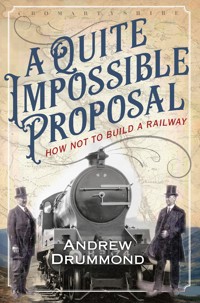
In the 1890s, the people of north-west Scotland grew tired of Government Commissions sent to consider a railway to Ullapool. Despite rock-solid arguments in favour of such a railway, neither government nor the big railway companies lifted a finger to build one. Against the recommendations of its own advisers, the Scottish Office dismissed the project as 'a quite impossible proposal'. In 1918, history repeated itself with another Commission and another failure to build the railway. 'Drivel' is how one local man described the official government inquiry reports. Few disagreed. This book tells the whole sorry tale of the attempt to improve transportation in the north-west Highlands and the resulting government inquiries, set against the region's economic and social problems and civil unrest in the crofting communities. Stories, facts and figures have been unearthed from the archives of government departments and railway companies, from local people's letters and petitions, from contemporary newspapers and from the plans prepared for the hoped-for railways. Other unbuilt railways to the north-west coast are also described. But this story is not just about planned railways that were never built. It is about the frustrations of the people of the Highlands in the face of government incompetence, railway-company obstructionism, local rivalries and the struggle against the historical injustice of land-ownership.
Sie lesen das E-Book in den Legimi-Apps auf:
Seitenzahl: 579
Veröffentlichungsjahr: 2020
Das E-Book (TTS) können Sie hören im Abo „Legimi Premium” in Legimi-Apps auf:
Ähnliche


















Andrew Drummond was born in Edinburgh and educated at the University of Aberdeen and King’s College, London. His first novel, An Abridged History of the Construction of the Railway Line between Garve, Ullapool and Lochinver, was published by Polygon and shortlisted for the Saltire First Book of the Year Award in 2004. His later novels, also published by Polygon, are A Handbook of Volapük, Elephantina and Novgorod the Great, and he is also author of The Intriguing Life and Ignominious Death of Maurice Benyovszky (Routledge).
First published in Great Britain in 2020 by
Origin, an imprint of Birlinn Ltd
West Newington House
10 Newington Road
Edinburgh
EH9 1QS
www.birlinn.co.uk
ISBN: 978 1 912476 88 6eISBN: 978 1 788852 71 5
Copyright © Andrew Drummond 2020
The right of Andrew Drummond to be identified as the author of this work has been asserted by him in accordance with the Copyright, Designs and Patents Act, 1988.All rights reserved. No part of this publication may be reproduced, stored, or transmitted in any form, or by any means, electronic, mechanical or photocopying, recording or otherwise, without the express written permission of the publisher.
British Library Cataloguing-in-Publication Data
A catalogue record for this book is available on request from the British Library.
Typeset by Biblichor Ltd, Edinburgh
Printed and bound by Clays Ltd, Elcograf, S.p.A.
CONTENTS
List of Illustrations
Acknowledgements
Introduction
1. ‘A Right to Improved Communications’
Railways for the North-West of Scotland?
2. ‘We Must Speak the Truth to All Men’
The Condition of the People of the Highlands and Islands
3. ‘Our Trusty and Well-Beloved Commissioners’
The Napier Commission and the Crofters’ Law
4. ‘The Railway Would Be the Making of the Place’
Agitation for Railways and Better Communications
5. ‘Encumbering Rocks and Great Hilliness’
The Garve to Ullapool Railway Proposal
6. ‘Bodies of Distinguished Strangers’
The Campaign and the Commissions
7. ‘The Day for Promises, Evasion and Trifling is Past’
Costs, Revenues and Government Prevarication
8. ‘A Railway Terminus on the Moon’
The Loch Maree and Aultbea Railway
9. ‘Zeal and Enterprise’
Plans for Other Railways
10. ‘Imprisonment With or Without Hard Labour’
The Light Railways Act of 1896
11. ‘Unsatisfactory from the Very Beginning’
Railways on Skye and Lewis
12. ‘The Luxury of a Steam-Tramway’
Tramlines and Electricity
13. ‘Pestilential Robber Barons’
Social Upheaval, 1918–1919
14. ‘Difficulties in Paying the Fare’
The Rural Transport (Scotland) Committee of 1918
15. ‘Not an Economic Proposition’
Major Vyner’s Idea
16. ‘National Duty and National Policy’
The Twenty-first Century
Appendices
1.
Table Showing Conversion of Farming Land to Deer Forest
2–9.
Members of Committees, Commissions and Company Boards
10.
Proposed Route of a Twenty-first-Century Railway Line
Chronology
Notes
Bibliography
Index
ILLUSTRATIONS
PLATES
Francis, Lord Napier, who chaired the inquiry into crofting and economic conditions in 1883.
John Murdoch, journalist and campaigner for land reform in the Highlands and Islands.
The HMSLively, which served as transportation for the Napier Commission, until it was wrecked in 1883.
Sir John Fowler, railway engineer and co-designer of the Forth Bridge.
Arthur Fowler, eldest son of Sir John Fowler, c. 1892, promoter of the Ullapool Railway in 1890 and 1896.
The rear of Braemore House, near Ullapool – built for Sir John Fowler.
A full-sized mock-up of one of the tunnels of London’s Metropolitan Railway, designed by Sir John Fowler, in the grounds of Braemore House.
Murdoch Paterson, chief engineer of the Highland Railway.
Ordnance Survey map showing proposed route of the Garve to Ullapool railway in 1890.
John Henry Dixon, who co-ordinated the Aultbea railway campaign.
View across the western end of Loch Maree from Inveran House.
Part of John Dixon’s map of the proposed Aultbea railway and its rival to Ullapool.
Map prepared by the Western Highlands and Island Commission in 1891, showing proposed lines to the west coast.
Stornoway Harbour c. 1906.
Western end of the Pentland Road, at Carloway, where there were plans for a light railway to Stornoway.
Map prepared by William Dunbar of the Scottish Office in 1892, showing most of the proposed railways.
Map of ‘compromise’ railway to link Achnashellach, Gairloch and Loch Broom.
Present-day view south-eastwards up the strath at the head of Loch Broom.
Rev. Montague Fowler, third son of Sir John, c. 1900.
D. S. Ross, Inspector of the Poor, and secretary of the Lochbroom Executive Committee of 1918, and Dr Wallace, local physician and Committee member.
Commander Clare Vyner (with the Queen Mother), proposer of an Ullapool railway in 1945.
IN-TEXT MAPS AND PLANS
5.2 Plan showing how the Ullapool railway would branch off the Strome Ferry line at Garve station.
5.3 Plan showing the terminus of the railway from Garve at Ullapool pier.
5.4 Detail from Paterson’s plans, showing the proposed tunnel at Braemore.
6.1 Section of Admiralty chart for Loch Broom, showing the area between Ullapool and the Summer Isles.
8.1 Part of the Ordnance Survey map supplied with the plans showing the Achnasheen to Aultbea railway in 1892.
8.2 Detail from the Meiks’ plans for the Aultbea railway, showing how the line would bypass Kinlochewe.
8.3 Detail from the Meiks’ plans for the Aultbea railway, showing the two tunnels above Loch Maree.
8.4 Detail from the Meiks’ plans for the Aultbea railway, showing the terminus at Aultbea pier.
11.1 For Skye, the Hebridean Light Railway Co. proposed two lines covering much of the island and skirting around some very hilly terrain. Note that Kyleakin, the ferry port for Kyle of Lochalsh, is not served at all: Mallaig was to be the mainland port of choice.
11.2 In 1898, the Hebridean Light Railway Co. drafted plans for a short railway which simply traversed Lewis from east to west, for the transportation of fish.
IN-TEXT ILLUSTRATIONS
2.1 Drawing (by Alexander Stuart Boyd, aka ‘Twym’) of the Napier Commission in session in Glasgow, 19 October 1883.
5.1 Sample page from the Book of Reference which accompanied the 1890 railway plans: items of interest at Ullapool.
Detailed maps and plans of the proposed railways may be viewed at: www.andydrummond.net/impossible
ACKNOWLEDGEMENTS
My thanks for assistance, advice and clues must go above all to Joan Michael of Ullapool, without whose encouragement, patience and local knowledge much of this book would be pure guesswork. I am seriously in debt to Jack Kernahan of Fortrose, who generously furnished me with the notes, plans and photos from his own researches into the Skye and Lewis railway proposals; and also to David Prescott of Dunblane for his enthusiastic, inspired and informed demonstration of how the Ullapool Railway might be built today. And then, in loose alphabetical order, to: Hugh Andrew for his suggestions on exploring the historical context; Dr Karen Buchanan of the Gairloch Museum, for her help on matters Aultbean; Andrew Cordier of Banchory for his calm explanations of unfathomable Admiralty charts; Peter Newling, for his kind sharing of Fowler family photographs and historical knowledge of the Braemore estate; David Spaven and John Yellowlees, gentlemen railway-encyclopaediae of Edinburgh, who kept my wheels on the correct rails; Gavin Strang, for his potted history of Lord Lovelace; David Sutherland, herring-history-man extraordinaire, for separating my red herrings and silver darlings; my editor Mairi Sutherland, whose stoicism has been exemplary; and finally to the ever helpful staff of the National Records of Scotland and the National Library of Scotland, in Edinburgh.
Should any of these people prove responsible in any way for my omissions and mistakes, then I will let them know quite forcefully. But the likelihood is small.
Andrew Drummond
1
‘A Right to Improved Communications’
Railways for the North-West of Scotland?
At the end of the First World War, a group of eminent civil servants put forward the idea that the inhabitants of north-west Scotland ‘have a “right” to improved communications in the same way that they have a “right” to cheap postage’.1 This rather bold sentiment reiterated what had been said several times before in connection with the development of railways in the remoter parts of Scotland. In 1891, for example, a Liberal MP in the House of Commons argued that
In the Postal Service a letter is carried for 1d., but it may cost the Post Office 6d. to carry it. There is a loss to the Exchequer, but there is no charity towards the individual whose correspondence is carried; he simply enjoys the advantage of a system in common with the rest of the country. So will the people pay for the use of harbours and light railways as they do in other parts of Scotland.2
Interesting and arguably very sound ideas, which stand up to robust examination even today. But in 1891, such reasoning had a greater resonance. Railways at that time constituted the very lifeblood of transportation. There were no motor-cars or charabancs puttering along country lanes anywhere in the north of Scotland: on land, you either rode on a cart or – less likely – inside a coach, walked or – less likely – rode on a horse; if you were lucky, had far to go, could afford it and lived near a harbour, you could take advantage of the erratic steamer services provided by David Macbrayne, which would transport you to Glasgow or the islands.
But the logistics of travel were daunting: a Barra man stated in 1883 that if he wished to make a judicial complaint of any sort, he would have to travel to see the procurator fiscal in Lochmaddy – a journey of at least 50 miles to be made on foot, with two ferries intervening. It took about two days. When asked whether he would ‘rather lose something than go on such business’ he replied ‘I would, by far.’3 Before the completion of the railway from Fort William to Mallaig in 1901, one could catch a coach from Arisaig to the Fort, around 35 miles; that journey took seven and a half hours and it cost around 11s – easily half of the average weekly wage. After the coming of the railway, the journey time was ninety minutes and the cost about one-third. Similarly, for the 50-mile trip from Fort William to Kingussie in the central Highlands, you had to pay the coachman 14s 6d (second class; or 17s 6d if you could rise to first class) and put up with being jolted around for six and a half hours. Even short-distance travel required long and painful inner debate.4 Towards the end of the First World War, many journeys in the remoter parts of the Highlands were still slow (the new-fangled motor-vehicles, a great rarity, could barely manage 8 mph), they were uncomfortable (sometimes one sat in the close company of live lobsters and calves) and they were expensive.
So railways constituted something of a revolutionary force – across the world – in the nineteenth century. In North America, the transcontinental railroads were effectively stitching together the United States and Canada. In Europe, railways were being laid down mile after mile to consolidate new or existing sovereign states. In Britain, the first half of the 1840s was characterised by ‘railway mania’, during which every town and county had its own building projects and competing lines. After the bubble of railway construction burst during the economic downturn of the second half of that decade, there was a short lull; and then came yet more railways across the land.
In Scotland, where things happened a little later, there was growth in both the central belt and Angus in the 1850s and 60s, largely driven by the need to move coal from mining areas to industrial towns and cities; the 1860s and 70s saw the building of railways up the central spine of Scotland (from Perth to Inverness) and into the north-east (Aberdeen and Elgin). Over this period, smaller railway companies were gobbled up by larger ones until, by the 1880s, the railway lines had almost all settled under the management of four huge companies – the Highland, the Great North of Scotland, the Caledonian and the North British. In the last two decades of the nineteenth century, these companies were anxious, on the one hand, to ensure that their rivals did not encroach on ‘their’ territory and, on the other hand, to milk as much revenue as possible from the routes that they controlled.
Such competition gave rise to some bizarre occurrences. On one day in December 1896, civil servants in London were surprised to receive no fewer than three rival proposals to build a railway between Fort Augustus and Inverness: one from the Highland Railway, one from the North British Railway and one from a tiny company named the Invergarry and Fort Augustus Railway (funded almost exclusively by the brewer Lord Burton, owner of the Cluanie and Loch Quoich estate). It was clear that neither of the two larger companies wanted Lord Burton to succeed – and one has to concede that the project to run a line up the side of Loch Ness to Inverness was a step too far for such a small outfit. It was equally clear that the Highland Railway did not want any rival coming within whistling distance of its citadel in Inverness; the Highland proposal therefore had the whiff of a ‘spoiler’ strategy. As we shall see, the company was not above getting permission to build a railway without any intention of going ahead with construction, the permission merely being used to block any competing attempt.5
While these railway companies tightened their grip over the Scottish landscape south and south-west of Inverness, the north-west of Scotland was largely left untouched. A desire for social and economic improvement was sweeping through communities in the northern counties and the western islands. Thus, while the Highland Railway was pressing ahead with plans to extend the Dingwall to Strome Ferry line all the way to Kyle of Lochalsh, and the West Highland Railway was ploutering its way muddily across the moors from Crianlarich to Fort William and ultimately Mallaig, the Scottish Office and Members of Parliament were being assailed with petitions from local communities advocating small branch lines to the north-west coast. We will look at these lines in more detail later, but let us list them here, to familiarise ourselves with the exotic nature of the proposals.
The southernmost project was the Achnasheen to Aultbea railway. This would branch off the Highland’s Dingwall to Strome Ferry line at Achnasheen, 28 miles west of Dingwall. It would then proceed in elegant curves up Glen Docherty and over the hill to Kinlochewe, before following the south shore of Loch Maree to its western end (some interesting engineering work was required, inclusive of several viaducts that would today be worthy backgrounds to a Hollywood blockbuster about boy wizards). At Poolewe it would curve around the eastern shore of Loch Ewe to terminate just at the end of the pier at Aultbea. From here, so the plan went, connecting steamers sailed to Stornoway. This line was to be slightly more than 37 miles in length.
Slightly further north came the Garve to Ullapool railway. This was a line of 33 miles in length which, like the Aultbea line, would branch off from the Strome Ferry line; the junction would be at the village of Garve, 12 miles west of Dingwall (16 miles east of Achnasheen). It would proceed north-westwards along the same route as the modern A835 road, drop in precipitous manner to the head of Loch Broom and end up conveniently at the steamer pier in the centre of Ullapool – where, with a hop and a skip, the refreshed and rested traveller could also board a steamer bound for Stornoway.
Thirdly, the Culrain to Lochinver branch railway would start on the existing Far North Line operated by the Highland Railway Company, at the village of Culrain, which lies about three miles north-west of Bonar Bridge. The Far North Line had connected Inverness with Bonar Bridge in 1864, and with Wick and Thurso in 1874. From Culrain, the branch line would make its way up Glen Oykel (following the route of the present-day A837), head north up to Loch Assynt and ease its way into Lochinver from the north-east: a line of about 42 miles in total.
Furthest north, the Lairg to Laxford railway was to start at the village of Lairg, also a station on the Far North Line and situated about 8 miles north of Culrain. This line would reach the west coast by following the modern A838 road past Loch Shin and Loch More and then down the Laxford River, to terminate at the head of the sea-loch at Laxford Bridge – a place slightly less deserted then than now (but not much). A distance of around 37 miles would have been covered.
On the islands, things were more complex. For Skye, several proposals were in circulation, all for lines centred on Portree. Railways were proposed from there to Dunvegan and to Uig or Snizort in the west of the island (with one proposal even suggesting Trumpan, a tiny place now, tucked away near the top of the Vaternish peninsula). All of these would have connected with steamers to Lewis or Harris. Southwards from Portree, there were to be lines to Broadford and even Kylerhea or Isleornsay, these connecting in imaginative ways to further transportation options on the mainland.
On Lewis, Stornoway was the obvious hub for lines extending in different directions – to Carloway on the west coast and to Ness at the top of the island, either via the township of Barvas on the west coast, or via Back and Tolsta on the east. From the west coast, there was no expectation of further sea connections even by the most fevered of imaginations: the railways would be primarily for the transportation of dead fish back to Stornoway. (Although, come to think of it . . . there was once a plan for Fort William to become a rival to Liverpool, the port of choice for transatlantic steamers to and from Quebec: the more northerly crossing would shave a day off a six-day voyage.6 So why not, after all, Canada to Carloway or Stornoway?)
Between 1888 and 1893 these six proposals, along with the extension lines to Kyle of Lochalsh and to Mallaig, exercised the minds of locals, of journalists from the big cities and of politicians resident in far distant London.
But why, you might object, should these railways be of any interest to us now? The fact that only the lines to Kyle and to Mallaig were ever built suggests that Fate had taken a good hard look at the other proposals and found them wanting. Anyway, the Victorians had a thing about building railways, so no surprises here – it’s just something they did. And are there not, in the words of a commentator of 1901, ‘perfectly good carriage roads’ on precisely the routes in question?
All quite valid points, until you remember that this is now, and that was then: a ‘perfectly good road’ was something of an oxymoron for the north-west Highlands at the end of the nineteenth century. For just a moment, picture life without basic transportation options: it is an uncomfortable image. Forget cars and buses and modern ferries. Forget bicycles and horses. Take a walk on the wild side of the Highlands and Islands even today, and then consider just how you could get your bare necessities to and from market without a decent road or a decent railway. Even by horse and cart, your journeys would take forever; by steamer, your options were severely limited. You would be cut off from even the most rudimentary centres of modern civilisation. Access to shops, doctors, schools, lawyers and officialdom would be difficult; in some cases it would be impossible. Your understanding of the outside world would be severely limited in breadth and in time.
So, to answer the central question of the importance of any railway in nineteenth-century Scotland, we need to appreciate that it was not just rails on sleepers. A railway had a social purpose. It could bring isolated settlements within comfortable distance of towns and cities, and it could underpin a developing economy. It allowed people to become part of a wider community and engage more fully with the political questions of the time. James Caldwell, the Liberal MP whom we quoted earlier, put it neatly:
For what purpose is such a railway proposed? Not merely to improve the locality through which the railway will pass, but also for the purpose of bringing the fishing villages into speedy communication with the markets. That is exactly what we want, and no one who knows anything about the North of Scotland will deny that that district is sadly in want of development. We simply ask that we should be treated as part of the United Kingdom. We do not want exceptional treatment. We ask that if poverty exists in Scotland it shall be dealt with.7
Railways as a cure for poverty: it is an assertion which demands closer investigation. In the pages which follow, we will traverse more than a hundred years of clearances, evictions and land-wars. We will contemplate the tragedy of the commons of Ireland. We will gaze upon land-owning hypocrisy, governmental myopia and charitable cruelty. We will stumble across caravans of political gentlemen and their hangers-on, and we shall be impressed by the sight of Royal Commissions sailing around the north and west of Scotland. Before we reach the first episode of the campaign to build a railway to Ullapool, we shall have been caught up in millions of barrels of fish and saluted the herring-eating peoples of the Baltic lands. We will consider forests that were not forests and improvements that failed to improve. We will hear the voices of the dispossessed. We will detect the whiff of revolution on the islands and witness the military occupation of Skye. We will do all of this, because the story of the railways of the north-west cannot be properly understood in isolation from the wider historical background.
2
‘We Must Speak the Truth to All Men’
The Condition of the People of the Highlands and Islands
At the risk of filling our pages with the pronouncements of just one man, we quote once more the words of James Caldwell, the Liberal Unionist MP for Glasgow St Rollox.
In Scotland there is only one thing which a man may do. He may not beg, he may not steal, he may not commit suicide, he has no legal right to relief. The only thing he can lawfully do is to die from starvation.1
Mr Caldwell could be accused of over-egging the facts; but in that period, for many of the people living on the west coast of Scotland and on the islands, his was by no means a fanciful summary. The poor who tried to wrestle a living from the land and the sea suffered from modern-day versions of the biblical plagues, albeit without the locusts: a relentless cycle of hunger and poverty, rent rises and evictions, emigration and migration. Whenever they sought help, it came with a sting in the tail. Whenever they protested, their voices were drowned out. Whenever they thought they had swum clear of the tidal race of penury, another wave crashed over them and sucked them back down. They had nothing, because the land they had once farmed was now the property of others.
THE THEFT OF THE LAND
‘One Absorbing Monopolising Class of Landlords’
In 1883, the Napier Commission was sent out into the wilds of northwest Scotland by a government made slightly nervous by recent events there. We will examine this commission and its works in more detail later, because it was quite extraordinary that such a group of gentlemen should actually talk and listen to ordinary people. The Commission very thoroughly investigated the conditions of crofters and landownership in the region. All of the evidence collected – both oral and written – was recorded for posterity in five enormous volumes; these statements provide us with a very clear view of society and the economics of the time and the place. In a typical example of evidence presented to the Commission, the crofter Donald Campbell of Barra made the following statement on behalf of the people of his township; it was a fair summary of the century so far.
They complain that they are kept down for the last sixty years with high rents, their little holding is made smaller, and deteriorating from having been long cropped, so that they are not now worth cultivating. They cannot support themselves but by their earnings elsewhere, only they lose their time by working after it and about it, and although they are constantly engaged with it, they are not able to make a livelihood out of it for themselves and their families. They are in that condition for the last sixty years. There are today twenty-six families where there were only twelve fifty years ago. They are very badly off . . . Very stormy winters prevailed, and our chief means of support, the potato, has been precarious ever since the potato disease . . . During winters such as these, perhaps the people of the place would have no means of support except shell-fish. [The proprietors] wished to deprive us of the shell-fish . . . They sent away most of our relatives to America thirty-five years ago. They pulled down the houses over their heads and injured them in every possible way. They valued the brutes higher than the men whom God created in his own image, and were more gentle with them.2
‘We must’, concluded Donald Campbell, ‘speak the truth to all men.’ He had just provided a thumbnail sketch of the intolerable conditions of life common in the western Highlands and the Islands. Crofters and fishermen were living in small townships which were packed tight beyond sustainability, only permitted to work land that was unworkable from the beginning or was now exhausted, forced to seek a living away from home or even on another continent. And all this was a result of the land policies pursued by the ruling class of Great Britain for over a century.
The nineteenth century in the northern and western Highlands and Islands is tragically associated with what came to be known as ‘the Clearances’. And the clearing of tenants from large areas of land reached its peak in the first half of the century. But this was merely the end result of a long period of decline that began well before 1745, as the traditional clan chiefs were sucked inexorably into the cycle of wealth and ruin of the southern British economy. Ancestral lands were slowly parcelled up and sold to cover disgraceful debts. After 1745, the process accelerated, and the largely self-sufficient rural economy began to be geared towards the production of goods capable of sale in a wider market. The principal export was soda ash, a substance derived from the burning of kelp seaweed, to be used in the production of glass and soap. Over the years, the west-coast communities also engaged in cattle-rearing, whisky-distilling and fishing, and, as global conditions demanded, in that most useful task of all – providing fighting men for the British army and navy. But after the end of the Napoleonic wars, kelp-processing succumbed to more efficient European alternatives and fighting men were no longer in demand. The people of the Highlands were required to stay at home and scratch a living from whatever land they might have at their disposal. All of this put a great deal of pressure on the land. Migration to the central belt of Scotland, or emigration to the British colonies, began to increase. Sometimes the internal migration was purely seasonal, and sometimes it was only short-term, for a year or two. The fisheries on the east coast, the farms in the south and the factories of the central belt all attracted these temporary migrants. A potato blight in 1846, while not as devastating as that which hit Ireland, exerted further pressure on the crofters and cottars (the landless rural poor) of the region.
At around this time, the availability of cheap and extensive estates began to attract the attention of wealthy industrialists and bankers from England, or those returning to Scotland having made their fortunes abroad. Following on from the instructive and encouraging example set by the Marquis of Stafford and his wife (later the Duke and Duchess of Sutherland),3 large tracts of land were swept quite clear of their original inhabitants and laid out as extensive sheep farms. In the early decades of the century, landowners were able to undertake these cleansing operations with impunity, assured that the political and legal establishment would not lift a finger to assist the victims. (Even William Wilberforce, who, along with Thomas Clarkson, did so much to abolish slavery, was persuaded to ignore the inhuman treatment of the poor much closer to home.)4 Such people as were evicted from their homes in the glens, where they had free access to decent arable and pasture land, were offered entirely unsuitable crofts on rocky parts of the coastline, leaving the sheep to enjoy the fruits of centuries of husbandry.
The Sutherland events, although deservedly infamous, were by no means the most cruel of the clearances. Quite appalling actions were taken against their tenants by the owners of land in other parts of the Highlands and Islands. In the 1830s and 1840s many of the larger estates were formed from smaller parcels of land acquired in stages, the purchasers most frequently being men who had made huge amounts of money in colonial plunder or in the more domestic varieties of human exploitation: mining, brewing and manufacturing. Landowners such as these were by no means averse to continuing the clearance of land under the more acceptable guise of ‘improvements’. In some cases, rather than remove people from their land by brute force, those landowners who could afford to do so would pay for emigration passages, weeding out the poorest and least productive tenants, slowly but surely freeing up the land for other purposes. On the Lewis estate of Sir James Matheson, for example, the strategy was to clear the west coast – where kelp-gathering had once been a traditional source of income – and move tenants either to distant countries or to the east coast of the island, where they could (it was faithfully promised) engage in fishing. The western side of the island thereby vacated was turned over to sheep and deer.
Other landowners were less concerned about the ultimate fate of their evicted tenants, unless it affected their ability to make money out of their estate. When, at the very end of the eighteenth century, the numbers of people taking passage to North America threatened to depopulate large tracts of land where kelp could be harvested, the landowners agitated for legislation which placed obstacles in the way of unfettered sea-passage across the Atlantic. This resulted in the Passenger Vessels Act of 1803. This Act set a high minimum cost of passage and limited the numbers which could be carried aboard a ship: no bad thing, given the utterly appalling and often fatal conditions in which people were forced to live below decks for weeks on end. Nominally, therefore, the legislation was a humane act. As a secondary argument, the promoters of the legislation (led by the Highland League) also suggested that unrestricted emigration would cause severe manpower shortages in the army, at a time when Britain was gearing up for yet another war against the French.
The Act being passed, the outflow of kelp-gatherers and cannon-fodder was stemmed. But when, twenty-five years later, the kelp industry had collapsed and young men were no longer required to line up and die for their country, the landowners suddenly discovered that their estates were cluttered with impoverished tenants and labourers. This perceived overpopulation soon led to agitation for the Government to assist people to leave the country; this necessitated, of course, the repeal of the Passenger Vessels Act, which duly occurred in 1827. So much for compassion.5 As the century progressed, many of the Highland and Island landowners exerted themselves to rid their land of the burden of a growing population. But it was a task fraught with risk: those people who could afford to emigrate and were willing to do so were often younger and more hardy, which meant that they would also be the most likely to provide the muscle to ‘improve’ the land at home and thereby contribute to the wealth of the estates. Generally speaking, though, no tears need be shed for the landowners. There was never a stagnant market for buying land in the Highlands and Islands.
The land reform campaigner John Murdoch summed it up with these words:
Under the land laws established in England by conquest and transplanted into Scotland by fraud, the property and power of the country are being concentrated in the hands of the one absorbing monopolising class of landlords. The estates and farms get larger and larger, and the country is depopulated, to the same end of aggrandising this class.6
John Murdoch deserves far more attention than he has so far received in Scottish history; over several decades he was an indefatigable champion of land reform, before, during and after the short existence of his weekly newspaper The Highlander. Although it would be a step too far to describe him as a revolutionary, he was unequivocally radical in his proposals and not a man to back down from an argument. During the summer of 1883, when the Napier Commission was making its way around Scotland seeking the views of crofters and landowners, John Murdoch followed on behind – and sometimes went ahead – mopping up those people who had missed the opportunity to give evidence to the Commission. He finally caught up with Lord Napier and his colleagues in Glasgow in October 1883 and proceeded to give them two days’ worth of his views, in the most polite, most intransigent and most rousing terms.
The first thing wanted in the Highlands is the revival of the spirit of the people. The second, the calling forth of their intelligence, common sense, and enterprise. The third, definite legislative protection from interference with them by such petty deputies of absentees and aliens as have kept them so long in a state of slavish uncertainty and fear.7
When asked whether he would like to ‘do away with landlordism’, he replied simply: ‘Decidedly.’
In the middle years of the century, the lot of the poor became even worse. From about 1846 onwards, over a period of almost ten years, potato crops were killed off by Phytophthora infestans, more commonly known as potato blight. This originated in Central and North America and was brought to Europe in 1844, where it almost immediately ravaged crops in the British Isles and across northern Europe. The devastation was most severe in Ireland, where, it is calculated, more than a million people died directly or indirectly from starvation. In Europe, while the effects were not so catastrophic, deaths occurred in the tens of thousands, with the Low Countries and Prussia being the worst affected; this crisis in a basic food staple is plausibly considered to be a prime cause of the revolutions of 1848 in France, Germany, Italy and beyond. Closer to home, in the Highlands as in much of the rest of Scotland, the potato had become the daily diet of the poor. This reliance on one cheap food was largely due to the changes in land tenancy – people being moved to tiny crofts with poor soil, where it was impossible to grow anything other than the potato.
The Westminster government intervened during the middle years of the century to alleviate the poverty and near-starvation caused by the lack of arable land and the potato failures. It could scarcely ignore the crisis. But its attitude to the victims tended to be punitive rather than supportive.
THE POOR LAWS
‘Prevent Assistance from Being Productive of Idleness’
Donald Fraser of Glenelg gave evidence to the Napier Commission; he was himself an evicted crofter, but now worked as a schoolteacher, a registrar and an Inspector of the Poor, supervising poor relief. His statements provide a succinct sketch of the state of the townships in the western Highlands. For the people of Glenelg parish, life was precarious: the locality was undergoing rapid depopulation due to ‘a good many [being] put out of their holdings’; there was no work, and the fishing in Loch Hourn was unpredictable. And around seventy-five of the Glenelg population of 1,600 were paupers. When asked, ‘Has the condition of the people improved since you came here?’ Fraser replied: ‘I think it is rather the reverse. I find that we require to give a larger allowance to our paupers than when I came here. They live very largely upon their neighbours – the crofters – who are not in a position to assist them.’8
Fifty years before Napier, the paupers in England and Wales had benefited from the wisdom of their political masters in the passing of the Poor Law Amendment Act of 1834. Although designed to reform provisions for the management of the poor, the Act simply set up institutions which were equally open to abuse – as we see in, for example, the novels of Charles Dickens – and moreover transferred the problems of the rural population to the larger cities, where disease and abject poverty already held sway. These Poor Laws, like later ones in Ireland and Scotland, were designed to place a firm grip on the poor, remove beggars and similar vagabonds from the streets of the cities and roads of the countryside, and put a halt to the ‘moral degradation’ arising from abject poverty. The poor of Ireland were little better off than their English counterparts, since the Irish Poor Law Act of 1838 was modelled closely on the English one.
Scotland had to wait another decade for similar legislation, the Poor Law (Scotland) Act being passed in 1845. The only advantage to being poor in Scotland rather than in England was that – in theory at least – those refused assistance had the right of appeal. In practice, however, this right amounted to very little. Some measure of patriotic protection was offered as well: there was provision in Clause 77 for the removal of English and Irish (and, indeed, Manx) paupers back to their countries of origin, if they had been resident in Scotland for less than five years. The English legislation had a reciprocal clause for Scottish repatriation. Interestingly, the Irish laws had no such clause, leading one later commentator to remark drily that this was ‘probably because it was thought that the Irish guardians would have no use for such power’9 – no pauper in their right mind would cross the sea and seek a living in Ireland.
The figures for poor relief in Scotland are quite striking: between 1846 and 1850 – 1847 being the year being when the potato blight was at its worst – the amount of poor relief dispensed doubled (from £295,000 to £581,000).10 The money to fund poor relief came from the rates; it is perhaps no surprise that crofters, frequently among those requiring relief, paid one shilling per pound of their rental towards relief, but that owners of sporting land paid no rates on the acreage of that land. The 1841 census put the population of Scotland at 2.6 million. In 1846, 2.6 per cent of that population were registered as ‘poor’ and 1 per cent received assistance; by 1848, the latter figure had risen fivefold (to 126,684 individuals). The number of paupers ‘removed’ to England and Ireland peaked in 1848 at around 13,700, and then fell back to around 6,000 per annum and were no longer of any concern to the Scottish inspectors of the poor.
What was quite clear from the policies of the Poor Law Commission was that it was never going to be charitable. The Assistant Secretary to the Treasury, Charles Trevelyan, who oversaw the Poor Laws in both Scotland and Ireland, pointed his officials firmly in the right direction:
Next to allowing the people to die of hunger, the greatest evil that could happen would be their being habituated to depend upon public charity. The object to be arrived at, therefore, is to prevent the assistance given from being productive of idleness and, if possible, to make it conducive of increased exertion.11
Following this very clear instruction, the Central Board of Management of the Fund for the Relief of the Destitute Inhabitants of the Highlands, founded in 1847 for the purpose of distributing moneys largely donated by churches and private citizens (the Government was not going to be seen funding any such thing), was very much against handouts: those who wanted relief would have to work for it, frequently in conditions not dissimilar to slavery. And there are today still very tangible traces of what was achieved by the labour of starving men in the north-west of Scotland: the ‘Destitution Roads’. The longest of these was the one running along the south side of Loch Maree, past Gairloch and up to Braemore – what is now the A832. There was another from Lairg to Laxford, now the A838. Rather conveniently, both of these roads provided much improved access to the huge estates belonging to Mackenzie of Gairloch on the one hand, and the Duke of Sutherland on the other – and all free of charge. Idleness turned to very good effect, their lordships would have agreed.
The Poor Law in Scotland provided some assistance but fell far short of addressing the underlying cause of the problems, which was not the lack of seaweed, potatoes or fish, but the hugely inequitable conditions of landownership. Evictions and migrations had not ceased; the crofters and landless cottars continued to become poorer; the landowners continued to become richer and to build extravagant homes, and very occasionally used their wealth to engage in estate improvements (we use the term both in its literal sense, and in its usage by the Duke of Sutherland). But what did change, slowly, was the attitude of the country’s newspapers and more principled MPs, who at last began to question the appalling conditions of the rural poor; in this burst of conscience, they were almost certainly prodded along by the activities of land reformers and by events in Ireland. One result of the agitation among the professional classes was a floodlight on the later clearances whenever they occurred; these tended to be of much smaller scope, but attracted much wider adverse publicity. One example, close to Ullapool, was Alexander Pirie’s eviction of twenty-three families in the Loch Broom area in 1879, of which we shall hear more later.
CROFTERS, TACKSMEN AND OTHERS
‘Extraordinary Privation’
It is perhaps worth pausing here to remind ourselves of the general economic and social status of the vast majority of people in the Highlands and Islands. A definition of the hierarchy of land-tenancy was provided by a gentleman writing in 1856 about the Scottish Poor Laws; we quote his definition below, as it is both revealing and flawed:12
The population of these districts [the Highlands and Islands] chiefly consists of three classes, each holding land directly from the proprietor. The ‘Crofters’ are persons occupying lands at a rental not exceeding 20l. [£20] a year, and are by far the most numerous class. The ‘Tacksmen’ have leases or ‘tacks’ generally paying a rent exceeding 50l. a year, and in point of circumstances are the most considerable of all the classes. Intermediate between these is another class paying rent of between 20l. to 50l., and who not having leases are not ‘Tacksmen’ and not liking to be classed with the ‘Crofters’ are called ‘Tenants’. Besides these three classes, who hold land directly from the proprietor, there is another called ‘Cottars’, who are numerous on some districts and who either do not hold land at all, or hold it only from year to year as sub-tenants.
Although this is a concise enough definition, the author mistakenly supposed that all crofters paid rent directly to the landowner; in fact, they generally paid rent to the tacksman, and one can see, from the discrepancy between multiple rents received of £20 each and one paid out of £50, just how much a tacksman stood to profit. Our commentator’s Victorian view of the population clearly pokes through when he mentions ‘cottars’ almost as an aside and most definitely apart from the ‘three classes’; cottars certainly out-numbered crofters and tacksmen and those rather posh ‘tenants’. He writes further that, whereas earlier the ordinary people had their own ‘runrigs’ and shared common grazing, rotating their management of the arable lands on a regular basis, a change came ‘in the present century’ which led to ‘crofters’, as they were now called, receiving a fixed allocation of land, usually small, which had to make do for themselves and their children. The gathering of kelp for a couple of months a year supplemented the family income. The crofter (our informant supposes) thus ‘lives, or rather did live, in a rude kind of abundance, comparatively idle, and knowing little of the daily toil by which labourers elsewhere obtain a livelihood’. The words ‘or rather did live’ give the game away.
Thirty years later, Lord Napier and his commission had the daunting task of fixing the crofter/cottar problem. When their massive report was published in 1884, even they were a little vague about the difference between a crofter and a cottar:
By the word crofter is usually understood a small tenant of land with or without a lease, who finds in the cultivation and produce of his holding a material portion of his occupation, earnings, and sustenance, and who pays rent directly to the proprietor. The term cottar commonly imports the occupier of a dwelling with or without some small portion of land, whose main subsistence is by the wages of labour, and whose rent, if any, is paid to a tenant and not to the landlord. The crofter is a small farmer who may live partly by the wages of labour; the cottar is a labourer who may have some share in the soil. But these definitions are deceptive, for there are crofters who are sub-tenants under tacksmen, and there are many cottars who pay rent to the owner. The distinction between the two classes is more easily felt and understood than delineated. Nor is a strict definition necessary. For the purposes of this inquiry and report we limit the class of crofters to tenants paying not more than £30 annual rent, but we are unable to fix any point in rental below which the crofter descends into the cottar class.13
What this tells us is that the distinction between a crofter and a cottar was quite unclear to a group of men tasked with improving the lives of crofters and cottars; it could not be defined by activity, income, rental or anything measurable; hence Napier’s arbitrary figure of £30 rent. Perhaps the people whom Napier interviewed were a little clearer about their own status: of 775 interviewees, well over half defined themselves as crofters (384) or cottars (36); and of these, more than a third also stated that they pursued an additional trade – ‘crofter and mason’, ‘crofter and post-master’, ‘cottar and fisherman’ and so on (there was even one ‘crofter and missionary’). But the distinction was important: it can be argued that the Napier Report’s lack of clarity about the difference between crofter and cottar led to faulty legislation at a later date.
It should be remembered that the rent was not restricted to rent for a piece of land; typically, a crofter would pay additional sums according to the number and type of animals he kept on his croft. During the course of a rather tetchy interview with the Napier Commission, William Gunn, the factor for the Cromartie estate near Ullapool, stated that supplementary rates ‘for cows were from 7s to 10s each; young cattle, 4s to 6s each; sheep 1s 6d to 2s 6d each; horses, 15s to 20s each’.14 One of Gunn’s tenants had earlier that day complained bitterly that he had to pay an extra £1 for every additional horse, regardless of where the horse was to be grazed; since he was already paying around £3 as a basic rent, a horse cost him an extra 33 per cent.15 But a horse was essential if any improvement was to be made either to the land or to the overall quality of life. And on top of all that, a crofter had to pay rates to the county council.
Crofting was a relatively new form of land management, arising in the second half of the eighteenth century.16 It replaced, as the above definition suggests, an earlier form of community-based tenancy, where much more of the available land was utilised in common and where the good and less good parcels of arable land were shared equally amongst the residents of the adjacent township. As a system, crofting was introduced in order to ensure that ‘improvements’ took place, by shunting the people of the more open townships into smaller, clearly delineated crofts which were most frequently – and quite deliberately – laid out too small to provide a living on their own: other employment needed to be found. And so, as if by magic, there was always a ready supply of labour to harvest kelp or man fishing boats, and so increase the income of the landowner. Crofting, then, emerged from the practice of clearing estates. Under more sympathetic governance, it might have led to a positive move towards the establishment of a peasant class on the European model; but in the way it was implemented in Scotland, it became the framework for oppression, poverty and – ultimately – the emptying of the land. As our Victorian Poor Law analyst explains:
Those who emigrated were for the most part the better description of tenants and crofters, whose lands were then in most cases let for sheep-farming, by which higher rents were obtained – yet adding at the same time to the disproportion between population and employments, and by consequence tending to depress the condition of the bulk of the people; and thus to render them less capable of bearing up against extraordinary privation, whether arising from failure of crops, the inclemency of the seasons, or any other cause.17
DISEASE, NUTRITION, HOUSING AND DEATH
‘Grossly Insanitary Conditions’
Alexander Fraser MB, of Edinbane, provided the Napier Commission with a report on the health of the people of Skye. Prefacing his remarks with the observation that, if the people did not live their days so much in the open air, things would be a lot worse, he reports
a good deal of scrofulous disease, and also a good deal of lung disease, and a large proportion of eye disease . . . This year, eye diseases from want of food – ulceration of the cornea and so on; scrofulous complaints, and abscesses connected with diseased bone.18
He attributed all this to the abysmal quality of housing, the nature of the food and the lack of proper clothing. Worst affected were children who ‘have not sufficient milk. There is no grass at present for the cows to make milk with.’ On the same theme, Roderick McMillan, grocer of Portree, stated that
the want of grazing for cows and the want of ground for potatoes is felt very much . . . The land surrounding Portree is practically in the hands of two individuals, none of whom will give grazing to the village people . . . The consequence is that the milk supply for the village is exceedingly scarce and very dear; and the children suffer in their health through the scarcity of milk.19
The comments of these two men were echoed throughout the body of evidence to the Napier Commission; clearly, the health of the average person in the Highlands and Islands was piteous. The root cause, once again, was the lack of land.
This dire situation was one which the Napier Commission did not address directly, and as a result, such conditions continued for another three decades. We are indebted to the report issued by the Dewar Committee of 1912 for a glimpse into the grim living conditions faced by crofters and cottars alike. Sir John Dewar was the elder son of the founder of the whisky blend; he and his Highlands and Islands Medical Service Committee were asked by the Treasury to consider ‘how far the provision of medical attendance in districts situated in the Highlands and Islands of Scotland is inadequate’ and come up with some proposals. Yet another glaring social problem, yet another committee. Fortunately, Dewar and his colleagues did not have to look far or investigate deeply to discover how ‘inadequate’ things were. Put simply and concisely:
The bulk of the people are, over large sections of area, in very straitened circumstances, especially at certain periods of the year, and are consequently unable to pay for medical attendance even when the fee, having regard to time and distance, is quite inadequate to compensate the doctor. Ready cash is a rarity with the ordinary crofter; and the amount is at most so small that when he has provided for the necessaries of life and paid his rent and rates he has, as a rule, little or nothing left to pay the doctor.20




