


26,99 €
Mehr erfahren.
- Herausgeber: John Wiley & Sons
- Kategorie: Geisteswissenschaft
- Serie: The American History Series
- Sprache: Englisch
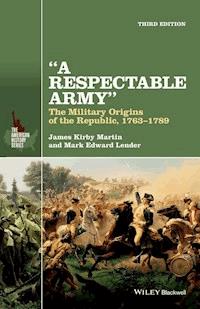
A fully revised and updated third edition of the most established and innovative historical analysis of the Continental Army and its role in the formation of the new republic.
- Written by two experts in the field of early U.S. history
- Includes fully updated coverage of the military, political, social, and cultural history of the Revolution
- Features maps, illustrations, a Note on Revolutionary War History and Historiography, and a fully revamped Bibliographical Essay
- Fully established as an essential resource for courses ranging from A.P. U.S. history to graduate seminars on the American Revolution
Sie lesen das E-Book in den Legimi-Apps auf:
Seitenzahl: 418
Veröffentlichungsjahr: 2015
Ähnliche



















CONTENTS
Cover
Title page
List of Illustrations
Preface
Epigraph
1 Of Lexington and Concord, and the Myths of the War, 1763–1775
Lexington and Concord
Of Standing Armies (Power) and Militia (Liberty)
Ideological Transmission
The Provincial Militia Tradition
The Tyranny of Standing Armies
2 The Republican War, 1775–1776
A Republican Order as the Goal
Regulars Versus Republicans: The British at Bay
The Adoption of a Continental Army
The British Military Counterthrust
The New York Campaign
Success and Failure
3 Toward an American Standing Army, 1776–1777
The Nature of the Continental Army
A New Model Rebel Army
William Howe’s Campaign of 1777
The Saratoga Campaign
The American Search for Manpower
The Old Myth and the New Soldiery
4 On and Off the Road of Despair, 1777–1779
Valley Forge
Mounting Anger in the Officer Corps
Tables Turned: New Life for the Cause
The British Dispersal of 1778
Growing Internal Division: Army and Society
5 Moral Defeat and Military Turnabout, 1779–1781
Dispersed Warfare
Patriot Naval Exploits
Financial Morass on the Home Front
The War in the Southern States
Treason, Pensions, and Mutinies
Sudden Turnabout: The Road to Yorktown
6 Of War, National Legitimacy, and the Republican Order, 1781–1789
The Yorktown Campaign
Formulating a Peace Settlement
The Newburgh Conspiracy
Transition to a Postwar World
Myth and Tradition: A Political/Military Settlement
A Note on Revolutionary War History and Historiography
Index
End User License Agreement
List of Illustrations
Chapter 02
Figure 2.1 Map of the Northern Campaigns.
Figure 2.2 George Washington by James Peale, after Charles Willson Peale, c.1787–1790.
Figure 2.3 Charles, Lord Cornwallis, British general. North Wind Picture Archives/Alamy.
Chapter 03
Figure 3.1 Horatio Gates by James Peale, c.1782. De Agostini Picture Library/Bridgeman Images Horatio Gates.
Figure 3.2 Molly Pitcher firing her fallen husband's cannon at the Battle of Monmouth. North Wind Picture Archives/Alamy.
Chapter 05
Figure 5.1 Map of Clark’s Western Campaigns, 1778–1779.
Figure 5.2 Thayendanegea or Chief Joseph Brant. The Art Archive/Alamy.
Figure 5.3 Action between the
Serapis
and
Bonhomme Richard
, 1779. Classic Image/Alamy.
Figure 5.4 Map of the Southern Campaigns.
Figure 5.5 Benedict Arnold. North Wind Picture Archives/Alamy.
Figure 5.6 Nathanael Greene, by Charles Willson Peale, from life, 1783, oil on canvas. Private Collection/Peter Newark Pictures/Bridgeman Images.
Chapter 06
Figure 6.1 Jean-Baptiste Donatien de Vimeur, Comte de Rochambeau, by Charles Willson Peale, from life, c. 1782.
Guide
Cover
Table of Contents
Begin Reading
Pages
ii
iii
iv
v
ix
x
xi
xii
xiv
1
2
3
4
5
6
7
8
9
10
11
12
13
14
15
16
17
18
19
20
21
22
23
24
25
26
27
28
29
30
31
32
33
34
35
36
37
38
39
40
41
42
43
44
45
46
47
48
49
50
51
52
53
54
55
56
57
58
59
60
61
62
63
64
65
66
67
68
69
70
71
72
73
74
75
76
77
78
79
80
81
82
83
84
85
86
87
88
89
90
91
92
93
94
95
96
97
98
99
100
101
102
103
104
105
106
107
108
109
110
111
112
113
114
115
116
117
118
119
120
121
122
123
124
125
126
127
128
129
130
131
132
133
134
135
136
137
138
139
140
141
142
143
144
145
146
147
148
149
150
151
152
153
154
155
156
157
158
159
160
161
162
163
164
165
166
167
168
169
170
171
172
173
174
175
176
177
178
179
180
181
182
183
184
185
186
187
188
189
190
191
192
193
194
195
196
197
198
199
200
201
202
203
204
205
206
207
208
209
210
211
212
213
214
215
216
217
218
219
220
221
222
223
224
225
226
227
228
229
230
231
232
233
234
235
236
237
238
239
240
241
242
243
244
245
246
247
248
249
250
The American History Series
Abbott, Carl
Urban America in the
Modern Age: 1920 to the Present
, 2d ed.
Aldridge, Daniel W.
Becoming American:
The African American Quest for Civil
Right, 1861–1976
Barkan, Elliott Robert
And Still They
Come: Immigrants and American Society,
1920s to the 1990s
Bartlett, Irving H.
The American Mind in
The Mid-Nineteenth Century
, 2d ed.
Beisner, Robert L.
From the Old Diplomacy
to the New, 1865–1900
, 2d ed.
Blaszczyk, Regina Lee
American Consumer
Society, 1865–2005: From Hearth to HDTV
Borden, Morton
Parties and Politics in the
Early Republic, 1789–1815
Carpenter, Roger M.
“Times Are Altered with Us”: American Indians from Contact to the New Republic
Carter, Paul A.
The Twenties in America,
2d ed.
Cherny, Robert W.
American Politics in
The Gilded Age, 1868–1900
Conkin, Paul K.
The New Deal
, 3d ed.
Doenecke, Justus D., and John E. Wilz
From Isolation to War, 1931–1941
, 3d ed.
Dubofsky, Melvyn
Industrialism and the
American Worker, 1865–1920
, 3d ed.
Ferling, John
Struggle for a Continent:
The Wars of Early America
Ginzberg, Lori D.
Women in Antebellum
Reform
Griffin, C. S.
The Ferment of Reform,
1830–1860
Hess, Gary R.
The United States at War,
1941–45
, 3d ed.
Iverson, Peter, and Wade Davies “
We Are Still Here”: American Indians since 1890,
2d ed.
James, D. Clayton, and Anne Sharp
Wells
America and the Great War,
1914–1920
Kraut, Alan M.
The Huddled Masses:
The Immigrant in American Society, 1880
–
19021
, 2d ed.
Levering, Ralph B.
The Cold War: A Post–Cold War History
, 2d ed.
Link, Arthur S. and Richard L. McCormick
Progressivism
Martin, James Kirby, and Mark Edward
Lender
“A Respectable Army”: The Military
Origins of the Republic, 1763–1789
, 3rd ed.
McCraw, Thomas K.
American Business
Since 1920: How It Worked
, 2d ed.
McMillen, Sally G.
Southern Women: Black and White in the Old South
, 2d ed.
Neu, Charles E.
America’s Lost War:
Vietnam, 1945–1975
Newmyer, R. Kent
The Supreme Court
under Marshall and Taney
, 2d ed.
Niven, John
The Coming of the Civil War,
1837–1861
O’Neill, William L.
The New Left: A History
Pastorello, Karen
The Progressives:
Activism and Reform in American
Society, 1893–1917
Perman, Michael
Emancipation and
Reconstruction
, 2d ed.
Porter, Glenn
The Rise of Big Business,
1860–1920
, 3d ed.
Reichard, Gary W.
Politics as Usual: The
Age of Truman and Eisenhower
, 2d ed.
Remini, Robert V.
The Jacksonian Era,
2d ed.
Riess, Steven A.
Sport in Industrial
America, 1850–1920
, 2d ed.
Simpson, Brooks D.
America’s Civil War
Southern, David W.
The Progressive
Era and Race: Reaction and Reform,
1900–1917
Storch, Randi
Working Hard for the
American Dream: Workers and Their
Unions, World War I to the Present
Turner, Elizabeth Hayes
Women and
Gender in the New South, 1865–1945
Ubbelohde, Carl
The American Colonies
and the British Empire, 1607–1763
, 2d ed.
Weeks, Philip
Farewell My Nation: The
American Indian and the United States in
The Nineteenth Century
, 2d ed.
Wellock, Thomas R.
Preserving the
Nation: The Conservation and Environmental Movements, 1870–2000
Winkler, Allan M.
Home Front U.S.A.:
America during World War II
, 3d ed.
Wright, Donald R.
African Americans in
the Colonial Era: From African Origins
through the American Revolution
, 3d ed.
“A Respectable Army”
The Military Origins of the Republic, 1763–1789
Third Edition
James Kirby MartinMark Edward Lender
This edition first published 2015© 2015 John Wiley & Sons, Inc.
Edition History: Harlan Davidson, Inc (2e, 2006, 1e, 1982)
Harlan Davidson was acquired by John Wiley & Sons in May 2012
Registered OfficeJohn Wiley & Sons, Ltd, The Atrium, Southern Gate, Chichester, West Sussex, PO19 8SQ, UK
Editorial Offices350 Main Street, Malden, MA 02148-5020, USA9600 Garsington Road, Oxford, OX4 2DQ, UKThe Atrium, Southern Gate, Chichester, West Sussex, PO19 8SQ, UK
For details of our global editorial offices, for customer services, and for information about how to apply for permission to reuse the copyright material in this book please see our website at www.wiley.com/wiley-blackwell.
The right of James Kirby Martin and Mark Edward Lender to be identified as the authors of this work has been asserted in accordance with the UK Copyright, Designs and Patents Act 1988.
All rights reserved. No part of this publication may be reproduced, stored in a retrieval system, or transmitted, in any form or by any means, electronic, mechanical, photocopying, recording or otherwise, except as permitted by the UK Copyright, Designs and Patents Act 1988, without the prior permission of the publisher.
Wiley also publishes its books in a variety of electronic formats. Some content that appears in print may not be available in electronic books.
Designations used by companies to distinguish their products are often claimed as trademarks. All brand names and product names used in this book are trade names, service marks, trademarks or registered trademarks of their respective owners. The publisher is not associated with any product or vendor mentioned in this book.
Limit of Liability/Disclaimer of Warranty: While the publisher and authors have used their best efforts in preparing this book, they make no representations or warranties with respect to the accuracy or completeness of the contents of this book and specifically disclaim any implied warranties of merchantability or fitness for a particular purpose. It is sold on the understanding that the publisher is not engaged in rendering professional services and neither the publisher nor the author shall be liable for damages arising herefrom. If professional advice or other expert assistance is required, the services of a competent professional should be sought.
Library of Congress Cataloging-in-Publication Data applied for.
Paperback ISBN: 9781118923887
A catalogue record for this book is available from the British Library.
Cover image: Emanuel Leutze (1816–1868), Washington at the Battle of Monmouth, oil on canvas, 1857. Monmouth County Historical Association, Freehold, New Jersey Gift of the descendants of David Leavitt, 1937.
ForFrederick William Martin
List of Illustrations
Figure 2.1 Map of the Northern Campaigns
Figure 2.2 George Washington by James Peale, after Charles Willson Peale, c.1787–1790
Figure 2.3 Charles, Lord Cornwallis, British general
Figure 3.1 Horatio Gates by James Peale, c.1782
Figure 3.2 Molly Pitcher firing her fallen husband's cannon at the Battle of Monmouth
Figure 5.1 Map of Clark’s Western Campaigns, 1778–1779
Figure 5.2 Thayendanegea or Chief Joseph Brant
Figure 5.3 Action between the Serapis and Bonhomme Richard, 1779
Figure 5.4 Map of the Southern Campaigns
Figure 5.5 Benedict Arnold
Figure 5.6 Nathanael Greene, by Charles Willson Peale, from life, 1783, oil on canvas
Figure 6.1 Jean-Baptiste Donatien de Vimeur, Comte de Rochambeau, by Charles Willson Peale, from life, c. 1782
Preface
When we initially put pen to paper in preparing the first edition of “A Respectable Army,” the proponents of the “new” military history were just gaining full momentum. Their objective was to reach beyond the traditional focus of military studies—the flow of guns, combat, and tactics that influenced the immediate outcome of battles and martial conflicts, often with little reference to broader historical contexts. The new military historians wanted to relate these time-honored considerations to the larger sweep of historical development and change. Virtually every subject, among them soldiers and societies, ideological constructions about standing forces, civil-military relations, and warfare and societal memories, started to come under careful scrutiny in the search for connections between martial issues and the critical matter of explaining the ever-changing contours of human history.
The late Walter Millis was an early proponent of the new military history. In his highly influential overview volume, Arms and Men: A Study in American Military History, he discussed how the experience and impact of war had lasting reverberations in molding the core ideals and values of the United States. Along the way, he offered an insightful statement regarding the War for Independence as a key component of the American Revolution. “The United States was born in an act of violence,” Millis wrote. “In light of that beginning, it is strange how little attention later generations were to give to the military factor in the origins and development of our institutions.”
We number ourselves among those historians who believe the Revolution cannot be fully appreciated without reckoning with the War for Independence and its effects in helping to shape the new American republic. With this thought in mind, we had to hurdle two major obstacles. First, we had to move beyond the deeply ingrained national mythology about the essence of the war effort, so neatly personified by the imagery of the embattled freehold farmer as the quintessential warrior of the Revolution. Second, we had to integrate, not persist in keeping separate, the fascinating history of the real Continental army into the mainstream of writing about the nation-making experience of the United States.
Our conclusion is that the hard-core regulars of Washington’s bedraggled and poorly supported army truly acted out the essence of republicanism and gave that concept concrete meaning in their era. What is so striking is that the Continentals were able to contain their mounting bitterness toward the society that spawned and spurned them, permitting the soldiery to measure up to the highest of Revolutionary ideals—virtuous citizenship in serving the greater good of the new American nation. The army did so in the face of a population, ostensibly committed to Revolutionary idealism, that proved more adept at words than deeds, at talking more than doing. Washington’s standing army, so serious a potential threat to liberty according to the ideological strains of the times, was ironically the lifeblood of freedom and republican virtue during the Revolution. Such irony helps explain why the origins of the United States cannot be treated separately from military considerations.
In the process of putting together this newly revised study (our third), we questioned every word, argument, and conclusion that appeared in the first two editions. Besides drawing on our own research of the past three decades plus, we have utilized the invaluable outpouring of recent scholarship, which we believe has substantially confirmed our earlier findings. Wherever necessary, we have made modifications, such as in our discussion of the militia’s role in successfully resisting and ultimately defeating British forces in America. Nor have we ignored important military engagements (the flow of guns and battles) in seeking to broaden the scenario and significance of the Revolutionary War and provide a more inclusive portrayal of America’s national origins. Our hope is that this third edition, with its modifications, may obtain the same kind of positive reception—and widespread acceptance—that its predecessor versions have so long enjoyed.
In our efforts to present a succinct, engaging commentary, we have received an abundance of generous assistance (accepting that we remain responsible for any errors in fact or judgment). Historians Richard H. Kohn, Theodore Crackel, Ira D. Gruber, Charles Royster, the late Hugh F. Rankin, and the late Howard H. Peckham offered critical commentary relating to the first edition. We also remain appreciative to former graduate students Robert J. Babbitz, David J. Fowler, and Robert T. Miller, as well as to Maureen Hewitt, Karen W. Martin, and Penny Booth Page for editorial and stylistic advice, and to Gail Heseltine and Wendy Yin for help in preparing the original manuscript for publication. Historians Charles Patrick Neimeyer, Irving Levinson, and Donald B. Connelly provided incisive commentary in support of this new edition. We would be remiss not to mention our good friend and editor Andrew J. Davidson (now with Wiley-Blackwell) who has enthusiastically supported us over the years. We each thank our families for their interest, patience, and concern, and we continue to dedicate this volume to Frederick William Martin, a loving brother and humane gentleman and friend.
James Kirby Martin
Mark Edward Lender
Remember officers and Soldiers, that you are Freemen, fighting for the blessings of Liberty—that slavery will be your portion, and that of your posterity, if you do not acquit yourselves like men.
George Washington, General Orders, New York, August 23, 1776
In a Word, the next will be a trying Campaign and as All that is dear and valuable may depend upon the issue of it, I would advise that nothing should be omitted that shall seem necessary to our success. Let us have a respectable Army, and such as will be competent to every Exigency.
George Washington, to the President of the Continental Congress, Headquarters at Keiths, Pennsylvania, December 16, 1776
We therefore still kept upon the parade in groups, venting our spleen at our country and government, then at our officers, and then at ourselves for our imbecility in staying there and starving in detail for an ungrateful people who did not care what became of us, so they could enjoy themselves while we were keeping a cruel enemy from them.
Private Joseph Plumb Martin of the Continental Army, reflecting back on 1780
1Of Lexington and Concord, and the Myths of the War, 1763–1775
Lexington and Concord
At dawn on April 19, 1775, a select force of 700 British regulars under the command of Lieutenant Colonel Francis Smith approached the outer edges of Lexington, Massachusetts. The column had set out from Boston the night before under instructions from Thomas Gage, the commander in chief of British military forces in North America as well as the new royal governor of the Bay Colony. Gage had ordered the column to capture and destroy patriot military stores at Concord, another six miles beyond Lexington. The redcoat operation was to have been secret, but many officers in Boston talked unguardedly about the details. Patriot alarm riders had alerted the countryside. As Smith’s advance units under Major John Pitcairn marched into Lexington, they saw some 70 minutemen assembling on the Green. Captain John Parker, the minuteman leader, was no fool. Completely outnumbered, his intention that fateful morning was not to provoke a fight with the British regulars but to demonstrate whig resolve—to state through the presence of his small militia force that troops of the King’s standing army had no legal right in time of peace to trample on the property of freeborn English subjects.
Acting thus as an army of observation, Parker and his troops intended to leave the field once they had made their symbolic martial protest. Witnesses agreed that a British officer rode forward and ordered the minutemen to disperse. Then, as the defiant patriots began to move aside, a shot rang out. No one knows who fired first, but before the smoke cleared and Pitcairn had restored order, eight colonists lay dead or dying with another 10 wounded. Some had been shot or bayoneted to death in their backs. That the redcoats had lost control of themselves chagrined Pitcairn, but he could not turn back the clock. Perhaps he comprehended the grave reality that a civil war that would have profound short- and long-term consequences throughout the western world had just begun.
Within minutes, the redcoats moved on toward Concord, their intended target. There they started to burn or toss into the village pond whatever military stores the patriots had failed to remove. Meanwhile, news of the bloodshed at Lexington swept far and fast. Militiamen began moving toward Concord. Half a mile from town, across the North Bridge, one group of armed freeholders, seeing the rising smoke and fearing that Concord was being put to the torch, pressed forward. The time was 8:30 a.m. Fighting flared between the advancing militia and a British light infantry company guarding the bridge. The outnumbered regulars soon retreated, leaving behind three dead comrades; another eight in their unit had received wounds. Blood now had been spilled on both sides.
Lieutenant Colonel Smith, a portly gentleman not known for quick decisions, slowly realized that his units were in a precarious position. Partisan colonials were gathering on all sides. After some vacillation, Smith ordered his troops to pull out. Citizen-soldiers raked the retreating royal column from behind trees, stone fences, and any other available cover. “We were fired on from all sides,” explained a dispirited British lieutenant. He and his comrades could not counter the sniping because the patriots “were so concealed there was hardly any seeing them.” Such action went on all the way back to Lexington, with American “numbers increasing from all parts, while ours was reducing by deaths, wounds, and fatigue; and we were totally surrounded with such an incessant fire as it’s impossible to conceive.”
At Lexington, Smith’s beleaguered redcoats linked up with a relief column. General Gage, suspecting the worst, had sent out Hugh, Lord Percy, with another 1,100 regulars. Even with these reinforcements and flanking parties challenging the Minutemen, the British continued to suffer heavily as they retreated from Lexington to Charlestown and Bunker Hill, which they reached at sundown. Of the 1,800 British regulars engaged in combat that day, 273 were killed, wounded, or missing. Counting the Lexington slain, the provincials had lost 95. What had begun as a sortie to destroy supplies had become a full-scale military confrontation, and the British regulars had fared poorly in comparison to the armed American amateurs who stood up in defense of family and property.
The battles of Lexington and Concord set in motion a civil war that would last for eight years, until 1783. Along with other events that soon followed, the martial clash on April 19, 1775, also has served to give credence to an enduring historical mythology about the Revolutionary era. Down to our own time, this mythology has dominated the conceptions that Americans hold about their national origins and their nation as an agency of peace in a sordid, warlike world.
Drawing lifeblood from the battles of Lexington and Concord, the dominant strands in the mythology about the War for Independence may be stated as follows: 1) that provincial Americans were reluctantly forced into war by their overbearing, if not tyrannical parent nation, Great Britain; 2) that the determined colonists willingly displayed public virtue and stouthearted commitment, rushing into combat as citizen-soldiers and steadfastly bearing arms through eight long years of military conflict; and 3) that, united as one family in the cause, they overcame the enemy after hundreds of battles, large and small, thereby assuring through their virtuous behavior that a republican political order would flourish and endure in post-Revolutionary America.
As with any national mythology, some truth (perhaps better stated as accurate observation) may be found in each of these strands. Otherwise, the mythology would have long since been dismissed as literary or patriotic conceit, worthy of study because of metaphorical form and symbolic effect but not because of factual substance. Just enough plausibility exists in these strands to make them believable—up to a limited point. Then they begin to fray and unravel.
One purpose of this volume is to separate popular mythology, aspects of which professional historians have too often enshrined in their writings, from the new historical reality that continues to come to light about the era of the American Revolution, of which the War for Independence was an integral part. Another purpose is to present a synthesis of the fragments of this new reality. As such, this study investigates how the experience of the war affected the establishment of republican values and institutions in Revolutionary America. Many historians have approached the war as an exclusive “guns-and-battles” phenomenon, not linking the conflict in any way to the larger currents of nation-making. The actual experience of the war, however, with all its hope, idealism, conflict, and dissension, was central to the process of constructing a specific form of well-ordered republicanism, as ultimately expressed in the Constitution of 1787. This examination of the historical evidence proposes that the military origins of American republic in the years 1763–89 should not only be evaluated but also given their rightful place in more completely constructing the history of the American Revolution.
The story must begin with Lexington and Concord because the salient features of the opening clash lent persuasive form to the deeply entrenched mythology. These qualities may be summarized by pointing out that the British army ostensibly invaded a peaceful countryside, thereby provoking the initial provincial response. The British force consisted of well-trained and disciplined regulars, representing a textbook standing army acting without provocation in time of peace. In turn, swarms of freedom-loving citizens beat back the regulars by using irregular tactics. Citizen-soldiers organized as militia found themselves in the position of fighting defensively to protect their liberties and property. Thus the beginning of the war fit neatly into the radical whig ideological mood of the era. For the colonists, the presence of Britain’s standing army symbolized the abuse of power. The citizen-soldiers of Massachusetts personified virtuous protectors of liberty.
What commentators, among them some historians, have not appreciated is that the Lexington and Concord paradigm came apart quite early. By fitting this model into the whole of the Revolutionary War, they have skewed their interpretations about the nature of the conflict that followed, including such central issues as the depth and tenacity of patriot commitment, the actual nature of the American military effort, the matter of who actually accepted the burdens of combat, and the effect of the military confrontation in establishing a sense of national legitimacy, nationhood, and republicanism. To move forward from mythology, this study must begin with the ideological roots of the American rebellion that did reflect the experience of Lexington and Concord.
Of Standing Armies (Power) and Militia (Liberty)
An understanding of the ideological framework that helped structure the world view of eighteenth-century American colonists is of prime importance in reconciling treasured myth with historical reality. A key underlying assumption was that of an ongoing struggle between power and liberty, based on the view that human beings naturally lusted after power and would resort to any form of corruption to satisfy their petty, self-serving objectives. Historian Bernard Bailyn, in The Ideological Origins of the American Revolution, has pointed out that Americans, as inheritors of England’s radical whig opposition tradition, believed that power “meant the dominion of some men over others, the human control of human life: ultimately force, compulsion.” Power, indeed, was constantly juxtaposed with liberty, which was “its natural prey, its necessary victim.” While power “was brutal, ceaselessly active, and heedless,” liberty “was delicate, passive, and sensitive,” in the history of human civilizations more often the victim of power rather than the victor.1
According to whig ideology, property-holding citizens organized as militia would naturally confront those who resorted to military force as a means of threatening liberty. The significant personage in the struggle between power and liberty, then, was the citizen-soldier, the individual who served as a minuteman at Lexington and Concord. From the mid-seventeenth century on, whig opposition writers in England had extolled the citizen-soldier. In particular, they were reacting to the Puritan Oliver Cromwell’s “New Model” army. According to these writers, Cromwell’s troops had shown little concern for popular rights after they had defeated King Charles I during the English Civil War of the 1640s. The New Model army became an instrument of repression. The apparent reason was that Cromwell’s soldiers had hardened into regulars, men whose loyalty in time of flux devolved onto their tyrannical Puritan leader—all at the expense of liberty.
Commentary in condemnation of standing armies and in praise of the citizen-soldier may be traced to early sixteenth-century Florence and the writings of Niccolò Machiavelli. Familiarity with Machiavelli’s thought in combination with the menacing reality of Cromwell’s army led Englishman James Harrington to write a broadly influential opposition tract, The Commonwealth of Oceana, published in 1656. Machiavelli had warned in his classic work, The Prince (1513), “that no state is safe unless it has its own arms. … Your own arms are those composed of your subjects or citizens or dependents, all others are either mercenaries or auxiliaries.” Harrington, in turn, defined the independent citizen as the individual property owner, such as a freehold farmer. The property-holding citizen had a clear economic stake in the preservation of society, and every property holder had to accept a fundamental duty of citizenship, to keep and bear arms for the preservation of public liberty and personal property.
To Harrington and other seventeenth-century opposition commentators who followed, “the … ideas of propertied independence and the militia” were inextricably tied together, as political scientist J. G. A. Pocock has observed. Since “independent proprietors,” those with a demonstrable stake in society, should naturally provide for “the public defense,” they would never become a “threat to the public liberty or the public purse.” If they did, they would be attacking the very polity in which their property gave them a clear stake, which would have been contradictory behavior.2
Long-term political and social stability thus depended on those who had property and, therefore, were citizens. For citizens to protect liberty, argued Harrington and others, they had to be ever vigilant against those potential tyrants like Cromwell who were hungry for power. They had to display public virtue, the essential quality of good citizenship. In The Creation of the American Republic, 1776–1787, historian Gordon S. Wood has described such behavior as “the willingness of the people to surrender all, even their lives, for the good of the state.” Public virtue “was primarily the consequence of men’s individual private virtues.”3 Without citizen virtue, nations would never be safe from the covetousness of the few who, for the sake of power, would enslave the many. “In free countries, as People work for themselves, so they fight for themselves,” explained radical whig pamphleteer Thomas Gordon in Cato’s Letters (1721). Every virtuous freeholder would willingly sacrifice his personal interests, even to the point of death, to defend property and liberties; for if these were lost, “he loses all the Blessings of Life.”4
England’s opposition writers worried endlessly about propertied citizens who would not meet the demands of public virtue and vigilance. Those frantic for power could always corrupt the system. They could bribe freeholders into passivity with fancy titles, sinecures, and even more grants of property. In addition, excessive prosperity and luxurious living might simply lull propertied citizens to sleep. Such an example could be found in Robert Molesworth’s widely read An Account of Denmark (1694). He told the story of a standing army’s destruction of a constitutional order because pleasure-seeking aristocrats refused to act as a check on that force’s rapacity. The corrupting hand of personal greed and the desire for luxury had replaced public virtue as the highest value among citizens in Denmark, as had happened in the ancient republics of Athens, Carthage, and Rome. Invariably, the outcome was disastrous for liberty, resulting directly in political tyranny.
The most virulent tool of impending tyranny, claimed the radical whigs, was a standing army. In this view, standing armies were organizations separate from the citizenry and uncommitted to the service of society. Unlike the citizen militia, they consisted of trained regulars, soldiers for hire (mercenaries) who had no propertied stake in society. Attacking property and liberty was something that only poverty stricken ne’er-do-wells would consider doing. Such rootless persons had nothing to lose and much to gain in the use of force and the destruction of the liberties of propertied citizens.
A standing army in any polity, the whig writers insisted, was an obvious indicator as well as agent of corruption. The presence of military hirelings suggested that property holders, as they wallowed in luxury, had blinded themselves to their obligations of citizenship by handing matters of community defense to hired substitutes. Those who grasped for power could use the many offices, places, and contracts needed to maintain a standing army as a resource to reward self-serving, propertied citizens willing to condone the actions of potential tyrants.
Like a spreading cancer, a standing army could destroy society from the inside. Its maintenance would demand heavier and heavier levels of taxation, eventually threatening the right to property itself as the foundation of independent citizenship. In time, citizens would be facing political slavery, the worst of all possible fates according to the opposition writers. Even if a standing army did not cause rot from within, it could always become a ruthless force in the hands of an aspiring tyrant to be turned against the people, as the whig writers viewed the case with Oliver Cromwell.
The existence of a standing army thus connoted to whig ideologues that luxury, corruption, power, and tyranny were to various degrees threatening property, liberty, and life itself. An active militia, by comparison, indicated that citizens were taking their obligations seriously and behaving virtuously. How well the Lexington and Concord confrontations fit this construct is especially interesting. Brute military power on the part of Gage’s regulars had not overcome the vigilant militia of the Massachusetts citizenry. Liberty, even if all but snuffed out by power-hungry imperial leaders in Britain (as provincial leaders so often proclaimed before and after 1775), still had a fighting chance in America—and had prevailed on April 19, 1775.
Ideological Transmission
Over the years, historians have investigated the ways in which the opposition whig writers of seventeenth- and eighteenth-century England influenced the ideological formulations and outcomes of the American Revolution. In his Ideological Origins, Bailyn considered the content of colonial political pamphlets, and he concluded that England’s radical whigs dramatically influenced the ideological world view of Revolutionary Americans. The opposition writers, Bailyn argued, transmitted to the colonists “a world regenerative creed” that underscored the necessity of defending liberty at all costs rather than succumbing to the conspiring forces of tyranny in a darkened world.5 Provincial Americans (or perhaps more accurately, those favored few who were well educated and had access to opposition pamphlets) thus absorbed the tenets of English radical whiggism. Provincial leaders, who increasingly found themselves in the position of opposition as they challenged Britain’s imperial policies, readily identified with the viewpoints of those who worried about the abuse of power by potential tyrants.
A major concern of patriot leaders related to virtuous citizenship and involved balance in government. A balanced government was one in which the three acknowledged social estates—the monarchy, aristocracy, and democracy—mixed and blended their particular interests as represented by the King and by the House of Lords and the House of Commons in Parliament. If any one of the three gained too much power in relation to the other two, that aggrandizing estate could threaten the political liberties of the others. Whig opposition writers interpreted much of seventeenth-century English history as a struggle to contain the absolutist cravings of the Stuart kings. Charles I paid with his head in 1649. James II had to flee the realm during the “Glorious Revolution” of 1688–89, and Parliament finally emerged as a political body capable of controlling willful monarchs.
Such alleged abuses of power in England did not stop with the ousting of the Stuart kings. As the eighteenth century unfolded, radical whigs fixated on the King’s chief advisers, or the “fourth hand” in government. Sir Robert Walpole, cabinet leader between 1721 and 1742, came to personify the newfound villains. The task was now to counteract these administrators, who reputedly used electoral bribery, patronage, and other forms of political influence to manipulate Parliament. The King’s ministers thus replaced the Stuart absolutists as the chief conspirators against liberty. Certainly after 1763, with reinvigorated imperial control directed toward the colonies, such an ideological perspective helped convince Americans that the hand of oppression was descending on them.
In England, as Bailyn and others have pointed out, the radical whig pamphleteers had little influence on governmental policies. Despite their persistent warnings, Parliament maintained and supported a peacetime standing army. This body did so within the context of language contained in the Bill of Rights, the grand document of the Glorious Revolution. The Bill of Rights mandated that any regular military establishment must be clearly subordinate to civil authority. Specifically it stated: “That the raising or keeping of a standing army within the kingdom in time of peace, unless it be with the consent of Parliament, is against the law.” Likewise, all citizens were to have the right to bear arms in defense of the state.
Ideologues who cheered the demise of James II and the promulgation of the Bill of Rights hoped that virtuous citizens formed into militia would be central to national defense. Reality, however, was different. Militia units did exist, yet Parliament relied most heavily on a trained standing army (along with superior naval forces). Parliament exercised civil control through yearly appropriations and the annual Mutiny Act, first adopted in 1689, that legitimized the standing military establishment and prescribed its code of discipline. Propertied citizens generally did not fret about the implications of a standing army in their midst, and the establishment remained the backbone of imperial defense, although with sharply reduced troop strength when not at war.
One important reason that British subjects did not object to a standing military, even with curtailed numbers in peacetime, was that the empire was persistently at war between 1689 and 1763, contending mostly with France and Spain over control of territories in Europe and America. At the same time, a conscious effort was underway to limit the destructiveness of war, a pattern historian Walter Millis (Arms and Men) has attributed to the rising spirit of “eighteenth-century rationalism.” Since warfare was an extension of diplomatic efforts to maintain a balance of power among nations, Millis argued that the new notion was to separate productive civilians from the impact of organized brutality, to make war “the king’s rather than the community’s business.”6 If Millis is correct, then trying to make warfare more rational in the Age of Reason effectively reduced the need for propertied citizens to become involved in military conflicts.
The desire to separate war and its destructiveness from society ties into another major reason for Britain’s primary reliance on standing forces. The skills and training required for engaging in combat were turning soldiers into highly specialized laborers. Whether the desire for separation spurred specialization, or vice versa, will likely never be determined. The result, however, as Millis has asserted, was that armies increasingly came to be “composed of a class apart: the professional, long-service soldiers and seamen who could be hired, cajoled, or pressed into doing the nation’s fighting, with a minimum of interference in the civilian’s pursuit of profit or pleasure.”7
Although Millis treats the functional specialization and separation of soldiers and war making from society as an important characteristic of the Enlightenment, that very specialization and separation worried the radical whigs. Clinging to their conception of the corrupting influence of standing forces, they balked at the social makeup of Britain’s soldiery. The rank and file rarely contained freeholding citizens. Common soldiers came from the poorer elements, described graphically by Millis as “the sweepings of jails, ginmills, and poorhouses, oafs from the farm beguiled into ‘taking the king’s shilling,’ adventurers and unfortunates who might find a home” in the ranks.8 Millis, however, overstated matters. More recently, historian Sylvia R. Frey, based on her sampling of British soldiers during the War for Independence, found that “the majority of British conscripts and German mercenaries did not come from the permanent substratum of the poor, but were members of the working classes who were temporarily unemployed or permanently displaced, and thus represented the less productive, but by no means useless, elements of society.”9
However low the social origins of the soldiery, military life in peace and war was harsh. Regular forces in Europe, according to historian John Keegan, were embedded in “a military slave system” and “kept in obedience by harsh discipline and an almost complete denial of civil rights to its members.”10 Some terms of service were for life, and discipline was severe (insolence toward officers and desertion often resulted in death sentences or penalties of 1,000 lashes). Still, a soldier’s existence was an alternative to filching in the streets, rotting in prison, or starving or freezing to death for want of food and clothing. Service in the standing military establishment thus became a means of helping the British care for their poor population, whether temporarily or permanently lacking work, in an era when the modern social service state did not yet exist.
Getting individuals from the poorer classes into service and, hence, sweeping the streets, represented one part of the social equation; the other related to the officer corps, drawn mostly from the ranks of the nobility and gentry. Training in, and the practice of, the military art had long since become a legitimate calling for sons who were not the firstborn and, therefore, would not share directly in the inheritance of landed estates and aristocratic titles. As an alternative, these younger sons of favored families could purchase commissions and move up the officer-grade ranks to lieutenant colonel, so long as they had the financial means. The price of commissions varied but frequently lay beyond the resources of the middle classes. Often, aspiring officers needed influential patrons in government who could help them (often for a fee) find commissions to purchase. Demonstration of military competence, regardless of social background, often played little role in the promotion of company- and field-grade officers. Service in the officer corps was a respectable source of status and potential advancement for the elite sons of Britain.
In its organization, then, England’s standing army provided employment for the sons of the well-to-do while preparing those with few or no advantages to serve as cannon fodder. Rigorous training and discipline taught the rank and file loyalty, if not blind obedience and unflinching courage in the face of enemy fire. Furthermore, officers assumed that harsh discipline was necessary to control down-and-outers in the ranks. The rigid disciplinary code governing military life was not for the ulterior purpose of producing mindless automatons who could be turned against the citizenry by some potential tyrant crazed for power. The likelihood of such a threat to civil society was extremely remote, given that the army’s officers had so clear a propertied stake in society.
Although radical whig pamphleteers persisted in issuing warnings about luxury, corruption, and irresponsible citizenship, Britain’s eighteenth-century standing military forces became more firmly entrenched as time passed. During the Seven Years’ War (1756–63, later known in its American phase as the French and Indian War), the military establishment demonstrated its effectiveness by defeating Spanish and French armies. By the Peace of Paris of 1763, France renounced all claims to Canada, thereby removing what every good English subject viewed as the “French menace” from the North American continent. To regain Cuba, Spain had to give up its claim to East and West Florida. In 1763, the British military establishment, with its impressive string of recent victories, could fairly claim to be among the mightiest in the world.
Only in the British North American provinces, it seems, were people paying serious attention to the anti-standing-army concerns of the radical whig writers. There the fear of a ministerial conspiracy against liberty would soon fuse with the anti-standing-army ideological strain and help produce conditions pointing toward open rebellion by the American settlers.
The Provincial Militia Tradition
During the decade before the triumphant high tide of the first British empire in 1763, British leaders had contemplated cracking down on American colonists and ending the so-called era of salutary neglect. Between 1700 and 1760 the legislative assertiveness of provincial assemblies and an attrition in the prerogatives of royal governors had increased. Such trends suggested to the King’s advisers that the colonists had lost sight of their subordinate status in the empire. Even before the Peace of Paris, the ministry of John Stuart, Lord Bute (youthful George III’s mentor and confidant), had made the decision to maintain regular forces in North America. Thus, amid all the victory celebrations came the startling announcement from London that there would be a peacetime lodgment of 8,000 to 10,000 royal troops. An astounded Philadelphia whig wrote: “While we were surrounded by the French, we had no army to defend us: but now they are removed, and [with] the English in quiet possession of the northern Continent … we are burdened with a standing army and subjected to the insufferable insults from any petty officer.” The decision was enough to make conspiracy-minded provincials suspicious of the ministry’s intentions, especially with the French menace eliminated.
Actually, the redcoats were to form a frontier constabulary to stand between aggrandizing white settlers and incensed Indians being pushed off tribal lands. The regulars were to keep the peace and to prevent uprisings like Pontiac’s Rebellion of 1763–64. This clash was bloody and financially costly, precipitated partly because of Native American concerns about holding onto their territory without traditional French support. Also, as Fred Anderson has shown (Crucible of War, 1754–66), new British trade policies would have curtailed tribal access to prized European goods. Don Higginbotham (The War of American Independence, 1763–1789) has offered a balanced conclusion on ministry intentions as of 1763: “While defense against the Indians or a resurgence of Bourbon ambitions figured implicitly in the decision to keep an army in North America, the chief function of the redcoats was actually to prevent war, not to wage it.”11 Most historians agree: the royal army was not coming in through the back door to deploy against recalcitrant colonials who might resist imperial policies.
British leaders were not plotting political slavery for the Americans. Their concerns after 1763 focused on achieving efficiency and economy in the administration of the vastly expanded postwar empire. During the Seven Years’ War the English national debt had jumped from £75 million to about £137 million; and no imperial leader wanted to see that figure, staggering for its time, rise any higher. Keeping white settlers separated from Native Americans would help avoid expensive and prolonged local Indian wars. Over the long term, the ministry reasoned, the presence of the troops would save money, even though someone would have to feed, house, and pay for them. Maintaining frontier harmony, furthermore, could not be entrusted to provincial militia because many units were virtually moribund. Also, colonial militia were as likely as anyone to spark a general conflagration, based on their traditional support of white land claimants. Regular troops were the only alternative, the ministry concluded, even if that necessitated a standing army present in North America during peacetime.
Despite the nonfunctional state of most provincial militia units, Americans took great pride in their system of armed defense built on the concept of the virtuous citizen-soldier. As early as 1632, points out historian John Shy, the assembly of Virginia had ordered every fit male to carry a weapon to church so that “he might exercise with it after the service.”12 During the next 130 years the militia system kept adapting to problems of the moment. Although early militia, especially those in New England, had been essential in defense against hostile Native Americans, militia units during the 1730s and 1740s in the South played a large part in guarding the white populace against individual slave depredations and group uprisings. Over time the militia became the exclusive province of free, white, adult, propertied males, usually between the ages of 16 and 60. Indians, slaves, free blacks, indentured servants, apprentices, and indigents came to be excluded from militia service. A primary function of the militia thus turned out to be protecting the propertied and the privileged in colonial society from the unpropertied and unprivileged.
Although militiamen developed a record of sorts in tracking down recalcitrant slaves and devastating small bands of Native Americans, citizen-soldiers did not earn much of a record in full-scale combat. During the imperial wars of 1689–1763, few encounters brought the militia glory. Candidates for front-line combat, as opposed to home defense, came from the poor and indigent classes, those who ironically had been excluded from militia service. Virginia, for example, in supporting British regiments during the Seven Years’ War, chose not to move its militia out of the province; rather, the planter-elite assembly passed legislation that placed the burden of service on “such able bodied men, as do not follow or exercise any lawful calling or employment, or have not, some other lawful and sufficient maintenance.”




