


26,99 €
Mehr erfahren.
- Herausgeber: John Wiley & Sons
- Kategorie: Geisteswissenschaft
- Sprache: Englisch
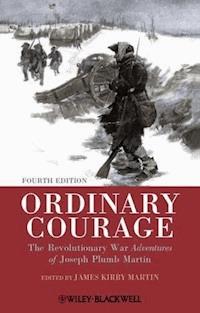
This remarkable memoir is one of the most celebrated documents to emerge from the tumult of America’s Revolutionary War. The ordinary and yet exceptional experiences of a young soldier in Washington’s army are given a new life in this fourth edition, sensitively edited for a modern readership.
- Classic primary source on the Revolutionary War
- Edited by a leading US authority on the period
- Now with extra maps and a more extensive bibliography
- Includes a new Afterword by Karen Guenther on film portrayals of the continental soldier
Sie lesen das E-Book in den Legimi-Apps auf:
Seitenzahl: 481
Veröffentlichungsjahr: 2012
Ähnliche




















Contents
Introductory Comments
Editorial Method
Acknowledgments
Overview Maps of Joseph Plumb Martin’s Adventures, 1776–1783
Martin’s Narrative of Adventures, Dangers and Sufferings
Preface
Chapter I: Introductory
Chapter II: Campaign of 1776
Chapter III: Campaign of 1777
Chapter IV: Campaign of 1778
Chapter V: Campaign of 1779
Chapter VI: Campaign of 1780
Chapter VII: Campaign of 1781
Chapter VIII: Campaign of 1782
Chapter IX: Campaign of 1783
The Revolutionary War Soldier on Film
Suggestions for Additional Reading
Index
This edition first published 2013© 2013 John Wiley & Sons, Inc.
Wiley-Blackwell is an imprint of John Wiley & Sons, formed by the merger of Wiley’s global Scientific, Technical and Medical business with Blackwell Publishing.
Registered OfficeJohn Wiley & Sons, Ltd, The Atrium, Southern Gate, Chichester, West Sussex, PO19 8SQ, UK
Editorial Offices350 Main Street, Malden, MA 02148–5020, USA9600 Garsington Road, Oxford, OX4 2DQ, UKThe Atrium, Southern Gate, Chichester, West Sussex, PO19 8SQ, UK
For details of our global editorial offices, for customer services, and for information about how to apply for permission to reuse the copyright material in this book please see our website at www.wiley.com/wiley-blackwell .
The right of James Kirby Martin to be identified as the author of the editorial material in this work has been asserted in accordance with the UK Copyright, Designs and Patents Act 1988.
All rights reserved. No part of this publication may be reproduced, stored in a retrieval system, or transmitted, in any form or by any means, electronic, mechanical, photocopying, recording or otherwise, except as permitted by the UK Copyright, Designs and Patents Act 1988, without the prior permission of the publisher.
Wiley also publishes its books in a variety of electronic formats. Some content that appears in print may not be available in electronic books.
Designations used by companies to distinguish their products are often claimed as trademarks. All brand names and product names used in this book are trade names, service marks, trademarks or registered trademarks of their respective owners. The publisher is not associated with any product or vendor mentioned in this book. This publication is designed to provide accurate and authoritative information in regard to the subject matter covered. It is sold on the understanding that the publisher is not engaged in rendering professional services. If professional advice or other expert assistance is required, the services of a competent professional should be sought.
Library of Congress Cataloging-in-Publication Data
Martin, Joseph Plumb, 1760–1850. [Narrative of some of the adventures, dangers, and sufferings of a Revolutionary soldier] Ordinary Courage : the Revolutionary War Adventures of Joseph Plumb Martin / edited by James Kirby Martin ; with an essay “The Revolutionary War Soldier on Film” by Karen Guenther. – Fourth edition. p. cm. Includes bibliographical references and index.
ISBN 978-1-4443-5135-4 (pbk. : alk. paper)1. Martin, Joseph Plumb, 1760–1850. 2. United States–History–Revolution, 1775–1783–Personal narratives. 3. Soldiers–United States–Biography. I. Martin, James Kirby, 1943– II. Title. E275.M38 2012 973.3′8–dc23
2011051679
A catalogue record for this book is available from the British Library.
For
Aunt Jane and Uncle Don McClelland with unbounded affection
Introductory Comments
On a scenic bluff overlooking the Penobscot River in the mid-coast region of Maine stands a tombstone bearing these modest words, “A Soldier of the Revolution.” Buried there is Joseph Plumb Martin. He was born during 1760 in western Massachusetts, just before the outbreak of the American Revolution. He lived for nearly 90 years, during which time the young United States established itself as a legitimate political entity, if not a potential rising star, among the nations of the world. He died in 1850, an “aged man” living in virtual poverty.1
Martin never commanded large bodies of troops in battle; he never held major political offices; he never engaged in vital diplomatic negotiations; he never invented anything of consequence or made a notable scientific discovery; and he never acquired great wealth to distribute as a renowned philanthropist. Martin was very much an ordinary person who in his youth served courageously in the Continental army and who in his adult years, according to one of his admirers, regularly displayed “a fund of knowledge, which, with his lively, social disposition, and ready wit, made him a highly entertaining and instructive companion.”2
1 Martin’s remains are buried at the Sandy Point Cemetery in Sandy Point, Waldo County, Maine, close to where he lived from the mid-1780 s to the time of his death in 1850.
2 Joseph Williamson, “Biographical Sketch of Joseph P. Martin, of Prospect, Maine, a Revolutionary Soldier,” The New England Historical and Genealogical Register, 30 (1876): 330–31. See also Philip Mead, “‘Adventures, Dangers, and Sufferings’; The Betrayals of Private Joseph Plumb Martin, Continental Soldier,” in Revolutionary Founders: Rebels, Radicals, and Reformers in the Making of the Nation, eds. Alfred F. Young et al. (New York, 2011), 117–34.
Martin grew to adulthood in times that were truly extraordinary. British North American colonists had begun to believe that their parent nation of Great Britain was attempting to subvert their fundamental liberties. When King and Parliament kept trying to tax them, the Americans vocalized such slogans as “no taxation without representation” and spoke anxiously about a plot by home government leaders to shackle them forever in the chains of imperial tyranny. They also protested defiantly, so much so that King George III during the summer of 1775 declared them to be in open rebellion. Four months earlier warfare had broken out when British regulars, looking for gunpowder and weapons, marched from Boston into the Massachusetts countryside and became entangled in a day of combat with resolute citizen-soldiers that began at the villages of Lexington and Concord.
Even after this initial shedding of blood, large numbers of colonists, including most patriot political leaders who gathered in Philadelphia during May 1775 to attend the Second Continental Congress, hoped and prayed for a peaceful resolution of grievances. More confrontational delegates, however, insisted upon making full provisions for defense. Their will prevailed. On June 14 Congress voted to establish a Continental army, initially to consist of the ten to fifteen thousand New England enthusiasts who had rallied together to challenge the King’s troops and keep them entrapped in Boston. Soon thereafter the delegates selected general officers, and they named as commander in chief the highly regarded Virginia planter George Washington, then attending Congress and an experienced veteran of the French and Indian War.
Lesen Sie weiter in der vollständigen Ausgabe!
Lesen Sie weiter in der vollständigen Ausgabe!
Lesen Sie weiter in der vollständigen Ausgabe!
Lesen Sie weiter in der vollständigen Ausgabe!
Lesen Sie weiter in der vollständigen Ausgabe!
Lesen Sie weiter in der vollständigen Ausgabe!
Lesen Sie weiter in der vollständigen Ausgabe!
Lesen Sie weiter in der vollständigen Ausgabe!
Lesen Sie weiter in der vollständigen Ausgabe!
Lesen Sie weiter in der vollständigen Ausgabe!
Lesen Sie weiter in der vollständigen Ausgabe!
Lesen Sie weiter in der vollständigen Ausgabe!
Lesen Sie weiter in der vollständigen Ausgabe!
Lesen Sie weiter in der vollständigen Ausgabe!
Lesen Sie weiter in der vollständigen Ausgabe!




