


17,99 €
Mehr erfahren.
- Herausgeber: Batsford
- Kategorie: Lebensstil
- Serie: A Day
- Sprache: Englisch
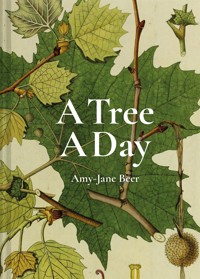
Discover the life of trees through science, folklore, history and art – every day of the year. Immerse yourself in the world of trees with A Tree A Day – packed with tree facts and richly illustrated throughout with photographs and art. Nature writer Amy-Jane Beer takes us on a tour around the world's woodlands to tell the stories of a variety of trees, from mysterious ginkos to historical oaks. Anyone who has sat in the dappled shade of a mighty oak or wandered in the blaze of a deciduous woodland in autumn cannot fail to appreciate the wonder of our trees and forests. Each of the 366 entries in this beautiful book – one for every day of the year – reveals some of the fascinating science, natural history or folklore of our great and gracious green neighbours, the history made beneath their branches, or the creativity they inspire. From the awesome Californian redwoods, titans of the tree world, to tiny but exquisite bonsai, and from the fantastically irritable sentinel willow of Harry Potter fame to the Japanese springtime tradition of hanami (blossom viewing) – this captivating collection showcases remarkable individuals and explores some of the ways trees support life on Earth as we know it. Celebrating one of the longest-living lifeforms on earth, A Tree A Day is forest bathing in book form and a wonder for nature lovers and tree enthusiasts alike.
Das E-Book können Sie in Legimi-Apps oder einer beliebigen App lesen, die das folgende Format unterstützen:
Seitenzahl: 279
Veröffentlichungsjahr: 2021
Ähnliche



















Quince tree, a chromolithography from 1870.
A TREE A DAY
A lone tree overlooks the North Kent Downs at sunset.
A TREE A DAY
Amy-Jane Beer
CONTENTS
Introduction
JANUARY
FEBRUARY
MARCH
APRIL
MAY
JUNE
JULY
AUGUST
SEPTEMBER
OCTOBER
NOVEMBER
DECEMBER
Index
Acknowledgements
Picture Credits
The forest floor of the New Forest in Hampshire.
INTRODUCTION
What is a tree? While most people have little difficulty naming a tree when they see one, hard-and-fast definitions are hard to pin down: there are exceptions to almost any simple rule of tree-hood. Trees are not a biologically distinct group. Rather the tree form has been adopted by a wide range of plants from a huge variety of taxonomic groups, and in its broadest sense the term can be applied to flowering and non-flowering plants, to monocots and dicots, to tall plants and small ones, upright and sprawling ones, woody plants and those with other means of making a rigid trunk such as tree ferns, palms and bamboos. Most, but not all, trees are woody plants, with one or more stems, known as trunks, and many, but not all, have the potential to grow tall.
In writing this book I’ve sought to address a different question: not what is a tree, but what do trees mean? Where do they fit in collectively and individually, to the web of experience that encompasses all life on Earth – including humans? I’ve explored some of those uncountable interactions and transactions in the following pages, but ultimately the question is a personal one. What does a tree mean you?
Humans and trees have been hanging out together since our very beginnings.
Bluebells carpet the floor in beautiful beech woodland.
1ST JANUARY
EMANCIPATION OAK
USA
It was under this huge southern live oak (Quercus virginiana) in the small satellite town of Hampton, Virginia, that local people gathered in 1863 to hear the first Southern reading of President Abraham Lincoln’s Emancipation Proclamation, which declared:
‘That on the first day of January in the year of our Lord, one thousand eight hundred and sixty-three, all persons held as slaves within any State … shall be then, thenceforward, and forever free.’
The tree is also linked with Mary Smith Peake, a free black woman, who defied state law to teach enslaved and free black Americans, continuing even as Civil War broke out. The oak under which her lessons took place was the first teaching space of what ultimately became Hampton University, on whose campus the oak still stands today.
1ST FEBRUARY
LAM TSUEN WISHING TREE
Hong Kong, China
The stately Chinese banyan trees (Ficus microcarpa) in the grounds of Tin Hau Temple in Fong Ma Po, Hong Kong, are the traditional focus of lunar New Year celebrations. Local people would write wishes on red joss paper scrolls tied to oranges, which were thrown into the branches. If the string caught, the wish was to be granted. The paper and oranges made a striking display, but as the trees aged, the weight of fruit became too much, and in 2005 an elderly man and a child were injured when a branch fell. As a consequence, the oranges used now are made from plastic and they are thrown, not into the banyans, but into replica trees.
The Lam Tsuen wishing trees hung with replica oranges and wish tags during the celebrations of the Lunar New Year.
2ND FEBRUARY
MENARA
Borneo
The Danum Valley, in the Malaysian state of Sabah in Borneo, is home to the world’s tallest flowering plant, a yellow meranti tree (Shorea faguetiana). Nicknamed Menara, meaning ‘tower’ in Malay, the tree was discovered in 2014 and LiDAR scanned by a team from Oxford University and University College London. Further terrestrial laser scanning, manual measurements of the base and a drone survey carried out in 2018 provided tantalizing details of its gigantic stature and estimated its mass at 81.5 metric tonnes. Then, in January 2019, conservationist and tree climber Unding Jami scaled the tree and dropped a tape from its very top, confirming its height at 100.8m (331ft), 30cm (12in) taller than the previous angiosperm record-holder, a mountain ash known as Centurion.
Yellow merantis are part of the emergent layer of the Bornean rainforest – their crowns towering over the canopy formed by less lofty species.
3
1ST MARCH
SACRED FIG OR PEEPAL TREE
Ficus religiosa
This potentially long-lived species has held special significance in Hinduism, Jainism and Buddhism for millennia (see also here and here). It is regarded as a form of world tree and home of the gods, and is referred to in the sacred Hindu text, the Bhagavad Gita, where Lord Krishna declares ‘Of all the trees, I am the peepal tree.’ The Sadhus of Hinduism and Jainism traditionally practice ascetic meditation under the branches of a sacred fig, either sitting or pacing around it, and it was at the end of such a meditation that Siddhartha Gautama was ‘awakened’ to become the Buddha. In life the tree is recognized by its heart-shaped leaves with a long narrow ‘drip tip’.
1ST APRIL
BANANA
(Musa acuminata)
Congratulations, you have found the joker in the pack. Bananas (also known as plantains although the latter usually refers to varieties used for cooking) are the elongated berries of a small but diverse group of monocots, the Zingiberales. The plants on which they grow are not palms or even strictly speaking trees, despite often being referred to as such, because their ‘trunk’ is in fact a non-woody false stem made of compressed leaf bases. The word banana has an Arabic root, meaning ‘finger’. In highly productive cultivars, over 200 individual fruits grow in tiers around a typical flowering stem, which can weigh 50kg (110lb) or more. The small bunches of a few to a dozen fruits in which bananas are usually sold are known in the trade as ‘hands’.
1ST
1ST JUNE
HEARTWOOD
England
The poem ‘Heartwood’ was written in 2018 by the writer and campaigner Robert Macfarlane as a ‘charm against harm’, in support of the campaign to save thousands of street trees in the city of Sheffield from unnecessary and indiscriminate felling (see also Vernon Oak). It was given copyright free, for reproduction in any form, and has since been translated, set to music by a number of recording artists and inspired artwork including this broadside linocut by illustrator and activist Hick Hayes.
Nick Hayes’ striking broadside poster appeared in bus stops around Sheffield during the street tree campaign.
2ND JUNE
THE GRANIT OAK
Bulgaria
The common or pedunculate oak (Quercus robur) on the edge of the Bulgarian village of Granit is a strong contender for the coveted claim of world’s oldest oak tree. The likely date of its germination was estimated from a ring count of a core sample collected in 1982 as 345 CE, making it 1,676 years old in 2021. It is surprisingly tall for such an ancient specimen, though most of the branches on one side are dead and rely on artificial support.
With only one bough still living, the venerable Granit Oak is nearing the end of its extraordinarily long life.
3RD JUNE
COPPER BEECH
Fagus sylvatica f. purpurea
Amutant form of common beech first recorded growing naturally in the Possenwald forest in the state of Thuringia (now part of Germany) in 1680 has given rise to a popular cultivar widely grown in parks and gardens around the world. The dark red colouring of copper beech leaves is due to production of excess anthocyanin pigments, but the leaves start green in spring and often revert to dark green in late summer. Copper beeches were introduced to Britain in the mid-18th century and appear to have been a favourite of the landscape designer Humphry Repton, featuring in many of his parkland settings.
A copper beech tree planted by Queen Victoria in the gardens of Drummond Castle in Perthshire, Scotland.
4TH JUNE
WILD CHERRY
Prunus avium
The wild cherry is a lovely tree in all seasons. It exhibits showstopping white blossom in April, a dramatic flush of leaf colour in autumn, and glossy peeling bark in winter. In the wild it typically grows along the edges of woods, looking as though deliberately planted there, but the effect is a natural consequence of the species’ liking for sunlight. Wild trees produce abundant red, yellow and black fruits, which are smaller and less sweet than cultivated varieties but still edible and excellent in pies. The wood is richly coloured and highly decorative, and popular with wood turners and cabinet makers.
Wild cherries are less sugary than cultivated ones, but still a sweet treat worth reaching for.
5TH JUNE
DEDHAM LOCK MILL
John Constable (1820)
Much of the British countryside does not appear now as it once did, even within living memory. The dwindling of hedgerows, the proliferation of urban areas, and the development of industrial, transport and energy infrastructure, are among the most visible changes since the mid-20th century, but perhaps the most poignant is the loss of the stately silhouettes of mature English elms, formerly the second most conspicuous broadleaved tree, after oaks. While not strictly native, Ulmus procera had formed part of the landscape of Britain since the Bronze Age, and its loss as a result of Dutch elm disease was a national tragedy. Several organizations are working on developing resistant varieties, some the result of crossbreeding, others cultivated from the few surviving trees that show varying degrees of natural resilience to infection.
The paintings of John Constable serve as a sad reminder of how the loss of English elms has changed the landscape.
6TH JUNE
THE HUNDRED ACRE WOOD
England
The setting of the celebrated Winnie the Pooh children’s stories by A.A. Milne is based on a real place – the mixed woodland of Ashdown Forest, East Sussex, in the south of England. The wood is part of what is now the High Weald Area of Outstanding Natural Beauty. The group of Scots pines, familiar to millions from the illustrations by E.H. Shepard has changed due to reduced grazing pressure on the surrounding heathland, but there is still a special atmosphere here. It is as if Christopher Robin, Pooh, Piglet, Tigger, Owl, Eeyore, Rabbit, Kanga and Roo have just gone on an adventure and will be back for tea any time now.
E.H. Shepard’s original sketches lay out a world of adventures for Christopher Robin and friends.
7TH JUNE
LIGNOTUBER
Also known as root crowns, root collars and root burls, lignotubers are woody swellings exhibited by some trees at ground level or just below. They are usually seen in species that are routinely exposed to fire, including young cork oaks, several species of Australian eucalyptus and bloodwood, oriental camphor trees and American coast redwoods. The root collar burls of the latter are among the most massive natural woody structures known, with diameters up to 12m (39ft). A lignotuber serves as a rapid regrowth point, with a readily accessible reserve of starch which can sustain the plant until it manages to start photosynthesizing again.
Burls and lignotubers are prized by woodworkers for the interesting swirls in the contorted grain.
8TH JUNE
VERNON OAK
England
The city of Sheffield is one of the greenest in the UK, thanks to the tens of thousands of mature trees that line its streets. A 150-year old oak in the suburb of Dore became a symbol of a battle to save thousands of these trees from unnecessary felling after the City Council signed an ill-advised deal with a private company to carry out street maintenance. Over seven years from 2012, an escalating conflict set residents, most of whom had never considered any kind of activism before, squarely against the council, contractors and police, and made news around the world. Vernon’s Twitter account was used to share updates on the campaign until its successful conclusion, when a new system of tree inspections and maintenance was agreed. Vernon and thousands of other healthy trees were saved, thanks to the passion, determination and creativity of their human neighbours (see also Heartwood).
Sheffield tree campaigner Keith Deakin carved his linocut print of Vernon oak from life during a protest event in 2017, when the tree faced needless felling.
9TH JUNE
‘Trees are poems the earth writes upon the sky. We fell them down and turn them into paper, that we may record our emptiness.’
KHALIL GIBRAN, LEBANESE AMERICAN POET (1883–1931)
10TH JUNE
MANIDOO-GIIZHIKENS OR LITTLE CEDAR SPIRIT TREE
USA
This ancient, somewhat stunted Eastern white cedar (Thuja occidentalis), also known as the Witch Tree, grows on Hat Point, Minnesota, overlooking Lake Superior. The site is part of the tribal lands of the Ojibwa people, to whom it is sacred and who leave offerings (traditionally of tobacco) before making journeys on the lake, in order to placate a spirit with the power to bring storms and dangerous conditions on the water. The tree is at least 300 years old and a natural bonsai, thanks to its exposed location and the lack of space afforded to its roots in the rocky outcrop.
With its roots penetrating deep into rocky crevices, the cedar spirit tree ekes out an existence, growing slowly and wisely, according to its means.
11TH JUNE
HOLLOW LOG
USA
No one knows exactly when this giant sequoia (Sequoiadendron giganteum) fell, but it was long before 1856, when the spacious hollow of its trunk was used as a base by soldiers during the Tule River Indian War. Prior to that it was already a well-known landmark and shelter used by the native Yokuts people. The log was purchased in 1885 along with the land in which it fell (now Balch Park, California), which also included a grove of standing sequoias, and it became a tourist attraction. The broken end of the log was sawn off for tidiness, and it was later bound with steel cables to improve its structural integrity. The fact that it remains intact and can still be walked on and crawled through, is testament to the extraordinary volume of wood laid down by the tree during its monumental life.
A vast hollow log in Tulare Country in the southern Sierra Nevada has been a local landmark for at least 200 years.
12TH JUNE
SPLIT HORNBEAM POLLARD
Hatfield Forest, England
What appears at first to be a pair of trees growing closely side by side is in fact the split trunk of a truly ancient individual, its heartwood long rotted away. Like many trees in the ancient park landscape of Hatfield Forest in Essex, this specimen on Bush End Plain has been repeatedly pollarded (cut at around head height) to encourage vigorous new growth to sprout, despite its colossal age. Trees maintained in this manner are far less likely to become top-heavy and fall and thus live to great ages – as long, in fact, as their trunks hold out. Hatfield Forest, now managed by the National Trust and a Nature Reserve, is the most intact example of a royal hunting forest in the UK.
This split hornbeam survives with most of its trunk missing because the active xylem and phloem which conduct water and nutrients are in the outer layers of wood.
13TH JUNE
QUINDÍO WAX PALM
Ceroxylon quindiuense
The tallest species of palm tree and thus also the world’s tallest monocot, the Quindío wax palm, is the national tree of Colombia, and native to montane forests in coffee-growing regions of the Andes. The tallest specimens can reach 60m (200ft), and their great height is emphasized by the relative slenderness of their trunk and complete absence of side branches.
The protective wax coating on the trunks of these stately trees was once used to make candles and soap.
14TH JUNE
AXEL ERLANDSON’S CIRCUS TREES
USA
In 1947, an unusual visitor attraction opened in Scotts Valley, California. The Tree Circus was the work of Swedish-American émigré horticulturalist Axel Erlandson, who used grafting and pruning to coax trees into extraordinary forms. Twenty-four of the trees now live in Gilroy Gardens Family Theme Park in California, while others have been preserved as dead wood and are displayed at the Santa Cruz Museum of Art and History and the American Visionary Art Museum in Baltimore.
The fantastical shapes of the Circus Trees in Gilroy Gardens are the result of grafting, pleaching and assiduous pruning by their creator.
15TH JUNE
LA HAYE-DE-ROUTOT YEWS
France
Two ancient yews in the churchyard to the village of La Haye-de-Routot in north-west France are thought to be between 1,000 and 1,300 years old. Both are hollow: one contains a shrine to the Virgin Mary, the other a tiny chapel dedicated to Saint Anne. The trees came to wider attention in 2015, when one of the trees sickened and analysis of the foliage suggested it had been chemically vandalized with glyphosate. A local community group was set up to protect and celebrate the trees, which are now watched over much more closely.
The cavities of ancient trees have long been regarded as places of refuge, both physically and spiritually.
16TH JUNE
‘THERE IS A WILLOWGROWS ASLANT A BROOK …’
Willows often grow directly on the banks of rivers, and the one-sidedness of their root growth means they tend to lean over the water and sometimes fall into it. This characteristic was captured in Shakespeare’s Hamlet, where Ophelia, driven mad by the prince’s rejection, falls from just such a tree and drowns, as reported by Hamlet’s mother, Queen Gertrude:
‘There is a willow grows aslant a brook,
That shows his hoar leaves in the glassy stream;
There with fantastic garlands did she come
Of crow-flowers, nettles, daisies, and long purples
That liberal shepherds give a grosser name,
But our cold maids do dead men’s fingers call them:
There, on the pendent boughs her coronet weeds
Clambering to hang, an envious sliver broke;
When down her weedy trophies and herself
Fell in the weeping brook. Her clothes spread wide;
And, mermaid-like, awhile they bore her up:
Which time she chanted snatches of old tunes;
As one incapable of her own distress,
Or like a creature native and indued
Unto that element: but long it could not be
Till that her garments, heavy with their drink,
Pull’d the poor wretch from her melodious lay
To muddy death.’
Hamlet, ACT IV, SCENE VII, WILLIAM SHAKESPEARE (c.1599)
The scene has been painted many times, but never more exquisitely than by John Everett Millais of the Pre-Raphaelite Brotherhood, who, on discovering the backdrop location on the River Hogsmill in Surrey, complete with fallen willow, is said to have cried out, ‘Look! Could anything be more perfect?’
Ophelia by Sir John Everett Millais, oil on canvas (1851–2).
17TH JUNE
THE BICYCLE TREE
Scotland
This self-seeded sycamore (Acer pseudoplatanus) that grew up amidst a pile of scrap discarded by the village blacksmith in Brig o’ Turk near Stirling in Scotland is said to have engulfed a variety of metal objects as it grew, including a ship’s anchor and chain, and a bicycle. The last was hung on a branch by a local man conscripted to fight in the First World War who never returned to retrieve it. All that can be seen of the bike now are its wide vintage handlebars and part of the frame. The tree was granted protected status in 2016 for its historical and landmark significance. (See also The Hungry Tree).
Thought to date back to the late 19th century, the tree has not suffered any ill effects from its metal addition.
18TH JUNE
TREE OF HIPPOCRATES
Greece
The Greek physician and teacher Hippocrates of Kos (c.460–370 BCE) is widely regarded as the Father of Medicine. He was one of the first Western thinkers to consider disease as a natural, biological phenomenon that could be treated – rather than the will of the gods or a supernatural affliction. He delivered his teachings under a plane tree in the ancient city of Kos, in what is now known as the Platia Plantanou or Plane Square. The tree that stands on the spot now, an oriental plane (Platanus orientalis) is around 500 years old, and is said to be a descendant of the original. Trees grown from seeds and cuttings of this tree have been gifted around the world, and many are located in the grounds of teaching hospitals and universities including Yale and Glasgow.
A large plane tree in Platia Plantanou in Kos marks the birthplace of western medical teaching.
19TH JUNE
BICENTENNIAL KARRI TREE
Australia
One of the world’s tallest tree species, the stately karri (Eucalyptus diversicolor) of south-western Australia, is a keystone species of biodiverse forests. The trees seem to benefit from occasional burning, which releases nutrients locked into the deep layers of leaf litter that accumulate over time on the forest floor. Such is their resilience to fire that karri trees were often rigged for easy climbing to use as look-out points by firefighters. In 1998, to mark the Australian bicentenary, this 75m (246ft) specimen in Warren National Park, Western Australia, was fitted with 165 horizontal metal spikes, forming a spiral ladder to reach a viewing platform. It is open to all adventurous visitors …
Intrepid tourists scale the Dave Evans Bicentennial Tree in Warren National Park, Western Australia.
20TH JUNE
Live thy Life,
Young and old,
Like yon oak,
Bright in spring,
Living gold;
Summer-rich
Then; and then
Autumn-changed
Soberer-hued
Gold again.
All his leaves
Fall’n at length,
Look, he stands,
Trunk and bough
Naked strength.
The Oak,ALFRED, LORD TENNYSON (1889)
A mature pedunculate oak is a thing of splendour in any season and serves as a symbol of strength in cultures throughout its range.
21ST JUNE
THE OAK KING
UK
An iteration of the Green Man and the archetypal horned forest god of pre-Christian European religions, the Oak King wages a cyclic battle with his alter ego the Holly King). Oak dominates the warm, light part of the year, symbolically giving way to holly in winter.
Green Men come in many forms, of which the summer Oak King is just one.
22ND JUNE
CAESARSBOOM (CAESAR’S TREE)
Belgium
The yew tree growing next to the 14th-century gateway to the small Belgian town of Lo is considerably older than the medieval walls that once surrounded the whole settlement. Local legend has it that the Roman emperor Julius Caesar paused here on his journey to Britain in 55 CE, hitching his horses to this very tree and dozing beneath its branches. Though there is no documentary evidence that Caesar came this way, the nearby road may well date to the Roman occupation, and the tree is almost certainly old enough.
Though the legend behind its name is unprovable, this ancient yew has Roman era origins.
23RD JUNE
DRUIDS
Ancient Britain
The Druids were a class of priests and intellectuals that united many of the disparate Celtic tribes of Ancient Britain. They served varied roles as shamans, healers, spiritual leaders, teachers and keepers of oral histories. As was common in pre-Christian Europe, the Druids regarded oak trees as sacred components of nature, perhaps because of the myriad other forms of life that depend on them. Even the word ‘druid’ is said to come from the root words drys, for oak, and wied, meaning knowledge. British Druids were systematically wiped out during the Roman occupation and many of their sacred groves were destroyed, but others were incorporated into Christian traditions and Druidism has enjoyed multiple romantic revivals and reinventions in recent centuries.
A 19th-century envisioning of a druidic ritual.
24TH JUNE
THE HUNGRY TREE
Ireland
In the genteel park surrounding King’s Inns, Dublin, a strange, inelegant spectacle is unfolding in slow motion. A relatively young London plane tree (Platanus × hispanica), planted no earlier than 1900, has engulfed most of the older iron bench it was presumably supposed to shade. The relatively fast-growing trunk appears to flow around the bench, which can no longer be sat upon comfortably, but has become an alternative tourist attraction.
The Hungry Tree bench at King’s Inns Park in Dublin, Ireland.
25TH JUNE
‘As an ook cometh of a little spyr’(as an oak comes from a little sapling)
GEOFFREY CHAUCER, TROILUS AND CRISEYDE (1374)
Chaucer’s Troilus and Criseyde kiss on a 1995 British stamp.
26TH JUNE
SUPERTREES
Singapore
An extensive urban nature park in central Singapore, known as The Gardens by the Bay, boasts multiple waterfronts, the world’s largest glasshouse, an indoor cloud forest and over 100ha (247 acres) of recreational space, typically visited by more than 50 million people a year. But the features that have brought worldwide recognition and become an icon of the city state are the 18 ‘supertrees’. These artificial structures range from 25–50m (82–164ft) in height, incorporate vertical gardens and perform some of the same functions as real trees, providing shade by day and harvesting solar energy. At night they glow with spectacular lighting displays.
Singapore’s unique and progressive attitude to urban nature is exemplified by its extraordinary Supertrees.
27TH JUNE
THE MAMMOTH TREE
USA
The vast trees of Calaveras Big Trees State Park in California have been wowing visitors for well over 150 years. One of them, known as the Mammoth Tree, was a 1,244-year-old, 90m (300ft) tall giant sequoia (Sequoiadendron giganteum) – the largest tree ever known at the time. However, at the height of the Gold Rush, this marvel of nature was seen purely as a money-making opportunity. The Mammoth was felled on 27th June 1853 following a three-week operation to sever the trunk. A year later the similar-sized Mother of the Forest met the same fate. A hotel was built nearby and parties of visitors held tea dances on the cut stump of the Mammoth Tree, while the felled trunk was used as a bowling alley. The sense of outrage over the fellings eventually began to percolate public consciousness and was a factor in the establishment of protected natural areas and the birth of the national park movement.
The felled trunk of the Mammoth Tree lies beside a tea pavilion erected over its cut stump. The pavilion is long gone, but the stump and the trunk can still be visited at Calaveras Big Trees State Park.
28TH JUNE
CUCUMBER TREE
Dendrosicyos socotranus
A further eccentric endemic from Yemen’s isle of arboreal wonder, Socotra, (see also Bottle Tree and Dragon Blood Tree), the cucumber tree is named for being part of the cucumber and pumpkin family, rather than the shape of its swollen, succulent trunk. Other species with the same common name live elsewhere.
Cucumber trees are now protected on Socotra to curb the unsustainable practice of using their pulped trunks as emergency animal food in dry periods.
29TH JUNE
A PRICE ON ITS CROWN
England
It seems a mercenary thing, to place a cash value on a tree – but doing so can be an effective means of preservation. In 2008, tree specialists in London developed a register of street trees in which specimens were valued as a means of protecting them from felling to protect other assets such as roads and buildings. The valuation process took account of size, condition, historical significance and amenity value. Several trees in the prestigious boroughs of Kensington and Chelsea and Westminster were valued at over £500,000, but those in Mayfair’s Berkley Square topped the list, with one particularly large London plane (Platanus × acerifolia) valued individually at £750,000.
Precious plane trees grace the green space in one of London’s most prestigious street addresses, Berkley Square. Watercolour by Edith Mary Garner.
30TH JUNE
ASH
Fraxinus excelsior
One of the most familiar great trees of Britain and Europe, the ash is recognized by its graceful proportions, domed crown and light foliage, which moves in the slightest of breezes and casts a beautiful dappled shade. The leaves are compound, with 7–13 leaflets – all but the terminal one arranged in pairs – and they drop in autumn when they are still green. The pale, straight-grained timber is exceptionally strong, with an ability to bear huge weights and impacts, which makes it the wood of choice for tools, sports equipment, furniture and carriages. Ash wood is still used to build the frames of classic Morgan motor cars. The expected loss of more than two-thirds of all ash trees to the dieback disease caused by the fungus Hymenoscyphus fraxineus will have a profound impact on landscapes across its range, and nowhere more so than Britain where it is second only to oak in landscape importance.
The light, feathery foliage of the ash is unique among large European broadleaf trees.
1ST JULY
‘A man has made at least a start on discovering the meaning of human life when he plants shade trees under which he knows full well he will never sit.’
D. ELTON TRUEBLOOD, AMERICAN QUAKER AND THEOLOGIAN (1900–1994)
2ND JULY
SON AND GRANDSON OF ROYAL OAK
England
In the years after the Restoration of the British monarchy, the oak tree near Boscobel House in Shropshire, in which Charles II purportedly hid from Roundhead troops after the Battle of Worcester in 1651 became an early tourist attraction. It died sometime in the 18th century, most likely as a result of damage caused by souvenir hunters cutting off branches. The tree now growing on the site and aged around 300 years, is said to be a direct descendant of the original (see also The Royal Oak). In an effort to ensure continuity, a third tree, grown from an acorn of the ‘Son’, was planted alongside by another Charles, Prince of Wales, in 2001.
The carefully tended oaks in the grounds of Boscobel House in Shropshire are descendants of the original Charles II Royal oak.
3RD JULY
NORTHERNMOST TREES
The Dahurian larch (Larix gmelinii) is the sole tree species growing in the world’s most northerly forests, those of north-eastern Siberia. It grows as an upright tree above 72 degrees north and creeping forms continue to form part of the ground cover as the forest gives way to tundra. The northernmost examples occur at 73° 04’ 32” N on the Taymyr Peninsula. In such places the growing season is reduced to around 100 days, and in winter (which lasts from late September to June), temperatures fall as low as minus 70°C (-94°F).
The Yamal Peninsula in Russia boasts some of the northernmost upright trees in the world.
4TH JULY
THE FARAWAY TREE
When three children arrive in a new home on the edge of a mysterious wood, they soon embark on a series of bizarre adventures in the branches of a vast tree, populated by eccentric and magical characters. At the top of the tree, a ladder leads through a hole in the clouds to strange lands – some nice, some nasty – which move on periodically. The stories, by prolific author Enid Blyton, continue to enchant young fans more than 80 years after they were first written.
Enid Blyton’s Faraway Tree books have survived updating to remain as weird and enthralling as ever.
5TH JULY
WILLOW PATTERN
The late 18th-century fashion for Chinese-inspired design, or Chinoiserie, in English ceramics coincided with the perfection of new techniques for mass production in the potteries of Stoke-on-Trent. Elements of the most famous blue-and-white design, now known as Willow Pattern (Blue Willow in the USA) – including the waterside garden and pavilion, fruit trees, willow, figures crossing a bridge, islands in the distance and two swallows overhead – were copied from genuine Chinese imports and used in various combinations by different potteries. The combination was first used on earthenware made by Spode in 1790, but versions were soon being widely produced and have remained hugely popular ever since. A story to accompany the design tells of doomed lovers from different social classes, who attempt to elope but are eventually captured and killed.
Spode Copeland Willow Pattern pottery.
6TH JULY
SYCAMORE
Acer pseudoplatanus
A




