


7,19 €
Mehr erfahren.
- Herausgeber: Uniform
- Kategorie: Geisteswissenschaft
- Sprache: Englisch
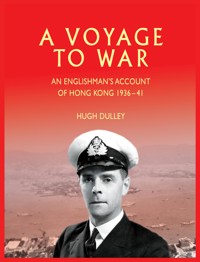
Hugh Dulley's father (Peter Dulley) and mother (Therese Sander) met in Hong Kong on New Year's Eve 1935. Four years later at the outbreak of war Peter, a weekend sailor, was called up in the Hong Kong Royal Naval Volunteer Reserve. He eventually graduated to commanding an ocean-going tug of 500 tons from Hong Kong to Aden. En route he called at islands still enjoying pre-war peacetime and navigated across the Indian Ocean using a sextant. In July 1940 Therese, who was eight months pregnant, was evacuated from Hong Kong to the Philippines, where Hugh was born. They then travelled to Australia after a short stop in Hong Kong, which was to be the last time she saw Peter. Collected here is Peter's correspondence to Therese over a period of six years. Edited and condensed by Hugh, it paints a unique and often humorous picture of life in Hong Kong in World War 2. It is published to coincide with the 75th anniversary of the Battle of Hong Kong.
Das E-Book können Sie in Legimi-Apps oder einer beliebigen App lesen, die das folgende Format unterstützen:
Veröffentlichungsjahr: 2016
Ähnliche




















A VOYAGE TO WAR
AN ENGLISHMAN’S ACCOUNT OF HONG KONG 1936 – 41
Taken from the original correspondence by Peter Dulley Written and edited by Hugh Dulley
To Peter and Therese
CONTENTS
Preface
A Voyage to War – An Englishman’s Account of Hong Kong 1936–41
On Sunday 7 December 1941 the Royal Hong Kong Yacht Club was hosting a regatta and preparing for lunch when news of the Japanese invasion of Hong Kong broke. Many members of the Club were killed or wounded in the subsequent fighting while those who survived became prisoners of war or, if civilians, interned.
Lieutenant Commander Dulley went missing, presumed killed in action, sometime between 7 and 25 December 1941. As a keen sailor and Olympic oarsman he had been a very active member of the Club for over 10 years, winning the Commodore’s Cup twice, the Cruiser Championship, the Illingworth Cup and the Long Harbour Race as well as coming second in the Macau Race.
To this day, the Club commemorates the important role played by Peter Dully and all those who volunteered for service with the Hong Kong Royal Naval Volunteer Reserve (HKRNVR), by running a pursuit race, in which sailor compete for the HKRNVR Memorial Vase.
We are proud to be recognising the sacrifices that these volunteers made and are honoured to have been asked to show appreciation for their efforts on our behalf in this book.
Mark Whitehead Commodore Royal Hong Kong Yacht Club May 2016
Foreword
There is a special poignancy in reading a story whose ending you already know. I first came across Lieutenant Commander Hugh ‘Peter’ Dulley’s name some thirty years ago. I knew him as one of a number of men who lost their lives at a house called Postbridge. At that time I knew nothing else about him; I didn’t even know where Postbridge was.
I even wrote about him, just a few words in a book I composed about the battle of Hong Kong. And then years later, when studying for my PhD about the evacuation of British women and children from Hong Kong to Australia in 1940, I came across his name again. Then I learned about his wife and as yet unborn son, and their break of journey in the Philippines where that son would be born.
Now, with this book, we have the chance to understand more about the family. Why Peter was in Hong Kong, how he met his wife, their romance and life together for a few short years before war came. And that of course is the poignancy; this was years before I was born, yet I am considerably older now than they were then. They were two young people trying to start a family at a time when much stronger forces were turning the world to war. In that experience, of course, they were far from being alone. And this just adds to the impact of their story. It speaks for thousands, in fact hundreds of thousands, of other ordinary people at that turning point in history.
So in essence it is a sad story, and yet an inspiring one. They did their best, though Peter would be killed and his wife left widowed and looking after young Hugh (the editor of this work) alone. Like many other ladies in that situation, she managed. She had little choice.
For Lieutenant Commander Dulley, and many of his comrades, December 1941 in Hong Kong marked the end. His body was never identified after the war. It may still be hidden somewhere in Wong Nai Chung Gap where he fell, though more likely he is lying in one of the many graves in Hong Kong marked only ‘Known Unto God’. That was Rudyard Kipling’s phrase, applied to all unknown British and Commonwealth graves ever since, originally including his own son John who was lost in the Great War.
So, in the absence of an identified memorial, this book will suffice – with a granularity of detail and personality that three words carved into stone could never reveal: Here lies Lieutenant Commander Hugh ‘Peter’ Dulley, in his Voyage to War.
Dr Tony Banham Hong Kong, May 2016
Introduction
Producing this book has been a hugely interesting and rewarding journey. I now feel that I have come to know my father (Peter) and to admire his letter writing, with all the illuminating insights into his life in Hong Kong. He took letter writing very seriously and allowed plenty of time, so that the result was a well-crafted letter. In preparing this book I had an advantage in that my mother (Therese) had told me stories about pre-war Hong Kong, and I know the Dulley and Davidson families well, both past and present.
The aim of this book was to make these letters on pre-World War 2 Hong Kong available to all who might be interested, so that they did not just lie in some archive, possibly never to be seen again. They provide a vivid picture of the social history of Hong Kong at the time and also life in the Hong Kong Royal Naval Volunteer Reserve in the lead up to the Japanese invasion. My main objective has now been achieved and I hope that the reader will be drawn into accompanying Peter on his journey.
It seems a long time ago but then the British Empire still ruled a large part of the world, those parts coloured in red in a school atlas, and many thought it would continue to do so. The invasion was to mark the beginning of the end of the British Empire. Hong Kong was a very different place to the modern, vibrant international city of today; it was even called sleepy by some. Many of the differences are well known, such as Hong Kong is no longer part of what was the British Empire, but has now reverted to being part of China, which then was a far cry from the major power it is today. It is hoped that this book will show the other differences.
As Tony Banham says in his Foreword, the Dulley’s fate was sadly not unique in Hong Kong or for that matter much of the rest of the world. World War 2 had an enormous impact on all, the men going away to war and many families having to leave their homes or to suffer enemy bombing or both. We have all been fortunate in living during a period of over seventy years without another World War, so it is hard to understand the sheer scale of the trauma created at the time.
I have added some additional chapters to the letters. Chapter 1 was written to cover what is not in the letters, which were written to Therese, Peter’s wife, who had lived in Hong Kong in the 1930s, so did not need a description of life there. For most this will not be the case as they were not living in Hong Kong in the 1930s or may not have been to Hong Kong. The introductory chapter also places Peter’s letters in context. Chapter 16 has been added to explain the Japanese threat to Hong Kong from 1936–41. Chapter 17 covers the invasion from Peter’s point of view and Chapter 18 brings the story to a conclusion following Peter’s death. Every effort has been made to ensure that these chapters and all the footnotes are historically correct, but if there are any errors, then I apologise to the reader in advance.
Chris Munn, who was then in the Hong Kong University Press, offered me one of the most important and delightful pieces of advice – ‘no matter how interesting the letters are they should be halved in length’. Remarkably this was achieved by removing duplication, information that would have been of no interest to the reader, and summarising some topics in the first chapter. A few colourful remarks and some short pieces that were not really part of the main story were also cut out. The letters to Therese are the main core of the book and other letters have been deleted where they duplicated information, apart from the letters written during the voyage to Aden, which have been amalgamated to provide one text.
I have read many books on Hong Kong’s history and carried out searches on the internet over the last five years. The object of the book was to publish the letters and the rest fits around them. There may be more detailed accounts of various subjects, but it was considered that what was required was an adequate explanation of the letters and life in those times, rather than an in-depth one.
The letters were written between 1936 and 1941, seventy-five to eighty years ago and naturally they reflect those times, which were very different to today. Events and comments need to be judged by early 20th-century standards and then compared with the 21st. It is on this basis that some pieces have been left in, which might otherwise have been deleted. As an observer we bring our own values to judge a situation; the values of today are very different to those of Hong Kong in the 1930s.
Of the many people I would like to thank for helping me with this enterprise, I wish to mention first my cousin, Mary Beal. She has given me a substantial amount of her time and we have had many valuable discussions. She also carried out some very useful research, drawing on a lifetime’s experience as an art historian. She advised on the format of the text and footnotes and carried out the original proofreading. She transcribed all the letters to other members of the family and the letters of condolence written to Therese. She believed in Peter’s letters and her support gave me confidence to complete the book.
Mary introduced me to Amelia Allsop of the Hong Kong Heritage Project and, through her, Chris Munn of the Hong Kong University Press, both of whom provided valuable advice on publishing.
I am also very grateful to Tony Banham, who wrote the definitive book on the invasion of Hong Kong, Not the Slightest Chance: The Defence of Hong Kong, 1941, on which I drew heavily for the chapter on the invasion. He has sent me many very helpful emails along the way and very kindly agreed to write the Foreword to this book, which I feel is perfect and really gets to the heart of the story. I would like to thank Mark Whitehead, Commodore of the Royal Hong Kong Yacht Club for writing a thoughtful Preface to the book and thereby providing a link to the Club’s past members, Peter and Therese and their friends.
My thanks to the Grieve family, Elizabeth Henderson and James Grieve, whose parents were great friends of Peter and Therese in Hong Kong, for their support and loan of photos and other material. The Davidson family for their interest and encouragement. Charles Moore, my old Australian friend, who has provided me with various insights on the Far East and Australia. The many people along the way who have given me advice and support, including Owen and Sally Bryant and my local walking friends and wives. Jardines, for allowing me to search their archives at Cambridge University. The archivists at the Imperial War Museum, London, the National Archives and at the Jardine Archive for all their help.
My thanks to Lucy Duckworth and her team at Unicorn Press, particularly Vivian Foster, for all their help, advice and ideas, the end product of which has been this quality book.
My daughters Kath Hipwell and Lou Carpenter and their husbands Simon and Ben for all their support and advice on some key issues and letting me draw on their advertising, research and IT skills.
Finally I would like to thank my wife Barbara for all her encouragement, support, advice, proofreading and many other things. In addition, for her ability to interpret Peter’s handwriting, using the skills she has developed over many years of reading doctors’ handwriting and finally for putting up with the many hours I have spent on the book.
This book is to be published shortly before the 75th anniversary of the Japanese invasion of Hong Kong and I hope that it will in a small way help to commemorate all those who were in Hong Kong at the time of the invasion.
Hugh Dulley
August 2016
Personal Timeline
Hugh William Macpherson Dulley 1903 –1941 (Known as Peter)
Map of Hong Kong in the 1930s
Map of Journey to Aden and Back
Map of the Mediterranean
Map of the Chinese Coastline
CHAPTER 1
Arriving in Hong Kong in the 1930s
‘To port lay the Island itself, with the hills coming down to the sea, but there were many promontories, on some of which were attractive houses set well apart, their white walls shining in the sun, their red or green roofs setting the seal on spacious comfort. The coastline was jagged, interspersed with sparkling sandy beaches on which the deep-blue water gently lapped … We passed the fishing village of Shau KI Wan, teeming with junks and sampans … Some were busy drying fish and others doing chores aboard their vessel.’1
Peter Dulley2 looked out from the deck of the Rawalpindi and, like many before him, felt he had arrived in a form of paradise and so it would be for the next nine years. There was no hint of the final role he would play in the year of the centenary of the founding of the Colony in 1941. Peter stood there enjoying the moment. He felt very happy about his decision to turn his back on a life in the City of London and the commute to work by train each day.
The last couple of years had been busy. He had decided after his return from Chile, where he worked for a mining company, Gibbs & Co., to go overseas again. From enquiries with friends, it was suggested he apply to Jardine Matheson in the City of London for a job overseas. He may have read of the Far East3 and been drawn by its mystique, the opportunity for adventure and the offer of a different career and lifestyle. Companies recruited British middle class men for careers in the Far East; they came from the public schools and were imbued with the idea of service.4 Selection depended on the interview. They particularly wanted sportsmen and those with some experience of leadership through being a school prefect or being in the Officer’s Training Corps.5
The selection process may not have proved a hurdle; however there were demands made by companies then. It was made clear to recruits that marriage before the end of the second tour of service was not considered appropriate, and permission had to be sought.6 Peter, however, married half way through his second tour but at thirty-three would have been older than many.
Hong Kong Island from the Harbour
Lesen Sie weiter in der vollständigen Ausgabe!
Lesen Sie weiter in der vollständigen Ausgabe!
Lesen Sie weiter in der vollständigen Ausgabe!
Lesen Sie weiter in der vollständigen Ausgabe!
Lesen Sie weiter in der vollständigen Ausgabe!
Lesen Sie weiter in der vollständigen Ausgabe!
Lesen Sie weiter in der vollständigen Ausgabe!
Lesen Sie weiter in der vollständigen Ausgabe!
Lesen Sie weiter in der vollständigen Ausgabe!
Lesen Sie weiter in der vollständigen Ausgabe!
Lesen Sie weiter in der vollständigen Ausgabe!
Lesen Sie weiter in der vollständigen Ausgabe!
Lesen Sie weiter in der vollständigen Ausgabe!
Lesen Sie weiter in der vollständigen Ausgabe!
Lesen Sie weiter in der vollständigen Ausgabe!
Lesen Sie weiter in der vollständigen Ausgabe!
Lesen Sie weiter in der vollständigen Ausgabe!
Lesen Sie weiter in der vollständigen Ausgabe!
Lesen Sie weiter in der vollständigen Ausgabe!
Lesen Sie weiter in der vollständigen Ausgabe!
Lesen Sie weiter in der vollständigen Ausgabe!
Lesen Sie weiter in der vollständigen Ausgabe!
Lesen Sie weiter in der vollständigen Ausgabe!
Lesen Sie weiter in der vollständigen Ausgabe!
Lesen Sie weiter in der vollständigen Ausgabe!
Lesen Sie weiter in der vollständigen Ausgabe!
Lesen Sie weiter in der vollständigen Ausgabe!
Lesen Sie weiter in der vollständigen Ausgabe!
Lesen Sie weiter in der vollständigen Ausgabe!
Lesen Sie weiter in der vollständigen Ausgabe!
Lesen Sie weiter in der vollständigen Ausgabe!
Lesen Sie weiter in der vollständigen Ausgabe!
Lesen Sie weiter in der vollständigen Ausgabe!
Lesen Sie weiter in der vollständigen Ausgabe!
Lesen Sie weiter in der vollständigen Ausgabe!
Lesen Sie weiter in der vollständigen Ausgabe!
Lesen Sie weiter in der vollständigen Ausgabe!
Lesen Sie weiter in der vollständigen Ausgabe!
Lesen Sie weiter in der vollständigen Ausgabe!
Lesen Sie weiter in der vollständigen Ausgabe!
Lesen Sie weiter in der vollständigen Ausgabe!
Lesen Sie weiter in der vollständigen Ausgabe!
Lesen Sie weiter in der vollständigen Ausgabe!
Lesen Sie weiter in der vollständigen Ausgabe!
Lesen Sie weiter in der vollständigen Ausgabe!
Lesen Sie weiter in der vollständigen Ausgabe!
Lesen Sie weiter in der vollständigen Ausgabe!
Lesen Sie weiter in der vollständigen Ausgabe!
Lesen Sie weiter in der vollständigen Ausgabe!
Lesen Sie weiter in der vollständigen Ausgabe!
Lesen Sie weiter in der vollständigen Ausgabe!
Lesen Sie weiter in der vollständigen Ausgabe!
Lesen Sie weiter in der vollständigen Ausgabe!
Lesen Sie weiter in der vollständigen Ausgabe!




