


Erhalten Sie Zugang zu diesem und mehr als 300000 Büchern ab EUR 5,99 monatlich.
- Herausgeber: The History Press
- Kategorie: Geisteswissenschaft
- Sprache: Englisch
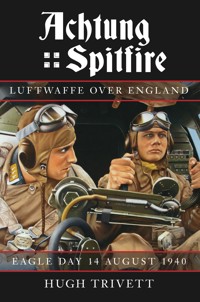
14 August 1940, which Hitler code-named 'Adlertag', or 'Eagle Day', was fated to become one of the most significant days in the Battle of Britain. It signified the start of the Luftwaffe's aerial offensive, planned to cripple Britain and clear the path for the German troops ammased in readiness for invasion. The Luftwaffe sent out waves of unescorted bombers to attack difficult and long-range targets by daylight, hoping to confuse and split the fighter defences with the small but numerous bomb formations. The tactic was a calculated gamble and one that cost the Germans deeply. Despite successes in attacking and damaging airfields, the losses were severe and and the following day Goering vetoed such tactics, now convinced his bombers could never operate over Britain without fighter cover. Using first-hand recollections of both Luftwaffe and RAF pilots as well as local witnesses to the day's action, gleaned from interviews and written accounts and with many unpublished photographs, Hugh Trivett has collated the definitive record of Eagle Day.
Sie lesen das E-Book in den Legimi-Apps auf:
Seitenzahl: 419
Veröffentlichungsjahr: 2016
Das E-Book (TTS) können Sie hören im Abo „Legimi Premium” in Legimi-Apps auf:
Ähnliche




















Fw. Heinrich Rodder at 7,000m
Junkers Ju 88A of LG 1, 1940
First published 2010
The History Press
The Mill, Brimscombe Port
Stroud, Gloucestershire, GL5 2QG
www.thehistorypress.co.uk
This ebook edition first published in 2016
All rights reserved
© Hugh Trivett, 2010
The right of Hugh Trivett to be identified as the Author of this work has been asserted in accordance with the Copyrights, Designs and Patents Act 1988.
This ebook is copyright material and must not be copied, reproduced, transferred, distributed, leased, licensed or publicly performed or used in any except as specifically permitted in writing by the publishers, as allowed under the terms and conditions under which it was purchased or as strictly permitted by applicable copyright law. Any unauthorised distribution or use of this text may be a direct infringement of the author’s and publisher’s rights, and those responsible may be liable in law accordingly.
EPUB ISBN 978 0 7509 8130 9
Typesetting and origination by The History Press
eBook converted by Geethik Technologies
Contents
Acknowledgements
Introduction
Chapter One
Night Operations 13-14 August 1940
Chapter Two
Messerschmitts over Manston
Chapter Three
Dogfight over Dover
Chapter Four
KG 55 enters the Fray
Chapter Five
Flying into History
Chapter Six
Middle Wallop in their Sights
Chapter Seven
Schnellbombers over the South-West
Chapter Eight
War over Wales
Chapter Nine
Last Raiders of the Day
Appendix I
Luftwaffe Combat Losses 14 August 1940
Appendix II
RAF Casualties as a Result of Enemy Action on 14 August 1940
Bibliography
Equivalent Ranks
Acknowledgements
Since I started writing this over twenty years ago, most of the combatants and many of those involved in the events, whose accounts form the backbone of the text, and even some of my fellow researchers, have unfortunately passed on but I will always be grateful for all their help and advice.
I am particularly indebted to the many RAF ground crews who endured the attacks on the airfields and who took the trouble to write accounts, often in great detail, of those traumatic events, but as they are all named in the relevant chapters I have not listed them here individually. For a similar reason the civilian eyewitnesses are also not listed. However, special mention must be made of the service provided by the Record Copying Department of the National Archives. They often sent detailed answers to my frequent enquiries that I was unable to resolve during my visits to Kew.
Information on the air battles of the summer of 1940 has been exchanged with many similarly interested individuals over the years, but especial thanks are extended to those listed below without whom this book would not have seen the light of day:
Perry Adams, Peter Ayerst, Jim Beedle, Mike Bent, Michael Boddington, Karl Brossler, Annette Collard, Peter Cornwell, Fritz Dietrich, Dieter Dorner, Mary Douglas-Osborn, Heinz Ebeling, Peter Foote, Adolf Galland, Erna Gerke, Walter Gietz, Heinrich Gramling, Clifford Gray, Ralph Havercroft, Anthony Hillman, Otto Hintze, Philippa Hodgkiss, Ian Hutton, Peter Johnson, Gerhard Kemen, Heinz Kochy, Christine Koschemann, Stephen Kramer, Wilhelmine Krause, Kurt Kupsch, Hedwig Liebchen, Walter Meyer, Jacob Neff, Phyllis Orr, John Penny, Erna Puttfarken, Hans Ramstetter, Erhard Reif, Heinrich Rodder, Irmengard Sauer, Ewald Schank, Walter Schaum, Gerhard Schopfel, Kurt Sodemann, Werner Stahl, Geoff Stephens, Ivor Sydenham, Margarete Thiel, Stanford Tuck, Hans Tuffers, Gustav Ullman, John Vasco, Artur Wiesemann, Dave Williams and Allan R. Wright.
To those whom I have inadvertently overlooked I apologise. Also, the original source of some of the featured photographs has been forgotten or mislaid over the years, and again to anyone whom I have not given a credit I apologise. I hope that I’m forgiven.
To avoid any possible confusion, all times in the book have been adjusted to British Summer Time (which ran one hour behind German Sommerzeit, in use by the Luftwaffe). Thus, 7.00 hrs shown in official German documents becomes 6.00 hrs in the text, and this expediency has been used throughout.
Hugh Trivett
Introduction
Flying over the rubble-strewn streets of Dunkirk early in the morning of 5 June 1940, Erhard Milch, the chubby Inspector General of the Luftwaffe, observed from the cockpit of his personal aircraft the absolute chaos left by a beaten army in full flight. Over 50,000 abandoned vehicles, trucks, lorries, cars and many heavy guns choked the roads and fields leading to the sea, and hulks of half-submerged British ships could be seen offshore. He couldn’t wait to land and inspect the devastation at first hand.
The beaches and sand dunes were littered with the spoils of war – bicycles, shoes, ammunition boxes, weapons, canned food, personal effects and souvenirs – all abandoned by the departing Allies in their mad scramble to board the armada bound for England. Fleeing as fast as they could from the constant bombing and strafing, they didn’t really appreciate that, ironically, it was the actions of the Luftwaffe that had enabled them to escape.
Goering had convinced Hitler (despite furious army opposition) that his air fleet alone could carry out the destruction of the British forces in the Dunkirk pocket, and this meant that the advance of the German army was halted for a crucial few days so enabling the Allies to regroup and erect a strong defensive perimeter. But fog blanketed the bomber bases for those three vital days and, when the beaches were finally attacked, the bombs buried deep into the sand inflicting few casualties. Furthermore, the mass of small boats presented poor targets and, with the French fighting a valiant rearguard action, the British army managed to slip away.
Equally significant was the protective ‘umbrella’ put over the beach by the RAF. The waves of Luftwaffe bombers and fighters were broken up outside the perimeter before they could attack the vast concentration of exhausted men huddled in the sand. Brian Kingcombe of 92 Squadron, then flying daily cover over Dunkirk, commentated, ‘the bombers were easy meat; a short burst from behind – the rear gun would tilt up, meaning the gunner was dead; later the rest were dead’. However, this tremendous effort was not without cost. In forty days the RAF had lost over 1,000 planes, of which 509 were fighters, losses they could ill afford for the coming defence of Britain.
As Milch picked his way through all the discarded clutter, accompanied by General Hoffman von Waldau of the Luftwaffe General Staff, the desolation on the beaches was an awesome sight but the dearth of dead bodies worried him. Except for the rearguard that had surrendered to the encircling German army, it appeared that the bulk of the British troops and many French soldiers had got clean way. The Luftwaffe had not wiped out the men trapped in the Dunkirk pocket. He did not share his companion’s view that a pile of empty bottles sticking out of the sand represented the gravestones of the British army. They were not beaten yet.
That evening he attended a meeting of the Luftwaffe High Command aboard Goering’s armoured train Asia and found the Field Marshal congratulating everyone for the annihilation of the British army on the beaches of Dunkirk. But Milch, ever the realist, said that he had only seen a handful of dead soldiers amongst the sand dunes and that the British had returned to England virtually intact.
Taken aback by his view that the war was not yet over, Goering asked Milch what he thought should be the next move. He was forthright in his reply: all available Luftwaffe forces should be moved up to the Channel coast for the immediate invasion of Britain. Paratroopers would have to capture a few vital airfields to enable the Luftwaffe to fly in fighter and Stuka squadrons, and to land the several hundred Ju 52 transport planes that would fly over two or three divisions. It would be a great gamble without the back up of heavy guns and tanks, but he was convinced that for the next few days the British would be incapable of beating off a determined landing.
‘I warn you Herr Field Marshal that if you give the English three or four weeks to recoup, it will be too late.’ He warned that to leave them in peace for any longer could be a fatal mistake and that the invasion must begin without any delay, but Goering was not convinced. It would be a huge and extremely risky undertaking, and his initial reaction was that it could not be done but, as the talks continued, he slowly began to come around to Milch’s point of view. He liked the idea, in that it would be an operation run solely by the Luftwaffe, and over the next few hours the plans for the invasion started to come together.
The next day he presented Hitler with their plans for the invasion and subjugation of Britain. Goering appreciated that the battle would be costly and bloody but, if they proceeded with the utmost speed, they could finally defeat the enemy. Hitler appreciated the initiative of the bold plan put before him but he was against putting it into operation. ‘Do nothing!’ he told Goering. Britain was on its knees and it would soon come to accept the hopelessness of its position and ask for peace.
Milch, however, did not believe that the British would make peace and was convinced even now that they would be preparing for battle. The only way to force them to sue for peace would be to land on their soil, blockade their ports and destroy what remained of their air force. But this was not to be and, despite his warning, the British actually got not four but almost nine weeks to rebuild their forces before the Luftwaffe launched their first major assaults on RAF airfields. On Eagle Day, 14 August 1940, the attacks began in earnest.
As Milch stood in the Chancellery on that August afternoon waiting to accept the bejewelled baton from Hitler, in recognition of his elevation to field marshall, did his thoughts wander back to that lost opportunity to invade England after the fall of Dunkirk? If so he kept them to himself as Hitler outlined his future intentions. Hitler wanted peace not the destruction of Britain, but the air war was to continue with the destruction of the RAF as a prelude to any invasion.
CHAPTER ONE
Night Operations 13–14 August 1940
As the Whitleys of 4 Group streamed back from attacking the Fiat factory in Turin and the Caproni works in Milan, the Heinkels He 111H of pathfinder group KGr 100 were returning from their first mission over England where they had bombed the Dunlop works east of Birmingham and the Spitfire factory at Castle Bromwich.
The RAF claimed to have inflicted serious damage on to the Italian factories, where fire and explosions were observed, with hits on railway lines, bridges and a marshalling yard. But with only four bombs apiece the destruction caused by the thirty-two Whitley bombers was hardly significant and the only tangible result of this, and subsequent raids, was to annoy Mussolini to such an extent that a detachment of the Italian Air Force was deployed against Britain towards the end of 1940.
This first RAF attack against the industrial heartland of Italy involved a 1,500-mile flight over the Alps, and it was a great morale booster for the moribund Bomber Command. In addition, the casualties were remarkably light because the Italian defences were so poor. In fact only one plane was hit by enemy fire, but the Whitley was such a robust plane that even on just one good engine it still managed to fly back over the Alps. As it crossed the English Channel and came within sight of the shore, the pilot attempted to land the crippled plane on the beach at Lympe, but the badly buckled aileron finally broke off and Whitley P4965 plunged into the sea taking Pilot Officer Ernest ‘Pip’ Parsons and Sgt Alfred Campion to their deaths. Their bodies were later washed up on the French coast and they are buried at Boulogne’s Eastern Cemetery in the Pas-de-Calais.
The other three crew members managed to extradite themselves from the plane as it sank below the waves, and Sgts Chamberlain and Sharpe were lucky to be rescued by a passing fishing boat. Even luckier was Sgt Marshall who was saved by Peggy Prince who paddled out in her frail canoe when she saw the Whitley hit the water. For this brave action she was awarded the British Empire Medal.
But what of the twenty-one Heinkels He 111H of KGr 100, which had set off from Vannes on their first mission to England? Nine were scheduled to attack the Spitfire factory but only five managed to find the target, and the bomb spread was so wide that fighter production was not seriously disrupted. A ‘Purple’ warning had been received at 22.54 hours and, ten minutes later, five bombers were reported coming in from the south and the searchlights and AA guns went into action as the bombs started to fall. In this first attack nineteen bombs fell on the 60-acre site, with some landing in the fields and on the roads, while a few hit the factory blocks wrecking the buildings and damaging the machinery. The bombs continued to rain down but little further damage was done though eight workers were killed, forty-one were seriously wounded and over 100 suffered minor injuries.
At the Dunlop factory there was even less damage or disruption to output as the bombers again failed to pinpoint their target. A stray bomb did land on the Bromford Tube factory in Birmingham that was producing seamless steel tubes for the War Office, but the plant was not damaged. Though a number of windows were smashed production was not halted. For this elite pathfinder unit this was an inauspicious beginning, and accurate bombing through cloud proved to be a continuing problem.
Approaching the Midlands, powerful beams of light had shot up into the air as the searchlights tried unsuccessfully to cone in on the black-coated planes. A trail of lights and flashes seemed to be tracking their flight path across the night sky. The flak was heavy and though the AA shells were initially bursting away in the distance, they soon closed in on their targets.
Some of the planes were rocked by the nearness of the explosions but they were not knocked off track and they completed their bombing runs without any problems. The He 111s of the 2nd Staffel came in last and, as the flashes of flak faded in the distance and with no sign of any threatening night fighters, they switched to auto-pilot and laid back hoping for an uninterrupted journey home.
They all managed to land safely back at Vannes, returning on a line via Birmingham–Carmarthen–Brest, even though some crews experienced in-flight problems with the auto-pilot and the master compass and, in one unfortunate incident, a signal pistol was fired inside the plane causing burns and blisters to two of the airmen. There were no further reports of any injuries or fatalities but Uffz. Fritz Dorner did not return from the raid. And his aircraft did not reach the target area.
As the He 111H (6N+HK) flown by Feldwebel Kaufmann made its directional turn towards Swindon, before heading north to the Midlands, there was an almighty thunderclap as a shell exploded alongside sending a shock wave shooting along the whole length of the plane, shaking it from end to end. A shower of sparks from the electrics started a fire in the fuselage that the flight mechanic fought frantically to extinguish. The aircraft then started to roll alarmingly from side to side and, out of control, it slid into a shallow dive. Kaufmann fought desperately to right the plane but there was no response from the controls, and he gave the order for the crew to abandon their crippled machine.
Uffz. Freidrich ‘Fritz’ Dorner
The pilot sat in an all-in-one parachute suit but, because of their in-flight duties, such an outfit was impracticable for the rest of the crew. Instead, over their flying suits they wore a harness into which the parachute had to be manhandled into place. The wireless operator Fritz Dorner was the first to clip on his parachute and, with a quick farewell, he baled out into the darkness.
Yet, as the remainder of the crew struggled with their parachute harnesses the plane remarkably righted itself and, as it levelled off, Kaufmann, with the aid of the flight mechanic, regained control of the shattered machine and, after a quick check, was satisfied it was still flyable. But to continue with the mission, with the plane in such a perilous state, would be foolhardy and he gently pointed the bomber back towards the Channel and home, even though without the radio operator it would be a hazardous return journey. As he nursed the battered bomber back to base he pondered on how he was going to explain the absence of one of his crew to his commanding officer.
As he floated down, Fritz peered into the gloom hoping to catch a glimpse of the white parachutes of the rest of the crew but, no matter how hard he looked, there was no sign of them. So intent was he in scanning the night sky that he didn’t realise how fast the ground was rushing up towards him and, by not bracing himself, he landed heavily, badly injuring his left leg. He came down in a grass field near some farm buildings on the outskirts of the small town of Balcombe, but despite the debilitating injury he managed to haul himself towards a farmhouse that he could see in the distance. Knocking on the door he fell into the hall as it opened and, looking up at the startled the farmer, he uttered the words he had rehearsed, ‘I have come from the air, can you help me?’ The farmer helped him into the house and made him comfortable. The police were soon on the scene and, when the military arrived, he was taken to a nearby hospital. Briefly he was interrogated at Cockfosters but they didn’t discover that he was a trained instructor in the X-Verfahren blind-bombing system and he was soon packed off to a POW camp. By the summer of 1941 he was languishing in Camp Angler in Canada where he sat out the rest of the war.
‘Fritz’ Dorner (second left, front row) with fellow POWs at Camp Angler. (Photograph: Friedrich Dorner)
Fritz had joined the Luftwaffe on 1 November 1935 and, after qualifying as a radio operator, he became an instructor before joining KGr 100 in February 1939 where he received intensive training at Wurzburg on the operation of the then secret X-Verfahren system. His flying book shows that these in-flight training sessions were undertaken in a variety of aircraft but mainly in the three-engine Junkers Ju 52 and the excellent, all-metal Focke-Wulf Fw 58. Mysteriously his flying book contains no entries for the three months from September to November 1939, even though he flew combat missions in He 111s during the invasion of Poland. During the attack on Norway, though KGr 100 was heavily engaged, it seems that Fritz stayed out of the action. And during the month of April, once the invasion had started, ten long-distance flights of over 600 miles were undertaken in Ju 52s from their forward base at Konisberg on the shores of the Baltic, which they completed without incident.
During the Blitzkrieg in the West, Fritz was off flying duties during which time the unit had moved back to Germany for its Heinkel He 111s to be re-fitted with the X-Verfahren blind-bombing system, which had been taken out of the plane for the Norwegian campaign. In addition to the W/T mast, the Heinkel He 111s with this equipment now carried two extra radio masts mounted on top of the fuselage and the three were easily recognisable. Promoted to unteroffizier in 1940, he would now be flying with the 2nd Staffel as Feldwebel Kaufmann’s radio operator from the unit’s bases at Kothen and Luneburg, where they would make almost thirty familiarisation flights, concentrating on all aspects of night flying and navigation, before KGr 100 was transferred to France in early August that year in preparation for pathfinder operations over Britain. His stamped logbook shows that he was signed off as an instructor on 10 August. Training was now over. The next flights would be for real.
Their new base was near Vannes, a town of some 30,000 inhabitants on the south-west coast of Brittany, a part of France he had never visited before. With its cafes and restaurants and not too unfriendly locals, it was a reasonable posting and being lodged in a hotel in the centre of the town was something of a bonus, but the airfield facilities were pretty basic. There were no concrete runways and very little maintenance space with only one small hangar and a few wooden buildings, and the planes were therefore kept out in the open where most of the servicing had to be undertaken. Canvas covers were flung over the engines to protect them from the salty sea air but, at best, this was a stop-gap solution because exposing aircraft to the corrosive Atlantic winds was a bad idea.
On 10 August, out of their total operational strength of thirty-nine Heinkel He 111s, only nineteen were serviceable, though this had more to do with the supply of parts than the weather. By 13 August extensive repairs must have been urgently carried out to get the planes up and running because twenty-one were ready for action for the unit’s first major attack on Britain that very night.
Taken by coach to the airfield, Fritz and the rest of the crew were in good spirits when they climbed aboard their plane. As they carried out their pre-flight checks they watched in excited silence as the other aircraft fired up their engines ready for take-off. As the exhausts glowed red it was a colourful and powerful sight as the seven Ketten (chain) of three aircraft lined up and took off in staggered intervals, with their aircraft one of the last to take-off.
Helmut Meyer’s three master Heinkel He 111 of KG 26 shows that it was equipped with the X-Verfahren system. The aircraft was badly damaged prior to the attack on Poland when one of the bombs waiting to be loaded blew up. (Photograph: Helmut Meyer via Geoff Stephens)
Royal Canadian Mountain Police POW record sheet
For Fritz this would be his first and last feindflug or battle flight over Britain, and his plane would be the only one that failed to reach its destination and scatter its bombs over the intended targets. Fritz had no way of knowing, but with their mission abandoned the bombs were probably jettisoned over the Channel – it would have been folly to make a forced landing with a full bomb load. As he fell badly he was just grateful to be alive and, as he shook himself down and limped towards the farmhouse, he started to feel a bit more hopeful and the initial feeling of gloom disappeared with every step. He thought he would not be incarcerated in a POW camp for too long as Britain must soon come to its senses and either surrender or sue for peace. Either way his time as a POW would be short.
The Red Cross would notify his family that he was alive and well and, with luck, he could be home by Christmas though there might be some delay as the ‘Tommies’ were known to be stubborn. Little did he know that he was going to spend the next seven years behind wire, mostly in the snowy wastes of Canada.
He finally made it back home to Thalmassig in 1947, and died in the nearby town of Greding on 9 October 2002, leaving behind a son Friedrich, also known as Fritz, to carry on the family name.
CHAPTER TWO
Messerschmitts over Manston
Early on the morning of 14 August 1940, Hauptmann Walter Rubensdorffer, Commander of Erprobungsgruppe 210, dispatched all serviceable aircraft from their home airfield at Denain to Calais-Mark, the forward base from which all their operations against England were now being launched. The only mission listed for that day was a lightning, low-level attack against Ramsgate and Manston aerodromes.
The 2nd and 3rd Staffels, equipped with Messerschmitt Me 110 Zerstorers, set off first for the short 25-minute flight at about 7.00 hours with the Me 109s of 1st Staffel – under the command of Oberleutnant Otto Hintze – taking-off slightly later, landing at Calais-Mark at 07.45 hours. The planes were then refuelled and made ready for action but, for some reason, Hintze’s pilots would not be thrown into the fray and remained inactive all day before flying back to Denain at 18.20 hours.
An experimental unit, Erprobungsgruppe 210 had only been formed some six weeks earlier, primarily to evaluate the dive-bombing capabilities of the Luftwaffe’s front-line fighters, the Me 109 and the Me 110. But such was the calibre of the crews and the enthusiasm generated by their energetic Swiss-born leader that it quickly became operational. By the middle of July it was already attacking shipping in the Thames Estuary and engaging with the RAF.
During the following weeks they continued to harry convoys in the Channel, sink ships in Dover harbour, and dive-bomb and badly damage the escorting naval destroyers. They certainly played their part in reducing the traffic in the Channel to a trickle but, despite this success, by the middle of August – except for an aborted attack on the Boulton Paul factory in Norwich – they had still not been given a target on the English mainland.
Then, on 12 August, they received orders to destroy four radar stations on the south coast and precision attacks were carried out against Dover, Rye, Pevensey and Dunkirk, but despite accurate dive-bombing they did not succeed in putting any of them permanently out of action. Although three of the targets initially went off air, by early afternoon they were all back in operation, albeit with reduced capacity. Perhaps the attacks should have been pressed home and the radar stations completely destroyed, but this was no longer the concern of Erpro Gr 210 as they had other orders. By midday they had landed back at Calais and rearmed, refuelled, and were ready to make up for this unsatisfactory performance by launching a devastating assault on RAF Manston with fourteen Me 110s of 1st & 2nd Staffels.
Rubensdorffer in a jovial mood with the airmen of Erpro Gr 210. (Photograph: Otto Hintze)
Officers of Erpro Gr 210. Obltn. Otto Hintze third from right. (Photograph: Otto Hintze)
Dornier Do 17s of KG 2 heading across the Channel. (Photograph: C. Goss)
Almost by accident they had joined up with some eighteen Dornier Do 17s of KG 2 and the ensuing double bombardment appeared to have reduced the airfield to rubble. The Dornier’s intended target was an inland airfield near Canterbury but, as Manston came into view, it seems that Oberst Johannes Fink, in the lead aircraft, couldn’t resist the opportunity to test his finely honed bomb-aiming skills. Having spent many a long hour glued over the new bombsight in simulator practice, Manston presented a quick and easy target and he swung the formation to starboard.
Flying in over Pegwell Bay, the Dorniers bombed in a dense pattern while almost simultaneously the Zerstorers had come in fast unleashing their 500kg bombs with almost pinpoint accuracy. They caught the RAF on the hop and were back across the Channel almost before the RAF fighters were airborne.
In less than five minutes 150 high-explosive bombs had been dropped right on target and, seeing the huge pall of black smoke spiralling skywards, the Germans reported that Manston had been completely destroyed. The war reporter Kurt Rasche, flying with KG 2, was stunned by the view from the air, and hurriedly took some photographs of the devastation and subsequently filed a comprehensive report that he was sure would be featured in one of the Luftwaffe war magazines.
And now the Heinkels of III/KG 55, under the command of Major Hans Schemmel, also made an appearance over Manston and, unhindered by fighters, leisurely dropped their bombs onto the airfield below. Three of their planes had strayed off course and bombed Ramsgate by mistake and some of the bombs had drifted off target, cratering the surrounding countryside and blocking the approach roads, but most fell on Manston adding to the already chaotic conditions on the ground.
But their presence had not gone unnoticed and out of the sun a swarm of Hurricanes came at them, all guns blazing. Lt Hans Tuffers saw them too late to take evasive action and his Heinkel shuddered as a stream of bullets blew the cowling off his left engine and set it on fire. Pouring smoke and oil, the engine coughed, spluttered and died. The plane rapidly lost height and speed and, Tuffers and his flight mechanic worked desperately to adjust the trim to keep it flying but it continued to sink lower and lower. When, over the in flight radio, he heard someone shout out, ‘Let him go’, he thought all was lost.
Their strenuous efforts to stabilise the machine were having very little effect when, miraculously, the Heinkel steadied itself and levelled out. There was now some response from the controls but, as Tuffers coaxed the crippled machine south, he spotted a Hurricane coming around for a second attack.
Kurt Rasche – in flying helmet – with a Dornier Do.17Z of I/KG 2. (Photograph: K. Rasche)
Suddenly a Me 110 appeared overhead and pointed out a clear exit path away from the menacing Hurricanes. It stayed with them flying in a defensive circle around their damaged plane until they were safely out over the Channel. Then, with a wave of the hand, the pilot wished them goodbye and sped away.
They now had every chance to make it home and, by shutting down the fuel to the wrecked motor, the fire was brought under control and eventually extinguished. Flying on the one good engine they limped back across the Channel to their base at Villacoublay but their ordeal was far from over. Approaching the airfield, Tuffers lowered the landing gear, only to be confronted with a big wheel-disk bearing the letter ‘R’ that showed that his right wheel was missing. Ignoring the warning to retract the undercarriage and make a crash-landing he continued with his approach and yelled to his crew to take up crash positions.
He was coming in a bit on the fast side but that extra bit of speed enabled him to keep the right wing up, and the plane touched down perfectly on the left front and rear wheels. A great piece of flying but as the plane ran on and slowed, the right wing dropped and the damaged landing gear ploughed into the ground gouging out a deep furrow. Tuffers tried to keep it in a straight line but it slewed around sixty degrees before coming sharply to a halt. Tuffers had a small gash above the right eye but his observer was badly wounded, though he made a full recovery.
It was a lucky escape but Tuffers had an even luckier escape on 15 September 1940 when his Heinkel 111P was shot down into the Channel. Attacked by seven Spitfires during a reconnaissance sortie to photograph the damage inflicted by KG 55 on Portland harbour, both engines were shot away and the plane glided down from 4,000m to splash into the sea. Most of the crew were wounded and died in the sinking plane but Tuffers and his observer Uffz. Heinz Rothen were rescued after floating in the cold sea for over 2 hours. Wounded in the arm, Tuffers was operated on at Cherbourg-Marine Hospital but was back in action within ten days to take part in the missions flown by the group against London, Liverpool and Bristol.
Then, as the last days of the Battle of Britain were being fought, he was shot down, for the third and last time, on 15 November, during a night attack on the Victoria docks in London. Hit by AA fire at high altitude the plane fell like a stone and he ordered the crew to bale out. Tuffers escaped through the top hatch but his head smashed against the radio antenna and he lost conscious. He woke at daybreak in the middle of a freshly cut cornfield to the sound of aircraft engines overhead, having no recollection of drifting through the air in the darkness or of hitting the ground.
Crawling along the ground on all fours he reached a small farm cottage where a ‘nice old couple’ helped him into the house and served him tea. His whole body hurt and he had a thumping headache but as he sat there it slowly dawned on him that they had no idea he was an enemy airman, even though the owner was in the Home Guard. His all-in-one canvas flying suit hid his Luftwaffe insignia and, to save his hosts any further embarrassment, he dropped a couple of hints as to his identity, finally in frustration blurting out ‘I am a German pilot shot down over London last night.’ They didn’t seem to believe him so to press home the point he said, ‘I think you should call the police.’ At this the wife, without saying a word, left the room to return later with a policeman who called an ambulance to take him to Hornchurch Hospital. There he was treated for injuries to his head, legs and spine. Making a full recovery after further treatment at Woolwich Hospital he spent the next six and a half years in captivity, most of it in a POW camp in Canada. A holder of the Iron Cross 1st and 2nd Class, he had also been awarded the Deutsche Cross in Gold. After the war he was in government service and died aged seventy in Koblenz, all thanks to his guardian angel.
Lt Hans-Adalbert Tuffers at the controls of Heinkel 111P (G1+AT) with Obfw. Martin Reiser
Dornier Do 17 of KG 2 unloading a bomb over an RAF airfield. (Photograph: C. Goss)
As the Me 110s of Erpro Gr 210 sped away from Manston the elated crews could hardly imagine that they would have to make a follow-up attack in two days’ time to try and finish the job. From the air the station appeared to be an utter ruin with hangars and buildings ablaze, aircraft destroyed, and the ground chewed up and badly cratered. They had seen their bombs explode amongst a group of fighters and were sure they had taken out a squadron of Spitfires before they could take-off. All but one of the Spitfires made it into the air and climbed out of harm’s way, though too late to engage the enemy.
As Manston only had grass runways it was proving difficult to put out of commission and, with the holes quickly filled in, it was soon made operational. To put the station out of action, once and for all, the hangars and buildings would have to be reduced to rubble and a return visit was inevitable. The date was fixed for 14 August.
Having emerged almost unscathed from the midday raid on Manston two days before, the entire 2nd Gruppe of KG 2 would in the late afternoon again set out, but this time their target was the RAF Station at Lympne, some 3 miles inland from Hythe, which had already been attacked earlier that morning at around 08.15 hours by the Do 17s of the 1st & 2nd Staffels of KG 2 when considerable damage was done to the airfield and buildings. Over 140 bombs had been released over the target, badly damaging three hangars, hitting the Pay Office and destroying some of the accommodation blocks. The place was a complete mess and a clean up was hurriedly organised because the airfield was scheduled to be inspected later in the day by Air Chief Marshall Sir Edgar Ludlow-Hewitt.
As they homed in on their target, Fink was in the lead aircraft and kept the Dorniers in a tight formation, but he wasn’t satisfied with the first untidy bombing run and the formation was taken in a big loop around the coast. As the bombers started to turn they came under determined, if sporadic, attacks by Spitfires that were faced with an amazing sight as a barrage of wire, grenades and even toilet paper was thrown in their direction. Stunned by these actions, the fighters immediately broke away only to be caught in the accurate crossfire from the Dorniers well-drilled gunners. In the ensuing mêlée one pilot baled out from his flaming fighter, probably Hurricane Pilot Officer Alan Geoffrey Page who landed in the sea suffering appalling burns to his face and hands.
Despite their efforts, the fighters failed to break up the formation and the second pass was right on target with the bombs dropping in a perfect line, hitting the hangars and buildings and ripping up the grass runways. A few of the Dorniers, whether intentionally or not, had released their bombs a little early and they landed on RAF Hawkinge just as it was being hit by Erpro Gr 210.
Though they didn’t lose any planes in this prolonged air battle, the Dorniers took some heavy hits with bullets shredding the cabin of the lead aircraft tearing up Finks’ map table but somehow failing to hit bone or flesh. Ofw. Hans Wolff’s aircraft of the 6th Staffel was hit eight times shredding the tail plane and fuselage, and two of Burkner’s crew were badly wounded but the bombers had much the better of the combat and they pressed home the attack on RAF Hawkinge.
The damage was as devastating as that caused by their earlier combined attack on Manston, with one hangar completely gutted, another wrecked, stores and workshops set on fire and large craters all over the place, but the airfield was not finished. The casualties were light with only five dead – three servicemen and two civilians – and six badly wounded, though many others had superficial wounds caused by splinters and flying glass.
Me 110 of Erpro Gr 210 being ‘bombed up’. (Photograph: J. Vasco)
Leutnant ‘Grock’ of Erpro Gr 210 waiting to scramble. The dog, believed to be a Scottish terrier, sitting in the deckchair ‘waiting to scramble’ is Leutnant Karl-Heinz Koch’s dog Grock, named after a popular German comedian of the 1930s. (Photograph: Otto Hintze)
Two Spitfires were wrecked by the blasts and a few more were rocked by flying debris, but they were all repairable. Almost thirty large bomb craters pitted the aerodrome but, despite this devastation, the morale of the airmen and civilian contractors wasn’t broken. Within two days the airfield was up and running, albeit on reduced capacity.
Erpro Gr 210, unlike the hits taken by KG 2, had dodged the defenders’ bullets during the attack on Hawkinge and, after making an uneventful journey home, arrived back at base completely unscathed. Within twenty-four hours the crew were fit and ready for action but their only battle flight on 13 August was aborted owing to the foul weather over the Channel. The next raid pencilled in for the next day was once again to be a lighting attack against Manston and, for some reason, the nearby airfield at Ramsgate.
Both Manston and Ramsgate, being less than 40 miles away, were prime targets but with heavy cloud hanging over most of the Channel it seemed the intended mission would have to be abandoned. As the morning of 14 August wore on, the weather conditions improved slightly but the crews were still expecting to be stood down when the attack order was received.
For whatever reason Rubensdorffer had decided that a successful raid could still be mounted. Possibly he thought the RAF fighters would be so occupied in their dogfight over Dover with the experienced pilots of JG 26 that little resistance could be expected. Standing down his Me 109s he used only the Me 110s on this mission, and sent 2nd Staffel to attack Manston at 12.00 hours followed slightly later by the eight aircraft of the 1st Staffel to attack Ramsgate.
Top cover was provided by the Me 109s of Jagdeschwader 52 should the RAF make an unexpected appearance. Feldwebel Ludwig Bielmaier of 5/JG 52 noted in his flying book that he was airborne from 11.32-12.32 hours operating over Ramsgate.
At a range of just over 30 miles they engaged Spitfires and Oberfeldwebel Hans Potthast was shot down into the Channel. Hoping against hope that his friend was not dead, Bielmaier entered in his log that Potthast was missing. But Potthast had not baled out and had gone straight down into the sea with his plane. His body was never recovered.
During this escort mission two pilots from the 4th Staffel of JG 52 also failed to return. The body of Ofw. Heinz Weiss was later washed ashore near Broadstairs and buried in Margate Cemetery but no trace was ever found of Ofw. Gunter Ruttinger. It is something of a mystery which RAF squadron shot down these three airmen as in his log Bielmaier entered that they had encountered Spitfires, but no Spitfire squadrons were covering Manston when the Me 110s of Erpro Gr 210 came into attack.
The Spitfires of 65 Squadron had been detailed to patrol the airfield but, probably itching for a fight, they had left their watch and flown south when they saw the barrage balloons over Dover being shot at and set on fire, and ‘A’ Flight dived to attack the raiders. ‘B’ Flight broke away from a possible attack against an enemy formation because they turned out to be friendly fighters, possibly the Hurricanes of 151 Squadron that had been ordered to intercept Raid 29 that was approaching Manston. ‘B’ Fight then heard over the radio that Manston was being bombed but arrived back too late to intercept the Zerostorers, though it is possible that they did engage with the Me 109s of JG 52 with the Hurricanes that had now become entangled in a fierce dogfight over Manston.
The nine Hurricanes of Red, Yellow and Green Sections of 151 Squadron had encountered about fifteen Me 109s some way out to sea, to the west of Margate, flying 3,000ft above them and though outnumbered Squadron Leader John ‘Pete’ Gordon led them into the attack. In the ensuing mêlée he latched on to the tail of one that went into a steep dive to shake him off, coming down to 2,000ft, but he gradually closed, firing a ten-second burst at 900ft.
The enemy plane started to smoke under the impact of 1,600 rounds but Gordon broke away and, when he turned towards him again, saw an aircraft going into the sea with the pilot floating down by parachute. This was his only victory claim during the Battle of Britain as he was shot down, wounded in the head and leg, and badly burned only four days later. He was killed in 1942 when he failed to return to return from a sweep over France.
Out of the corner of his eye Sub Lt Harry Beggs saw Gordon’s kill go down in smoke as he lined up a Me 109 in his sights. Closing in from 900ft he fired a deflection burst until he overshot the target and then fired again as it went into a dive. Following it down he once again closed to within 900ft, and continued to fire until it splashed into the sea, sending up a huge plume of spray. On loan from the Fleet Air Arm he would be shot down and severely wounded the next day. Although he recovered from his wounds he didn’t survive the war and was killed when his ship was sunk in 1942.
Pilots of 5th Staffel of JG 52. Left to right: Herbert Hoffman, Hans Pottharst, Leo Zaunbrecher, Ludwig Bielmeir. (Photograph: G. Bielmeir)
Pilots of 5th Staffel of JG 52 with Me 109 displaying the unit insignia: Left to right: Beilmeir, Zaunbrecher, Potthast, Hoffman, Greiner and Jug ( Jung?). (Photograph: G. Beilmeir)
Clearing up the damage to No.2 Gun Post at RAF Manston after the attack on 12 August 1940. Tom Beggs is second from right. (Photograph: Tom Beggs)
The Canadian Pilot Officer James Johnson was firing away at another enemy fighter and was sure it was severely damaged, but he lost sight of it as he was forced to brake away when he came under attack. This was his only victory claim as he would be shot down into the Channel and killed the following day. His body was recovered from the sea. But 151 Squadron did not get it all its own way during this confrontation because Sgt George Atkinson, who had led Green Section into the fight after abandoning convoy escort, was attacked and his Hurricane was shot to pieces.
Hit by a cannon shell and raked by bullets the plane almost broke up and, though slightly wounded, he somehow managed to bale out safely. Bobbing about in the sea he was lucky enough to be picked up by a boat and then transferred to the Margate lifeboat. But his wounds were not serious and, after three weeks in hospital, he was able to return to the squadron. He almost survived the war but was killed in a flying accident in March 1945.
The airmen of Erpro Gr 210 hadn’t witnessed this fighter skirmish and thought their speedy approach across the Channel had outwitted the RAF. The skies seemed empty of Spitfires and Hurricanes and, as they climbed through the ten-tenths cloud barrier to 10,000ft a trouble-free attack on Manston aerodrome was in prospect. Ramsgate, situated about 2 miles north of the town centre, was a small commercial airport that, in common with other civilian airfields, closed at the outbreak of war. It had no real military significance and was a strange choice for a Luftwaffe attack. Possibly it had been photographed when some dispersed planes had been parked there and subsequently incorrectly listed by Luftwaffe Intelligence as an operational fighter base.
Manston, on the other hand, about 2 miles west of Ramsgate, was an important RAF station at the heart of ‘Hellfire Corner’. Standing guard over the Thames Estuary, being ideally placed to defend London, it was constantly manned by single and twin-engine fighter squadrons. The single-seaters arrived at dawn after their first patrol and flew back to their home bases after the dusk patrol. But Manston was also extremely exposed and vulnerable to swift, low-level attacks because it was just 3 miles from the coast. Even heavy bombers could attack it before any radar warning was received. The aerodrome was in a perilous location and an easy Luftwaffe target.
The raid on 12 August had badly cratered the airfield, damaged two hangers in East Camp and almost levelled the workshops where a civilian worker was killed. During the attack a couple of Blenheims of 600 Squadron had been badly hit (one subsequently being written off) and three Spitfires taxing for take-off suffered superficial damage. There were holes everywhere but within twenty-four hours the aerodrome was almost fully operational.
By lunchtime on 14 August the ground crews were filling in the last of the remaining craters that pitted the airfield, and looking forward to a well-earned tea break when, once again, they heard the drone of approaching enemy planes. Should they down tools and run for cover or wait for the air-raid siren? Some dived for the nearest slit trench but most rushed for the comparative safety of the air-raid shelters. But hiding in the bunkers was out of the question because Station Warrant Officer Jackson would have malingerers out in double-quick time as soon as the all-clear was sounded. The civilian workers, though, were not so easily moved.
Me 110s of Erpro Gr 210 heading for the Channel
Banking away from the formation, the 1st Staffel commenced their descent to Ramsgate airfield only to find their flight path blocked by barrage balloons over the harbour. Breaking off the bombing run they turned and climbed fast to join the Me 110s of 2nd Staffel in a concerted all-out attack on Manston.
Out over the Channel two of the Me 110s of 1st Staffel developed engine trouble and, with their instruments showing serious problems and with oil pressure dropping, were forced to turn for home. Both managed a tricky but safe, wheels-down landing at Calais-Mark.
The remaining aircraft, under the command of Oberleutnant Willhelm Rossinger, lined up in pairs and, in a shallow dive, at over 350mph, commenced their attack from 10,000ft. The raiders were almost on top of Manston before it sounded the red alert and, as the wailing sirens blared out a warning of an immediate attack, everyone rushed for cover.
Used as a low-level dive-bomber, the twin-engine Me 110 was an impressive aircraft. Carrying two 500kg bombs it could deliver them almost as accurately as a Ju 87 Stuka, but it had the added advantage of being able to defend itself once the bombs had been released. In the hands of the experienced pilots of Erpro Gr 210 it was a deadly instrument and, as they rapidly closed in on Manston, they carefully selected their targets. The rear gunners, alert for fighters, primed their MG 15 machine-guns and checked that the 75-round magazines were correctly positioned for easy replacement.
Manston was equipped with a motley but nevertheless pretty formidable arsenal. In addition to the 40mm Bofors guns and three armoured cars mounted with twin machine-guns, manned by the Royal Artillery, there were four gun posts housing 20mm Hispano cannons and Lewis machine-guns manned by the station airmen. All this was backed up by the improvised defences rigged up by 600 Squadron, creating a very decent ad hoc defence.
Probably because of the poor weather conditions no single-seat fighter squadrons had arrived at Manston, but some of the twin-engine Blenheims of 600 Squadron were parked out in the open like sitting ducks. The warning had come too late to get them airborne and they were left to their fate as the raiders roared in over East Camp.




