


Erhalten Sie Zugang zu diesem und mehr als 300000 Büchern ab EUR 5,99 monatlich.
- Herausgeber: Nick Hern Books
- Kategorie: Geisteswissenschaft
- Sprache: Englisch
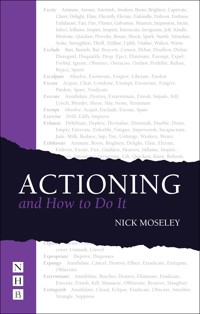
Actioning – and How to Do It is the indispensable companion to a vital component in every actor's toolkit. Actioning is one of the most widely used rehearsal techniques for actors. It helps bring clarity to every moment or thought in the text, energising rehearsals and bringing performances to life. Actioning will enable you to discover and unlock newfound energy, range, variety and clarity of body and voice, by: - Interrogating the text and making initial action verb choices - Playing your chosen actions, both verbally and physically - Maintaining an imaginative and emotional connection with each moment - Signposting each thought to your scene partnerFrom the publishers of the internationally successful Actions: The Actors' Thesaurus, this is the first in-depth exploration of Actioning for student actors, those who train them, and professionals working in the industry, whether they're brand new to the technique or have been practising it for years. This step-by-step guide draws on concepts from Stanislavsky, using sample scenes from classic plays such as The Seagull and The Importance of Being Earnest, as well as contemporary pieces, and is filled with exercises to demonstrate the technique at work.
Sie lesen das E-Book in den Legimi-Apps auf:
Seitenzahl: 176
Veröffentlichungsjahr: 2016
Das E-Book (TTS) können Sie hören im Abo „Legimi Premium” in Legimi-Apps auf:
Ähnliche


















ACTIONING
and How to Do It
NICK MOSELEY
NICK HERN BOOKS
London
www.nickhernbooks.co.uk
Contents
Introduction
Acknowledgements
1 Beginning Actioning
2 Complex Text
3 Playing the Actions
4 The Physical Dimension of Actioning
5 Discovering the Physical Form
6 Maintaining Connection
7 Signposting
8 Moving Forward
Afterword
About the Author
Copyright Information
Introduction
The Actioning technique, sometimes called ‘Psychophysical Actioning’, is probably the most firmly established of all early rehearsal processes within the British theatre. Most drama schools and many directors see it as an essential part of rehearsal ‘table work’ and the bedrock of the actor’s work on the text.
Contrary to popular belief, Actioning is not a Stanislavskian technique, and is in fact little used outside of the UK. It was devised and developed by the Joint Stock Theatre Company in the late 1970s under the direction of Bill Gaskill and Max Stafford-Clark, largely in order to empower the actor to serve the play and the production by making clear and simple choices on each line of the text. It has since found its way into the arsenal of the majority of UK actors and directors.
Put simply, the Actioning technique requires you, the actor, in the early stages of rehearsing a play, to divide up your own lines into separate phrases or thoughts, to assign each thought an ‘action verb’ which expresses the underlying intention of the line, and then, having assembled this series of verbs, to attempt to speak and act each thought in the manner of the chosen verb.
The verbs themselves must be ‘transitive’ – in other words, something your character can do to another character, such as ‘prod’, ‘ridicule’ or ‘encourage’, rather than non-transitive verbs such as ‘muse’, ‘cry’ or ‘hesitate’, which tend to pull your focus back onto yourself. This means that each thought, spoken with a particular action verb in mind, becomes an attempt to affect another character in the manner implied by that verb.
Actioning is radical because it always begins with the text itself, and with the creation of a ‘template’ of shifting character intentions that serves as a living analysis of the possible intentions of the playwright. The post-Stanislavskian technique of Active Analysis, by contrast, postpones engagement with the words of the text until the actor is physically and emotionally immersed in the imagined world of the play, and in the relationships and the journey of each scene. In Active Analysis actors initially improvise the dialogue of the play, exploring the relationships and the journey of each scene to the point where the actual text can be ‘drip-fed’ into the imaginary world thereby created.
There is much argument about which technique works better for actors, but for me the debate is largely irrelevant. In either case you are still faced with the problem of how you deal with that difficult moment when you have to start speaking words written by someone else, and possibly spoken by hundreds of actors before you, as if they had just spontaneously popped into your head within an entirely new and present situation!
My view is that the Actioning technique is a highly effective and efficient way of making the text your own from day one. By ‘Actioning’ the text, you can impose your actor’s will upon it, not in a random or perverse way, but by applying an analytical process which encapsulates each moment of a play into a single word that you yourself have selected.
For Gaskill and Stafford-Clark, Actioning was partly a response to the difficulty their actors seemed to have with ‘motivation’, especially in the case of political and polemical texts. In productions such as David Hare’s Fanshen (Joint Stock Theatre Company, 1975), some actors were apparently unable to find the impulse to speak and act in a way that would clearly and simply reveal the human story and the social narrative. The director required the actors to serve the production by inhabiting and ‘living’ the form of the text; by contrast the actors seemed to want to explore individualised subtextual narratives which were emotionally and psychologically complex but which blurred the dialectical storyline and disrupted its rhythm.
The beauty of the Actioning technique is that, from the outset, it demands that you (often in collaboration with your director) interrogate the text in minute detail in order to find the right verbs to express your interpretation of each thought. The choice of a single verb, simple though it might seem, requires you to think about character, situation, scene objective and relationships at each point in the text, and to encapsulate them in one word. Having chosen your verbs, you then also have to ‘play’ them, through clear and tangible vocal shifts between one verb and the next. By bringing your vocal and physical resources to the task of delivering a line in the manner of the verb, you then start to own the text from a very early stage of rehearsal.
Actioning has often been criticised for being ‘inorganic’, and for not allowing the actor enough space to discover the meaning of the text through rehearsal and interaction. Actors have claimed to feel ‘straitjacketed’ and constricted by their action-verb choices, unable to speak as their impulse dictates in the moment. My view of this is that Actioning is no different from any of the other ‘set’ elements of the play and production. You cannot generally stray from the playwright’s text, or from the moves set by the director, since those elements are fixed. So it is with the action verbs, yet none of these fixed aspects necessarily leads to a fixed performance. Even within those boundaries, you, the actor, still have huge scope for being reactive, impulsive and present, and no two performances will ever be quite the same. Like the text, the blocking and all the other fixed elements of a performance, the action verbs are there to help and support you – to give you a structure and a direction so that you can be free to respond in the moment without fear of losing the thread of the narrative or the form of the play.
Having said that, it is important to remember that action verbs can also be changed, not randomly or inadvertently, but through moments of clarity and realisation, when you decide at some point in rehearsal that your initial choice is not working. My view is that you are more likely to arrive at such moments by making clear and definite choices to begin with.
It might also be argued that Actioning serves another vital purpose, crucial to the age we live in, which is to force actors to develop vocal and physical precision and to broaden their expressive range, in a world where so much of our communication is now electronic – and where the notion of being physically, vocally and mentally ‘present’ is blurred by the reality that, for much of our lives, we are communicating simultaneously within two or three different contexts. For young actors in particular, the process of turning the body into a clear and efficient signifier, and of focusing the mind onto a single thought and intention in each moment of the action, works in opposition to the recent cultural shifts which encourage a much more dispersed energy and divided focus. This is not an entirely new endeavour – actors have always had to learn to speak and move with clarity – but there has never been a greater need for core training techniques which inspire and stimulate actors to expand and refine their physical and vocal capacity. Actioning is such a technique, and I believe it to be a fundamental tool for approaching text.
This book will attempt to go beyond traditional notions of using Actioning in rehearsal, by investigating the Actioning technique both as a tool for analysing and speaking text, and as a springboard into the actual staging of a scene. When I first used the technique, as an actor in the 1980s, I found it hard to see the connection between the action verbs chosen on the text and the work done on the rehearsal-room floor, and I saw other actors also struggling with this. Over many years of teaching the technique I have realised that action verbs also have a strong spatial/physical dimension which offers the actor possibilities for interacting with other characters and with the space. In the later chapters of this book I will be giving an account of these discoveries and showing how the actor can use Actioning as a physical as well as a verbal tool.
Acknowledgements
Max Stafford-Clark for allowing me to interview him about the Actioning technique.
The students of the BA (Hons) Acting Course at The Royal Central School of Speech and Drama for helping me explore these ideas over a number of years.
My partner for her tolerance and support.
The aim of this chapter is to help you develop skills in the first stages of the Actioning technique, namely the analysis of the text preparatory to choosing your action verbs. We need to be clear from the outset that Actioning is in no sense an alternative to other text work which an actor undertakes. It is impossible, in fact, to ‘action’ a text effectively without having first undertaken a range of Stanislavsky-derived processes and exercises, in order to establish, as appropriate, the background context and the specific circumstances in which a scene takes place. This analysis is a lengthy process in itself, but for the purposes of this chapter I have provided, in condensed form, much of the information you will need to get started on Actioning the sample texts and scenes.
As you will see, the business of choosing action verbs is not mechanical or formulaic. Rather it requires the actor to enter into a ‘dialogue’ with the text in order to tease out the right verbs. A great deal of analysis and thought has to go into this process, but the need to arrive at a single verb for each thought within the text stops this dialogue from turning into ‘psychobabble’ and saves the actors from drowning in a sea of possibilities. It is essential that when you first get up to rehearse a scene, you are only playing one choice at a time!
The sample dialogue below is designed to illustrate on a simple level some of the key features you will later identify in more complex scripts.
Sample Dialogue 1
(UNIT 1)
A newsagent’s shop. BECKY (aged eighteen) is standing behind the counter, checking off something on a list. JOHN enters the shop. BECKY looks up.
JOHN. Hi. / Could I get some headache pills?
BECKY looks behind her at the row of medications.
BECKY. Which sort?
JOHN. Have you got any paracetamol?
BECKY. No, sorry, / just Nurofen and Anadin.
JOHN. Okay then, could I have some Nurofen?
______________EVENT_______________
(UNIT 2)
BECKY. Are you over sixteen? / I’m not allowed to sell them otherwise.
JOHN. Of course I am.
BECKY. Do you have any ID?
JOHN. No, I didn’t bring any. / Look, this is crazy, I’m twenty-two!
BECKY. You don’t look it.
JOHN. Come on, take a look at me. / Do I really look fifteen?
BECKY. I could get into trouble.
JOHN. Trust me, I’m twenty-two! BECKY (doubtfully). Okay.
She hands him the Nurofen.
The analysis of any scene, be it simple or complex, must always begin with the following questions:
1. What are the broad given circumstances? Include era, location, season, time of day, specific setting.
2. What are the specific given circumstances? Include characters and their backstories; previous relationships, if any; the basic contention (what the scene is about).
3. What do the characters want? We call these ‘wants’ objectives. Whose objective is the strongest? This person will be the scene driver.
4. What is stopping each character achieving their objective? This is the obstacle. Obstacles are usually created by the resistance of the other character.
5. What events happen in the scene, which change the situation? An event signifies the start of a new unit within the text.
6. What are the smaller ‘wants’ – sub-objectives – within each unit, which are leading towards the bigger want – main objective?
7. Are there any counter-objectives? A counter-objective is something else the character wants, or wants to avoid, which is in some measure opposed to the main objective, so that it becomes an internal obstacle.
Since the two characters in this scene clearly do not know each other, and the nature of their encounter is largely transactional, the given circumstances of the scene are relatively straightforward, as are the character objectives. John (the scene driver) clearly has a main objective ‘to buy tablets to cure his headache’. In the first unit of the scene, his sub-objective might be ‘to find out what tablets they have in the shop’. There is no serious obstacle to this, and he ‘caps’ this objective easily.
An event then takes place, in which Becky, who has presumably been focusing mainly on the shelves up until that point, suddenly realises that John looks very young. This creates a new unit, and although John’s main objective does not change, his sub-objective now becomes ‘to convince Becky of his age’. His obstacle is now Becky’s doubt.
Becky’s main objective is probably ‘to do her job properly’. In the first unit her sub-objective might be ‘to assist John’, while in the second unit she perhaps wants ‘to be sure John is over sixteen’ because she feels her job might be at risk. She has no significant obstacle in the first unit (other than the absence of paracetamol), but in the second unit, her obstacle is that John has no ID. Becky also has a counter-objective, which is that she doesn’t want to annoy a customer, as this could also have consequences for her. This puts her into a dilemma, which requires John’s help to be resolved.
Once you have considered all of these questions, and before you can ‘action’ the text, you next have to divide the dialogue into ‘thoughts’, as indicated by the forward slashes in the text above. Some speeches will just be a single thought; others will contain several ‘thought-changes’. Broadly, the definition of a thought is the extent of what a character intended to say when they started speaking. That may be just a short phrase or sentence, or it may be several lines. The new thought begins when the character suddenly thinks of something new, or additional, to say, or when another character starts to speak. Each thought will have its own action verb allocated to it.
John’s first line is divided into two thoughts. ‘Hi’ is clearly just a conventional greeting, and the verb we allocate will probably be I GREET. The intention of this action is presumably to get Becky’s attention in a friendly way. His second thought, ‘Could I get some headache pills?’, although framed as a question, is in fact quite an urgent request, so I SOLICIT might be the verb. The verb reflects the level of need, which we can assume is fairly acute.
Becky’s first thought – ‘Which sort?’ – is a simple I QUESTION, as is John’s reply ‘Have you got any paracetamol?’, although in this context we might use I PROBE, reflecting the level of need. Becky’s ‘No, sorry’ is clearly I PLACATE, while her ‘Just Nurofen and Anadin.’ might be I CHEER. Note that we are focusing on Becky’s intention, not the actual effect of the information on John. John might, for example, be disappointed by the news that there is no paracetamol, but Becky’s action is not I DISAPPOINT because that is not the intended effect.
It is worth mentioning at this point that when you choose your action verbs, you should as far as possible avoid ‘neutral’ verbs like ‘I INFORM’. The reason for this is that verbs of this kind don’t really suggest a strong intention or strategy, and consequently they do not offer the actor a clear instruction about how to speak or move. The short scene above might not seem particularly exciting, yet however seemingly dull the dialogue, it is the actor’s job to reveal the dramatic action through the action choices. A headache might not seem to be the most dramatic premise for a scene, but it is never the actor’s job to downplay the central issue. As we know, quite small things can seem very important to those actually in the situation!
John’s next line ‘Okay then, could I have some Nurofen?’ is probably I INSTRUCT, even though it is phrased as a question. This should really end the transaction and cap both objectives, but at this point the EVENT happens. Becky notices that John appears to be quite young, and she is suddenly thrown into doubt about whether she is allowed to proceed with the transaction. Her first thought is ‘Are you over sixteen?’ (I QUIZ), followed by ‘I’m not allowed to sell them otherwise’ for which you might choose I EDUCATE. (Again, we avoid I INFORM.) The reason we choose this verb is that Becky first asks a question but doesn’t wait for the answer. From this we can infer that she sees a reaction arising in John (possibly confusion about why she has asked his age) and seeks to anticipate it.
John’s answer ‘Of course I am’ indicates that he thinks this a stupid and unnecessary question. I would choose I RIDICULE as an action for this thought, which may seem a strong choice, but when choosing action verbs you have to take into account the precise circumstances. In this case, John, with a severe headache, has had to accept his second choice of medication, and is now faced with the possibility of not being allowed to buy it at all. For him this is a highly problematic situation, and he reacts accordingly. As a general rule I would always encourage actors to pick stronger rather than weaker verbs, because strong verbs force actors to engage with each other and discover the contention of a scene.
Becky’s reply ‘Have you got any ID?’ may seem quite provocative, but it is likely that her only intention here is to INVITE him to present his ID so that they can both move on. John then REJECTS her invitation (‘No, I didn’t bring any’) and proceeds to UNDERMINE her (‘Look, this is crazy, I’m twenty-two’). Becky counters with ‘You don’t look it’ (I RESIST). John presumably realises that he does look younger than his age, but since he does not have to prove his actual age, merely that he is over sixteen, he CHALLENGES her (‘Come on, take a look at me’) and then INTERROGATES her (‘Do I really look fifteen?’).
Becky then APPEALS TO him with her line ‘I could get into trouble’, upon which he REASSURES her with ‘Trust me, I’m twenty-two’. Finally she ACCEPTS him (‘Okay’), the transaction takes place, he caps his objective, and the scene ends.
The key to choosing verbs that are both accurate and stimulating lies in the actors’ ability to bring the text to life in their imagination. Thoughts should never be considered out of context, but should always be seen as part of the through-line of the dialogue. Imagining how the dialogue might sound will also encourage you to choose strong and evocative verbs, rather than neutral or uninspiring ones. Strong verbs are not only easier to relate to and play; they are also far more likely to stimulate a reaction from your fellow actor once you start to get a scene onto its feet.
I should also emphasise that the verb choices listed above are not the only possibilities. You may have your own suggestions or interpretations that give you a clearer sense of the action, or even lead you to play a thought differently. The initial verb choices are merely ‘ways in’ to the scene. They stop you getting stuck in flat and meaningless delivery of the text when you start rehearsing, and they help you realise the different moments and shifts within the scene. Many of the action verbs you choose will remain throughout rehearsal, but some may change as you gain a deeper understanding of a scene and take account of your fellow actors’ choices. For this reason, all action verbs (and indeed all text notes) should be written in pencil!
The second excerpt, below, requires you to consider not just the dialogue itself, but the background circumstances and the backstories of both characters:
Sample Dialogue 2
The given circumstances are that Sam, who has no money and lots of debts, has managed to borrow two hundred pounds from Rosie, an ex-girlfriend who lived with him in the flat for two years, and with whom he is still on very good terms. His current girlfriend, Fran, is suspicious of Rosie, who is not just Sam’s ex but also his childhood friend. The previous evening Sam arrived home quite drunk, thinking the money was in his jacket pocket, but he now can’t find it.
A shabby shared living room in a rented flat. Sunday morning. A battered black-leather sofa and two mismatched armchairs. Mess, beer cans, rubbish. SAM (late twenties) dressed only in T-shirt and boxer shorts, is looking for something. He searches among the rubbish, then stops and thinks. The doorbell rings.
___________EVENT FOR SAM___________
SAM answers it. It is FRAN, SAM’s girlfriend (early twenties).
FRAN. Morning!
SAM. Hi.
FRAN steps into the flat and stares around with distaste.
FRAN. This place is a tip. / You should clear it up.
SAM. Why don’t




