


15,99 €
Mehr erfahren.
- Herausgeber: John Wiley & Sons
- Kategorie: Ratgeber
- Sprache: Englisch
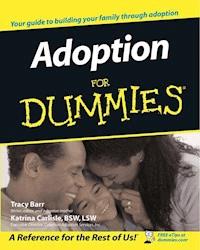
You hear all sorts of things said or implied about adoption. Some information comes from people who know a lot about it, while some comes from people who don't know anything about it but make assumptions anyway. Some comes from people whose experiences have been good; some from those whose experiences have been bad. The result? Enough conflicting information to make your head spin. So when everyone has an opinion and most of the books on the market deal with specific aspects on adoption or particular types of adoptions, where do you turn to for reliable information? Start with Adoption For Dummies. The great thing about this guide is that you decide where to start and what to read. It's a reference you can jump into and out of at will. Just head to the table of contents or the index to find the information you want. Each part of Adoption For Dummies covers a particular aspect of adoption, including: * Answering the basic adoption questions - How much does it cost? Who's involved? How long does it take? What do I need to know that I don't know to ask? And more. * Getting started - and figuring out what steps you have to take. * Dealing with birthmothers and birthfathers - and why, even though they may not be part of your life, they're still important to you. * Confronting the issues adoptive families face - issues from sharing the adoption story with your child, to answering your child's questions about his birthparents, to handling rude family members who treat your child differently than her cousins. * Finding help - from books, resources, and support groups. No adoption book - at least no adoption book that you can carry around without a hydraulic lift - can tell you everything there is to know about adoption. What Adoption For Dummies tells you is what you need to know, all in an easy-to-use reference.
Sie lesen das E-Book in den Legimi-Apps auf:
Seitenzahl: 646
Veröffentlichungsjahr: 2011
Ähnliche

















Adoption For Dummies®
by Tracy Barr and Katrina Carlisle
Adoption For Dummies®
Published byWiley Publishing, Inc.111 River St.Hoboken, NJ 07030-5774www.wiley.com
Copyright © 2003 by Wiley Publishing, Inc., Indianapolis, Indiana
Published by Wiley Publishing, Inc., Indianapolis, Indiana
Published simultaneously in Canada
No part of this publication may be reproduced, stored in a retrieval system, or transmitted in any form or by any means, electronic, mechanical, photocopying, recording, scanning, or otherwise, except as permitted under Sections 107 or 108 of the 1976 United States Copyright Act, without either the prior written permission of the Publisher, or authorization through payment of the appropriate per-copy fee to the Copyright Clearance Center, 222 Rosewood Drive, Danvers, MA 01923, 978-750-8400, fax 978-646-8700. Requests to the Publisher for permission should be addressed to the Legal Department, Wiley Publishing, Inc., 10475 Crosspoint Blvd., Indianapolis, IN 46256, 317-572-3447, fax 317-572-4447, or e-mail [email protected]
Trademarks: Wiley, the Wiley Publishing logo, For Dummies, the Dummies Man logo, A Reference for the Rest of Us!, The Dummies Way, Dummies Daily, The Fun and Easy Way, Dummies.com and related trade dress are trademarks or registered trademarks of John Wiley & Sons, Inc., and/or its affiliates. All other trademarks are the property of their respective owners. Wiley Publishing, Inc., is not associated with any product or vendor mentioned in this book.
LIMIT OF LIABILITY/DISCLAIMER OF WARRANTY: While the publisher and author have used their best efforts in preparing this book, they make no representations or warranties with respect to the accuracy or completeness of the contents of this book and specifically disclaim any implied warranties of merchantability or fitness for a particular purpose. No warranty may be created or extended by sales representatives or written sales materials. The advice and strategies contained herein may not be suitable for your situation. You should consult with a professional where appropriate. Neither the publisher nor author shall be liable for any loss of profit or any other commercial damages, including but not limited to special, incidental, consequential, or other damages.
For general information on our other products and services or to obtain technical support, please contact our Customer Care Department within the U.S. at 800-762-2974, outside the U.S. at 317-572-3993, or fax 317-572-4002.
Wiley also publishes its books in a variety of electronic formats. Some content that appears in print may not be available in electronic books.
Library of Congress Cataloging-in-Publication Data:
Library of Congress Control Number: 2003105677
ISBN: 0-7645-5488-3
Manufactured in the United States of America
10 9 8 7 6 5 4 3 2 1
About the Authors
Tracy Barr has been a part of the Dummies phenomenon for almost a decade. In that time, she has served as editor, editorial manager, writer, and consultant to the folks who write and edit For Dummies books. Most recently, she helped write World War II For Dummies with Keith D. Dickson, Latin For Dummies with Clifford Hull and Steven Perkins, and Religion For Dummies with Rabbi Marc Gellman and Monsignor Thomas Hartman. Her most challenging and rewarding role, however, is a personal one. She built her family through adoption and is the mother of four rambunctiously wonderful children. Her personal experience with adoption did not begin with her own children, however, but with her family of origin, which itself was built through adoption. As one of six children in an interracial family and as an adoptive mother, she is well aware of the issues that adoptees and their parents face.
Katrina Carlisle, BSW, LSW, is currently the executive director of Coleman Adoption Services, Inc., in Indianapolis, Indiana. Her duties include providing direct services to birthparents prior to placement and post-placement, conducting home studies and post-placement supervision visits for adoptive parents, providing search and reunion services for adult adoptees and birthparents, and leading transracial adoption seminars and other types of community education. She has three years of experience as a social worker in adoption and child welfare agencies. Two of her four children were adopted.
Dedication
From Katrina: In loving memory of my son, Bryce Ryan Carlisle October 16, 1979–November 23, 2000 “Always remembered, forever loved”
From Tracy: To my husband, Larry, who has given my life happiness, and to my children — Adam, Sarah, Mary, and Alex — who have given it meaning.
Acknowledgments
From Katrina: I would like to thank the following people: My coauthor, Tracy, for asking me to do this project and then for having the patience to guide me through it. My husband, John, for his love and support in everything I do. My children, Derrick and Kara, for teaching me about adoption and allowing me to share their stories. My son Reid for understanding that his stories are not about adoption and, therefore, not in the book. My grandchildren for sharing their energy with me and my daughters-in-law for their encouragement. My mom and dad for their enthusiasm for this book and for telling everyone they know about it. My personal cheerleaders, Kenan and Mary. All my co-workers at Coleman Adoption Services, Inc., for believing in me and to all the wonderful birthmothers, adoptive parents, and adoptees who have taught me everything I know.
From Tracy: I would like to thank the following people: My coauthor, Katrina, for trusting me when I said that, together, she and I could actually write this book. My husband, Larry, for his love, support, and too many other things to list here. My children, for interrupting me regularly enough to remind me exactly why I took on the task of writing this book. And the people in the family I grew up in: my parents, Lanny and Mary Carmichael; and my siblings, Kelly, Sandy, Billy, David, and Wendy, just because.
From both authors: Several people helped create this book: Natasha Graf, Norm Crampton, Alissa Schwipps, and Tina Sims, the Wiley acquisitions and editing team that pulled everything together; Melitta Payne, of Bethany Christian Services, who graciously provided information on international adoptions; Kathy Gallop, of Lutheran Social Services, who took time from her busy schedule to read the manuscript and offer always helpful suggestions; and to all the people who shared their own adoption stories with us: Laura and Brian Allen, Sherry and Bill Frazer, Amy Young-Gray, Jon and Jennifer Kirkman, Charlotte Ottinger, Christine and Maurice Rembert, Leon and Tonna Thomas, Ilene Watson, and Carl and Vicki Witmer.
Publisher’s Acknowledgments
We’re proud of this book; please send us your comments through our Dummies online registration form located at www.dummies.com/register/.
Some of the people who helped bring this book to market include the following:
Acquisitions, Editorial, and Media Development
Senior Project Editor: Alissa D. Schwipps
Acquisitions Editor: Natasha Graf
Senior Copy Editor: Tina Sims
Acquisitions Coordinator: Holly Grimes
Technical Editor: Kathy J. Gallup
Editorial Manager: Jennifer Ehrlich
Editorial Assistant: Elizabeth Rea
Cover Photos: ©SuperStock/SuperStock/PictureQuest
Cartoons: Rich Tennant, www.the5thwave.com
Production
Project Coordinators: Nancee Reeves and Kristie Rees
Layout and Graphics: Jennifer Click, Seth Conley, Carrie Foster, Stephanie D. Jumper, Jacque Schneider
Proofreaders: TECHBOOKS Production Services, Brian H. Walls
Indexer: TECHBOOKS Production Services
Publishing and Editorial for Consumer Dummies
Diane Graves Steele, Vice President and Publisher, Consumer Dummies
Joyce Pepple, Acquisitions Director, Consumer Dummies
Kristin A. Cocks, Product Development Director, Consumer Dummies
Michael Spring, Vice President and Publisher, Travel
Brice Gosnell, Publishing Director, Travel
Suzanne Jannetta, Editorial Director, Travel
Publishing for Technology Dummies
Andy Cummings, Vice President and Publisher, Dummies Technology/General User
Composition Services
Gerry Fahey, Vice President of Production Services
Debbie Stailey, Director of Composition Services
Contents
Title
Introduction
About This Book
Conventions Used in This Book
What You’re Not to Read
Foolish Assumptions
How This Book Is Organized
Icons Used in This Book
Where to Go from Here
Part I : Everything You Ever Wanted to Know about Adoption but Didn’t Know Whom to Ask
Chapter 1: Adoption Basics
Defining Adoption
Looking at the Adoption Process: What Happens When?
It Takes (Half) a Village: Meeting the Folks Involved
Spending Time and Money: You’ll Probably Need Both
Examining Adoption Issues You and Your Child(ren) Will Face
Your Child and You
Questions to Ask Yourself
Chapter 2: Sorting It All Out: Types of Adoptions
Agency, Attorney, or Other: Ways to Connect to Your Child
At Home or Abroad: Where the Children Come From
Infants, Older Children, and Special-Needs Kids: The Children You Adopt
Closed, Semi-Open, and Open: The Adoption Arrangement
Chapter 3: The Adoption Process from Beginning to End
Born in the USA: Adopting in America
The Wide World of International Adoption
Extra Prep for Special Situations
Beyond Finalization
Chapter 4: The Gasp Factor: What You Can Expect to Pay
Money’s Role in American Adoption
The Cost of Private Agency Adoptions
State Agencies: Your Government at Work
There Oughta Be a Law! Cost of Attorney Adoptions
International Adoptions: Exchange Rates Not a Factor
What You Can’t Pay For
Don’t Panic: You Don’t Have to Be Rich to Adopt
Chapter 5: Who Can Adopt?
Profiling Adoptive Parents: Who Gets Kids?
Considering Other Issues That Can Impact Your Chances to Adopt
Getting to the Bottom Line: What Folks Look for in Adoptive Parents
Chapter 6: Building a Family through Adoption: Is It for You?
Motivating Factors: Examining Why You Want to Adopt
Fears and Concerns You May Have
Part II : Getting Started and Moving Forward, One Milestone at a Time
Chapter 7: Getting the Ball Rolling: Finding an Agency or Lawyer
Step One: Get on the Horn
Finding a Reputable Agency
Finding a Reputable Adoption Lawyer — No Joke
Finding an Adoption Facilitator
Protecting Yourself
Chapter 8: Thinking about Your Future Child
Describing Your Child
Honesty Is the Best Policy — Honest
Making the Info Work for You
Chapter 9: Applications, Home Studies, and Other Really Fun Stuff
Filling Out the Application
Show and Tell Time: The Home Study
But I’m a Good Person! The Reasons for the Scrutiny
Chapter 10: Doing Hard Time: The Wait
Facing the Wait and Staying Sane at the Same Time
Preparing for the Arrival of Your Child
Taking Care of Special Prep Work for International Adoptions
Making Special Preparations for Special-Needs Adoptions
Chapter 11: A Child’s Available! Now What? Placement and Follow-up Visits
Looking at How a Child Becomes Available
Getting the Most Important Call in Your Life
Finally, Signing the Placement Agreement
Your Child Is Home! Welcome to the Supervision Period
Chapter 12: Here Comes the Judge: The Court Appearance
Where and When and How to Dress
The Cast and Crew and Their Roles
Taking the Stand: What Happens
Making Your Court Appearance in International Adoptions
What to Do after the Deed Is Done
Part III : Birthmothers and Birthfathers
Chapter 13: God Bless the Birthmothers
The Birthmother: Who She Is
Making an Adoption Plan
Helping the Birthmother: What You Can Do
Chapter 14: Birthfathers and Their Role in Your Adoption
Defining the Legal Categories of Birthfathers
Understanding the Birthfather’s Rights
Putative Father Registries
Birthfathers as Part of the Adoption Team
Chapter 15: Keeping in Touch: Meetings and Contact with the Birthmother
Getting to Know You: Contact Prior to Placement
Trading Info after Placement
Agreeing to Contact: Things to Think About
Arranging Contact in Older Child Adoptions
Part IV : Issues Adoptive Families Face
Chapter 16: All in the Family: Issues You Deal with at Home
Once Upon a Time . . . The Adoption Story
Who’s Yer Daddy (or Mommy)? Dealing with the “Real” Parent Issue
Handling Feelings of Rejection
Special Issues in Transracial and Transcultural Adoptions
Special Issues Faced by Parents of Older Adopted Children
Special Issues Faced by Parents of Children Adopted Internationally
Chapter 17: Beyond the Family: Dealing with Outsiders
Who to Tell What about the Adoption
Dealing with Tactless Neighbors and Friends and Nosy Strangers
Dealing with Adoption When Your Child Hits School Age
Helping Your Child Deal with Negative Perceptions of Adoption
Chapter 18: What Can Go Wrong and What You Can Do
I Want My Baby Back: Challenges to Placement
Things Don’t Work Out: Disrupted Adoptions
Problems You Didn’t Know Existed
Chapter 19: In Search of . . . Birthparents
Why Kids Seek Birthparents
The Search Is On
Happily Ever After? When the Search Ends
How You Can Help
Part V : The Part of Tens
Chapter 20: Ten Great Books to Read to Your Kids
The Mulberry Bird: An Adoption Story
A Mother for Choco
The Day We Met You
Never Never Never Will She Stop Loving You: The Adoption Love Story of Angel Annie
When You Were Born In China: A Memory Book for Children Adopted from China
Zachary’s New Home: A Story for Foster and Adopted Children
A New Barker in the House
Tell Me Again about the Night I Was Born
W.I.S.E. Up! Powerbook
All About Me
Chapter 21: Ten Support Groups for Adoptive Families
Latin America Parents Association (LAPA)
The National Adoption Center (NAC)
The National Council for Single Adoptive Parents
North American Council on Adoptable Children (NACAC)
Adoptive Families of America (AFA)
Families Adopting Children Everywhere (FACE)
Families of Children from Vietnam (FCV)
The Korean American Adoptee Adoptive Family Network (KAAN)
Families with Children from China (FCC)
To Find Other Groups in Your Area
Chapter 22: Ten Helpful Web Sites
General Adoption Web Sites
Sites for International Adoptions
Introduction
Y ou hear all sorts of things said or implied about adoption. Some info comes from people who know a lot about it; some comes from people who don’t know jack about it but make assumptions anyway. Some comes from people whose experiences have been good; some from those whose experiences have been bad. The result? Enough conflicting information to make your head spin.
The truth is, the adoption experience is as varied and unique as the people who are touched by it. What may be true for some, based on their unique circumstances and influenced by their own perceptions, may not be true for others.
So when everybody has an opinion and most of the books on the market deal with specific aspects on adoption or particular types of adoptions, where do you go when you don’t know enough to know what you need to know more about? To a general reference, and that’s what Adoption For Dummies is.
One thing you should know is that everyone who writes about adoption has a bias, and so do we. We’re all for it. Our own personal and professional experiences with adoption have only reaffirmed for us that adoption is a wonderful and natural way to build families. Having said that, you also need to know that we don’t try to “sell” you on the idea of adoption. Why? Because adoption isn’t the right choice for everyone. But for those for whom adoption is the right choice, we can say that you’re in for the ride of your life.
About This Book
No adoption book — or at least no adoption book that you can carry around without a hydraulic lift — can tell you everything there is to know about adoption. In this book, we don’t even try. What this book does is tell you what you need to know. How does adoption work? How much can it cost? How do you decide whether adoption is a good choice for your family? What kinds of things do you need to be prepared to deal with if you build your family through adoption? And more. And all in an easy-to-use reference.
Each chapter is divided into sections, and each section contains information about some part of understanding adoption, like
What you can expect during your home study and what to include in the profile you’ll be writing
Who the people involved in your adoption are (birthparents, social workers, and so on) and what roles they play
Adoption laws and guidelines you need to be aware of
Questions to ask when you start hunting for a reputable adoption agency or attorney
How to deal with the issues that adoptive families face
The great thing about this book is that you decide where to start and what to read. It’s a reference you can jump into and out of at will. Just head to the table of contents or the index to find the information you want.
Conventions Used in This Book
To help you navigate through this book, we’ve set up a few conventions:
Italic is used for emphasis and to highlight new words or terms that are defined.
Boldfaced text is used to indicate the action part of numbered steps.
Monofont is used for Web addresses.
What You’re Not to Read
We’ve written this book so that you can 1) find information easily and 2) easily understand what you find. And although we’d like to believe that you want to pore over every last word between the two yellow covers, we actually make it easy for you to identify “skippable” material. This information is the stuff that, although interesting and related to the topic at hand, isn’t essential for you to know:
Text in sidebars: The sidebars are the shaded boxes that appear here and there. They share personal stories and observations, but aren’t necessary reading.
Anything with a Technical Stuff icon attached: This information is interesting but not critical to your understanding of adoption.
The stuff on the copyright page: No kidding. You’ll find nothing here of interest unless you’re inexplicably enamored by legal language and Library of Congress numbers.
Foolish Assumptions
Every book is written with a particular reader in mind, and this one is no different. As we wrote this book, we made a few assumptions about you:
You haven’t had much experience with adoption — beyond what you see on TV — and want to find out whether it’s really as perilous an endeavor as some people would lead you to believe.
You’re thinking about adopting but aren’t sure whether it’s the right choice for your family. Or you want to adopt, but you don’t know where to start or what to expect.
You want basic information, but you don’t want to become an expert in adoption law or to have to spend inordinate amounts of time scouring through legal journals.
You’ve decided to adopt but are facing objections from family members or friends, and you want an adoption book that’s hefty enough to have an impact when you hit them upside the head with it.
How This Book Is Organized
To help you find information that you’re looking for, this book is divided into five parts. Each part covers a particular aspect on adoption and contains chapters relating to that part.
Part I: Everything You Ever Wanted to Know about Adoption but Didn’t Know Whom to Ask
Many people starting the adoption journey have a zillion questions: What’s it mean? How much does it cost? Who’s involved? How long does it take? What do I need to know that I don’t know to ask? And more. If you have the same questions, welcome to Part I. Here you can find the answers to basic questions that rattle around the brains of just about everyone who first considers adoption as an option in family planning.
Part II: Getting Started and Moving Forward, One Milestone at a Time
Let’s face it. Filling out an application on which you state both your weight and your income is not as fun as having sex. As a result, many people, when they first think about adoption, don’t think, “Goody. We get to conjure up a family.” They think, “How many painful, silly, embarrassing things am I going to have to do to get a child?” This part sets aside the fact that this is exactly the same question that people who conceive their children should be asking and explains, in detail, what steps you have to take.
Part III: Birthmothers and Birthfathers
All adoptions involve birthparents. These are the people who created the child you love and whom you may fret the most about, especially during the early stages of your adoption. “Will they like and select us?” “Will they follow through with the adoption plan?” “Will they challenge the adoption?” “How involved will they be after the placement?” are all questions that adoptive parents ask themselves at one time or another. To help alleviate your concerns, this part explains who the birthparents are, the roles they have in your adoption plans, and why, even though they may not be part of your life, they’re still important to you.
Part IV: Issues Adoptive Families Face
As an adoptive family, you’re going to face issues that parents who give birth to their children don’t have to face. These issues include things like deciding whom to tell what about the adoption, how to share the adoption story with your child, how to help your child deal with questions or emotions she has about her birthmother, how to shut up rude strangers who focus on the ways in which your family is different, or how to handle family members who treat your kids differently than their cousins. This part explains what issues you should be prepared to face and offers suggestions on how to deal with them when they arise.
Part V: The Part of Tens
Want to know what adoption books are great to read to your kids? How about resources that you, as an adoptive parent, can use? Think you need a support group? This part offers lists of things — books, resources, and support groups — that you may find helpful.
Icons Used in This Book
The icons in this book help you find particular kinds of information that may be of use to you:
You see this icon anywhere we offer a suggestion or bit of advice — like how to save time or who to use as a resource — that can help you with the task at hand.
This icon points out important information that you want to remember.
Most people you work with in adoption are ethical, honest, and competent, but some aren’t. Whether the problem is one of intentional wrongdoing or just plain ignorance, the implications for your adoption can be disastrous. This icon serves as your warning to beware of certain people or situations.
This icon appears beside information that is interesting but not necessary to know. In fact, feel free to skip the info here if you want. Doing so won’t impair your understanding of adoption.
The best people to hear from are the people who’ve gone through what you’re going through (or thinking about going through). So we include personal stories from people who have adopted or been adopted. To help you easily find these anecdotes, we highlight them with this icon.
Where to Go from Here
This book is organized so that you can go wherever you want to find complete information. Want to know about birthparent searches, for example? Head to Chapter 19. If you’re interested in how to create your profile, go to Chapter 9 for that. You can use the table of contents to find broad categories of information or the index to look up more specific things.
If you’re not sure where you want to go, you may want to start with Part I. It gives you all the basic info you need to understand adoption and points to places where you can find more detailed information.
Part I
Everything You Ever Wanted to Know about Adoption but Didn’t Know Whom to Ask
In this part . . .
If you’re like most people first considering adoption, you may have a few basic questions swirling around in your brain that you want answered before you go much further. What does it require? How much does it cost? How long does it take? Whom do I contact or work with? And how will my past affect my chances? This part answers these questions for you, and then it asks one more: Is adoption the right choice for you? Although you won’t find the answer to that question here, you do find things to think about as you decide.
Chapter 1
Adoption Basics
In This Chapter
Understanding adoption: What it is and what it isn’t
Knowing what happens when you adopt
Getting to know the people involved in the process
Preparing to spend time and money
Anticipating issues you’ll face as an adoptive family
Becoming a fearless parent
S ome cultures believe that children visit their parents in dreams before they are born — that the child’s soul somehow recognizes its parent’s soul and is drawn to it, despite the boundaries of time and space and even physical existence. Whether you accept this belief or not, it is a compelling idea, don’t you think? That something other than conventional ties — genetic ties, historical ties, racial or ethnicity ties — joins people together and that this connection exists beyond time. Maybe adoption is simply what this mystery looks like after bureaucrats get hold of it.
Part of adoption is the practical stuff: the filling out of papers, the home studies and interviews, the things you cross off your list and store away in your closet as you wait. But the other part is the indefinable thing that makes adoption — having a child who is so completely yours that your heart seems to beat in time with his or hers — as mysterious and miraculous as conception and birth.
The mechanics are slightly different, true. After all, sex is optional in adoption (but then, nowadays, it is in some conceptions, too), the wait may be a few weeks or a few years, and your child may come to you in the gangly body of a preteen or the teetering one of a toddler. But in the end, your child is your child. This chapter gives you a quick tour of what adoption is, what you do when you adopt, what you need to know, and where to go to get more detailed information.
Lesen Sie weiter in der vollständigen Ausgabe!
Lesen Sie weiter in der vollständigen Ausgabe!
Lesen Sie weiter in der vollständigen Ausgabe!
Lesen Sie weiter in der vollständigen Ausgabe!
Lesen Sie weiter in der vollständigen Ausgabe!
Lesen Sie weiter in der vollständigen Ausgabe!
Lesen Sie weiter in der vollständigen Ausgabe!
Lesen Sie weiter in der vollständigen Ausgabe!
Lesen Sie weiter in der vollständigen Ausgabe!
Lesen Sie weiter in der vollständigen Ausgabe!
Lesen Sie weiter in der vollständigen Ausgabe!
Lesen Sie weiter in der vollständigen Ausgabe!
Lesen Sie weiter in der vollständigen Ausgabe!
Lesen Sie weiter in der vollständigen Ausgabe!
Lesen Sie weiter in der vollständigen Ausgabe!
Lesen Sie weiter in der vollständigen Ausgabe!
Lesen Sie weiter in der vollständigen Ausgabe!
Lesen Sie weiter in der vollständigen Ausgabe!
Lesen Sie weiter in der vollständigen Ausgabe!
Lesen Sie weiter in der vollständigen Ausgabe!
Lesen Sie weiter in der vollständigen Ausgabe!
Lesen Sie weiter in der vollständigen Ausgabe!
Lesen Sie weiter in der vollständigen Ausgabe!
Lesen Sie weiter in der vollständigen Ausgabe!
Lesen Sie weiter in der vollständigen Ausgabe!




