


153,99 €
Mehr erfahren.
- Herausgeber: John Wiley & Sons
- Kategorie: Fachliteratur
- Serie: Advance Materials Series
- Sprache: Englisch
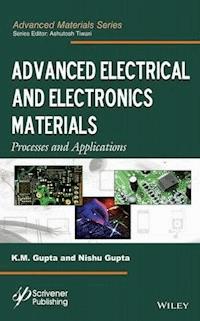
This comprehensive and unique book is intended to cover the vast and fast-growing field of electrical and electronic materials and their engineering in accordance with modern developments. Basic and pre-requisite information has been included for easy transition to more complex topics. Latest developments in various fields of materials and their sciences/engineering, processing and applications have been included. Latest topics like PLZT, vacuum as insulator, fiber-optics, high temperature superconductors, smart materials, ferromagnetic semiconductors etc. are covered. Illustrations and examples encompass different engineering disciplines such as robotics, electrical, mechanical, electronics, instrumentation and control, computer, and their inter-disciplinary branches. A variety of materials ranging from iridium to garnets, microelectronics, micro alloys to memory devices, left-handed materials, advanced and futuristic materials are described in detail.
Sie lesen das E-Book in den Legimi-Apps auf:
Seitenzahl: 903
Veröffentlichungsjahr: 2015
Ähnliche

















Contents
Cover
Half Title page
Title page
Copyright page
Dedication
Preface
Acknowledgement
About the Authors
Abbreviations
Chapter 1: General Introduction to Electrical and Electronic Materials
1.1 Importance of Materials
1.2 Importance of Electrical and Electronic Materials
1.3 Classification of Electrical and Electronic Materials
1.4 Scope of Electrical and Electronic Materials
1.5 Requirements of Engineering Materials
1.6 Operational Requirements of Electrical and Electronic Materials
1.7 Classification of Solids on the Basis of Energy Gap
1.8 Glimpse of Some Electronic Products, Their Working Principles and Choicest Materials
1.9 Different Types of Engineering Materials
1.10 Different Levels of Materials Structure
1.11 Spintronics (The Electronics of Tomorrow) and Spintronic Materials
1.12 Ferromagnetic Semiconductor
1.13 Left-Handed (LH) Materials
1.14 Solved Examples
Chapter 2: Atomic Models, Bonding in Solids, Crystal Geometry, and Miller Indices
2.1 Atomic Models
2.2 Bohr’s Quantum Atomic Model
2.3 Modern Concept of Atomic Model
2.4 Electron Configuration
2.5 Meaning of Chemical (or Atomic) Bonding
2.6 Classification of Chemical Bonds
2.7 Ionic Bond
2.8 Covalent Bonds
2.9 Monocrystalline and Polycrystalline Crystal Structures
2.10 Space Lattice
2.11 Basis
2.12 Unit Cell and Crystal
2.13 Bravais Crystal System
2.14 Primitive and Non-Primitive Unit Cells
2.15 Coordination Number
2.16 Atomic Packing Fraction
2.17 Calculation of Density (or Bulk Density)
2.18 Miller Indices
2.19 Interplaner Spacing
2.20 Linear Density
2.21 Planer Density
Chapter 3: Solid Structures, Characterization of Materials, Crystal Imperfections, and Mechanical Properties of Materials
3.1 Crystallography
3.2 Crystalline and Non-Crystalline Structures
3.3 Hexagonally Closed Packed Structure (HCP)
3.4 VOIDS
3.5 Covalent Solids
3.6 Bragg’s Law of X-Rays Diffraction
3.7 Structure Determination
3.8 Microscopy
3.9 Different Types of Metallurgical Microscopes and Their Features
3.10 Working Principle of Electron Microscope
3.11 Ideal and Real Crystals, and Imperfections
3.12 Classification of Imperfections
3.13 Point Imperfections
3.14 Effects of Point Imperfections
3.15 Line Imperfections
3.16 Features of Edge Dislocation
3.17 Screw Dislocation
3.18 Characteristics of Dislocations
3.19 Sources of Dislocations, Their Effects and Remedies
3.20 Grain Boundary
3.21 Twin or Twinning
3.22 Mechanical Properties of Metals
Chapter 4: Conductive Materials: Electron Theories, Properties and Behaviour
4.1 Electrons and Their Role in Conductivity
4.2 Electron Theories of Solids
4.3 Free Electron Theory
4.4 Energy Band Theory
4.5 Brillouin Zone Theory
4.6 Conductors
4.7 Factors Affecting Conductivity (and Resistivity) of Metals
4.8 Thermal Conductivity
4.9 Heating Effect of Current
4.10 Thermoelectric Effect (or Thermoelectricity)
4.11 Seebeck Effect
4.12 Peltier Effect
4.13 Thomson Effect
4.14 Wiedemann-Franz Law and Lorentz Relation
4.15 Solved Examples
Chapter 5: Conductive Materials: Types and Applications
5.1 Mechanically Processed Forms of Electrical Materials
5.2 Types of Conducting Materials
5.3 Low Resistivity Materials
5.4 High Resistivity Materials
5.5 Contact Materials
5.6 Fusible (or Fuse) Materials
5.7 Filament Materials
5.8 Carbon As Filamentary and Brush Material
5.9 Conductors, Cables, and Wires: Types and Materials
5.10 Solder Materials for Joining Wires and Joints in Power Apparatuses
5.11 Sheathing Materials
5.12 Sealing Materials
5.13 Solved Examples
Chapter 6: Semiconducting Materials: Properties and Behaviour
6.1 Introduction to Semiconductors
6.2 Different Types of Semiconducting Materials
6.3 Determining the Percentage Ionic Character of Compound Semiconductor
6.4 Fermi Energy Level
6.5 Intrinsic Semiconductors
6.6 Extrinsic Semiconductors
6.7 Effective Mass
6.8 Density of State
6.9 Temperature Dependency of Carrier Concentrations
6.10 Effects of Temperature on Mobility of Carriers
6.11 Direct and Indirect Energy Band Semiconductors
6.12 Variation of Eg with Alloy Composition
6.13 Degenerate Semiconductors
6.14 Hall Effect
6.15 Analysis of Drift and Diffusion Currents
6.16 Continuity Equation
6.17 Solved Examples
Chapter 7: Semiconducting Materials: Types and Applications
7.1 Element Form Semiconducting Materials
7.2 Formulated (Compound and Alloyed) Semiconducting Materials
7.3 Lattice Structures of Some Compound Semiconductors
7.4 Solar Cells
7.5 Semiconductor Lasers
7.6 Optical Materials in Light Emitting Diodes
7.7 Materials for Optical Fibres
7.8 Choicest Materials for Different Semiconductor Devices
7.9 Solved Examples
Chapter 8: Semiconducting Materials: Processing and Devices
8.1 Production of Element Form Of Silicon (Si)
8.2 Semiconductor Crystal Growth
8.3 Processing of Semiconducting Materials
8.4 Zone Refining
8.5 Manufacturing of Wafers
8.6 Semiconductors Fabrication Technology
8.7 Fabrication of a Semiconductor P-N Junction
8.8 Transistor Manufacturing Processes
8.9 Semiconducting Devices and Their Operating Principle
8.10 Important Applications of Semiconductor Devices
8.11 Brief Description of Some Semiconductor Devices
8.12 P-N Junction Diode
8.13 Working of P-N Diode When not Connected to a Battery
8.14 Different Types of P-N Junction Diodes
8.15 Junction Transistors
8.16 Bipolar Junction Transistor (BJT)
8.17 Field-Effect Transistor (FET)
8.18 Metal-Semiconductor Field-Effect Transistors (MESFET)
8.19 Insulated Gate Field Effect Transistor (IGFET) or Metal-Insulator-Semiconductor Field-Effect Transistor (MISFET)
8.20 Charge Coupled Devices
8.21 Solved Examples
Chapter 9: Dielectric Materials: Properties and Behaviour
9.1 Introduction to Dielectric Materials
9.2 Classification of Dielectric (or Insulating) Materials
9.3 Main Properties
9.4 Dielectric Constant
9.5 Dielectric Strength
9.6 Dielectric Loss
9.7 Polarization
9.8 Mechanism of Polarization
9.9 Comparison of Different Polarization Processes
9.10 Factors Affecting Polarization
9.11 Spontaneous Polarization
9.12 Behaviour of Polarization Under Impulse and Frequency Switching
9.13 Decay and Build-Up of Polarization Under Alternating Current (A.C.) Field
9.14 Complex Dielectric Constant
9.15 Determining the Internal Field Due to Polarization Inside the Dielectric
9.16 Clausius-Mossotti Relation
9.17 Solved Examples
Chapter 10: Dielectric Materials: Types and Applications
10.1 Solid Insulating Materials and their Applications
10.2 Polymeric Insulating Materials
10.3 Natural and Synthetic Rubber as Insulating Material
10.4 Paper as a Fibrous Insulating Material
10.5 Choices of Solid Insulating Materials for Different Applications
10.6 Liquid Insulating Materials
10.7 Gaseous Insulating Materials
10.8 Ferroelectric Materials
10.9 Barium Titanate: A Ferroelectric Ceramic
10.10 Modified Barium Titanate
10.11 PLZT as an Electro-Optic Material
10.12 Piezoelectricity
10.13 Piezoelectrics in Transducer Uses
10.14 Relation Between Young’s Modulus and Electric Field in Piezoelectric Material
10.15 Electrostriction
10.16 Pyroelectricity
10.17 Lead Zirconate Titanate (PZT): A Piezoelectric Ceramic
10.18 Lead Lanthanum Zirconate Titanate (PLZT)
10.19 Solved Examples
Chapter 11: Magnetic Materials: Properties and Behaviour
11.1 Origin of Permanent Magnetic Dipole
11.2 Terminologies Defined
11.3 Classification of Magnetic Materials
11.4 Diamagnetism and Diamagnetic Materials
11.5 Paramagnetism and Paramagnetic Materials
11.6 Ferromagnetism and Ferromagnetic Materials
11.7 Antiferromagnetism and Antiferromagnetic Materials
11.8 Ferrimagnetism and Ferrites
11.9 Curie Temperature
11.10 Laws of Magnetic Materials
11.11 Magnetization Curve, and Initial and Maximum Permeability
11.12 Hysteresis and Eddy Current Losses
11.13 Domain Theory
11.14 Magnetostriction
11.15 Ferromagnetic Anisotropy
11.16 Domain Growth and Domain Wall Rotation
11.17 Derivation of Langevin’s Theory of Diamagnetism and Expression For Diamagnetic Susceptibility
11.18 Derivation of Langevin’s Theory of Paramagnetism and Expression for Paramagnetic Susceptibility
11.19 Solved Examples
Chapter 12: Magnetic Materials: Types and Applications
12.1 Types of Magnetic Materials
12.2 Magnetic Materials
12.3 Soft Magnetic Materials
12.4 Hard Magnetic Materials
12.5 High Energy (Product) Hard Magnetic Materials (HEHMMs)
12.6 Commercial Grade Soft Magnetic Materials
12.7 Commercial Grade Hard Magnetic Materials
12.8 Ferrites in Memory Devices
12.9 Magnetic Storage
12.10 Metallic Glasses
12.11 Magnetic Bubbles
12.12 Effects of Alloying Elements on Magnetic Properties
12.13 Textured Magnetic Materials
12.14 Amorphous (or Oxide) Magnetic Materials
12.15 Powder Magnetic Materials
12.16 Solved Examples
Chapter 13: Superconductive Materials
13.1 Concept of Superconductors
13.2 Properties of Superconductors
13.3 Types of Superconductors
13.4 Critical Magnetic Field and Critical Temperature
13.5 Ideal and Hard Superconductors
13.6 Mechanism of Superconduction
13.7 London’s Theory For Type I Superconductors
13.8 GLAG Theory For Type II Superconductors
13.9 BCS Theory
13.10 Current Applications and Limitations
13.11 Milestones in Research and Development of Superconductors
13.12 Present Scenario of the Main Applications of High Temperature Superconductors
13.13 Producing the Superconducting Solenoids and Magnets
13.14 MRI for Medical Diagnostics
13.15 Solved Examples
Chapter 14: Passive Components (Resistors)
14.1 Passive and Active Components
14.2 Introduction to Resistors
14.3 Manufacturing Method of a Resistor
14.4 Basic Classification of Resistors
14.5 Constructional Details of Different Kinds of Fixed Resistors
14.6 Comparison Among Different Types of Fixed Resistors
14.7 Specifications of Resistors
14.8 Variable Resistors (i.e. Varistors)
14.9 Non-Linear Resistors
14.10 Thermistors
14.11 Solved Examples
Chapter 15: Passive Components (Capacitors)
15.1 Capacitor: an Introduction
15.2 Characteristics of Capacitors
15.3 Classification of Capacitors
15.4 Forms and Materials of Common Types of Capacitors
15.5 Constructional Details of Fixed Value Capacitors
15.6 Plastic Film Capacitors
15.7 Ceramic Dielectric Capacitors
15.8 Electrolytic Capacitors
15.9 Tantalum Electrolytic Capacitor
15.10 Air Capacitor
15.11 Polarized and Non-Polarized Capacitors
15.12 Variable Capacitors
15.13 Specifications of Capacitors
15.14 Identification of Capacitors
15.15 Solved Examples
Chapter 16: Printed Circuit Board (PCB) Fabrication
16.1 Printed Circuit Board
16.2 Types of PCBs
16.3 Types of PCB Substrates (or Laminates)
16.4 Manufacturing Process of Copper Cladded Laminate
16.5 Layout and Design of a Printed Circuit Board
16.6 Manufacturing Processes For PCB
16.7 Manufacturing of Single Sided PCBs
16.8 Manufacturing of Double-Sided PCBs
16.9 Solved Examples
Chapter 17: Optical Properties of Materials, and Materials for Opto-Electronic Devices
17.1 Introduction
17.2 Optical Phenomena
17.3 Reflection
17.4 Refraction
17.5 Transmittivity
17.6 Scattering
17.7 Optical Absorption
17.8 Optical Properties of Non-Metals
17.9 Optical Properties of Metals
17.10 Optical Properties of Semiconductors
17.11 Optical Properties of Insulators
17.12 Luminescence
17.13 Opto-Electronic Devices
17.14 Photoconductivity
17.15 Photoconductive Cell
17.16 Solved Examples
Chapter 18: Specific Materials for Electrical, Electronics, Computers, Instruments, Robotics, and Other Applications
18.1 Recent Developments
18.2 Specific Materials for Electrical Applications
18.3 Specific Materials For A Typical Battery
18.4 Specific Materials for Electronics Applications
18.5 Specific Materials for Computer Applications
18.6 Specific Materials for Instruments and Control Applications
18.7 Materials Used in Robots Construction
18.8 Information Transmission from Cricket Field to Worldwide Televisions
18.9 Specific Materials for Networking Applications
18.10 Specific Electronic, Computer, and Robotic Components; and Their Materials in Automobile Applications
18.11 Pen Drives (or Flash Memory) and Its Materials [1]
18.12 Remote Control Devices and Materials Used in Them
18.13 Hand Held Devices and Materials Used in Them
References
Chapter 19: Recent Advances and Emerging Trends in Electrical and Electronic Materials
19.1 Novel Applications of Functionally Graded Nano, Optoelectronic and Thermoelectric Materials
19.2 CNT Reinforced FGM Composites [1]
19.3 FGM in Optoelectronic Devices [2]
19.4 Advanced Thermoelectric Materials in Electrical and Electronic Applications
19.5 Frontiers in Electronic Materials Research
19.6 New Pyroelectric Thin Composite Films [7]
19.7 Composite and Nanocomposite Polymer Electrolytes for Electrochemical Energy Sources [8]
19.8 Novel Nanostructured Materials for A Variety of Renewable Energy Applications [9]
19.9 Critical Fields in Lithium Niobate Nano Ferroelectrics [10]
19.10 Nanoengineering of Wood Fibres for Conducting Paper [11]
19.11 Effects of E - Waste on Environment and Their Solution by Reclamation of Green Materials From the Waste [12]
19.12 Plastics in Electrical and Electronics Applications
19.13 Composite Materials for Electronics Applications
19.14 Electrical Behaviour of Ceramics
19.15 Giant Magneto-Resistance (GMR) [18]
19.16 Ferrorfluids (or Magnetic Fluids) [19]
19.17 Information Storage Density
19.18 Magnetocaloric Materials [21]
19.19 Magneto-Dielectric Materials [23]
19.20 Biomimetics and Biomimetic Materials in Electrical and Electronics Applications
References
Appendix I: SI Prefixes of Multiples and Submultiples
Appendix II: Greek Alphabet
Appendix III: Conventions to be Followed While Using SI UNIT
Appendix IV: Physical Constants
Appendix V: Conversion Factors
Glossary of Terminologies
References
Answers to Numerical Questions
Answers to Objective Questions
Index
Advanced Electrical and Electronics Materials
Scrivener Publishing100 Cummings Center, Suite 541JBeverly, MA 01915-6106
Advanced Materials SeriesThe Advanced Materials Series provides recent advancements of the fascinating field of advanced materials science and technology, particularly in the area of structure, synthesis and processing, characterization, advanced-state properties, and applications. The volumes will cover theoretical and experimental approaches of molecular device materials, biomimetic materials, hybrid-type composite materials, functionalized polymers, supramolecular systems, information- and energy-transfer materials, biobased and biodegradable or environmental friendly materials. Each volume will be devoted to one broad subject and the multi-disciplinary aspects will be drawn out in full.
Series Editor: Dr. Ashutosh TiwariBiosensors and Bioelectronics CentreLinköping UniversitySE-581 83 LinköpingSwedenE-mail: [email protected]
Publishers at ScrivenerMartin Scrivener([email protected])Phillip Carmical ([email protected])
Copyright © 2015 by Scrivener Publishing LLC. All rights reserved.
Co-published by John Wiley & Sons, Inc. Hoboken, New Jersey and Scrivener Publishing LLC, Salem, Massachusetts.Published simultaneously in Canada.
No part of this publication may be reproduced, stored in a retrieval system, or transmitted in any form or by any means, electronic, mechanical, photocopying, recording, scanning, or otherwise, except as permitted under Section 107 or 108 of the 1976 United States Copyright Act, without either the prior written permission of the Publisher, or authorization through payment of the appropriate per-copy fee to the Copyright Clearance Centre, Inc., 222 Rosewood Drive, Danvers, MA 01923, (978) 750-8400, fax (978) 750-4470, or on the web at www.copyright.com. Requests to the Publisher for permission should be addressed to the Permissions Department, John Wiley & Sons, Inc., 111 River Street, Hoboken, NJ 07030, (201) 748-6011, fax (201) 748-6008, or online at http://www.wiley.com/go/permission.
Limit of Liability/Disclaimer of Warranty: While the publisher and author have used their best efforts in preparing this book, they make no representations or warranties with respect to the accuracy or completeness of the contents of this book and specifically disclaim any implied warranties of merchantability or fitness for a particular purpose. No warranty may be created or extended by sales representatives or written sales materials. The advice and strategies contained herein may not be suitable for your situation. You should consult with a professional where appropriate. Neither the publisher nor author shall be liable for any loss of profit or any other commercial damages, including but not limited to special, incidental, consequential, or other damages.
For general information on our other products and services or for technical support, please contact our Customer Care Department within the United States at (800) 762-2974, outside the United States at (317) 572-3993 or fax (317) 572-4002.
Wiley also publishes its books in a variety of electronic formats. Some content that appears in print may not be available in electronic formats. For more information about Wiley products, visit our web site at www.wiley.com.
For more information about Scrivener products please visit www.scrivenerpublishing.com.
Library of Congress Cataloging-in-Publication Data:
ISBN 978-1-118-99835-9
Dedicated tomy respected mother BELA,father (Late) Ram Nath,Godfather (Late) Lakhan Lal,father-in-law (Late) Kishori Lal,brother-in-law and sister: Jawahar and Savitri,nephew (Late) Jayant (Babul)andall forefathers and foremotherswhoseblessings have always been a boon in my life
Preface
This book is intended to cover the vast and fast growing field of electrical and electronic materials and their science in accordance with the modern trends. The level of the book covers the syllabi being taught at graduate and undergraduate standard of Engineering Colleges in many countries around the world including the United States and India. It also covers the syllabi of various Indian national level examinations. The contents of the book will also be very helpful to the students of postgraduate studies.
Basic and pre-requisite information has been included for easy transition to newer topics. Latest developments in various fields of materials; their sciences, processes and applications have been accommodated. Latest topics like spintronics, high energy hard magnetic materials, ferrites, plzt, vacuum as insulator, fibre-optics, high temperature superconductors, ferroelectrics, smart materials, ferromagnetic semiconductors etc. have been included.
Illustrations, examples, and details of sciences are such that they include different disciplines of engineering e.g. robotics, electrical, mechanical, electronics, instrumentation and control, computer, and inter-disciplinary branches. Topics like electron theories, magnetostriction, high voltage engineering, brillouin zone theory, gas-filled conductors etc. have been explained. A variety of materials ranging from iridium to garnets, resistors, capacitors, printed circuit boards to microelectronics, micro alloys to memory devices, left-handed materials, advance and futuristic materials are described.
Review and Objective Type Questions are based on concepts, design, construction, applications and practical orientations. Objective questions of all kinds viz.; ‘Multiple Choice’ type, ‘Assertion and Reasoning’ type, ‘Matching’ type, ‘Fill in the Blanks’ type, ‘Pick up the Correct Choice’, ‘True-False’ type are included. A large number of numerical examples have been worked out. Numerical exercises for practice and self evaluation are also given with their answers. SI units, in general, have been incorporated throughout the text but for familiarity the MKS units have also been used.
The book is substantiated by a large number of diagrams, tables, equations, review questions, objective questions, solved numericals, unsolved numerical exercises, question-answers, and terms in quick revision summary. I gratefully acknowledge the authors and publishers of the books and other literature quoted in references which have have been consulted in preparing this book.
I acknowledge the inspiration and blessings of my respected mother Smt. BELA DEVI, brother-in-law Sri JAWAHAR LAL, sister Smt. SAVITRI LAL, elder brother Sri GOPAL DAS GUPTA and other family members. I am full of gratitude to my daughter NIDHI, son NISHU, wife RITA, son-in-law RITESH, grandson AKARSH (RAM) and granddaughter GAURI for the patience shown and encouragement given to complete this venture.
I am highly obliged to my postgraduate student Mr. Kishor Kalauni, M.Tech. (Materials Science) without whose help and support it was not possible to publish this book. He took great pains in formatting and typing of a large number of pages, typesetting, making figures etc. I also acknowledge my student Mr. Saurabh Kumar Singh, M.Tech. (Materials Science) for some typing work. I extend my heartfelt gratitude to my friends Er. Ranjeet Singh Virmani, Er. K.R.D. Tewari, and Er. Satish Chandra Srivastava for their technical support in several ways. Last but not the least, I owe a lot to Sri S.C. Sant, Mr. Anurag Sant and Mrs. Shilpa Sant for their continued support, guidance and cooperation in preparing this book.
Enormous effort has been made to avoid errors and mistakes; however, their presence cannot be ruled out. Any suggestion to improve the standard of this book, indication towards errors, omissions and mistakes will be highly appreciated.
January 2015Allahabad, India
Dr. K.M. [email protected] [email protected]
Acknowledgement
The Author of this book acknowledges with heartfelt gratitude to Mr. S.C.Sant and Mr. Anurag Sant, the publishers of the Umesh Publications (4230/1 Ansari Road, Daryaganj, Delhi-110002) India, for being kind enough to provide some literature support and valuable information that proved very useful in preparing this book. Author (Dr. K. M. Gupta) thanks especially Mr. Anurag Sant for his courteous gesture.
Dr. K.M. Gupta
About the Authors
Dr. K.M. Gupta is a Professor in the Department of Applied Mechanics, Motilal Nehru National Institute of Technology, Allahabad. He has over 38 years of teaching, research and consultancy experience. He obtained Diploma (with Honours) in Mechanical Engineering, Bachelor of Engineering (Gr. I.E., AMIE) in Mechanical Engineering, Postgraduation (M.E. with Honours) in 1977, and completed his Doctorate (Ph.D.) degree from University of Allahabad. Although a Mechanical Engineer but he has also specialised in Automobile Engineering discipline. He has authored 29 books and edited 2 books on Engineering subjects, and a chapter in Scrivener Wiley published ‘Handbook of Bioplastics and Biocomposites Engineering Applications’. He has also authored 120 research papers in reputed International and National Journals and Conferences to his credit. Professor K.M. Gupta has presented his research papers in 16 International conferences abroad at USA, UK, Japan, China, France, Muscat, Bangkok, South Africa, Hongkong etc. He has also chaired 8 International Conferences in China, Singapore, Dubai, Bangkok etc. He has acted as Editor-in-Chief of The International Journal of Materials, Mechanics and Manufacturing (IJMMM) Singapore.
Recipient of many Gold Medals and Prizes for his outstanding career from Diploma to Doctorate (a rare achievement in this India); he has served as Head of Automobile Engineering Department at the Institute of Engineering and Rural Technology, Allahabad. He developed several laboratories viz. Automobile related Labs, Materials Science Lab., Strength of Materials Lab., Hydraulics Lab. etc. at different Institutes/colleges.
Currently, Dr. Gupta is teaching materials science, engineering mechanics, thermodynamics of materials, electrical and electronic materials etc. his research interests are in the fields of materials science, composite materials, stress analysis, solid mechanics etc.
Nishu Gupta is a Research Scholar in the department of Electronics and Communication Engineering, Motilal Nehru National Institute of Technology, Allahabad, India. He received his B.Tech. Degree in Electronics and Communication Engineering from U.P. Technical University, M.Tech. Degree in Nanoscience and Technology from Delhi Technological University (formerly Delhi College of Engineering), Delhi. He served as Visiting Faculty in the department of Electronics and Communication Engineering, Motilal Nehru National Institute of Technology, Allahabad; as Adhoc Faculty in the department of Electronics and Communication Engineering at National Institute of Technology, Sikkim. He also served as Deputed Faculty at NIT Calicut.
Prior to coming to academic profession, he has served as Software Engineer at Infosys Technologies Limited, and as Senior Software Engineer at Tech Mahindra Limited. He has 18 Research papers to his credit which were published in various International and National Conferences in India and abroad, and out of these has published 5 papers in International Journals. He has attended 5 International conferences abroad out of which he delivered presentations in 3 conferences, all as a student, which is an incredible accomplishment. His honours and awards include the recommendations for “Top 2000 Intellectuals of the 21st century by International Biographical Centre, Cambridge, England”, and for inclusion in the list of “2009 edition of Marquis Who’s Who in the World”. He has been shortlisted by the Ministry of HRD, Government of India for the Commonwealth Scholarship/Fellowship Plan, 2012 offered by the Government of United Kingdom.
His research interests are in the field of Semiconductor Devices, Hybrid Solar Cells, Photonics, Nano-optics and related fields.
Abbreviations
ACSR
Aluminum Conductor Steel Reinforced
AR
Anti Reflective
BCT
Body Centred Tetragonal
BJT
Bipolar Junction Transistor
BMG
Bulk Metallic Glass
CCD
Charge Coupled Device
CIC
Cable- In- Conduit
CNC
Computerized Numerically Controlled
DC
Diamond Cubic
EGS
Electronic Grade Silicon
EHP
Electron–Hole Pair
FCC
Face Centred Cube
FFC
Flexible–Film–Circuit
FPC
Flexible Printed Circuit
GGG
Gadolium Gallium Garnet
GMR
Giant Magneto–Resistance
HCP
Hexagonally Closed Packed
HMM
Hard Magnetic Materials
HTS
High Temperature Superconductor
IGFET
Insulated Gate Field–Effect Transistor
IFF
Ionic Ferrofluid
KDP
Potassium Dihydrogen Phosphate (a piezoelectric material)
LBL
Layer–By–Layer
LDR
Light Dependent Resistor
LED
Light Emitting Diode
LHM
Left–Handed Material
LTS
Low Temperature Superconductor
MBD
Magnetic Bipolar Diode
MBT
Magnetic Bipolar Transistor
MCE
Magneto–Caloric Effect
MEE
Magneto–Electro–Elastic
MGS
Metallurgical Grade Silicon
MHD
Magneto–Hydro–Dynamic
MOSFET
Metallic Oxide Semiconductor Field- effect Transistor
MRAM
Magnetic Random Access Memory
NLO
Non–Linearly Optical
NTC
Negative Temperature Coefficient (Thermistor)
OFHC
Oxygen Free High Conductivity
OMR
Optical Magnetic Reader
PCB
Printed Circuit Board
PLZT
Lead Lanthanum Zirconate Titanate
PTC
Positive Temperature Coefficient (Thermistor)
PZT
Lead Zirconate Titanate
RHM
Right Handed Material
SET
Single Electron Transistor
SFF
Surfated Ferrofluid
SMC
Surface Mounted Device
SOI
Silicon-On-Insulator
SQUID
Superconducting Quantum Interference Device
TEC
Thermo–Electric Cooler
TEE
Thermo–Electric Effect
UPT
Unipolar Transistor
USB
Universal Serial Bus (interface)
VDR
Voltage- Dependent Resistor
VLSI
Very Large Scale Integration
VVR
Voltage–Variable Resistor
WAN
Wide Area Network
WC
Tungsten Carbide
XRD
X-ray Diffraction
Chapter 1
General Introduction to Electrical and Electronic Materials
1.1 Importance of Materials
Use of materials is an indispensible requirement for the development of engineering and technology. They provide the basis for manufacturing, fabrication, operations, and constructions etc. It may be the construction of a building, manufacturing of a machine, generation of electricity, transmission of message from one place to another, or control instruments; they all make use of some materials. These materials are of different natures viz., R.C.C. (reinforced cement concrete), steel and iron, copper and aluminium, mica and rubber, alloy and glass etc.
Depending upon the areas in which they are used, the materials may be known as
These days, most materials find inter-disciplinary uses. It, therefore, becomes difficult to conceive as to which material belongs to which category. As an illustration, we take the example of aluminium. It is generally known as a mechanical engineering material but it finds use in electrical engineering also as a conductor; is used in electronics engineering for doping of intrinsic semiconductors; is used in metallurgical engineering as an alloying element; is used in civil engineering for decorative items. These are inter-disciplinary uses. However, conventionally we call RCC as civil engineering material, insulator (e.g. mica) as electrical engineering material, metals as mechanical engineering materials, semiconductors as electronics engineering materials, uranium as nuclear engineering materials etc,
1.2 Importance of Electrical and Electronic Materials
Advancement of any engineering discipline is not possible without the development of materials suitable for appropriate uses. The development necessitates progress in the science: physics and chemistry, engineering and technology of the materials. Rapid advancement in electron-based computers, revolutionary changes in electronics engineering from vacuum valves to very large scale Integration (VLSI); developments of conducting polymers, ferroelectrics as a modern breed of dielectrics, and ferrites as a superb magnetic material (in addition to several other versatilities) are some illustrations which are the outcome of developments in electrical materials technology.
Further advancement in electrical, electronics, computers, and instrumentation fields are likely to be in the form of whisker-based fibre optics, light-based computers, high temperature superconductors etc. But dreams of these futuristic advances will become a reality only after achieving a breakthrough in certain materials properties. Most likely the 21st century will see the high voltage transmission through hair- sized conducting wires, the hybrid magnets of more than 100 T (tesla) capacities, the magnetic refrigerators operating well above 100 K (kelvin), and hybrid crystals (e.g. Hg-Cd-Te) serving as sensor elements.
Lesen Sie weiter in der vollständigen Ausgabe!
Lesen Sie weiter in der vollständigen Ausgabe!
Lesen Sie weiter in der vollständigen Ausgabe!
Lesen Sie weiter in der vollständigen Ausgabe!
Lesen Sie weiter in der vollständigen Ausgabe!
Lesen Sie weiter in der vollständigen Ausgabe!
Lesen Sie weiter in der vollständigen Ausgabe!
Lesen Sie weiter in der vollständigen Ausgabe!
Lesen Sie weiter in der vollständigen Ausgabe!
Lesen Sie weiter in der vollständigen Ausgabe!
Lesen Sie weiter in der vollständigen Ausgabe!
Lesen Sie weiter in der vollständigen Ausgabe!
Lesen Sie weiter in der vollständigen Ausgabe!
Lesen Sie weiter in der vollständigen Ausgabe!
Lesen Sie weiter in der vollständigen Ausgabe!
Lesen Sie weiter in der vollständigen Ausgabe!
Lesen Sie weiter in der vollständigen Ausgabe!
Lesen Sie weiter in der vollständigen Ausgabe!
Lesen Sie weiter in der vollständigen Ausgabe!
Lesen Sie weiter in der vollständigen Ausgabe!
Lesen Sie weiter in der vollständigen Ausgabe!
Lesen Sie weiter in der vollständigen Ausgabe!
Lesen Sie weiter in der vollständigen Ausgabe!
Lesen Sie weiter in der vollständigen Ausgabe!
Lesen Sie weiter in der vollständigen Ausgabe!
Lesen Sie weiter in der vollständigen Ausgabe!
Lesen Sie weiter in der vollständigen Ausgabe!
Lesen Sie weiter in der vollständigen Ausgabe!
Lesen Sie weiter in der vollständigen Ausgabe!




