


19,99 €
Mehr erfahren.
- Herausgeber: Prestel
- Kategorie: Geisteswissenschaft
- Sprache: Englisch
"Why Have There Been No Great Women Artists?" asked the prominent art historian Linda Nochlin in a provocative 1971 essay. Today her insightful critique serves as a benchmark against which the progress of women artists may be measured. In this book, four prominent critics and curators describe the impact of women artists on contemporary art since the advent of the feminist movement.
Das E-Book können Sie in Legimi-Apps oder einer beliebigen App lesen, die das folgende Format unterstützen:
Seitenzahl: 514
Veröffentlichungsjahr: 2013
Ähnliche



















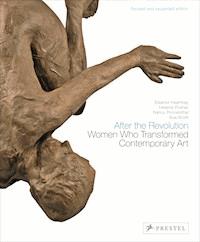
After the Revolution
Women Who Transformed
Contemporary Art
Louise Bourgeois, Nature Study , 1984
After the Revolution
Women Who Transformed
Contemporary Art
Revised and expanded edition
Eleanor Heartney Helaine Posner Nancy Princenthal Sue Scott
With a Foreword by
Linda Nochlin
PRESTEL
Munich · London · New York
Der Inhalt dieses E-Books ist urheberrechtlich geschützt und enthält technische Sicherungsmaßnahmen gegen unbefugte Nutzung. Die Entfernung dieser Sicherung sowie die Nutzung durch unbefugte Verarbeitung, Vervielfältigung, Verbreitung oder öffentliche Zugänglichmachung, insbesondere in elektronischer Form, ist untersagt und kann straf- und zivilrechtliche Sanktionen nach sich ziehen. Sollte diese Publikation Links auf Webseiten Dritter enthalten, so übernehmen wir für deren Inhalte keine Haftung, da wir uns diese nicht zu eigen machen, sondern lediglich auf deren Stand zum Zeitpunkt der Erstveröffentlichung verweisen. Front cover: Kiki Smith, Lilith (detail), 1994. see p. 213.
Frontispiece: Louise Bourgeois, Nature Study , 1984. Bronze and polished patina, 30 x 19 x 15 in. (76.2 x 48.3 x 38.1 cm). Whitney Museum of American Art, New York. © Louise Bourgeois Trust / VG Bild-Kunst, Bonn 2013. Photo: Allan Finkelman.
Second print edition, published in 2013 by Prestel, a member of Verlagsgruppe Random House GmbH.
© Prestel Verlag, Munich · London · New York, 2007.
© for the text by Eleanor Heartney, Helaine Posner, Nancy Princenthal, and Sue Scott, 2007.
For illustrations of works of art under copyright refer to picture captions.
Prestel Verlag
Neumarkter Strasse 28
81673 Munich
Tel. +49 (0)89 4136-0
Fax +49 (0)89 4136-2335
Prestel Publishing Ltd.
14-17 Wells Street
London W1T 3PD
Tel. +44 (0)20 7323 5004
Fax +44 (0)20 7323 0271
Prestel Publishing
900 Broadway, Suite 603
New York, N.Y. 10003
Tel. +1 212 995-2720
Fax +1 212 995-2733
www.prestel.com
Prestel books are available worldwide. Please contact your nearest bookseller or one of the above addresses for information concerning your local distributor.
Library of Congress Control Number: 2012953512
Editorial direction by Christopher Lyon
Revision coordination by Ryan Newbanks
Editorial assistance by Reegan Koester and Brandon Peterson
Copyedited by Mary Christian
Proofreading by Samantha Waller
Bibliography by Amy Lucker
Cover by Beverly Joel, pulp, ink.
Layout design by Liquid, Augsburg
Layout revision by Makiko Katoh
Origination by Reproline Mediateam, Munich
ISBN 978-3-641-10821-2V002
Contents
Foreword Linda Nochlin
Introduction Eleanor Heartney, Helaine Posner, Nancy Princenthal, Sue Scott
Louise Bourgeois: Intensity and Influence H elaine Posner
Nancy Spero: Radical History Painter Helaine Posner
Elizabeth Murray: Fractious Formalist Nancy Princenthal
Marina Abramovi ć : Between Life and Death Sue Scott
Judy Pfaff: Storming the White Cube Nancy Princenthal
Jenny Holzer: Language Lessons Nancy Princenthal
Cindy Sherman: The Polemics of Play Eleanor Heartney
Kiki Smith: A View from the Inside Out Eleanor Heartney
Ann Hamilton: The Poetics of Place Helaine Posner
Shirin Neshat: Living between Cultures Eleanor Heartney
Ellen Gallagher: Mapping the Unmentionable Eleanor Heartney
Dana Schutz: The Elephant in the Living Room Sue Scott
Bibliography
Index
Acknowledgments
Foreword
Linda Nochlin
Fig. 1 . Jenny Holzer, Times Square Sign , 1982.
© VG Bild-Kunst, Bonn 2013
After the revolution comes the reckoning. Exactly what has been accomplished, what changed? What individuals or groups, previously repressed or ignored now come into the foreground, gain status and confidence? How has the nature of “reality” itself changed as a result of the revolution, peaceful in this case, that took place, and has continued, as a result of the feminist movement in art?
A great deal has changed, not just in the art world, but also in the world at large, since the first feminist manifestations and manifestoes of the seventies. Any academician of my age remembers, for example, the strict parietal rules that held sway at Vassar College when I went there and started teaching in the early fifties. Students, all women of course, had to sign in and out to leave overnight. Male visitors were allowed access to a student’s room only if the door was partially opened. Today students have co-ed dorms and total freedom to come and go as they will; many live off campus with groups of their own choosing. More seriously, when I was a freshman, two young women students committed suicide because they had entered into lesbian relationships; today, in the same college, there is a gay and lesbian center that holds dances and puts out a newsletter. When I was a young woman, a woman doctor was a rarity. When my female cousin wanted to go to medical school, there was more or less one choice: a women’s medical school in Philadelphia. Today, it is as normal to have a woman doctor or lawyer as to have a male one. When I was young, the presence of blacks in a restaurant or a theater was practically unheard of; today it is totally accepted, indeed, unnoticed. Back in the fifties, a person of color as a fashion model or a talk show host would have been unthinkable; a black family advertising soap flakes or cereal impossible—today it seems totally “natural” to have an Oprah Winfrey or a Naomi Campbell, or a black family advertising some product on the TV screen.
In a sense, the most profound results of a revolution are those that have become so assimilated and normalized that they are no longer noticed, have become part of the unconscious fabric of our lives. Of course, there are exceptions—gay bashing, anti-Semitism, color prejudice. But in terms of cultural practice, things have changed mightily. The powerful presence of women artists within the world of contemporary art has become an accepted fact. Yet it is important to locate its genesis within the context of the broader social and cultural revolutions—black, gay, feminist, post-colonial—that have taken place since the seventies and are still ongoing.
Still, contemporary women artists as a group need to be singled out for critical attention. This is partly because their work has been less studied than that of some of their male colleagues and partly because only by taking them as a group can the range and variety of their stylistic and expressive projects be understood. For it is difference rather than similarity that is at stake here. No subtle or summarizable “essence” of femininity unites the work of Louise Bourgeois, Jenny Holzer, and Marina Abramov i ć . On the contrary, all their work is marked by extreme divergence of media, style, and implication. Indeed, in many cases, like that of Louise Bourgeois or Cindy Sherman, for example, the work itself is marked by extreme diversification. Can we unite the film stills of Sherman’s early career with the horror shows of her later career? And how do we assimilate Louise Bourgeois’s multipart Cells with her delicate marble carvings?
What unites all the artists considered in these essays, though, is originality, invention, complexity, and a certain oppositional stance, whether it be Sherman’s deconstruction of the myth of a single, fixed identity or Shirin Neshat’s refusal to attach her work or her attitudes to a single national or ethnic culture. None of these women artists is creating so-called “positive images” of women or “great goddesses,” thereby perpetuating existing stereotypes; their practice might be said to be critical rather than positive, a characteristic marking much of the post-modernist enterprise of our time. All of them have created new formal languages to express intensely new ideas, or rather, the new formal languages and the new ideas have come into being together, as they must in any kind of original art.
Finally, all of these artists occupy important, indeed, in some cases, major positions in the art world today, internationally as well as domestically. Younger artists, male and female, look to their work as a source of inspiration and stimulation, as they once looked to male artists alone. As the inspiration to future generations of artists, these women artists bear witness to the revolution that has taken place in art. Whether they are “great” or not is beside the point today; there is something stodgy and fixed about the very word “great,” something that smells of the past and tradition. Leave greatness to Michelangelo and Cézanne, if you will. They are dead and gone. For the women artists considered in this book, it is vitality, originality, malleability, an incisive relationship to the present and all it implies, and an ability to deal with darkness and negativity and ambiguity that is at stake, not some mythic status that would confine them to fixed, eternal truth. It is in this sense that they are both revolutionaries and post-revolutionary at the same time.
Introduction
Eleanor Heartney, Helaine Posner,
Nancy Princenthal, Sue Scott
Fig. 2. Nancy Spero, To the Revolution (detail), 1981. Handprinting and collage on paper, 20 x 113 in. (50.8 x 287 cm).
© VG Bild-Kunst, Bonn 2013. Courtesy of the Estate of Nancy Spero and Galerie Lelong, New York
Linda Nochlin, in a landmark essay of 1971, asked the intentionally provocative question “Why have there been no great women artists?” 1 She was not simply questioning the absence of women in the history of art. She was, instead, revealing the conceptual inadequacy, in the field of art history, of the white Western male viewpoint, in accepting as “natural” what she termed “the unstated domination of white male subjectivity.” 2 She went on to recast the question not as one of innate capacity (“greatness” or “genius”) but as an issue rooted in “the nature of given social institutions and what they forbid or encourage in various classes or groups of individuals.” 3 By examining what she called “the whole erroneous substructure” of the question, she aimed to stress “the institutional—that is, the public—rather than the individual, or private, preconditions for achievement or the lack of it in the arts.” 4 Nochlin’s essay has rung down through the succeeding decades like a clarion call, challenging each generation to assess changes and improvements in the conditions under which women artists work.
It may seem contradictory to preface a book surveying the achievements of twelve individuals with reference to an essay focusing on the institutional obstacles to women artists. But though it is possible to statistically assess the changes in women’s representation in galleries and museums, or in monographs, in the decades since Nochlin’s essay, as we have done below, there is of course no way to measure women’s stature as artists, in terms of sustained accomplishment, critical acclaim, or influence, except individually. We remain mindful of Nochlin’s observation that “the existence of a few superstars or token achievers” does not at all mean that institutional obstacles don’t remain deeply entrenched, and our essays on the twelve artists we have chosen are not intended to establish their “greatness.” Nevertheless, we hope the cumulative weight of their individual achievement may help to demonstrate an underlying institutional shift, during the past thirty-five years, which has helped make possible these artists’ critically successful and sustained careers.
In his review of the Salon of 1845, Baudelaire singled out the painter Eugénie Gautier for praise, writing, “This woman knows her old masters—there is a touch of Van Dyck about her—she paints like a man. … Mlle Eugénie Gautier’s painting has nothing to do with woman’s painting. ” 5 Georgia O’Keeffe is reported to have complained, “I would hear men saying ‘She’s pretty good for a woman; she paints like a man.’ ” 6 The greatest compliment Lee Krasner received from Hans Hofmann, with whom she studied, was, “This is so good you would not know it was painted by a woman. ” 7 The senior artists represented in this book still could hear such left-handed compliments in their youth. During the testosterone-charged Abstract Expressionist period, women like Krasner were likely to be seen as muses or helpmates to male artists, and when they had the effrontery to make art themselves, they tended to be ignored or relegated to the status of minor players.
The situation of women artists changed decisively in the 1960s and 1970s, when the feminist movement helped set off a social revolution with repercussions that are still being felt. Feminism challenged the assumptions about women’s proper roles that had been put back in place in the postwar years after the gains made by women in the workplace during World War II. This “second wave” of feminism (the “first wave” was the women’s suffrage movement) rose in tandem with social liberation movements—especially the civil rights movement—as marginalized groups demanded equal rights and opportunities. Feminism’s resurgence in the 1960s saw the forming of the National Organization of Women in 1966 “to bring women into full participation in society”; the passage by Congress in 1972 of the Equal Rights Amendment to the Constitution, which, however, was not eventually ratified by all the states; the founding of the feminist magazine Ms. by Gloria Steinem, also in 1972; and the Supreme Court’s 1973 decision in the case of Roe vs. Wade, which established that most state laws against abortion violated a constitutional right to privacy under the Fourteenth Amendment. American women more forcefully asserted their claims for equal status in the political, social, cultural, and personal spheres. Support for the work of women artists, opportunities for professional development, and recognition were being demanded of the art establishment (with some success) and initiatives were being taken by the artists themselves. Along with this institutional activity, women artists attempted to find an authentic voice. This task, difficult for any artist, was especially hard for women artists, faced with institutional resistance and demands to balance artistic ambitions with the responsibilities of home and family.
The need to find a voice and an arena in which to be heard has been a concern for most of the artists represented in After the Revolution and for their contemporaries across three generations. For artists such as the feminist heroines Louise Bourgeois and Nancy Spero, art-world recognition came only after many years of working in relative anonymity, with only occasional opportunities to exhibit. Both of these women spent decades juggling their artistic practices with the demands of motherhood (each had three sons) and marriage to prominent art-world figures. 8 In the early 1970s Nancy Spero created the Codex Artaud , paintings on paper that incorporate the “ferocious language” of the French writer Antonin Artaud, which can be understood on one level as expressing her fury at being silenced (see figs. 34 and 39 ). 9 Like many of her contemporaries, she also marched, demonstrated, wrote, and organized to further the recognition of women in art. These activities culminated in her participation in the founding of A.I.R . , the first cooperative gallery dedicated to exhibiting women’s art.
Louise Bourgeois also actively participated in feminist meetings, protests, and exhibitions, but responded differently to her marginalization. In 1992 she stated, “I worked in peace for forty years,” a situation that gave her the privacy she required to create a deeply psychological body of work exploring her past and her own complex inner workings. 10 The female figure as a subject was pivotal to the work of these very different artists and was, in fact, Spero’s only subject after 1974. For each, the feminist movement was a career-defining experience and absolutely crucial to the critical reception, relatively late in their careers, of their now highly respected work.
The fervent, single-minded feminism of the early political phase became more complicated and ambivalent as the woman’s movement progressed. Members of the transitional generation such as Elizabeth Murray were well aware that their lives had been transformed by feminism, and they were the first to deal directly with the complexity of assimilating this major cultural change and negotiating newly defined personal and professional relationships. While many women artists recognized the benefits of entering an art world more open to women, and seized the opportunity to create work that explored a multiplicity of subjects, styles, media, and ideas, others distanced themselves from the movement for fear of being ghettoized. As Murray, who exuberantly reinvented in her work the traditionally male domain of formalist painting, said in 1984, “I don’t believe there’s such a thing as ‘women’s art.’ It’s a distasteful phrase, like any categorization … I see my own work as androgynous. ” 11 Yet she freely introduced more conventionally female, domestic imagery into her painting and she has spoken openly about her warm family life, acknowledging a pleasure in domesticity that might have seemed problematic to an earlier generation of women trying to make it in a man’s world.
The momentum of the 1970s was fruitful as women artists moved to the forefront of advanced artistic production in the 1980s. Cindy Sherman’s postmodern photographic tableaux dissecting the cultural constructions of femininity and Jenny Holzer’s posters, electronic signboards, and monumental light projections, which address social injustice, political and sexual violence, death, and grief, added to conceptualism a socially informed, feminist perspective. Marina Abramović, in partnership with artist Ulay beginning in 1975 and on her own since 1989, created indelible, meditative performance works using her body as the primary subject and medium. Ann Hamilton constructed room-sized, immersive environments that activate the senses and encourage the viewer to experience more holistic ways of knowing, through the body as well as the mind. These artists and others—such as Janine Antoni (see fig. 74 ), Sophie Calle, Janet Cardiff, Jana Sterbak, Roni Horn, Rebecca Horn, Annette Messager, Laurie Simmons, and Lorna Simpson—worked in the areas of installation, performance, and new media that transformed the landscape of contemporary art in the 1980s and 1990s.
Women also took leading roles in the main cultural discourses of the 1980s and 1990s, when issues of gender, identity, and multiculturalism dominated contemporary art and academic inquiry. For nearly fifteen years, from the early 1980s until the mid-1990s, Kiki Smith represented the female body, both fragmented and whole, in often tender yet visceral sculptures, as part of a body of work that aimed to heal private wounds and mend social divisions. She depicted the female form not as the idealized object of male desire but as the site of women’s lived experience. Smith assumed an unflinchingly feminist point of view in her reclamation of the female body as a subject, and she remains clear about her allegiance to its principles, stating, “I came of age in the sixties and seventies and that I exist is a result of feminism. ” 12
With the late 1990s and first years of this century another generation of women artists came to the fore. Iranian artist Shirin Neshat created photographs and, more recently, poetically beautiful and mysterious video works that examine divisions between the Islamic and Western worlds, male and female, and tradition and modernity. Her work is a paradigm for women attempting to forge a hybrid cultural identity, which she achieves through a sophisticated use of new media. Having come of age at a time when women artists are highly visible in galleries, museums, and art schools, such artists feel free to explore all aspects of contemporary art. They can be found in every corner of the contemporary art world, exploring ethnic and racial identities from a female perspective, invading the once-male bastions of abstraction, and opening art up to explorations of narrative, fantasy, and myth. They contribute to the melding of art with fields such as science, popular culture, architecture, and urbanism. No longer regarded as second-class citizens of the art world, these women happily partake in the freewheeling pluralism that characterizes art today.
As this rapid survey suggests, feminism as a social movement underlies all the work in this book to the extent that it created an environment in which women’s art could be taken seriously and women artists could pursue their craft with at least an approximation of the conditions available to male artists. The relationship of feminist art theory to the works seen here is a more complicated issue. While many women artists have enthusiastically embraced the label of feminist artist, others, like Elizabeth Murray, have been more ambivalent, reluctant to confine themselves to what they perceived as an overly limiting definition of their art practice. But in fact, a survey of the evolution of feminist art reveals that this is a complex and many-layered movement, and that feminist theory and contemporary art have been entwined in a state of continuous evolution.
Beginning in the late 1960s, the feminist art movement mounted an attack on some of the most ingrained assumptions about art and artists. Linda Nochlin, as we have seen, and many others objected to a historical narrative of art that ignored the contributions of women. Many of them challenged the idea that the criteria for judging art’s quality have universal validity. In their attack on the “quality issue,” as it came to be called, feminists asserted that behind claims to universality were a plethora of unexamined biases and special interests, and that Western taste was in fact grounded in the assumptions of a patriarchal culture. Similarly, feminists suggested that certain subject matter, materials, and approaches had been dismissed from serious consideration because they were associated with female experience and forms of expression.
These developments opened the door to a new generation of women artists who were not afraid to create from their unique place in the world. In 1975 feminist critic Lucy Lippard listed some of the recurring motifs that she believed suggested a female sensibility. These included the abstracted sexuality inherent in circles, domes, eggs, spheres, boxes, and biomorphic shapes; a preoccupation with body and bodylike materials; and a fragmentary, nonlinear approach in the work of women that set it off from the art of their male counterparts. 13 She argued that such qualities could be traced to societal differences, noting, “The overwhelming fact remains that a woman’s experience in this society—social and biological—is simply not like that of a man. If art comes from inside, as it must, then the art of men and women must be different too. And if this factor does not show up in women’s work, only repression can be to blame. ” 14
This new freedom led women in remarkably different directions. Some challenged the tyranny of the male gaze, which had organized the representation of women in art to maximize the pleasure of the male viewer. Sylvia Sleigh attempted to reverse the male gaze by painting male nudes in poses that deliberately mimicked the luscious odalisques and flirtatious Venuses of the old masters. Joan Semmel personalized the gaze by presenting the view of her own and her lover’s naked body as seen through her own eyes. Artists such as Carolee Schneemann ( fig. 3 ), Hannah Wilke ( fig. 4 ), and Mary Beth Edelson explored the varieties of female pleasure, posing naked as goddess figures or sex kittens and taking back the female nude for their own ends. Judy Chicago enlisted the efforts of many artists to create a monumental work, The Dinner Party , a table laid with ceramic plates, featuring imagery supposedly derived from butterflies and symbolic of a “vaginal core,” presented on beautifully embroidered runners, all dedicated to great women of myth and history.
Other artists defiantly resuscitated crafts and applied arts that had traditionally been dismissed as “women’s work.” Joyce Kozloff based paintings on the intricate decorative patterns of non-Western cultures ( fig. 5 ). Faith Ringgold incorporated quilting and other craft traditions into work that dealt with her own history and that of her African American ancestors. Miriam Schapiro invented a format she called “femmage,” collage paintings using lace, aprons, embroidered handkerchiefs, and other feminine materials. Nancy Spero explored archetypes of female power and vulnerability in paintings that asserted an alternative kind of monumentality from that of works by her male contemporaries; she expressed herself with delicate and fugitive images stenciled, stamped, collaged, or traced onto transparent papers, assembled in scrolls of up to twenty-five feet in length.
Yet others explored the traditional identification of women with nature and body. Artists like Mary Miss, Nancy Holt, Michelle Stuart, and Alice Aycock addressed the burgeoning interest in earth works and land art, but did so from a female perspective, creating environmental works that melded with nature rather than ripping it open in the manner of male counterparts like Michael Heizer, whose Double Negative (1969–70) is a trench 1,500 feet long, 50 feet deep, and 30 feet wide, cut into facing slopes of a Nevada mesa. Women artists such as Mary Frank and Ana Mendieta, who dealt explicitly with the body, communicated experience from the inside out in ways that contrasted sharply with the more objective expressions of male figurative artists.
Nor were women artists content simply to develop alternative kinds of art. The 1970s were also full of experiments in social and institutional organization, as women artists formed cooperative galleries, organized exhibitions of women’s work, and generally saw their art as a form of feminist consciousness raising. One of the most influential of these enterprises was the short-lived Womanhouse, a women-only installation and performance space in Los Angeles that was the brainchild of critic Arlene Raven, Sheila de Bretteville, and Judy Chicago.
By the late seventies, however, a reaction was setting in against the approach embraced by many of these pioneers. It was part of a larger turn toward postmodernism, which replaced the freewheeling pluralism of the late sixties and seventies with an approach to art making that was more structured, theoretical, and critical of aesthetic pleasure. Postmodernism has many definitions, but it is closely identified with a critique of the modernist faith in authenticity, value, and originality. Hence postmodernism shifts the focus from firsthand experience and personal expression to an analysis of the representations that create our sense of reality.
From a feminist perspective, postmodernism provided tools for critiquing the representations of women in art and popular culture. It also undermined the efforts of first-generation feminist artists by suggesting that they were guilty of essentialism, that is, of perpetuating the search for a mythical female essence. According to this critique, the embrace of authentically female modes of expression and experience simply reinforced the exclusion imposed upon women by a patriarchal culture. In this view, efforts to embrace the identification of women with nature, body, or intuition were nothing more than putting a positive spin on qualities denigrated by the larger culture.
Instead, postmodern feminists believed their job was to reveal the ways in which all our ideas of womanhood and femininity are socially constructed. Rejecting the notion of female essence, they sought to demonstrate that categories like “male” and “female” are internalized sets of representations. In this view, femininity is a masquerade, a set of poses adopted by women in order to conform to societal expectations about womanhood. Articulating this idea, artists such as Barbara Kruger worked with mass-media images of women, combining them with text to suggest the implicit messages about female submission and vulnerability that they were designed to convey ( fig. 6 ). Cindy Sherman explored a variety of female personas in photographs that were read as a postmodern critique of female representation. Mary Kelly created a scrapbook of the first six years of her son’s life that examined psychoanalytic accounts of the child’s process of socialization. Suzanne McClelland has used traditionally made paintings to examine the social construction of power. Her ongoing series of target or “O” paintings, begun in the late nineties, explore the way women—specifically controversial or high-profile women—are “targeted” for negative attention in the media ( fig. 7 ).
In its strictest form, postmodern feminist theory took issue with art’s traditional concern with aesthetics, seeing instead a link between visual pleasure and the objectification of women. Feminist critics such as Laura Mulvey and artists such as Silvia Kolbowski advocated a kind of iconoclasm, arguing that traditional representations of the female body should be avoided or dismantled because they uphold the patriarchal gaze. In a highly influential essay on images of women in Hollywood movies, Mulvey concluded, “It is said that analyzing pleasure, or beauty, destroys it. That is the intention of this essay. ” 15
This went too far for many artists and observers, and by the mid-1980s, galleries were filled with art that represented the body and the female experience in ways that combined the approaches of both the pioneers and the postmodern feminists. There were a number of reasons for the sea change. For one, the notion of the body as an abstract social construct ran counter to the experience of very real bodies subject to the ravages of the AIDS epidemic. There was also a growing interest among some feminists in old theories of gender-based dualisms that attributed qualities of nature, intuition, and body to woman, while associating culture, reason, and mind with man. These distinctions, which go back to the ancient Greeks, are so deeply embedded in Western culture that they have become almost invisible. In challenging them, feminists took a variety of approaches. Some, like Bul Lee and Orlan, attempted to expose and dismantle the traditional identification of women with nature, while artists like Helen Chadwick, Mary Lucier, and Petah Coyne chose to embrace and redefine these associations in more positive terms.
Some women began to explore the idea that there might be a kind of carnal knowing that depended on the melding of mind and body. Finally, the return of the body as the subject of art served as an alternative to the growing reach of disembodied virtual experience provided by the electronic revolution. This time around, art grounded in the body and its experiences was embraced by male and female artists alike—a signal that the feminist revolution had made significant inroads into the social consciousness. Artists like Kiki Smith and Janine Antoni were joined by male artists such as Robert Gober, Paul McCarthy, and Mike Kelley in the presentation of art works that presented the body in all its messy physicality. Also in the 1980s and 1990s artists like Smith, Karen Finley, Tania Bruguera, and Sue Williams reengaged questions of violence and abjection which had been raised in the 1960s and 1970s by artists like Marina Abramović, Yoko Ono, and Hannah Wilke.
By the 1990s and the first years of the new century, feminism became so integrated into the fabric of women’s lives that rights and privileges which seemed hard-won only a few years before were taken for granted. The early and impressive successes of a younger generation of women artists including the gestural figurative painters Cecily Brown ( fig. 8 ), Jenny Saville, and Dana Schutz; the semiabstract painter Julie Mehretu; and Kara Walker, who revived the art of cut-paper silhouettes ( fig. 9 ), and sculptor Sarah Sze (both awarded a MacArthur Foundation Fellowship), all suggest the degree to which the status of women artists has changed. These younger artists have enjoyed wide recognition both in the museum world and the marketplace.
Discussions of the market are often considered taboo in a historical and critical study of contemporary art, but gallery representation and market demand are revealing indicators of change. Women artists’ growing presence in major public and private collections does indicate that a shift has occurred in the situation of women artists. Female artists in their twenties and thirties are not only represented by some of the most influential galleries in New York, but they command prices for their work that exceed those of their female predecessors and surpass those of their male counterparts.
Interestingly, younger women artists’ awareness of increasing opportunity is often accompanied by a sense of disconnection and even discomfort with feminism generally and the feminist art movement in particular. When they hear the “f-word,” this generation of women artists tends to think of the early stages of activism and essentialism, of a feminism they reject for its associations with anger and a sense of victimization, and for being devoted to simplistic, retrograde representations of the female body. Contributing to such rejection, perhaps, is a retrospective caricature of early feminism as a movement that rejected all that was male and disapproved of heterosexuality. (Such ideas were in fact embraced only by a radical faction of the early feminist movement.) Latter-day feminists, while fully embracing equality, are less eager to insist on being separate from men. Younger women artists are perhaps not so aware of the profound impact of feminism, or its subtle influences, and this curious oblivion may help explain a tendency to dismiss feminism as an outmoded ideology.
The discomfort runs both ways. Some older feminist artists look askance at the “bad girls”—Kara Walker, Lisa Yuskavage, Cecily Brown—who ironically employ sexist (or racist) clichés in their work, often to undercut male prerogatives or assumptions. But where older artists see backsliding, younger women may see such work as defending against the creeping puritanism of contemporary culture. They may point to the practices of such pioneers as Hannah Wilke and Carolee Schneemann to reinforce the notion that beauty, pleasure, and the raucous celebration of female sexuality are not alien to feminism. Such internal skirmishes cannot obscure how significantly feminism has expanded the possibilities for women artists.
How far have we come? As curators and critics with at least thirty years of experience each, we are aware of the strides made by women artists since the advent of the feminist movement and the resulting growth of support on the part of museums, galleries, and educational institutions. We were uncertain, however, whether those strides are measurably significant. We wondered, for example, what percentage of solo exhibitions featured women artists over the course of the past thirty-five years. To obtain an overview, we identified and surveyed twenty influential galleries in New York City, chosen for their prominence in terms of sales and critical reputation, and a representative selection of museum contemporary art exhibition programs in the United States. Data were acquired through gallery and museum publications, websites, and responses to telephone inquiries. While this is not a comprehensive study, the statistics we assembled provide an indicator of women artists’ progress in the past few decades.
Because certain women artists—from thirty-seven-year-old Dana Schutz to the recently deceased Louise Bourgeois—currently have high profiles in galleries, major private collections, museums, and the marketplace, it may be perceived that the situation for women artists has improved significantly during the time period covered in this book. But is this really the case?
Examining the number of solo exhibitions by women artists presented from the early seventies until 2010, through a representative sampling of influential galleries, we can see that the situation has gradually improved (see fig. 10 ). In the 1970s, women accounted for only 11.6 percent of solo gallery exhibitions. In the 1980s, the percentage of solo exhibitions by women crept up to 14.8 percent; in the 1990s it increased to 23.9 percent; and between 2000 and 2010 it reached 24.3 percent. The recent proportion of solo gallery exhibitions by women artists is significantly better than the average of women’s exhibitions for the entire period under consideration, 19.6 percent. However, while the number of women artists’ exhibitions has doubled since the early seventies, it has really only kept pace with an expanded market: women still have roughly one opportunity for every four of the opportunities open to men.
Museums have a slightly better track record (see fig. 11 ). During the forty years we surveyed, 22.9 percent of solo museum exhibitions presented the work of women artists. Of 3,979 museum exhibitions in our data base, 1,606 were one-person shows. Of that number, 1,239 were devoted to men and 363 to women. The percentages of museum solo exhibitions devoted to women per decade parallel the comparable percentages for galleries, but, perhaps reflecting the greater freedom of non-profit environments, women’s representation was somewhat better, most notably in the last two decades, when women’s portion of solo shows in museums nearly reached 30 percent.
We also looked at women’s representation in monographic publications since 1970 (see fig. 12 ). A monograph was defined for this survey as a publication on a single artist: either a collection catalog, a biographical work, or an exhibition catalog. Statistics were compiled for trade (commercial) publishers and museum publishers. Eleven key U.S. museums were surveyed; and a separate survey was made of a database for a distribution service that specializes in making available to libraries exhibition catalogs from throughout the world. 16
The numbers of monographs published by decade dedicated to contemporary (living) women artists was compared to the total number of publications issued by each publisher during the time period. Generally the searches included all markets, but in some cases were restricted to the U.S. and U.K. Given the variety of sources of data, specific numbers may not always be exact, but the overall trends are similar for each type of publisher.
Books on contemporary women artists published by U.S. museums were in most cases exhibition-related, although some were catalogues raisonnés and collection catalogues. In the case of museum publications, three numbers were gathered: monographs dedicated to one female artist, ones dedicated to one male artist, and total publications per decade. 17
The results of all three surveys demonstrated similar trends. The overall percentage of commercial publications dedicated to female artists grew steadily from the 1970s to the present, from less than one-half of one percent to approximately 2.7 percent. Interestingly, publishers specializing in photography (notably Aperture, Nazraeli, Scalo, Schirmer/Mosel, and Twin Palms) had significantly higher percentages of their total lists devoted to single-artist books on women. This suggests that photography may have been, for various reasons, something of a “gateway” medium for women seeking recognition in the arts.
In the case of museum publications, there is also a steady rise through the 1990s but a slight drop-off in the early 2000s. The slowing of publication of monographs generally may reflect an overall weakness in the market for art books, as well as a continuing rise in costs of publishing and reductions in U.S. museum budgets during the past decade.
In the survey of eleven U.S. museum publishers, we took the opportunity to compare percentages of women’s and men’s one-person publications. The number of one-person publications devoted to women artists averaged about one-quarter the total number of one-person publications, so three men’s publications appeared for every one devoted to women. As the table here shows, the proportion of one-person publications of women’s art increased significantly from the 1970s and 1980s, when it hovered around 20 percent, to the 1990s, when it reached nearly a third of the total, but it declined a bit in the early 2000s. In conclusion, while an overall rise in the number of publications dedicated to female artists is certainly encouraging, the comparison of that number to the number of publications dedicated to male artists tempers one’s optimism.
The book we set out to write is not a manifesto for women’s art. It is not meant to be hortatory nor especially prospective—we are not heralding a brave new art form being brought forth by women marching boldly in formation into a clearly envisioned future. Instead, we’ve tried to look back at the last forty years of art-making by a small number of key figures to gain a better understanding of how art works by women have shaped the art of our time. Gender does not provide anything like an exhaustive explanation for the meanings or motivations of the work under consideration, or of its impact on our culture. But neither is gender incidental to those things. Simply put, it seemed to us that to take stock of these women’s contributions would be illuminating.
Above all, we wanted to demonstrate the complexity and variety of work made by women, incontrovertible evidence that what feminism set into motion when it urged attention to neglected voices in the arts was an embrace of limitless possibility rather than of any kind of dogma. Introducing a recent book of papers assembled from a conference on women’s art, Carol Armstrong wrote, “coloring by otherness, by outsiderness, by difference, is a positive, not a negative—an expansion, not a reduction, of what it means to be a person and an artist.” 18 The abandonment of fixed standards of valuation is a benefit, Armstrong said, “not only for women but for men as well, for we all gain by the changed face and expanded definition of humanness that ensues.”
Choosing the dozen artists we’ve focused on in this book was, needless to say, very hard. We started with a much longer list, and every time we tried to winnow it, it grew. Deciding to reverse direction and discuss an arbitrarily small number was a radical solution, and we feel it worked. We hope these artists will be considered representative of a large community, rather than the full membership of an exclusive club. Inevitably, some of our criteria for inclusion are hard to quantify: when the subject is art, definitions tend to dissolve. But some were clear from the outset. We wanted to illustrate the diversity of women’s contributions—to write about a spectrum of viewpoints, of starting positions (where the artists came from, both biographically and stylistically) and of chosen solutions in terms of medium, process, and subject. One outcome of these decisions has been, for us, a clearer picture of just how much those disciplines and formats that are of key importance in current art, including installation and performance art, figurative painting and sculpture based on internal experience, and indeed all those forms that allow exploration of identity, have developed in and around work by women.
As its title suggests, our project was undertaken in a cultural moment heavily colored by a complicated kind of nostalgia. The post -ness of all things is now much remarked upon, not least in the terminology of cultural categorization: post-modernism has bred, conspicuously, both post-blackness (a term of Thelma Golden’s coinage) and, no less nebulously, or contentiously, post-feminism. But we hardly believe the story to be over. Another way of looking at our title’s implications is to note that this is not a book about a finished narrative, but a hopeful beginning. If it is a little wistful (the revolution, however it is defined, is a historical episode, not a living event), our book is intended to be more optimistic than elegiac, celebrating an expanded approach to viewing and judging art as well as making it. In Carol Armstrong’s publication, Linda Nochlin writes, “In the post–World War II years, greatness was constructed as a sex-linked characteristic in the cultural struggle in which the promotion of ‘intellectuals’ was a cold war priority. … Today, I believe it is safe to say that most members of the art world are far less ready to worry about what is great and what is not.” 19 The battles may not all have been won, and equality of opportunity across gender (and race and class) remains an elusive goal, but the barricades are gradually coming down, and work proceeds on all fronts in glorious profusion.
Fig . 3 . Carolee Schneemann, Meat Joy . Performance using raw fish, chickens, sausages, wet paint, plastic, rope, and paper scrap. Judson Church, New York, 1964.
© VG Bild-Kunst, Bonn 2013. Photo: © Robert R. McElroy / Licensed by VAGA, New York
Fig. 4. Hannah Wilke, S.O.S. Starification Object Series , 1974–82. Ten silver-gelatin photographic prints with fifteen chewing gum sculptures in plastic boxes mounted on board and framed, 41 x 58 in. (104.1 x 147.3 cm). The Museum of Modern Art, New York.
© VG Bild-Kunst, Bonn 2013
Fig. 5. Joyce Kozloff, Three Facades , 1973. Acrylic on canvas, 80 x 59 in. (203.2 x 149.8 cm). List Visual Arts Center, Massachusetts Institute of Technology, Cambridge.
Courtesy of the artist and DC Moore Gallery, New York
Fig. 6. Barbara Kruger, Untitled (Your body is a battleground) , 1989. Photographic silkscreen on vinyl, 112 x 112 in. (284.5 x 284.5 cm). The Broad Art Foundation, Santa Monica.
© Barbara Kruger, courtesy of Mary Boone Gallery, New York
Fig. 7. Suzanne McClelland, OOO (for Martha) , 2003. Oil, acrylic, and pastel on linen with accessories, 40 x 48 in. (101.6 x 121.9 cm).
Courtesy of the artist
Fig. 8. Cecily Brown, The Girl Who Had Everything , 1998. Oil on linen, 100 x 110 in. (254 x 279.4 cm).
© Cecily Brown, courtesy of Gagosian Gallery, New York
Fig. 9. Kara Walker, Camptown Ladies (detail) , 1998. Cut paper and adhesive on wall, overall: 9 x 67 ft. (274.3 x 2,042 cm).
Courtesy of Sikkema Jenkins & Co.
Fig. 10. Number and percentage of solo exhibitions at galleries by gender
Figure 11 . Number and percentage of solo exhibitions at museums by gender
Figure 12 : Number and percentage of monographic publications by gender
1 . “Why Have There Been No Great Women Artists? (1971)” in Linda Nochlin , Women, Art, and Power and Other Essays (Harper & Row, 1988), pp. 145–78.
2 . Nochlin, p. 146.
3 . Nochlin, p. 158.
4 . Nochlin, p. 176.
5 . Charles Baudelaire, “The Salon of 1845,” in Art in Paris 1845–1862 . Trans. and ed. Jonathan Mayne (Oxford: Phaidon, 1965), p. 18.
6 . Susan Fillin-Yeh, “Dandies, Marginality and Modernism: Georgia O’Keeffe, Marcel Duchamp and Other Cross-Dressers,” Oxford Art Journal , v. 18, no. 2 (1995), p. 37.
7 . Anne Middleton Wagner, Three Artists, (Three Women): Modernism and the Art of Hesse, Krasner and O’Keeffe (Berkeley: The University of California Press, 1996), p. 115.
8 . Bourgeois is the widow of the art historian and curator Robert Goldwater and Spero of the painter Leon Golub.
9 . Quoted in Katy Kline and Helaine Posner, “A Conversation with Leon Golub and Nancy Spero,” in Leon Golub and Nancy Spero: War and Memory (Cambridge, Mass.: MIT List Visual Arts Center, 1994), p. 39.
10 . Quoted in Charlotta Kotik, “The Locus of Memory: An Introduction to the Work of Louise Bourgeois,” in Louise Bourgeois: The Locus of Memory, Works 1982–1993 (New York, Harry N. Abrams, Inc., 1994), p. 16. Originally quoted in Louise Bourgeois, “In Conversation with Christiane Meyer-Thoss,” in Christiane Meyer-Thoss, Louise Bourgeois: Designing for Free Fall (Zurich: Ammann Verlag, 1992), p. 139.
11 . Paul Gardner, “Elizabeth Murray Shapes Up,” Art News , September 1984, p. 55.
12 . Dierdre Summerbell, “Marrying Your Own Personal Nutty Trips with the Outside World: A Conversation with Kiki Smith,” Trans>arts.cultures.media , 9/10, 2001, p. 208.
13 . Lucy Lippard, “What is Female Imagery?” in From the Center: Feminist Essays on Women’s Art (E. P. Dutton, 1976), pp. 81–82.
14 . Lucy Lippard, “Prefaces to Catalogues,” in From the Center , p. 49.
15 . Laura Mulvey, “Visual Pleasure and Narrative Cinema,” reprinted in Wallis, ed., Art After Modernism , New Museum of Contemporary Art, New York, in association with David R. Godine, Boston, 198 4 , p. 36.
16 . Worldwide Books (http://www.worldwide-artbooks.com/) specializes in making available to libraries exhibition catalogs from throughout the world. Their on-line database was surveyed by decade to see how many listed catalogues were dedicated to one female artist. The results were divided by territory into U.S., Europe, Asia, and “other”.
17 . For these statistics, searches were done on-line in Dadabase, the on-line library catalogue of the Museum of Modern Art, New York. The nature of this institution’s collecting policies ensures that its library collections are representative of the trends that were being tracked. To ascertain numbers for MoMA itself, the on-line catalog of the Library of Congress was used, since the museum collects vast amounts of ephemera related to itself that would skew the statistics.
18 . Carol Armstrong, preface, Women Artists at the Millennium , Armstrong and Catherine de Zegher, eds. (Cambridge, Mass. and London: The MIT Press, 2006), p. xii.
19 . Nochlin, op. cit. p. 22.
Louise Bourgeois :
Intensity and Influence
Helaine Posner
Fig. 13. Louise Bourgeois, Cell VII (interior view) , 1998. Mixed media, 81 ½ x 87 x 83 in. (207 x 221 x 210.8 cm). Private collection, Berlin.
© Louise Bourgeois Trust / VG Bild-Kunst, Bonn 2013
Writing in Artforum in March 1975, feminist art and cultural critic Lucy Lippard observed, “It is difficult to find a framework vivid enough to incorporate Louise Bourgeois’s sculpture. Attempts to bring a coolly evolutionary or art-historical order to her work, or to see it in the context of one art group or another, have proved more or less irrelevant. Any approach—non-objective, figurative, sexually explicit, awkward or chaotic; and any material—perishable latex and plaster, traditional marble and bronze, wood, cement, paint, wax, resin—can serve to define her own needs and emotions. Rarely has an abstract art been so directly and honestly informed by its maker’s psyche. ” 1
In her perceptive appraisal of Bourgeois’s sculpture, Lippard effectively captured the nature of the artist’s uniquely personal and compelling body of work in terms that had only recently been made familiar through the language of feminism. Her pivotal essay described the extraordinarily expansive and inventive psychological approach to art making that Bourgeois had, in fact, been practicing for over thirty years, but for which she was only beginning to receive wide attention. It was a time of major change in the art world. The strict formalism that had dominated art since the advent of modernism was giving way to a more emotionally rich and stylistically varied art ushered in by feminism, postminimalism, and other cultural forces. In 1982 the artist belatedly received her well-deserved recognition when the Museum of Modern Art presented a major and highly successful retrospective exhibition of her work, and she rightly assumed the mantle of “feminist foremother. ” 2 The past three decades arguably have been her most ambitious, productive, and creative to date. Remarkably, her retrospective exhibition at age seventy-one prompted a new beginning for this senior artist.
Bourgeois’s body of work (including painting, drawing, printmaking, sculpture, and installation) constitutes a profound, life-long examination of her complex inner workings, often intense and fragile relationships, and personal anxiety. 3 She has simply stated, “I identify myself with extreme emotions,” and the sensations her work evokes resonate deeply with the viewer. 4 These emotional states and the imagery the artist created from them are based on her difficult experiences growing up in a largely patriarchal society. Fear and pain, anger and aggression, and sexuality and obsession frequently find expression in the artist’s charged representations of the body—or body part—and the home. Eventually, maternal themes also began to emerge. Although she initially practiced modernist abstraction and later anticipated many of the innovations of postmodern art, Bourgeois has never conformed to a single movement or style. She decided to pursue a more eccentric path, choosing instead to give form to the urgings of her psyche. Her means have ranged from the abstract to the figurative; from hard to soft; from single object to architectural environment; and from skillful carving, modeling, and casting, to the precise arrangement of found objects—all in an effort to plumb the depths of human experience, from desire to death.
Bourgeois’s personal history, which she first made public at the time of her 1982 retrospective, has been the source of her work from the start. It is the stuff of legend; though certainly embellished over time, it nonetheless seems to be true. Not surprisingly, it is a psychological narrative, based on unresolved conflicts and tensions arising from her childhood years in France that have continued to affect her emotional life as an adult. Born in Paris in 1911 to an affluent family who were in the business of repairing and selling seventeenth- and eighteenth-century tapestries, she was the middle child of a capable, nurturing mother, who headed the family’s restoration workshop, and a handsome, flirtatious, often volatile father, for whom she was named and whose attentions she courted. She attended the prestigious Lycée Fénelon with her sister and brother and did well, particularly in mathematics. During her formative years, her father invited his English mistress, Sadie Richmond, into the household to be the children’s tutor; while her mother accepted this situation, it was intolerable to the young Louise, who was required to ignore her father’s blatant infidelities, endure his betrayals, and accept Sadie, the hated rival for her father’s love. The anxiety, jealousy, and rage born of this bizarre family drama have fueled aspects of her passionately expressive art throughout her career and, as observed by art historian Robert Storr, are the source of her obsessional return to early trauma. 5
As a young woman Bourgeois went on to study mathematics and philosophy at the Sorbonne and art history at the Louvre. Beginning in 1934, she shifted her focus to art and continued her studies at the École des Beaux-Arts, the Académie de la Grande-Chaumière, the Académie Julian, and the Académie Ranson, and with the noted artists Fernand Léger and André Lhote, among others. Bourgeois was invited to exhibit her work at the Salon d’Automne in 1938, the year she met and married the American art historian Robert Goldwater, who published that year the classic text Primitivism in Modern Art . He would become a prominent curator and professor of fine arts at Queens College and later New York University. Until her husband’s death in 1973 he remained one of her most ardent supporters.
Bourgeois and Goldwater settled permanently in New York in 1938, just prior to World War II; there they raised three sons, Michel, Jean-Louis, and Alain. In addition to her traditional European education, Bourgeois participated in the most sophisticated avant-garde artistic and intellectual circles of her time, first in Paris, and later New York, which became the new center of advanced culture after the war. Already as a student she had been acquainted with the Surrealists in Paris, and in New York she knew and socialized with members of the Surrealist community in exile, as well as with the leading writers, scholars, and curators who were her husband’s friends and colleagues. She absorbed, integrated, rejected, and transformed the art of two continents while developing a distinctly independent and idiosyncratic artistic vision. Yet in general, she remained a loner.
During her student years Bourgeois practiced an abstract style of painting and drawing, based on the tenets of Cubism, and also began to explore a more introspective, figurative mode of expression influenced by Surrealism, later blending aspects of each to create her Femme Maison paintings of the late 1940s. The artist had an understandably guarded attitude toward the Surrealists, with whom she was acquainted as a student in Paris and later knew as a professional artist in New York. Although she shared some of their aesthetic concerns—such as the desire to give visual form to subconscious subject matter, its traumatic and erotic compulsions, and strange disjunctions—she rejected the phallocentric, doctrinaire stance of André Breton (1896–1966) and others in his circle who relegated women artists to the role of muse, either femme-enfant or femme fatale , and refused to accept them as artistic peers. Nevertheless, aspects of Surrealism, often subjected to her witty, feminist reinterpretations, infuse Bourgeois’s work. Parallels also exist between Bourgeois’s work and that of such early twentieth-century sculptors as Jean Arp (1886–1966), Constantin Brancusi (1876–1957), and Alberto Giacometti (1901–1966), in the pure, simplified, biomorphic forms of their work and the Surreal or Existentialist aura that surrounds it—qualities that inform Bourgeois’s first major series of sculpture, called the Personages. She has emphasized her stylistic affinity with these artists: “I seek formal perfection, that goes without saying”—a statement that reveals little about her emphatically personal content. 6
From 1945 to 1947 Bourgeois created a series of disturbing works, all titled Femme Maison (Woman house), in which a house replaces or engulfs the head of a nude woman, negating her identity and isolating her from the outside world ( fig. 14 ). Here the traditional domain and supposed haven of women is made a suffocating confinement, more a prison than a source of familial contentment. Oddly, while her head is concealed by the house, her nude body remains vulnerably exposed. These flat, schematic paintings and drawings are penetrating icons of private and cultural estrangement and indelible works of feminist commentary. In format, they recall the Surrealist exquisite corpse , a collective game in which players pass on a folded piece of paper on which they have drawn, then concealed for the next participant, a different zone of the body, creating a final image of disjunctive parts. Bourgeois surely knew this technique and reimagined it from the feminist perspective that has informed her entire career.
In the late 1940s Bourgeois decided to abandon painting because she was “not satisfied with its level of reality,” and she took up sculpture as her primary medium in the belief that its tangible, physical presence would better convey her experiences and intense emotions. 7 As she explained, “I could express much deeper things in three dimensions. ” 8 From 1947 to 1950 she created the Personages, a collection of about thirty sculptures basically consisting of simple carved wooden posts with color added or various objects attached. In addition to their modernist sources, these primal forms also suggest fetish figures or ancient ancestor totems, and seem to be imbued with a similar power. According to the artist, these evocative life-size, anthropomorphic forms were meant to represent significant people in her life, including family members and friends left behind in France during the traumatic war years. The individual Personages , and their assembled presence, helped to soothe the artist’s painful feelings of separation and loss. When these works were exhibited at the Peridot Gallery in New York (1949 and 1950), the artist scattered single figures or pairs, and small groupings, around the space to suggest a gathering of disparate individuals and the various interactions that might or might not take place among them ( fig. 15 ). Upon entering the gallery, the viewer was free to mingle with the curious occupants of this early installation work.
As the fifties progressed Bourgeois’s wooden sculptures became more formally and conceptually complex. She began to assemble the previously solitary Personages in related groups and mount them on a single base, an arrangement that underscored the relationships among them. In One and Others (1955) she expanded on this theme, creating a dense cluster of colorfully painted, different-size, biomorphic shapes that suggest both healthy organic growth and the close contact of various human beings ( fig. 16 ). The work’s title, One and Others , according to Robert Storr, “names the fundamental social and psychological dynamic at the basis of all of Bourgeois’s work of this period, and much of it since, that being the uneasy coexistence of the individual and the community” as it also alludes to the protections, tensions, and inequities of family life in its tight huddle of alternately smaller and larger forms. 9 The accumulation of abstract components was a thoroughly new approach for the artist that permanently entered her artistic vocabulary and allowed for her deeper investigation of human relations.
Bourgeois came into her own as an artist in the lively New York art world of the early 1950s with several solo exhibitions, regular inclusion in the Whitney Annuals, and participation in group shows with the Abstract Expressionists, including Willem de Kooning, Jackson Pollock, and Mark Rothko. Although she enjoyed initial success and recognition, the private idiosyncrasy of her art kept her from the mainstream for many years. In addition, Bourgeois’s lifelong struggles with anxiety and depression made it difficult for her to work, at times for extended periods, in the 1950s causing her to withdraw from the art scene for more than a decade, until she re-emerged in the 1960s with a solo exhibition at the Stable Gallery (1964) and in Lucy Lippard’s groundbreaking Eccentric Abstraction (1966), an exhibition focusing on the antiformal, process-based approach that Lippard recognized in Bourgeois’s work and in that of such important younger artists as Bruce Nauman, Keith Sonnier, and Eva Hesse.
The fifty-year-old artist experienced a time of tremendous experimentation in the sixties. Change and variety manifested themselves in everything from her choice of materials to the distinctive forms and imagery seen in her new work. Whereas her earlier sculpture consisted of vertical figures constructed of wood, her latest work was fashioned from plaster, cement, latex, and plastic-fluid materials that allowed the artist to explore increasingly amorphous physical and psychological states. Twisted labyrinths and towers, rough spirals, knotted masses, and primitive nests proliferate, as the artist made a major shift from, in her words, “rigidity to pliability.” 10 The nestlike Lairs




