


9,99 €
Mehr erfahren.
- Herausgeber: Logart Press Editore
- Kategorie: Lebensstil
- Sprache: Englisch
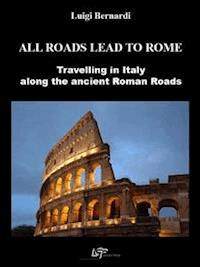
The best guide to visit Italy in a different and most interesting way! From Southern Italy – Apulia, Naples on to Rome, Florence and the North of Italy, all the way up to Monte Carlo. Travelling in Italy along the old Roman roads built by Consuls and Emperors centuries ago, spreading knowledge, law, language, art, civilization and above all, uniting Italy and Europe. A fascinating itinerary full of historical memories, places where to stop, monuments to see, archaeological sites to visit whilst driving across the oldest, largest and most efficient road network still in use to day.
Das E-Book können Sie in Legimi-Apps oder einer beliebigen App lesen, die das folgende Format unterstützen:
Veröffentlichungsjahr: 2012
Ähnliche


















Cover
Colophon
English version: Madelaine Grimoldi
Photos: Wilma Salvati
LogartPressEditore
Piazza Cavour, 3 - 00193 Roma
Tel:0039/06 6833902 - Fax:0039/06 68308160
e-mail:[email protected]
www.logartpress.com
ISBN 978-88-876-6622-9
Ebook version by
Title page
Luigi Bernardi
ALL ROADS LEAD TO ROME
Temple of the Sibyl at Tivoli
Engraving by Pardoni (1850)
Contents
Preface
Introduction
The Via Aurelia
The Via Cassia-Clodia
The Via Flaminia
The Via Salaria-Nomentana
The Via Tiburtina-Valeria
The Via Aurelia
The Via Salaria-Nomentana
The Via Tiburtina-Valeria
The Via Cassia-Clodia
The Via Flaminia
The Via Latina-Casilina
The Via Appia
Preface
Would there have been a Europe - this Europe that we now know as our common homeland - without the Roman Roads? Probably not. As a matter of fact, certainly not. Along the roads wanted by Consuls and Generals, laid out by victorious Emperors and watched over by diligent prosecutors - spread out from the Caucasus to the Atlantic, from Great Britain to the Balkans - legions have passed by and with these legions, language as well as rights have passed by; art forms, models for a civil society, urban customs including public squares and basilicas, with libraries and theatres, have been spread and assimilated in every direction.
This book, written with great enthusiasm and admirable expertise by Luigi Bernardi, discusses the Italian Consular Roads. But if the road network, here so effectively reproduced concerning the Italian Peninsula, were outlined and analysed in full regarding our entire continent, from the Atlantic to the Rhine, it would be obvious that Europe is like a large and intersected leaf whose indispensable vein like network is exactly like the road outlines that the Romans, conquerors and civilizers that they were, laid out many centuries ago. The Romans were the first to want a grand globalization, and their roads made that feasible.
All roads lead to Rome. But all the roads - which depart from Rome, cross Italy and lead to the boundaries of Europe - are guiding lights in art and civilization, as eloquently revealed by the marvellous testimonies stratified and accumulated along their stretch and here illustrated and commented as far as regards our Consular Roads.
A book such as this one is invaluable because not only is it an archaeological reconstruction, it is more than that. It is a conscious tribute to the noble framework that for two millenniums has sustained, and continues to sustain, our civilization.
AntonioPaolucci
Superintendent of the Fine Arts Museums in Florence
Introduction
In the year 20 B.C., Octavian - not yet called Augustus, but “curator” of roads - erected in the Roman Forum, in front of the Temple of Saturn, the milliarium aureum. This was an enormous bronze column on which were engraved the names of the most important cities of the Empire and their distances from Rome.
The milliario d’oro was located at the fork of the three ancient axis of the urban roads: the Vicus Jugarius, the Clivus Argentarius and the “Via Sacra”. In a certain sense, the consular roads could be considered their extension. The first one continued on towards the Via Ostiense, which led to the sea and therefore a point of embarkation for Africa, and towards the Aurelia, which led to the north. The second one was in the direction of the Flaminia, the Cassia and the Salaria, leading to the north and northeast. Proceeding along the third road, one could reach the Latina and the Appia, that is, the great arteries to the south. The milliario aureo therefore was the centre of the world then known and represented the famous saying that “all roads lead to Rome”. Other peoples before the Romans built roads: the Persians, the Egyptians, the Greeks. But none of them created a true road system; their techniques were rather primitive, probably only intended to reinforce or widen old footpaths or pre-existing trails.
Instead, the Romans were the first to carefully examine with engineering solutions the problem and build a thick network of itineraries. These, according to a census taken at the time of the Emperor Diocletian, included 372 large roads that amounted to 80,000 kilometres. From the Iberian Peninsula to Asia Minor, and from Britannia to the Sahara one could practically reach everywhere, across a territory that now covers 35 countries.
This road system, essential to keep under control such a vast Empire, encountered a dramatic turning point when at the beginning of the 5th century an emperor informed the governors of the various provinces that the supervision and control of the roads could no longer be guaranteed. Therefore, the linkups and orders from the centre of the Empire were no longer assured. The announcement, in effect, signalled the beginning of the end of the Roman Empire and the dawn of the Middle Ages, and moreover the shattering of the united world civilization.
Everywhere much evidence concerning the Roman roads has survived, but obviously especially in Italy. Paved stretches, bridges, viaducts, tombs, arches and other monuments are the actors in these pages.
THE VIA AURELIA
Roads, for the Romans, were a spade but at the same time an extended hand towards other people. With the Aurelia, the grand coastal road extending to the north, to Gaul, began the Roman expansion and the unity of Europe. Nothing stopped the conquerors and the builders: they scaled steep mountains and surmounted rivers with arduous bridges, many of which are still in existence. A colossal monument on the La Turbie Mountain, above the Principality of Monaco, commemorates the Emperor Augustus and curatorviarum.
The Via Aurelia
ItsnamederivesfromGaioAurelioCotta.BuiltduringthesecondcenturyB.C.,itextendedfor590miles(1miteequals1,480metres)fromRometoAlbintimilium(Ventimiglia).
MAJOR MONUMENTS
1. Rome: Broken Bridge and Sant’Angelo Bridge,
2. Castel di Guido: Station of Posta.
3. Santa Marinella: Five bridges and a memorial stone.
4. Ansedonia: Ruins of Cosa.
5. Massaciuccoli: Thermal baths.
6. Luni: Ruins of the ancient city.
7. Rapallo: Hannibal’s Bridge.
8. Albisola: Station of Alba Docilia.
9. Finale Ligure: Bridges.
10. Alassio-Albegna: Ancient route.
11. Ventimiglia: Ancient road.
Lesen Sie weiter in der vollständigen Ausgabe!
Lesen Sie weiter in der vollständigen Ausgabe!
Lesen Sie weiter in der vollständigen Ausgabe!
Lesen Sie weiter in der vollständigen Ausgabe!
Lesen Sie weiter in der vollständigen Ausgabe!
Lesen Sie weiter in der vollständigen Ausgabe!
Lesen Sie weiter in der vollständigen Ausgabe!
Lesen Sie weiter in der vollständigen Ausgabe!
Lesen Sie weiter in der vollständigen Ausgabe!
Lesen Sie weiter in der vollständigen Ausgabe!
Lesen Sie weiter in der vollständigen Ausgabe!
Lesen Sie weiter in der vollständigen Ausgabe!
Lesen Sie weiter in der vollständigen Ausgabe!
Lesen Sie weiter in der vollständigen Ausgabe!
Lesen Sie weiter in der vollständigen Ausgabe!
Lesen Sie weiter in der vollständigen Ausgabe!
Lesen Sie weiter in der vollständigen Ausgabe!
Lesen Sie weiter in der vollständigen Ausgabe!
Lesen Sie weiter in der vollständigen Ausgabe!
Lesen Sie weiter in der vollständigen Ausgabe!
Lesen Sie weiter in der vollständigen Ausgabe!
Lesen Sie weiter in der vollständigen Ausgabe!
Lesen Sie weiter in der vollständigen Ausgabe!




