


6,99 €
Mehr erfahren.
- Herausgeber: Mursia
- Kategorie: Lebensstil
- Sprache: Englisch
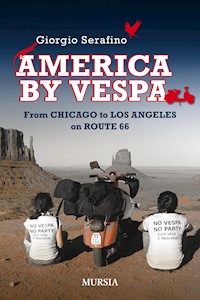
I didn’t know anything about America other than what my dreams had been telling me: I wanted to travel the Mother Road.
Lots of people told me not to go: Route 66 doesn’t exist anymore, they kept saying, America doesn’t even exist anymore.
But whenever I thought about it I felt something in my stomach that was almost pain!
I set out on an unsuitable vehicle, maybe in order to force myself to go slow. And in that big country, my dream exploded. I felt everything I’d always dreamed of beating inside my soul, changing my life forever. Along the road people hugged us, blessed us, gave us hospitality and lived our dream as if it were their own. Those hugs were so powerful that they allowed us to throw ourselves headlong into thunderstorms while lightning struck the ground only feet away from us...
I leaped into that road and found a beautiful America; on the burning hot asphalt I brushed by poisonous snakes and spiders while listening to the song of the coyotes, and together with them I gazed at the moon from that place/non-place known by the bad name of Death Valley; I touched heaven while standing in hell, motionless at the bottom of the valley while the sky from Chicago to Los Angeles ran above me.
I skidded between dream and reality until I no longer distinguished between them. I almost needed help because my emotions were too strong. I traveled under a huge electric guitar suspended in the sky playing rock music.
I wrote this book for the angels I met, and to tell those who think America is nothing but war and business: Hey man, you’re wrong! The Americans of the street still exist. The eyes of a homeless person, of a waitress, of a motel owner, can still see beyond, and if you look at them closely, you can see what I saw, you can see them looking beyond.
The little Vespa was my soul which humbly and slowly brought me across a country’s people in a place where dreams still grow, a place where you can regrow your wings if you want and the strong wind carries you up high to where, if you’re quick enough, you can give God himself a high five!
Das E-Book können Sie in Legimi-Apps oder einer beliebigen App lesen, die das folgende Format unterstützen:
Veröffentlichungsjahr: 2015
Ähnliche



















Summary
Cover Page
Copyright
Biography
Series
Title
Introduction
Chapter 1 - Cambodia, the Birth of the Dream
Chapter 2 - Giulia, Travel Companion
Chapter 3 - The General
Chapter 4 - Dedicated to Saint Jude Thaddeus, Protector of Lost Causes
Chapter 5 - Chicago––Thank You Baba!
Chapter 6 - Illinois: Begin Route 66!
Chapter 7 - Missouri: Pursued By the Tornado
Chapter 8 - Warmed By the Sun of Kansas
Chapter 9 - Oklahoma: Red Earth and Blue Sky
Chapter 10 - Texas: Against the Wind to the Midpoint
Chapter 11 - New Mexico: Cold Moon and Snakes
Chapter 12 - Arizona, Under a Roof of Stars
Chapter 13 - David Brown, Navajo Indian
Chapter 14 - The General Lee Conquers the Grand Canyon
Chapter 15 - Las Vegas: Boiling Nevada
Chapter 16 - California: Mojave Desert
Chapter 17 - Scent of the Ocean, End of the Voyage
Chapter 18 - Escape to Las Vegas
Chapter 19 - Death Valley
Chapter 20 - Time for Goodbyes
Acknowledgments
Info
Photo Insert
This ebook contains copyrighted material and may not be copied, replicated, transferred, given away, rented, released or circulated in public, or used in any way other than what has been specifically authorized by the publisher, under the terms and conditions of purchase or under the specific provisions of applicable law. All non-authorized distribution or use of this book, as well as electronic alteration of the information, constitutes infringement of the publisher’s and of the writer’s copyright and will be prosecuted and punished according to Law No. 633/1941 and its amendments. This ebook may not in any way be the object of exchange, commerce, rent, resale or circulation without the prior written permission of the publisher. Technical rule of use: it can be viewed exclusively on Apple iPad and iPhone device.
Original title of the Italian edition: L’America in vespa. Da Chicago a Los Angeles sulla Route 66
Translated by Giada Diano and Matthew Gleeson
Cover: Valeria Rusconi Clerici
Cover photo and insert photographs are by the Author
The Internet address of the Author is: www.terraeasfalto.it
© Copyright 2011 Ugo Mursia Editore s.r.l. – Milano
Ebook ISBN: 978-88-425-5397-7
First electronic edition, 2014
www.mursia.com
BIOGRAPHY
Giorgio Serafino, born in 1975, is from Civitanova Marche and lives in Montecosaro (Macerata) in a farmhouse he restored. With his wife Giuliana Foresi he has travelled in Europe, Canada (where he obtained citizenship), Brazil, Morocco (which he toured on a rented motorbike, by bus, and hitchhiking), Thailand, and Cambodia (on a motorbike). In 2010 he travelled along Route 66 from Chicago to Los Angeles on a 1978 Vespa 50 Special that he restored and named The General Lee. Since then, with Giuliana as always, he has travelled on the General through Thailand, Laos and Cambodia; he wrote about this experience in his second book, “Paradiso di Polvere,” published in November 2013.
VIAGGI, SCOPERTE E TRADIZIONI
Giorgio Serafino
AMERICA BY VESPA
From Chicago to Los Angeles on Route 66
MURSIA
INTRODUCTION
I’m very pleased to be able to introduce an English-speaking audience to this work of Giorgio Serafino, which is excellently translated from the Italian by Giada Diano and Matt Gleeson. Doubly pleased since I don’t arrive at these prefatory remarks as a distant literary critic: a few years ago, I and Agneta Falk were invited by Giorgio and his compagna Giuliana Foresi—through their friend Giada—to give readings of our works in the town of Montecosaro, which is on the eastern coast of Italy, facing the Adriatic Sea, about 50 kilometers from the city of Ancona.
Aggie and I stayed in the home of Giorgio and Giuliana, along with Giada, before the reading at the Montecosaro Theater. The house was in a valley. It had been built by Giorgio and Giuliana themselves. It is a beautiful place, with sort of a farm-like garden out back. They have a horse and a duck, a dog and cat. Truly, one might ask oneself: why would anyone want to leave this house so beautifully constructed in an awesome valley?
But in fact Giorgio and Giuliana are not your ordinary homebodies. Their life together is deeply connected to the road. In a word, they are planetary adventurers. When Aggie and I were there they were preparing for their next voyage, which would be the African continent.
They simply love to journey. Indeed it’s as if they memorized what I personally consider the most important poem written by an American, Walt Whitman’s “Song of the Open Road” (Jack London and Jack Kerouac were BORN from that poem!).
And this book describes their Vespa travels from Chicago, the most “prole”-tarian city in the U.S., to Los Angeles, the most dislocated—in the 21st century sense of the word—and their root-governance, which is human friendship and the adventure of adventuring itself. That is what underlies Giorgio and Giuliana’s ontheroadness (with “hero” in the word, to point to both of them).
And now the writing.
For someone now in his late 30’s who never even graduated high school, Giorgio’s account is something of a tour de force. Simply put: Giorgio writes like he rides, that is clearly, directly forward and with a breathlessness of breath in the telling of the couple’s adventures that translators Diano and Gleeson have caught brilliantly.
So in effect this read is going to be not only an account of a ride but in fact something of a ride itself in style and grace—as, for example, the anxieties about the Vespa’s arrival by air to Chicago, which are as much a part of the journey.
And it’s all full of heart, as you’ll very soon become aware of. So enjoy the ride. Andiamo!
Jack Hirschman, March 2014
CHAPTER 1
CAMBODIA, THE BIRTH OF THE DREAM
Drums. Echo of drums. They beat in a constant, hypnotic rhythm. But nobody’s playing, they’re only in my mind. Still I hear them, clearly. It’s beautiful and peace envelops me. I don’t know why, but this rhythm is a confirmation: we’re going in the right direction.
We’re in front of a high, steep ditch, with the water running below, black as pitch. A few meters further on, a large tree trunk makes a bridge, but it’s impossible to cross by motorcycle. I tell Giulia to cross on foot and wait for me on the other side, and I’ll try to ford the stream. I put the motorcycle in first gear, slowly draw close to the bank and then... down, through a steep jostling descent! The water comes up to the seat, the muffler gurgles without air, the motorbike gives a jerk.
I’m begging you, don’t break down here! Very long seconds bring me out, and I shout to Giulia to take a running jump onto the bike so the motor doesn’t die, she succeeds, and we manage to lurch onward.
My heart is racing, and now there’s no more sun. The drums come back, and the night drops on us like someone putting his hands over our eyes. Huge bats like airplanes brush against us. We travel at two miles an hour, three maximum, and I can’t see anything, until finally a distant pulsing light gives me hope again. It’s a fire. We go closer. Two women are chatting. They laugh: they’ve suddenly understood that we’re lost. One of them takes Giulia by the hand and leads her under a stilt house, starts shouting a name, and out she comes, lit by the flame of a torch: a Dutch girl. She’s tall and blond; for an instant I’m convinced I’m seeing the Madonna, yes, who’s appeared to help us. The girl is real; she’s been living here for six years with her little daughter.
She may not be the Madonna, but she still works a miracle, welcoming us into her home on stilts: she hangs up two hammocks covered with mosquito nets; she makes us plum cake with honey, and excellent coffee.
That was the most beautiful night and the best dinner of my life. It was there I made a decision: I wanted to keep traveling that way because it was the only thing I knew to do with my heart, the only thing that made me feel alive.
However it ended up going, I had to try it. Stretched out in a hammock in the middle of a jungle in Cambodia, I thought about my whole life, every single action or thought that had brought me there. I also thought about the Vespa.
As soon as I got home I would realize that dream, I didn’t know how yet, but I would do it. I was sure of it: I had had a vision.
Getting lost in the jungle had caused me to find my soul again.
CHAPTER 2
GIULIA, TRAVEL COMPANION
13th of June 1998, 10 pm, Porto Potenza railroad station: the day of my date with the girl of my dreams. I didn’t know whether she would come or not. In the preceding days I hadn’t been able to think of anything but her, her, only her.
I wasn’t working anymore, I wasn’t eating, I wasn’t sleeping and I was smoking an outlandish amount of cigarettes. I could not and did not want to tell anybody what I was feeling. I was cruising around on my rigid frame ’89 Honda Shadow. I had bought it with the insurance money I got from an accident in which I’d broken a vertebra. Three months in an orthopedic brace: July, August and September. My motorbike was the only one to know all. At every bend or straight road she would tell me: “Come on, let’s not stop, we can go anywhere,” and I would ask her to be patient, to wait a little more. The days were warm; among the hills, the asphalt looked wet under the scorching sun.
I loved to see the road undulating in front of me: in those moments I didn’t feel like I was in Italy but in Mexico, in Texas, or on the fabled Route 66.
The dream, however, would last only a few moments, until the looming date gnawed at my heart and mind. The hours were endless, contrasting sensations were overwhelming me: I would stop and cry. A month earlier, I had gone on a motorbike ride with some friends and there she was with us, Giulia. Giulia, whom I’d only just met, and already her name was tattooed on my heart.
I wasn’t even seventeen when I quit school to start working, and the days passed slowly, very slowly. Every morning waking up at 6:30, leaving for the construction site, having lunch on a makeshift table with my grandfather and his workman. I remember that, when lunch was finished, I would secretly go and sleep on the roofs, so time passed more quickly and in the meantime I dreamed... My desires were strong, my dreams wandered all over the place, but my body stayed stuck in reality. I wanted to play the way I used to, waste time the way I’d done long ago. Nobody could possibly understand. Nobody could do anything for me.
I searched, suffered, hoped... the heat of fire and the cold of snow. I chased after moments of joy in conquests that no longer existed, I wanted passion, storms, waves to tame. I wanted to battle with life.
Those insufferable people and that fucking job, I didn’t give a damn about it, I didn’t feel it inside, even if I was learning it well. Those tiles and those construction sites were colder than an arctic winter. But I had to go back to work.
“Duty.” I’ll repudiate the meaning of this word until the day I die. It has invaded my life since kindergarten, when they told me that “it was my duty” to go and learn to be with others. But who wanted to be there? I lived in the country in Civitanova Marche and I didn’t need anybody or anything. I had the fields, the olive trees and my dog, whom I’ll never forget. I’ll never forget any of the dogs I’ve had. I wanted to be outdoors, always outdoors; I wanted to build my house in a tree, high up, where no one could reach. The fireflies would light my way at night, if necessary I’d go hunting and eat roots. But it wasn’t allowed, I “had to” go to kindergarten, where I spent the mornings crying, I didn’t want to be there and I cried. I remember that main door that led inside to a sad world, made of artificial toys and fake life. Even today, when I pass by it, I look in the other direction.
It was at least 12 feet high or maybe more, light brown. The door was huge, and the building appeared to me even more imposing and sad. A few more feet and you reached another door, of the same size, but with the glass walls ornamented with white, or at least that’s what I remember. Inside a musty odor and a kitchen smell stagnated; nuns over a hundred years old told us what we must or mustn’t do. Everybody seemed to be playing happily, with light hearts. I wondered: how the hell do they do it? I really couldn’t do it, I wanted to go home, outdoors, with nobody around pretending to have fun. When I wasn’t there and it was sunny, I would go out early in the morning. The air was fresh and fragrant, the warm sun filled me with dreams, the little woods around my house became forests, the tiny spiders turned into very poisonous tarantulas. I built little houses that fell down soon afterwards, but I enjoyed myself. In that endless world I was free; on my own time everything was possible.
In elementary school it was the same thing, or maybe worse. I remember a spring morning, when the call of the fields was too strong: right in front of the entrance gate, instead of walking into the school, I ran away. I think it was during second grade. I hid out in a place where there was a small lake and caught tadpoles and frogs, then around eleven I went back to school as if nothing had happened, and I got written up for the first time. I didn’t care, I was happy, I had done something I liked at the exact moment when I needed to. It was totally worth it; in the end, all I had gotten was a write-up! Who cares about a written reprimand in exchange for freedom?
Nothing, absolutely nothing, no whipping, no torture, just a scolding. What could those two spiteful sentences full of unhappiness do to me? Nothing. I dragged myself along for five long years and then passed to secondary school, where the word “duty” took on an even more imperative meaning.
In those four years my rage and repulsion towards any kind of scholastic authority grew stronger and stronger. Every so often I didn’t go, and with a faked signature I got away with it. So I was suspended and held back a grade. The teachers gave me confirmation of the sadness of a job done without passion, love, curiosity or hope. I watched them come in each morning and I promised myself I’d never become like them. I didn’t want to live a life devoid of dreams like theirs. They stank of resignation and frustration. You could tell from their eyes, which had no light. Dull people who do what they do because they have to. But what is it that forces the majority of people to do what they do even if they don’t want to do it? In order to eat? Because they have to sustain their house and family? No, I don’t believe that. They do it because they’re afraid of facing the world, they’re afraid of the unknown. As for me... the unknown keeps me alive, uncertainty cheers me up.
One day I started getting sick: it was while I was repeating my third year of secondary school; I hadn’t even been allowed to take my final exams the year before. I was home, with a fever and strong abdominal pains; the light filtered through the closed shutter. My fever reached 104 and they decided to take me to the hospital, where I was told it was non-acute appendicitis and that they could operate on me the following day, but I was feeling very sick, I couldn’t walk. They gave me a bed in a six-person dormitory that I didn’t like at all. Towards evening I had to go to the bathroom but, since I couldn’t stand up, they gave me a plastic thing to do my business in right there. The moment I tried to find a more comfortable position, a pain I didn’t even think could exist poured through my mind and body. My fever had reached almost 106, yet I felt so cold I couldn’t talk. My appendix had burst: peritonitis.
I woke up in the same bed with a still-open incision in the right side of my groin and, a couple of centimeters down, another hole out of which a little tube was coming.
I should have felt better, but that’s not exactly how it turned out.
My mouth was as dry as if I’d spent a month in the Sahara, I couldn’t drink, least of all eat, but I wasn’t hungry, only thirsty, so very thirsty. All I could do was moisten my lips with a wet napkin that I eagerly tried to suck.
A day went by, two days, and they started to give me some tea. A few spoonfuls were enough to unleash hell in my stomach, it felt like I had drunk pure acid.
They gave me some Maalox. I was fourteen and I wasn’t by any means a doctor, but I knew it wouldn’t be enough. I felt bad, worse and worse, and the acidity in my stomach didn’t diminish, rather it increased. It increased so much that I started to vomit blood. Panic...
They introduced a tiny tube from my nose all the way down to my stomach. I don’t know how much stuff left me through that tube. IV drip, tube in the nose, open incision, the other tube exiting me further down. I couldn’t even move a finger, I didn’t have the strength to. I think that at that point, if I had died, I wouldn’t have suffered much more, I would have fallen asleep and that was it.
Around evening a friar came by and blessed me with Holy Oil, but I didn’t understand, I didn’t think he was there because I might die. He was a friend of my father, he hung out at our house and I didn’t make much of his presence, I was happy he was there because I have faith, but nothing more than that.
Some nurses came, put me on a gurney and told me: “Count to five.”
I don’t know how much time passed. When I opened my eyes, I was in another room. I saw a turned-off television and asked to turn it on, I felt fine. My belly itched, I tried scratching it and I felt a little pain, I lifted the sheet to give a look and there was a huge bandage. They told me they’d had to operate on me again: I’d had an intestinal blockage due to the stress of the peritonitis. Their fault? I don’t know and I don’t care.
I had been born again.
According to me only God decides if you live or die. Maybe the hand of the surgeon also has something to do with it, but I do believe that without God I wouldn’t be here.
I only have one positive memory from those days: a doctor, the one who’d said in the first place that there was no rush to operate on me, lived not far from the hospital, and every morning he arrived on foot. Every time he stepped into my room, he brought the smell of the morning air, of the mist that forms when the sun rises. That smell carried my mind outside, into the fields and onto the streets, so that I dreamed of reaching faraway and unknown places. At that point I knew I’d recover. Hunger arrived. What a nice sensation to be hungry. They took out all the tubes and the IV and after a month in the hospital I was finally dismissed.




