


25,99 €
Mehr erfahren.
- Herausgeber: John Wiley & Sons
- Kategorie: Geisteswissenschaft
- Sprache: Englisch
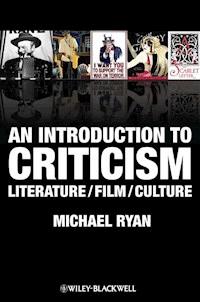
An accessible and thorough introduction to literary theory and contemporary critical practice, this book is an essential resource for beginning students of literary criticism.
- Covers traditional approaches such as formalism and structuralism, as well as more recent developments in criticism such as evolutionary theory, cognitive studies, ethical criticism, and ecocriticism
- Offers explanations of key works and major ideas in literary criticism and suggests key elements to look for in a literary text
- Also applies critical approaches to various examples from film studies
- Helps students to build a critical framework and write analytically
Sie lesen das E-Book in den Legimi-Apps auf:
Seitenzahl: 379
Veröffentlichungsjahr: 2011
Ähnliche



















Contents
Preface
1 Formalism
Major Texts
Major Ideas
Major Terms
Summary and Discussion
Examples of Formalist Critical Analysis
Things to Look for in Literary and Cultural Texts
2 Structuralism
Major Texts
Major Ideas
Major Terms
Summary and Discussion
Examples of Structuralist Analysis
Things to Look for in Literary and Cultural Texts
3 Historical Criticism
Major Texts
Major Ideas
Major Terms
Summary and Discussion
Examples of Historical Analysis
Things to Look for in Literary and Cultural Texts
4 Psychoanalysis and Psychology
Major Texts
Major Ideas
Major Terms
Summary and Discussion
Examples of Psychological Analysis
Things to Look for in Literary and Cultural Texts
5 Marxism and Political Criticism
Major Texts
Major Ideas
Major Terms
Summary and Discussion
Examples of Marxist Analysis
Things to Look for in Literary and Cultural Texts
6 Post-Structuralism and Deconstruction
Major Texts
Major Ideas
Major Terms
Summary and Discussion
Examples of Deconstructive Analysis
Things to Look for in Literary and Cultural Texts
7 Gender Criticism
Major Works
Major Ideas
Major Terms
Summary and Discussion
Examples of Gender Analysis
Things to Look for in Literary and Cultural Texts
8 Ethnic, Post-Colonial, and Transnational Criticism
Major Texts
Major Ideas
Major Terms
Summary and Discussion
Examples of Post-Colonial and Ethnic Analysis
Things to Look for in Literary and Cultural Texts
9 Scientific Criticism
Major Texts
Major Ideas
Major Terms
Summary and Discussion
Examples of Scientific Criticism
Things to Look for in Literary and Cultural Texts
10 Film Studies
Major Works
Major Ideas
Major Terms
Summary and Discussion
Examples of Film Analysis
Things to Look for in Film Texts
11 Cultural Studies
Major Texts
Major Ideas
Major Terms
Summary and Discussion
Examples of Cultural Analysis
Things to Look for in Cultural Texts
Summary: Theory for Beginners
1 Culture is nature
2 Words make things
3 We know what we know
4 Learn Arabic
5 Reality is a fabrication
6 Not all stories are true
7 Power is belief
8 You are not who you think you are
9 You have to learn to be yourself
10 Capitalism is bad for you
11 Effects are sometimes causes
12 Identity is difference – and is therefore contingent
13 We all live in the past
14 The world is all there is
15 Nature is culture
Plates
Index
This edition first published 2012© 2012 Michael Ryan
Blackwell Publishing was acquired by John Wiley & Sons in February 2007. Blackwell’s publishing program has been merged with Wiley’s global Scientific, Technical, and Medical business to form Wiley-Blackwell.
Registered OfficeJohn Wiley & Sons Ltd, The Atrium, Southern Gate, Chichester, West Sussex,PO19 8SQ, UK
Editorial Offices350 Main Street, Malden, MA 02148-5020, USA9600 Garsington Road, Oxford, OX4 2DQ, UKThe Atrium, Southern Gate, Chichester, West Sussex, PO19 8SQ, UK
For details of our global editorial offices, for customer services, and for information about how to apply for permission to reuse the copyright material in this book please see our website at www.wiley.com/wiley-blackwell.
The right of Michael Ryan to be identified as the author of this work has been asserted in accordance with the UK Copyright, Designs and Patents Act 1988.
All rights reserved. No part of this publication may be reproduced, stored in a retrieval system, or transmitted, in any form or by any means, electronic, mechanical, photocopying, recording or otherwise, except as permitted by the UK Copyright, Designs and Patents Act 1988, without the prior permission of the publisher.
Wiley also publishes its books in a variety of electronic formats. Some content that appears in print may not be available in electronic books.
Designations used by companies to distinguish their products are often claimed as trademarks. All brand names and product names used in this book are trade names, service marks, trademarks or registered trademarks of their respective owners. The publisher is not associated with any product or vendor mentioned in this book. This publication is designed to provide accurate and authoritative information in regard to the subject matter covered. It is sold on the understanding that the publisher is not engaged in rendering professional services. If professional advice or other expert assistance is required, the services of a competent professional should be sought.
Library of Congress Cataloging-in-Publication Data
Ryan, Michael, 1951–An introduction to criticism : literature / film / culture / Michael Ryan.p. cm.Includes index.
ISBN 978-1-4051-8283-6 (hardback) – ISBN 978-1-4051-8282-9 (paper)1. Criticism. I. Title.PN81.L93 2012801′.95–dc23
2011035306
A catalogue record for this book is available from the British Library.
For Nathaniel
Preface
An Introduction to Critical Analysis
Criticism is the analysis of human cultural life. What science does to physical life criticism does to cultural life. It takes it apart and studies it and figures out why it works the way it does.
Such analysis ranges from the techniques used to make cultural artifacts such as novels, movies, music, and paintings to the ideas contained in such artifacts, the world out of which they arise, and their implications in our lives.
The specific region of culture that criticism analyzes is stitched into a larger cultural web that includes money, language, mathematics, engineering, commerce, digital computing, religion, and law. Without such culture in the larger sense, there would be no human life on earth. It is our most important creation as humans. It allows us to manipulate things without laying our hands on them, and it allows us to make the world work by using symbols or signs such as currency and words rather than hammers and levers.
The region of human culture that criticism addresses, the culture of plays, movies, novels, poems, public discourse, and songs, has an important function within that larger culture. It directs human thought, feeling, and belief in ways that help maintain human physical existence. It reinforces norms that guide behavior, and it remakes old assumptions about how we should behave that have lost their adaptive usefulness. Cultural artifacts promote ideas that motivate action and they provide moral instruction. They are teachers, ministers, advertisers, politicians, and parents all in one. They help us manage our lives by providing us with useful examples of how to live. Culture in this sense is akin to biochemistry. It does not do the actual work of life, but without the instructions it provides, that work could not occur.
The arts, including poems, novels, and plays, were invented at the same moment in human history as large-scale communities because the arts spread norms, and norms ensured that we humans could live together cooperatively. They allowed us to transcend our animal nature, which mandates violence and mutual predation for the sake of survival. To get beyond that stage of human existence, humans had to develop new cognitive powers, and one of the crucial powers was the ability to hold ideas and images in one’s mind independently of things we perceive in the world. That kind of thinking ability led to the invention of religion; it made writing possible (seeing ideas in marks on a page); and it worked to invent laws based on ideal principles of justice. It also made norms possible, unwritten rules that were passed on through speech of various kinds such as oral tales and plays, as well as religious teaching and school instruction. Another name for the new cognitive ability that made cooperative civilized communities possible is imagination.
Cooperation is essential to human civilization because it makes larger human communities possible. Those communities were first enabled by changes in human cognition that made it possible for humans to use signs and to infuse objects with ideas. Strokes on paper became numbers that facilitated trade; signs in the marketplace became laws that were instructions for living properly; and certain ritual acts became embodiments of a regulating principle in human life – “God’s commandments” – that made people behave in ways useful to the survival of the community.
With what we call “meaning” – the association of ideas with things – was born the human ability to create large-scale civilizations. Large-scale human communities could only exist if all people held the same ideas of right and wrong in their minds. And religion, which might be called the first major human art form, provided such unanimity. It consisted of a mix of theater, fictional narrative, painting, and song. With time, actual theater supplanted it, and with even more time, modern cultural forms such as novels and movies took over the task of providing positive images of norms distinguishing right from wrong that sustain cooperative human communities still. The Great Gatsby teaches, among other things, that excess wealth is dangerous and destructive of human relations. It promotes a norm of moderate behavior.
As human civilization has developed over the past several millennia, culture has moved from unanimous meanings and beliefs that were largely religious in character to meanings that are multiple, complex, and contingent. Culture has become a realm where norms are debated as much as promoted. Societies held together by one religion are increasingly supplanted by ones in which multiple stories contend regarding what is true and good. As a result, the critical analysis of culture requires a variety of critical approaches. You will encounter them in this book.
1
Formalism
Major Texts
Viktor Shklovsky, “Art as Technique”
Vladimir Propp, Morphology of the Folk-Tale
Mikhail Bakhtin, Discourse in the Novel
Cleanth Brooks, The Well-Wrought Urn
Major Ideas
Formalists pay attention to the “how” in “how things are done.” They notice form. When a ballerina executes the familiar moves of the dances in Swan Lake, she performs the story of the ballet, but she also performs moves that are technical in nature; she follows certain well-known forms. Those watching might be struck by what good form the ballerina has or by how well she executes moves they know so well, quite apart from the content of the story of the ballet. Form in this example would consist of “the way something is done” as opposed to “what it is about” or “the story being told.”The story of the ballet would not be possible without the dances that construct the story, the forms the ballerina uses or performs. If you removed the dances and sat in the theater watching the stage, there would be no story and no Swan Lake. Form in this broad sense means the practical dimension of art, the way it is executed and constructed so that it can tell stories or make meanings. Some would say that form in this sense is all that art is. The narrative reality of Swan Lake on the stage consists of practical exercises in balletic form. You may think you are seeing a story, but in fact all you are seeing is performers executing techniques.If content is not possible without form, form is also radically separable from content, the things stories are about. Think of a ballerina in the practice room going through the moves that she will be performing that evening in the actual ballet. They are the same as those in the ballet, but they are without significance. They are forms only, mere exercises in technique. In this sense, form is pure technique or technique without any content attached to it. The study of this practical dimension of a work of art constitutes Formalist Criticism.The Russian Formalists argued that the language of literature should be studied in and of itself, without reference to meaning. For example, the way stories are told (the “narrative”) is an important dimension of fiction. Certain writers are more known for the way they tell stories than for the ideas they advance. James Joyce is famous for his “stream of consciousness” technique, for example, in his epic novel Ulysses. Marcel Proust, in Remembrance of Things Past, engages in a meditation on the role of time in human life by telling his entire novel retrospectively, beginning in the distant past and ending in the present. Technique and form are crucial to poetry. Some forms were prescribed, such as the sonnet, but more recent poetry is free-form. In poetry, such techniques as rhyme and repetition distinguish poetic form from other literary forms such as prose.Another group of Formalist critics, the American New Critics, felt literature embodied universal truth in concrete form. They were more concerned with how literature made meaning than with how techniques could be studied entirely on their own apart from what they meant. Often the meanings these Formalist critics were interested in were religious paradoxes – such as one loses mortal life but gains eternal life. They also felt “great” poems were complex, made up of elements in ironic tension with one another – a universal idea and a concrete image, for example. Irony means that two very different things are said in the same statement, and the New Critics felt that great complex poetry was ironic for this reason. It is universal and particular, ideal and concrete, idea and image all at once. Moreover, if one studies a poem, one usually finds that it is an organic unity: the form of the poem and the ideas it communicates are inseparable. Form is usually a perfect embodiment of theme in great poetry. The “what” of literature is usually bound up quite tightly with the “how” of literature. For example, William Wordsworth felt life was paradoxical; the simplest natural things tend, according to him, to embody universal truths. And his poems rely quite heavily on paradox.Major Terms
Form/Content Form is how a work of art is done or made, the techniques and procedures that an artist uses to construct a story or convey a feeling or an idea. Content is what a work of art is about.
Technique A technique is a particular way of doing something such as telling a story or establishing a setting or constructing a character. Techniques are also called devices and procedures.
Narration/Story The narration or fabula is the series of events that are actually reported or represented in a novel or a film. The story or szujhet (or subject matter) is the much longer span of time and of life from which the events reported, represented, or narrated are selected. It is the story world itself, rather than the story about that world. Another term for story is “diegesis.”
Perspective/Point of View Perspective is the position from which a narration operates. A film like Iron Man is told from the point of view or perspective of a wealthy western white man. Predictably, the way people very different from him – angry Middle Easterners, for example – are portrayed is skewed by that perspective; they appear menacing because they are so different; his perspective is laden with fear and he paints the world accordingly. Other terms associated with perspective are “focus” and “focalization.”
Motif A recurring element of a narration such as a particular event or a particular symbol or metaphor used repeatedly.
Function Narratives often follow patterns that they share with other narratives. In folk-tales, a common function is “the hero leaves home.” All tales seemed to have this particular narrative turn.
Discourse A coherent body of statements about something such as an event, an object, or an issue – for example, the discourse on race or the discourse of science. A discourse is generated by rules for making statements that produce consistency and uniformity across different statements. Such norms make for unity or consistency across different statements. They also make for easily demarcated boundaries between statements internal to the discourse and statements that fall outside its range.
Genre A group of artistic works that share certain traits. Works within the genre are easily recognized as being similar to one another and as being examples of the genre’s rules or conventions (agreements to do something a certain way). For example, works in the genre of melodrama usually contain a theme of unjust action wronging someone, who must vindicate his or her virtue.
Hypotaxis and Parataxis These terms describe two different ways in which relationships between successive ideas are expressed. In parataxis, the main elements are placed in a sequence of simple phrases, linked together by the conjunction and (or variations such as but). In hypotaxis, relations are specified as subordinate clauses joined by temporal or relational links such as when, although, after, etc. The Old Testament largely uses parataxis, but many modern translations use hypotaxis extensively, as it is seen by modern readers as providing more interest and variety. However, the narrative pace is changed by doing this, and certain deliberate breaks in the pattern are obscured. An (invented) example of the same idea, rendered in the two different styles is: “When Joseph arrived at the field, he spoke to his brothers, urging them to come home even though they were unwilling,” and “Joseph arrived at the field and spoke to his brothers and said ‘come home’ but they would not.”
Poetic Meter Traditional metric poetry uses five rhythms of stressed and unstressed syllables. An iambic foot of verse is unstressed/stressed: “That time of year thou mayst in me behold.” A trochaic foot is stressed/unstressed: “Tell me not in mournful numbers.” A spondaic foot is stressed/stressed: “Break, break, break / On thy cold gray stones, O Sea!” Lines vary in number of feet. The iambic pentameter consists of five iambic feet as in the example above. Tetrameter has four feet, trimeter three, and hexameter six.
New Criticism The approach to literature advocated by a group of critics in the middle of the 20th century in America. Alan Tate, Cleanth Brooks, Robert Penn Warren, and others argued that literary study should focus only on the text – not on history, psychology, or sociology. The goal was to describe the organic unity of the work, the way form and content cohered perfectly. An author’s intention was irrelevant, as was a reader’s reaction. Only the text, especially the intricate web of image and argument, was worthy of “close reading.” The New Critics were therefore skeptical of the notion that a writer’s intention determined what a work meant (the “intentional fallacy”), and they opposed criticism that relied on a reader’s emotional reaction to or impression of a work (the “affective fallacy”).
Summary and Discussion
How you do something is sometimes more important than what you do. If you walk into a job interview with an arrogant swagger dressed as if you just got out of bed and sit slouched picking your nose and daydreaming while the interviewer poses questions, you in all likelihood will do less well, despite being eminently well qualified for the position, than if you adopted a more professional demeanor, dressed in a suit, adhered to the rules of proper manners, and listened attentively while sitting up straight. Good posture can be everything. It is a species of what is called “good form,” which means “playing by the rules” or “following the reigning conventions of behavior.”
Similarly, how you say something can be as important as what you say. You can say “I love you” softly and gently, and it will mean one thing – a sincere expression of affection and commitment – or you can say it with the emphasis falling heavily on “you” followed by a questioning rise in tone – as in “I love YOU? (of all people).” The tone is now sarcastic rather than sincere, and the meaning changes as a result from sincere affection to something like “You’ve got to be kidding.” The feelings your statement generates will be quite different.
Formalists attend to these differences in how things are said or done. All works of culture – film, poem, rap song, novel – consist of technical choices that have meaning. You may have an idea – “adultery is really not a vice; it can be an expression of genuine, even divine love” – but getting it across in a work of fiction requires that you use literary techniques to create character, plot, situation, and event. You have to use words, wrought in a certain way, to make meaning. Or you have to choose where to place your camera, what lighting to use, how to direct actors to deliver lines, and so on.
Formalist critics notice that “how” is often as important as, or more important than, “what.” We like to think books and movies and songs are about life. And they are, of course. But they are also technical exercises that entail choices regarding such things as the perspective from which the story will be told, the kind of tone used, the logical evolution of the narrative, the way characters are constructed, the way lyrics are chosen and arranged, the structure of the melody, the placement of the camera, the kind of lighting used, the images chosen to illustrate points, and the like.
In order to mean, cultural works must have a formal dimension that consists of carefully chosen and arranged techniques.
Formalists in literary study were initially concerned primarily with poetry because poetry is so different from ordinary speech. It is clearly formed, made different by being arranged differently. It possesses rhythm and rhyme; it has melody and depends often on phonic harmony created by alliteration or the repetition of sounds. “Poetics” is the term for the formal study of poetry.
The formal analysis of a poem begins with a simple non-judgmental and non-interpretive description of the work. It describes the themes, the setting, the speaker or narrator, the characters if any, the implied world of the poem (what precedes the poem and what follows), the structure of the poem, such as the breakdown into stanzas, the genre or type of poem, the meter used (such as iambic pentameter), the rhyme scheme, the emotional movement of the poem toward a climax if any, the repetition of words, the images used, the figurative language such as metaphors and symbols, the congruence or dissonance of sounds in alliteration and assonance, the overall thematic argument as that is worked out in the language, etc.
Here are websites that will provide you with most of the important terms to use in such a basic description: http://www.infoplease.com/spot/pmglossary1.html; http://www.factmonster.com/ipka/A0903237.html.
Formalists are also concerned with rhetoric, the shape a writer gives to thoughts or themes in various language constructions. Rhetoric consists of more complex forms of speech or writing that writers use. For example, a favorite rhetorical form American New Critical Formalists studied was paradox (as in the Shakespeare line “Reason in madness”). Another was irony, as when Orson Welles juxtaposes an image of Charlie Kane feeling triumphant with an image of him reflected in glass and looking quite insubstantial and ephemeral. If paradox brings opposed ideas together, irony undermines one proposition with another. It consists of saying one thing and meaning something quite different (as when someone says “You look lovely, darling,” when in fact you just got out of bed). Irony is also found in theater and film, when a situation is such that the audience knows more than one of the characters. Irony of situation occurs when a result is quite different from what was intended (e.g., an attempt to save a life ends a life).
For a list of rhetorical terms used in such analysis, here is another site: http://www.tnellen.com/cybereng/lit_terms/.
American New Critical Formalists like Cleanth Brooks (The Well-Wrought Urn) were concerned with how poems embody universal truth. Poems contain concrete images that are just the opposite of universal truths, which are abstract rather than concrete. Brooks believed all poetry, therefore, was paradoxical because it was both universal and specific at the same time. He favored a religious view of poetry that saw it as the embodiment of spiritual meaning (universal truth) in concrete figural form (the poem).
Examples of Formalist Critical Analysis
A good example of a poem that clearly embodies what New Critic Cleanth Brooks contends is Williams Wordsworth’s “Intimations Ode” (http://www.bartleby.com/101/536.html).
It is organized around a paradox: all that we cherish passes, yet it passes away only in order to last forever. It is still possible to find something permanent and enduring in nature, and that is spirit. Spirit guarantees a more enduring life than the one of physical experience that is so fleeting and that passes so quickly. In a way, although we lose, we gain. That is the paradox of nature in as much as it embodies an enduring, transcendental spirit.
The kind of spiritualist thinking one finds in Wordsworth and Brooks has been increasingly displaced in recent decades by more scientific ways of thinking. Now it is more common to believe that there is no spirit world. The physical world is all we have. Many writers in this post-religious tradition have written poems about the change from spiritualism to a more physicalist vision of life. Increasingly, they are skeptical of the idea that there are “universal truths,” spiritual ideas that apply to everyone everywhere and that are a version of Christian theology. One of the more formally interesting is Elizabeth Bishop. Her poem, “At the Fishhouses” is about the fact that the emblems of Christian religious belief persist, yet the spiritual world they supposedly embody no longer seems credible (http://www.poemhunter.com/poem/at-the-fishhouses/).
The structure of the poem seems to invite a meditation on the possibility of a spiritual world. The first stanza is about physical things; the second, the very short one, seems a deliberate hinge in that it talks of the water’s “edge,” and the third meditates on religious ideas. It is as if Bishop were trying to be Wordsworth – looking at the physical world and then finding in it emblems of “immortality,” a spirit world behind the physical one. But the poem seems more about how difficult and exciting it is to live in a world that can no longer be said to contain a Christian version of spirit. For Bishop, the world is all there is.
Notice how the first stanza contains descriptions of physical objects with resonance in Christian imagery – the wooden captan shaped like a cross, the dried blood that recalls the crucifixion of Jesus Christ, the central story of the Christian religion, and the fisherman who recalls the Christian idea of the “fisher of men” who would bring those without faith into the Christian faith. Christ is often figured as a fish (“ichthys”) because that was an ancient symbol of the way the spiritual and the physical world joined together. But notice that Bishop is less concerned with suggesting that there is a spiritual meaning in these physical objects than with noting how they are, as objects, simply beautiful in themselves. She seems to suggest that the process of physical life is sufficient. We should concentrate on it, like the old fisherman, and not try to find spirit where there is none.
Notice that the net is “almost invisible,” which suggests the way, in a spiritualist vision of existence, the physical world would disappear into its true meaning as an embodiment of spirit. But the physical world persists in Bishop’s vision, and it assaults the senses: the codfish make her nose run and her eyes water. Moreover, while the church-like fishhouses with their high peaks evoke the possibility of transcendence (of leaving the physical world for the spiritual by moving up the gangplank at the hinge between water and land), this possibility is countered by the sheer weight of the sea, a dense physical object that seems resistant to being seen as an embodiment of spirit. It is “opaque,” rather than being a transparent glass through which one might, as one would in a Wordsworth poem, see Eternity. “Translucence” rather than “transcendence” seems to be what occupies Bishop, and that word is used to describe the simple physical beauty of the actual world. Perhaps this world is enough, she seems to suggest. Perhaps we need to reach or imagine no further by turning it into an embodiment of spirit. While the Christian cross-like wooden capstan is “melancholy,” the old man himself, for example, possesses “the principal beauty.” He is committed to life itself, lived through the repetition of simple tasks that are “unnumbered.” They never turn into spirit; they simply endure and continue, taking hope from Lucky Strikes, an image of the way a brave person who has given up the security of religion might face life in the physical world.
Bishop begins to speak in a Wordsworthian spiritualist way twice and then interrupts herself and returns to the physical world. Twice she begins to intone “Cold dark and deep …” It is as if she were a poet like Wordsworth who sees the physical world as having a “deep” meaning that is the universal truth of the spirit world that is “bearable to no mortal,” but she stops herself, allows herself to be interrupted by everyday things like a seal. The physical world has small pleasures, not big transcendental rewards, she seems to suggest. But it is also a hard place, and enduring life in it without a sense of spiritual meaning can be difficult. Bishop suggests we may be protecting ourselves from facing the hard truth of physical reality – that we all die and pass away. That is why she recalls the hymn “A Mighty Fortress Is Our God.” The fantasy of God protects us from the hard reality of the world. Knowledge of that reality burns your tongue; it is cold and hard; and unlike the fixed meanings of the Christmas trees and the churches, it is in physical time and flows on and away constantly: “our knowledge is historical, flowing and flown.” Christmas trees are only natural objects; it is we who turn them into spiritual meaning. But by themselves they are simply innumerable things. They make the physical world special, but that world, for Bishop, is indifferent. It recognizes none of our special occasions, our ways of making meaning of it. The Christmas trees “stand/waiting for Christmas,” as the cold water of the world swings “indifferently … above the stones.” Fire is often used in the Christian tradition as an image for the transmutation of physical things into spiritual ones. But Bishop’s physical reality is one that cannot be burned away into spirit (“transmutation of fire”). Its flame is oddly “gray,” and it “feeds on stones,” things that cannot be burned. In her metaphor, they resist being transmuted into spirit.
Bishop’s technique in the poem consists of creating resonances with Christianity through allusions (“A Mighty Fortress,” the bloody capstan). But while Wordsworth turns the ordinary world into a manifestation of spirit, Bishop evokes that poetic gesture and then does not perform it. She remains resolutely on the surface of the ordinary.
The Formalist study of fiction is called narratology because it is often concerned with how stories are told. Consider the formal difference between James Joyce in Ulysses and Ernest Hemingway in In Our Time, books written just a few years apart. Hemingway’s theme is toughness and how to get it. Men who fail are losers. Those who succeed harden themselves against the world and hold emotional attachments at a safe distance. They keep a tight lid on their emotions.
What kind of form would you expect with these themes? Here is an excerpt from a story about a young man fishing in a river near a swamp:
A big cedar slanted all the way across the stream. Beyond that the river went into the swamp. Nick did not want to go in there now. He felt a reaction against deep wading with the water deepening up under his armpits, to hook big trout in places impossible to land them. … In the swamp fishing was a tragic adventure. Nick did not want it. He did not want to go down the stream any further today. He took out his knife, opened it and stuck it in the log. Then he pulled up the sack, reached into it and brought out one of the trout. Holding him near the tail, hard to hold, alive in his hand, he whacked him against the log. The trout quivered, rigid. Nick laid him on the log in the shade and broke the neck of the other fish the same way. He laid them side by side on the log. They were fine trout.
Notice the simplicity of the sentences, the clean sense of orderliness in the prose. No feminine swirls here, no decorative adjectives. No signs of what other men looking on might take to be emotionality or vulnerability. Notice too the symbolic lay-out of the landscape, with the wet swamp that threatens to swallow up the man on the one side and the neat log on the other where the man can do his brutal work and maintain a sense of order in the face of potential engulfment and tragedy or loss. The simple form of the sentences is a way of keeping what the swamp represents – loss of clear boundaries around oneself – at bay. “Nick did not want it” is a way of ensuring through the very clean, clear, crisp, unadorned form of the sentence that he will not be overwhelmed by the swamp. Form here is almost a weapon like the knife. Its sharp edge keeps the male keen and out of the swamp of emotional disclosure and self-loss.
Now consider Joyce who concludes Ulysses by occupying the perspective of a woman who has just had an adulterous relationship during the day and who now lies in bed beside her husband, an affable, not at all duped, keenly aware man who nevertheless puts up with her antics. Here she thinks about a past flirtation, a play about adultery, the onset of menstruation, and her lover of the afternoon:
“I was fit to be tied though I wouldn’t give in with that gentleman of fashion staring down at me with his glasses and him the other side of me talking about Spinoza and his soul that’s dead I suppose millions of years ago I smiled the best I could all in a swamp leaning forward as if I was interested having to sit it out then to the last tag I wont forget that wife of Scarli in a hurry supposed to be a fast play about adultery that idiot in the gallery hissing the woman adulteress he shouted I suppose he went and had a woman in the next lane running round all the back ways after to make up for it I wish he had what I had then hed boo I bet the cat itself is better off than us have we too much blood up in us or what O patience above its pouring out of me like the sea anyhow he didn’t make pregnant as big as he is.”
The first thing that strikes one about the form of this passage is the lack of grammatical markers; everything flows together. Molly is funny, warm, earthy, resentful, and quite physical. She thinks more about getting laid well than about whether or not she is a proper woman or has a proper feminine identity (whatever that might be). The tone is one of good-humored tolerance, especially toward things normally considered “sins” by her Catholic compatriots in Ireland at the beginning of the 20th century. That tolerance suggests an emotional lability and openness that does not need to prove itself through evidence of order, firm boundaries, or toughness. Quite the opposite, in fact.
Form is often appropriate to content. It is the mode of execution of certain ideas or themes. In the case of Hemingway, the form of the sentences is crisp and clear, simple and neat, like the orderly boundary Nick wishes to maintain in the face of the symbolically feminine swamp. In the case of Joyce, the form of the sentences is fluid and boundaryless, associative and connective, like the personality of Molly Bloom.
Narrative is the ordering of events in a story or film such that they plausibly resemble real life. In some respects, narrative emerges from perspective. To see the world from a particular perspective is to tell the story of the world in a particular way. Perspective allows you to see only so much of the world. Narratives are therefore always focalized; they allow one to see, but they limit what one sees.
Narratives are selective constructs. When we tell a story about what happened to us the night before, we do not recount every second and every single thought we had. We instead select and recount only those events and thoughts that are most relevant, most significant, or most interesting for the effect we wish to create. All fictional stories and all films do the same thing. They select from actual events and combine the selected material into a sequence called a narrative.
Narratives are exercises in logic. Each event is a cause from which follow subsequent events. Narratives are also usually spatial as well as temporal. They tell stories in sequence through time, of course, but they also embody spatial schemes of meaning. The Scarlet Letter poses an ideal of natural freedom against a social world in which religion and law are fused for the sake of moral government. That spatial structure of meaning is worked out through the temporal narrative.
Narratives are characterized by motifs and functions. A motif is a recurring element within the same story – say, a reference to a blind man’s cane in Joyce’s Ulysses, for example. A function is a recurring element found in a diverse array of stories. In all heroic narratives, for example, the hero leaves home, is tested, receives help, and vanquishes the villain. The author draws on such forms or patterns in making his or her particular story. As a result, the story contains elements that can be found in other similar stories. Its form is shaped by conventions or formulaic patterns specific to its particular genre (the melodrama, the heroic legend, the comedy, etc.). The conventions of genre lend shape to certain kinds of stories such as the comedy and the tragedy. In comedy, the hero is usually low on the social scale and rises up; in tragedy, a figure who is high up socially falls. Certain such conventions are specific to historical eras. We seldom read or see tragedies these days because the era of kings and nobles is past. We see lots of comedies, on the other hand, because we live in a class-stratified society in which rising up socially or economically is a constant issue, one that provides many examples suited to comedic purposes. Knocked Up is a comedy of class ascent; a poor boy gets a well-to-do girl. His virtue transcends the usual barriers to non-success. Comedy is an appropriate form for such content because comedy thrives on breached boundaries and broken rules. And the main male character breaches a class boundary in the story of the movie.
Let’s now consider a specific example of narrative at greater length. The Scarlet Letter is about a minister who gets a young woman pregnant and then refuses for years to take public responsibility for what he has done. He allows her to suffer the opprobrium of the community and to be branded with the red “A” for adulteress. She is stigmatized and lives a life of shame – at first. She eventually, through her good works, wins over the community, who come to see her first as “Able”, then as “Angel.” The minister eventually reveals his sin and dies from his private suffering, but not before he publicly adopts his illicit family and acknowledges paternity of the child.
The Scarlet Letter is a symbolic narrative in which characters represent certain types – typical emblems of particular kinds of strength or virtue or vice. Hester is a woman associated with nature and with a supposedly (for the era) natural woman’s role of care-giver and nurturer. But she is also a free spirit who defies the authority of the world she lives in. Her daughter Pearl represents embodied spirituality in nature, a spontaneous being whose every act is an expression of virtue. Chillingworth represents moral supervision that would torment those guilty of natural lapses such as adultery, while Dimmesdale is the emblem of all the damage such moral government does in the world by making nature seem evil.
The novel’s form is also ironic. It begins with one set of moral premises, but during the course of the narrative those premises are inverted. The term for this is chiasmus, or crossing. In the course of the narrative, terms cross and change value. What began as virtue ends up seeming like vice, and what began as vice appears in the end to be the only true virtue. At issue is the 19th-century religious notion of “sin,” the idea that natural human actions can be categorized as evil by those who disapprove of them. Hawthorne demonstrates that what the Puritan church authorities declare to be sin – sexual desire – is in fact a universal human trait. Both Hester and Dimmesdale, the two putative sinners in the Puritan moral scheme, sense others around them who share their passionate sexuality.
The novel is filled with symbols and metaphors largely because, while writing it, Nathaniel Hawthorne read a controversial book that appeared the same year called God in Christ by Horace Bushnell, a Protestant theologian and minister who was persecuted for his beliefs, a theme that Hawthorne takes up in his novel. Bushnell devotes his first chapter to “typology,” the idea that divinity manifests itself in emblems in the world. For Bushnell, as for Hawthorne in the novel, sunlight is a symbol or emblem of divinity. The scarlet A that Hester is obliged to wear as a sign of adultery is an important symbol largely because, for Hawthorne, it comes to mean something quite different from what the Puritan clerics intended. It is a sign of Hester’s natural spirituality because she has made it in such an ornate and creative way that it subverts the harsh simplicity and simple-mindedness of the Puritan moral scheme. Her private spirituality is beyond the reach of conservative moral government. It is its own justification. The Puritans taught children using a simple “primer” that associated letters with words and moral lessons (“In Adam’s fall, we sinned all”). Hawthorne in the novel favors instead a more naturalist brand of religiosity that sees divinity in nature. Hester’s free-spirited reworking of the A, so that it symbolizes natural talent and natural moral freedom, subverts the meaning the Puritan clerics intended. Moreover, the attempt by the Puritan clerics to establish a fixed moral scheme for everyone is undone by the mobility of meaning of Hester’s letter. It comes to mean “Able” then “Angel,” a meaning completely at odds with what the clerics intended. Nature subverts moral government, Hawthorne argues in the novel, and the fate of this central symbol confirms that argument.
The narrative draws on the prevailing Puritan moral story, one in which redemption is attained through painful suffering for sins that some would consider simply the expression of natural passions, and it then ironically reworks those premises so that their values are reversed. Because Hawthorne endorses the view that sees nature as inherently moral and sexual passion as beyond moral schemes, the novel makes the Puritan moral story seem perverse and unnatural. Normally, the Puritan narrative of redemption would portray those who have sinned as evil and in need of moral supervision from holy men. But in this instance, the holy man is himself prone to natural passions. He fathers a child with a young woman. She, rather than being presented as a repository of negative or immoral traits, turns out to be one of the more moral characters in the novel. Her “progress” is not toward reconciliation with the conservative moral authorities; it is, rather, a progress away from the church toward a more natural, spontaneously generated morality that focuses on actually doing good for people instead of branding them as evil for having natural passions.
One important function in the conservative Puritan narrative would be the moment when the sinner accepts the judgment of the holy men and acknowledges his or her wrong. No such moment occurs in The Scarlet Letter. Instead, the two moments that might have fulfilled that narrative function – when Hester stands before the crowd on the scaffold in the market and the moment at the end when Dimmesdale mounts the scaffold with her and Pearl – serve a very different narrative goal and have a very different thematic purpose. Both are moments of defiance, when Hester proudly rejects the admonition of the Puritan elders and when Dimmesdale proudly adopts his natural family as his own. Rather than acknowledge guilt or confess to sin, he does what the virtuous Pearl asks of him and freely accepts his natural family as his own. Hawthorne thus creates an ironic version of the standard Puritan narrative of progress toward redemption and away from sin, assisted by the holy men and the holy teachings of the church. In his view, the church itself is evil, and progress consists of movement away from it and toward nature. The Scarlet Letter begins with the Puritan premise that sinners (those whose natural passions count as sins in the Puritan moral scheme, that is) should be punished. But Hawthorne immediately questions this premise by portraying his significant characters as rebels whose rebellion is justified. It too is an embodiment of the same natural spirituality that stands opposed to Puritan moral assumptions.
Form is essential to filmmaking because movies are in some respects nothing but exercises in technique. When you shoot a scene in a movie, you have to decide what form is appropriate to the ends you wish to achieve, be they thematic (getting an idea right) or representational (depicting a particular world accurately). You have to decide where to place the camera and what different effects different camera positions will create. You have to decide how to light the scene so as to suggest one emotional tone or another. Will it be dark or light, and how will each one affect the audience’s perceptions of the imagined reality? Similarly, in literature, one has to decide as a writer whether to be “light,” to use a humorous tone even with serious material as James Joyce chooses to do in Ulysses




