


Erhalten Sie Zugang zu diesem und mehr als 300000 Büchern ab EUR 5,99 monatlich.
- Herausgeber: Mercier Press
- Kategorie: Geisteswissenschaft
- Sprache: Englisch
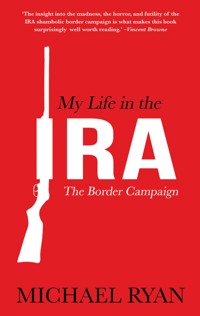
Discover the Inspiring Story of a Revolutionary: Mick Ryan's memoir of growing up in Dublin's East Wall and his journey as former IRA Director of Operations. Explore his commitment to the cause, despite suffering, hardship, and disappointment in My Life in the IRA. Understand why these volunteers persisted against all odds, driven by a deep sense of obligation to the ideals of 1916. Immerse yourself in the journey of a man who saw his involvement as a calling, a way to give meaning to his life. Get a unique perspective on the Irish struggle for independence and be moved by this tale of bravery, conviction and regret.
Sie lesen das E-Book in den Legimi-Apps auf:
Seitenzahl: 446
Veröffentlichungsjahr: 2018
Das E-Book (TTS) können Sie hören im Abo „Legimi Premium” in Legimi-Apps auf:
Ähnliche



















MERCIER PRESS
3B Oak House, Bessboro Rd
Blackrock, Cork, Ireland.
www.mercierpress.ie
http://twitter.com/IrishPublisher
http://www.facebook.com/mercier.press
© Text: Michael Ryan, 2018
© Introduction and Epilogue: Pádraig Yeates, 2018
ISBN: 978 1 78117 518 7
Epub ISBN: 978 1 78117 519 4
Mobi ISBN: 978 1 78117 520 0
This eBook is copyright material and must not be copied, reproduced, transferred, distributed, leased, licensed or publicly performed or used in any way except as specifically permitted in writing by the publishers, as allowed under the terms and conditions under which it was purchased or as strictly permitted by applicable copyright law. Any unauthorised distribution or use of this text may be a direct infringement of the author’s and publisher’s rights and those responsible may be liable in law accordingly.
Dedication
To my mother, who was always involved in fighting for the rights of her community and neighbours, and quietly supported me through all the tough times; to my father, who always felt passionately about social issues and suffered greatly; to Anjo, my wife of thirty-eight years, who supported me through good times and bad, and continues to care for me; and to all the brave men and women who took great risks and made great sacrifices in the cause of freedom.
Acknowledgements
This book is based on my own recollections of a period now long past and of experiences I shared with many people, some of whom are no longer with us. They include friends and comrades such as Nicky Boggan, the Collins family in Navan, Cathal Goulding, John Hobden, Tomás Mac Giolla, Proinsias McAirt, Jack McCabe, Dan Moore, Charlie Murphy, Tommy Nixon, Ruairí Ó Brádaigh, Eamonn Ó Murchú, Redmond O’Sullivan, Seamus Ó Tuathail, Tommy Smith, Leo Steenson, Pádraig Ó Snodaigh, the lads in Knockatallon, north Monaghan, Sean Keane of Milwaukee, the Prendiville family in San Francisco, Seamus Collins and the late, great Dick Walsh of The Irish Times. I also wish to express my gratitude to my other friends around the country whose names are too numerous to mention and still support our struggle for a better Ireland. I would like to thank Brian Hanley and Scott Millar for their research and work on The Lost Revolution, which helped revive my own memories; Pádraig Yeates, long-time friend and comrade, without whom this book would not have been ‘sorted’; and the Mercier team for advice and help in preparing it for publication.
Introduction
Pádraig Yeates
This is a memoir of growing up in Dublin in the 1940s and 1950s, and of the author’s subsequent involvement in the IRA border campaign of 1956 to 1962. It is a tale of times past and things that happened rather than an explanation of why they happened. It is a testament, not an apologia. The author has recalled people and events as honestly as recollection allows because they are important to him and to a dwindling band of comrades who participated in that campaign. They also had a bearing on subsequent events, especially in the North of Ireland, a few years later.
Mick Ryan grew up in East Wall, Dublin, a working-class community permeated by the history of Ireland’s struggle for independence. As a boy his father had been one of the many civilians injured in the Easter Rising and his first teacher at St Laurence O’Toole’s National School, otherwise known as ‘Larrier’s’, was Frank Cahill, a member of the Irish Citizen Army and 1916 veteran. According to the author, Cahill was one of only two teachers he encountered there ‘who had a natural sense of culture, or the gentleness that comes from a strong and generous spirit’. This is one of many pen portraits of contemporaries provided by the author that are, largely, sympathetic and judicious.
What makes this book of particular interest to students of modern Ireland, the Republican movement and the still largely neglected history of the 1950s and early 1960s, is that the author was one of a handful of IRA volunteers to serve in the border campaign from beginning to end, his service only broken by two relatively brief periods of imprisonment. It is a story of suffering, hardship, frustration and constant disappointment that will leave some readers wondering why anyone would become involved in such a patently hopeless cause and, even more so, why these volunteers persisted when defeat loomed from an early stage.
But the author and his comrades were different from the vast majority of their contemporaries. They regarded the objectives of 1916 not as pious aspirations but as a bequest from previous generations of revolutionaries that provided them with the opportunity to give meaning to their own lives. Mick Ryan had ‘a deep sense of regret’ that he had not been born early enough to participate in the Easter Rising and the subsequent struggle for independence. For him and his comrades to give up would have been a form of self-betrayal akin to the loss of a vocation among his more religiously inclined contemporaries. Even many who lost faith in the successful outcome of the border campaign still believed in what, to them, was the self-evident justice of their cause.
His story also provides glimpses of a society on the brink of change, albeit one that was still weighed down by poverty, superstition and social deference. Life in East Wall was hard, yet it was harder on the border, where the homes of many of the movement’s supporters were still lit by oil lamps, water was drawn from a well, and the farmer’s dole, poitín making and smuggling bridged the gap between living in poverty and not living at all. They felt no affinity to the ‘Free State’ and their hopes of a better life rested with the yet-to-be-realised Irish Republic. As Mick Ryan remarks, the nature of that republic was rarely discussed. That they believed it would be better than what they had was essentially an act of faith.
Note on IRA structures:An army convention was a meeting of the supreme governing body of the IRA, composed of delegates representing its constituent units, where policy was determined and an Army Executive of twelve members was elected. The Executive appointed an Army Council of seven, usually, but not exclusively, drawn from within its own ranks. The Army Council was charged with implementing the policy of the organisation between conventions. It was appointed in this way to protect the identities and positions held by members of the Army Council. The Army Executive retained a power of oversight. It could convene another army convention when it deemed it necessary.
Catholics and Protestants:In this book Catholics and Protestants are regarded as largely synonymous with nationalists and unionists respectively in the 1950s and 1960s. While there were many exceptions to this general rule, most Catholics living in the areas where Mick Ryan operated were deeply alienated from the unionist-controlled government in Stormont. Whether or not they shared the author’s republican outlook, they were sympathetic to his cause, as this narrative clearly shows.
1 A Dublin Childhood, 1936–50
My mother was a native of Oldcastle, Co. Meath, but it was a place I seldom visited in my youth. It was Killary in Co. Meath, the birthplace of my maternal great-grandmother, and Collon in Co. Louth, the home of my maternal grandfather, where my siblings and I spent almost every summer holiday.
My father was Dublin-born and proud of it. His father and mother came from Golden, near Cashel, Co. Tipperary. They eloped in 1898 and settled in Dublin. My grandfather joined the tram company of William Martin Murphy, the notorious Dublin employer who locked out the workers in the infamous 1913 Dublin Lockout. My grandfather was one of the few inspectors who joined the subsequent strike. As a result, he lost his job and was thrown out of the company house in Dock Street, where he had lived from the time he became an inspector. The hardship endured by my father’s family because of the strike left its mark and he was never to forget it. My father had an abiding hatred for Murphy, as did thousands of Dubliners who had suffered terrible deprivation in the Lockout. He was only twelve when the Irish Volunteers and the Citizen Army made their brave revolt against British rule in 1916, but he became one of the casualties nevertheless when he was wounded in the lower left leg by a bullet or piece of shrapnel. The wound never healed properly. It caused him pain and gave him a limp for the rest of his life.
At sixteen he began work, selling coal door-to-door from a handcart. He later bought his own horse and cart and expanded his round, so that by 1932, at the age of twenty-eight, he was making a good weekly income and was able to marry my mother, who was eighteen at the time. He bought his house outright for £300. However, he was something of an enigma, on the one hand capable of deep sensitivity and sympathy, while on the other sometimes very cruel in his treatment of my mother. He became addicted to drink and would get fiercely angry when drunk, invariably taking it out on her. He would also have bouts of insane jealousy and accuse her of all kinds of infidelity.
I was born in 1936 and my memory of childhood was one of constant fear as well as deprivation. There was a permanent shortage of money to buy food, clothes and other essentials. Things were in short supply generally in the war years because of rationing. Together with my father’s abuse of drink, it made life seem almost intolerably sad for me, my five sisters – Eithne, Monica, Gertie, Gretta and Minnie – and my younger brother, Nicholas.
Coal shortages after the outbreak of war saw my father emigrate to England to find work. He earned good money, sending back enough for my mother to make ends meet. My memory of these years is vague, but I was certainly conscious of the war because of the blackouts, the shortage of food, clothes and money. There was the anxious wait for letters from my father and relatives in England, so we would know they were all right. More immediate news was hard to come by because very few people on our road had a radio. On the day of a big match in Croke Park, if the weather was fine, people with radios would put them in their front parlour and open the window so that neighbours could gather round to hear the commentary. We would generally go to our Aunt Molly McLean’s to hear the match or a play, and my uncle, John Geraghty, used to call regularly and tell us of the latest broadcast from Berlin by ‘Lord Haw-Haw’ (the nickname for pro-German broadcaster William Joyce, who was hanged by the British after the war). There was always an air of seriousness when there was talk of the latest developments because so many families had relatives in England or in the British forces.
There always seemed to be a wan twilight in the houses at the time, probably because of the blackouts and fuel shortages. Our cooking was done on a Stanley range in the kitchen, and Mother did wonders with our rations. Our diet was supplemented by the odd sack of spuds, a chicken or a few eggs that came from our grandfather in Collon. And every summer from when I was seven until I was fourteen I went to his house for a few weeks. The food, the freedom and security, along with the happy family atmosphere, made it seem like a paradise compared with home.
After my father’s return from England once the war finished, he began selling turf. It was mainly winter work, as most people who bought from the ‘bellman’ (so called from the bell that hung from his horse’s collar to announce his arrival) couldn’t afford a fire from May to October, and carried out in appalling conditions of snow, rain and sleet. From 1947 his limp began to give him trouble and he decided to invest in a motor truck that a ‘friend’ said he could buy for £100. The idea was that the truck could be used for other business when the winter fuel season ended. He had to borrow the £100 from a loan company in Castle Street at exorbitant interest, mortgaging our house as collateral. The truck never went right; it was old and in bad repair. He did get a few weeks’ work hauling oranges from the docks when the first big shipment arrived after the war. Then the truck just stopped. It took years to pay off the debt. I cried a lot in those days and was increasingly angry at my father’s behaviour and the wrong he had done to our family.
The worst aspect of his drunkenness and his treatment of us over the years was the fact that all the neighbours knew what was going on. For me this was a terrible source of shame and embarrassment, affecting almost everything I did or thought. Our poverty also meant that neither my sisters nor I could consider staying on in school. Even before we left, we supplemented his meagre social welfare payments (he had never paid social insurance contributions) by making a small handcart and buying loads of short pieces of wood from a local timber merchant. We chopped them into thin sticks at home and tied them into bundles for kindling. The load would cost about a shilling and we would get perhaps 120 to 140 bundles out of the load, which we would then load into our boxcar and sell door-to-door. We would all take a hand in the chopping and tying, but my sister Gretta and I usually did the selling. We sold some to local people, but our main sales were on the Howth Road and in Marino, which were well-to-do areas by our standards and where, I suspect, people bought from us as much out of sympathy as for the firewood.
It was hard work, but we had no other way of making money until we left school. It was always a thrill when the last bundle was sold and we could head home on a Friday or Saturday night, cold but with twelve or fifteen shillings to give to Father, who handled the money; he would then hand some part of it over to Mother. So, indirectly, he felt he contributed.
I don’t wish to give the impression that my father was intrinsically cruel. He had a hard life, the final blow of which came in 1948 when he developed gangrene and had to have his leg amputated. He spent almost a year in hospital and in a convalescent home. After that, his reduced mobility meant that he was no longer able to instil the same fear into us and I think he suffered remorse. Although he never referred to it, it came through in other ways. From the time of his operation until he died he was more like his real self – a man who was sensitive, loved music and literature, and was extraordinarily well read and informed on Irish history and international events. Needless to say, the experience of the truck, the way he was pursued by the loan company for repayments and the amputation of his leg left him bitter about life and society. It was certainly a factor in his hatred of capitalism, landlords and loan sharks, as well as his gradual conversion to socialism. He was also a romantic, and some of that he no doubt passed on to me.
***
As a child, I had a very tender conscience, the kind that leaves one in a constant state of anxiety. It made even the prospect of confession – never mind the event itself – a worrying experience. I was particularly apprehensive about my confession before being confirmed because it was a thorough investigation of one’s qualifications for membership of the ‘league of strong and perfect Christians’. I had had mental reservations when I took confession for my First Communion, but Confirmation was an altogether more serious matter and I was more aware of what a serious step it represented. That summer of 1947, I had helped unload thousands of oranges at Dublin port onto my father’s truck to be carted to the fruit importers. The sight and smell of so many oranges was delicious and a source of wonder to me and to the rest of the children of Dublin, who had never seen an orange in the flesh. In the process, I must have eaten dozens of them and given dozens more to my pals. But they were never noticed out of all those millions. I had been to confession every month for six months previously and had managed to avoid mentioning the business of the oranges; but conscience and fear got the better of me ahead of my confession for Confirmation. I went into the confessional expecting that my regular confessor, a quiet, friendly priest, would be there, but it was the parish priest, Father Browne, a gruff, loud-voiced, thick man inclined to deafness. I was nearly last in the queue and was petrified when I discovered he was in the box. I couldn’t move elsewhere, as the curtains were only partly pulled over and he could see me waiting. Showing a preference for one priest over another by leaving a queue was regarded as extremely unseemly.
So I started with a more than usually pious recitation of my sins, starting of course with the most innocuous. ‘I didn’t do the First Friday this month, Father.’1 This of course wasn’t a sin, but I felt it would impress him: ‘I took the Lord’s name in vain a few times … I cursed a few times, Father’ (you always repeated the ‘Father’ bit, as it helped to cement your acknowledgement of his superiority and underlined your tone of sorrow and obedience). ‘How many times, my son?’ he’d say, and invariably the reply would be ‘Four or five times, Father’, usually an uneven number, as that would look like you actually kept a count.
Then came the hard ones. ‘Father, I had bad thoughts, seven times since my last confession.’ This always brought the question: ‘And did you encourage these thoughts, or take pleasure from them, my son?’ in a tolerant manner to get you to tell the real truth. Usually I’d reply, ‘I tried not to bring them on but they came into my head, Father, without me thinking of them, and I tried not to take pleasure in them.’ Then, hoping I’d struck the right mood, I burst out with the big ones. ‘Father, I committed a bad action on my own, and I’m heartily sorry; and, Father, I also stole some oranges,’ followed in a most heartfelt whisper by, ‘I’m sorry for all my sins and promise not to do them again, Father.’
I was hoping he’d deal with the impure one and let the oranges go, it being the lesser of the two, or so I thought. But no. In a voice loud enough for anyone within ten feet of the box to hear, he said, ‘You stole oranges? This is terrible!’ He was really angry. ‘How many did you steal, boy?’ At this point I was afraid that he’d ask when I stole them, and then I’d really have been in the soup, because I’d stolen them six months before and had never confessed to what was clearly a really serious sin before now. ‘I stole thirteen, Father,’ I said in a whisper, really frightened now, especially as the real figure would have been nearer 113. Coldly and quite mercilessly he asked, ‘And are you going to pay back to the merchant what you stole before you make your Confirmation?’
And all I could say was that I wouldn’t be able to, that I had no money, and we’d no money at home to pay it back that soon. ‘No good, no good at all,’ he said with the finality of a hanging judge. ‘Leave the box, young man; I cannot forgive you your sins until you pay back what you stole.’ And he closed the little shutter on me, and immediately I heard the shutter on the other side being pulled back and the murmuring of the boy on the other side intoning the Confiteor.2
It was several seconds before I could compose myself sufficiently to leave the box. I kept thinking about how, without confession, I wouldn’t be allowed to be confirmed. I walked past the others waiting outside without showing that I was nearly in tears. Those nearest heard it all and looked up in silent shock and admiration. I waited outside for my best friends to emerge and hear their advice on what I should do. Out they came, speedier than usual because of what had happened.
By this time the word had gone around the church in dramatic whispers that ‘Mick was put out o’ the confession box by Father Browne’, and speculation was rife. I told them about the oranges and they were thrilled at this happening to one of their pals. It was a kind of notoriety. So there was much swapping of stories, none of them relevant or coming near to solving my problem, except for one lad, Christy, who said, ‘Hey, Mick, why don’t you go to another priest and don’t tell him about the oranges. You’ll get confession and then later some time you’ll be able to pay yer man back for the oranges you robbed? Anyway,’ said Christy, ‘Browne leaves the box earlier than the rest. We’ll wait until he goes and tell yeh. Then yeh can go to yer usual man.’
This was the plan agreed to. When Browne duly crossed the street to the parochial house with his slow, sanctimonious tread, I headed back into the church. But I wasn’t taking any chances this time, so the tale of the oranges was not related, and out I came, relieved beyond belief, ready to become a strong and perfect Christian.
The real fear of the stigma that would have attached to my family and me if I had been refused Confirmation is hard to relay nowadays.
***
My school days were not the happiest of my life. After East Wall Infants’ National School I had graduated to St Laurence O’Toole’s National School, ‘Larrier’s’, at the tender age of eight, where the harsh and sometimes cruel actions of some teachers probably affected me even more because of the problems at home. But there were two great exceptions. One was Frank Cahill, my first teacher, who had been a member of the Irish Citizen Army, had fought in 1916 with James Connolly and had a grand attitude to children and to people generally. The other was the teacher in charge of the choir, Brother Cordiale, who was perhaps the only teacher apart from Frank Cahill who had a natural sense of culture, or the gentleness that comes from a strong and generous spirit. Both were generous with their time and had a strong sense of humanity, which they expressed in many ways.
Frank Cahill was intensely patriotic, and one of my first lessons on joining his class was to learn the Fenian song ‘Deep in Canadian Woods’, followed closely by ‘A Nation Once Again’. They had to be sung loudly and with feeling, putting the emphasis on the right words. Frank was dead set against moneylenders, pawnbrokers – who did a great trade in those times – and the ‘cheque man’, who provided a form of hire purchase at exorbitant interest. He lumped them together as ‘those cursed Jewmen’, and unfortunately most of us equated the legalised robbery that constituted moneylending in all its guises with Jews. Of course I discovered in time that a fair proportion of usurers were Catholics, Irish and, worse still, Dubliners.
Otherwise, Frank gave us a solid grounding in human values. But, alas, that first year flew, and it was not long until I joined the class of Brother Leonard, a Kerryman who had a great interest in hurling and athletics but little else. He didn’t seem to understand anything at all of the complexities of young boys, their fears, shyness, or the law of uneven development. If you didn’t know the answer to a question, or were hesitant in giving it, he would swish quickly past your desk and hit you on the back of your head with his closed fist, or lift you out of the seat by your ear. He practised a form of psychological warfare. With head bent downwards, as though getting inspiration from the floor, he’d ask a question slowly, and raising his head and sweeping the class with those penetrating X-ray eyes, would home in on those who didn’t know the answer.
It seemed that he gloated over the ignorant rather than seeking the cause of their ignorance and doing something to correct it. He instilled such fear of not knowing answers that many who felt they did have the answers were too afraid to take the chance of being wrong. The pulling of ears or rabbit punches – quick blows to the back of the head or neck – were only a prelude to the formal punishment of four or five strokes of the leather, applied with all his force, usually so that the tip of the strap snaked an inch or two up over the palm of the hand onto the soft skin of the wrist. There is no doubt that the intention was to inflict pain. If he was in particularly bad form, which was frequently, you would be put standing against the wall at the top of the room until the next break, all of which was fairly normal for a punishment cell in a barracks but not a classroom.
We all heaved a sigh of relief when the year with Brother Leonard ended, thinking that the year with the worst master we were ever likely to encounter was over. We were soon disabused of that notion, for on returning to school after the summer holidays we discovered that our new teacher was Billy O’Neill.
‘Billier’, as we called him, was, if anything, worse than Leonard. He was six foot in height, weighed about sixteen stone and spoke with what he thought was a cultured Cork accent. On the first morning he made a lengthy speech about the opportunities that were opening up for lads who had the privilege of going to O’Toole’s, and that he was a fair-minded man who used the leather or the wooden pointer as a last resort. Their use hurt him more than they hurt us, and one day we’d appreciate all he had tried to do for us. Then he went over our names. Were we related to someone of the same name who had been in his class the year before? O’Neill would refer to these as either a bad puppy or a hard-working, intelligent chap, neither of which was usually true. And your performance was then judged against your relatives. He’d ask what your father worked at and whether you were in the school team or the choir or whatever. A natural snob, he looked down on those whose fathers were labouring, as distinct from being a tradesman or a shopkeeper. The latter category was the most privileged in the class, closely followed by the tradesmen’s sons. At the bottom of the heap were the sons of bellmen, dockers and labourers.
I found it extremely difficult to apply myself, being very shy and lacking confidence. O’Neill’s tendency to ridicule did not help. He gave me the nickname ‘Musical Johnny’ because I was in the choir. For some reason he did not like the choirmaster and he attributed all my shortcomings to the time I spent in choir practice. I can say that one of the greatest reliefs of my life was the day I left O’Neill’s class and could look forward to the following year in Brother Cordiale’s class, who was also the choirmaster and a man who understood the nature of teaching and had an empathy with his pupils.
With Brother Cordiale an English lesson or Irish lesson, poetry or Irish history, were explorations of strange places for hidden treasure. I can safely say that the year spent with him was the only one I learned anything worth learning. Other than that, all my learning came from my parents, particularly my mother, who seemed to know most things. It was my mother, too, who explained why a knowledge of Irish and of Irish history was important.
Overall, I suppose school mustn’t have been too bad, because I survived and I have some good memories of those years. There was the great feeling of release at Christmas and summer, and from seeing the classroom altar decorated in early May with daffodils and tulips. The scent would fill the classroom, particularly on a day when the sun was shining into the room. It wasn’t just the flowers, though, but the thought of summer that flowers inevitably brought to my mind – of a quiet, friendly, happy Killary and Collon, havens of my youth, and the deeply felt religious faith I held at that time, wanting to believe in all the promises that were made on its behalf by our teachers, which were bolstered by the lectures of visiting priests and missionaries.
There was also a tremendous feeling of elation and well-being getting up early in the morning and going out into the still-dark streets to 7 a.m. mass. I remember receiving communion in the weeks of Lent and sitting among the scattering of the devout, prayerful people gathered in the seats nearest the altar, waiting for the communion; the ting-a-ling of the bells and the sleepy-eyed altar boys intoning the magic, unknowable words in rhythm with the priest in his colourful golden-threaded vestments.
Mother was pleased I went, the teacher was pleased to note that ten of his pupils went to daily mass, and I was pleased at not having to lie that I did. For years I thought the communion wafers came into the tabernacle by aid of a Godly miracle. Otherwise why was there so much secrecy surrounding the golden-clad darkness of the tabernacle, which, even when open, was blocked from your vision by the priest’s raised cloaked arms? I’d be all right as long as I didn’t spot a beautiful girl, and I would concentrate my thoughts on the holiness of all things, at least until I had received the communion bread.
***
I had a constant love–hate relationship with the church and religion. I wanted to believe all that was promised, even if it was only in the next life, but at times it was impossible to even think the right things, never mind act on them. Once, when I was eleven and Father had been particularly bad, I remember clearly swearing that I was leaving home. I walked up towards the old Wharf Road, intending to go to Fairview Park, thinking all kinds of thoughts, mainly of the lack of fairness in the world and the cruelty of things. And just as I was passing the old church I slowed down and spat on the footpath at the entrance gates and said grimly under my breath, ‘Fuck you, God. Fuck you, fuck you. I don’t believe in you’, and almost cried with the frustration of knowing how bad things really were. That was the first time I really faced up to the reality of our home predicament and contrasted it with the prosperous and happy homes of my pals, all of whom were very good to me.
But it made going to my next confession very difficult. Swearing and cursing was one thing, bad thoughts were bad enough, orange-stealing worse still – but to actually curse God was the limit. In fact, the priest refused to believe me when I told him. He said, ‘Ah, my son, you only think you meant to curse God or to deny his existence. Isn’t that so?’ And of course by that time I had forgotten my resolve not to believe in God, the church or religion and was hugely relieved when he left me the opening. ‘Now, be a good boy and say you are sorry to God. Promise him that you’ll never say such terrible things again. Even if you don’t believe them, they are still a sin against God. So say your Act of Contrition and say one decade of the rosary in honour of the Blessed Virgin Mary, the mother of God.’
I couldn’t believe my luck. I was sure he would ask me my name and see my parents about it. So, having said my Act of Contrition, very slowly and with feeling, I left the box and made my way up towards the altar, where I said my decade of the rosary amidst thoughts of my near escape and trying to understand why he was so lenient.
It was around this time that my father had bought a horse and cart and began selling turf, as there was still no coal available because fuel shortages lasted until well after the war. The turf was stacked in ‘clamps’ containing thousands of tons in the Alexandra Basin, not far from our home, and in the Phoenix Park. These ‘clamps’ were a hundred yards long and about twenty feet high. They were far too big to allow the turf to dry; only the outside layers were dry and the rest would be damp or even sodden.
Both places were exposed, but where we collected the turf on the Alexandra Road was the colder of the two, with a biting wind that always seemed to sweep over the docks. The cart men would have to queue for hours, beginning at 6 a.m. to be near the top of the queue when the loaders arrived for work at 8 a.m. But, however early we left home, we were never first in the queue.
The Phoenix Park was different. In the park there was always the prospect of seeing the racehorses out with their riders. The thrill of seeing them was matched only by the secret hope that one day I might be a jockey myself. Then there were the squirrels, birds of all kinds and deer among the trees and little woods. The park was also a place that Father, in better days, before he was soured with Mother and with life, had brought us on summer Sundays to hear the bands playing on the bandstand in The Hollow, which most day trippers made their way to at some point. Besides the music of the band and the colours of children in their Sunday best, there was the prospect of an ice cream from the man with the big icebox on his three-wheeled bicycle. My father would often bring us over to the sky-high monument built to commemorate the battles won by the Duke of Wellington, a Dublin-born man who spent many years living in Trim, ‘near where your mother was born’. We would climb the steps to the base of the 100-foot spear and try to look up the side of it, but it made me dizzy with the effort and I’d quickly abandon the attempt.
Then maybe we’d go over to the Gough statue, that magnificent memorial to General Hubert Gough on his horse. My father would say, ‘That’s the finest statue of its kind in the world, and it was done by a Dublin man named Foley. That’s bronze,’ he’d say, and he’d walk us round the statue, examining the beautiful lines of the horse. The proud, seated figure on it and the strength and unity of horse and rider never failed to thrill me and provoke my imagination to thoughts of the battles he fought and to regret that I had never done such things.
After a few more words to some other admirer of the statue, we would start the long walk back to Parkgate Street for the bus to the North Strand and then the mile walk home, tired but thrilled with the memory of Wellington and Gough and the band, and maybe some inner feelings, vague but disturbing, that I could not understand or bring myself to understand.
Easter was another time for a trip, this time to the city centre to watch the military parade march past the General Post Office (GPO). It was always thrilling to sit on my father’s shoulders watching the thousands of soldiers and the armoured cars go by. The blood would race through my veins at the sound of the pipe bands. The leaders of the state standing solemnly to attention were reminiscent to my child’s mind of the soldiers of Easter 1916, when they took over the GPO on that historic Monday. I would feel a tremendous elation at the folk memories that stirred within me, and I longed to have lived in that great time and played my part alongside the heroes, Connolly, Pearse and Ceannt, or in the Fianna of the romantic Constance Markievicz.
And in years when Easter was late, the day itself would be fine, with the promise of the balmy days of June to September, which seemed to suit the implied promise of what the Easter parade commemorated. We would go home by way of Madigan’s pub, where Father would buy a pint of frothy-topped Guinness for himself and a glass of lemonade for the lad. He’d have another pint and then we’d be out for the walk home by way of Marlborough Street, Abbey Street, past the old Abbey Theatre. He’d always make some remark about F. J. McCormick or some such famous name who’d be playing there in The Plough and the Stars or The Righteous are Bold, none of which meant much to my young mind, but I’d do my best to look as if I was impressed.3
Then we’d walk on to Beresford Place to within a few yards of the old Liberty Hall, where Father would point and say, ‘That’s the place where poor Jem Larkin and Connolly spoke to thousands of the strikers in 1913. Ah, Jem Larkin was a great man. You should have heard him talk to the men. He wasn’t afraid of anyone – the Peelers, them dirty DMP [Dublin Metropolitan Police], or [William] Martin Murphy either … His son isn’t the man that Jem was.’4
Then we’d travel round by the railings on towards the Custom House. ‘That’s where the IRA burned all the government records in 1920, and that was a big blow to the British that time. Look, you can still see the bullet marks made by the big British guns in the Tan War.’ And, right enough, there were large pockmarks that looked like they were made by bullets. And all the history of that marvellous epoch would come alive for me.
On down by the Liffey towards the gantry, over the canal bridge and the ships moored to the quays; past Campion’s pub, where there were still a few stragglers making polite exchanges of ‘Nice day’, ‘Bad day’, or whatever. We would pass onto Wapping Street, a dead street, like the rest of the quays on a Sunday, deserted and depressing, with nothing but the steady thrumming of the Pigeon House pumping-station in the background.
At last we’d reach Barnabas’ Church, a Protestant church, and move up Johnny Cullen’s Hill. Not far to go now, and just as well, for I’d be very tired and the hill was steep enough. At the top we had a view of the many railway lines passing under the bridge, and the cranes of the docks stretching their giant arms to the sky. Down the hill now, on the home stretch, on to East Road, past Cullen’s Yard and Boland’s, Dinan Dowdall’s, and here we were in Caledon Road, a relief but a letdown all the same. For it was as if our journey back in time had only been an illusion.
***
It seemed that we were always short of money, though the horse was well cared for and my father could always buy all the drink he wanted and buy rounds for his friends. But when he came home drunk all his worst instincts would emerge: his jealousies, suspicions and, perhaps, his frustrations with life and the restrictions fate had placed on whatever secret ambitions he had.
I often went out with him on the turf round after school on winter evenings and on Saturdays, and would call to the doors ahead of the cart and get the orders. I’d be delighted when I’d be asked to leave a bag or two, as the more orders I got the more pleased Father would be and the sooner we’d be able to fold the last empty sack and light the candle in the lamp on the outside of the cart and start home in the darkening evening.
Heading home was great when my father was in good humour and if he wasn’t too drunk. On those occasions he’d let the horse go at a fast trot and he’d even let me take the reins for the straight run down the Old Wharf Road. The horse would always know he was heading back to the stables and his feed of warm bran and linseed oil. He’d soon be at the turn at Cadbury’s and heading down Church Road and into the stables. We’d both unyoke the horse and I remember well the thrill the first time my father let me brush the horse down. The stable seemed snug and warm after the cold and dampness of the winter streets.
The summers were always slack, with little demand for turf, but the rounds would be done anyway. But the stops outside Gaffney’s, Cole’s and Murphy’s became more frequent. He’d be inside for an hour sometimes, leaving me outside with the warning: ‘Mind the horse and take the nosebag off when he’s finished. Mind, now, d’ya hear? That’s a good lad.’ But after an hour or so even the horse would be fretting and lifting his head up and down, twisting around at odd times, looking at the door of the pub.
There were many summer Sundays when Father would take us all out for a jaunt into the ‘country’ or to the seaside. It would begin with the intention of spending the entire day around Coolock or Portmarnock; but in those days the bona fide law still applied: if you travelled five miles from your home you were a bona fide traveller and so could get a drink in any pub after hours. So Campion’s pub in Balgriffin, which was just over the five miles from our home, would be the first stop. Once there my father would make his way inside and a minute or two later come out with lemonade for the kids, and then back inside for a pint or two, then on a bit further and another stop at another favourite pub, and the same ritual until eventually we’d get to the seaside, a little late but still with time to get to the strand and wolf down the tea and sandwiches, usually bread and jam and tomatoes, and then, after a couple of hours’ play-acting around the beach, yoking the horse again for the long journey home.
On the way home there’d be only the one stop at Campion’s for a couple of pints to kill his thirst. He’d say, ‘I’ll have to get a pint; me tongue feels like blottin’ paper.’ Then he’d emerge, thirst slaked and in good form. He’d slap the reins lightly over the horse’s rump and she’d move off at a nice fast trot, sensing that we were heading home.
By now there would be others travelling home to the city centre, for at that time, the mid-to-late 1940s, the city ended at Killester, Whitehall and the little cottages of Coolock. They’d be travelling mainly in horse-drawn vehicles: ponies and traps, high gigs, fancy closed cabs, and hacks hired by a few thirsty Dubliners to travel out to the bona fides of Campion’s on the north side or the Dead Man’s at Lucan or the Strawberry Beds on the back road out of Chapelizod. There would be a few, like my family, who would have painted the cart in bright summer red, blue and yellow to make it appear less like a work cart. Then there would be the long open coaches with the seats running down both sides, which the workers of Collen Brothers, the East Wall building firm, would have for outings to Baldoyle Races or Fairyhouse. It was horses all the way, with only an odd Baby Ford or Austin Seven passing the horses out. The horse drivers – including my father – looked with derision on the cars and complained about the noise of them, the way they frightened the horses and the danger they were to everyone else on the road. All of us identified with our father in his sentimentality, whether it was against cars and for the horse, for the good old days as against the rude present, for the sailing ship as against the motor vessel, and so on.
There was many a summer Sunday when we’d go nowhere, of course. On such days, particularly if the weather was bad and if there was a particularly good film on in the Strand or the Fairview cinemas, or the last episode of the follower-upper (a weekly cinema serial) was showing, my pal Terry, whose father was a painter and handed up all his wages to his mother, would call to see if I’d go to the pictures. Then would begin the long, nervous way around my father or mother for the four pence. Most times I wouldn’t get it, because it wasn’t there. My father would tell me not to be filling my head with that nonsense – a walk to the park would be much better for me. It might have been, but it could never compensate for not seeing the great Destry Rides Again or whether Buck Jones won out against the crooks. That night my pal Terry would relate blow by blow all that happened in the film and some of his accounts were so good that years afterwards, when I saw some of the films on television, I had the distinct feeling that I had seen them before.
My father and mother at those odd times when things were good between them went to a good few pictures together. They both enjoyed the singing of Jeanette MacDonald and Nelson Eddy, and the acting of Greta Garbo, and the humour of Charlie Chaplin. And, like with many of their sentimental attachments, I in turn liked them all, developing an obsession for Greta Garbo. I first saw her beautiful haunting eyes in Camille when it was reissued in the Adelphi. Whenever a Garbo film was shown after that I’d go to it. Some of them weren’t so good, but I couldn’t bring myself to be disloyal by letting myself dwell on their faults. I loved her tragic, wistful roles and my obsession continued into Garbo’s old age, when I myself was in my forties. Later in life, when I became immersed in republicanism and the mystique that surrounded Ireland’s heroic past, I was to feel the same intense pathos and affection for Constance Markievicz the first time I saw that picture of her standing at the fireplace in the long room of Lissadell.
I was also affected by the strong sense of community and history in the area where I grew up. There were two dairies in East Wall, both of which kept their own cows, made their own butter and sold their milk door-to-door. Barber’s was in a back lane off Church Road, and Cullen’s was on the East Road at the bottom of Johnny Cullen’s Hill. I preferred to go to Cullen’s, because I would always be allowed into the front room to get the jug filled, and there were lots of interesting things in that room. It was always dark with the blinds drawn halfway down to keep out the sunlight and stop the milk going sour. There was a large earthenware crock into which Annie Cullen would dip the pint measure carefully and empty it into the jug, then she’d always dip it in again for another drop to make up for any spilt. Mrs Cullen would ask who you were and made you feel important. She seemed always to be clean and smelling of Lifebuoy soap. Her hair would be pinned tightly back into a bun and both she and her sister, Annie, wore old-fashioned, navy, flowered dresses that were almost a uniform.
The area generally was steeped in history. I often thought sadly of the Young Irelander John Mitchel and how he must have felt that day he passed along Seville Place on his way to the North Wall and deportation to Van Diemen’s Land.5 There were times when I could imagine him shackled hand and foot to a Peeler looking out the window of his horse-drawn cab, getting his last glimpse of Dublin’s streets and its citizens.
Frank Cahill often spoke of the Invincibles and Joe Brady, one of the men hanged for assassinating the chief secretary, Frederick Cavendish, and his under secretary, Thomas Burke, in the Phoenix Park in 1882.6 Brady had lived in a little street off Seville Place and still had relatives alive. ‘Ah,’ Frank would say, ‘remember poor brave Joe Brady and never forget Skin the Goat [cab driver James FitzHarris], the man they couldn’t get to betray his comrades, even though he was offered a fortune in gold and his passage to any part of the world.’ Frank would enthral us with vivid accounts of recent history, almost making them come to life again.
When I’d hear these stories I always felt a strange mixture of sadness and elation, wishing I had lived through those exciting times and been part of such great adventures that gave life meaning. Ballybough, which was a village about a mile from my home, also had its Invincibles, and during my childhood there were characters such as Fluther Good, whom Sean O’Casey immortalised in The Plough and the Stars. Fluther became famous overnight. One spin-off was that he was made honorary president of East Wall Soccer Club. The trouble was that he knew nothing about soccer, his main skill being cadging pints of stout. But it didn’t prevent him from attending matches in Fairview Park and shouting, ‘Come on, yiz silly bastards! I taught yiz all I know and yiz still know nothin’!’
My father knew Fluther well and would usually buy him a drink. There would be Fluther standing outside the pub. As my father climbed down off the cart Fluther would be over like a shot. ‘Here, Ned, I’ll look after the nosebag for yeh; go on in.’ My father, of course, would make his way in, leaving Fluther to take the nosebag down and fix it over the horse’s eager head. Then, after a respectful few minutes my father would feel Fluther at his elbow and Fluther would declare: ‘Jasus, Ned, the horse is in great order. He’s a credit to you. How’s business? Things are bad enough around here.’ And at that point my father would call for a pint for Fluther, who would make his usual half-hearted protest and then recount his latest row with the police, removing his hat after a couple of pints to show his bumps and scars.
Ballybough was a sort of old-world village in the 1940s with tiny secret lanes, thatched cottages, odd piggeries and dairies. John Walsh’s forge at the back of Poplar Row was where my father would bring the horse once a month for shoeing and the odd treatment for a bad hoof, or to get a wheel band tightened. Though Merriman, the farrier and smith, was a better wheelwright, my father preferred to go to John Walsh, as did I. There was a feeling of things old, grand and hidden in the forge: the smell of the hoof burning to prepare it for the shoe, the smoke and the magic of the farrier’s touch, never hitting a nail in the wrong way. It was a great place on a cold day, with the darkness and the intermittent red glow of the coke fire blazing up when he’d bellows it, fading to a nice reddish glow in between times.
John Walsh wasn’t the huge giant you expected a farrier to be but he was lithe and muscular. He wielded the hammer and tongs deftly, using just the right amount of force. He achieved a kind of rhythm when knocking the red-hot iron into the horseshoe shape by striking the anvil, or rather bouncing the hammer off it once for every two blows on the red-hot iron: ga-aang, ga-aang, ga, ga, gang, one-two-three-four, one-two-three-four, it would go. And gradually, from a flat, dead-straight length of cold iron would be shaped the U of the shoe.
He was a great man to handle a horse, no petting as such, but he’d be firm and few horses would chance to frolic about with John Walsh, though he’d talk to the horse being shod all the time. ‘Come on, girl. Come over outa that. That’s a girl, that’s a girl. Shewo, wo. That’s it, that’s it. Take her, Ned, there, now,’ and all the time with the horse’s hoof caught between his knees and resting in the lap of his leather apron. He’d be pulling out the old nails and removing the worn shoe; then would begin paring and evening the hoof to take the new shoe, with an examination of the upper hoof and hock for any weakness or damage. Then the best moment of all, the burning of the hoof, the nailing on of the new shoe and painting the hoof black. Now the horse, which would have been getting restless by this time, would start fretting and almost dash out when we’d be ready to go.
During those years of childhood, which now seem to have been long and packed full of events, many of which were not so happy, the years with the horse seemed to extend right through, but they could only have been four years and they were difficult ones.
There were many other things happening of which I was only vaguely aware through what I heard my father and mother discuss at odd times, or by listening to my father and John Walsh. These were years when religion and puritanism were paramount, when Brinsley MacNamara’s novel The Valley of the Squinting Windows was banned, as well as James Joyce’s works and many others. The saddest censorship of all, the burning by local priests of Eric Cross’s The Tailor and Ansty in a west Cork village, will only make people wonder today why such a harmless account of an earthy married couple could arouse such anger, spite and fear.




