


20,99 €
Mehr erfahren.
- Herausgeber: The History Press
- Kategorie: Lebensstil
- Sprache: Englisch
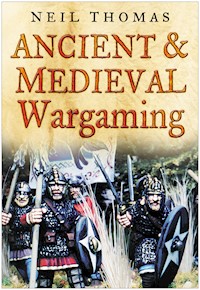
Re-fight some of the bloodiest battles of the ancient and medieval worlds! Seasoned wargamer and author Neil Thomas brings historical perspective to the hobby with a description and interpretation of significant military developments from 3,000BC to AD1500. Wargaming is the simulation of accurate historical battles using miniature figures to fight over three dimensional terrain, their movement and combat being regulated by clearly defined rules. Neil Thomas' new book provides specific coverage of ancient and medieval wargaming, thanks to its division into biblical, classical, Dark Age and medieval sections. Each section has its own set of rules and much expanded army lists. The wargamer gains additional perspective from data panels containing facts about weaponry, personalities and chroniclers, and quotations from original document sources. Useful suggestions for further reading are also included, while battle reports in each section provide tactical insights for both novice and veteran wargamers.
Das E-Book können Sie in Legimi-Apps oder einer beliebigen App lesen, die das folgende Format unterstützen:
Veröffentlichungsjahr: 2007
Ähnliche


















ANCIENT &MEDIEVAL
Wargaming
ANCIENT &MEDIEVAL
Wargaming
NEIL THOMAS
First published in 2007
The History Press
The Mill, Brimscombe Port
Stroud, Gloucestershire, GL5 2QG
www.thehistorypress.co.uk
This ebook edition first published in 2013
All rights reserved
© Neil Thomas, 2007, 2013
The right of Neil Thomas to be identified as the Author of this work has been asserted in accordance with the Copyrights, Designs and Patents Act 1988.
This ebook is copyright material and must not be copied, reproduced, transferred, distributed, leased, licensed or publicly performed or used in any way except as specifically permitted in writing by the publishers, as allowed under the terms and conditions under which it was purchased or as strictly permitted by applicable copyright law. Any unauthorised distribution or use of this text may be a direct infringement of the author’s and publisher’s rights, and those responsible may be liable in law accordingly.
EPUB ISBN 978 0 7524 9611 5
Original typesetting by The History Press
Contents
Acknowledgements
Key to Symbols
Introduction
1 Biblical Warfare 3000 BC–500 BC
2 Biblical Wargaming
3 Biblical Wargames Rules
4 Biblical Wargames Armies
5 Biblical Battle Report
6 Classical Warfare 500 BC–AD 300
7 Classical Wargaming
8 Classical Wargames Rules
9 Classical Wargames Armies
10 Classical Battle Report
11 Dark Age Warfare 300–1100
12 Dark Age Wargaming
13 Dark Age Wargames Rules
14 Dark Age Wargames Armies
15 Dark Age Battle Report
16 Medieval Warfare 1100–1485
17 Medieval Wargaming
18 Medieval Wargames Rules
19 Medieval Wargames Armies
20 Medieval Battle Report
Appendix I Figure Sizes, Scales and Prices
Appendix II Useful Addresses
Acknowledgements
I would like to start by thanking my father, Kaye Thomas, for typing the manuscript of this book. Also to everyone at Sutton Publishing for their efforts, especially Nick Reynolds, Julia Fenn and Jonathan Falconer.
This book has benefited greatly from the magnificent colour photographs that grace the plate section. The battle scenes were provided by Miniature Wargames® magazine, for which I would like to thank editor Iain Dickie and photographer Richard Ellis. I am also very fortunate to have been supplied some images by master figure painters Kevin Dallimore, Paul Baker (Brush Strokes) and Gerard Cronin (GJM Figurines).
Finally, any writers on Ancient and Medieval wargaming must record their debt to Phil Barker and other members of the Wargames Research Group. Without their pioneering work over the last forty years the hobby would be sorely diminished, both in size and in scope.
Key to Symbols
The illustrations of unit deployments in the army lists and battle reports, utilise various symbols to depict different troop types. They are defined below:
Introduction
This book represents a sequel to and development of my earlier work, Wargaming: An Introduction (also published by Sutton). While my previous book covered all periods of wargaming by providing rules and an appropriate selection of army lists, this one specialises in the Ancient and Medieval periods. The aim is to provide a much more comprehensive examination of one of the most exciting epochs of wargaming, by greatly expanding the numbers of army lists, and providing some historical perspective.
One major change from my last book lies in the number of rulesets. I felt that the nuances of this epoch are best covered by four different sets of rules for each defined period: the Biblical age (3000 BC–500 BC); the Classical age (500 BC–AD 300); the Dark Ages (300–1100); and the Medieval age (1100–1485). However, the reader should rest assured that the rules systems for each period are essentially identical to that printed in Wargaming: An Introduction; all use the same core concepts, and are intended to be both simple and playable. However, the use of four different sets of rules allows for the subtle variations in each period to come to the fore (it also effectively prevents the contests between Ancient Egyptians and Wars of the Roses English armies, that are a lamentable feature of the many wargames competitions that use a generic ruleset covering the entire epoch from 3000 BC to AD 1485).
Each period is allocated five chapters. The first of these provides historical perspective; it outlines the major military (and occasionally political) developments. This should give any wargamer some useful contextual information, and hopefully give him or her the encouragement to pursue an interest by consulting the reading list provided. All wargamers should appreciate that there really is so much more to this hobby than playing games; the history of each individual period is absolutely fascinating, and an understanding of it will enrich the gaming experience immensely.
The second chapter in each section explains how I interpret the historical background in the wargaming context; in particular, I define the troop types that perform on the wargames table. The rules themselves form the third chapter.
The fourth chapter covers the army lists for the relevant epoch. Devoting an entire book to the Ancient and Medieval period allows me not only to cover a large number of armies, but also to greatly expand the format of each list. Every wargames force therefore contains far more than just the composition of each army and a brief interpretive paragraph. I am also able to include a set of special rules for each force; a diagrammatic representation of how armies can deploy on the wargames table; a guide to the availability of figures and their suitability for use in other wargames forces (with the best will in the world, no wargamer could possibly collect all the armies in this book: the opportunity of having units serve in more than one force does, however, allow for the rapid acquisition of extra wargames armies); a reading list; and finally some snippets of historical information and (where possible) a primary source quotation.
The final chapter of each section covers a wargames battle report. Each of these is based upon a famous historical battle. I start by stating what happened in the real life engagements, and then describe the events that ensued when the encounter was reproduced as a wargame. Hopefully, the reader will feel encouraged to follow suit; either by reproducing the battles described or (even better) research other momentous encounters and wargame them.
I end the book with some appendices covering wargames figures: the sizes and scales available; current prices (these are inevitably likely to change, and are only included as a general guide); and a list of useful addresses.
Having bought this book, the reader is about to sample the wargames period with the greatest variety of armies, and some of history’s more fascinating personalities – now you too can be Alexander the Great, Julius Caesar, Queen Boudicca, King Arthur, William the Conqueror or Henry V. Who could possibly resist such a temptation?
Chapter 1
Biblical Warfare 3000 BC–500 BC
KEY EVENTS
Date
Event
2500–900
BC
Bronze Age.
2500–2100
Growth of Sumerian city states.
2100
Sargon of Akkad captures Sumerian cities.
1920
Fall of Akkadian Empire. Sumerian cities regain independence.
1793
Fall of Ur to Amorites. End of Sumerian city states.
1565
Hammurabi ascends Babylonian throne.
1400
Egypt invaded by Hyksos (Canaanite) armies.
1362
Babylon sacked by Hittites. End of Hammurabic Empire.
1185
Hyksos expelled from Egypt. New Kingdom created.
1115
Battle of Megiddo. Egypt defeats (Canaanite) King of Kadesh in history’s first recorded battle.
1050
Rise of Hittite Empire.
1010–1000
Creation of Israelite Kingdom as David defeats Philistines.
941
Battle of Kadesh. In the most famous encounter of the period, Egypt and the Hittite Empire fight in a bloody but inconclusive clash.
910–900
Mycenean Greek invaders besiege and take Troy.
900
Iron Age.
867–855
Sea Peoples invade Hittite Empire and Egypt.
858
Hittite Empire disintegrates as Hattusas falls to Sea Peoples. Replaced by confederation of minor Kingdoms.
855
Battle of the Nile. Sea Peoples’ invasion of Egypt repulsed.
850
Mycenean Greece falls to Sea Peoples.
810
Civil war in Egypt. New Kingdom divided in two.
745
Rise of New Assyrian Empire under Tiglath-Pileser III.
721
Samaria falls to Assyrians. New Assyrian Empire dominates Syria and Palestine.
720–700
Assyria dominates, but never entirely controls, Babylonian region.
675–650
Assyrians take Egypt, but are eventually expelled.
650–600
Scythian invasions of Middle East.
630–610
Babylonian revival under Nabopolassar.
612
Fall of Ninevah to Babylonians and Medes. Destruction of New Assyrian Empire.
587
Fall of Jerusalem to Babylonians. Downfall of Israelite Kingdom.
550
Rise of Persia as Cyrus overthrows Median overlords.
539
Babylon falls to Persians.
A NOTE ON CHRONOLOGY
One of the greatest drawbacks in the study of this period is the lack of any reliable chronology until the year 763 BC (the latter date being identified thanks to the accurate modern backdating of a solar eclipse noted by Assyrian chroniclers). The last fifteen years have seen a challenge to the conventional dating, which has naturally enough been referred to as the New Chronology (which will doubtless become the Old Chronology over the next century or so). This new approach has been endorsed by Nigel Stillman in his Chariot Wars (Warhammer Historical Wargames, 1999), and has been followed by me.
To simplify the argument somewhat, the New Chronology rests upon archaeological evidence that the Egyptian 21st and 22nd Dynasties reigned concurrently in different parts of Egypt, rather than in succession as previously assumed. This actually helps matters greatly for any historian, since the new dating effectively abolishes the previous 350-year chronological gap from which no evidence has survived. With no fallacious gulf, there is no otherwise inexplicable ‘dark age’. The New Chronology also provides support for the account provided in the history books of the Old Testament, and can in addition be confirmed by radiocarbon dating from Egyptian excavations (which previously tended to be ignored by scholars on the grounds that it rather inconveniently contradicted the conventional dating).
Readers who wish to examine the arguments supporting the New Chronology in greater detail might like to consult the following books:
James, Peter et al. Centuries of Darkness, Pimlico, 1991
Rohl, David. A Test of Time, Century, 1995
WHY WARFARE DEVELOPED
Warfare needs civilisation (although any decent civilisation neither wants nor needs warfare). This somewhat cryptic statement needs clarification. In essence, organised warfare can only occur between distinct political entities, be they formal states, an identifiable band of rebels, or a homogenous tribal grouping. It can therefore be seen that Stone Age hunter-gatherers may have fought between themselves, but such contests (even when involving different groups) were brief clashes that could not be dignified with the epithet of ‘warfare’. Wars only started when humans settled in territories where greater food reserves could be garnered by cultivating land, rather than by following herds of wild animals around and killing beasts as required. One of the first environments where climatic conditions proved conducive to permanent settlement was what we now call the Middle East, especially the areas around the Rivers Tigris, Euphrates and Nile.
Once settlement occurred, civilisation could develop. Cities grew, and literacy arose; the latter being an aid to trade, a facilitator of good administration and a means of glorifying the local ruler and his favoured god(s). It is a somewhat depressing fact that the desirability of acquiring culture, poetry and philosophy provided little impulse for the development of literacy.
However, once small states arose, they began to find themselves at war with each other. By far the best explanation of why this state of affairs arose can be found from the great philosopher Thomas Hobbes:
So that in the nature of man, we find three principal courses of quarrel. First, competition: secondly, diffidence; thirdly, glory. The first maketh men invade for gain; the second, for safety; and the third, for reputation.
Thomas Hobbes, Leviathan (1651), quoted in Dawson, Doyne, The First Armies, Cassell, 2001, p. 14.
Although I would argue that man has no natural predisposition towards strife, unlike Hobbes (his rather gloomy thesis takes no account of the equally powerful human impulses of compassion for the plight of the helpless and disabled), his account does provide a good summary of the possible causes of strife. All three occurred in the first real civilisations, namely the Sumerian city states that grew in what is now Iraq. The original impulse was to seek safety and security, which explains the early development of fortified cities. However, a run of bad harvests would create a scarcity of resources, resulting in competition between neighbouring cities, and the consequent growth of aggressive campaigning and pitched battles. Finally, Kings found it necessary to assert their political primacy, both over proximate political entities and their own nobility. As a result, such monarchs would engage in warfare, commemorating their victories in court propaganda extolling both the king and his god(s).
The Sumerian states did moreover have new and potent weaponry at their disposal. Whereas the flints and wooden clubs of Stone Age man could prove lethal, the invention of bronze allowed for the development of infinitely more dangerous pointed weapons (such as spears, swords and arrows). Moreover, the domestication of asses and eventually (albeit not by the Sumerians) horses resulted in the invention of the war chariot.
BIBLICAL INFANTRY
Although forming a large proportion of all Biblical armies, infantry was not highly regarded. This was principally due to the fact that the nobility fought from chariots, and spent little time with their foot soldiers. As a consequence of this neglect, many early Biblical armies only provided the most basic equipment for their infantry. They tended to be given a wooden shield and metal helmet for protection, but no body armour. Their chief weapon was the spear, either a long version used to thrust, or a shorter type that could be thrown at very close range (up to 10 or 20m). Provided that the infantry remained in the close formation that is clearly depicted on existing pictorial evidence, they could both engage their enemy counterparts with reasonable effectiveness, and ward off any frontal assaults from chariots.
Other foot soldiers were even less comprehensively equipped. These were unprotected by any armour or shield, but were given javelins (which could be thrown between 30 and 50m). Such skirmishers operated in dispersed formation; their role was to avoid hand-to-hand combat, and protect the flanks of close-order infantry. Nevertheless, the chief role of foot soldiers did not lie in pitched battle. Their major functions were to besiege and garrison fortresses (in which sphere chariots were utterly useless) and to protect friendly chariots from surprise attack, both by guarding the latter on the march and by providing sentry duty at night.
To generalise somewhat, infantry were regarded as the poor relations of chariots – a fact of which they were all too aware. Consisting as they did of conscripted men, neglected by the noble elite, and given limited protective equipment, morale and performance tended to be low. The one great exception to this was the army of New Kingdom Egypt, whose infantry eventually acquired body armour (albeit not metallic) in addition to their shields, as well as a degree of training which served them well. As a rule however, all foot (including the Egyptians) was far from highly disciplined, and as a result proved vulnerable to archery and chariot attack.
ARCHERY
Although simple bows had been around ever since the Stone Age, their effectiveness was limited by their short range (no more than 100m at best). All this changed by the time of the Akkadian Empire, which saw some foot soldiers (operating at close order) equipped with a new weapon, the so-called composite bow. This used a combination of wood, horn and sinew. It worked on the basis that when drawn, the ends of the bow would be pulled back to a much greater extent than the centre (the old bows, being made solely of wood, effectively had even pressure exerted all the way along the weapon). This allowed for much greater velocity for the arrow, and hence an increase both in range (up to 250m) and penetrative power. All this had major implications. Close-order Biblical Infantry was now vulnerable to long-range archery; the spearmen’s limited discipline and enthusiasm made them especially vulnerable to effective bowfire.
As a consequence, foot archers equipped with composite bows proved to be important auxiliaries to spearmen. The Babylonian armies followed the Akkadians in equipping some troops with bows, and the Egyptian archers eventually replaced their simple wooden weapons with the composite version, after being subjected to its ill effects at the hands of the Hyksos invaders.
However effective it may have been in the hands of foot soldiers operating in close-order formation, the composite bow really came into its own as the weapon of choice for chariot warriors, to whom we must now turn.
CHARIOT WARFARE
As soon as asses became domesticated, the Sumerians hit upon the idea of using them as draught animals for battle wagons, and the chariot was born. It was however rather primitive at this stage. Of somewhat ramshackle construction, with four heavy solid wheels, and drawn by asses (onagers) noted chiefly for their foul temperament and contrary disposition, Sumerian chariots were not at first glance an especially formidable weapon – especially as the fighting crewman (as opposed to the unarmed driver) was equipped with javelins rather than a composite bow. Moreover, the onagers could only be controlled by having the chariot driver’s reins attached to a nose ring, as the bit had not yet been devised. Some writers have therefore assumed that such limited performance meant that Sumerian chariots were little more than personnel carriers, being used to transport the warrior to the decisive point of the battlefield, at which time he would dismount and fight on foot.
Such a conclusion may appear plausible, but it would be mistaken. For one thing, modern tests with replicas of Sumerian chariots have shown them to be surprisingly manoeuvrable. Accordingly, it is possible to envisage their being used to drive up to javelin range, discharge a few missiles, and either retire or charge the enemy. For although it is true that the aforementioned modern tests showed that nothing would induce asses to charge a solid obstacle, bodies of men only form a rigid wall for as long as their morale holds. It is certainly possible to envisage a unit of Sumerian chariots head towards a body of enemy infantry with apparently murderous intent, which would have the effect of seeing the latter waver and run from the (socially superior) noble charioteers.
It is therefore clear that chariots could either engage their enemy equivalents with missilry; or fire at enemy infantry in order to create panic, prior to charging at their victims and thereby inducing a rout. The potential of the chariot was greatly increased once horses were introduced into the region, originally by Aryan invaders crossing the Caucasus Mountains into what is now Turkey. Although too small to ride, the early horses were easily domesticated (unlike the onagers), and provided excellent draught animals for chariots, whose construction was now greatly improved. New craftsmanship had by now created a much lighter vehicle than the Sumerian battle cart, and the new chariot only needed two light spoked wheels, as opposed to the four heavy and solid ones of the Sumerian version. The development of the composite bow, and the eventual use of quilted protection for horses and bronze armour for the crew served to create a formidable war machine. The chariot could advance with great speed, pepper the enemy with arrows, and retire or charge home as appropriate. Provided that clashes occurred on open terrain rather than in uneven rocky areas, the chariot dominated the Biblical battlefield.
Other developments followed. Many armies took to having a force of light infantry skirmishers accompany the chariots, either on foot or (I would maintain the more likely scenario) on the vehicles themselves prior to dismounting and engaging the enemy with javelin fire. Later chariots, especially in the Hittite and Assyrian armies, had a tendency to become heavier, carrying extra crew and being far more prepared to charge enemy units and engage them at close-quarters, rather than indulge in long-range skirmishing.
Chariots were undoubtedly the rulers of the Biblical battlefield. However, they were potentially vulnerable. The first problem was one of logistics. Any chariot force required a veritable army of carpenters, and a large supply of wood to keep it in the field. Consequently, a support network of cities was necessary – and if one of these fell to the enemy, the army would either be forced to retreat, or suffer unacceptable chariot losses owing to attrition. Of equal importance, chariotry could only dominate the arena for as long as enemy infantry proved vulnerable to archery. This would only be the case while foot soldiers remained poor relations; once they acquired discipline and esprit de corps, the ascendancy of chariots could be challenged – and with the invasions of the Sea Peoples, the gauntlet was well and truly thrown down.
THE SEA PEOPLES
The civilised parts of the Ancient world were always prone to mass migrations, and occasionally mass invasions. That of the Sea Peoples did, however, prove particularly destructive, causing as it did the end of the Hittite and Mycenean Greek empires, and the survival of the Egyptian New Kingdom only after a particularly bitter struggle.
The term ‘Sea Peoples’ is a convenient shorthand for groups of invaders from the Balkans, Sardinia, Sicily and Italy. They had originally served as mercenary infantry in the great kingdoms of the Middle East, and had carried news of wealth back to their homelands. As a consequence, the invasions started just after the Iron Age had begun.
The Sea Peoples were largely infantry armies operating in loose formation. This was essentially a compromise between the close order of Biblical infantry, and the dispersed formations of skirmishers. They could therefore move faster than close-formation foot, were not disordered by rocky or other potentially disruptive terrain, and could outclass skirmishers in hand-to-hand combat. They should have been defeated habitually by close-order foot in open terrain, but this does not seem to have happened. The fact was that the Sea Peoples were well led and highly motivated, in some contrast to the conscripts they opposed. With their nobles fighting in the ranks of the infantry, the Sea Peoples foot were able to dominate most of their foes. In essence, enemy bowfire did not demoralise them, and they could in any event move into close combat quite quickly – thereby reducing the time they were to be subjected to enemy bowshot.
The Sea Peoples were equipped with javelins, giving them a missile capability. However, they also had a long sword which, once penetrating beyond enemy spearpoints, could inflict great execution at close quarters. Moreover, the Sea Peoples tended to be equipped with superior iron weaponry, and also iron breastplates. Their round shields were large enough to be used for protection, but small enough to allow unimpeded use of the sword in close combat. All in all, the Sea Peoples presented a major challenge to the old empires, and demonstrated just how important it was to have an effective and well-equipped infantry force (one reason the Egyptians were able to resist the invasions was because their foot soldiers had body armour as well as a shield). The lesson was not lost upon the rising power of Assyria.
THE NEW ASSYRIAN ARMY
The kingdom of Assyria had always been surrounded by potential enemies, and its rulers appreciated that a high-quality army was essential if it was to survive. The creation of the New Assyrian Empire saw the arrival of the most formidable military machine yet devised.
The key to Assyrian success lay in the widespread use of iron weaponry, and the institution of a regular disciplined army. Mixed divisions of infantry, cavalry and chariots were created, which trained and campaigned together during spring and summer; the troops only returned to the fields to collect the harvest each autumn.
The most decisive Assyrian weapon was its Heavy Infantry arm. This was essentially close-order infantry operating in the Biblical tradition, but with the training and discipline more usually associated with the Sea Peoples. Half the men in each unit had thrusting spears, the rest being equipped with a composite bow. All had iron body armour; the spearmen had round shields too. The combination of disruptive archery and aggressive infantry whose close-order formation rendered it formidable in hand-to-hand combat, made for a terrifying instrument of war.
Other infantrymen formed auxiliary units. They had similar weaponry to the Heavy Infantry, but lacked body armour. They fought in a similar manner to the Sea Peoples, adopting a loose-order formation that was particularly effective in difficult terrain. As such, the auxiliary infantry provided useful and valued support for their heavier counterparts.
As already mentioned, the Assyrians were great advocates of heavy chariots. With a crew of three armoured fighting men equipped with thrusting spears (in addition to the unarmed driver), and pulled by four horses protected by quilted armour, the Assyrian chariot was a distinctly frightening weapon. It proved that the old king of the battlefield was still a vital weapon.
However, chariots eventually found themselves largely replaced by cavalry in the Assyrian battle order. Once horses became strong enough to bear the weight of riders it became inevitable that they would be ridden into battle. Despite not reaching their full potential owing to the lack of stirrups, cavalry could still be very useful on the battlefield. Indeed, the Scythian invaders who wrought such havoc in the seventh century BC consisted largely of light horse archers. Nevertheless, the Assyrians had a formidable cavalry arm of their own. They were equipped along the lines of Heavy Infantry units, with half the men having spears, and the rest composite bows. All had iron body armour, but were unshielded; horsemanship had not yet reached the stage where riders could both carry a shield and control their mounts. The Assyrian cavalry nevertheless proved very useful on the battlefield, although probably not as effective as chariots. The reason the latter were eventually replaced by the former was due to sound logistical factors: chariots needed a huge support network of carpenters and a ready supply of wood in order to function; cavalry required none of these, and military mathematics soon dictated that four separate horsemen would prove more useful in the long run than a single chariot drawn by four animals. Chariots were defeated by economic rather than tactical considerations; cavalry were only slightly less effective, but were much cheaper.
With such a magnificent army, the Assyrians acquired a huge empire. Few other states dared to resist them on the battlefield, and those who defended fortresses were dealt with ruthlessly. The Assyrians would butcher the garrison of any city that opposed them, and would not only deport surviving civilians, but would scatter them throughout the empire. This served to prevent any reassertion of ethnic identity; the unfortunate victims were separated from their compatriots, and also merely existing as a source of forced labour for their Assyrian overlords. The Assyrian empire may have been great in terms of its conquests; its art also has a certain grandeur, but does in a sense encapsulate the Assyrian dilemma. For the empire’s art was devoted entirely to depiction of military accomplishments; the more refined aspects of life were not illustrated. The New Assyrian regime may have been a great empire; it was emphatically not a great civilisation.
As a consequence of their cruelty, the Assyrians only aroused hatred. Eventually, all the surrounding states allied themselves against their great oppressor, leading to the collapse of the Assyrian Empire when Ninevah fell to the Babylonians and Medians in 612 BC. Their appalling political legacy notwithstanding, the Assyrians’ military system provided a template that was far ahead of its time. Although the concept of a regular army was not fully embraced for centuries, the example of disciplined Heavy Infantry was the key troop type whose potential was to be realised in the Classical age.
PRIMARY SOURCES
The Holy Bible: a modern translation is probably best, owing to its greater clarity and up-to-date scholarship. The Old Testament books from Joshua up to and including 2 Chronicles (except Ruth) detail the Israelite invasion, conquest and consolidation over what is now referred to as the Holy Land.
SECONDARY SOURCES
Anglim, Simon et al. Fighting Techniques of the Ancient World, Greenhill, 2002
Carey, Brian Todd et al. Warfare in the Ancient World, Pen & Sword, 2005
Drews, Robert. The End of the Bronze Age, Princeton, 1993
Dawson, Doyne. The First Armies, Cassell, 2001
Montgomery, Field Marshal Viscount. A Concise History of Warfare, Wordsworth, 2000 (originally 1968)
Stillman, Nigel. Chariot Wars, Warhammer Historical Wargames, 1999
Stillman, Nigel, and Tallis, Nigel. Armies of the Ancient Near East, Wargames Research Group, 1984
Wise, Terence. Ancient Armies of the Middle East, Osprey, 1981
JOURNAL ARTICLES
Barker, Phil. ‘Some Trust in Chariots’ in Slingshot no. 203 (May 1999), 59–60
Charlesworth, Martin. ‘The Tactical Use of Chariots in the Ancient Near East’ in Slingshot no. 201 (January 1999), 15–19
Charlesworth, Martin. ‘On Horses, Chariots, Bows and Scythes’ in Slingshot no. 210 (July 2000), 21–5
Griffiths, Gareth. ‘Some Practical Considerations on Chariot Warfare’ in Slingshot no. 219 (January 2002), 46–8
Kinnear, Chris. ‘Belshazzar’s Feast’ in Slingshot no. 205 (September 1999), 53–4
O’Steen, Stuart. ‘Late Bronze Age Warfare: A Plausible Scenario’ in Slingshot no. 212 (November 2000), 21–9
Chapter 2
Biblical Wargaming
When wargaming the Biblical period, any set of rules must account for the primitive level of infantry development and the vulnerability of many troops to archery. The problem was essentially one of discipline; relatively untrained units were prone to suffer far greater trauma from missilry, than the very capable troops featuring in the Sea Peoples and Assyrian armies among others.
This problem is best approached by increasing the varieties of infantry. The old Heavy Infantry and Warband categories from Wargaming: An Introduction remain (although the latter type is renamed Auxiliary Infantry), but a special category of Biblical Infantry has been added. This essentially represents a much less potent variety of Heavy Infantry.
Unlike my old rules, shooting now has an effect upon morale. Whereas all units have to assess their morale when a base is removed in hand-to-hand combat, the loss of a base from missile fire also mandates a morale test – except for Heavy Infantry and Auxiliary Infantry (who had sufficient training not to panic from the disruptive effects of arrows and javelins).
As was my practice in Wargaming: An Introduction, I have listed the main categories of troops used in these rules below.
HEAVY INFANTRY
Any army fortunate enough to enjoy the services of these troops is likely to be very effective. Being well-drilled, often quite heavily armoured, and extremely formidable in hand-to-hand combat, Heavy Infantry are best avoided by any enemy in open terrain. However, retaining their close-order formation necessitates slow movement, and they can be disordered (and hence rendered less effective in combat) in difficult terrain such as woods.
BIBLICAL INFANTRY
Essentially a much less effective variety of Heavy Infantry, these troops are not only less capable in combat but are vulnerable to missile fire. However, they are still competent troops in hand-to-hand combat in open terrain, since they are only inferior to Heavy Infantry, and superior to all archers and javelinmen.
AUXILIARY INFANTRY
These are disciplined troops who adopt a looser formation than the similarly well-drilled Heavy Infantry (which is why they are represented with three figures per base, rather than the four of close-order foot). They are accordingly less capable than Heavy Infantry when fighting in open terrain, although their training makes them fully the equal of Biblical Infantry. However, their loose-order formation makes them deadly in woods or rocky terrain (which has identical effects to wooded areas), where close-order troops are disrupted. Auxiliary Infantry also move faster than foot in tight formation, and can therefore spend less time assailed by missile fire before engaging archers and javelinmen in hand-to-hand combat.
HEAVY ARCHERS
These are close-order infantry that rely upon bows rather than close combat weapons. They are much less effective in hand-to-hand combat than close- or loose-order infantry, but the demoralising effects of their archery can wreak a heavy toll on all troops except Heavy Infantry and Auxiliary Infantry.
LIGHT INFANTRY
These troops skirmish at long range using javelins or bows. This sniping can be very effective, and their dispersed formation makes them extremely mobile. However, they are utterly ineffective in hand-to-hand combat in open terrain. As a consequence, Light Infantry were always expected to withdraw from mêlée, which they are allowed to do under these rules.
HEAVY CAVALRY
As already discussed, these only appeared at the end of the Biblical period. Although outclassed by Heavy Infantry, heavy horse are quite effective against other troops in the open, and are particularly useful if using their increased mobility to attack enemy flanks.
LIGHT CAVALRY
Although not a feature of many armies in this period, these very mobile troops can literally run rings round their opponents. They can withdraw from hand-to-hand combat when desired, and by using javelins or bows in a hit-and-run role, can be extremely useful.
HEAVY CHARIOTS
Being a more effective variety of Heavy Cavalry, these chariots can be exceptionally dangerous to enemy troops (this is reflected by Heavy Chariots being awarded a combat bonus in the initial round of hand-to-hand combat). The crewmen of these vehicles were usually equipped with long spears, although some were armed with bows. The latter are however assumed to be used in a close support role, rather than long-range firing. Accordingly, Heavy Chariots do not have a shooting capability in these rules.
LIGHT CHARIOTS
This more effective brand of Light Cavalry represented the defining troop type of the Biblical age. The nobility of the Ancient Near East were invariably light charioteers, and frequently played a decisive role in combat. Incidentally, the combat bonus enjoyed by Light Chariots in the first round of hand-to-hand combat, reflects deadly close-range bowfire rather than extensive engagement in close-quarter fighting.
A reading of the rules will reveal how the qualities of the various troop types are simulated. However, some other aspects of the wargame need to be explained. As far as movement is concerned, close-order units inevitably move more slowly than those in dispersed or open order. Light troops may also move and fire, although it will be apparent that men equipped with javelins have a greater fire and movement capacity than those equipped with bows. This is primarily because javelins were a very short-range weapon, and also because the soldier inevitably carried fewer of them than would be the case with the much lighter and smaller arrows. As a result, the light javelinman would hurl his weapon, and then make for the rear as quickly as possible. In contrast, the bowman would take the time to fire several shots at longer range before withdrawing from an advancing enemy.
You may wonder why cavalry with bows has a shorter firing range than its infantry counterpart. This stems from the fact that a mobile horse is inevitably not as stable a firing platform as the earth on which the footman stood. As a consequence, the effective range of the horse archer is reduced.
The role of armour is very important, for when a soldier is hit, he is not necessarily killed. It is quite possible that armour can turn away what would otherwise be a lethal blow. Accordingly, armoured troops always roll one dice for every potential casualty. If the dice score achieves the saving roll required for the relevant type of armour, the casualty point loss does not occur. In case the reader is wondering, armour classification is evaluated according to the following rough criteria. If a soldier is equipped with a breastplate or a shield, he counts as having light armour; if he has a breastplate and a shield, he has medium armour. These ratings can be augmented if the man has extra armour, horse armour, or an unusually large shield. Note that cavalry armour is often downgraded in effectiveness compared with its infantry counterpart. This is principally because it is harder to protect such a large target, and that horses can panic when wounds are inflicted upon them, unseating their riders as a result. This tendency is most easily simulated by conferring a lower saving roll upon cavalry than troops on foot with equivalent armour.
Hand-to-hand combat usually takes the form of a fight to the finish. However, light units and cavalry can engage in delaying actions by withdrawing from combat, provided that their movement factor exceeds that of their antagonists. Note that units can only withdraw in their own move; this means that they must suffer at least one round of hand-to-hand combat before retreating. Note that withdrawal from combat is not mandatory (although it is usually a very good idea for light troops), and there may indeed be occasions on which the wargames general demands the supreme sacrifice from his or her miniature warriors.
To win the wargames battle, the enemy force must be reduced to 25 per cent of its original force (that is to say, when armies only have two units left on the battlefield, since they always start with eight units). Note that exiting the board on the enemy side of the battlefield has an effect, in the sense that the exiting unit is eliminated but so also are two enemy units. This is because the exiting unit is assumed to be looting the enemy rear areas. This pillaging expedition renders the unit in question out of the battle (which is why it counts as being eliminated); however, the demoralising effect of having one’s baggage looted results in very serious loss of cohesion on the enemy side. This is why two enemy units are immediately removed from the table (the enemy player may choose which units). You may wonder why only Heavy Infantry, Auxiliary Infantry or Heavy Archers may exit the battlefield and loot the enemy baggage, especially as history is littered with examples of light and cavalry units indulging in pillage. The reason is simply that the raids of these units only had a nuisance value, since they were only capable of assaulting unfortified areas. In contrast, heavier units could take and hold fortified camps, and it was the looting of such militarily significant targets that triggered panic on the enemy side.
Hopefully, you will gain some insight as to why the rules (which are in the next chapter) took the form they did. Needless to say, these rules, like any other set, reflect the prejudices and historical understanding of their writer. If you feel, after your own research, that my rules are faulty, then you must feel free to alter them. Any set of wargames rules will always be a work in progress; my sole object has been to produce a historically valid, yet playable and exciting game; my only hope is that readers of this book think I have succeeded.
Chapter 3
Biblical Wargames Rules
UNITS
Each unit generally consists of four bases, each of which has dimensions of 40mm × 20mm. Each base has a variable number of figures on it, depending upon the troop type, as listed below. (Note: the standard base size is ideal for 15–20mm figures. However, 25mm miniatures may require larger dimensions: 60mm × 40mm is suitable for these larger size figures.) As noted, units usually have four bases, which are aligned in two ranks of two bases.
HOW TO WIN
Victory is achieved as soon as one side is reduced to a strength of two remaining units.
a)Exiting the map. For every infantry unit (other than Light Infantry) exiting the mapboard on the enemy side, the enemy immediately withdraws two of his units. All three count as eliminated.
SEQUENCE OF PLAY
Each side follows the sequence listed below in each of its turns:
1)Charge sequence.
2)Movement.
3)Shooting.
4)Hand-to-hand combat.
5)Morale tests.
1) The Charge Sequence
Every time a general wishes a unit to enter into hand-to-hand combat with an enemy unit, the procedure is as follows:
1a)Charge Declaration. Declare the charge. Measure the distance between the units. If the charging unit can reach the enemy, move it into physical contact (bases touching).
1b)Defensive fire. If the defender is equipped with javelins, and if the attacker launched its charge from further than 8cm away, the defender may fire at its assailant.
1c)Initiate hand-to-hand combat. After removing any losses caused by defensive fire, the two antagonists will fight in the hand-to-hand phase.
2) Movement
2a)Movement allowances. In general, units move the distance listed below during each turn. They do not have to use up all their movement allowance, but may not carry over any unused movement to the next turn.
2b)Turning. If an Auxiliary Infantry, Heavy Infantry, Biblical Infantry, Heavy Archer, Heavy Chariot, or Heavy Cavalry unit wishes to deviate more than 30° from a straight line, it must use up half its movement allowance to do so.
i) Light Infantry, Light Chariots and Light Cavalry may turn without penalty.
2c)Difficult terrain. Ancient battles generally involved no more than three types of terrain; specifically hills, rivers and woods. They affect movement in varying ways.
i) Hills have no effect on movement (they were usually gentle slopes).
ii) All units take a complete turn to cross a river.
iii) Cavalry and Chariots may not enter woods.
iv) Heavy Infantry, Biblical Infantry and Heavy Archers have their movement reduced to 4cm every turn they move in a wood.
v) Light Infantry and Auxiliary Infantry are unaffected by woods, and may move up to their full movement allowance if desired.
2d)Moving and firing. Heavy troops may never move and fire. Light Infantry, Light Cavalry and Light Chariots may do so under certain circumstances.
i) Light Infantry may move and fire if equipped with javelins. The firing may either precede or follow movement.
ii) Light Cavalry and Light Chariots may move and fire if equipped with bows (firing must either precede or follow movement). However, Light Cavalry and Light Chariots equipped with javelins are allowed to split-move. That is to say, they may not only move and fire, but are allowed to fire at any point during their move (if the target is in range at the time of firing). They may for example move half their allowance, throw their javelins, turn around, and retire their remaining half-move away from the enemy they had just shot at.
iii) No unit may ever fire if it is charging an enemy unit.
3) Shooting
3a)Missile ranges. When a unit wishes to shoot, it must first check to see if the enemy is in range.
3b)Rolling to hit. Infantry and cavalry units with bows, slings or javelin roll one die for each base currently remaining. A successful hit may possibly inflict a casualty point on the defending unit.
i) Bowmen, slingers and javelinmen hit on a throw of 4–6.
ii) Units in woods only suffer half the number of hits registered.
3c)Saving rolls. However, the defender is permitted what is known as a saving roll for each potential casualty. This is dependent upon armour thickness. For every hit scored, the defender rolls a die. If the score achieves the required saving roll, the casualty is not inflicted.
3d)Base removal. For every four casualty points inflicted remove a base (denote the current number of casualties using markers).
4) Hand-to-Hand Combat
4a)Procedure. When units engage in hand-to-hand combat, the fight usually continues each turn until one side is eliminated (Cavalry, Light Chariots and Light Infantry may withdraw a full move after a round of combat, but only if their movement rate exceeds that of their assailants).
4b)Order of striking. Blows are always struck simultaneously.
4c)Hand-to hand combat (open terrain). Each base in a unit rolls a variable number of dice, depending upon the type of opponent it is engaging.
i) Heavy and Light Chariots roll one extra die per base remaining in the first round of any combat.
ii) Units uphill of their antagonists also roll one extra die per base remaining in the first round of any combat.
iii) Units defending a river bank similarly roll one extra die per base remaining, if their assailants are crossing the river at the time. Again, this only applies during the first round.
iv) Units attacking the flank or rear of an enemy always roll an additional die per base engaged.
v) Units hit in their flanks may turn to face their enemy in the second or subsequent rounds of hand-to-hand combat, but only if they are not simultaneously being engaged to their front.
vi) For every dice rolled, a 4–6 is needed to stand the chance of inflicting a casualty point loss on the enemy.
4d)Saving roll. As with shooting, the defending unit is entitled to a saving roll for each potential casualty. Use the same chart provided in the shooting section of these rules (see 3c above).
4e)Combat in woods. This uses a (very) different hand-to-hand combat table.
5) Morale tests
5a)When to test morale. Units test morale when the following conditions apply:
i) Whenever any unit loses a base in hand-to-hand combat.
ii) Whenever any unit other than Heavy Infantry or Auxiliary Infantry loses a base as a result of missile fire.
5b)How to test morale. For every base removed, the victim must roll a die. For each failure to achieve the appropriate score, an additional base is removed.




