


35,99 €
Mehr erfahren.
- Herausgeber: John Wiley & Sons
- Kategorie: Geisteswissenschaft
- Serie: Blackwell Sourcebooks in Ancient History
- Sprache: Englisch
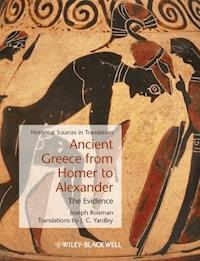
With fresh, new translations and extensive introductions and annotations, this sourcebook provides an inclusive and integrated view of Greek history, from Homer to Alexander the Great.
- New translations of original sources are contextualized by insightful introductions and annotations
- Includes a range of literary, artistic and material evidence from the Homeric, Archaic and Classical Ages
- Focuses on important developments as well as specific themes to create an integrated perspective on the period
- Links the political and social history of the Greeks to their intellectual accomplishments
- Includes an up-to-date bibliography of seminal scholarship
- An accompanying website offers additional evidence and explanations, as well as links to useful online resources
Sie lesen das E-Book in den Legimi-Apps auf:
Seitenzahl: 1292
Veröffentlichungsjahr: 2011
Ähnliche




















Contents
List of Illustrations
List of Maps
Preface and Acknowledgments
How to Use This Book
Abbreviations
Glossary
Greek Weights, Measures, Coins, and the Athenian Calendar
Timeline
Introduction: The Evidence for Greek History and Culture
I The Archaeological Evidence
II Coins
II The Written Evidence
1 The World of Homer
1.1 A Funeral Scene on a Dipylon Vase
1.2 The Homeric Household (Oikos)
1.5 The Measure of Happiness
1.6 A Household in Trouble
1.7 Households and Community
1.8 Homeric Leaders
1.9 Kings, Council, and Assembly
1.11 Homeric Values: Honor and Excellence
1.12 Reciprocity and Guest-Friendship (Xenia)
2 The World of Hesiod
2.1 Individual, Communal, and Divine Justice
2.2 Women and Pandora’s Jar
2.4 The Value of Labor
2.6 The Orientalizing Period
3 The Early Greek Polis (City-State) and the Ethnos
3.1 The Homeric Polis
3.3 An Early Settlement on Andros (Zagora; ca. 700)
3.5 Ancient Views of the Origins of the Polis
3.6 Ethnos: The Ionians
4 Settlements Across the Sea: Greek “Colonization”
4.1 Greek Settlements in the Western Mediterranean
4.2 The Settlement at Pithecoussae (ca. 750)
4.4 The Foundation of Cyrene (631)
4.6 Mother-City and Colony: Corinth, Corcyra, and Epidamnus (435)
4.7 Settlers and Locals
4.8 Selinus (651/0?)
5 Aristocratic Power and Attitudes
5.1 Aristocratic Power and Offices in Athens
5.3 Aristocratic Exclusiveness
5.4 Aristocratic Anxiety
6 Archaic Tyranny
6.1 How Tyrants Attained Power
6.3 Cypselus’ Tyranny in Corinth (ca. 650-625)
6.4 Periander’s Tyranny in Corinth (625-585)
6.6 A Failed Attempt at Tyranny in Athens: Cylon (632)
7 Archaic and Classical Sparta
7.2 The Messenian Wars (735-650) and the Conquered Population
7.3 The Helots
7.4 Eliminating Helots
7.5 The Krypteia
7.6 Lycurgus’ Regulations
7.8 The Spartan Government and the Great Rhetra
7.9 Spartan Kingship
7.11 The Spartan Gerousia (Council)
7.12 The Ephors
7.14 State and Family: The Scrutiny of Spartan Babies
7.15 The Schooling of Boys
7.17 Girls’ Education and Rituals
7.19 Spartan Marriage
7.20 Wife-Sharing
7.22 The Common Messes
7.24 Spartan Equality: Ideology and Reality
7.25 Courage and Cowardice in Sparta
7.26 The Peloponnesian League and Spartan Alliances
7.28 King Cleomenes, Plataea, and Athens (519) L.
8 Hoplites and Their Values
8.1 Hoplites and Their Weapons
8.2 Standing in a Phalanx Formation
8.3 Hoplite Battles
8.4 Hoplite Ideals
8.6 The Spartan or Hoplite Ideology
8.7 Hoplites and Politics
9 Archaic Athens From Draco to Solon
9.1 Draco’s Law of Homicide (621/0) U
9.3 The Background to Solon’s Legislation
9.4 Solon’s Middle-of-the-Road Policy (594)
9.6 Solon’s Economic Regulations: Land and Debts
9.8 Solon’s Political Regulations
9.9 Solon’s Judicial Regulations
9.10 olonian Polis
10 Tyranny in Athens
10.2 ns after Solon
10.3 Rivalryfor Power
10.4 stratus’ First Attempt at Tyranny (561/0)
10.5 stratus’ Second Attempt at Tyranny His Exile and Return (556-546)
10.7 Peisistratus’ Tyranny (546-528/7)
10.9 Tyranny and the Athenian Elite: The Archon List
10.10 The Athenian Tyrannicides (514/3)
10.12 The Expulsion of the Tyrants (511/0)
11 Cleisthenes and Athenian Democracy (508/7)
11.1 Cleisthenesand His Opposition
11.2 Cleisthenes Reforms (508/7)
11.4 Membership in the Deme
11.5 Ostracism (Ostrakismos)
11.7 Generalship
12 Archaic Society and Culture: Gender, Sexuality, Banquets, and Competition
12.1 Manly Youth: A Kouros
12.2 Homoerotic Couples
12.3 Courting Men and Women
12.4 Cretan Lovers
12.6 Sex, Power, and the Eurymedon Vase
12.8 The Banquet (Symposion)
12.9 Competition and the Rewards of Victory
12.11 Archaic Women: Sappho on Love
12.13 Seducing Maidens
12.15 Portraits of Wives
13 Archaic Law
14 Archaic Greek Religion
14.1 Herodotus on Homer and Hesiod’s Contribution to Greek Religion
14.3 Worship
14.4 Greek Temples and the Mysteries of Demeter in Eleusis
14.6 The Decree of Offering First-Fruits in Eleusis (420s)
15 The Ionian Revolt: Persians and Greeks
15.2 Persia and the Ionians
15.4 The Greek Tyrants at the Bridge (ca. 513)
15.6 The Causes of the Ionian Revolt (499-494)
15.8 Aristagoras’ Quest for Help in Greece (500)
15.10 The Fall of Miletus and Phrynichus’ Capture of Miletus (494)
15.11 The Change of Persian Policy in Ionia
16 The Battle of Marathon (490)
16.1 Darius Demands Surrender
16.3 The Persian Expedition and Athens’ Request for Help (490)
16.4 The Battle of Marathon (490)
16.5 An Attempt to Capture the City with Alcmeonid Aid?
16.6 The Fame of Marathon and Its Commemoration
17 The Persian War (480-479)
17.1 Greek Perspectives of the Persian War
17.3 Themistocles and His Naval Program
17.5 The Athenian Trireme
17.7 Greek Responses to Xerxes’ Invasion
17.9 The Hellenic Alliance Against Persia
17.10 The Greek Retreat from Thessaly and its Aftermath (480)
17.11 The Battle of Thermopylae (480)
17.13 The Evacuation of Athens
17.15 The Battle of Salamis (480)
17.17 The Battle of Plataea (479)
17.19 Commemorating the Battle of Plataea
17.21 The Battle of Mycale (479)
18 The Athenian Empire
18.1 Rebuilding Athens’ Walls (479/8)
18.3 Pausanias of Sparta, Athens, and the Allies
18.5 The Formation of the Delian League (478)
18.7 Cimon and the Athenian Empire: The Conquest of Eion, Scyros, Carystus, and Naxos (477/6-465)
18.9 Operations in Asia Minor and the Battle of Eurymedon (469-466)
18.11 Operations in Northern Greece (465/4-463/2)
18.12 Sparta’s Wars in the Peloponnese, the Great Helots’ Revolt, and the Mt. Ithome Affair (473-460)
18.14 The Messenians Settle Naupactus
19 Empowering Athenian Democracy (462/1-445/4)
19.1 Ephialtes’ Reforms (462/1)
19.3 Blocking Illegal Decrees (Graphê Paranomon)
19.4 Examination of State Officials (Dokimasia)
19.5 Rendering Accounts (Euthynai)
19.6 Expanding Eligibility to the Archonship
19.7 Pericles’ Democratic Measures
19.8 Democratic Mechanisms and State Salary (Misthos
19.9 Criticism of State Salaries
19.11 Pericles’ Citizenship Law (451/0)
19.13 Pericles and Thucydides Son of Melesias
20 War and Peace in Greece (461/0-437/6)
20.1 Athens’ Clash with Corinth Over Megara (461/0)
20.3 The Athenian Expedition to Egypt (460)
20.5 Athens Campaigns on Several Fronts (460-459)
20.7 The Long Walls (458)
20.9 The Battle of Tanagra (458)
20.11 The Peace of Callias (450?)
20.13 The Peloponnesian Invasion of Attica (446)
20.15 The Thirty-Year Peace Between Athens and Sparta (446/5)
20.17 Athenian Colonization and the Colony of Brea (447-445)
20.18 A Hippodamian City Plan
20.20 The Foundation of Amphipolis (437/6)
21 The Administration of the Empire and the Athenian Tribute Quota Lists
21.1 The Cleinias Decree
21.2 The Tribute Quota List of 453/2
21.3 The Erythraean Decree (453/2)
21.5 The Samian Revolt (441/0-440/39)
21.6 Allies’ Attitudes Toward the Empire
22 The City of Athens
23 The Sophists, Athenian Democracy, and Democracy’s Critics
23.1 The Sophists’ View of Justice
23.2 Right and Might
23.3 Justice and Expediency
23.4 Sophocles’ Antigone and the Debate with the Sophists
23.5 Tyranny and Democracy in Euripides’ Suppliant Women
23.7 Criticizing Democracy
24 The Causes of the Peloponnesian War and the Athenian and Spartan Strategies
24.1 Thucydides’ View of the Causes of the Peloponnesian War
24.3 The Megarian Decree (432?), Corinthian Pressure, and Spartan Demands
24.5 The Spartan (Archidamian) Strategy
24.7 The “Periclean Strategy”
25 The Peloponnesian War: The Archidamian War (431-421)
25.1 Athens and the Plague
25.3 Pericles’ Political Successors
25.5 Nicias and Cleon
25.7 The Pylos Campaign (425)
25.9 Brasidas
25.11 The Peace of Nicias (421)
26 Finances and Allies During the Archidamian War
26.1 A Spartan War Fund
26.2 Athenian Finance: Raising the Property Tax (Eisphora)
26.3 Raising the Tribute: The Thudippus Decree
26.5 Special Treatment: The Methone Decrees
26.6 The Athenian Coinage, Weights, and Measures Decree
27 The Uneasy Peace and the Sicilian Expedition (421-413)
27.1 Alcibiades
27.3 Egesta and the Origins of the Sicilian Expedition (416)
27.5 The Athenians’ Goals in Sicily
27.7 The Herms and Mysteries Affairs
27.9 Alcibiades Escapes to Sparta
27.11 Sparta Enters the War
27.13 The Athenian Defeat in Sicily
28 The Peloponnesian War: The Decelean War (413-404)
28.1 The Spartan Occupation of Decelea (413)
28.2 Sparta’s Maritime Strategy and Persia
28.4 The Athenian Oligarchy of 411
28.6 Ransoming Captives and the Selymbrian Decree (408-407)
28.8 Cyrus the Younger and Lysander of Sparta
28.10 The Arginusae Affair (406/5)
28.12 Athens’ Defeat and the End of the Peloponnesian War (405/4)
28.13 Honoring the Victor
29 The Rule of the Thirty, the Athenian Amnesty, and Socrates’ Trial
29.1 The Establishment of the Rule of the Thirty (404)
29.2 The Thirty Tyrants
29.3 The Fall of the Thirty (403)
29.5 The Spartans’ Grave at Athens and the Athenian Amnesty (403)
29.7 Socrates’ Trial (399)
30 Sparta After the Peloponnesian War: Politics, Wealth, and Demography
30.1 The Accession of Agesilaus II (400)
30.2 The Cinadon Conspiracy (400/399)
30.3 Empire and Wealth in Sparta
30.4 Epitadeus’ Law (?) and the Shortage of Men (Oliganthropia)
30.5 Princess Cynisca
31 The Spartan Hegemony, the Corinthian War, and the Peace of Antalcidas (404/3-388/7)
31.1 Sparta and Persia
31.3 Agesilaus’ Asian Campaign and Lysander’s Demotion
31.5 The Outbreak of the Corinthian War (395)
31.7 The Loss of Spartan Maritime Hegemony (394)
31.9 The Dexileus Monument
31.10 Peltasts and the Battle of Lechaeum (390)
31.12 The Peace of Antalcidas (388/7) M
31.14 The Call for a Panhellenic Campaign Against Persia
32 From the Peace of Antalcidas (388/7) to the Battle of Leuctra and Its Aftermath (371)
32.1 The Boeotian Federation in the Fourth Century
32.3 Sparta Dissolves Greek Federations in the Name of Autonomy
32.5 Spartan Occupation of the Cadmea (Citadel) of Thebes (382)
32.7 The Sphodrias Affair (379/8)
32.9 The Formation of the Second Athenian League (378/7)
32.10 Desiring Peace
32.11 The Common Peace of 371
32.12 The Sacred Band
32.13 The Battle of Leuctra (371)
32.15 The Foundation of Messene (370/69)
32.16 The Dissolution of the Peloponnesian League (365)
33 Jason of Pherae (?-370)
34 The Second Athenian League and Theban Hegemony
34.1 Athens’ Treatment of Chalcis (Euboea) and the Island of Paros (378/7-372)
34.2 Athens’ Colonization of Samos (365)
34.3 Athens’ Treatment of Arcesine (Amorgus; ca. 357/6)
34.5 The Theban Hegemony: A Theban Common Peace (367)
34.6 Thebes’ Treatment of Orchomenus (364)
34.8 The Battle of Mantinea (II; 362)
35 Running the Athenian Polis: Politics, Finances, Grain, and Trade in the Fourth Century
35.1 The Restored Athenian Democracy: Laws and Decrees
35.2 The Fourth-Century Assembly and Council
35.4 Fourth-Century Democratic Leadership
35.6 The Jury Courts
35.7 State Revenues and Taxation
35.9 Liturgies
35.10 Lightening the Burden: The Antidosis
35.11 The Theoric Fund
35.12 Financing Military Operations
35.13 The Grain Import
35.15 A Law of Coinage Certification
35.16 A Maritime Contract
36 Metics (Resident Aliens), Slaves, and Barbarians
37 Masculine and Feminine Gender in Classical Athens
37.1 Manly Ideals: The Ephebic Oath
37.2 The Manly Body
37.3 The Unmanly Man
37.5 Violence and Men in Love
37.6 Artisans and Manual Laborers
37.7 Men, Women, and the Household
37.8 Wives and Mothers
37.9 A Woman’s Lot
37.10 Running the Household
37.12 Virtuous and Unfaithful Women
38 Philip II of Macedonia (359-336)
38.1 Philip’s Accession and Challenges to his Rule (359)
38.3 Philip’s Military Reforms and Coinage
38.4 Philip’s Court: Companions and Royal Boys (Pages)
38.5 Philip’s Wives
38.6 Philip and the Third Sacred War (356-346)
38.8 Demosthenes’ War Plan Against Philip (352/1)
38.9 Philip’s Capture of Olynthus (348)
38.11 The Peace of Philocrates and the End of the Third Sacred War (346)
38.13 Athens Proclaims War on Philip (340)
38.15 The Battle of Chaeronea (338)
38.17 Philip and the Greeks after Chaeronea (338-336)
38.19 The Murder of Philip II (336) and the Royal Tombs at Vergina
39 Alexander the Great (336-323)
39.1 The Destruction of Thebes (335)
39.2 Alexander in Asia Minor (334-333)
39.4 The Battle of Issus (333)
39.6 Alexander Visits the Oracle of Ammon at Siwa (332/1) M
39.8 Fire in Persepolis (331-330)
39.9 Conspiracy in Court: The Philotas Affair (330)
39.10 Alexander Kills the Veteran General Cleitus (328)
39.11 Alexander Turns “Asian”
39.13 Victory in India (326)
39.14 Alexander, the Macedonians, Iranians, and the Opis Mutiny
39.16 Alexander and the Exiles Decree (324)
39.17 Alexander’s Death
References
Index of Ancient Sources
General Index
Blackwell Sourcebooks in Ancient History
This series presents readers with new translations of the raw material of ancient history. It provides direct access to the ancient world, from wars and power politics to daily life and entertainment, allowing readers to discover the extraordinary diversity of ancient societies.
Published
The Ancient Near EastEdited Mark W. ChavalasThe Roman GamesAlison FutrellAlexander the Great Waldemar Heckel and J. C. YardleyThe Hellenistic PeriodRoger Bagnall and Peter DerowAncient Greek ReligionEmily KearnsAncient Greece from Homer to AlexanderJoseph Roisman; translations by J. C. Yardley
In Preparation
Sexuality in the Classical WorldHolt Parker
This edition first published 2011© 2011 Blackwell Publishing LtdTranslations © 2011 John Yardley
Blackwell Publishing was acquired by John Wiley & Sons in February 2007. Blackwell’s publishing program has been merged with Wiley’s global Scientific, Technical, and Medical business to form Wiley-Blackwell.
Registered OfficeJohn Wiley & Sons Ltd, The Atrium, Southern Gate, Chichester, West Sussex, PO19 8SQ, United Kingdom
Editorial Offices350 Main Street, Malden, MA 02148-5020, USA9600 Garsington Road, Oxford, OX4 2DQ, UKThe Atrium, Southern Gate, Chichester, West Sussex, PO19 8SQ, UK
For details of our global editorial offices, for customer services, and for information about how to apply for permission to reuse the copyright material in this book please see our website at www.wiley.com/wiley-blackwell.
The right of Joseph Roisman to be identified as the author of this work has been asserted in accordance with the UK Copyright, Designs and Patents Act 1988.
All rights reserved. No part of this publication may be reproduced, stored in a retrieval system, or transmitted, in any form or by any means, electronic, mechanical, photocopying, recording or otherwise, except as permitted by the UK Copyright, Designs and Patents Act 1988, without the prior permission of the publisher.
Wiley also publishes its books in a variety of electronic formats. Some content that appears in print may not be available in electronic books.
Designations used by companies to distinguish their products are often claimed as trademarks. All brand names and product names used in this book are trade names, service marks, trademarks or registered trademarks of their respective owners. The publisher is not associated with any product or vendor mentioned in this book. This publication is designed to provide accurate and authoritative information in regard to the subject matter covered. It is soldon the understanding that the publisher is not engaged in rendering professional services. If professional advice or other expert assistance is required, the services of a competent professional should be sought.
Library of Congress Cataloging-in-Publication Data
Roisman, Joseph, 1946–Ancient Greece from Homer to Alexander: the evidence / Joseph Roisman.p. cm. — (Blackwell sourcebooks in ancient history)Includes bibliographical references and index.
ISBN 978-1-4051-2775-2 (hardcover: alk. paper)—ISBN 978-1-4051-2776-9 (pbk.: alk.paper) 1. Greece—Civilization—To 146 B.C.—Sources. 2. Greece—History—To 146B.C.—Sources. I. Title. DF12.R65 2011938–dc22
2010025066
A catalogue record for this book is available from the British Library.
Illustrations
Figure I.1The Toumba BuildingFigure I.2Exekias Vase with Ajax and AchillesFigure I.3A silver tetradrachm from Memphis, Egypt, 332-323Figure 1.1A funeral scene on a Dipylon VaseFigure 2.1A griffin jug from AeginaFigure 3.1The settlement in Zagora, AndrosFigure 4.1Selinus site planFigure 7.1An Archaic bronze figurine of a young Spartan female, dressed as a runnerFigure 7.2The Symposion of Five Cup, ca. 565Figure 8.1A soldier on the frieze of the Vix Krater, ca. 530-520Figure 8.2The Chigi Vase, ca. 640Figure 10.1The statues of Harmodius and AristogeitonFigure 11.1Ostraka with inscription: “Themistocles, son of Neocles”Figure 12.1A kourosFigure 12.2The Peithinus Cup: male couplesFigure 12.3The Peithinus Cup: young men and womenFigure 12.4The Eurymedon VaseFigure 12.5A banquet scene, Paestum, ItalyFigure 12.6A Panathenaic oil jarFigure 14.1The Macron Cup with TriptolemusFigure 16.1The mound at MarathonFigure 17.1The Lenormant Relief of a trireme in the Acropolis MuseumFigure 17.2Olympia, a reconstruction of a classical triremeFigure 17.3The battle plan of SalamisFigure 20.1Miletus city planFigure W22.1The Lysicrates monumentFigure 25.1Plan of a mass burial in the KerameikosFigure 25.2A Spartan shield from PylosFigure 27.1Nolan amphora by the Micon Painter showing a HermFigure 29.1The Spartan tomb in the KerameikosFigure 31.1The Dexileus MonumentFigure 31.2A Thracian peltastFigure 32.1A Boeotian federal coinFigure 32.2Eirene with Wealth (Plutus)Figure 32.3Messene’s wallsFigure 35.1A juror’s token (pinakion)Figure 35.2A counterfeit coinFigure 37.1A Roman copy of Polyclitus, DoryphorosFigure 37.2A hydria by the Munich Painter with a domestic sceneFigure 38.1The metal parts of a sarissa: spearhead, butt-spike, and connecting socketFigure 38.2Plan of an Olynthian houseFigure 38.3Plan of the battle of ChaeroneaFigure 38.4The PhilippeumFigure 38.5A reconstruction of the face of Tomb II, VerginaFigure 39.1The Alexander MosaicFigure 39.2The Porus medallionMaps
Map 0.1Greece and the AegeanMap 4.1Greek settlements in the westMap 11.1The Athenian demes: Attica political organizationMap 17.1Xerxes’ expeditionMap 20.1The Long WallsMap 25.1Pylos and SphacteriaMap 27.1Ancient SicilyMap 38.1Ancient MacedoniaMap 39.1Alexander’s campaigns, 334-323Preface and Acknowledgments
The aim of this book is to acquaint the reader with the main evidence for Greek history from Homer and the end of the Dark Age to Alexander the Great (ca. 800–323 BCE). Although the editor hopes to have covered diverse political, social, and cultural aspects of Archaic and Classical Greece, he does not strive to be exhaustive or to provide a substitute for a textbook on the subject. Indeed, much of the volume deals with the Greek mainland and is less concerned with Greeks in the western Mediterranean. Similarly, the bibliography of modern scholarship at the end of each chapter does not aim to be comprehensive but is limited to works in English, with a clear preference for more recent publications. (Only the author and the year of publication are given in these bibliographical notes. Fuller details can be found in the References at the end of the book.) Finally, the selection of the evidence may at times reflect the personal interests of the editor. Yet an attempt was made to create a continuity of themes and processes by placing the evidence in a broader historical context and by linking various documents together. A companion website provides further evidence and explanations in addition to those offered here as well as links to relevant online sites.
The volume is the collaborative work of Joseph Roisman, who has selected, introduced, and annotated the evidence, and John Yardley, who translated nearly all of the texts from their Greek and Latin originals. All dates in this book are BCE unless otherwise noted. Dates of key events are given in the timeline at the front of the book and in parentheses in the text. Frequently dates show an overlap of two consecutive years (e.g., 455/4); this is due to the difficulty of matching the modern calendar year with the Athenian one, which began around July. Square brackets indicate editorial comments and modern restorations of words and lines in inscriptions. They also enclose authors whose identity is in doubt. Greek names are Latinized to promote accessibility, although some inconsistency is not always avoidable. The transliteration of Greek terms includes an accent only where necessary to distinguish the term’s pronunciation from English usage.
Acknowledgment is due to previous publications that have been helpful in the preparation of this book, especially to E. David, The Classical Democracy (Jerusalem, 2003; Hebrew); M. Dillon and L. Garland, Ancient Greece: Social and Historical Documents from Archaic Times to the Death of Socrates (c.800–399BC), 2nd ed. (London and New York, 2000); and P.J. Rhodes, A History of the Classical Greek World:478–323BC (Malden, MA, 2006). The editor and translator are equally grateful to the anonymous readers of the manuscript for their most helpful comments. We also wish to thank Al Bertrand, Haze Humbert, Brigitte Lee Messenger, and Louise Butler of Wiley-Blackwell for their assistance.
This book is dedicated to Hanna, Elad, and Shalev Roisman, to my mentor Professor Zeev W. Rubinsohn and his wife Nadia, and to the memory of Iolo Davies.
How to Use This Book
The following book is divided into chapters, which in turn are divided into sections. Chapters and sections are labeled and titled individually. For example, Chapter 1 is titled “The World of Homer,” and section 7 within it, labeled 1.7, is titled “Household and Community.” For the sake of clarity, cross-references to documents outside the chapter include the section title where appropriate, for example, “see 1.7 (‘Household and Community’).”
The book is accompanied by a website available at www.wiley.com/go/AncientGreece that includes supplementary written and electronic material. The labeling of the documents on the web corresponds to as well as complements that of the book. To facilitate the identification of web documents and links, every web section or chapter is accompanied by the icon . In the contents list, this icon distinguishes items on the web from items in the book. For example, the web section “ 1.10 A Trial Scene” follows “1.9 Kings, Council, and Assembly,” which appears in the book. Cross-references in the book to items on the web identify them using the term “WEB” followed, where appropriate, by the section title, for example, “see WEB 9.2 (‘Draco’s Harsh Laws’).” Cross-references on the web to sections in the book are prefixed by the label “BOOK.”
Abbreviations
AJAAmerican Journal of ArchaeologyAJPAmerican Journal of PhilologyAth. Pol.Aristotle (?), Athenaion Politeia (“The Constitution of the Athenians”)CAHCambridge Ancient History, 2nd and 3rd eds.CampbellCampbell, D.A., ed. 1989–1993. Greek Lyric (Loeb Classical Library). 5 vols. Cambridge, MACJClassical JournalClAntClassical AntiquityCPhClassical PhilologyCQClassical QuarterlyDKDiels, H. and W. Kranz. 1960–1961. Die Fragmente der Vorsokratiker10 (Diels-Kranz). BerlinF, FF, fr., frs.fragment(s)FGrHistJacoby, F., ed. 1957–1969. Die Fragmente der griechischen Historiker. 18 vols. LeidenFornaraFornara, C.W., ed. 1983. Archaic Times to the End of the Peloponnesian War. 2nd ed. CambridgeG&RGreece & RomeGerberGerber, D.E., trans. 1999. Greek Elegiac Poetry: From the Seventh to the Fifth Centuries BC (Loeb Classical Library). Cambridge, MAGRBSGreek, Roman, and Byzantine StudiesHardingHarding, P., ed. 1985. From the End of the Peloponnesian War to the Battle of Ipsus. CambridgeHSCPHarvard Studies in Classical PhilologyIGInscriptiones GraecaeJensenJensen, Chr. 1963. Hyperides: Orationes. StuttgartJHSJournal of Hellenic StudiesLPLobel, E. and D.L. Page, eds. 1955. Poetarum Lesbiorum Fragmenta. OxfordMLMeiggs, R. and D. Lewis, eds. 1988. A Selection of Greek Historical Inscriptions to the End of the Fifth Century. Rev. ed. OxfordPagePage, D., ed. 1962. Poetae Melici Graeci. OxfordR&ORhodes, P.J. and R. Osborne, eds. 2003. Greek Historical Inscriptions: 404–323BC. OxfordRadtRadt, S., ed., 1977. Tragicorum Graecorum Fragmenta, vol. 4: Sophocles. GottingenSEGSupplementum Epigraphicum GraecumTAPhATransactions of the American Philological AssociationTodTod, M.N., ed. 1985. Greek Historical Inscriptions: From the Sixth CenturyBC to the Death of Alexander the Great in 323BC. 2 vols. Reprint. ChicagoWestWest, M.L. 1989–1992. Iambi et Elegi Graeci ante Alexandrum Cantati. 2 vols. OxfordYCSYale Classical StudiesZPEZeitschrift für Papyrologie und EpigraphikGlossary
AgonContestAntidosisGroup of states that supervised Apollo’s sanctuary at DelphiApoikia“Giving in exchange”: a legal procedure aiming to transfer a costly public duty (liturgy) to an allegedly richer manApoikiaIndependent settlement abroadArchonChief Athenian officialAreopagusAthenian council of former archons that served as a homicide court and, up to the 460s, supervised public officialsAretêExcellence; valorBasileusKing; chieftain; Athenian archon who managed religious affairsBoeotarchSenior magistrate in the Boeotian LeagueBoulêCouncilChoregyPublic service by rich citizens that involved producing and financing performances in Athenian festivalsCleruchyAthenian colonyCommon PeacePeace agreement among Greeks imposed by hegem-onic power(s)DecarchyGovernment of ten men supported by the SpartansDemagoguePopular leader; leader of the peopleDemosThe people; commoners; democracy; township (deme)DikasterionJury courtDikêJustice; private legal actionDionysiaAthenian festival in honor of Dionysus that included dramatic performancesDokimasiaExamination of an individual’s eligibility for office or CitizenshipEisangeliaLegal procedure of impeachment against officials or leadersEisphoraProperty tax designed to finance military projectsEkklesiaPopular citizens’ assemblyEleutheriaFreedomEphebesYoung adults trained by the state in the military and good citizenshipEphorsAnnual magistrates in SpartaErastês“Lover,” the elder partner in a homosexual relationshipEromenos“Beloved,” the younger partner in a homosexual relationshipEthnosPeople, tribal stateEunomiaGood orderEuthynai (pl.)Giving of accounts by officials at the end of their term in officeGerousiaSpartan council of eldersGraphêPublic legal actionGraphê paranomonLegal action against decrees that allegedly contradicted existing lawsHarmostSpartan governor and commander of a garrisonHeliaea“People’s Court,” the largest court in Athens under the presidency of the Thesmothetae (“Lawgivers”)Hellenotamiai (pl.)Treasurers of the Greeks: Athenian officials who collected the allies’ tributesHelotsPeople of servile status in SpartaHetaira“Female companion,” courtesanHetaireiaCompanionshipHetairoi (pl.)Companions of Homeric and Macedonian kingsHippeisCavalry; the second richest class in Solon’s systemHomoioi (pl.)“Similar ones,” Spartan full citizensHoplitesHeavy infantrymenIsegoriaThe equal right to speak in publicIsonomiaEquality before the lawKaloi k’agathoi (pl.)“The beautiful and good,” description of the eliteKlerosPlot of landKoinonLeague, federationKrypteiaKilling of helots by stealthKyriosHead of household; husband; male guardianLiturgyRich man’s tax designed to finance festivals (choregy) or the upkeep of a battleship (trierarchy)MedismSupporting or collaborating with the Persian enemyMeticResident alienNomos (pl. nomoi)Law(s), convention(s)OikistêsLeader of a new settlement; founderOikosHousehold; familyOliganthropiaShortage of men (especially in Sparta)OstracismVoting a citizen to ten-year exilePanathenaeaAthenian festival in honor of AthenaParrhesiaThe right to speak one’s mind in a public forumPerioeci (perioikoi)“Dwellers around”: Sparta’s free subjects who provided the state with military and economic servicesPhoros“Tribute,” the allies’ payment to the Delian LeaguePhratry“Brotherhood,” a social and religious associationPhylêTribePolemarchMilitary leader/magistratePolisCity-statePoliteiaGovernment, constitutionProskynesisObeisance performed in sanctuaries or for Persian superiorsPrytanyOne-tenth of the Athenian year. During this term, fifty prytanies (presidents) per tribe presided over the Council and the assembly. The Prytaneum was the town hallPsephismaDecreePythiaApollo’s priestess at the oracle at DelphiRhetores (pl.)Orators, public speakers, and leadersRhetra“Utterance,” Spartan lawSacred BandTheban elite military unitSarissaPike used in particular by the Macedonian phalanxSophistsTeachers of wisdom, expertsSophrosynêSelf-control, moderationStasisCivil conflict within a city-stateStrategosGeneral (an elected official in Athens)Symposion“Drinking together,” a banquetSynedrionA league’s councilSyssition“Sitting together,” a common messTheoric FundAthenian fund for civilian projects such as festivalsThirty, theOligarchic government in Athens (404-403)TrierarchyPublic service by rich citizens that involved financing a warship (trireme) for one yearTriremeGalley whose oarsmen sat in three rowsTyrant (tyrannos)Non-elected ruler or a man who ruled contrary to traditionXenia, proxeniaGuest-friendshipTimeline
ca.3000-1200 BCEBronze Age Greececa. 1260Trojan Warca. 1200-800/700Dark Age800/700-500Archaic Age776First Olympic Gamesca. 750Foundation of Pithecoussaeca. 735-650Sparta’s Messenian Warsca. 651/0Foundation of Selinusca. 650-625Cypselus’ tyranny in Corinth632Cylon’s attempt at tyranny in Athens631Foundation of Cyrene625-585Periander’s tyranny in Corinth621/0Draco’s legislation594/3Solon’s archonshipca. 580/575-530Cyrus the Great of Persia561/0Peisistratus’ first tyranny at Athens560-546Croesus of Lydiaca. 557-530Reign of Cyrus the Great of Persia556Peisistratus’ second tyranny at Athensca. 550Sparta’s war against Tegeaca. 547Lesen Sie weiter in der vollständigen Ausgabe!
Lesen Sie weiter in der vollständigen Ausgabe!
Lesen Sie weiter in der vollständigen Ausgabe!
Lesen Sie weiter in der vollständigen Ausgabe!
Lesen Sie weiter in der vollständigen Ausgabe!
Lesen Sie weiter in der vollständigen Ausgabe!
Lesen Sie weiter in der vollständigen Ausgabe!
Lesen Sie weiter in der vollständigen Ausgabe!
Lesen Sie weiter in der vollständigen Ausgabe!
Lesen Sie weiter in der vollständigen Ausgabe!
Lesen Sie weiter in der vollständigen Ausgabe!
Lesen Sie weiter in der vollständigen Ausgabe!
Lesen Sie weiter in der vollständigen Ausgabe!
Lesen Sie weiter in der vollständigen Ausgabe!
Lesen Sie weiter in der vollständigen Ausgabe!
Lesen Sie weiter in der vollständigen Ausgabe!
Lesen Sie weiter in der vollständigen Ausgabe!
Lesen Sie weiter in der vollständigen Ausgabe!
Lesen Sie weiter in der vollständigen Ausgabe!
Lesen Sie weiter in der vollständigen Ausgabe!
Lesen Sie weiter in der vollständigen Ausgabe!
Lesen Sie weiter in der vollständigen Ausgabe!
Lesen Sie weiter in der vollständigen Ausgabe!
Lesen Sie weiter in der vollständigen Ausgabe!
Lesen Sie weiter in der vollständigen Ausgabe!
Lesen Sie weiter in der vollständigen Ausgabe!
Lesen Sie weiter in der vollständigen Ausgabe!
Lesen Sie weiter in der vollständigen Ausgabe!
Lesen Sie weiter in der vollständigen Ausgabe!
Lesen Sie weiter in der vollständigen Ausgabe!
Lesen Sie weiter in der vollständigen Ausgabe!
Lesen Sie weiter in der vollständigen Ausgabe!
Lesen Sie weiter in der vollständigen Ausgabe!
Lesen Sie weiter in der vollständigen Ausgabe!
Lesen Sie weiter in der vollständigen Ausgabe!
Lesen Sie weiter in der vollständigen Ausgabe!
Lesen Sie weiter in der vollständigen Ausgabe!
Lesen Sie weiter in der vollständigen Ausgabe!
Lesen Sie weiter in der vollständigen Ausgabe!
Lesen Sie weiter in der vollständigen Ausgabe!
Lesen Sie weiter in der vollständigen Ausgabe!
Lesen Sie weiter in der vollständigen Ausgabe!
Lesen Sie weiter in der vollständigen Ausgabe!




