


7,49 €
Mehr erfahren.
- Herausgeber: A.J.Kingston
- Kategorie: Geisteswissenschaft
- Sprache: Englisch
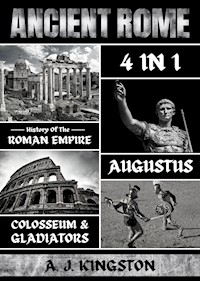
Introducing the Ancient Rome 4 in 1 book bundle, a must-have collection for any history buff or lover of ancient civilizations. This bundle includes four captivating books that delve deep into the history of the Roman Empire, Augustus, the Colosseum, and Gladiators.
In Book 1, The Roman Empire: A Tale of Power, Politics, and Enduring Legacy, you will discover the fascinating history of one of the world's most powerful empires. From its humble beginnings to its eventual collapse, this book covers all the major events and influential figures that shaped the Roman Empire.
Book 2, Augustus: The Rise of Rome's First Emperor and the Foundation of the Roman Empire, takes a closer look at the life of Augustus, the man who transformed Rome from a republic to an empire. You will learn about Augustus' rise to power, his reforms, and the lasting impact he had on Roman society.
Book 3, Blood, Sand, and Stone: The History and Legacy of the Colosseum in Ancient Rome, explores one of the most iconic symbols of ancient Rome. From the design and construction of the Colosseum to the gruesome gladiatorial battles that took place within its walls, this book provides a comprehensive look at the history and legacy of this remarkable structure.
Finally, Book 4, Gladiators of Ancient Rome: A Bloody Legacy of Combat and Courage, takes you on a journey through the fascinating world of gladiatorial combat. You will learn about the different types of gladiators, their training regimens, and the role they played in ancient Roman society.
Whether you are a history buff or simply curious about the fascinating world of ancient Rome, the Ancient Rome 4 in 1 book bundle is the perfect collection for you. Order now and discover the captivating history and enduring legacy of one of the world's greatest civilizations.
Das E-Book können Sie in Legimi-Apps oder einer beliebigen App lesen, die das folgende Format unterstützen:
Veröffentlichungsjahr: 2023
Ähnliche













ANCIENT ROME
HISTORY OF THE ROMAN EMPIRE, AUGUSTUS, COLOSSEUM & GLADIATORS
4 IN 1
Book 1:
The Roman Empire: A Tale of Power, Politics, and Enduring Legacy
Book 2:
Augustus: The Rise of Rome's First Emperor and the Foundation of the Roman Empire
Book 3:
Blood, Sand, and Stone: The History and Legacy of the Colosseum in Ancient Rome
Book 4:
Gladiators of Ancient Rome: A Bloody Legacy of Combat and Courage
BY A.J. KINGSTON
Copyright © 2023 by A. J. Kingston
All rights reserved. No part of this book may be reproduced or transmitted in any form or by any means, electronic or mechanical, including photocopying, recording, or by any information storage and retrieval system, without permission in writing from the publisher.
Published by A. J. Kingston
Library of Congress Cataloging-in-Publication Data
ISBN 978-1-83938-278-9
Cover design by Rizzo
Disclaimer
The contents of this book are based on extensive research and the best available historical sources. However, the author and publisher make no claims, promises, or guarantees about the accuracy, completeness, or adequacy of the information contained herein. The information in this book is provided on an "as is" basis, and the author and publisher disclaim any and all liability for any errors, omissions, or inaccuracies in the information or for any actions taken in reliance on such information.
The opinions and views expressed in this book are those of the author and do not necessarily reflect the official policy or position of any organization or individual mentioned in this book. Any reference to specific people, places, or events is intended only to provide historical context and is not intended to defame or malign any group, individual, or entity.
The information in this book is intended for educational and entertainment purposes only. It is not intended to be a substitute for professional advice or judgment. Readers are encouraged to conduct their own research and to seek professional advice where appropriate.
Every effort has been made to obtain necessary permissions and acknowledgments for all images and other copyrighted material used in this book. Any errors or omissions in this regard are unintentional, and the author and publisher will correct them in future editions.
Join Our Productivity Group and Access your Bonus
If you're passionate about history books and want to connect with others who share your love of the subject, joining our Facebook group (search for “History Books by A.J.Kingston”) can be a great way to do so. By joining a group dedicated to history books, you'll have the opportunity to connect with like-minded individuals, share your thoughts and ideas, and even discover new books that you might not have come across otherwise. You can also access your FREE BONUS once you joined our Facebook group called “History Books by A.J.Kingston”.
>> Click Here to Join Our Productivity Group <<
One of the biggest advantages of joining our Facebook group is the sense of community it provides. You'll be able to interact with other history book enthusiasts, ask questions, and share your own knowledge and expertise. This can be especially valuable if you're a student or someone who is just starting to explore the world of history books.
>> Click Here to Follow A.J. Kingston <<
>> Click Here to Download your Free Bonus <<
If you love audiobooks, then joining our YouTube channel that offers free audiobooks on a weekly basis can be a great way to stay entertained and engaged. By subscribing to our channel, you'll have access to a range of audiobooks across different genres, all for free. Not only this is a great opportunity to enjoy some new audiobooks, but it's also a chance to discover new authors and titles that you might not have come across otherwise.
>> Click Here to Join our YouTube Channel <<
Lastly, don’t forget to follow us on Facebook and YouTube by searching for A.J. Kingston.
Table of Contents – Book 1
The Roman Empire: A Tale of Power, Politics, and Enduring Legacy
Introduction
Chapter 1: Rome's Founding Myths: The Story of Romulus and Remus
Chapter 2: The Roman Republic: From Senate to Empire
Chapter 3: The Rise of Julius Caesar: The Beginning of a New Era
Chapter 4: Augustus: The First Emperor and the Establishment of the Empire
Chapter 5: Pax Romana: A Golden Age of Stability and Prosperity
Chapter 6: The Roman Army: Conquest, Power, and Expansion
Chapter 7: Roman Society: Slavery, Women, and Class Structure
Chapter 8: Religion in Ancient Rome: From Polytheism to Christianity
Chapter 9: The Decline and Fall of the Western Roman Empire
Chapter 10: The Byzantine Empire: Continuation of Roman Legacy
Table of Contents – Book 2
Augustus: The Rise of Rome's First Emperor and the Foundation of the Roman Empire
Chapter 1: The Early Life of Augustus: From Adopted Son to Political Rival
Chapter 2: The Battle of Actium: Augustus' Triumph Over Antony and Cleopatra
Chapter 3: The First Settlement: Augustus' Consolidation of Power in Rome
Chapter 4: The Second Settlement: The Emperor Establishes Constitutional Order
Chapter 5: The Roman Army Under Augustus: Reforms and Expansion
Chapter 6: Augustus' Social Reforms: The Building Blocks of Roman Society
Chapter 7: The Imperial Cult: Augustus' Introduction of Divine Worship
Chapter 8: Augustus' Religious Policies: From Persecution to Acceptance of Christianity
Chapter 9: The Ara Pacis: Augustus' Monument to Roman Peace and Prosperity
Chapter 10: Augustus' Legacy: The Enduring Impact of Rome's First Emperor
Table of Contents – Book 3
Blood, Sand, and Stone: The History and Legacy of the Colosseum in Ancient Rome
Chapter 1: The Colosseum: Engineering Marvel of Ancient Rome
Chapter 2: Gladiators: Fighting for Glory and Survival in the Arena
Chapter 3: The Games: From Public Spectacle to Political Tool
Chapter 4: The Politics of the Colosseum: From Bread and Circuses to Imperial Propaganda
Chapter 5: The Colosseum and Roman Society: Class and Power in the Ancient World
Chapter 6: Animal Hunts: The Exotic and the Dangerous in the Arena
Chapter 7: The Martyrs of the Colosseum: Christian Persecution and Resistance
Chapter 8: Architecture and Design of the Colosseum: Inspiration for the Ages
Chapter 9: The Fall and Rebirth of the Colosseum: Ruin, Restoration, and Modern Significance
Chapter 10: The Enduring Legacy of the Colosseum: Symbol of Rome's Power, Glory, and Brutality
Table of Contents – Book 4
Gladiators of Ancient Rome: A Bloody Legacy of Combat and Courage
Chapter 1: Gladiator Origins: From Slaves and Criminals to Celebrity Fighters
Chapter 2: Gladiator Training: The Brutal Process of Becoming a Fighter
Chapter 3: The Gladiatorial Games: A Public Spectacle of Blood and Death
Chapter 4: The Politics of Gladiatorial Combat: From Entertainment to Political Tool
Chapter 5: The Combatants: Different Types of Gladiators and Fighting Styles
Chapter 6: The Role of Women in Gladiatorial Combat: Fighters, Supporters, and Spectators
Chapter 7: The Rise of Christian Martyrs: Resistance and Persecution in the Arena
Chapter 8: The End of Gladiatorial Combat: Reasons for Its Decline and Demise
Chapter 9: Gladiator Legacy: From Ancient Rome to Modern Culture and Entertainment
Chapter 10: The Myth and Reality of Gladiators: Separating Fact from Fiction
Conclusion
About A. J. Kingston
Introduction
Welcome to the Ancient Rome: 4 in 1 book bundle, where you will explore the fascinating history of one of the world's most influential civilizations. This bundle contains four captivating books that delve into different aspects of Ancient Rome: The Roman Empire, Augustus, The Colosseum, and Gladiators of Ancient Rome.
In Book 1, The Roman Empire: A Tale of Power, Politics, and Enduring Legacy, you will discover the rise and fall of one of the world's most powerful empires. From its origins as a small city-state to its transformation into a massive world power, this book explores the key events and figures that shaped the Roman Empire.
In Book 2, Augustus: The Rise of Rome's First Emperor and the Foundation of the Roman Empire, you will explore the life of one of the most influential leaders in Roman history. Augustus transformed the Republic into an Empire and set the stage for centuries of Roman dominance. This book examines Augustus's rise to power, his reign, and his lasting legacy.
In Book 3, Blood, Sand, and Stone: The History and Legacy of the Colosseum in Ancient Rome, you will delve into the iconic arena that has captured the imagination of people around the world. From its construction to the gladiatorial games that took place within its walls, this book explores the history and legacy of the Colosseum in vivid detail.
In Book 4, Gladiators of Ancient Rome: A Bloody Legacy of Combat and Courage, you will discover the stories of the men who fought in the arena, risking their lives for fame and fortune. This book examines the different types of gladiators, their weapons and armor, and the training required to prepare for combat.
Whether you are a history enthusiast or just looking to learn more about Ancient Rome, this book bundle has something for everyone. So sit back, relax, and immerse yourself in the fascinating world of Ancient Rome.
Book 1
The Roman Empire
A Tale of Power, Politics, and Enduring Legacy
BY A.J. KINGSTON
Chapter 1: Rome's Founding Myths: The Story of Romulus and Remus
In the early days of Rome, before the grandeur of the Republic and the glory of the Empire, there existed a tale of a she-wolf who nurtured and raised two infant boys. This myth has long been regarded as the beginning of Rome's story, and while the truth of the tale may be shrouded in the mists of time, the symbolism and significance of the tale cannot be denied.
According to the legend, the two boys were Romulus and Remus, who would go on to found Rome and establish themselves as the city's first rulers. As infants, they were abandoned in the wilderness and left to die, but fate intervened in the form of a she-wolf who came upon the boys and took them under her care. She nurtured them as her own, and when they were old enough, she helped them survive in the harsh environment of the Italian countryside.
The tale of the she-wolf and the two boys is a powerful symbol of survival and the nurturing of new life. It speaks to the notion that even in the most challenging and inhospitable environments, the human spirit can find a way to thrive and prosper. It is a testament to the resilience and determination of the human race, and it serves as a reminder that even in the face of adversity, hope can be found.
While the tale of the she-wolf and Romulus and Remus is undoubtedly a myth, it is a myth that has endured for centuries, and it has become a symbol of the greatness of Rome itself. The city of Rome was founded on this story, and the image of the she-wolf has become synonymous with the city and its history.
However, as with many myths and legends, the true origins of the tale are shrouded in mystery. Some scholars believe that the story of the she-wolf may have originated in Etruscan mythology, and that it was later adopted by the Romans. Others argue that the tale may have its roots in Greek mythology, and that it was brought to Italy by Greek settlers.
Regardless of its origins, the tale of the she-wolf and the two boys has become an integral part of Roman mythology, and it has served as a powerful symbol for the city and its people for centuries. It has been celebrated in art, literature, and music, and it has become a source of inspiration for countless generations of Romans.
In the end, the tale of the she-wolf and the two boys serves as a reminder that even the most humble beginnings can lead to greatness. It is a tale of survival, perseverance, and determination, and it speaks to the enduring spirit of the human race. Whether it is based on fact or fiction, the story of the she-wolf and Romulus and Remus will continue to be a powerful symbol of the greatness of Rome, and it will continue to inspire and captivate people for generations to come.
In the early days of Rome, there existed a tale of two brothers, Romulus and Remus, who would go on to become the founders of the Eternal City. This myth, though shrouded in the mists of time, has become an integral part of Roman mythology and a symbol of the city's greatness.
According to the legend, the two brothers were born to Rhea Silvia, a vestal virgin who had been violated by the god Mars. Fearing retribution, Rhea Silvia's uncle, Amulius, ordered the boys to be abandoned in the wilderness. However, they were rescued by a she-wolf who nurtured and raised them as her own. As they grew older, the brothers learned to hunt and survive in the wild, and they became skilled warriors and leaders.
The tale of Romulus and Remus is a powerful symbol of brotherhood, leadership, and the triumph of the human spirit. It speaks to the notion that even in the face of adversity, the human spirit can rise above its circumstances and achieve greatness. It is a testament to the resilience and determination of the human race, and it serves as a reminder that even the most humble of beginnings can lead to greatness.
As the two brothers grew older, they decided to found a city on the banks of the Tiber River. However, they soon fell into a bitter dispute over where to locate the city, and in a fit of rage, Romulus killed Remus. This tragic event has become a powerful symbol of the dangers of hubris and the consequences of unchecked ambition.
Despite the tragic end to their story, the brothers Romulus and Remus have become symbols of the greatness of Rome itself. The city of Rome was founded on their story, and their image has become synonymous with the city and its history. The story of their lives has been celebrated in art, literature, and music, and it has inspired countless generations of Romans.
However, as with many myths and legends, the true origins of the tale of Romulus and Remus are shrouded in mystery. Some scholars believe that the story may have originated in Etruscan mythology and that it was later adopted by the Romans. Others argue that the tale may have its roots in Greek mythology and that it was brought to Italy by Greek settlers.
Regardless of its origins, the story of the brothers Romulus and Remus has become an integral part of Roman mythology and a symbol of the city's greatness. It has served as a reminder of the power of brotherhood, leadership, and the human spirit, and it has inspired countless generations of Romans to strive for greatness.
In the end, the tale of Romulus and Remus is a powerful symbol of the human capacity for greatness. It is a story of brotherhood, leadership, and the triumph of the human spirit, and it serves as a reminder that even in the face of adversity, hope and greatness can be found. Whether it is based on fact or fiction, the story of the brothers Romulus and Remus will continue to be a powerful symbol of the greatness of Rome, and it will continue to inspire and captivate people for generations to come.
The tale of Romulus and Remus has become one of the most enduring and captivating stories in Roman mythology. From their humble beginnings as abandoned infants to their eventual rise as leaders of the fledgling city of Rome, their story has captured the imaginations of people for centuries. However, it is the tragic ending to their tale that has become perhaps the most compelling and intriguing aspect of their story.
As the two brothers grew older and began to establish the city of Rome, tensions began to rise between them. According to legend, they could not agree on where to locate the city, and as their dispute grew more heated, Romulus flew into a rage and killed Remus. This violent act has become one of the defining moments in Roman mythology and a powerful symbol of the dangers of unchecked ambition.
For centuries, scholars and historians have debated the true nature of Romulus' killing of Remus. Some have suggested that it was a cold-blooded act of murder, while others have argued that it was a tragic accident brought about by the heat of the moment. Regardless of the true nature of the event, it is clear that the killing of Remus had a profound impact on the fledgling city of Rome.
In the aftermath of Remus' death, Romulus became the undisputed ruler of the city of Rome. He worked tirelessly to establish the city and its people, building walls and fortifications and creating a system of government that would endure for centuries. He was revered by the people of Rome as a great leader and a symbol of their city's greatness.
However, despite his many accomplishments, Romulus was plagued by the memory of his brother's death. He lived the rest of his life haunted by the knowledge that he had killed his own brother and that his greatest achievement had been built on a foundation of violence and tragedy.
Despite the tragic ending to their story, the tale of Romulus and Remus has become a powerful symbol of the human struggle for power and the dangers of unchecked ambition. It speaks to the notion that even the greatest of achievements can be built on a foundation of tragedy and that the pursuit of power can be a dangerous and treacherous path.
In the end, the story of Romulus and Remus serves as a powerful reminder of the complex and often brutal nature of human history. It is a tale of brotherhood, leadership, and the struggle for power, and it has captured the imaginations of people for centuries. Whether it is based on fact or fiction, the story of Romulus and Remus will continue to be a powerful symbol of the human experience, inspiring and captivating people for generations to come.
The founding myths of ancient Rome have been a subject of fascination and debate for centuries. From the tale of Romulus and Remus to the heroic exploits of Julius Caesar, these stories have captured the imagination of people throughout the ages. However, the accuracy of these myths has long been a subject of debate among historians and scholars.
One of the most enduring myths of ancient Rome is the tale of Romulus and Remus, the twin brothers who are said to have founded the city of Rome. According to legend, the brothers were abandoned as infants and were suckled by a she-wolf until they were discovered by a shepherd. As they grew older, they decided to found a city, but a disagreement over where to locate it led to Romulus killing Remus. Romulus then went on to found the city of Rome and become its first king.
While this story has become one of the defining myths of ancient Rome, historians have long debated its accuracy. Some scholars have suggested that the tale of Romulus and Remus may have been inspired by earlier legends and myths, while others have argued that it may have been based on actual events.
Another founding myth that has been the subject of historical debate is the story of Aeneas, the Trojan prince who is said to have founded the city of Rome. According to legend, Aeneas fled from Troy after its fall and sailed to Italy, where he founded a new city that eventually became Rome.
Like the tale of Romulus and Remus, the story of Aeneas has been the subject of debate among historians. While some scholars have argued that Aeneas may have been a real historical figure, others have suggested that the story of his journey from Troy to Italy may have been a literary invention.
Despite the uncertainty surrounding the accuracy of these founding myths, they continue to hold a powerful place in the popular imagination. They have inspired countless works of art, literature, and film, and have become a symbol of the enduring legacy of ancient Rome.
However, while these myths may be inspiring and captivating, it is important to remember that they are just that - myths. While they may be based on some kernel of historical truth, they have been embellished and transformed over time to become the stories we know today.
This is not to say that these myths have no value. On the contrary, they can provide important insights into the values and beliefs of ancient Roman society. They can also help us to understand how the people of ancient Rome saw themselves and their place in the world.
At the same time, it is important to remember that these myths are not history. They are stories, passed down from generation to generation, and they should be approached with a critical eye. We must always be careful to separate fact from fiction and to recognize that the stories we tell ourselves about the past are often just that - stories.
In the end, the founding myths of ancient Rome continue to capture the imagination and inspire us to this day. Whether they are based on fact or fiction, they remain an important part of our cultural heritage and a testament to the enduring legacy of one of the greatest civilizations in human history.
The founding myths of ancient Rome have left an indelible mark on the cultural legacy of Western civilization. Perhaps none are as enduring as the tale of Romulus and Remus, the twin brothers who are said to have founded the city of Rome. For centuries, this myth has been retold and reimagined, inspiring countless works of art, literature, and film.
At its core, the story of Romulus and Remus is a story of struggle and sacrifice. It tells of two brothers who, against all odds, built a city from nothing, only to see it torn apart by their own internal strife. It is a story that speaks to the human condition, of our innate desire to build something lasting and meaningful, even in the face of great adversity.
But the legacy of this myth extends far beyond its narrative themes. For the people of ancient Rome, Romulus and Remus were more than just characters in a story. They were symbols of the very essence of Roman identity.
In many ways, the story of Romulus and Remus can be seen as an allegory for the founding of Rome itself. According to legend, the city was built on the site where Romulus killed his brother, a sacrifice that was necessary in order to establish a new order and bring about the birth of a great civilization. In this sense, the story of Romulus and Remus became a powerful symbol of the sacrifice and struggle that lay at the heart of Roman identity.
As Rome grew and prospered, the myth of Romulus and Remus continued to play a central role in Roman culture. It was retold and reinterpreted by poets, historians, and artists, who sought to capture the essence of the Roman experience through this powerful allegory.
One of the most enduring representations of the myth of Romulus and Remus is the famous statue of the Capitoline Wolf, which is said to date back to the 5th century BCE. This bronze statue depicts a she-wolf suckling the infant twins, and has become one of the most iconic symbols of ancient Rome. For centuries, it stood as a testament to the enduring power of the founding myth of Rome, a reminder of the city's roots and its place in the world.
But the legacy of the myth of Romulus and Remus extends far beyond just the art and literature of ancient Rome. It has become a symbol of Western civilization as a whole, inspiring countless works of art, literature, and film over the centuries.
From Shakespeare's "Titus Andronicus" to Fellini's "Roma," the story of Romulus and Remus has been retold and reimagined by generations of artists and writers. It has become a powerful symbol of the human condition, of the struggle and sacrifice that are necessary to build something great and enduring.
In many ways, the myth of Romulus and Remus is a reflection of the enduring power of the human imagination. It is a testament to the fact that, no matter how much time passes or how much our world changes, the stories we tell ourselves about the past will always have the power to inspire and move us.
In the end, the legacy of the myth of Romulus and Remus is a testament to the enduring power of myth and storytelling in our lives. It reminds us that, no matter how much our world may change, the stories we tell ourselves about our past will always be a part of who we are and what we aspire to be.
Chapter 2: The Roman Republic: From Senate to Empire
The founding of the Roman Republic marked a critical moment in the history of ancient Rome. For the first time, the city was governed by a constitution that gave power to the people, rather than to a single ruler or group of aristocrats. But this new system of government was far from perfect, and the early years of the Republic were marked by a constant struggle for power and representation.
At the heart of this struggle was the struggle between two classes of people: the patricians and the plebeians. The patricians were the wealthy landowners and aristocrats of Rome, while the plebeians were the common people, including farmers, tradespeople, and laborers.
In the early years of the Republic, the patricians held most of the power. They dominated the Senate and held most of the important government positions. This left the plebeians feeling disenfranchised and powerless, leading to a series of protests and uprisings.
One of the key demands of the plebeians was for greater representation in the government. They wanted their own representatives in the Senate and a greater say in how the city was run. This demand eventually led to the creation of the office of the Tribune, a position specifically designed to represent the interests of the plebeians.
The struggle for power between the patricians and plebeians also led to a series of political reforms. One of the most important of these was the Twelve Tables, a set of laws that were written down and displayed in public for all to see. This helped to establish a sense of fairness and equality in the legal system, something that had been sorely lacking under the old monarchical system.
But the struggle for power and representation was far from over. In the early years of the Republic, Rome was constantly threatened by outside forces, including the Etruscans and the Gauls. This led to a series of wars and military campaigns that put a strain on the fledgling government.
In order to cope with these threats, the Roman government developed a system of military conscription. This allowed the Republic to raise armies quickly and efficiently, but it also put a great burden on the plebeians, who were often forced to serve in the army for years at a time.
Despite these challenges, the early Republic managed to survive and even thrive. The government became more stable, and the people began to enjoy greater rights and freedoms. This led to a period of expansion and conquest, as Rome began to extend its influence beyond the Italian peninsula.
But the struggle for power and representation would continue to be a central theme in Roman history. Even as the Republic grew stronger and more prosperous, the patricians and plebeians continued to jockey for power and influence.
Eventually, this struggle would lead to the downfall of the Republic and the rise of the Empire. But the legacy of the early Republic would live on, serving as a reminder of the importance of democracy and representation in government.
In the end, the story of the early Republic is a reminder that the struggle for power and representation is a constant and ongoing process. It is a reminder that no government is perfect, and that the people must constantly strive to make their voices heard and their rights respected. And it is a reminder that, no matter how much time passes or how much our world changes, the struggle for freedom and democracy will always be a central part of the human experience.
The Roman Senate was one of the most important institutions of the ancient world. It was a body of elected officials who were responsible for making laws, managing foreign affairs, and overseeing the government of Rome. For centuries, the Senate was the most powerful institution in the Roman Republic and Empire, and its members wielded immense influence over the course of Roman history.
The structure of the Roman Senate was complex and carefully designed to ensure that power was distributed evenly among its members. The Senate was composed of 300 members, each of whom was elected for life by the Roman people. In order to be eligible for election, a candidate had to meet certain criteria, including being a Roman citizen and owning a certain amount of property.
Once elected, a senator was assigned to one of two classes: the patricians or the plebeians. The patricians were the wealthy and influential landowners of Rome, while the plebeians were the common people. Each senator was also assigned to a specific committee, or "curia," that was responsible for overseeing a particular aspect of government.
The responsibilities of the Roman Senate were wide-ranging and included everything from passing laws to managing the empire's finances. The Senate was also responsible for overseeing the military and making decisions about war and peace. It was also responsible for appointing the most important government officials, including the consuls and the censors.
Despite its many responsibilities, the Senate's influence was not unlimited. In the Roman Republic, the Senate shared power with two elected officials known as the consuls. The consuls were responsible for carrying out the will of the Senate and overseeing the day-to-day operations of the government. They were also responsible for leading the Roman military in times of war.
Over time, the power of the Senate grew, and it became the most important institution in the Roman Empire. The Senate's authority was bolstered by the emperors, who relied on the Senate's support to maintain their power. The Senate became a symbol of Rome's strength and prestige, and its members were among the most influential and powerful people in the ancient world.
Despite its many achievements, the Roman Senate was not without its flaws. One of the biggest problems with the Senate was that its members were often more concerned with maintaining their own power and influence than with serving the needs of the people. This led to a series of conflicts and power struggles that threatened the stability of the government.
Another problem with the Senate was that it was often slow to respond to new challenges and crises. This was partly due to its size and complexity, but it was also due to the fact that many of its members were more interested in preserving the status quo than in taking bold action.
Despite these challenges, the Roman Senate played a critical role in the development and maintenance of the Roman Empire. It helped to establish a system of government that was relatively stable and efficient, and it served as a model for governments around the world for centuries to come.
Today, the legacy of the Roman Senate can still be felt in the modern world. The Senate remains an important institution in many democratic societies, and its principles of representation and democracy continue to inspire people around the world. Whether we are looking to the past or to the future, the Roman Senate remains a symbol of the enduring power and importance of good governance and responsible leadership.
In the ancient world, Roman society was divided into distinct classes, each with its own customs, traditions, and privileges. At the top of the social hierarchy were the patricians, the wealthy and influential landowners of Rome. Below them were the plebeians, the common people who made up the vast majority of the population.
The patricians were the ruling class of Rome, and they held most of the important government positions. They were wealthy landowners who owned large estates and controlled vast amounts of wealth and resources. They were also the only ones allowed to hold certain religious offices and participate in certain rituals.
The plebeians, on the other hand, were largely excluded from positions of power and influence. They were farmers, artisans, and merchants who made up the bulk of the Roman population. They had few political rights and were largely at the mercy of the patricians.
Despite this unequal division of power, the relationship between the patricians and the plebeians was not always one of conflict. In fact, there were many instances in which the two groups worked together to achieve common goals.
One of the most significant of these instances was the struggle for the creation of the Roman Republic. In the early days of the Republic, the plebeians were excluded from many important government positions, and they had little say in the affairs of the state. However, they gradually began to organize themselves and demand greater representation in government.
Over time, the plebeians gained more power and influence, and they were eventually able to force the patricians to grant them a greater degree of political rights. This led to the creation of new government institutions, such as the Tribunes of the Plebs, which were designed to represent the interests of the common people.
Despite these gains, however, the patricians continued to hold most of the important government positions, and they continued to dominate the political and economic life of Rome. This led to a great deal of tension and conflict between the two groups, and it was not until the end of the Roman Republic that the plebeians were able to achieve true equality with the patricians.
One of the most significant legacies of Roman society was its emphasis on social class and hierarchy. This emphasis on social class was reflected in everything from the design of the city to the clothing that people wore. It also had a profound impact on the development of Roman art and culture, as well as on the political and economic systems of the empire.
Today, the legacy of Roman society can still be felt in many parts of the world. The ideas of social class and hierarchy continue to influence the way that people think about society and politics, and the Roman emphasis on discipline, order, and organization remains an important model for many modern societies.
In summary, the class structure of Roman society was a defining feature of the ancient world. The patricians and plebeians were two distinct groups with their own customs, traditions, and privileges. Although there were many instances of conflict between the two groups, there were also many instances of cooperation and collaboration. The legacy of Roman society can still be felt in the modern world, and its influence on art, culture, politics, and economics is profound and enduring.
The Roman Empire was one of the most powerful and influential empires in world history, and much of its success can be attributed to its ability to expand and conquer new territories. Over the course of several centuries, the Romans were able to build an empire that spanned much of the known world, from Britain in the west to Egypt in the east.
The expansion of the Roman Empire began in the third century BC, with the conquest of Italy. This was followed by a series of wars with neighboring powers, such as Carthage and Macedonia, that resulted in the acquisition of new territories and the subjugation of new peoples.
One of the most significant moments in the expansion of the Roman Empire was the conquest of Gaul, which is modern-day France. This conquest was led by Julius Caesar, who was appointed governor of the region in 58 BC. Caesar's campaign in Gaul was a brutal one, marked by countless battles and sieges, but in the end, the Romans were victorious. The conquest of Gaul brought vast new territories under Roman control, and it also helped to solidify Caesar's position as one of the most powerful men in Rome.
Another major moment in the expansion of the Roman Empire was the conquest of Egypt. This conquest was led by Octavian, who later became the first Roman Emperor, Augustus. Egypt was one of the wealthiest and most powerful nations in the ancient world, and its conquest brought vast new resources and territories under Roman control. It also gave the Romans control of the Mediterranean Sea, which allowed them to dominate trade and commerce in the region.
The Roman Empire continued to expand throughout the first few centuries AD, with new conquests in the Balkans, North Africa, and the Middle East. These conquests were marked by a great deal of brutality and violence, but they also helped to spread Roman culture, language, and institutions throughout the world.
One of the key factors in the success of Roman expansion was the strength of the Roman military. The Roman army was one of the most powerful and well-trained in the ancient world, and it was able to defeat much larger and more powerful armies through a combination of discipline, organization, and technology. The Roman army was also very flexible, and it was able to adapt to different types of terrain and warfare.
Another key factor in the success of Roman expansion was the ability of the Romans to assimilate conquered peoples into their society. The Romans were very tolerant of different cultures and religions, and they often allowed conquered peoples to retain their own customs and traditions. This helped to create a sense of unity and stability within the empire, and it also helped to spread Roman culture and institutions throughout the world.
Despite its many successes, the expansion of the Roman Empire was not without its challenges. The vast size of the empire made it difficult to govern effectively, and there were often rebellions and uprisings in far-flung territories. Additionally, the vast wealth and power of the empire made it a target for invasion and conquest by other powers, such as the Germanic tribes and the Huns.
In summary, the expansion and conquest of new territories was a defining feature of the Roman Empire. The Romans were able to build one of the largest and most powerful empires in world history through a combination of military might, cultural tolerance, and assimilation of conquered peoples. Although the expansion of the empire was marked by a great deal of violence and brutality, it also helped to spread Roman culture and institutions throughout the world, and its legacy can still be felt today.
The end of the Roman Republic was marked by a period of great turmoil and violence. The period between the late second century BC and the mid-first century BC was marked by a series of civil wars, political upheavals, and the rise of powerful individuals who sought to assert their dominance over the Roman state.
The first major crisis in the Roman Republic occurred in the late second century BC, with the Gracchi brothers. Tiberius and Gaius Gracchus were two powerful politicians who sought to reform the Roman Republic by redistributing land and wealth to the poor. Their reforms were met with great resistance by the wealthy landowners who dominated the Roman Senate, and both brothers were eventually assassinated.
The death of the Gracchi brothers marked the beginning of a period of political instability in the Roman Republic. Over the next few decades, the Roman state was rocked by a series of civil wars and political upheavals. The most significant of these was the conflict between the military general Marius and the politician Sulla, which saw both men vying for control of the Roman state.
The civil wars of the late second and early first century BC were characterized by a great deal of violence and bloodshed. Armies were raised and battles were fought across the Roman world, with each side seeking to gain control of the state. In many cases, these conflicts were fought between the armies of powerful individuals who sought to establish themselves as the dominant force in Roman politics.
One of the most significant figures to emerge from this period of political turmoil was Julius Caesar. Caesar was a military general and politician who rose to prominence during the civil wars of the first century BC. He was a skilled strategist and leader, and he was able to rally the support of many Roman citizens who were dissatisfied with the corruption and dysfunction of the Roman Republic.
Caesar's rise to power was marked by a great deal of political intrigue and violence. He aligned himself with powerful individuals and made strategic alliances, and he was eventually able to gain control of the Roman state. However, his rise to power was not without its challenges. He faced opposition from many powerful individuals who sought to undermine his authority, and he was eventually assassinated by a group of senators who feared his growing power.
The assassination of Julius Caesar marked the end of the Roman Republic and the beginning of the Roman Empire. The civil wars and political upheavals of the previous century had left the Roman state in a state of disarray, and the assassination of Caesar marked the final breakdown of the traditional Roman political system. In the aftermath of Caesar's death, a power struggle ensued, with various individuals vying for control of the Roman state.
Ultimately, it was Octavian, Caesar's adopted son and heir, who emerged as the dominant force in Roman politics. Octavian was a skilled politician and strategist, and he was able to consolidate his power and establish himself as the first Roman Emperor, Augustus.
In summary, the end of the Roman Republic was marked by a period of great political instability and violence. The civil wars and political upheavals of the first century BC marked the breakdown of the traditional Roman political system, and paved the way for the rise of powerful individuals who sought to assert their dominance over the Roman state. Julius Caesar was one of the most significant figures to emerge from this period of political turmoil, and his assassination marked the final breakdown of the Roman Republic. The rise of Augustus and the establishment of the Roman Empire marked a new chapter in Roman history, and would have far-reaching consequences for the Roman world and the wider Mediterranean region.
Chapter 3: The Rise of Julius Caesar: The Beginning of a New Era
The life of Julius Caesar is one of the most fascinating and consequential stories in all of Roman history. Born into a noble family in the city of Rome in 100 BC, Caesar was destined for a life of privilege and power. However, it was his innate ambition and political acumen that would ultimately set him apart from his peers and propel him to greatness.
Caesar's early life was marked by privilege and opportunity. He was born into a wealthy family and received an excellent education, studying under some of the most renowned scholars of his day. Despite his advantages, however, Caesar was not content to simply rest on his laurels. From an early age, he displayed a remarkable intelligence and a keen sense of ambition, traits that would serve him well throughout his life.
As a young man, Caesar quickly established himself as a skilled orator and politician. He was elected to a number of minor political positions, and he quickly gained a reputation as a shrewd and ambitious politician. Despite his youth and inexperience, he was able to navigate the treacherous waters of Roman politics with remarkable skill, forging alliances and making strategic partnerships that would ultimately prove critical to his success.
It was during this period that Caesar began to develop his famous military acumen. He joined the Roman army and quickly rose through the ranks, demonstrating a remarkable ability to lead and inspire his troops. His early military successes in Spain and Gaul served to cement his reputation as a skilled military leader, and he was soon recognized as one of the most formidable generals in the Roman world.
Despite his military success, however, Caesar remained primarily focused on politics. He continued to make strategic alliances and forge new partnerships, and he quickly became one of the most influential politicians in the Roman Republic. His keen intellect and political acumen allowed him to navigate the complex web of alliances and rivalries that characterized Roman politics, and he was able to forge a path to power that would ultimately lead him to the pinnacle of Roman society.
It was during this period that Caesar first began to develop his reputation as a reformer. He recognized the deep-seated problems that plagued the Roman Republic, and he was committed to finding solutions to these problems. He advocated for greater political representation for the Roman people, and he was an early champion of the idea of a strong central government that could provide stability and security for the Roman state.
Despite his many accomplishments, Caesar's early life was not without its challenges. He faced fierce opposition from many of his political rivals, who were jealous of his success and threatened by his growing power. He also suffered a number of personal tragedies, including the death of his wife and the loss of his beloved daughter.
Despite these setbacks, however, Caesar remained steadfast in his determination to achieve greatness. He continued to pursue his political and military ambitions with unwavering determination, and he ultimately emerged as one of the most powerful and influential figures in all of Roman history.
In summary, the early life of Julius Caesar is a testament to the power of ambition and political acumen. Despite his privileged upbringing, Caesar was not content to simply rest on his laurels. He recognized the deep-seated problems that plagued the Roman Republic, and he was determined to find solutions to these problems. His keen intellect and political savvy allowed him to navigate the complex web of alliances and rivalries that characterized Roman politics, and he ultimately emerged as one of the most formidable politicians and military leaders in all of Roman history.
Julius Caesar's military campaigns in Gaul and his triumph in battle are among the most celebrated feats in Roman history. As a general, Caesar was renowned for his tactical skill, his strategic vision, and his ability to inspire his troops to greatness. His campaigns in Gaul and beyond were marked by daring maneuvers, bold tactics, and stunning victories that left a lasting impact on the Roman world.
Caesar's conquest of Gaul began in 58 BC, when he was appointed governor of the province. The region was home to a number of tribes that had long resisted Roman rule, and Caesar saw an opportunity to expand the Roman Empire and cement his own place in history. Over the next eight years, Caesar waged a relentless campaign against the Gauls, employing a variety of tactics and strategies to gain the upper hand.
One of Caesar's greatest strengths as a general was his ability to adapt to changing circumstances. He recognized that the Gauls were a formidable foe, and he developed a number of new tactics to overcome their advantages. He used intelligence-gathering and espionage to gain information on his enemies, and he employed scorched-earth tactics to deny the Gauls their resources and supply lines. He also developed a new type of cavalry unit, the Gallic Horse, which was trained to fight with the ferocity and skill of the Gauls themselves.
Despite these challenges, Caesar was able to achieve stunning victories against the Gauls. His most famous battle was the Siege of Alesia in 52 BC, which pitted his army against the combined forces of the Gauls and their Germanic allies. In a daring maneuver, Caesar constructed a massive ring of fortifications around the city, cutting off the Gauls from their outside allies and trapping them inside. After a long and grueling siege, Caesar's army was ultimately victorious, and the Gauls were forced to submit to Roman rule.
Caesar's military campaigns in Gaul were not without their challenges, however. He faced fierce opposition from a number of his political rivals, who accused him of exceeding his authority and engaging in war for personal gain. He also faced a number of logistical challenges, including supply shortages and difficulties with communication and coordination.
Despite these setbacks, however, Caesar emerged from his campaigns in Gaul as one of the most celebrated military commanders in all of Roman history. He had expanded the Roman Empire to include much of modern-day France, Belgium, and parts of Switzerland and Germany. He had demonstrated his tactical and strategic prowess on the battlefield, and he had cemented his place as one of the most powerful and influential figures in all of Rome.
In summary, Julius Caesar's military campaigns in Gaul and his triumph in battle are a testament to the power of strategic vision, tactical skill, and unyielding determination. Despite facing a number of challenges and setbacks, Caesar was able to achieve stunning victories against his enemies, expanding the Roman Empire and cementing his place in history as one of the greatest military commanders of all time. His campaigns in Gaul and beyond left an enduring legacy on the Roman world, and his tactics and strategies continue to inspire military commanders to this day.
The First Triumvirate was a political alliance between three of the most powerful figures in the Roman Republic: Julius Caesar, Pompey the Great, and Marcus Licinius Crassus. The alliance was formed in 60 BC, at a time when Rome was experiencing political turmoil and upheaval, and it marked a significant turning point in the history of the Republic.
The three men who formed the First Triumvirate were each powerful figures in their own right. Caesar was a rising star in Roman politics, renowned for his military campaigns in Gaul and his charisma and oratorical skills. Pompey was one of the most celebrated military commanders in all of Rome, having achieved a number of stunning victories in the East and the West. Crassus, meanwhile, was one of the wealthiest men in Rome, with extensive business interests and political connections.
The formation of the First Triumvirate was a response to a number of political challenges facing each of the men. Caesar, for his part, was facing increasing opposition from a number of his political rivals, who saw him as a threat to their own power and influence. Pompey, meanwhile, had grown increasingly disillusioned with the Senate, which he saw as corrupt and ineffective. Crassus, too, was looking for ways to increase his political power and influence, and saw the Triumvirate as a way to achieve this.
The Triumvirate was not without its challenges, however. The three men were all ambitious and powerful figures, and they each had their own agenda and priorities. There were a number of disagreements and conflicts between them, particularly over the issue of land reform, which Caesar championed but which Pompey and Crassus were more hesitant to support.
Despite these challenges, however, the Triumvirate was able to achieve a number of important political victories. They worked together to secure Caesar's election as Consul in 59 BC, and they were able to push through a number of important reforms and initiatives, including the extension of Caesar's governorship in Gaul and the provision of land to veterans of the Roman army.
However, the First Triumvirate was not to last. The alliance began to unravel in the late 50s BC, as tensions between the three men increased and their priorities diverged. In 53 BC, Crassus was killed in battle in Syria, and the alliance was further weakened. Pompey and Caesar continued to work together for a time, but their relationship was strained by their growing political differences and their mutual mistrust.
Ultimately, the First Triumvirate came to an end in 49 BC, when Caesar crossed the Rubicon River and began his march on Rome, effectively declaring war on the Roman state. Pompey and the Senate fled the city, and Caesar emerged as the undisputed ruler of Rome. The end of the Triumvirate marked a significant turning point in Roman history, and it paved the way for Caesar's eventual ascension to the position of dictator and the establishment of the Roman Empire.
In summary, the First Triumvirate was a political alliance that marked a significant turning point in the history of the Roman Republic. The alliance between Caesar, Pompey, and Crassus was able to achieve a number of important political victories and reforms, but it was ultimately unable to withstand the pressures of ambition and competition between the three men. The end of the Triumvirate paved the way for the establishment of the Roman Empire and the rise of Julius Caesar as one of the most powerful and influential figures in all of Roman history.
In the year 49 BC, Gaius Julius Caesar, a prominent Roman general and politician, took the fateful step that changed the course of Roman history. He crossed the Rubicon River, a border that no Roman general was allowed to cross with an army, in defiance of the Senate's orders. The act was a declaration of war against the Roman Republic, and it marked the beginning of Caesar's civil war against his fellow Romans.
The political situation in Rome at the time was tumultuous, with long-standing rivalries and tensions between powerful politicians vying for power. Caesar, who had made a name for himself as a successful military commander and conqueror of Gaul, had been ordered by the Senate to disband his army and return to Rome as a private citizen. This demand was seen as a threat to Caesar's power and influence, and he refused to comply.
With his army at his back, Caesar marched towards Rome, taking control of cities and territories along the way. His actions sparked a civil war against the forces of the Roman Republic, led by his former ally, Pompey. The two sides clashed in a series of battles, with Caesar ultimately emerging victorious.
The crossing of the Rubicon was a pivotal moment in Caesar's career, and it became a symbol of his daring and ambition. It was a bold move that defied the authority of the Senate and the established order of the Republic. It showed Caesar's willingness to take risks and pursue his goals by any means necessary.
But the crossing of the Rubicon was not without consequences. Caesar's actions plunged Rome into a period of instability and conflict, as the civil war took its toll on the city and its citizens. The war ultimately led to the end of the Roman Republic and the establishment of Caesar as the first dictator of Rome.
The legacy of Caesar's crossing of the Rubicon is a mixed one. On the one hand, it is celebrated as a moment of boldness and daring, a symbol of the power and ambition of one of Rome's greatest leaders. On the other hand, it is seen as a betrayal of the principles of the Republic and the rule of law, a reckless act that led to years of conflict and upheaval.
Regardless of one's view of Caesar's actions, it is clear that the crossing of the Rubicon was a turning point in Roman history. It marked the end of the Roman Republic and the beginning of a new era of Roman rule under the emperors. And it stands as a testament to the power and complexity of politics and power in ancient Rome.
The end of the Roman Republic was a tumultuous period in Roman history, marked by political turmoil, civil unrest, and the rise of powerful military leaders. Gaius Julius Caesar, one of the most influential figures of the time, played a key role in the collapse of the Republic and the establishment of the Roman Empire.
Caesar's rise to power began with his military conquests in Gaul, which brought him fame and fortune, as well as a loyal following among his soldiers. But it was his political ambitions that ultimately led to his downfall. In 49 BC, Caesar crossed the Rubicon River with his army, sparking a civil war against the forces of the Roman Republic. After a series of victories, he emerged as the undisputed ruler of Rome.
Caesar's dictatorship was a marked departure from the political traditions of the Republic, which had been governed by elected officials and a system of checks and balances. As dictator, Caesar had absolute power over the Roman state and its people, and he used that power to enact a series of reforms aimed at improving the lives of ordinary citizens.
But Caesar's reforms and ambitions were met with resistance from a group of senators who saw him as a threat to the Republic and its institutions. In 44 BC, a group of senators led by Marcus Junius Brutus and Gaius Cassius Longinus conspired to assassinate Caesar, hoping to restore the Republic to its former glory.
The assassination of Caesar was a shocking event that sent shockwaves throughout Rome and the wider world. It marked the end of an era and the beginning of a new phase of Roman history, one marked by violence, instability, and uncertainty.
In the aftermath of Caesar's death, Rome was plunged into chaos. A power struggle ensued among his former allies and rivals, with several men vying for control of the Roman state. Ultimately, it was Caesar's adopted son and heir, Gaius Octavius, who emerged as the new ruler of Rome, ushering in the period of the Roman Empire.
The legacy of Caesar's dictatorship and assassination is a complex one. On the one hand, Caesar is celebrated as one of Rome's greatest leaders, a man of vision and ambition who transformed the Roman state and laid the foundation for the Empire. On the other hand, he is also seen as a dictator who betrayed the principles of the Republic and undermined the institutions that had made Rome great.
The assassination of Caesar, meanwhile, is viewed by some as a noble act of resistance against tyranny, while others see it as a cowardly and selfish act that plunged Rome into chaos and bloodshed.
Despite the controversies surrounding Caesar's dictatorship and assassination, it is clear that these events had a profound impact on the course of Roman history. They marked the end of the Republic and the beginning of a new era of Roman rule, one that would shape the destiny of the Mediterranean world for centuries to come.




