


Erhalten Sie Zugang zu diesem und mehr als 300000 Büchern ab EUR 5,99 monatlich.
- Herausgeber: Kamera Books
- Kategorie: Geisteswissenschaft
- Sprache: Englisch
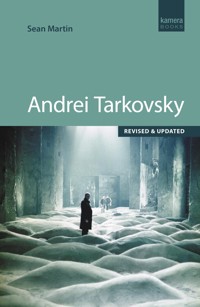
Andrei Tarkovsky is the most celebrated Russian filmmaker since Eisenstein, and one of the most important directors to have emerged during the 1960s and 70s. Although he made only seven features, each one was a major landmark in cinema, the most well-known of them being the mediaeval epic Andrei Rublev - widely regarded as one of the greatest films of all time - and the autobiographical Mirror, set during the Russia of Stalin's purges in the 1930s and the years of stagnation under Brezhnev. Both films landed Tarkovsky in considerable trouble with the authorities, and he gained a reputation for being a tortured - and ultimately martyred - filmmaker. Despite the harshness of the conditions under which he worked, Tarkovsky built up a remarkable body of work. He burst upon the international scene in 1962 with his debut feature Ivan's Childhood, which won the Golden Lion at Venice and immediately established him as a major filmmaker. During the 1970s, he made two classic ventures into science-fiction, Solaris, regarded at the time as being the Soviet reply to Kubrick's 2001: A Space Odyssey and later remade by Steven Soderbergh, and Stalker, which was thought to have predicted the Chernobyl disaster. Harassed at home, Tarkovsky went into exile and made his last two films in the West, where he also published his classic work of film and artistic theory, Sculpting in Time. Since his death in Paris in 1986, his reputation continued - and continues - to grow. Sean Martin considers the whole of Tarkovsky's oeuvre, from the classic student film The Steamroller and the Violin, across the full-length films, to the later stage works and Tarkovsky's writings, paintings and photographs. Martin also seeks to demystify Tarkovsky as a 'difficult' director, whilst also celebrating his radical aesthetic of long takes and tracking shots, which Tarkovsky was to dub 'imprinted' or 'sculpted' time, and to make a case for Tarkovsky's position not just as an important filmmaker, but also as an artist who speaks directly about the most important spiritual issues of our time.
Sie lesen das E-Book in den Legimi-Apps auf:
Seitenzahl: 342
Veröffentlichungsjahr: 2011
Das E-Book (TTS) können Sie hören im Abo „Legimi Premium” in Legimi-Apps auf:
Ähnliche
















Sean Martin
ANDREI TARKOVSKY
My discovery of Tarkovsky’s first film was like a miracle. Suddenly, I found myself standing at the door of a room, the keys of which had, until then, never been given to me. It was a room I had always wanted to enter and where he was moving freely and fully at ease.
I felt encouraged and stimulated: someone was expressing what I had always wanted to say without knowing how.
Tarkovsky is for me the greatest, the one who invented a new language, true to the nature of film, as it captures life as a reflection, life as a dream.
Ingmar Bergman
Acknowledgements
Thanks are due to the Royal Opera House, Covent Garden; Trond S Trondsen and Jan Bielawski of nostalghia.com; Nick Harding; Olegar Fedoro; Marina Tarkovskaya; André Bennett; Layla Alexander-Garrett; Vadim Yusov; Louise S Milne; Alexandra Strelkova; my sister Lois; and, for answering my Tarkovsky-related questions of yesteryear, Mark Le Fanu.
This third edition quietly corrects a couple of errors from the previous, adds a few extra details that have come to my attention, and updates the Filmography and Suggestions for Further Reading.
Introduction
This book is intended to serve as a short overview of Tarkovsky’s work for those unfamiliar with it, or as a stimulus to go back and rewatch the films for those already acquainted with them.
My aim has been to discuss all aspects of Tarkovsky’s work, from his full-length films to the lesser-known works for television, radio and stage. Tarkovsky saw himself primarily as a poet and it is a poetic sensibility that pervades all his work, regardless of medium. There are problems, however, in attempting to write about Tarkovsky at all. As Natasha Synessios wrote, ‘Most of us still visit the cinema for entertainment, or escapism, not for spiritual sustenance, for revelations and benedictions. Yet those of us who are “Tarkovsky-marked” experience his films in just such religious terms. Analysis is not usually conducive to this type of experience, yet through it one hopes to unravel something of the mysterious and ineffable process of creation.’1 My approach has therefore been only partially concerned with analysis, as I feel that the inherent mystery of Tarkovsky’s films speaks for itself, and the films are, ultimately, not solvable. They are films that change as we do.
Tarkovsky’s films could be seen to move through three phases, concentrating successively on History, the Family and a final, more philosophical phase, which I have labelled the Triptych. Obviously, these distinctions are somewhat arbitrary: The Sacrifice, for instance – the third part of the Triptych – could also be seen as a portrait of a dysfunctional family, while Mirror is as much about history as it is the family. Others may be inclined to feel that Tarkovsky’s work falls neatly into two sections, with Mirror marking the end of the first period, or still others may feel that his work is one homogenous whole.
In giving a production history and brief discussion of each film – intended more to provoke reflection than to try to explain what the films mean – I have also added sections on the autobiographical elements of each. Tarkovsky’s life and work are inextricably entwined. One can, of course, enjoy Tarkovsky’s work without knowing anything about his personal circumstances, but as Peter Green observed, the subjects of his films – childhood, war, a yearning for belief, the complexities of family life, nostalgia for home, exile and death – are also ‘stations in his own life. There is a rare congruence between subject and object that goes beyond the usual autobiographical parallels artists draw in their work.’2
Of course, no book, including this one, can replace seeing the actual films, preferably on the big screen, and if this book inspires the reader to go back to Tarkovsky’s films and to watch them with both an open and an active mind, then it will have served its purpose. Natasha Synessios’s words about Mirror are valid for the whole of Tarkovsky’s cinema: ‘When all is said and done, [it] works on the heart and soul, not the mind; it is with them, first and foremost, that we must approach it.’3
Life and Times
Andrei Tarkovsky (1932–86) was a part of the generation of Soviet filmmakers that emerged during the Khrushchev Thaw years, which also saw the emergence of such directors as Otar Iosseliani, Sergei Parajanov and Andrei Mikhalkov-Konchalovsky. Tarkovsky made only seven full-length films, yet this slender oeuvre has established him as the most important and well-known Russian director since Eisenstein. Although Tarkovsky’s reputation continues to grow, especially in North America, where initial critical reaction was decidedly cooler than in Europe,4 his genius was recognised within his own lifetime by Jean-Paul Sartre, who championed Tarkovsky’s first feature, Ivan’s Childhood, and Ingmar Bergman, who regarded Tarkovsky as ‘the greatest of them all’.5 Tarkovsky’s work was admired by directors as diverse as Bergman, Victor Erice, Terry Gilliam, Peter Greenaway, Krzysztof Kieślowski and Lars von Trier. In its Ten Best Films of All Time poll in 1982, Sight and Sound critics voted Tarkovsky’s second feature, Andrei Rublev, as runner-up, a remarkable achievement since the film had only been released in the UK in 1973, making it the youngest film on the list by far.
Tarkovsky’s films are slow, dreamlike searches for faith and redemption, and it comes as no surprise to learn that, during his years in the Soviet Union, he was often criticised for ‘mysticism’ and his continued failure to tackle subjects in a style more acceptable to Socialist Realism. And yet Tarkovsky and his films were very much a product of the Soviet system, which ironically allowed directors a great deal of freedom to express themselves. Before we move on to examine Tarkovsky’s films, writings and works in other media, it is instructive to explore briefly the Soviet film industry as it was when Tarkovsky was working within it and Tarkovsky’s own biography, as both played an important part in making Tarkovsky’s films what they are.
TARKOVSKY’S EARLY YEARS
Andrei Arsenevich Tarkovsky was born on 4 April 1932 in the village of Zavrazhie, which lies just outside the town of Yurievets on the banks of the Volga in the Ivanovo region about 60 miles north of Moscow. The family were literary: his paternal grandfather, Alexander (1860–1920), was a poet who had been a member of the People’s Freedom Movement, which espoused culture and learning for all; as a result, he was banished by the Tsar for his liberal views. Tarkovsky’s father was the poet Arseny Tarkovsky, who was born in the Ukrainian city of Kirovograd (then Elizavetgrad) in 1907. He attended the Moscow Literary Institute during the late-1920s, where he met Maria Ivanovna Vishnakova. They subsequently married and had two children, Andrei and his sister, Marina (born 1934). Tarkovsky senior had yet to be published and so, to support the family, worked away from home as a translator. The family moved to Moscow in 1935, where Tarkovsky’s mother took a job as a proofreader at the First State Printing House. Tarkovsky’s father left the family in 1937 to live with another woman, although he continued to support his family financially and to visit on birthdays and other important occasions. Tarkovsky began his schooling in Moscow in 1939, but with the Nazi invasion of Russia two years later, was evacuated with his mother and sister back to Yurievets, where they remained for two years. Although the family were confirmed Muscovites, Tarkovsky’s early life in the country, both before the family moved to Moscow and during his time as an evacuee, would leave an indelible impression on him which he would later portray in Mirror.
Tarkovsky claimed that his mother groomed him from childhood to be an artist, making sure that he was exposed to art and literature from an early age (though given both Arseny’s and Maria Ivanovna’s literary predilections, it would have been difficult for the young Tarkovsky to have avoided books and works of art). To further this end, Tarkovsky studied music for seven years, as well as having three years of art lessons at the 1905 Academy.
Tarkovsky seems to have resented his mother’s attempts to foster in him a sense that he was an artist-in-waiting, as a result rebelling by hanging out with kids his mother didn’t approve of, playing football and acting tough. However, despite his rebelliousness, he did love books, and was apparently only quiet when reading.6 At school, he was an average pupil, a ‘dreamer more than thinker’.7 It was perhaps his lack of academic aptitude that made Tarkovsky realise that he might indeed become an artist one day, perhaps as a composer, painter or writer. Although as a boy and teenager, the young Tarkovsky ‘caused his mother a lot of worry’8 – in addition to his difficult behaviour, he also suffered from tuberculosis – he was always to write in later life of his high regard for her, although this would seem to be, in part, a retrospective judgement.
His relationship with his father was likewise complex. Tarkovsky detested Antonina, his father’s second wife, and can have only felt something like relief when she died unexpectedly in 1940. Arseny joined the Red Army as a war journalist and was sent to the Front, where he lost a leg. Tarkovsky’s memories of the war revolved around waiting for it to end and for his father to come home. When Arseny did return home, as a decorated war hero (he received the Order of the Red Star), he did not rejoin his first family; indeed, he did not even go to meet the young Andrei when he and his sister returned to Moscow from their time as evacuees in Yurievets. But despite this apparent callousness, Tarkovsky held his father in high regard and, as a teenager, seems to have been closer to his father than his mother, spending what time he could with him, discussing books, listening to Arseny read his own poetry and sampling his father’s extensive record collection (Bach was to become a favourite). The teenage Tarkovsky seems to have regarded his mother as the more guilty party with regard to the break-up of the marriage, which again may go some way to explain why he would want to spend so much time with his father at this stage of his life.9
In 1951, Tarkovsky enrolled in the School of Oriental Languages to study Arabic; he had been interested in the East since an early age (perhaps as a result of hearing stories about his family’s supposed origins among the Daghestani nobility during the reign of Ivan the Terrible).10 However, he did not finish his course due to concussing himself in the gym one day, and he found employment instead on a geological expedition to Siberia, where he spent a year (1953–4) prospecting the remote Turuchansk region for mineral deposits. That Tarkovsky ended up on this expedition may not have been entirely his own doing: his lack of aptitude for serious academic study had been a continuing worry for the family, and it seems that, after the incident in the gym, Tarkovsky’s mother intervened and virtually exiled the would-be director to the East, to prevent him wasting away among Moscow’s stilyaga, the dandified Russian equivalent of the Beat Generation.
Despite being summarily sent away, Tarkovsky thrived in Siberia. He walked many hundreds of miles along the River Kureika, where he spent a lot of time drawing and thinking. It is not recorded how successful he was as an employee of the expedition, but as he didn’t get fired, we can assume that he passed muster. But the expedition did not ignite in him the desire to be a geologist. Rather, alone with nature – and himself – for the first lengthy period since his days as an evacuee in Yurievets, he resolved to become a film director. Maya Turovskaya notes that Tarkovsky’s ‘spiritual baggage was acquired during his none-too-happy childhood and was little affected by subsequent external influences’.11 Likewise, his year in the Siberian taiga would serve as a dramatic baseline for nearly all his subsequent work. Nature is ever present in his films – often celebrated, always mysterious – as is the lone protagonist, struggling to come to terms with his own life and the world around – and within – him.
Upon returning from Siberia, Tarkovsky applied for a place at the prestigious All-Union State Institute of Cinematography, VGIK. That year (1954), there were around 500 applicants for only 15 places. Tarkovsky was among those chosen, and he began studies under the veteran director, Mikhail Romm (1901–71). Romm appeared to be temperamentally at the opposite end of the spectrum to Tarkovsky. He was known chiefly for his films of the 1930s, such as Lenin in October (1937) and Lenin in 1918 (1939), both of which firmly toed the Party line. Given that, and combined with Tarkovsky’s less than inspiring academic record up to that time, one could be forgiven for assuming that his time at VGIK was not to be a success. Yet Romm was a brilliant and unorthodox teacher, and unorthodoxy was precisely what Tarkovsky needed. Romm believed that one could not be taught to be a director, but had to learn to think for oneself and develop an individual voice.
During his time at VGIK, Tarkovsky and his fellow students studied all aspects of filmmaking, watching the classics of Soviet cinema and taking part in workshops in which they would demonstrate their technical ability. This even included acting; Tarkovsky’s fellow student and friend, Alexander Gordon (1931-2020), remembers him giving a superb performance as the ageing Prince Bolkonsky when Romm got the students to perform scenes from War and Peace during their third year at VGIK.12 Tarkovsky saw many classics from outside the Soviet Union, including Citizen Kane, the films of John Ford and William Wyler, and the works of the fathers of the French New Wave, Jean Renoir and Jean Vigo. Tarkovsky developed a personal pantheon that included Bergman, Buñuel, Mizoguchi and Kurosawa, Fellini and Antonioni. The only Soviet director who made it into his pantheon was Dovzhenko, although he was good friends with the Georgian director Sergei Parajanov, whom he regarded as ‘a genius in everything’. He also spoke highly of Iosseliani, and, on occasion, of Boris Barnet. But above them all was the towering figure of Robert Bresson, whom Tarkovsky regarded as the ultimate film artist.
Whilst at VGIK, Tarkovsky co-directed two shorts, The Killers (1956) and There Will Be No Leave Today (1959), which are discussed in the ‘Student Films’ chapter. He also saw Hamlet on stage for the first time (the Paul Scofield production). In 1957, he married fellow student Irma Rausch, with whom he had a son, Arseny (Senka), who was born in 1962.
TARKOVSKY’S PROFESSIONAL CAREER
Tarkovsky’s life and career after VGIK are perhaps better known. A year after making There Will Be No Leave Today, he completed his studies and made his award-winning diploma film, The Steam Roller and the Violin, which won first prize at the New York Student Film Festival in 1961. It was an auspicious time for new filmmakers to be emerging in the Soviet Union. The Soviet film industry was undergoing something of a renaissance; the resultant surge in production from the mid-1950s on would bode well for Tarkovsky and his generation. Films such as The Cranes are Flying and The Ballad of a Soldier caused an international sensation, and Tarkovsky would become the new star in the firmament of this Soviet New Wave.
Tarkovsky shot his first full-length film, Ivan’s Childhood, in 1961. At the film’s first screening in Moscow in March 1962, Mikhail Romm famously declared ‘Remember the name: Tarkovsky.’13 They would prove to be prophetic words: the film won the Golden Lion at Venice later that year and was championed in the West by no less than Jean-Paul Sartre, who praised it as ‘Socialist surrealism’.14 Tarkovsky was instantly recognised in the West as a major director; Ingmar Bergman would later write that his discovery of Ivan’s Childhood was ‘like a miracle’ and that ‘Tarkovsky is for me the greatest, the one who invented a new language, true to the nature of film, as it captures life as a reflection, life as a dream.’15 As Tarkovsky began work on what would become his second feature, Andrei Rublev, his standing was at its high-water mark in Moscow. He would never enjoy such a position again in his homeland.
Andrei Rublev was to be the beginning of the end for Tarkovsky in the Soviet Union. Although completed in 1966, it was not released until 1971 on the grounds that it was too naturalistic, unpatriotic and, perhaps worst of all in the eyes of the authorities, ‘mystical’. The film was first screened at the Cannes Film Festival in 1969, where it was awarded the FIPRESCI Prize. It was finally released in the West in 1973.
By the time Andrei Rublev was released, Tarkovsky had shot his third feature, an adaptation of Stanislaw Lem’s novel, Solaris. Although the film was part of the seemingly ‘safe’ genre of science fiction, the shoot was difficult, primarily due to frequent arguments between Tarkovsky and his cameraman, Vadim Yusov, who had shot all of Tarkovsky’s films from The Steamroller and the Violin onwards. The two men would not work together again, and Tarkovsky asked Georgy Rerberg to shoot his next feature, the autobiographical Mirror. Mirror is at the heart of Tarkovsky’s oeuvre in every way, but was met with official condemnation for being obscure and elitist. Such was the furore surrounding the film that Tarkovsky briefly considered giving up filmmaking and also began to toy with the idea of making a film in the West.
The last film Tarkovsky would make in the Soviet Union was another venture into science fiction, Stalker. The film, based on a novel by Arkady and Boris Strugatsky, marks a turning point in Tarkovsky’s work, towards a more pared-down and minimalistic style. The film was completed in 1979 and was shown in Cannes to rapturous reviews in 1980. The Polish director Andrzej Wajda felt that, with Stalker, Tarkovsky was ‘throwing down the gauntlet’.16 The film heralds the onset of Tarkovsky’s late period, which would be rounded out by his last two features, Nostalgia (1983) and The Sacrifice (1986).
Nostalgia was shot in Italy in the autumn of 1982. Tarkovsky had first visited the country 20 years earlier, when Ivan’s Childhood had triumphed at Venice. In 1976, after the controversy surrounding Mirror had left Tarkovsky disillusioned and bitter, he began making notes for what would become Tempo di Viaggio (1980), his only documentary, and his only film to be shot abroad. The film was finally shot in Italy in the summer of 1979, by which time Tarkovsky and the screenwriter Tonino Guerra, his long-time friend, had had an idea – provisionally entitled ‘The End of the World’ – that would turn into Nostalgia.17 The screenplay was completed in May 1980; Tarkovsky then spent two years in a bureaucratic quagmire before the film could be made. Soviet officials prevented the film from winning the Palme d’Or at the 1983 Cannes Film Festival, a scandal that enraged Tarkovsky and hardened his resolve that he could no longer continue working in the Soviet Union.18
On 10 July 1984, Tarkovsky announced his intention to remain in the West at a press conference in Milan. He had considered defecting in 1981 during a trip to Sweden, but concern for his wife and son prevented him from proceeding. When he finally did make the decision to remain in the West, his son was still in the Soviet Union, and would not be allowed out until January 1986, by which time Tarkovsky had been diagnosed with terminal lung cancer. His final film, The Sacrifice, won four prizes at the 1986 Cannes Film Festival, including the Grand Prix and the Special Jury Prize. Tarkovsky was too ill to attend, so his son Andrei Jr collected the prizes on his behalf. Tarkovsky seemed to be in remission during the summer of 1986, but the cancer returned. He died in Paris on 29 December 1986.
Tarkovsky did not live long enough to experience glasnost, although he predicted that, after his death, he would be rehabilitated in his homeland. His prediction came true: a major retrospective of his work was held at Dom Kino (the House of Cinema) in the spring of 1987. The following year, the original 205-minute cut of Andrei Rublev received its first public screening. An Andrei Tarkovsky Memorial Prize was established in 1989, its first recipient being the legendary animator, Yuri Norstein. In April 1990, Tarkovsky was posthumously awarded the Lenin Prize, the highest form of recognition in the Soviet Union.
TARKOVSKY AND THE SOVIET CONTEXT
Tarkovsky made five feature films in the Soviet Union between 1962 and 1979. All of them were seen – at least in Western Europe – as major masterpieces, even one of which would have guaranteed their director a place in cinema history. Unlike some directors, such as his close friend Sergei Parajanov (1924–90), who spent a number of years in prison on trumped-up charges and whose career was badly hampered by the authorities, Tarkovsky managed to remain relatively free to pursue his vision, despite the fact that he was not a Party man and his films did not conform to the Socialist Realist norm that the Communist Party championed. This suggests that the Soviet system was not as monolithic as we might be tempted to think it was, to say nothing of Tarkovsky’s own tenacity. A brief overview of the Soviet film industry will go some way towards helping us to appreciate what obstacles a filmmaker in the Soviet Union had to face and how this, in turn, played a part in shaping Tarkovsky’s films.
The Soviet film industry, like every other walk of life in the Soviet Union, was heavily centralised. Goskino, a body founded in 1922, oversaw every aspect of filmmaking in the USSR, having final say on each stage of the production of a film, from script approval to green-lighting a film’s release. All 40 or so studios across the Soviet Union were answerable to Goskino, including the largest studio, Mosfilm in Moscow, where Tarkovsky made all of his Soviet features. During Tarkovsky’s career, Goskino was headed first by Alexei Romanov (1963–72) and then by Filip Yermash (1972–86), who would become something of a personal nemesis for Tarkovsky.
Mosfilm, like the other studios, comprised various departmental heads, who oversaw their respective areas – such as production, scriptwriting and editing – together with an artistic council made up of Mosfilm top brass, filmmakers and Party officials. This council had the final say in how a film should be distributed, either in Category 1 (wide release in the major cinemas), or Category 2 (limited release in smaller cinemas). Everyone at the studio was answerable to the studio head. In Tarkovsky’s time, these were V Surin and then Nikolai Sizov. Although Tarkovsky quickly developed a reputation for being stubborn and refusing to make cuts in his films, Goskino and Mosfilm officials, as we shall see later, were not necessarily hostile to Tarkovsky just for the sake of it; sometimes Tarkovsky took their feedback on board and made changes to his films accordingly (especially in the case of Mirror).
The process of getting a script approved was frequently a long and frustrating one. A project would first be submitted to the editor of the script department at the studio, who would then review it before passing it up the hierarchy. Finally, the script would arrive at the desk of the head of the studio. The studio head could not, however, greenlight a film until the whole process had been repeated at Goskino. Despite these supposedly stringent controls, however, the system was hampered by one major factor: during the mid- to late-1950s, the Soviet film industry began expanding at an almost exponential rate, epitomised by the international success of Mikhail Kalatozov’s The Cranes are Flying, which won the Palme d’Or at Cannes in 1957.
This resurgence owed a lot to the 20th Party Congress in 1956, at which Khrushchev denounced Stalinism, thereby precipitating the ‘Thaw’ that initiated the most liberal cultural climate in the Soviet Union for 30 years. The film industry thrived as a result. In 1955, 65 features were produced; by the early 1960s, this had risen to over 100 per year. Cinemas likewise doubled in number, from 59,000 in 1955 to 118,000 in 1965. Aside from Kalatozov, other directors rose to prominence between the late-1950s and mid-1960s, such as Elem Klimov, Larisa Shepitko and Andrei Mikhalkov-Konchalovsky, and the only two Soviet directors Tarkovsky professed to admire, Otar Iosseliani and Sergei Parajanov.
The very success of the Soviet film industry meant, ironically, that theory (i.e. ideology) was not always practice. Industry personnel were overworked, deadlines had to be met, and scripts and films had to be approved. Once a script had been approved, a director such as Tarkovsky, who enjoyed an international reputation, would face very little, if any, interference from either Mosfilm or Goskino during shooting. Problems usually set in when Tarkovsky submitted a film for approval. Discussions would be held, cuts would be demanded, complaints would be lodged. As Tarkovsky often rewrote his scripts while shooting them (especially in the cases of Mirror and Stalker), this stage would often be fraught.
Tarkovsky would sometimes submit edits of his films that he knew were too long, so that, when calls came for cuts, he could then cut the parts he was dissatisfied with, and thus show that he had complied with requests to shorten the film. Although Alexei Romanov personally screened every film submitted for approval to Goskino, his successor, Filip Yermash, often approved films for release without even seeing them. However, as Tarkovsky was regarded abroad as the most important Soviet director then working, all of his films were subject to a great deal of scrutiny and debate before – and after – they were released.
All of Tarkovsky’s Soviet features were released in Category 2, with the exception of Solaris. He felt bitter about this and came to feel that he was being persecuted. This sense of persecution intensified as his career in the Soviet Union progressed, until it became one of the chief reasons why he decided to remain in the West after completing Nostalgia. Ironically, while Tarkovsky did indeed battle relentlessly to get his films made according to his wishes, in some respects he enjoyed privileges not extended to other directors, some of whom resented what they saw as Tarkovsky’s ‘special treatment’. He travelled a good deal throughout the 1970s, for example, often accepting invitations to appear at film festivals, sometimes even participating in jury activities (such as at Locarno in 1972, when he was president of the jury). Compared with his friend Parajanov, who was imprisoned between 1974 and 1977 and then again briefly in the early 1980s, while Tarkovsky’s situation might have been difficult and ultimately impossible in the late 70s and early 80s, at least he remained at liberty to pursue his vision.
Theory and Practice
Tarkovsky’s films contain a number of recurring themes and visual motifs, as well as narrative and stylistic devices that will be examined in this chapter. We will also look at his theories of the art of cinema, which he wrote about at length in his book, Sculpting in Time (1984). It should be noted that Tarkovsky was adamantly opposed to interpretation; instead, he urged his audiences simply to watch his films. When asked why there was so much rain in his films, Tarkovsky would reply that it was always raining in Russia. Be that as it may, it must also be noted that rain, for example, might have another possible function in the films, such as cleansing or blessing. The Polish director Krzysztof Kieślowski explained that if a cigarette lighter in a film doesn’t work, it means it doesn’t work and nothing else. But on the rare occasion that a filmmaker can get it to mean something else, then they have achieved a miracle. ‘Only one director in the world has managed to achieve that miracle in the last few years,’ he notes, ‘and that’s Tarkovsky.’19
But before we examine Tarkovsky’s work in terms of its thematic and poetic content, it is instructive to be reminded of his working methods, aspects of which make his achievement all the more remarkable.
WORKING METHODS: DEVELOPMENT
With the exception of Ivan’s Childhood, on which he was a hired-hand director, Tarkovsky initiated all of his projects himself. How he chose what would be his next film was a mysterious process that he did not fully understand. He notes in his diary, ‘It is obviously a most mysterious, imperceptible process. It carries on independently of ourselves, in the subconscious, crystallising on the walls of the soul.’20 (The diaries furthermore attest to the fact that Tarkovsky continually entertained ideas about many projects, only a handful of which he actually managed to realise – see Appendix II.) But, for Tarkovsky, a project usually began with a feeling for ‘the inner state, the distinctive inner tension of the scenes to be filmed, and the psychology of the characters’.21
Once the ‘inner state’ had been glimpsed, Tarkovsky would then pitch his idea to a potential screenwriting collaborator. He regarded screenwriting as a separate discipline from literature. ‘I do not understand why anyone with literary talent should ever want to be a scriptwriter,’ he declares in Sculpting in Time, his reasons being that a script will inevitably change during the course of development, shooting and postproduction. The script should only be treated as a blueprint for the film: ‘If a scenario is a brilliant piece of literature, then it is far better that it should remain as prose.’22
Tarkovsky worked with a co-writer on all of his films, bar The Sacrifice, which he wrote alone. Vladimir Akimov, a screenwriter who knew him (but never worked with him), believed that Tarkovsky essentially used his co-writer as a sounding board on which to test new ideas, and also as someone who would ensure that good scenes were not cut on a whim,23 as one notable feature of Tarkovsky’s working method was its organic nature: scripts and films would be constantly changing as Tarkovsky’s understanding grew as to what each scene or film required.
Andrei Mikhalkov-Konchalovsky was Tarkovsky’s first collaborator, with whom he co-wrote The Steamroller and the Violin, Ivan’s Childhood and Andrei Rublev.24 On the first two of these, they shared the writing more or less equally, although on Ivan’s Childhood their work was to modify an existing script to make it conform to Tarkovsky’s conception of the film. Tarkovsky apparently began writing Andrei Rublev on his own, but called Mikhalkov-Konchalovsky in for later drafts. Mikhalkov-Konchalovsky noted that Tarkovsky would always work from his intuition, which would frequently exasperate him. During work on Andrei Rublev, the two of them decamped to Georgia for a writing retreat. In a break from working on the script, they went out for a walk, hoping to resolve their current impasse, but Tarkovsky, rather than telling his collaborator what he wanted, began talking about the buds on the trees that they were walking past. Mikhalkov-Konchalovsky later accused Tarkovsky of being pretentious, and the two men parted company. (The feeling, it has to be said, was mutual.)
Tarkovsky had a much better working relationship with Alexander Misharin, with whom he wrote Mirror. Tarkovsky knew some of the episodes he wanted, but he and Misharin first talked at length about what they remembered of their childhoods in order to arrive at the others. Once this process was complete, they wrote scenes individually and would meet every day to read what they had written. Working like this, they wrote the script in two weeks. Before and during shooting, the script was then rewritten on a daily basis, with Misharin feeling that ‘Tarkovsky knew what he wanted but was unable to articulate it’.25 Unusually for a writer, Misharin was also consulted about the edit, and would sometimes sit in with Tarkovsky and the film’s editor, Ludmila Feiginova.26
Tarkovsky’s intuitive approach resulted in tense and stormy relationships with authors whose work he adapted, namely Vladimir Bogomolov (Ivan’s Childhood), Stanislaw Lem (Solaris) and the Strugatsky brothers (Stalker). The dream sequences in Ivan’s Childhood, which were one of the things Bogomolov objected to, were present in the script as soon as Tarkovsky started work on the film, which again suggests that he knew what he wanted from the beginning. Similarly, his approach to adapting Solaris, which he did with Friedrich Gorenstein, was to make the material his own, rather than trying to film Lem’s novel as it was written. Lem was furious that the Earth scenes were in the film (in the first draft three-quarters of the action took place on Earth), and was also displeased that Tarkovsky did not seem to be interested in the theme of the novel, that of the progress of science and knowledge, but instead supplied his own, revolving around familial concerns and his love of nature.
On Stalker, Tarkovsky was actually collaborating with the authors of the original novel, but a broadly analogous situation arose when Arkady Strugatsky, frustrated by the endless rewrites and Tarkovsky’s vagueness about what he wanted, suggested dropping the science-fiction element of the story. Tarkovsky immediately beamed ‘like a cat that has eaten its owner’s parrot’,27 and admitted this was what he had been wanting for a long time but that he had not wanted to offend the brothers by suggesting it.
WORKING METHODS: PRODUCTION
From Andrei Rublev onwards, Tarkovsky was in complete control once shooting had started, with no external interference. He was fanatically involved in all aspects of production, having the last word on set design, costume and choice of location. Although some saw this as dictatorial behaviour, Tarkovsky viewed it as part of the director’s job. In the documentary Directed by Andrei Tarkovsky, his widow Larissa quotes from his diary: ‘Never trouble anyone else with what you can do yourself.’28
Tarkovsky was also highly selective about which actors he would use. He preferred to use the same actors as often as possible, and built up a company that he would use again and again, including Nikolai Grinko, Anatoly Solonitsyn, Irma Rausch, Stefan Krylov, Nikolai Burlyaev, Yuri Nazarov, Sos Sarkissian, Olga Kizilova, Tamara Ogorodnikova, Oleg Yankovsky and Erland Josephson. He favoured the same approach with his crew, and in addition to his collaborations with Vadim Yusov, Tarkovsky also developed long-standing relationships with composers Vyacheslav Ovchinnikov and Eduard Artemyev, costume designer Nelly Fomina, editor Ludmila Feiginova, sound recordists Inna Zelentsova and Semyon Litvinov, make-up artist Vera Rudina, assistant director Masha Chugunova and musical director Emil Kachaturian.
Although some of his shoots were a purgatorial experience for all concerned (especially Stalker), nearly everyone who worked with him admired him and some professed an almost fanatical loyalty to him. Once his collaborators had earned Tarkovsky’s trust, he would welcome suggestions from them provided that they stayed within the overall framework he had established. Tarkovsky himself would frequently diverge from the script, and his films, despite looking carefully thought out, are in fact partially the result of improvisation on set. Because time was not so pressing a factor as it was when he came to work in the West, he would often halt filming for a few days in order to solve a problem, rehearse or wait for props to arrive. With intense rehearsals and a strong intuition of what he wanted (even if he was not able to articulate himself clearly), Tarkovsky was able to get what he wanted usually in only one or two takes. Given that many of his takes are lengthy and involve careful choreography, this is little short of remarkable. At Mosfilm, he was known as ‘One-Take Tarkovsky’.29
Tarkovsky’s closest relationship during shooting was always with his director of photography. That the visual style of his films was essentially Tarkovsky’s own is borne out by the fact that, after his collaboration with Vadim Yusov ended with Solaris, each subsequent film was shot by a different cameraman: Georgy Rerberg (Mirror); Alexander Knyazhinsky (Stalker); Giuseppe Lanci (Nostalgia); and Sven Nykvist (The Sacrifice). For Knyazhinsky, Tarkovsky was one of the few directors who understood film as being, above all else, essentially a visual medium (as opposed to a dramatic medium, like theatre) and remembers Tarkovsky saying that ‘if they got the images right, the film was sure to be a success’.30 Lanci admitted that working with Tarkovsky was a ‘most enriching’ experience, and felt that, in order to shoot the film according to Tarkovsky’s vision, he had to try to enter Tarkovsky’s poetic world more and more each day, until Lanci ‘[felt] as he did, to think as he did. And it was a tremendous experience, unrepeatable… working with him one could risk anything... he was always nearby to give you courage, to give you strength to achieve the objectives that the film required.’31
Working Methods: Post-Production
Ludmila Feiginova cut all of Tarkovsky’s Soviet features. As there were rarely more than one or two takes of a scene, her job was mainly to decide where to begin and end each individual shot. Tarkovsky also hardly ever shot scenes that didn’t make it into the final film, the main exception being the ‘mirror room’ from Solaris.32 Feiginova’s other main task was to determine – in conjunction with Tarkovsky himself – how to shorten scenes. This played a big part in appeasing the authorities in that, if they demanded cuts, Tarkovsky would cut something and then say that he had shortened the film, hoping that the authorities would not notice that things they objected to were still in the film. As with his collaborators during the actual shooting, Tarkovsky allowed Feiginova to contribute ideas. Indeed, some of her suggestions were inspired, such as the moving of the stuttering boy scene to the beginning of Mirror, or the moving of the speech by Stalker’s wife from the bar to the flat, where, instead of addressing the three men, she now appears to address the audience directly. Feiginova was also present at the mixing and dubbing of Tarkovsky’s Soviet films.
In the West, Tarkovsky’s main editing problems concerned the fact that he wasn’t allowed to start cutting until the film had been shot, which had been contrary to his practice in the Soviet Union. Practical considerations such as lack of time for rehearsal also meant that Tarkovsky went beyond his usual one or two takes when working in the West, but, given that he was covering his scenes in much the same way as in the Soviet Union, the editorial decisions involved on Nostalgia and The Sacrifice were very much the same.
Tarkovsky’s relationship with composers was as unorthodox as the rest of his working practice. Usually, a composer would be called in to score a film once it had been shot, which is what happened with Vyacheslav Ovchinnikov when he worked on The Steamroller and the Violin and Ivan’s Childhood. However, when Tarkovsky started work on Andrei Rublev, he asked Ovchinnikov to compose some music for the Kulikovo Field battle scene while the script was still being written. As it turned out, the scene wasn’t shot, and Tarkovsky used some of the music in the epilogue without consulting Ovchinnikov first. The inevitable row meant that the two men would not work together again.
Ovchinnikov’s replacement was Eduard Artemyev, whom Tarkovsky met while he was preparing Solaris. Tarkovsky was interested in Artemyev’s electronic music, believing that it was the way to dispense with a conventional score altogether, which he felt that films did not really need. As a result, much of the music Artemyev composed for Tarkovsky has an abstract, ambient quality to it. The main exceptions are arrangements of the Bach prelude used in Solaris, and the opening theme of Stalker, which is an amalgam of plainchant and Indian music. Tarkovsky felt that music in films was best used as a refrain, which, when repeated throughout a film, would ‘[open] up the possibility of a new, transfigured impression of the same material… The meaning… is not changed, but the [film] takes on a new colouring… Perception is deepened.’33
Tarkovsky believed that sounds could be as important as music, if not more so, and so his soundtracks are rich in natural sounds. In his last two films, he abandoned a conventional score altogether, using instead a collage of classical music and natural sounds. Owe Svensson, the sound designer on The Sacrifice




