


0,49 €
Mehr erfahren.
- Herausgeber: Booksell-Verlag
- Kategorie: Lebensstil
- Sprache: Englisch
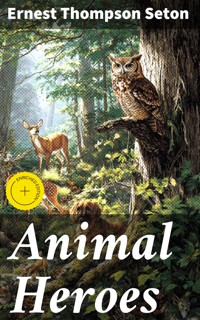
In "Animal Heroes," Ernest Thompson Seton presents a captivating collection of biographical sketches that explore the lives of various animals, revealing their remarkable intelligence, character, and emotional depth. Seton's prose blends naturalistic observation with an engaging storytelling style, aiming to bridge the gap between humans and the animal kingdom. Each narrative is meticulously crafted to highlight the complexities of animal behavior and the moral lessons they impart, reflecting the burgeoning interest in wildlife conservation and animal rights that characterized the early 20th century. Seton, a key figure in the early American conservation movement and one of the founding members of the Boy Scouts of America, was deeply influenced by his love for nature and animals. His experiences as a nature illustrator and his extensive field observations informed the vivid portrayal of animal protagonists in this work. Seton's passion for fostering a greater understanding of the natural world is evident in his meticulous research and empathetic rendering of animal lives, which challenge the anthropocentric perspectives prevalent in his time. "Animal Heroes" is a must-read for nature enthusiasts, animal lovers, and those interested in environmental ethics. Seton's engaging narratives not only entertain but also encourage a deeper respect for wildlife and an appreciation for coexisting with nature. This book serves as both a celebration of animal life and a poignant reminder of our responsibility towards the creatures with whom we share the planet. In this enriched edition, we have carefully created added value for your reading experience: - A comprehensive Introduction outlines these selected works' unifying features, themes, or stylistic evolutions. - A Historical Context section situates the works in their broader era—social currents, cultural trends, and key events that underpin their creation. - A concise Synopsis (Selection) offers an accessible overview of the included texts, helping readers navigate plotlines and main ideas without revealing critical twists. - A unified Analysis examines recurring motifs and stylistic hallmarks across the collection, tying the stories together while spotlighting the different work's strengths. - Reflection questions inspire deeper contemplation of the author's overarching message, inviting readers to draw connections among different texts and relate them to modern contexts. - Lastly, our hand‐picked Memorable Quotes distill pivotal lines and turning points, serving as touchstones for the collection's central themes.
Das E-Book können Sie in Legimi-Apps oder einer beliebigen App lesen, die das folgende Format unterstützen:
Veröffentlichungsjahr: 2019
Ähnliche




Animal Heroes
Table of Contents
Introduction
Animal Heroes gathers, in a single-author volume, Ernest Thompson Seton’s sustained portraits of nonhuman lives. Conceived as a cohesive cycle rather than a miscellany, it presents self-contained narratives that together sketch a broad panorama of animal experience. First appearing in the early twentieth century, the collection reflects Seton’s dual commitment to storytelling and careful observation. Its purpose is not to compile a “complete works,” but to present a focused suite of narratives in which individual animals emerge as protagonists with distinct trajectories. Read consecutively, these histories form a composite study of courage, adaptation, and survival under varied natural and human pressures.
The volume is composed of prose narratives—short stories and novella-length tales—divided into chapters that unfold as chronicles, histories, or legends. Each narrative centers on a particular animal or closely related group, with episodes structured to follow the rhythms of season, pursuit, migration, training, or homecoming. While compact and dramatic, the pieces remain grounded in descriptive natural history and field detail. The collection does not include plays, poems, letters, or diaries. Instead, it stays within the flexible boundaries of narrative nonfiction and fiction, allowing Seton to blend documented behavior with interpretive scenes that lend coherence to the lives he reconstructs.
A unifying theme is the insistence that animals are individuals whose lives can be followed with the same attentiveness afforded human biography. Across the book, “heroism” is defined through persistence: a pigeon’s homing instinct tested by distance and peril; the resourcefulness of wolves in austere country; the wary intelligence of a lynx; the quick reflexes of a jack-rabbit; the loyalty and training of a bull-terrier; the endurance associated with reindeer in severe climates. Seton’s protagonists confront weather, hunger, predation, and human interference. Survival is never sentimentalized; episodes emphasize skill, habit, and learned response as animals meet challenges specific to their species and place.
Stylistically, the narratives balance economy with exactitude. Seton builds scenes from concrete signs—tracks, scents, winds, the lay of a cañon or plain—then advances them with the pacing of an adventure tale. His narrators infer motive cautiously from observable behavior, maintaining a deliberate distance between interpretation and fact. The chaptered form provides flexibility: compact action sequences alternate with reflective passages on habit formation, territory, and the quiet intervals that shape an animal’s “career.” The prose favors clarity over ornament, yet it is attentive to atmosphere, especially at dusk, in storms, and on snow, where visibility and sound become decisive elements of survival.
Considered as a whole, the collection remains significant for placing animals at the center of narrative interest while preserving a respect for real behavior. It bridges natural history and literature, encouraging readers to track cause and effect without diminishing wonder. The stories invite ethical attention not through argument but through method: by following a life closely, they elicit sympathy rooted in evidence. This approach has helped the book endure as both engaging storytelling and a model of humane observation. Its emphasis on specificity—particular landscapes, particular trials—avoids allegory’s abstractions and keeps the focus on what can be seen, taught, learned, and remembered.
The settings range across plains, badlands, river valleys, forests, and northern ranges, reflecting the diversity of North American environments encountered by the featured animals. Human presence appears in many guises—ranchlands, traps, training yards, roads—and becomes part of the ecological field in which choices are made. Several narratives explore thresholds where wild and domestic knowledge overlap: homing as a learned discipline, the limits and possibilities of training, the testing of instinct against human cunning. Recurring patterns—tracks at dawn, the challenge of deep snow, the peril of a scent on a shifting wind—create continuity across distinct species and tales.
Read individually, each narrative offers the satisfactions of a complete life-story; read together, they accumulate into a comparative study of adaptation, character, and chance. The collection’s architecture encourages readers to notice echoes across species—how orientation, memory, and social bonds differently express themselves—without collapsing those differences. As an introduction to Seton’s method, it shows his preference for measured empathy, field-grounded detail, and narrative restraint. The result is a sequence that rewards attentive reading, invites reflection on coexistence, and affirms the literary vitality of animal-centered storytelling. In bringing these lives into focus, Animal Heroes asks us to attend carefully, and to remember.
Historical Context
Ernest Thompson Seton (1860–1946) wrote Animal Heroes in 1905 while living in the United States after formative years on the Canadian prairie. Born in South Shields, England, and raised in Ontario and Manitoba, he combined field naturalism with illustration and storytelling learned through transatlantic artistic circles and North American scientific networks. His Manitoba seasons in the 1880s and wolf studies in the American Southwest fed narratives ranging from prairie predators to urban animals. Published by Charles Scribner’s Sons in New York, the collection appeared amid Progressive Era debates on wildlife, education, and moral uplift, and followed his influential Wild Animals I Have Known (1898).
Many stories reflect landscapes transformed between 1870 and 1905 by railways, ranching, and settlement. The Canadian Pacific Railway’s completion in 1885 accelerated Winnipeg’s rise as the “Gateway to the West,” while the Little Missouri Badlands of Dakota Territory drew cattlemen, including Theodore Roosevelt at Elkhorn Ranch (1884–1887). Predator bounties, municipal wolf hunts, and steel-trap commerce defined these regions. In the United States, the Division of Economic Ornithology and Mammalogy (1885), later the Bureau of Biological Survey (1905), coordinated predator eradication on open range. Seton’s wolves and jackrabbits move through these contested frontiers, where livestock protection, fur markets, and new towns collided with older ecological orders.
Urbanization furnished a counterpoint: dog breeding, pigeon racing, and municipal animal control expanded with cities like New York and Philadelphia in the 1880s–1900s. The American Kennel Club (founded 1884) standardized breeds, including the bull-terrier, while public health campaigns targeted strays and rabies. Homing pigeons bridged sport and utility; the U.S. Army Signal Corps established a pigeon service in 1896, even as telegraph and telephone networks spread. Clubs, lofts, and competitive flights gave rise to metropolitan animal cultures that Seton observed firsthand. His portraits of dogs and pigeons are situated within these dense human–animal infrastructures, where companionship, work, and spectacle reshaped species’ roles.
Northern forests and the fur trade furnish another historical backdrop. The Hudson’s Bay Company, operating since 1670, still structured trapping economies across Ontario, Manitoba, and Quebec into the late nineteenth century, with lynx, marten, and fox pelts traveling from remote traplines to global markets. Settler and Indigenous communities navigated changing access to land as reserves, timber leases, and game laws expanded after Confederation (1867). Naturalists mined trade records for ecological patterns, and the lynx–snowshoe hare cycle later analyzed by Charles Elton in the 1920s had already imprinted northern life. Seton’s scenes of boreal predators and boys reflect these intertwined subsistence, market, and scientific histories.
Animal Heroes belongs to the emergent conservation era. The Boone and Crockett Club (1887), Yellowstone National Park (1872), the Canadian Rocky Mountains Park at Banff (1885), and the U.S. Forest Service (1905) signaled institutional change. The Lacey Act (1900) curbed interstate wildlife trafficking; Audubon societies founded in the 1890s campaigned against plume hunting; the Migratory Bird Treaty (1916) lay ahead. Seton’s empathetic wildlife portraits worked alongside policy by shaping public sentiment. By narrating wolves on the plains, pigeons over cities, and reindeer of the North, he dramatized ecological limits in an era of market hunting, predator bounties, and rapid conversion of grassland and forest.
The collection appeared amid the Nature Fakers controversy. John Burroughs’s “Real and Sham Natural History” (Atlantic Monthly, 1903) and Theodore Roosevelt’s public interventions (notably 1907) challenged writers, including Seton, for anthropomorphism and unverified animal psychology. Seton defended his methods with field notes, measurements, and sketches, insisting on the moral as well as observational value of close study. The debate sharpened expectations for evidence in popular natural history just as universities expanded biological sciences. Readers encountered Animal Heroes at a moment when narrative technique, scientific authority, and ethics of representation were all under scrutiny, influencing reception of tales about dogs, wolves, and birds.
Transnational currents inform the book’s northern and arctic motifs. European fascination with the polar regions surged with Fridtjof Nansen’s Fram expedition (1893–1896) and Roald Amundsen’s Northwest Passage voyage (1903–1906). Reindeer husbandry among Sámi communities attracted reformers and scientists; in 1891 Sheldon Jackson initiated reindeer transfers from Siberia to Alaska to support Indigenous livelihoods. Folkloric imagery of white reindeer and snowbound travel circulated through travelogues and ethnographies in London and New York. Seton drew upon this cultural geography—combining folklore, ethnographic reportage, and natural history—to craft narratives that resonated with readers for whom the Arctic symbolized both scientific modernity and enduring tradition.
Seton’s integration of text and image reflects Progressive Era print culture and education. He illustrated his own books for Scribner’s and the Century Company, aligning with the nature-study movement advanced by Liberty Hyde Bailey and Anna Botsford Comstock’s Handbook of Nature Study (1903). His Woodcraft Indians (founded 1902) and role in launching the Boy Scouts of America (1910, as first Chief Scout) embedded animal lore within youth pedagogy, camping ethics, and citizenship. Animal Heroes thus functioned as literature, field guide, and moral primer, circulating in classrooms and clubs from New York to Winnipeg and London, shaping a generation’s understanding of North American wildlife.
Synopsis (Selection)
Life I–IV (I–XII)
A suite of brief essays outlining the forces that shape animal existence—instinct, learning, hunger, fear, and adaptation—serving as thematic preludes to the stories. They sketch how wild creatures survive and respond to human encroachment without following a single narrative.
Arnaux: The Chronicle of a Homing Pigeon
Follows a champion homing pigeon from early training through arduous races and urban hazards, emphasizing fidelity to home. A final demanding flight tests the limits of instinct and endurance.
Badlands Billy: The Wolf that Won
Tracks a plains wolf from puphood to seasoned outlaw as he learns to read traps, hounds, and human cunning. A long contest with hunters culminates in a decisive chase that measures craft against relentless pursuit.
The Boy and the Lynx
Interwoven portraits of a settler boy and a lynx maturing in the same northern woods, each learning the land’s rules and dangers. Their paths cross in a tense encounter that reframes fear, skill, and respect for the wild.
Little Warhorse: The History of a Jack-rabbit
The life of a jackrabbit famed for grit and speed, detailing the evasions, habits, and split-second choices that keep a prey animal alive on the open range. Seasonal shifts and predators test his adaptability.
Snap: The Story of a Bull-Terrier
A bull-terrier’s journey through training, scrapes, and service alongside his master, highlighting loyalty and toughness. Trials of courage reveal the bond between dog and human and the costs of bravery.
The Winnipeg Wolf
A solitary wolf haunts the outskirts of Winnipeg, outwitting traps and drawing bounties as sightings fuel a civic manhunt. Near-misses and close tracking lead to a final confrontation between wild resilience and human order.
The Legend of the White Reindeer
A northern tale of a rare pale reindeer that becomes an object of awe and pursuit. Blending observation with folklore, it explores the tension between reverence for rarity and the urge to possess it.




