


5,49 €
Mehr erfahren.
- Herausgeber: Revela Press
- Kategorie: Geisteswissenschaft
- Sprache: Englisch
2021 Next Generation Indie Book Award “Non-Fiction”
2021 Next Generation Indie Book Award “Women’s Issues Non-Fiction”
2021 Next Generation Indie Book Award “General Non-Fiction”
2021 Next Generation Indie Book Award “Education/Academic”
2021 IndieReader Discovery Awards “History”
2021 Benjamin Franklin Award “Silver for History”
2021 Benjamin Franklin Award “Gold for Interior Design”
“Books of the Week” — Smithsonian Magazine
“17 Brilliant Books That You Won’t Struggle to Finish” — Buzzfeed
“With a global economic crisis looming, Ansary’s book is a reminder that our responses must be alive to inequalities already at play.” — The Times Literary Supplement
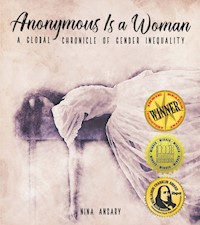
Award-winning author, women's rights advocate, and historian Dr. Nina Ansary takes readers on a 4,000-year historical journey to expose the roots and manifestations of systemic gender discrimination. The book’s biographical profiles of fifty forgotten female innovators—brought to life by international illustrator Petra Dufkova—shatter deeply rooted gender myths to tell remarkable stories about groundbreaking contributions to the global community.
In 1929, British novelist Virginia Woolf ran her fingers along the spines of the books in her library wondering why no woman in Shakespeare’s era had written “a word of that extraordinary literature when every other man, it seemed, was capable of song or sonnet.” She concluded, “Indeed, I would venture to guess that Anon, who wrote so many poems without signing them, was often a woman.”
Nearly a century after Woolf penned those incisive words—frequently modified as “For most of history, Anonymous was a woman”—the phenomenon of female anonymity persists as women worldwide continue to be restricted by society’s formal and unspoken barriers.
Why does Virginia Woolf’s statement still echo in the twenty-first century? Why have women been consistently denied opportunities that are automatically given to men? And why has the historical record failed to adequately recognize notable women?
Anonymous Is a Woman. . .exposes the roots and manifestations of institutionalized gender and racial discrimination; dismantles centuries of historical bias through biographical profiles of fifty remarkable, yet forgotten women innovators; and challenges ingrained stereotypical assumptions to advance an unconventional argument for equality and inclusivity.
100% of the proceeds from the sale of this book will be donated. The primary recipients will be The Center for Human Rights in Iran, a New York-based 501(c)(3) registered nonprofit, nonpartisan organization dedicated to the protection and promotion of human rights in Iran, and The London School of Economics Centre for Women, Peace, and Security, an academic space for scholars, practitioners, activists, policymakers, and students to develop strategies that promote justice, human rights, and participation of women in conflict-affected situations around the world.
Das E-Book können Sie in Legimi-Apps oder einer beliebigen App lesen, die das folgende Format unterstützen:
Seitenzahl: 328
Veröffentlichungsjahr: 2020
Ähnliche




















Praise for Anonymous Is a Woman
“Dr. Nina Ansary has written a powerful book on a critical subject. Gender discrimination continues to pose a challenge to women’s equality and inclusion everywhere. The author makes a strong case for accelerated collective action by all of us to advance women’s progress. This is an indispensable, brilliantly written call to action. Read the book and heed her call.”
—Melanne Verveer, Former US Ambassador for Global Women’s Issues and Executive Director of the Georgetown Institute for Women, Peace and Security at Georgetown University
“Inspiring and insightful: An expert journey and an elegant authoritative exploration of gender and society in this jewel of a book. Fifty shades of genius—exquisite portraits, splendid sketches and a gorgeous tribute to women long forgotten by history and an expert guide to help ensure it won’t happen again.”
—Lyse Doucet, OBE award-winning journalist and BBC’s Chief International Correspondent
“Anonymous Is a Woman makes an essential contribution to illuminating the current social, economic, and political trends that are squashing the potential of at least 50 percent of the human population. This timely book highlights forgotten pioneering women in history and the repercussions of obstructing the full depth of human potential.”
—Scott Barry Kaufman, Author, Professor of Psychology, Barnard College, Columbia University
“Dr. Nina Ansary has written a must-read book for everyone who wants to understand the roots and manifestations of systemic gender discrimination in everyday life. This insightful book makes the invisible visible, shedding light on how gender inequality permeates everyday life. Read this book—and learn from one of the best.”
—Michelle King, Director of Inclusion, Netflix
“Anonymous Is a Woman is an eye-opening wake-up call and an essential reading that impacted my views of the world, as a man and a father, as much as Half The Sky: Turning Oppression into Opportunity for Women Worldwide. Any man who doubts the overwhelming benefits of diversity and gender equality in life, business, and politics needs to read this book. If Ansary’s compellingly succinct and common-sense approach doesn’t leave you banging your head against your desk about all the opportunities you’re missing, you’re simply beyond saving.”
—Gregory Hogben, author of My Daughter’s Army, Advocate for Women’s Rights and LGBT Equality
“To ensure an equitable and thriving global future, Nina Ansary has written one of this new decade’s most significant books that will inspire every culture to understand the power of historical gender bias, recognize, and even seek out their female innovators.”
—Claudia Chan, Founder of S.H.E. Summit & Author of This Is How We Rise
“This beautifully written and elegantly illustrated book deserves wide readership. Dr. Nina Ansary has added to the historical record while striking an important blow on behalf of all humankind.”
—Jerrold D. Green, President and CEO, Pacific Council on International Policy
“Full of fascinating stories and clearly a labour of love, an inspiring addition to the work of rediscovering the remarkable women of the past—would make the perfect present for any woman or girl finding her way into our shared history.”
—Rosalind Miles, Award winning Journalist, Critic, BBC Broadcaster, and Author of Who Cooked the Last Supper? The Women’s History of the World
“Anonymous Is a Woman is a testament to the true resilience of women. Women whose voices were silenced by societal norms, whose achievements went unrecognized or were attributed to others, whose potential was squashed by systemic discrimination and bias. Dr. Ansary is changing history—and challenging today’s world where women continue to be marginalized —through the impact of her work which powerfully screams the names and stories of those for too long ignored.”
—Kristy Wallace, CEO, Ellevate Network
“In Anonymous Is a Woman, Dr. Nina Ansary analyzes the historic eclipsing of female achievement and explains why that period is coming to an end. She also reclaims the stories of fifty phenomenal trailblazers (many international women of color) adding shining new faces to our growing catalogue of women to be remembered and celebrated.”
—Julie Hébert, Peabody Award winning television writer, director, producer, and Founder of Look What She Did!
“Nina Ansary’s portraits of fifty “forgotten” female innovators bring them out of obscurity to underscore the costs of holding back half the Earth’s population. Her impassioned appeal to accelerate the global movement for gender equality challenges each of us to spread the carpet of justice to unlock the potential of women everywhere.”
—Bill Clifford, President and CEO, World Affairs Councils of America
“Too often in history, the voices of women have gone unheard. This lovely, important and much-needed compendium puts that right.”
—Dr. Peter Frankopan, Professor of Global History at Oxford University and Director of the Oxford Centre for Byzantine Research
Also by Nina Ansary
Jewels of Allah: The Untold Story of Women in Iran
A GLOBAL CHRONICLE OF GENDER INEQUALITY
Nina Ansary, PhD
Anonymous Is a Woman:A Global Chronicle of Gender Inequality
© 2020, Nina Ansary. All rights reserved.Published by Revela Press, Los Angeles, California
Revelapress.com
Without limiting the rights under copyright reserved above, no part of this publication may be reproduced, stored in or introduced into a retrieval system, or transmitted in any form or by any means (electronic, mechanical, photocopying, recording or otherwise whether now or hereafter known), without the prior written permission of both the copyright owner and the above publisher of this book, except by a reviewer who wishes to quote brief passages in connection with a review written for insertion in a magazine, newspaper, broadcast, website, blog or other outlet in conformity with United States and International Fair Use or comparable guidelines to such copyright exceptions.
Please address queries to [email protected] with “permissions” in the subject line of the email.
This book is intended to provide accurate information with regard to its subject matter and reflects the opinion and perspective of the author. However, in times of rapid change, ensuring all information provided is entirely accurate and upto-date at all times is not always possible. Therefore, the author and publisher accept no responsibility for inaccuracies or omissions and specifically disclaim any liability, loss or risk, personal, professional or otherwise, which may be incurred as a consequence, directly or indirectly, of the use and/or application of any of the contents of this book.
978-0-9864064-4-7 (hardcover)978-0-9864064-5-4 (paperback)978-0-9864064-3-0 (eBook)Library of Congress Control Number: 2019918549
Publisher’s Cataloging-In-Publication Data
Names: Ansary, Nina, author. | Dufkova, Petra, illustrator.
Title: Anonymous is a woman : a global chronicle of gender inequality / Nina Ansary ; [interior illustration artist: Petra Dufkova].
Description: Los Angeles, California : Revela Press, [2020] | Includes bibliographical references and index.
Identifiers: ISBN 9780986406447 (hardcover) | ISBN 9780986406454 (paperback) | ISBN 9780986406430 (ebook)
Subjects: LCSH: Sex discrimination against women--History. | Women--Social conditions--History. | Women--Biography. | Sex role--History. | Patriarchy--History. | Anonymous persons--History. | LCGFT: Biographies.
Classification: LCC HQ1237 .A57 2020 (print) | LCC HQ1237 (ebook) | DDC 305.42--dc23
To my father and my daughter—always in my heart.
One hundred percent of the proceeds from the sale of this book will be donated.
The primary recipients will be The Center for Human Rights in Iran, a New York-based 501(c)(3) registered nonprofit, nonpartisan organization dedicated to the protection and promotion of human rights in Iran, and The London School of Economics Centre for Women, Peace, and Security, an academic space for scholars, practitioners, activists, policymakers, and students to develop strategies that promote justice, human rights, and participation of women in conflict-affected situations around the world.
“
. . . the struggle we engage in on behalf of all humanity is fundamental to life itself.
— Nina Ansary
The sketches of the fifty forgotten innovators profiled in this book are artist renderings.
In several cases, no known images or artifacts of their likeness exist. In cases where they do exist, images often reflected cultural, social, and historical restrictions as to appearance, dress code, posture, and facial expression, as well as the social mores and historic perspective of the respective artists at the time of the rendering.
It is the author’s intent that their accomplishments be accompanied by portraits that capture the spirit, courage, and true self of each woman.
Contents
Female Anonymity
1 Shakespeare’s Sister: Are We Anonymous?
2 Women by the Numbers
3 Yinyang and the Economics of Gender Balance
4 Forgotten Innovators
Beyond Anonymity
Further Reading
Notes
About the Artists
About the Author
Forgotten Innovators
En Hedu-Anna
ca. 2300 BCE, Akkadian
Tapputi-Belatekallim
ca. 1200 BCE, Babylonian
Kentake Amanerinas
60s–50s BCE–ca. 10 BCE, Ethiopian
Cleopatra Metrodora
ca. 200–400 CE, Greek
Sutayta Al-Mahamali
Birthdate unknown–987, Arab
Mariam Al-Ijliya
Tenth Century, Syrian
Rabi’a Balkhi
Tenth Century, Afghan
Liang Hongyu
1102–1135, Chinese
Alessandra Giliani
1307–1326, Italian
Tan Yunxian
1461–ca. 1556, Chinese
Gaitana
Sixteenth Century, Yalcón (Indigenous Colombian)
Doña Grácia Mendes
1510–1569, Portuguese
Oliva Sabuco
1562–1622, Spanish
Izumo no Okuni
ca. 1572–ca. 1613, Japanese
Michaelina Wautier
1604–1689, Belgian
Barbara Strozzi
1619–1677, Italian
Beatriz Kimpa Vita
ca. 1684–1706, Kongolese
Eva Ekeblad
1724–1786, Swedish
Elizabeth Freeman
ca. 1742–1829, American
Olympe de Gouges
1748–1793, French
Wang Zhenyi
1768–1797, Chinese
Marie-Sophie Germain
1776–1831, French
Jeanne Villepreux-Power
1794–1871, French
Shanawdithit
ca. 1801–1829, Beothuk (Indigenous Canadian)
Maria Mitchell
1818–1889, American
Eunice Newton Foote
1819–1888, American
Marianne North
1830–1890, English
Savitribai Phule
1831–1897, Indian
Mary Edwards Walker
1832–1919, American
Margaret E. Knight
1838–1914, American
Bertha von Suttner
1843–1914, Austrian
Augusta Holmès
1847–1903, French
Sofia Kovalevskaya
1850–1891, Russian
Bibi Khanum Astarabadi
1858–1921, Iranian
Diana Agabeg Apcar
1859–1937, Armenian
Nettie Maria Stevens
1861–1912, American
Clelia Duel Mosher
1863–1940, American
Zoila Ugarte de Landivar
1864–1969, Ecuadorian
Alimotu Pelewura
1865–1951, Nigerian
Alice Hamilton
1869–1970, American
Marion Mahony Griffin
1871–1961, American
Charlotte Maxeke
1874–1939, South African
Zitkala-Ša
1876–1938, Yankton Sioux (Indigenous American)
Lise Meitner
1878–1968, Austrian
Lillian Gilbreth
1878–1972, American
Lois Weber
1879–1939, American
Huda Sha’arawi
1879–1947, Egyptian
Maria Blanchard
1881–1932, Spanish
Bessie Coleman
1892–1926, American
Alice Ball
1892–1916, American
In 1929, British novelist Virginia Woolf (1882–1941) ran her fingers along the spines of the books in her library wondering why no woman during Shakespeare’s era had written “a word of that extraordinary literature, when every other man, it seemed, was capable of song or sonnet.”1 She concluded, “Indeed, I would venture to guess that Anon, who wrote so many poems without signing them was often a woman.”2
Nearly a century after Woolf penned those incisive words—frequently modified as “For most of history, Anonymous was a woman” —the phenomenon of female anonymity persists, as women worldwide continue to be restricted by society’s formal and unspoken barriers.
Throughout history women have had to contend with overwhelming obstacles preventing them from realizing their full potential. Although there has been incremental progress and advancement, women still have a long road to travel before they are equally represented within the global community.
Why have women been consistently denied opportunities that are automatically given to men? And why does Virginia Woolf ’s statement still echo in the twenty-first century?
As a woman born in pre-revolutionary Iran during a relatively progressive period, I witnessed my homeland radically shift with the Islamic Revolution (1979– ) and with it the lives of its women, whose burgeoning freedoms were extinguished in the immediate aftermath by the plethora of gender-discriminatory decrees embedded in policy and law.
My first book, Jewels of Allah: The Untold Story of Women in Iran (2015), based on my doctoral thesis for Columbia University (2013), shattered the stereotypical assumptions about the often misunderstood story of women in Iran. Highlighting many courageous female leaders and advocates throughout Iran’s history, the book illuminated the unanticipated factors contributing to the development of a women’s rights movement in post-revolutionary Iran.3
Anonymous Is a Woman: A Global Chronicle of Gender Inequality expands the lens beyond my birth country of Iran and takes readers on a 4,000-year historic journey to expose the roots and manifestations of institutionalized gender discrimination and the myriad ways it permeates nearly every aspect of modern life.
The primary focus of the book is to challenge discriminatory policies, laws, and ingrained stereotypical assumptions that create barriers for women and girls to succeed at a level commensurate with their aptitude and skills. This includes the failure to acknowledge and give proper recognition to notable women for their significant contributions throughout history.
Part One(Shakespeare’s Sister: Are We Anonymous?) explores Virginia Woolf ’s contention through the fervent calls for women’s rights—from Western countries to the Middle East, the Far East, Africa, to South America. Voices that contest traditional patriarchal ideology, challenge and argue against a worldview that consigns women to an inferior status—a global resistance demanding change, expanded opportunities, and equality for women.
Part Two(Women by the Numbers) examines the state of the current gender gap and global statistics that underscore the repercussions of gender inequality and discriminatory practices for the global community at large.
Part Three(Yinyang and the Economics of Gender Balance) advances an unconventional argument for equality and inclusivity combining economic and philosophical analyses that reveal the benefits of gender balance.
Part Four(Forgotten Innovators) dismantles centuries of historical bias to reveal a formidable array of women who achieved distinction despite a tradition of oppression. The biographical profiles of fifty extraordinary, yet forgotten innovators refute gender-based assumptions which continue to limit opportunities for women and girls in the twenty-first century. To varying degrees, despite their significant contributions, individuals profiled have not received the accolades and the breadth of recognition bestowed on their male counterparts.
Distinguished by their innovative spirit and creative brilliance, all of these women were born before 1900— from 2300 BCE to 1892—when opportunities were even more limited for women than they are today. They represent a mere fraction of those deserving acclaim in every sector of achievement yet have been relegated to the back pages of history.
The motivation and inspiration for writing Anonymous Is a Woman stems from my unwavering commitment to women’s rights and gender equality, as well as my work both as a Visiting Fellow at the London School of Economics Centre for Women, Peace and Security, and as a UN Women Global Champion for Innovation.
The academic and advocacy journey leading into this project culminated in research exploring centuries of gender inequality, including the present imbalance whereby women are underrepresented and undervalued in practically every sector. The global community faces interconnected challenges, and the advancement of women’s social, economic, and political rights is of critical importance.
A crucial ingredient to providing support and raising awareness of the ongoing gender apartheid in countries like Iran requires building bridges with the international community, as the multitude of issues related to women in conflict cannot be divorced from wider gender discrimination around the world. The opportunity to collaborate in a manner that not only values global partnerships, but also provides substantive influence and expertise to accelerate gender equality and women’s rights, is of vital importance. In this respect, I am immensely grateful to be part of two extraordinary communities whose respective platforms resonate and align with my overall objective.4,5
Building a sustainable and lasting infrastructure enabling women’s equal participation and contribution entails not only bringing about changes in policy and law, but also challenging antiquated myths and pervasive gender inequalities. Anonymous Is a Woman engages in that challenge by combining traditional and contemporary theoretical frameworks—a paradigm disclosing how systemic discrimination and bias obstructs human potential.
According to Dr. Bettany Hughes: “Women have always been 50% of the population, but only occupy around 0.5% of recorded history. . . These are brilliantly feisty women that should be household names but just aren’t.”6 And in her 1981 foreword to Virginia Woolf ’s essay A Room of One’s Own, American author Mary Gordon (1949– ) writes, “the challenge Woolf gives to women writers is to capture these [women’s] lives in all their variety: ‘All these infinitely obscure lives to be recorded.’”7
In capturing the “obscure lives” of these accomplished, yet forgotten female innovators, my hope is that this book inspires women and girls to move beyond gender-based barriers and assumptions by not viewing obstacles as roadblocks, but as challenges that can be overcome. If this book contributes, even in a small way, to creating a more equitable path for future generations, including my own daughter, then it will have succeeded.
Shakespeare’s Sister
ARE WE ANONYMOUS?
In A Room of One’s Own published in 1929,1 Virginia Woolf considers why there was no female Shakespeare and why the shelves in her library that ought to house the titles of plays by Shakespearean-era women are completely empty. With wit and historical perspective, she speculates that a sixteenth-century woman, even one born into a privileged family, would have had to contend with overwhelming barriers in order to freely practice the art and craft of writing, much less get her book published or have her play performed:
Let me imagine … what would have happened had Shakespeare had a wonderfully gifted sister, called Judith, let us say … She was as adventurous, as imaginative, as agog to see the world as he was. But she was not sent to school. She had no chance of learning grammar and logic, let alone of reading Horace and Virgil. She picked up a book now and then, one of her brother’s perhaps, and read a few pages. But then her parents came in and told her to mend the stockings or mind the stew and not moon about with books and papers. They would have spoken sharply but kindly, for they were substantial people who knew the conditions of life for a woman.
Before she was out of her teens, she was to be betrothed to the son of a neighbouring wool-stapler. She cried out that marriage was hateful to her, and for that she was severely beaten by her father. Then he ceased to scold her. He begged her instead not to hurt him, not to shame him in this matter of her marriage … How could she disobey him? How could she break his heart? The force of her own gift alone drove her to it.
She … let herself down by a rope one summer’s night and took the road to London. She was not seventeen … She had the quickest fancy, a gift like her brother’s, for the tune of words. Like him, she had a taste for the theatre. She stood at the stage door; she wanted to act, she said. Men laughed in her face … She could get no training in her craft. Could she even seek her dinner in a tavern or roam the streets at midnight? Yet her genius was for fiction and lusted to feed abundantly upon the lives of men and women and the study of their ways.
[Judith] killed herself one winter’s night and lies buried at some crossroads.
That, more or less is how the story would run, I think, if a woman in Shakespeare’s day had had Shakespeare’s genius.
After imagining this darkly realistic scenario, Woolf goes on to assert that [in Shakespeare’s day]:
Genius of a sort must have existed among women …
But certainly it never got itself on to paper.2
Or did it? Perhaps there were those female writers who somehow managed to overcome societal impediments and to successfully engage in their creative work. But rather than suffer the condemnation, disregard, or ridicule of attaching their names to their work, they became anonymous. Again, Virginia Woolf speculates:
Indeed, I would venture to guess that Anon, who wrote so many poems without signing them, was often a woman … And undoubtedly, I thought, looking at the shelf where there are no plays by women, her work would have gone unsigned.3
It is an unfortunate reality that throughout much of our history women writers have felt compelled to hide their female identity in order to publish and/or gain acceptance of their work. It may surprise some readers to learn that a number of highly regarded literary works of the last several centuries were either “unsigned” or unacknowledged as written by a woman.
For instance, during her lifetime, English novelist Jane Austen’s (1775–1817) books were all published anonymously. The byline of her first published novel, Sense and Sensibility (published in 1811), read simply “By a Lady.” Her next published novel, Pride and Prejudice (published in 1813), read “By the Author of Sense and Sensibility.” While she identified herself as female, perhaps one reason she preferred to be anonymous was to preserve her modesty and protect her reputation, a priority in nineteenth-century English society.4
More recently, female authors have taken on male or gender-ambiguous pseudonyms in order to assure that their work would be regarded more seriously or to avoid the assumption that their books were “for women readers only.” Such prominent examples include:
• French author Amantine Lucile Aurore Dupin (1804–1876) (George Sand)
• English author Emily Brontë (1818–1848) (Ellis Bell)
• English author Charlotte Brontë (1816–1855) (Currer Bell)
• English author Anne Brontë (1820–1849) (Acton Bell)
• English author Mary Ann Evans (1819–1880) (George Eliot)
• American author Louisa May Alcott (1832–1888) (A. M. Barnard, prior to the publication of Little Women in 1868)
• American author Nelle Harper Lee (1926–2016) (Harper Lee)
• Canadian author Lucy Maud Montgomery (1874– 1942) (L. M. Montgomery, author of Anne of Green Gables, published in 1908)
• Danish author Karen Blixen (1885–1962) (Isak Dinesen, author of Out of Africa, published in 1937)
• English author Joanne Rowling (1965– ) (J. K. Rowling5)
• American author Nora Roberts (1950– ) (J. D. Robb)
• American author Amy M. Homes (1961– ) (A. M. Homes)
It is an interesting phenomenon that Woolf ’s actual quote is very often misquoted as: “For most of history, Anonymous was a woman.” Why is the quote so often altered and yet repeatedly referenced in numerous contexts? (Including its appearance on consumer items from coffee mugs and water bottles to bracelets, T-shirts, tote bags, pillows, and bath mats!) I believe the revised quote reveals that women continue to relate to its essential truth—women are too often unacknowledged and unknown.
Why do such discrepancies persist in the twenty-first century? Why have women been consistently denied opportunities that are freely and automatically given to men? And why has the historical record failed to adequately recognize notable women?
According to French writer Simone de Beauvoir (1908–1986):
This world has always belonged to males, and none of the reasons given for this have ever seemed sufficient.6
RESISTING MISOGYNY
Despite de Beauvoir’s pronouncement that women have always lived in a man’s world, there have been progressive thinkers throughout history who have contested traditional patriarchal ideology. While in the minority, these outspoken individuals have challenged and argued against a worldview that consigns women to an inferior status.
Italian-French writer Christine de Pizan (1364–ca. 1430), author of The Book of the City of Ladies (published in 1405) and Epistle to the God of Love (published in 1399), was one of the first women to denounce misogyny and write about the relationship of the sexes. In The Book of the City of Ladies, de Pizan envisions a city populated by intelligent, courageous women from the past who embody admirable traits that boldly contradict negative female stereotypes. Among the numerous often-quoted passages:
Therefore, it is not all men, especially not the most intelligent, who agree with the view that it is a bad idea to educate women. However, it’s true that those who are not very clever come out with this opinion because they don’t want women to know more than they do.7
Several centuries after de Pizan, the writings of Mexican poet and scholar Sor Juana Inés de la Cruz (1651–1695) “celebrated woman as the seat of reason and knowledge rather than passion.”8 Having joined a convent in order to have “the freedom to study, write, and conduct scientific experiments—pursuits that women were not allowed to engage in at the time,”9 de la Cruz wrote thousands of poems, including one of her most celebrated, entitled “Hombres Necios” (“Foolish Men”). The poem “highlights the double standard that women lived with in New Spain” and is “a scathing criticism of Spanish colonial patriarchy.”10
You foolish men, who accuse
Women without good reason,
You are the cause of what you blame,
Yours the guilt you deny.11
Also challenging the conventional mindset that denigrated the intelligence and status of women was French philosopher François Poullain de la Barre (1647–1723) who employed Cartesian principles in his Three Cartesian Feminist Treatises, originally published separately in the 1670s. He used these principles to demonstrate “by rational deduction that the supposedly ‘self-evident’ inequality of the sexes was nothing more than unfounded prejudice.”12 In one of the three treatises, On the Equality of the Two Sexes, Poullain de la Barre states:
We have to recognize that those who drew up the laws, being men, favored their own sex, as women might well have done if they had been in the same position; and since, from the very beginning of societies, laws were made as they are now with respect to women, the lawmakers, who had their own biases, attributed to nature a distinction that derives mainly from custom.13
In A Vindication of the Rights of Woman published in 1792, British novelist Mary Wollstonecraft (1759–1797) called for a revolution committed to educating and respecting women as the equally intelligent half of the human race. Wollstonecraft discloses the manner in which “religion,” and “the language of men,” have devalued women and deprived them of their “natural prerogatives” in life.14 She makes the compelling argument that “the nature of reason must be the same in all, if it be an emanation of divinity”:
Reason is, consequently, the simple power of improvement; or more properly speaking, of discerning truth. Each individual is in this respect a world in itself. More or less may be conspicuous in one being than another, but the nature of reason must be the same in all, if it be an emanation of divinity, the tie that connects the creature with the Creator; for can that soul be stamped with the heavenly image that is not perfected by the exercise of its own reason? … This understanding, strictly speaking, has been denied to woman; and instinct, sublimated into wit and cunning, for the purposes of life, has been substituted in its stead.15
In nineteenth-century Europe and the United States, which were traditional patriarchal societies, a movement advocating the advancement of women was under way. The first women’s right’s convention in the United States, known as the Seneca Falls Convention, took place in New York State in 1848. American suffragist Elizabeth Cady Stanton (1851–1902) took the stage to address the necessity “for women’s wrongs to be laid out before the public.” She believed that:
A woman herself must do this work, for woman alone can understand the height, the depth, the length and the breadth of her own degradation.16
At the core of Stanton’s address was a declaration that women have the right “to be free as a man is free”:
But we are assembled to protest against a form of government existing without the consent of the governed—to declare our right to be free as man is free, to be represented in the government which we are taxed to support, to have such disgraceful laws as give man the power to chastise and imprison his wife, to take the wages which she earns, the property which she inherits, and, in case of separation, the children of her love; laws which make her the mere dependent on his bounty. It is to protest against such unjust laws as these that we are assembled today, and to have them, if possible, forever erased from our statute books, deeming them a shame and a disgrace to a Christian republic in the nineteenth century. We have met to uplift woman’s fallen divinity upon an even pedestal with man’s. And, strange as it may seem to many, we now demand our right to vote according to the declaration of the government under which we live.17
In her book The Woman’s Bible (published in two parts in 1895 and 1898), Stanton and twenty-six other women boldly challenged the Judeo-Christian tradition by concluding that “the Bible in its teachings degrades women from Genesis to Revelation.”18
There was, however, a chasm between Stanton’s movement advocating equality for women and that of African American suffragists. While mainstream accounts of the early women’s suffrage movement tend to ignore this rift, increasingly historians are focusing on it, including Lori Ginzberg, professor of history and women’s studies at Penn State University and author of Elizabeth Cady Stanton: An American Life (published in 2010):
In the post-Civil War period, when there was a battle among abolitionists—of which Stanton counted herself —between having a 15th Amendment that gave black men the vote or holding out for a suffrage amendment that granted the vote to all adult Americans, Stanton and her friend Susan B. Anthony stood on what they claimed was the highest moral ground by demanding universal human rights for all and — historians have argued about this ever since.
[Stanton] didn’t just stand on the moral high ground. She also descended to some rather ugly racist rhetoric along the lines of, ‘We educated, virtuous white women are more worthy of the vote.’19
While it is important to rightfully acknowledge feminist trailblazers like Stanton, it is equally important to acknowledge the unfavorable facts as they relate to the exclusion of women of color in nineteenth- and twentieth-century women’s movements. For example, in 1913, organizers of a parade in Washington D.C., sponsored by the National American Woman Suffrage Association, demanded that Black participants march in an all-Black assembly at the back of the parade.20 African American feminist, journalist, anti-lynching advocate, and abolitionist Ida B. Wells (1862–1931) refused, stating:
Either I go with you or not at all. I am not taking this stand because I personally wish for recognition. I am doing it for the future benefit of my whole race.21
Initially, Wells left the parade, suggesting that she was obeying the organizers’ request. But she soon returned, marching with her Illinois delegation with the support of her white co-suffragists Belle Squires and Virginia Brooks. This event, and specifically Wells’ actions, was met with significant newspaper coverage that illuminated the harsh reality for African American involvement in politics.22
Despite clashes between African American and white suffragists, in the aftermath of Elizabeth Stanton’s declarations, major figures established a number of initiatives to eradicate patriarchal norms, attacking the institutions that reduced women to a life of confinement and obedience.
Among them was American feminist Charlotte Perkins Gilman (1860–1935), an author whose works include her short story “The Yellow Wallpaper” (1892) about a depressed woman under the control of her husband, and the novel Herland (1915), a response to the male-centered ideology of divine scriptures. Gilman declared that there is “no female mind, as the brain is not an organ of sex.”23 She advanced the notion that:
A normal feminine influence in recasting religious assumptions will do more than any other thing to improve the world.24
A core issue in the quest to achieve gender equality is the challenge of freeing oneself from the domestic shackles that prevent women from working and achieving fulfillment outside the home. Although poor and working-class women don’t always have the choice not to work outside the domestic sphere, it is still the case that throughout history women have had to deal with their fathers’ and husbands’ ingrained notions of female inferiority, which result in household confinement.
In her emotionally charged speech “Professions for Women,” delivered to the Women’s Service League in 1931, Virginia Woolf mocks a narrative poem by British poet Coventry Patmore (1823–1896)25 entitled “The Angel in the House.” Patmore’s description of his proper Victorian wife reveals her to be, above all, pure, in addition to passive, submissive, pious, charming, and graceful, among other qualities. Satirical in tone, Woolf ’s clever parody ridicules the image of Patmore’s “angel” by professing the need to “kill” this selfless, obedient, devoted creature, whose sole purpose is to accommodate the needs of her husband and children. Woolf conveys that the metaphorical annihilation of this submissive being is essential if women are to reveal their true selves and develop minds of their own. She asserts that if she is to engage in a profession, in her case as a writer, she will need to “kill the angel” in the house:
I should need to do battle with a certain phantom. And the phantom was a woman, and when I came to know her better, I called her after the heroine of a famous poem, The Angel in the House .… It was she who bothered me and wasted my time and so tormented me .… I will describe her as shortly as I can. She was intensely sympathetic. She was immensely charming. She was utterly unselfish. If there was chicken, she took the leg, if there was a draught she sat in it—in short, she was so constituted that she never had a mind or a wish of her own, but preferred to sympathize always with the minds and wishes of others.26
For Woolf, the only way for women to gain their freedom was to destroy this “phantom” no matter how difficult the struggle. In an exhilarating finale, she describes the outcome:
I killed her …The Angel was dead—She died hard. Had I not killed her, she would have killed me!27
In a forceful feminist tone, she calls on all women to summon the courage and strength to consciously release their minds as part of a continuous struggle to disentangle the imprisoned soul:
Those aims cannot be taken for granted; they must be perpetually questioned and examined. You have won a room of your own in the house hitherto exclusively owned by men. But this freedom is only the beginning. The room is your own but it is still bare. It has to be furnished; it has to be decorated; it has to be shared.28
Female advocates in the twentieth-century women’s movement continued to echo the theme of killing/relinquishing the traditional female roles promulgated by patriarchal values in order to achieve personal fulfillment and gender equality. One of the most notable writers who illuminated this theme was American Betty Friedan (1921–2006), author of the bestselling The Feminine Mystique, published in 1963. She skillfully articulated “The problem that has no name”—the dissatisfaction of white, middle-class housewives who felt stultified by the post-World War II fiction that women ought to be utterly fulfilled in their appropriately “feminine” role as wife, mother, and household maven:
Just what was this problem that has no name? What were the words women used when they tried to express it? Sometimes a woman would say, “I feel empty somehow … incomplete.” Or she would say, “I feel as if I don’t exist.”
We can no longer ignore that voice within women that says: “I want something more than my husband and my children and my home.”29
According to historian Lindsay Blake Churchill, “feminists of color, including bell hooks, found Friedan’s manifesto both racist and classist, not at all applicable to African Americans and other working-class women who joined the labor force from necessity.”30 Nonetheless, The Feminine Mystique awakened many middle-class women to their heretofore unspoken need to seek fulfillment beyond the role of homemaker.
GLOBAL RESISTANCE
The fervent call for women’s rights arose not only in Western countries. From the Middle East to the Far East, Africa to South America, voices demanding change, expanded opportunities, and equality for women refused to be silenced.
Qurrat al-‘Ayn, known as Tahirah (c.1817–1852), considered the first suffrage martyr in Iran, was a Persian theologian and spiritual advocate of women’s emancipation.31 She was a follower of Sayyid ‘Ali Muhammad of Shiraz who claimed to be the Messiah, or Bab, and wanted a break from established Sharia or Islamic law. Tahirah gave lectures espousing her views, which were widely attended by both women and men, but which also drew the attention of critics. At a gathering in 1848 in support of a new Babi religion that supported the equality of women, Tahirah appeared without a veil, shocking many attendees. It was not long afterward that the government crushed the Babi movement and executed the Bab. Tahirah was placed under house arrest and put to death in 1852.32
Revered by members of the Baha’i faith, the religion that succeeded the Babi movement after her death, Tahirah is remembered as an important spiritual figure, a martyr for the Babi cause and for women’s emancipation. In her poem translated as “The Morn of Guidance,” Tahirah expresses her disdain for religious hypocrisy, superstition, and “false commands”—and proclaims her reverence for “the carpet of justice” and “the seeds of friendship and unity”:
The Morn of Guidance (Translated by Susan Stiles Maneck and Farzad Nakhai)
Truly the morn of Guidance commands the breeze to begin
All the world has been illuminated; every horizon; every people,
No more sits the Shaykh in the seat of hypocrisy
No more becomes the mosque a shop dispensing holiness
The tie of the turban will be cut at its source
No Shaykh will remain, neither glitter nor secrecy
The world will be free from superstition and vain imaginings
The people free from deception and temptation
Tyranny is destined for the arm of justice
Ignorance will be defeated by perception
The carpet of justice will be outspread to everywhere
And the seeds of friendship and unity will be spread throughout
The false commands eradicated from the earth
The principle of opposition changed to that of unity.33
Articulating grievances similar to those expressed in The Feminine Mystique in 1963, Indian feminist and essayist, Tarabai Shinde (ca. 1850–1910) published an essay in 1882 contesting “the patriarchal foundations of social customs that confined women to prescribed roles of wife and mother and made great demands on them to live up to models of pativrata (ideal womanhood).”34 Addressing the male establishment on behalf of women in nineteenth-century India, Shinde’s outrage was profound, as evidenced in this excerpt from her essay:
You label women with all sorts of insulting names, calling them utterly feeble, stupid, bold, thoughtless— you beat out the sound of their names in shame. You shut them up endlessly in the prison of the home, while you go about building up your own importance .… Starting from your childhood you collect all rights in your own hands and womankind you just push in a dark corner far from the real world … dominated as if she was a female slave.35
Another important women’s advocate in the late nineteenth century was Japanese feminist Kishida Toshiko (1863–1901).36 Toshiko spoke out against the inequality of Japanese women, and in her celebrated 1883 speech “Daughters in Boxes,” she referred to her contention that Japanese daughters were unjustly locked into the commonly referred to “boxes” that were symbolic of particular requirements they were obligated to fulfill. The first box required that daughters were not to leave their rooms and that they were not to have access to anything that belonged to the outside world. The second box referred to a daughter’s obligation to obey her parents without complaint. And the third box required that daughters be taught ancient knowledge, of which Kishida strongly approved due to her conviction that authentic education always serves to empower women. But her unique contribution to this conceptual value system was the belief that a girl’s freedom should be the crucial element in the “box” that defines her life, meaning that her envisioned “box” would have no walls and would be completely open for her to explore the world:
The expression “daughters in boxes” is a popular one, heard with frequency in the regions of Kyoto and Osaka. It is the daughters of middle-class families and above who are often referred to as such.




