


13,99 €
Mehr erfahren.
Is anxiety wreaking havoc on your relationship, leaving you feeling overwhelmed and disconnected? Discover the path to a healthier, more harmonious partnership with "Anxiety In Relationship."
In this insightful book, you'll explore:
- Understanding Relationship Anxiety: Gain a deep understanding of what relationship anxiety is and how it can impact your connection with your partner.
- Effective Coping Strategies: Learn proven techniques and strategies to manage anxiety within your relationship, fostering trust, communication, and intimacy.
- The Role of Therapy: Discover the power of therapy in addressing and alleviating relationship anxiety. Find out how professional guidance can lead to transformative changes in your partnership.
- Real-Life Success Stories: Draw inspiration from real-life couples who have faced and conquered relationship anxiety, finding renewed love and understanding.
- Expert Advice: Benefit from the advice of experienced therapists and relationship experts who provide valuable insights and practical solutions.
No permita que la ansiedad continúe erosionando los cimientos de su relación. Dé el primer paso hacia una relación más amorosa y satisfactoria. Obtenga su copia de "Ansiedad en las relaciones" hoy y descubra cómo la terapia puede ser la clave para una vida amorosa más feliz, saludable y conectada.
Das E-Book können Sie in Legimi-Apps oder einer beliebigen App lesen, die das folgende Format unterstützen:
Veröffentlichungsjahr: 2023
Ähnliche



















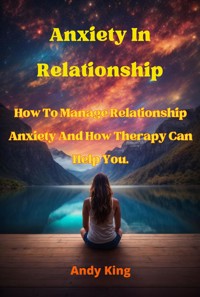
Anxiety In Relationship
How To Manage Relationship Anxiety And How Therapy Can Help You.
Be Andy King
Chapter 1. What is relational anxiety?
Chapter 2. Anxiety in couple relationships Attachment and jealousy
Chapter 3. How to manage anxiety in relationships?
Chapter 4. Essential and affordable remedies
Chapter 5. Making a list of your emotional state
Chapter 6. How to eliminate negative thinking?
Chapter 7. Parenting with an anxious partner
Chapter 8. Beware of blaming and criticizing.
Chapter 9. Cultivating Healthy and Flamboyant Relationships
Chapter 10. Boundaries in Relationships
Chapter 11. Therapy and how it can help you
Chapter 12. Handling Tips
Chapter 1. What is relational anxiety?
Anxiety can be a major problem and a mental health disorder that can lead to many other problems if left unchecked. Everyone experiences anxiety from time to time and when it gets worse when it becomes serious.
Here are some of the questions that may be going around in your head when you are stressed in a relationship:
What if he's not in love like I'm in love with him?
What if they lie to me?
What if he cheats on me?
What if I'm not good enough for my partner?
What if they meet someone else who is more attractive?
What if his family doesn't love me?
What if we decide to break up?
It's normal to have these thoughts when you're in a relationship that's new.
But, if thoughts like these cross your mind on a regular basis, this could be an indication of anxiety-related problems. The amount of time you spend on the above questions, as well as other similar issues, determines the degree to which you have fallen into an anxiety disorder. It also determines the degree to which your relationship is vulnerable.
These anxious thoughts manifest themselves in a variety of ways, and manifest themselves in the form of symptoms such as breathing problems, insomnia, and panic or anxiety attacks. It is possible that when you think like this, panic attacks are triggered in which your heart races, it beats very loudly and you start shaking all over your body. These are the signs that you suffer from anxiety disorders.
In certain situations, anxiety can cause your partner to act in ways that make you feel stressed and can strain the relationship. This is because you are so transparent with your partner that they are able to see that you are very insecure.
You may be worried and nervous about being the one who initiates a conversation all the time. It becomes a recurring thought inside your head that your spouse doesn't like communicating with you because he or she doesn't initiate communication as often as you do. The fear builds up and increases in intensity and you begin to believe that he or she will never talk to you unless you don't talk to him or her first.
To alleviate this fear, if you are feeling anxious, the best thing you can do is to remain silent for a while. This will get your partner to talk to you, until you feel confident that he or she will make the effort. This will allow you to confront your irrational and anxious belief that he or she will not try to contact you first. However, this is not the best idea. Finding the root of anxiety and rebuilding trust is the most effective method of overcoming anxiety and living a free and happy life.
Intimate relationships can be emotionally intense. This is due to the bond one has with another person. Unfortunately, this closeness can make one feel powerless and cause anxiety and fear. Anxiety is fear of something, and insecurity is self-doubt and lack of self-confidence.
You begin to perceive your partner's motives or actions as negative, and you begin to think of your partner as difficult or even negative.
Some symptoms of an intense anxiety disorder may include:
Feelings of restlessness
Tense muscles
Difficulty concentrating or remembering
Reluctance or difficulty making decisions
Worry that makes us continue to need security
Inability to sleep and rest
As often as relationships are beautiful and satisfying, they can create anxious thoughts and emotions. Thoughts can arise at any point in the relationship. If you are not yet in a relationship and are thinking about finding the right person or being in a relationship, this can cause anxiety in you and you need to be able to deal with it.
Insecurity can be the result of not feeling secure enough or feeling threatened in some way.
Many people believe that insecurity is caused by the actions or inactions of their loved ones. In reality, most anxiety comes from within you. Insecurity is created when you compare yourself to others and criticize yourself harshly. Most of the fears you experience in your relationships come from unfounded thoughts and fears that you are not good enough, and that you are incapable of making another person happy.
However, this is not the truth!
If you start to feel the discomfort of feeling insecure, the first option is to start taking stock of your worth. Insecurity causes you to focus on what you think is wrong with you. In the most balanced relationships, each person brings unique strengths and attributes that complement each other.
Developing self-esteem is important in overcoming the fears you experience in your relationships.
You are a whole person within your own self and should be able to let your self-confidence and independence shine through your words and actions. If your well-being depends on someone else, you hand them the keys to your happiness and give them the power to make decisions. This can be very unhealthy for your partner and definitely does not work well in a relationship. One way to increase your self-esteem is to let go of your inner critic and keep your attention and mind on the positive aspects of your character.
If you were doing an excellent job of attending to physical and mental, and even emotional demands before the relationship, you should not stop doing that just because you are in an intimate relationship. You must keep your independence in check and never become dependent. Being an individual with an identity and a life outside of the relationship can make you a more attractive and appealing partner. Your life must keep moving forward and you will make substantial improvements when you are in the course of a relationship. In a committed relationship, it is not the end of your life. On the contrary, you should continue with determination and work to achieve more goals, which will make you more attractive to your partner.
Anxiety and relationships in psychology
Are you experiencing relationship anxiety? It is also known as relationship tension or relationship distress.
The most common reason for relationship anxiety is the feeling that you are not worthy of being with your partner, or that you are not worthy of your partner, but it can also be due to the belief that your partner is not good enough for you and might be with someone else rather than you.
It can also be the result of feeling that another person is not interested in you (or perhaps even that you don't like him or her).
The term "relational anxiety" refers to an anxiety disorder that causes distress, nervousness and anxiety when you are in a relationship. The anxiety experienced by this type of person is not due to physical signs or external causes, but to the importance of the relationship, in which the person's mental health is often at stake. It can affect relationships with family members, friends and strangers.
There are numerous theories about what triggers relationship anxiety, and each has different merits as to what causes someone to experience it in a particular circumstance. Dr. Aaron Beck, a psychiatrist specializing in this area of study, has an opinion on the four main causes of relationship anxiety. He believes that sufferers of this type of anxiety are afraid of abandonment, loss of identity or betrayal.
Anxiety in parents and children
Children are prone to a certain type of anxiety when their parents are away, or react differently than they would with them, known as relationship anxiety. This type of anxiety is common in children who have not yet acquired the mental capacity to recognize that their parents may be there for them even if they do not show it in the same way as when they are present. Most children outgrow this stage by the age of three or four, but may return to it later if their parents' behavior changes.
Relational stress toward friends
The term "relational stress" can be applied to people who experience anxiety about their interactions with family and friends, such as family members or friends.
We all encounter emotional turmoil at times, which is often caused by the intensification of our emotions. If these emotions are not related to a specific issue and seem to occur randomly, it could mean that the person may need to focus more on their own and other people's relationships. Relationship stress is thought to be due to the fact that we all need some kind of help from others to get through difficult times. Being alone is not easy for some people. If this support is not readily available, as it can be when we are young, it can make us feel emotionally drained even if the stress is not visible.




