


162,99 €
Mehr erfahren.
- Herausgeber: John Wiley & Sons
- Kategorie: Fachliteratur
- Sprache: Englisch
A hands-on, integrated approach to solving combustion problems in diverse areas An understanding of turbulence, combustion, and multiphase reacting flows is essential for engineers and scientists in many industries, including power genera-tion, jet and rocket propulsion, pollution control, fire prevention and safety, and material processing. This book offers a highly practical discussion of burning behavior and chemical processes occurring in diverse materials, arming readers with the tools they need to solve the most complex combustion problems facing the scientific community today. The second of a two-volume work, Applications of Turbulent and Multiphase Combustion expands on topics involving laminar flames from Professor Kuo's bestselling book Principles of Combustion, Second Edition, then builds upon the theory discussed in the companion volume Fundamentals of Turbulent and Multiphase Combustion to address in detail cutting-edge experimental techniques and applications not covered anywhere else. Special features of this book include: * Coverage of advanced applications such as solid propellants, burning behavior, and chemical boundary layer flows * A multiphase systems approach discussing basic concepts before moving to higher-level applications * A large number of practical examples gleaned from the authors' experience along with problems and a solutions manual Engineers and researchers in chemical and mechanical engineering and materials science will find Applications of Turbulent and Multiphase Combustion an indispensable guide for upgrading their skills and keeping up with this rapidly evolving area. It is also an excellent resource for students and professionals in mechanical, chemical, and aerospace engineering.
Sie lesen das E-Book in den Legimi-Apps auf:
Seitenzahl: 798
Veröffentlichungsjahr: 2012
Ähnliche


















Table of Contents
Title Page
Copyright
Dedication
Preface
Volume 1, Fundamentals of Turbulent and Multiphase Combustion
Volume 2, Applications of Turbulent and Multiphase Combustion
Chapter 1: Solid Propellants and Their Combustion Characteristics
1.1 Background of Solid Propellant Combustion
1.2 Solid-Propellant Rocket and Gun Performance Parameters
Chapter Problems
Chapter 2: Thermal Decomposition and Combustion of Nitramines
2.1 Thermophysical Properties of Selected Nitramines
2.2 Polymorphic Forms of Nitramines
2.3 Thermal Decomposition of RDX
2.4 Gas-Phase Reactions of RDX
2.5 Modeling of RDX Monopropellant Combustion with Surface Reactions
Chapter Problems
Chapter 3: Burning Behavior of Homogeneous Solid Propellants
3.1 Common Ingredients in Homogeneous Propellants
3.2 Combustion Wave Structure of a Double-Base Propellant
3.3 Burning Rate Behavior of a Double-Base Propellant
3.4 Burning Rate Behavior of Catalyzed Nitrate-Ester Propellants
3.5 Thermal Wave Structure and Pyrolysis Law of Homogeneous Propellants
3.6 Modeling and Prediction of Homogeneous Propellant Combustion Behavior
3.7 Transient Burning Characterization of Homogeneous Solid Propellant
Chapter Problems
Chapter 4: Chemically Reacting Boundary-Layer Flows
4.1 Introduction
4.2 Governing Equations for Two-Dimensional Reacting Boundary-Layer Flows
4.3 Boundary Conditions
4.4 Chemical Kinetics
4.5 Laminar Boundary-Layer Flows with Surface Reactions
4.6 Laminar Boundary-Layer Flows With Gas-Phase Reactions
4.7 Turbulent Boundary-Layer Flows with Chemical Reactions
Chapter Problems
Chapter 5: Ignition and Combustion of Single Energetic Solid Particles
5.1 Why Energetic Particles Are Attractive for Combustion Enhancement in Propulsion
5.2 Metal Combustion Classification
5.3 Metal Particle Combustion Regimes
5.4 Ignition of Boron Particles
5.5 Experimental Studies
5.6 Theoretical Studies of Boron Ignition and Combustion
5.7 Theoretical Model Development of Boron Particle Combustion
5.8 Ignition and Combustion of Boron Particles in Fluorine-Containing Environments
5.9 Combustion of a Single Aluminum Particle
5.10 Ignition of Aluminum Particle in a Controlled Postflame Zone
5.11 Physical Concepts of Aluminum Agglomerate Formation
5.12 Combustion Behavior for Fine and Ultrafine Aluminum Particles
5.13 Potential Use of Energetic Nanosize Powders for Combustion and Rocket Propulsion
Chapter Problems
Chapter 6: Combustion of Solid Particles in Multiphase Flows
6.1 Void Fraction and Specific Particle Surface Area
6.2 Mathematical Formulation
6.3 Method of Characteristics Formulation
6.4 Ignition Cartridge Results
6.5 Governing Equations for the Mortar Tube
6.6 Predictions of Mortar Performance and Model Validation
6.7 Approximate Riemann Solver: Roe-Pike Method
6.8 Roe's Method
6.9 Roe-Pike Method
6.10 Entropy Condition and Entropy Fix
6.11 Flux Limiter
6.12 Higher Order Correction
6.13 Three-Dimensional Wave Propagation
Chapter Problems
Appendix A: Useful Vector and Tensor Operations
Appendix B: Constants and Conversion Factors Often Used in Combustion
Appendix C: Naming of Hydrocarbons
Appendix D: Particle Size–U.S. Sieve Size and Tyler Screen Mesh Equivalents
Bibliography
Index
This book is printed on acid-free paper.
Copyright © 2012 by John Wiley & Sons, Inc. All rights reserved
Published by John Wiley & Sons, Inc., Hoboken, New Jersey
Published simultaneously in Canada
No part of this publication may be reproduced, stored in a retrieval system, or transmitted in any form or by any means, electronic, mechanical, photocopying, recording, scanning, or otherwise, except as permitted under Section 107 or 108 of the 1976 United States Copyright Act, without either the prior written permission of the Publisher, or authorization through payment of the appropriate per-copy fee to the Copyright Clearance Center, 222 Rosewood Drive, Danvers, MA 01923, (978) 750-8400, fax (978) 646-8600, or on the web at www.copyright.com. Requests to the Publisher for permission should be addressed to the Permissions Department, John Wiley & Sons, Inc., 111 River Street, Hoboken, NJ 07030, (201) 748-6011, fax (201) 748-6008, or online at www.wiley.com/go/permissions.
Limit of Liability/Disclaimer of Warranty: While the publisher and the author have used their best efforts in preparing this book, they make no representations or warranties with respect to the accuracy or completeness of the contents of this book and specifically disclaim any implied warranties of merchantability or fitness for a particular purpose. No warranty may be created or extended by sales representatives or written sales materials. The advice and strategies contained herein may not be suitable for your situation. You should consult with a professional where appropriate. Neither the publisher nor the author shall be liable for damages arising herefrom.
For general information about our other products and services, please contact our Customer Care Department within the United States at (800) 762-2974, outside the United States at (317) 572-3993 or fax (317) 572-4002.
Wiley publishes in a variety of print and electronic formats and by print-on-demand. Some material included with standard print versions of this book may not be included in e-books or in print-on-demand. If this book refers to media such as a CD or DVD that is not included in the version you purchased, you may download this material at http://booksupport.wiley.com. For more information about Wiley products, visit www.wiley.com.
Library of Congress Cataloging-in-Publication Data:
Kuo, Kenneth K.
Applications of turbulent and multiphase combustion / Kenneth K. Kuo,
Ragini Acharya.
p. cm.
Includes bibliographical references and index.
ISBN 978-1-118-12756-8 (hardback); 978-1-118-12757-5 (ebk.); 978-1-118-12758-2 (ebk.); 978-1-118-12759-9 (ebk.); 978-1-118-13068-1 (ebk.); 978-1-118-13069-8 (ebk.); 978-1-118-13070-4 (ebk.)
1. Combustion engineering. 2. Turbulence. 3. Multiphase flow—Mathematical models. 4. Combustion—Mathematical models. I. Acharya, Ragini. II. Title.
TJ254.5.K847 2012
621.4023—dc23
2011051086
ISBN: 978-1-118-12756-8
Ken Kuo would like to dedicate this book to his wife, Olivia (Jeon-lin), and their daughters, Phyllis and Angela, for their love, understanding, patience, and support, and to his mother, Mrs. Wen-Chen Kuo, for her love and encouragement.
Preface
There is an ever-increasing need to understand turbulent and multiphase combustion due to their broad application in energy, environment, propulsion, transportation, industrial safety, and nanotechnology. More engineers and scientists with skills in these areas are needed to solve many multifaceted problems. Turbulence itself is one of the most complex problems the scientific community faces. Its complexity increases with chemical reactions and even more in the presence of multiphase flows.
A number of useful books have been published recently in the areas of theory of turbulence, multiphase fluid dynamics, turbulent combustion, and combustion of propellants. These include Theoretical and Numerical Combustion by Poinsot and Veynante; Turbulent Flows by Pope; Introduction to Turbulent Flow by Mathieu and Scott; Turbulent Combustion by Peters; Multiphase Flow Dynamics by Kolev; Combustion Physics by Law; Fluid Dynamics and Transport of Droplet and Sprays by Sirignano; Compressible, Turbulence, and High-SpeedFlow by Gatski and Bonnet; Combustion by Glassman and Yetter, among others.
Kenneth Kuo, the first author of this book, previously published Principles of Combustion. The second edition, published in 2005, contains comprehensive material on laminar flames, chemical thermodynamics, reaction kinetics, and transport properties for multicomponent mixtures. As the research in laminar flames was overwhelming, he decided to develop two separate books dedicated entirely to turbulent and multiphase combustion.
Turbulence, turbulent combustion, and multiphase reacting flows have been major research topics for many decades, and research in these areas is expected to continue at even a greater pace. Usually the research has focused on experimental studies with phenomenological approaches, resulting in the development of empirical correlations. Theoretical approaches have achieved some degree of success. However, in the past 20 years, advances in computational capability have enabled significant progress to be made toward comprehensive theoretical modeling and numerical simulation. Experimental diagnostics, especially nonintrusive laser-based measurement techniques, have been developed and used to obtain accurate data, which have been used for model validation. There is a greater synergy between the experimental and theoretical/numerical approaches. Due to these ongoing developments and advancements, theoretical modeling and numerical simulation hold great potential for future solutions of problems. In these two new books, we have attempted to integrate the fundamental theories of turbulence, combustion, and multiphase phenomena as well as experimental techniques, so that readers can acquire a firm background in both contemporary and classical approaches. The first book volume is called Fundamentals of Turbulent and Multiphase Combustion; the second is called Applications of Turbulent and Multiphase Combustion. The first volume can serve as a graduate-level textbook that covers the area of turbulent combustion and multiphase reacting flows as well as material that builds on these fundamentals. This volume also can be useful for research purpose. It is oriented toward the theories of combustion, turbulence, multiphase flows, and turbulent jets. Whenever appropriate, experimental setups and results are provided. The first volume addresses eight basic topical areas in combustion and multiphase flows, including laminar premixed and nonpremixed flames; theory of turbulence; turbulent premixed and nonpremixed flames; background of multiphase flows; and spray atomization and combustion. A deep understanding of these topics is necessary for researchers in the field of combustion.
The six chapters in the second volume build on the ground covered in the first volume. Its chapters include: solid propellant combustion, thermal decomposition and combustion of nitramines burning behavior of homogeneous solid propellants, chemically reacting boundary-layer flows, ignition and combustion of combustion of single energetic solid particles, and combustion of solid particles in multiphase flows. The major reason for including solid-propellant combustion here is to provide concepts for condensed-phase combustion modeling as an example. Nitramines are explosive or propellant ingredients; their decomposition and reaction mechanisms are also good examples for combustion behavior of condensed-phase materials. Chapters in Volume 2 focus on the application aspect of fundamental concepts and can form the framework for an advanced graduate-level course in combustion of condensed-phase materials. However, the selection of materials for instruction depends extirely on the interests of instructors and students. Although several chapters address solid propellant combustion, this volume is not a textbook for solid propellant combustion; many topics in this area are not included due to space limitations.
Volume 1, Fundamentals of Turbulent and Multiphase Combustion
Chapter 1 introduces and stresses the importance of combustion and multiphase flows in research. It also provides a succinct review of major conservation equations. Appendix A provides the vector and tensor operations frequently used in the formulation and manipulation of these equations.
Chapter 2 covers the basic structure of laminar premixed flames, conservation equations, various models for diffusion velocities in a multicomponent gas system with increasing complexities, laminar flame thickness, asymptotic analyses, and flame speeds. Effect of flame stretch on laminar flame speed, Karlovitz number, and Markstein lengths are also discussed in detail along with soot formation in laminar premixed flames.
Chapter 3 discusses the basic structure of laminar nonpremixed flames and provides detailed descriptions of mixture fraction definition, balance equations for mixture fraction, temperature-mixture fraction relationship, and examples, since mixture fraction is a very important parameter in the study of nonpremixed flames. The chapter also discusses laminar flamelet structure and equations, critical scalar dissipation rate, steady-state combustion, and examples of laminar diffusion flames with equations and solutions. Since pollution, specifically soot formation, has become a major topic of interest, it is also covered in this chapter with respect to laminar diffusion flames. Appendix D provides a detailed soot formation mechanism and rate constants that was proposed by Wang and Frenklach.
Chapter 4 is devoted entirely to turbulent flows. It covers the fundamental understanding of turbulence from a statistical point of view; homogeneous and/or isotropic turbulence, averaging procedures, statistical moments, and correlation functions; Kolmogorov hypotheses; turbulent scales; filtering and large-eddy simulation (LES) concepts along with various subgrid scale models; and basic definitions to prepare readers for the probability density function (pdf) approach in later chapters. This chapter also includes the governing equations for compressible flows. A short introduction of the direct numerical simulation (DNS) approach is also provided at the end of the chapter.
Chapters 5 and 6 focus on the turbulent premixed and nonpremixed flames, respectively. Chapter 5 consists of physical interpretation; studies for turbulent flame-speed correlation development; Borghi diagram and physical interpretation of various regimes; eddy breakup models; measurements in premixed turbulent flames; flame-turbulence interaction (effects of turbulence on flame as well as effect of flame on turbulence); turbulence combustion modeling approaches; Bray-Moss-Libby model (gradient and counter-gradient transport); level set approach and G-equation for flame surfaces; and the pdf approach and closure of chemical reaction source term. In Chapter 6, the discussion focuses on major problems in nonpremixed turbulent combustion; turbulent Damkhler number and Reynolds number; scales in nonpremixed turbulent flames; regime diagrams; target flames; turbulence-chemistry interaction; pdf approach; flamelet models; flame-vortex interaction; flame instability; partially premixed flames; and edge flames.
The fundamentals of multiphase flows are covered in Chapter 7, which has sections on classification of multiphase flows; homogeneous versus multiphase mixtures; averaging methods; local instant formulation; Eulerian-Eulerian modeling; Eulerian-Lagrangian modeling; interface transport (tracking and capturing) methods (volume of fluid, surface fitted method, markers on interface); and discrete particle methods. This chapter also provides many contemporary approaches for modeling two-phase flows.
Spray combustion is an extremely important topic for combustion, and Chapter 8 provides a comprehensive account of various modeling approaches to spray combustion associated with single drop behavior, drop breakup mechanisms, jet breakup models, group combustion models, droplet-droplet collisions, and dense sprays. Experimental approaches and results are also presented in this chapter.
Volume 2, Applications of Turbulent and Multiphase Combustion
Chapter 1 provides a background in solid propellants and their combustion behavior, including desirable characteristics; oxygen balance; homogeneous and heterogeneous propellants; fuel binders, oxidizer ingredients, curing and cross-linking agents, and aging; hazard classifications; material characterization of solid propellants; and gun performance parameters including thrust, specific impulse, and stable/unstable burning behavior.
Chapter 2 focuses on nitramine decomposition and combustion; phase transformation; and three different approaches for thermal decomposition of royal demolition explosive (RDX) as well as gas-phase reactions. This chapter also describes a modeling approach for RDX combustion.
Chapter 3 covers the burning behavior of homogeneous (e.g., double-base) propellants, describing both the experimental and modeling approaches to study and predict the burning rate and temperature sensitivities of common solid propellants. The transient burning characteristics of a typical homogeneous propellant is also presented in detail, including the Zel'dovich map technique and the Novozhilov stability parameters.
Chapter 4 covers reacting turbulent boundary-layer flows, a topic of research for the last six decades. The chapter discusses the modeling approaches from 1940s to the current date. Graphite nozzle erosion process by high-temperature combustion product gases through heterogeneous chemical reactions is covered in detail. Turbulent wall fires are also covered.
Chapter 5 contains the ignition and combustion studies of single energetic particles (such as micron-size boron and aluminum particles) including multistage combustion models for cases with and without the presence of oxide layers, kinetic mechanisms, criterion for diffusion-controlled combustion versus, kinetic controlled combustion, effect of oxidizers (such as oxygen- and fluorine-containing species), combustion of nano-size energetic particles, and their strong dependency on kinetic rates.
Chapter 6 addresses the two-phase reacting flow simulation and focuses on granular bed combustion with different solution techniques for the governing equations. It also includes experimental validation of the calculated results.
We would like to acknowledge the contributions of many of our combustion and turbulence colleagues for reviewing and providing a critical assessment of multiple chapters of these volumes includes Professor Forman A. Williams of the University of California-San Diego; Professor Stephen B. Pope, Cornell University; Dr. Richard Behrens, Jr. of Sandia National Laboratory; Dr. William R. Anderson of the U.S. Army Research Laboratory; Professor Luigi T. DeLuca of Politecnico di Milano, Italy; and Professors James G. Brasseur, Daniel C. Haworth, and Michael M. Micci of Pennsylvania State University. They spent their valuable time reading chapters and helped us to improve the material covered in Volume 1 and Volume 2. We also want to thank Professor Michael Frenklach of University of California-Berkeley for providing us the detailed information on soot formation kinetics used in Appendix D of Volume 1. We also like to thank Professor William A. Sirignano of University of California-Irvine for his valuable input on evaporation and combustion of droplet arrays. Professor Norbert Peters of the Institut fr Technische Mechanik of Aachen, Germany, was very geneous to provide his book draft to Kenneth Kuo while he was visiting the Pennsylvania State University. His notes were very helpful in explaining turbulent combustion topics.
During the sabbatical leave of the first author at the U.S. Army Research Lab (ARL), Dr. Brad E. Forch of ARL and Dr. Ralph A. Anthenien Jr. of the Army Research Office (ARO)hosted and supported a series of his lectures. The lecture materials, which we prepared jointly, were used in the development of several chapters of Volume 2. We greatly appreciate the encouragement and support of Dr. Forch and Dr. Anthenien.
Kenneth Kuo would like to take this opportunity to thank his many research project sponsors, since his in-depth understanding of many topics in turbulent and multiphase combustion has been acquired through multi-year research. These sponsors include: Drs. Richard S. Miller, Judah Goldwasser, and Clifford D. Bedford of ONR of the U.S. Navy; Drs. David M. Mann, Robert W. Shaw, Ralph A. Anthenien, Jr. of ARO; Dr. Martin S. Miller of ARL; Mr. Carl Gotzmer of NSWC-Indian Head; Dr. Rich Bowen of NAVSEA of the US Navy, Drs. William H. Wilson and Suhithi Peiris of the Defense Threat Reduction Agency (DTRA); and Drs. Jeff Rybak, Claudia Meyer, and Matthew Cross of NASA. The authors would like to thank Mr. Henry T. Rand of ARDEC and Mr. Jack Sacco of Savit Corporation for sponsoring our project on granular propellant combustion.
Ragini Acharya would like to thank several professors at The Pennsylvania State University for developing the framework and knowledge base to aid her in writing the book manuscript, including Professors Andr L. Boehman, James G. Brasseur, John H. Mahaffy, Daniel C. Haworth, and Richard A. Yetter.
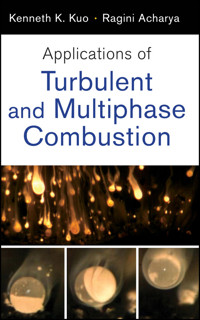
We both would like to acknowledge the generosity of Professor Peyman Givi of the University of Pittsburgh for granting us full permission to use some of his numerical simulation results of RANS, LES, and DNS of a turbulent jet flame on the jacket of Volume 1. For the cover of Volume 2, we would like to thank Dr. Larry P. Goss of Innovative Scientific Solutions, Inc and Dr. J. Eric Boyer of the High Pressure Combustion Lab of PSU for the photograph of metalized propellant combustion. Also, Professor Luigi De Luca and his colleagues Dr. Filippo Maggi at the Polytechnic Institute of Milan for granting the permission to use their close-up photographs of the burning surface region of metallized solid propellants, showing the dynamic motion of the burning of aluminum/Al2O3 particles.
We would also like to thank Ms. Petek Jinkins and Ms. Aqsa Ahmed for typing references, preliminary proofreading, and miscellaneous help with the preparation of the manuscript. We also want to thank John Wiley & Sons for their patience and cooperation. Last but not least, we also would like to thank our family members for their sacrifice during the long and difficult process of manuscript preparation.
Kenneth K. Kuo and Ragini Acharya
University Park, Pennsylvania
Chapter 1
Solid Propellants and Their Combustion Characteristics
Symbols (An optimized version of this table can be viewed at www.wiley.com/go/kuo2tables)
Symbol
Description
Dimension
A
e
Exit area of a rocket nozzle
L
2
A
s
Arrhenius factor in
Equation 1.27
(L/t)/(T)
A
t
Throat area of the rocket nozzle
L
2
a
Coefficient used in Saint-Robert's burning rate law (or Vieille's Law)
(L/t)/(F/L
2
)
n
C
D
Mass flow factor defined in
Equation 1.50
t/L
C
F
Dimensionless thrust coefficient
—
C
p
Constant-pressure specific heat
Q/(MT)
C*
Characteristic velocity, defined in
Equation 1.62
L/t
DI
sp
Density impulse defined in
Equation 1.60
Mt/L
3
Symbol
Description
Dimension
E
a
Activation energy in the Arrhenius law of
Equation 1.24
Q/N
F
Thrust force of a solid propellant rocket
F
F
e
Net force acting on the exterior surface of a rocket motor
F
F
i
Net force acting on the interior surface of a rocket motor
F
I
f
Radiative energy flux
Q/(L
2
t)
I
m
Impetus of a gun propellant
Q/M
I
st
Specific impulse
t
Symbol
Description
Dimension
I
t
Total impulse of a rocket
Ft
K
n
Ratio of propellant burning surface area to throat area
—
k
f
Specific reaction-rate constant (for a forward reaction of order of m)
(N/L
3
)
1-m
/t
k
g
Thermal conductivity of gas
Q/(LTt)
k
p
Thermal conductivity of propellant
Q/(LTt)
Dynamic vivacity, defined in
Equation 1.96
L
2
/(Ft)
L
w
Web thickness
L
M
Mass
M
M
i
The
i
th
molecular species
—
M
w
Molecular weight of the combustion products
M/N
Propellant mass burning rate per unit area
M/(L
2
t)
N
Total number of chemical species
—
Symbol
Description
Dimension
n
Pressure exponent of Saint-Robert's law (or Vieille's law)
—
P
or
p
Pressure
F/L
2
P
c
Pressure in the rocket motor combustor
F/L
2
Q
g
Heat of reaction per unit mass
Q/M
Q
s
Heat release per unit mass at burning propellant surface
Q/M
Radiative heat flux
Q/(L
2
t)
r
b
Burning rate of solid propellant
L/t
R
Gas constant
Q/(MT)
RF
Relative force, defined in
Equation 1.93
—
RQ
Relative quickness, defined in
Equation 1.92
—
R
u
Universal gas constant
Q/(NT)
T
Temperature
T
Symbol
Description
Dimension
T
i
Initial temperature
T
T
s
Surface temperature of a burning propellant
T
t
Time
t
U
Internal energy
Q
U
g
Gas velocity
L/t
or V
Volume
L
3
V
e
Exhaust jet velocity from a rocket motor, or muzzle velocity
L/t
V
e
,
vac
Effective vacuum exhaust jet velocity of a rocket motor
L/t
W
Work
Q
X
k
Mole fraction of the
k
th
species
—
x
Distance measured away from burning propellant surface
L
Symbol
Description
Dimension
Y
i
Mass fraction of
i
th
species, defined in Equation 2.59
—
y
Subsurface distance normal to the burning surface of a propellant
L
Symbol
Description
Dimension
Greek Symbols
d
Divergence angle of the nozzle exit station measured from centerline
p
Thermal diffusivity of solid propellant
L
2
/t
Dimensionless temperature exponent, defined in
Equation 1.27
—
Dimensionless parameter defined in
Equation 1.44
—
th
Thermal wave thickness
L
Heat of explosion per unit mass, defined in
Equation 1.91
Q/M
Strain
—
Characteristic coefficient of a gun system
—
b
Ballistic efficiency, defined in
Equation 1.85
—
Thrust coefficient efficiency, defined in
Equation 1.71
—
p
Piezometric efficiency, defined in
Equation 1.83
—
Symbol
Description
Dimension
th
Thermal efficiency of a gun system, defined in
Equation 1.88
—
Dimensionless temperature defined in
Equation 1.5
—
Ratio of propellant mass to rocket motor mass
—
Paremeter associated with the divergence angle of the nozzle exit section, defined in
Equation 1.40
—
Stoichiometric coefficient of the
i
th
reactant
— or N
Stoichiometric coefficient of the
i
th
product
— or N
k
Pressure insensitivity of the rocket motor, defined in
Equation 1.66
1/T
Density
M/L
3
p
Temperature sensitivity of a propellant
1/T
Stress
F/L
2
Gas-phase reaction rate per unit volume
M/(L
3
t)
Symbol
Description
Dimension
Subscripts
f
Forward reaction
g
Gas
i
Initial or i
th
species
p
Propellant
s
Surface
Many books are specifically devoted to solid propellants. Readers interested in extensive discussions of solid propellant combustion can read the books edited by Kuo and Summerfield (1984), De Luca, Price, Summerfield (1992), Yang, Brill, and Ren (2000), and Kubota (2007). This chapter provides the background information for readers to understand certain basic materials related to the solid propellants and their combustion characteristics.
The chapter includes performance parameter considerations for solid propellant rocket motors and gun propulsion systems. Definitions and significance of many important parameters for rocket motors are covered at the beginning of the chapter, including specific impulse, characteristic velocity, thrust coefficient, density Isp, pressure sensitivity parameter, thrust-coefficient efficiency, and others. Various performance parameters for solid-propellant gun systems are also covered, including muzzle velocity, pressure-travel curve, maximum pressure, velocity-travel curves, piezometeric efficiency, ballistic efficiency, gun-propellant impetus, thermal efficiency, characteristic coefficient, relative quickness, relative force, and dynamic vivacity. Many of these parameters have been considered in the formulation and development of modern solid propellants for both rocket and gun propulsion systems for space propulsion and military applications. The chapter also addresses the relationship between propellant burning rate behavior and these performance parameters.
Lesen Sie weiter in der vollständigen Ausgabe!
Lesen Sie weiter in der vollständigen Ausgabe!
Lesen Sie weiter in der vollständigen Ausgabe!
Lesen Sie weiter in der vollständigen Ausgabe!
Lesen Sie weiter in der vollständigen Ausgabe!
Lesen Sie weiter in der vollständigen Ausgabe!
Lesen Sie weiter in der vollständigen Ausgabe!
Lesen Sie weiter in der vollständigen Ausgabe!
Lesen Sie weiter in der vollständigen Ausgabe!
Lesen Sie weiter in der vollständigen Ausgabe!
Lesen Sie weiter in der vollständigen Ausgabe!
Lesen Sie weiter in der vollständigen Ausgabe!
Lesen Sie weiter in der vollständigen Ausgabe!
Lesen Sie weiter in der vollständigen Ausgabe!




