


30,99 €
Mehr erfahren.
- Herausgeber: John Wiley & Sons
- Kategorie: Fachliteratur
- Serie: Wiley Finance Editions
- Sprache: Englisch
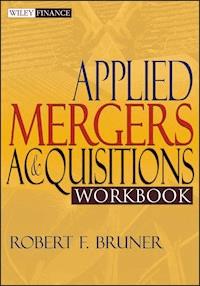
The Applied Mergers and Acquisitions Workbook provides a useful self-training study guide for readers of Applied Mergers and Acquisitions who want to review the drivers of M&A success and failure. Useful review questions as well as problems and answers are provided for both professionals and students. Readers will further their knowledge, build practical intuition, and learn the art and science of M&A by using this comprehensive self-study workbook in conjunction with the main text.
Sie lesen das E-Book in den Legimi-Apps auf:
Seitenzahl: 533
Veröffentlichungsjahr: 2011
Ähnliche
















Contents
Introduction to the Workbook
Part One: Questions
Chapter 1: Introduction and Executive Summary
Chapter 2: Ethics in M&A
Chapter 3: Does M&A Pay?
Chapter 4: M&A Activity
Chapter 5: Cross-Border M&A
Chapter 6: Strategy and the Uses of M&A to Grow or Restructure the Firm
Chapter 7: Acquisition Search and Deal Origination: Some Guiding Principles
Chapter 8: Due Diligence
Chapter 9: Valuing Firms
Chapter 10: Valuing Options
Chapter 11: Valuing Synergies
Chapter 12: Valuing the Firm across Borders
Chapter 13: Valuing the Highly Levered Firm, Assessing the Highly Levered Transaction
Chapter 14: Real Options and Their Impact on M&A
Chapter 15: Valuing Liquidity and Control
Chapter 16: Financial Accounting for Mergers and Acquisitions
Chapter 17: Momentum Acquisition Strategies: An Illustration of Why Value Creation Is the Best Financial Criterion
Chapter 18: An Introduction to Deal Design in M&A
Chapter 19: Choosing the Form of Acquisitive Reorganization
Chapter 20: Choosing the Form of Payment and Financing
Chapter 21: Framework for Structuring the Terms of Exchange: Finding the “Win-Win” Deal
Chapter 22: Structuring and Valuing Contingent Payments in M&A
Chapter 23: Risk Management in M&A
Chapter 24: Social Issues
Chapter 25: How a Negotiated Deal Takes Shape
Chapter 26: Governance in M&A: The Board of Directors and Shareholder Voting
Chapter 27: Rules of the Road: Securities Law, Issuance Process, Disclosure, and Insider Trading
Chapter 28: Rules of the Road: Antitrust Law
Chapter 29: Documenting the M&A Deal
Chapter 30: Negotiating the Deal
Chapter 31: Auctions in M&A
Chapter 32: Hostile Takeovers: Preparing a Bid in Light of Competition and Arbitrage
Chapter 33: Takeover Attack and Defense
Chapter 34: The Leveraged Restructuring as a Takeover Defense: The Case of American Standard
Chapter 35: Communicating the Deal: Gaining Mandates, Approval, and Support
Chapter 36: Framework for Postmerger Integration
Chapter 37: Corporate Development as a Strategic Capability: The Approach of GE Power Systems
Chapter 38: M&A “Best Practices”: Some Lessons and Next Steps
Part Two: Answers
Chapter 1: Introduction and Executive Summary
Chapter 2: Ethics in M&A
Chapter 3: Does M&A Pay?
Chapter 4: M&A Activity
Chapter 5: Cross-Border M&A
Chapter 6: Strategy and the Uses of M&A to Grow or Restructure the Firm
Chapter 7: Acquisition Search and Deal Origination: Some Guiding Principles
Chapter 8: Due Diligence
Chapter 9: Valuing Firms
Chapter 10: Valuing Options
Chapter 11: Valuing Synergies
Chapter 12: Valuing the Firm across Borders
Chapter 13: Valuing the Highly Levered Firm, Assessing the Highly Levered Transaction
Chapter 14: Real Options and Their Impact on M&A
Chapter 15: Valuing Liquidity and Control
Chapter 16: Financial Accounting for Mergers and Acquisitions
Chapter 17: Momentum Acquisition Strategies: An Illustration of Why Value Creation Is the Best Financial Criterion
Chapter 18: An Introduction to Deal Design in M&A
Chapter 19: Choosing the Form of Acquisitive Reorganization
Chapter 20: Choosing the Form of Payment and Financing
Chapter 21: Framework for Structuring the Terms of Exchange: Finding the “Win-Win” Deal
Chapter 22: Structuring and Valuing Contingent Payments in M&A
Chapter 23: Risk Management in M&A
Chapter 24: Social Issues
Chapter 25: How a Negotiated Deal Takes Shape
Chapter 26: Governance in M&A: The Board of Directors and Shareholder Voting
Chapter 27: Rules of the Road: Securities Law, Issuance Process, Disclosure, and Insider Trading
Chapter 28: Rules of the Road: Antitrust Law
Chapter 29: Documenting the M&A Deal
Chapter 30: Negotiating the Deal
Chapter 31: Auctions in M&A
Chapter 32: Hostile Takeovers: Preparing a Bid in Light of Competition and Arbitrage
Chapter 33: Takeover Attack and Defense
Chapter 34: The Leveraged Restructuring as a Takeover Defense: The Case of American Standard
Chapter 35: Communicating the Deal: Gaining Mandates, Approval, and Support
Chapter 36: Framework for Postmerger Integration
Chapter 37: Corporate Development as a Strategic Capability: The Approach of GE Power Systems
Chapter 38: M&A “Best Practices”: Some Lessons and Next Steps
Founded in 1807, John Wiley & Sons is the oldest independent publishing company in the United States. With offices in North America, Europe, Australia and Asia, Wiley is globally committed to developing and marketing print and electronic products and services for our customers’ professional and personal knowledge and understanding.
The Wiley Finance series contains books written specifically for finance and investment professionals as well as sophisticated individual investors and their financial advisors. Book topics range from portfolio management to e-commerce, risk management, financial engineering, valuation and financial instrument analysis, as well as much more.
For a list of available titles, please visit our Web site at www.WileyFinance.com.
Copyright © 2004 by Robert F. Bruner. All rights reserved.
Published by John Wiley & Sons, Inc., Hoboken, New Jersey.
Published simultaneously in Canada.
No part of this publication may be reproduced, stored in a retrieval system, or transmitted in any form or by any means, electronic, mechanical, photocopying, recording, scanning, or otherwise, except as permitted under Section 107 or 108 of the 1976 United States Copyright Act, without either the prior written permission of the Publisher, or authorization through payment of the appropriate per-copy fee to the Copyright Clearance Center, Inc., 222 Rosewood Drive, Danvers, MA 01923, 978-750-8400, fax 978-646-8600, or on the web at www.copyright.com. Requests to the Publisher for permission should be addressed to the Permissions Department, John Wiley & Sons, Inc., 111 River Street, Hoboken, NJ 07030, 201-748-6011, fax 201-748-6008.
Limit of Liability/Disclaimer of Warranty: While the publisher and author have used their best efforts in preparing this book, they make no representations or warranties with respect to the accuracy or completeness of the contents of this book and specifically disclaim any implied warranties of merchantability or fitness for a particular purpose. No warranty may be created or extended by sales representatives or written sales materials. The advice and strategies contained herein may not be suitable for your situation. You should consult with a professional where appropriate. Neither the publisher nor author shall be liable for any loss of profit or any other commercial damages, including but not limited to special, incidental, consequential, or other damages.
For general information on our other products and services, or technical support, please contact our Customer Care Department within the United States at 800-762-2974, outside the United States at 317-572-3993 or fax 317-572-4002.
Wiley also publishes its books in a variety of electronic formats. Some content that appears in print may not be available in electronic books.
For more information about Wiley products, visit our web site at www.wiley.com.
ISBN: 0-471-39585-4
With gratitude, I dedicate this workbook to my students.
Acknowledgments
I am greatly thankful for the contributions of my able research assistants, who prepared questions for this workbook under my direction. The principal assistant for this project was Jessica Chan. Bright, patient, and a tenacious researcher, her work showed great care and dedication. Jessica led a team consisting of herself, Christine Shim, and Baocheng Yang. Christine was especially creative in framing financial problems in realistic terms; she is a champion wordsmith. Baocheng was the champion quant, contributing analytic care, modeling, and real option valuation. The complementary efforts of the three assistants lent flair and precision to the book. I must also recognize Frank Wilmot, Research Librarian at Darden, who gave excellent support in obtaining sometimes obscure data and references. I am truly grateful to them for the creativity and exceptionally hard work they brought to the project. Many of the illustrations in this book draw on the efforts of my earlier research assistants
I am very grateful to the staff of the Darden School for its support in this project. Excellent editorial assistance at Darden was provided by Stephen Smith (Darden’s unflappable editor) and Sherry Alston. Betty Sprouse gave stalwart secretarial support. Outstanding library research support was given by Karen Marsh and Frank Wilmot. The patience, care, and dedication of these people are richly appreciated.
I must also acknowledge the great support and encouragement given by my editors (and now friends) at John Wiley & Sons: Bill Falloon, Senior Editor, Finance and Investments; Melissa Scuereb, Editorial Assistant; Robin Factor, Managing Production Editor; and Todd Tedesco, Senior Production Editor. I thank the staff at Cape Cod Compositors as well for their fine attention to detail. Also at Wiley, Pamela Van Giessen, Executive Editor; Joan O’Neil, Publisher, Finance and Investment; and Will Pesce, President, were decisive in my commitment to embark on this project. For the vision and enthusiasm of the Wiley organization, I am very thankful.
Lewis O’Brien of HPS Permissions read everything and gave very helpful advice regarding editorial presentation and support in obtaining permissions.
Of all the contributors, my wife, Barbara McTigue Bruner, and two sons, Jonathan and Alexander, have endured some of the greatest sacrifices to see this book appear. I owe this to them.
All these acknowledgments notwithstanding, responsibility for the final product is mine. I welcome suggestions for its enhancement. Please let me know of your experience with this book either through Wiley or contact me directly.
—Robert F. Bruner
Distinguished Professor of Business Administration and Executive Director of the Batten Institute Darden Graduate Business School University of Virginia E-mail: [email protected].
About the Author
Robert F. Bruner is Distinguished Professor of Business Administration and Executive Director of the Batten Institute at the Darden Graduate School of Business Administration, University of Virginia. He teaches the course, “Mergers and Acquisitions” in Darden’s MBA program, and is the faculty director of Darden’s executive education program, “Mergers and Acquisitions.” He has received numerous awards for teaching and casewriting in the United States and Europe. BusinessWeek magazine cited him as one of the “masters of the MBA classroom.” He is the author or co-author of over 400 case studies and notes, and of Case Studies in Finance: Managing for Corporate Value Creation, now in its fourth edition. His research has been published in journals such as Financial Management, Journal of Accounting and Economics, Journal of Applied Corporate Finance, Journal of Financial Economics, Journal of Financial and Quantitative Analysis, and Journal of Money, Credit, and Banking. Industrial corporations, financial institutions, and government agencies have retained him for counsel and training. He has served the Darden School, professional groups, and community organizations in various positions of leadership. Copies of his papers and essays may be obtained from his website, http://faculty.darden.edu/brunerb/. He may be reached via e-mail at [email protected].
Introduction to the Workbook
This Workbook aims to help you learn faster and more deeply from Applied Mergers and Acquisitions by Robert F. Bruner. Its mission is to promote self-instruction about M&A. Its chapters track exactly the content of the chapters in the main book. The problems and answers in this book carry the reader beyond the end-of-chapter questions on the CD-ROM, offering more exercise, stimulating further reflection, and exploring the topics in more depth. Specifically, each chapter in this book can help you:
Review the main ideas in each chapter and a few focused problems and questions.Survey the ideas in a forthcoming class and chapter reading assignment.Track the quantitative analysis of M&A issues in a step-by-step fashion.Exercise spreadsheet models in hands-on fashion.Test your own grasp of tools and concepts.Activities such as these are valuable in the effort to gain a solid mastery of M&A. The Workbook has four key features supporting the study of each chapter:
1.Introduction to the chapter. Stated in a few sentences, the introduction conveys the main focus of the chapter.
2.Key ideas. These are listed at the start of each review chapter in bullet-point fashion to summarize and express key learning points.
3.Worked-through problems and questions. These are useful to illustrate key concepts and to test your grasp of lessons.
4.References to Excel spreadsheet files. Found on the CD-ROM, these contain the actual models underlying the worked-through problems. You can study these files for the structure of the models and the logic of the analysis.
Chapter 38 of the main book emphasizes the importance of active learning to support one’s study. It is not enough simply to read: one must do. The spirit of this Workbook is to help you convert ideas into best practice in your daily work.
PART ONE
Questions
CHAPTER 1
Introduction and Executive Summary
M&A (mergers and acquisitions) is one of the most important means by which companies respond to changing conditions. Many firms have no alternative but to merge, acquire, or be acquired.
Although M&A is often portrayed as a gamble that one cannot win, it is possible to succeed in M&A. However, competitive forces may limit the chances of success.
M&A is a world of contingencies. There are few universal absolute truths about M&A success. For the M&A professional, therefore, there will always be a market for diligent research, sound judgment, and artful execution.Success in M&A is driven by both the structure of the M&A opportunity one faces and the conduct by which one pursues it.Elements of structure of the M&A environment include: Economics. This refers to quantitative drivers of the attractiveness of the opportunity: revenues, costs (both fixed and variable), risk, and required rates of return—these determine cash flow and the net present value of an M&A transaction. They also drive the financial stability and future growth of Newco. Best practitioners in M&A are rigorous analysts of the economics of an opportunity.Strategy. Strategic strengths, weaknesses, opportunities, and threats are part of the structure of the M&A environment. Many M&A transactions are motivated by a need to respond to the strategic environment. Careful strategic planning is crucial to success in M&A.Organization. Culture, leadership, talent, and organizational architecture of the merging firms have a major influence on the ability of Newco to achieve benefits of the deal. M&A practitioners must therefore lend careful thought to postmerger organizational structure.Brand. Large intangible influences in the setting of the M&A opportunity are the reputations of buyer and target. As a brand name affects the thinking of consumers, reputations can shape the expectations and behavior of participants in a merger. Best practitioners seek to create and preserve brand value, and to understand the sources of the counterparty’s brand.Law. Laws and regulations limit the actions of buyer and target firms. M&A practitioners must manage legal risk exposure and to consider opportunities to shape legislation.Ethics. Ethical norms surround everything one does in M&A and are often discovered only after they are broken. Best practitioners in M&A consciously address the ethical dimension in deal development.Conduct is the behavior of managers in the pursuit of good M&A outcomes and appears in M&A in the form of creativity, interpersonal skills, and elements of personality. Behavior is important because it filters and interacts with the structural elements of a deal. Behavior affects M&A outcomes in areas such as the following: Search for partners. Discovery of partners may rely on “networking,” which relies on social skills.Due diligence. Success in due diligence is tied to the investigator’s attitude and personal attributes such as stamina, care, and capacity for critical thinking.Negotiation and bidding. Psychology and self-discipline affect the outcomes of negotiation and bidding. Attitudes, appetites, and negotiation tactics have a large influence on deal prices and terms.Dealing with laws, regulations, and the justice system. Although laws and regulations may seem like constraints on actions, the M&A practitioner can strive to actually shape the structure of the M&A situation.Deal design. Deal design entails searching for trade-offs that will result in a win-win deal for both buyer and seller. Often, such a search requires flexibility and creativity from the deal negotiators.Postmerger integration. It takes managerial skill to successfully implement postmerger integration.Deal development process. Good process is one of the key drivers of good outcomes. Conscientiousness in developing a process mind-set lends discipline to thinking and increases the likelihood of a successful M&A outcome.The framework reminds us that successful outcomes have many dimensions. Best practitioners think in terms of the entire range of outcomes rather than narrowly in just one or two dimensions. One can benchmark the success of a deal against at least seven measures:1.Creation of market value. This is necessarily the first measure of success because of the obligation of managers and directors to serve the welfare of shareholders. But it is rarely sufficient by itself—to take an extreme example, value created unethically or illegally would be unacceptable.
2.Financial stability. Another measure of success is whether a deal strengthens the financial structure of the firm. Some deals have been so aggressively financed that they led to bankruptcy shortly after closing.
3.Improved strategic position. The deal should serve the mission and strategic objectives of the firm. Best practitioners look for a solid strategic rationale.
4.Organizational strength. The acquisition of talent, rejuvenation of a worn-out or defeatist culture, improvement of learning or technology transfer, and transformation of the organizational architecture of a firm are examples of ways in which a deal can strengthen the organization.
5.Enhanced brand. A successful deal may strengthen the esteem for the firm in the eyes of competitors, suppliers, customers, and employees.
6.Observance of the letter and spirit of ethical norms and laws. Success means more than avoiding criminal indictment: Best practitioners understand that it is important not only to do deals well, but also to do them right.
7.Improved process. Every transaction should sharpen a firm’s leadership and business processes. This happens when one conducts a deal with a learning mind-set.
CHAPTER 1—WORKBOOK QUESTIONS
Explain why each of the following statements is false:
1. Success in M&A is determined solely by structural factors.
2. In the behavioral realm, success in postmerger integration is influenced more by the conduct and interpersonal skills of managers than by organizational structure.
3. Best practice in the legal area of M&A emphasizes only the avoidance of violating laws or regulations so that the pre- and postmerger firms involved in the M&A transaction are not exposed to any legal jeopardy.
4. Actions in M&A that are not clearly ethical or that even are unethical will not lead to outright failure as long as they do not violate the law.
5. Being able to negotiate and consummate a deal is the hallmark of success in M&A.
6. Planning everything with painstaking care ensures a successful outcome.
7. The best due diligence processes are those that simply verify facts.
8. In M&A, outcomes are more important than processes.
9. For every M&A deal, there is one “best” deal design.
10. Decision makers should always refer to market prices for signals about behavior.
CHAPTER 2
Ethics in M&A
Ethical dilemmas are pervasive in M&A.
Unethical business practices are unsustainable; they do not provide a strong foundation for long-term corporate or professional success.
Companies that are committed to ethical behavior build trust and add meaningful value to their brand. A strong corporate reputation attracts active buyers, intermediaries, advisers, repeat business, and price premiums that ultimately yield attractive profits and higher returns.Ethical business practices promote strong leadership and teamwork in organizations. Ethical behavior aligns a company’s human capital around a set of shared values, which in turn enhance business processes and capabilities.A company committed to ethics will look above and beyond the law to set its standards for good business practices. The law is the lowest common denominator of social norms; it enforces punishment only for illegal behavior.Professionals who are guided by their consciences and commitment to ethical standards understand that personal pride and self-respect are invaluable, intangible assets.In most, if not all, cases, M&A professionals act as agents on behalf of a company’s stockholders and/or stakeholders. The stockholder theory, advanced by Milton Friedman (1962), holds that a company must act in the best interests of its owners and strive to maximize shareholders’ returns.Alternatively, Edward Freeman’s stakeholder theory (1984) prescribes a broader view: management should act in the interests of all of its stakeholders, which include constituent groups such as customers, buyers, and employees.Moral philosophy offers at least three bases for assessing what is right versus wrong.1.Consequences. The first perspective asks who will be affected, and how. This branch of philosophy argues that the “right actions” are those that produce the greatest good for the greatest number. Its best-known proponents include philosophers Jeremy Bentham (1748–1832) and John Stuart Mill (1806–1873).
2.Duties or intentions. The second perspective focuses on the matrix of duties surrounding the manager and the consistency of one’s intentions to fulfill them. An action is deemed as moral if it is intended to benefit and respect others and it is done out of a sense of duty, not self-gain. Perhaps the best-known deontologist is Immanuel Kant (1724–1804).
3.Virtues. The third perspective asks how an action will affect one’s virtue, either in one’s own or in others’ eyes. A simple test is to imagine how you would feel if the contemplated action were published on the front page of tomorrow’s newspaper. Rather than following rules, people are best guided by considering what a paragon of virtue would do. The Greek philosopher Aristotle (384–322 b.c.) prescribed this view.
CHAPTER 2—WORKBOOK QUESTIONS
Analysis of the 1984 Disney Case
Imagine a conversation among three student philosophers: David, who is focused on duties; Ulyssa, focused on consequences; and Vera, a virtue-ethicist. They are debating the Disney Company’s decision to pay greenmail. (For more information about this, see Chapter 2 of the main text.)
1a. What do you think the three philosophers would say about Ron Miller and the 1984 greenmail situation?
1b. In your opinion, which philosopher could most successfully convince you as to whether paying greenmail was ethical and why? How might one philosopher’s line of reasoning supersede the others?
Applying Ethics to Real Business Situations
Case #1
Former majority owners of a manufacturing company, Power Electronics, have filed a lawsuit in federal district court against Systems Integration Corporation (SIC), to whom they recently sold Power Electronics. The plaintiffs claim that the buyer, SIC, ended up paying them about $20 million less than the agreed-upon $220 million for the company after accountants supposedly manipulated the post-closing account. That account included $17 million held in escrow and $4 million in receivables.
The two companies entered into a purchase agreement a year ago. As is standard practice, the seller filed a financial statement at the time of the contract. At the closing, the usual practice is for the buyer to hold back a portion of the agreed-upon price and put it in escrow while it checks the acquired company’s books. The acquirer takes possession of the business and produces a final accounting of inventory, receivables, and other assets and liabilities, then often makes a final adjustment to the purchase price from the escrow money.
In the agreement, both companies agreed to use the same rules that conformed to generally accepted accounting principles (GAAP) to avoid any discrepancies regarding inventory and other issues. The two sides hired separate well-known accounting firms. In the event of a dispute, they agreed to use one of the internationally recognized accounting firms as an arbiter.
According to the claimants, the buyer’s accountants were intent on finding ways to reduce the purchase price. They claim that the accountants found ways to show that the inventory was lower and that the tax credits would not be fully used because the company’s future earnings would be lower than expected.
They are now suing SIC for $25 million, plus legal fees. The plaintiffs have declined to use an arbiter, arguing that they believe that it would be difficult to find one that was objective since many have had dealings with SIC.
On the side of the defense, Systems Integration Corporation’s accountants say the company doesn’t owe anything to the sellers. According to their audit, the company should not only keep the $17 million in escrow, but should also inform the sellers that they owe another $6 million to SIC.
2. What ethical issues does this dispute raise? Set aside the legal question of the lawsuit and focus on the frameworks outlined in the chapter.
Case #2
Hershey was a sweet target stuck in a bitter controversy. Dealmakers and M&A lawyers say that there probably never was a controversy of this type plaguing an acquisition, and there may never be again.
—Mergers & Acquisitions, October 2002
On July 25, 2002, the Hershey Trust Company—the primary owner of Hershey Foods and holder of 77 percent of Hershey Foods’ voting stock—publicly announced that it wanted Hershey Foods to explore a sale of the entire company. The trust’s primary financial and social responsibility is to operate the Milton Hershey School. It had decided that exploring a possible sale of the company “was the most prudent course of action” consistent with its diversification objectives, claiming it needed to diversify its portfolio in order to protect the assets of its beneficiary. When rival food firms like Wrigley and Nestlé inquired about buying the entire stake, the trustees also liked the prospect of receiving a large premium for their control of the company. Wrigley and Nestlé bid $12.5 billion and $11.2 billion, respectively, for Hershey Foods.
Richard Lenny, CEO of Hershey Foods, proposed to buy back the trust’s shares over time at a small premium, but Robert Vowler, CEO and president of the Hershey Trust Company, rejected the offer. Robert Vowler released a statement in mid-August 2002 saying, “The board continues to believe this course [of selling its shares in Hershey Foods] is in keeping with its fiduciary responsibility to protect and preserve the Trust, which through the Milton Hershey School serves children in need. We’re not talking about making more money. That’s not what this is all about. This is about protecting the trust fund in perpetuity, protecting it from risk.” But members of the school’s alumni association criticized the trust for careless spending, exorbitant salaries, and inadequate oversight of the student facility. Alumni of the Milton Hershey School contended that “modern business temptations, mismanagement, and conflicts of interest have diverted Hershey trustees from the philanthropic and educational mission set down a century ago.”
3. What ethical issues emerge in the controversy over the Hershey Trust’s decision to put Hershey Foods up for sale?
CHAPTER 3
Does M&A Pay?
The degree of success or failure of M&A transactions is of the utmost importance to CEOs, business planners, investors, and government regulators. “Success” can be defined in many ways, but profitability from an economic standpoint is the most rigorous and measurable definition. The scientific evidence suggests that M&A does pay.
The best measurable benchmark for evaluating any investment is the investors’ required return, also known as the return that investors could have earned on other investment opportunities of similar risk. Value is created when the returns on the investment exceed the required rate of return.Value is destroyed when the investment returns fall short of the return rate required by investors.Value is conserved when investors earn the “required rate of return”: that which they expect to receive.The primary parties to an M&A transaction are the buying and selling companies. To evaluate value creation, one must consider the economic consequences of M&A transactions on the shareholders of both of the primary parties. These consequences are measured by researchers in four main ways from the standpoint of buyers and sellers.1. Event studies
2. Accounting studies
3. Surveys of executives
4. Clinical studies
CHAPTER 3—WORKBOOK QUESTIONS
Part I: Short Answer
1. There are several different research methods of M&A profitability. Please briefly describe four examples, and the advantages and limitations of each method.
2. Will accounting-based studies and market return analyses reveal the same information regarding the value created by a merger? Why or why not?
Part II: Questions on Real Business Situations
Case #11
In October 2001, the J. M. Smucker Co.2 agreed to purchase Jif peanut butter and Crisco cooking oil and shortening brands from Procter & Gamble3 for $810 million in stock. P&G shareholders would receive one share of new Smucker stock for every 50 shares they held in P&G. This would shift 53 percent of Smucker stock into the hands of P&G shareholders, and would roughly double its total shares outstanding. However, the new arrangement called for existing Smucker shareholders to retain control over major decisions despite holding a minority share in the company.
Adding Jif and Crisco was expected to double Smucker’s projected revenues to an estimated $1.3 billion in fiscal 2003. Due to the acquisition, Smucker’s market share would rise to 41 percent in jam, 38 percent in peanut butter, and 24 percent in cooking oils.
At the time of the acquisition, Smucker did not have its own sales force. Because of its small size, it sold its products through brokers. Smucker had recently finished a three-year $35 million overhaul in its inventory and customer-service systems.
Analysts suspected that this would not be Smucker’s last acquisition. The company held a cash balance of $67 million and was believed to have borrowing capacity for a further $500 million to $1 billion in debt.
Many expected P&G shareholders to sell their new Smucker shares. Because P&G was heavily owned by many index funds, this large constituent of P&G shareholders would have to unload Smucker stock because unlike P&G, Smucker was not in the Standard & Poor’s 500-stock index. Other institutional investors, too, might sell if they believed Smucker would not be actively traded or enjoy good growth prospects.
The deal closed in June 2002. The chart shows the historical price of Smucker between September 2001 and June 2002.
1. Based solely on the information provided here and the general findings about acquisition returns in Chapter 3 of the main text, do you think this was a good acquisition for Smucker? Why or why not?
Case #2
In 1997, Quaker Oats Co. agreed to sell Snapple Beverage Corp. to Triarc Cos. for $300 million—a little over two years after it had spent $1.7 billion to acquire the specialty drink maker. Three years later, in October 2000, Triarc sold the Snapple brand to Cadbury Schweppes for approximately $1 billion.
When Quaker made this purchase in 1994, the company believed it would be able to increase the value of the independent beverage producer and to enhance its revenue streams. At the time, however, the growth of the specialty beverage market was slowing, and huge rivals, such as Coca-Cola Co. and PepsiCo, were unleashing new products to compete against Snapple.
After Quaker completed the acquisition, Snapple had more than half of its sales at convenience stores, gas stations, and similar outlets, primarily on the East and West Coasts. Quaker decided to move beyond working with Snapple’s small independent distributors in order to leverage its prowess in large-scale market distribution (i.e., supermarkets, mass merchants). Since Quaker’s Gatorade drink had been selling well through mass distribution, the company expected that Snapple would meet similar success through those channels.
2. How did the acquisition of Snapple turn out for Quaker and Triarc, respectively? What might explain Quaker’s experience with Snapple? Is past success a good indicator of future experience?
NOTES
1.Source: Wall Street Journal, October 11, 2001.
2. Smucker is the number one U.S. producer of jams, jellies, and preserves, and also makes dessert toppings, peanut butter, juices, and specialty fruit spreads under brand names.
3. Procter & Gamble is a large consumer-goods manufacturer that markets over 250 brands to nearly five billion consumers in over 140 countries. These brands include Tide, Crest, Pantene, Always, Pringles, Pampers, Olay, Folgers, Cover Girl, Downy, Dawn, Bounty, and Charmin.
CHAPTER 4
M&A Activity
This chapter explores the drivers of M&A activity in the economy. Of the many possible explanations, the role of “shocks” or economic turbulence offers the greatest traction for the practitioner seeking to understand why M&A appears in waves. The chapter surveys approaches for listening for the forces that drive M&A activity.
Reflecting on M&A deals of the past helps us to learn and understand the drivers of M&A activity. While past M&A activity does not necessarily reflect the present or predict the future, it does provide key lessons that should be learned and analyzed for future application.Lesen Sie weiter in der vollständigen Ausgabe!
Lesen Sie weiter in der vollständigen Ausgabe!
Lesen Sie weiter in der vollständigen Ausgabe!
Lesen Sie weiter in der vollständigen Ausgabe!
Lesen Sie weiter in der vollständigen Ausgabe!
Lesen Sie weiter in der vollständigen Ausgabe!
Lesen Sie weiter in der vollständigen Ausgabe!
Lesen Sie weiter in der vollständigen Ausgabe!
Lesen Sie weiter in der vollständigen Ausgabe!
Lesen Sie weiter in der vollständigen Ausgabe!
Lesen Sie weiter in der vollständigen Ausgabe!
Lesen Sie weiter in der vollständigen Ausgabe!
Lesen Sie weiter in der vollständigen Ausgabe!
Lesen Sie weiter in der vollständigen Ausgabe!
Lesen Sie weiter in der vollständigen Ausgabe!
Lesen Sie weiter in der vollständigen Ausgabe!
Lesen Sie weiter in der vollständigen Ausgabe!
Lesen Sie weiter in der vollständigen Ausgabe!
Lesen Sie weiter in der vollständigen Ausgabe!
Lesen Sie weiter in der vollständigen Ausgabe!
Lesen Sie weiter in der vollständigen Ausgabe!
Lesen Sie weiter in der vollständigen Ausgabe!
Lesen Sie weiter in der vollständigen Ausgabe!
Lesen Sie weiter in der vollständigen Ausgabe!
Lesen Sie weiter in der vollständigen Ausgabe!
Lesen Sie weiter in der vollständigen Ausgabe!
Lesen Sie weiter in der vollständigen Ausgabe!
Lesen Sie weiter in der vollständigen Ausgabe!
Lesen Sie weiter in der vollständigen Ausgabe!
Lesen Sie weiter in der vollständigen Ausgabe!
Lesen Sie weiter in der vollständigen Ausgabe!
Lesen Sie weiter in der vollständigen Ausgabe!
Lesen Sie weiter in der vollständigen Ausgabe!
Lesen Sie weiter in der vollständigen Ausgabe!
Lesen Sie weiter in der vollständigen Ausgabe!
Lesen Sie weiter in der vollständigen Ausgabe!
Lesen Sie weiter in der vollständigen Ausgabe!
Lesen Sie weiter in der vollständigen Ausgabe!
Lesen Sie weiter in der vollständigen Ausgabe!
Lesen Sie weiter in der vollständigen Ausgabe!
Lesen Sie weiter in der vollständigen Ausgabe!
Lesen Sie weiter in der vollständigen Ausgabe!
Lesen Sie weiter in der vollständigen Ausgabe!
Lesen Sie weiter in der vollständigen Ausgabe!
Lesen Sie weiter in der vollständigen Ausgabe!
Lesen Sie weiter in der vollständigen Ausgabe!
Lesen Sie weiter in der vollständigen Ausgabe!
Lesen Sie weiter in der vollständigen Ausgabe!
Lesen Sie weiter in der vollständigen Ausgabe!
Lesen Sie weiter in der vollständigen Ausgabe!
Lesen Sie weiter in der vollständigen Ausgabe!
Lesen Sie weiter in der vollständigen Ausgabe!
Lesen Sie weiter in der vollständigen Ausgabe!
Lesen Sie weiter in der vollständigen Ausgabe!
Lesen Sie weiter in der vollständigen Ausgabe!
Lesen Sie weiter in der vollständigen Ausgabe!
Lesen Sie weiter in der vollständigen Ausgabe!
Lesen Sie weiter in der vollständigen Ausgabe!
Lesen Sie weiter in der vollständigen Ausgabe!
Lesen Sie weiter in der vollständigen Ausgabe!
Lesen Sie weiter in der vollständigen Ausgabe!
Lesen Sie weiter in der vollständigen Ausgabe!
Lesen Sie weiter in der vollständigen Ausgabe!
Lesen Sie weiter in der vollständigen Ausgabe!
Lesen Sie weiter in der vollständigen Ausgabe!
Lesen Sie weiter in der vollständigen Ausgabe!
Lesen Sie weiter in der vollständigen Ausgabe!
Lesen Sie weiter in der vollständigen Ausgabe!
Lesen Sie weiter in der vollständigen Ausgabe!
Lesen Sie weiter in der vollständigen Ausgabe!
Lesen Sie weiter in der vollständigen Ausgabe!
Lesen Sie weiter in der vollständigen Ausgabe!
Lesen Sie weiter in der vollständigen Ausgabe!




