Table of Contents
Title Page
Copyright Page
Praise
Dedication
Foreword
Acknowledgements
Chapter 1 - Introduction
OVERVIEW OF THE BOOK
OVERVIEW OF THE FINDINGS
CONCLUSION: ANTICIPATING M&A FAILURE CAN ENHANCE SUCCESS
NOTES
I - THE FOUNDATIONS OF M&A FAILURE
Chapter 2 - Where M&A Pays and Where It Strays: A Survey of Research
CONVENTIONAL WISDOM ON M&A FAILURE: STILL HAZY AFTER ALL THESE YEARS
MEASUREMENT OF M&A PROFITABILITY: BETTER THAN WHAT?
THE BROAD FINDING: M&A PAYS
ALL M&A IS LOCAL
WHERE M&A PAYS AND WHERE IT STRAYS
CONCLUSION: WHAT THE ’HOODS TELL US
NOTES
Chapter 3 - Profiling the Outlying M&A Deals
EXTREME PERFORMERS
NOTES
Chapter 4 - Real Disasters and M&A Failure
M&A FAILURE AS DISASTER
REAL DISASTERS AND THEIR ORIGINS
SOME COMMON ELEMENTS OF REAL DISASTERS
FORESTALLING REAL DISASTERS: SYSTEM REDESIGN AND THE HIGH RELIABILITY ORGANIZATION
CONCLUSIONS
NOTES
II - CASE STUDIES OF M&A FAILURE
Chapter 5 - February 1968: Merger of the Pennsylvania and New York Central Railroads
BEFORE AND AFTER
WORSENING FUNDAMENTALS FOR U.S. RAILROADS AT MID-CENTURY
HISTORY OF THE DEAL
THE MERGER TEAM
THE AFTERMATH
EPILOGUE
COUNTERPOINTS: SUBSEQUENT RAILROAD MERGERS
CONCLUSION
NOTES
Chapter 6 - December 1986: The Leveraged Buyout of Revco Drug Stores
THE DEMISE OF REVCO
COUNTERPOINT: THE LBO OF JACK ECKERD CORPORATION
THE PROBLEM OF CAPITAL ADEQUACY
CONCLUSION: WHAT WENT WRONG
NOTES
Chapter 7 - September 1989: The Acquisition of Columbia Pictures by Sony Corporation
BEAMING ONTO THE BIG SCREEN
MOTIVES FOR THE ACQUISITION
STRIKING THE DEAL
THE GUBER-PETERS YEARS
COUNTERPOINT: UNILEVER’S ACQUISITION OF BESTFOODS
CONCLUSION: WHEN STRETCH TURNS INTO STRAIN
NOTES
Chapter 8 - September 1991: The Acquisition of NCR Corporation by AT&T Corporation
AT&T: COLLECT CALL
ORIGINS OF THE ACQUISITION
NCR: FROM CASH REGISTERS TO COMPUTING
THE TAKEOVER
AFTERMATH
A COMPLEMENTARY DEAL FROM HELL: MERCK AND MEDCO
CONCLUSION
NOTES
Chapter 9 - December 1993: Renault’s Proposed Merger with Volvo
MOTIVES FOR MERGER: RENAULT AND VOLVO
REACTION TO THE MERGER PROPOSAL
COUNTERPOINT: HEWLETT-PACKARD/COMPAQ
RATIONALE FOR THE MERGER OF HP AND COMPAQ
REACTION BY THE MARKET AND WALTER HEWLETT
TERMS OF THE MERGER
THE CAMPAIGN FOR VOTES
THE OUTCOME: HEWLETT-PACKARD/COMPAQ
REFLECTION: THE VALUE OF COMMUNICATION, CREDIBILITY, AND CONTROL
NOTES
Chapter 10 - December 1994: The Acquisition of Snapple by Quaker Oats
SNAPPLE BEVERAGE CORPORATION
MOTIVES FOR QUAKER’S ACQUISITION OF SNAPPLE
HOW THE ACQUISITION PLAYED OUT
COUNTERPOINT: SMUCKER’S ACQUISITION OF JIF AND CRISCO
REFLECTION: THE ROLE OF STRATEGIC REACTION
NOTES
Chapter 11 - May 1999: Mattel’s Acquisition of The Learning Company
MATTEL’S ANNOUNCEMENT OF THE DEAL
COUNTERPOINT: IBM’S ACQUISITION OF LOTUS DEVELOPMENT CORPORATION
CONCLUSION
NOTES
Chapter 12 - January 2001: Merger of AOL and Time Warner
INTRODUCTION
ORIGIN OF THE MERGER
AOL
MOTIVES FOR THE MERGER
AFTERMATH
THE DRIVERS OF FAILURE
COUNTERPOINT: YAHOO! ACQUIRES GEOCITIES AND BROADCAST.COM
THE ACQUISITION OF BROADCAST.COM
AFTERMATH: YAHOO!
CONCLUSION
NOTES
Chapter 13 - December 2001: Dynegy’s Proposed Merger with Enron
THE MERGING FIRMS: ENRON AND DYNEGY
EVENTS LEADING UP TO THE MERGER PROPOSAL
NEGOTIATIONS TO MERGE ENRON AND DYNEGY
THE DYNEGY/ENRON MERGER FALLS APART
COUNTERPOINT: ACQUISITION OF GENERAL CINEMA BY AMC
WHY DYNEGY/ENRON FAILED AND AMC/GENERAL CINEMA SURVIVED
NOTES
Chapter 14 - January 2002: Acquisition Program of Tyco International
TYCO’S SURPRISING NEWS
COUNTERPOINT: THE ACQUISITION PROGRAM AT BERKSHIRE HATHAWAY
CONCLUSION: SOME LESSONS ABOUT MOMENTUM ACQUIRING
NOTES
III - AVOIDING THE DEAL FROM HELL
Chapter 15 - Conclusions and Implications
THE “WHAT” OF M&A FAILURE: PREVALENCE OF FAILURE AND SUCCESS
THE “WHERE” OF M&A FAILURE: NEIGHBORHOODS OF FAILURE AND SUCCESS
THE “WHO” OF M&A FAILURE: PROFILES OF FAILURE AND SUCCESS
THE “HOW” OF M&A FAILURE: THE “PARABLE”
THE “WHY” OF M&A FAILURE: THE PERFECT STORM
FURTHERMORE: A FAILURE-FREE WORLD OF M&A?
Chapter 16 - Memo to the CEO: A Coda on Growth
CULTURE OF GROWTH MOMENTUM
THE KIND OF GROWTH THAT MATTERS
MANAGING IN A HIGGLEDY-PIGGLEDY WORLD
WAKE UP AND SMELL THE SULFUR
References
About the Author
Index
Copyright © 2005 by Robert F. Bruner. All rights reserved.
Published by John Wiley & Sons, Inc., Hoboken, New Jersey. Published simultaneously in Canada.
No part of this publication may be reproduced, stored in a retrieval system, or transmitted in any form or by any means, electronic, mechanical, photocopying, recording, scanning, or otherwise, except as permitted under Section 107 or 108 of the 1976 United States Copyright Act, without either the prior written permission of the Publisher, or authorization through payment of the appropriate per-copy fee to the Copyright Clearance Center, 222 Rosewood Drive, Danvers, MA 01923, 978-750-8400, fax 978-646-8600, or on the web at www.copyright.com. Requests to the Publisher for permission should be addressed to the Permissions Department, John Wiley & Sons, Inc., 111 River Street, Hoboken, NJ 07030, 201-748-6011, fax 201-748-6008, or online at http://www.wiley.com/go/permissions.
Limit of Liability/Disclaimer of Warranty: While the publisher and the author have used their best efforts in preparing this book, they make no representations or warranties with respect to the accuracy or completeness of the contents of this book and specifically disclaim any implied warranties of merchantability or fitness for a particular purpose. No warranty may be created or extended by sales representatives or written sales materials. The advice and strategies contained herein may not be suitable for your situation.You should consult with a professional where appropriate. Neither the publisher nor the author shall be liable for any loss of profit or any other commercial damages, including but not limited to special, incidental, consequential, or other damages.
For general information about our other products and services, please contact our Customer Care Department within the United States at 800-762-2974, outside the United States at 317-572-3993 or fax 317-572-4002.
Wiley also publishes its books in a variety of electronic formats. Some content that appears in print may not be available in electronic books. For more information about Wiley products, visit our web site at www.wiley.com.
Library of Congress Cataloging-in-Publication Data:Bruner, Robert F.
Deals from hell : M & A lessons that rise above the ashes / Robert F. Bruner.
p. cm.
Includes bibliographical references and index.
eISBN : 978-0-470-52774-0
1. Consolidation and merger of corporations. 2. Business failures. I. Title.
HG4028.M4B78 2005
658.1’62—dc22
2004029114
A writer doesn’t so much choose a story as a story chooses him. I know lots of stories, but for some reason only a few grab hold of me. They catch me and worry me and stick with me and raise questions . . .
—Robert Penn Warren
To my students:May these stories grab hold of you, worry you,and continue to raise questions.
Foreword
Students sometimes ask the most amazing and perplexing questions, and oftentimes their innocence and point-blank questioning in the classroom aren’t wasted and can prompt a very important reply. If posed to the right professor, the answers can also prove equally delightful and insightful—particularly when a good professor has thought long and hard about the question for more than a dozen years. Such is the case with this book.
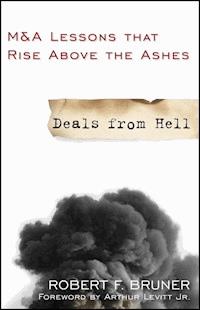
I am delighted to introduce you to Professor Robert Bruner of The Darden School. His book with the Dilbertian or apocalyptic title (depending on your point of view) Deals from Hell will serve great purpose in bringing more discipline and sharper thinking to the art and science of M&A, and to financial markets.
Whether you are investor or dealmaker, corporate executive or aspiring MBA looking for a career on Wall Street, you are sure to find this book both troublesome and inspiring. Great instruction always is. It cannot be otherwise when you carefully examine a series of M&A “train wrecks” through the same lens as Professor Bruner, a creative teacher in the field of M&A, who has been able to extract the hard, instructive lessons from these disasters. That knowledge, in this book, comes through artful contrasting of failures with other deals where greater discipline and care led to different results.
From my vantage point, this particular trip through M&A hell is very reminiscent of what happened soon after the space shuttle Challenger and its crew were destroyed as a result of a catastrophic explosion on January 28, 1986. No one likes to remember that episode, but none of us can forget it. And it was only with great reluctance that the great scientist Richard Feynman accepted a key role as part of the NASA-appointed Rogers Commission to investigate that particular disaster. Little did Feynman know at the time that he would be the one to discover and eloquently explain the direct causes of this disaster, and how it might be avoided in the future.
In the case of Feynman, to show just what a risky business flying a space shuttle truly is, his estimate of the chance of failure was actually closer to 1 in 100, not the 1 in 100,000 calculation used by NASA officials. He also learned that rubber used to seal the solid rocket booster joints using O-rings failed to expand when the temperature was at or below 32 degrees Fahrenheit (0°C), the exact temperature at the time of the Challenger liftoff. He simulated and explained this failure to the world by dropping a piece of O-ring material, squeezed with a C-clamp to simulate the actual conditions of the shuttle, into a glass of ice water. As Feynman explained, because the O-rings cannot expand in 32-degree weather, the gas finds gaps in the joints, which led to the explosion of the booster and the loss of the shuttle itself.
Feynman was always a fabulous communicator, and so is Bruner. To find out what causes M&A failure and success, he has dug deep with the people and sources who have built something that failed, and probed for answers. He offers us conclusions (painful as they sometimes are) that promise greater success in the future, not failure.
As Bruner points out, great financial risk in M&A—as with space exploration—is part of the cost of doing business. Either we can stop at potentially greater expense to society, or we can learn how to do it the right way and bat a higher success percentage.
As this book demonstrates, bad deals have led to some titanic failures for shareholders. But success is always there for those who learn how to succeed by understanding failure. There will always be huge winners and losers when it comes to M&A—and knowledge combined with discipline can lead to superior results. From 1982 to 2003, in fact, Warren Buffett’s Berkshire Hathaway has acquired companies worth $45 billion, a fact that many investors don’t think about. Is he a great investor, or an even greater M&A specialist? In September 2004, the firm’s share price was $86,650 for a 27 percent annual compound growth rate.
We simply need greater care and thinking when future M&A deals are on the launch pad. This will lead to even greater wealth for society and investors. It is time we all read on, and let Professor Bruner lead by instruction.
ARTHUR LEVITT, JR.
Westport, Connecticut February 18, 2005
Acknowledgments
A student’s question seeded the research that became this book. “What are the worst mergers?” struck me as supercial when posed more than a dozen years ago. But the question would not let go: It morphed from “what?” into “why?” and “how?” I came to conclude that stories of failure in mergers and acquisitions (M&A) were hugely instructive. And interesting cases never ceased boiling to the surface to offer new lessons. Finally, watching the agony of these deals prompted me to bring these lessons to the public. I believe these stories will change the way you think about M&A and help you to understand—and better yet, to anticipate—such failures to come.
I owe a very great debt of thanks to colleagues, friends, assistants, and students who have contributed to the manuscript over time. Each chapter acknowledges research assistants and colleagues; among these I especially recognize Anna Buchanan, Sean Carr, and Jessica Chan. Research co-authors contributed to work that appears directly or in summary form here: Samuel Bodily, Kenneth Eades, and Robert Spekman. I have benefited enormously from comments by Michael Schill, Don Chew, Saras Sarasvathy, and seminar participants at Virginia (Darden), Harvard, and Indiana universities. Also, the staff at Darden gave helpful support—I especially recognize Frank Wilmot, Stephen Smith (Darden’s nonpareil editor), Sherry Alston, and my administrative assistant, Betty Sprouse. The patience, care, and dedication of these people are richly appreciated. This project would not have been possible without the encouragement of Dean Robert S. Harris and the financial support of the University of Virginia Darden School Foundation, the Batten Institute, and Columbia Business School.
I must also acknowledge the support given by my editors at John Wiley & Sons: Bill Falloon, senior editor; Karen Ludke, editorial program assistant; Robin Factor, production manager; and Todd Tedesco, senior production editor. Pamela Van Giessen, executive editor, Joan O’Neil, publisher, and Will Pesce, president, were decisive in my commitment to embark on this project.
Lewis O’Brien checked the manuscript, offered editorial advice, and ferreted out some elusive permissions to quote the material of other authors.
Friends and mentors encouraged me at important moments in the development of this work. Mac and Elsie Thompson urged me into this project during an animated dinner conversation a decade ago. John H. McArthur and David W. Mullins, Jr. ignited my interest in M&A.
In terms of absolute sacrifice, none have contributed more than my wife, Barbara McTigue Bruner, and two sons, Jonathan and Alexander. This book is significantly a product of their faith, hope, and charity. I will remain, forever, in their loving debt.
All these acknowledgments notwithstanding, responsibility for the final product is mine, alone.
ROBERT F. BRUNER
Charlottesville,Virginia October 31, 2004
1
Introduction
“Merger” is the consolidation of two firms that creates a new entity in the eyes of the law. The French have a good word for it: fusion—conveying the emergence of a new structure out of two old ones. An “acquisition” on the other hand, is simply a purchase.The distinction is important to lawyers, accountants, and tax specialists, but less so in terms of its economic impact. Businesspeople use the terms interchangeably. The acronym, “M&A,” stands for it all.
M&A enters and leaves the public mind with waves of activity, such as those depicted in Figure 1.1. These waves roughly synchronize with equity market conditions and thus carry with them the cachet of excess, hype, and passion that swirl in the booms. Over time, M&A activity radically transforms industries, typically shrinking the number of players, inflating the size of those who remain, and kindling anxieties about the power of corporations in society. Every M&A boom has a bust, typically spangled with a few spectacular collapses of merged firms. These failures significantly shape the public mind, and especially business strategies and public policy. We should study M&A failure not merely as a form of entertainment, but as a foundation for sensible policies and practices in future M&A waves.
Failure pervades business, and most firms fail eventually.Venture capitalists typically reject 90-95 percent of proposals they see. Up to 90 percent 1 of new businesses fail not long after founding. Even mature businesses pass on: Of the 501 firms listed on the New York Stock Exchange in 1925, only 13 percent existed in their independent corporate form in 2004. Within healthy growing businesses, failure is a constant companion. Most patented inventions fail to become commercial successes. Most new products fizzle out not long after the launch pad. Paradoxically, the success and renewal of capitalism depends on this enormous rate of failure, what the economist Joseph Schumpeter called the “perennial gale of creative destruction.” In the world of M&A, most transactions fail to close: That deal you may be discussing has perhaps a one-in-ten chance of consummation. And those transactions that do close, though profitable on average, tend to fall short of the most optimistic expectations.
Figure 1.1M&A Activity by Year
Source: Author’s analysis with data from indicated sources.
Studying M&A failure offers titillating entertainment, worthy of Cosmopolitan , the National Enquirer, or Geraldo. However, it is also a springboard to business insight. All professions understand that the study of failure is the source of thoughtful advances. Medicine began with the study of pathology. Engineers study mechanical and structural failures. And psychologists study errors, anomalies, and biases in human behavior. At business schools, the study of cases considers successes and failures. To my knowledge, this book is the first focused study of failure in mergers and acquisitions.
Perhaps the chief insight of this book is that M&A failure is complicated, the result of a convergence of forces. But conventional thinking sees it differently, preferring quick and dismissive explanations arguing, for instance, that merger failure is due to some bad apples in the executive suite, nonobservance of one big Golden Rule (“They took their eye off the customer”), or some kind of industry hoo-doo curse (“Technology mergers have never ever worked”). While these may contain a nugget of reason, they are more remarkable for what they ignore than what they tell us. Most importantly, they are not terribly useful to guide the man or woman on the hot seat toward doing good business. Such bromides remind one of Woody Allen, who took a speed reading course and then read Tolstoy’s War and Peace. All Allen could say about the book was “It’s about Russia.”
I wrote this book to fill the gap in our understanding. It addresses four questions:
1. What is “merger failure”? How can we measure it?
2. How prevalent is failure among mergers and acquisitions?
3. What causes merger failure?
4. What are the implications of our answers for managers and policymakers?
OVERVIEW OF THE BOOK
I frame the response to these questions in the three parts of this book. Part I (chapters 2, 3, and 4) offers perspectives on merger failure from the standpoints of previous research. Chapter 2 summarizes what we know about merger failure and success based on more than 130 studies drawn from research in business and financial economics. The research shows that the field of M&A is highly segmented; there are attractive and unattractive neighborhoods. This is the foundation for my argument that all M&A is local. Chapter 3 offers a summary profile of the best and worst deals from 1985 to 2000. Chapter 4 gives a perspective on the processes of failure, drawn from analyses of real disasters and from concepts in a number of disciplines, including cognitive psychology, sociology, and engineering. Thus, Part I constructs a lens through which to view the causes of merger failure.
Part II lends texture to our understanding of M&A failure through 10 case studies of big M&A disasters. I have paired each of the 10 with a counterpoint or complementary case so that each chapter is actually a paired comparison of what can go wrong and how. The comparison cases are not intended to be deals from heaven; they merely differ in some instructive way. The comparisons suggest how little the situation must differ in order to deliver rather different results.
These 10 cases are not necessarily the worst in any absolute sense. However, judged on common standards there can be little disagreement that they belong on a short list of bad deals. One has a large pool of candidates from which to select. I chose these 10 for several reasons.
• Size of damage.Big bad deals certainly get one’s attention and have face validity. I looked for losses in the billions of dollars, for layoffs, CEO change, tarnished reputation, and possibly, bankruptcy.
• Diversity of industry, deal type, and challenges. I could fill a book of M&A disasters drawn from any one of a number of industries. However, as I argue here, industry conditions have a powerful effect on merger success and failure. Thus, diversity of settings sharpens our understanding about how industry has an impact and intrigues us with its local surprises.
• Access to information. In half of these cases, I was fortunate to find insiders or knowledgeable outside observers to interview and inform the discussion. However, most participants do not want to discuss their M&A failures. In five instances, I was able to tap valuable archives that lent some insight into senior management’s views. For the rest, I relied on a diverse collection of investigative journalism, security analysis, and open commentary. Regardless of sources of information, I aimed to bring a fresh lens through which to view these cases, informed by economics and a scientific mind-set.
I tried to avoid M&A disaster cases caused mainly by crimes, looting, fraud, and sabotage.These are more appropriate for a book on white-collar crime. Such cases are a small fraction of the larger sample of messes we can find and by their notoriety, tend to obscure more important lessons for CEOs and the public. Even so, criminal litigation followed two of the cases described here.
The research and framework from Part I and the case studies in Part II open the door to Part III. There I offer some summary implications for CEOs, investors, and those concerned with public policy.
This is an exercise in inductive research, the generation of a way of thinking about failure in M&A, drawn from a detailed look at the research and cases. These were all failures that could have been avoided or sharply mitigated. I hope to show why and how. The result is a volume that seeks to teach, rather than harangue, titillate the reader, or humiliate the protagonists. Where the facts do not fit with sympathetic explanations, I speak plainly; but generally, my bias is to view the challenges facing executives as extremely difficult, arenas in which scholars and the casual reader could easily have done worse. Other analysts may beg to differ on the interpretation of specific events in certain cases or of detailed points in the research stories summarized here.Yet such differences should not obscure the larger point that there are considerable similarities among merger failures and that such similarities lend insight into the causes of failure and the implications for managers.
OVERVIEW OF THE FINDINGS
The key message of this book is that mergers fail because of a “perfect storm” of factors that combine to destroy the new firm. This message invites consideration of the definition, frequency, profiles, and process of failure.
What Is Merger Failure?
The first question is definitional. Though “failure” is commonly understood, it has several differing applications. For instance, the Oxford English Dictionary defines “failure” as:
1. A failing to occur, to be performed, or be produced; an omitting to perform something due or required; default . . . 2. The fact of becoming exhausted or running short, giving way under trial, breaking down in health, declining in strength or activity, etc. . . . 3. The fact of failing to effect one’s purpose; want of success . . . 4. The fact of failing in business; bankruptcy, insolvency . . .2
As the dictionary suggests, “failure” connotes both a process (“a failing to occur . . . omitting to perform . . . giving way . . . breaking down”) and an outcome (“fact of . . . want of,” and bankruptcy). In this book, I aim to discuss both process and outcome. My method is to begin with identifiable outcomes and induce from them some insights about process.
What, then, is the outcome of M&A failure? Consider at least these six dimensions:
1. Destruction of market value. Harnessing the perspective of the providers of capital, we measure the destruction of value by the percentage change in share values, net of changes in a benchmark, such as a large portfolio of stocks.
2. Financial instability. Some of the saddest M&A deals are those that, rather than making the buyer stronger, actually destabilize it. In most of these cases, the buyer overreaches its financial capacity. Degree of financial stability is reflected in debt ratings, earnings coverage ratios, probability of default, and other measures of the ability of the firm to bear risk.
3. Impaired strategic position. Many M&A transactions are motivated by a strategic purpose that seeks to improve the firm’s competitive position, acquire new capabilities, improve agility, or obtain resources that are vital to future prosperity. Indications of failure in this dimension would include loss of market share, and involuntary abandonment of products, geographic markets, or research and development (R&D) programs.
4. Organizational weakness. Knitting together two firms is especially challenging from an organizational perspective. Most CEOs would agree with the old slogan “People are our most important asset.” In essence, one could measure organizational strength in terms of depth of talent and leadership, effectiveness of business processes, and the transmission of culture and values. Adverse changes in human resources appear in unanticipated workforce layoffs, involuntary changes of leadership in senior management and the board, and defections of talented individuals to competitors.
5. Damaged reputation. The M&A deal should improve the reputation of the acquirer and its deal architects. Usually, the realization of these other aims will do just that. But one can imagine deals that depend on acrimony, subterfuge, and a win-lose mentality—in a world of repeated play, the executive must consider how these qualities might affect one’s M&A success in future deals. Measurable outcomes in this dimension would include changes in name recognition, reputation, analyst sentiment, and press coverage.
6. Violation of ethical norms and laws. You can gain financial, organizational, and strategic objectives in M&A, but in ways that violate norms such as equity, duty, honesty, and lawful observance. After the corporate scandals of recent years, any assessment of outcomes would be incomplete without consideration of laws and ethics. Adverse judgments in criminal and civil litigation would be a rough measure of M&A failure, though they usually follow an extended lapse in ethics.
I was influenced in my selection of the 10 case studies by all of these factors. However, some of these criteria are difficult or impossible to benchmark. As a result, the discussion that follows gives somewhat more attention (though not necessarily more weight) to the financial dimension.
How Prevalent Is M&A Failure?
M&A failures amount to a small percentage of the total volume of M&A activity. Investments through acquisition appear to pay about as well as other forms of corporate investment. The mass of research suggests that on average, buyers earn a reasonable return relative to their risks. M&A is no money-pump. But neither is it a loser’s game. Conventional wisdom seems to think otherwise, even though the empirical basis for such a view is scant.
Of more interest to the thoughtful practitioner is not the average result, but the distribution around it. The wide variation in findings about the profitability of M&A suggests that something may be going on to tilt the odds of success and failure. Chapter 2 identifies 18 neighborhoods or dimensions of the M&A market, along which returns to buyers vary significantly. For instance, acquisitions of public companies tend to be much less profitable to buyers than are acquisitions of privately held companies.
The existence of neighborhoods of return suggest that all M&A is local . That is, managerial choice can have a huge impact on the results of M&A: Quite simply, where you choose to do business will influence success or failure.
What Causes M&A Failure?
That M&A is local also implies that we might find constructive or destructive patterns of managerial choice in the deals from hell or heaven that they produce. Chapter 3 reports that the extreme outliers of deals, both good and bad, differ from each other and from the middle in at least four general ways.
The first regards strategy. In the best deals, buyers acquire targets in industrially related areas. In the worst deals, targets are in areas that are more distant. This may reflect the benefits of sticking to your knitting: Better knowledge of a related industry may yield fewer surprises and more opportunities to succeed.
In addition, the fit of the buyer and target matter significantly. In successful deals, buyers acquire from strength—the performance attributes of buyers are stronger than their targets suggesting that in good deals, the buyer brings something important to the success of Newco. In the worst deals, buyers acquire from weakness. There, the target is significantly stronger, and one can guess that the buyer hoped to fix some problem by means of the acquisition.
Third, the worst deals show a propensity to occur in “hot” market conditions. The preeminent hot market in business history was the equity market bubble from 1998 to 2000 associated with the emergence of the Internet. Industries can also be hotbeds of activity caused by sudden deregulation, technological change, shifts in consumer demand, and so on. Recent research suggests that many mergers are motivated by strategic turbulence in their industries. The best deals occur in cooler market conditions. Chapters 2 and 3 discuss the possible reasons for this disparity.
Finally, deal tailoring pays. One size does not fit all. Better deals are associated with payment by cash and earnout schemes and the use of specialized deal terms. The worst deals are associated with payment by stock.
Chapters 2 and 3 show that managers’ choices matter. However, as the dictionary definition of “failure” suggests, there is more to the story, namely, what can go wrong between the managers’ choices and the outcomes. Here is where the case studies of merger failure become vitally important. Chapter 4 shapes a lens through which to view these cases. In that chapter, I turn to research on real disasters (those involving the loss of life and property) to highlight six factors that lend traction in understanding the cases of M&A failure:
1. The businesses and/or the deal were complicated.This made it difficult for people on the scene to understand what was going on or to take quick and effective action.
2. Flexibility was at a minimum. Little slack or inadequate safety buffers meant that problems in one part of the business system would radiate to other parts.Trouble would travel.
3. Deliberately or inadvertently, management made some choices that elevated the risk exposure of the new firm.
4. The thinking of decision makers was biased by recent successes, sunk costs, pride, overoptimism, and so on.
5. Business was not as usual. Something in the business environment departed from expectation causing errors or problems.
6. The operational team broke down. Cultural differences between the buyer and target, unresolved political issues, and generally overwhelming stress prevented the team from responding appropriately to the unfolding crisis.
The case studies in Chapters 5 through 14 illustrate these six factors at work in producing the “perfect storm” of merger failure. Each case highlights one or more special aspects of the storm. Chapters 15 and 16 discuss important implications for deal-doers, operating managers, and CEOs.
CONCLUSION: ANTICIPATING M&A FAILURE CAN ENHANCE SUCCESS
I wrote this book to lift the practice of M&A. Given the sheer complexity of these deals, best practice cannot be reduced easily to a sound bite. For this reason, case studies are excellent for helping the thoughtful practitioner envision what can go wrong and what to do about it. More importantly, the book suggests that success depends vitally on adopting the right attitude about M&A as a path of corporate growth. It is no formula for surefire success; rewards are extremely difficult to sustain over time; risks are legion; it is to be undertaken only with very serious planning and preparation; and the effort should be motivated by the right values and respect for investors. As William Blake said, “Execution is the chariot of genius.”
NOTES
1 See Sarasvathy and Menon (2002) and Gartner (1988) for overviews of research on entrepreneurial failure. The research on failure rates of new firms shows wide variation from one study to the next.This is most likely attributable to variations in the length of time after founding from which failure is measured.
2Oxford English Dictionary (Oxford, England: Oxford University Press, 2d ed. 1989), volume V, 667.
I
THE FOUNDATIONS OF M&A FAILURE
2
Where M&A Pays and Where It Strays: A Survey of Research
How you assess an M&A deal or the whole flow of M&A activity depends on your frame of reference, on beliefs that help you decide whether specific deals represent the average, or what statisticians call the “tails of the distribution.” This frame of reference is a hugely important filter for decision makers and their advisers and is typically built on a blend of personal experience, anecdotes, conventional wisdom, and facts. The aim of this chapter is to enrich your frame of reference about success and failure in M&A with the findings of scientific research.1
I have two basic criticisms of the way most people think about M&A. First, the conventional wisdom is poorly grounded in the scientific evidence on the subject. The fashionable view seems to be that M&A is a loser’s game.Yet an objective reading of more than 130 studies supports the conclusion that M&A does pay.2 These studies show that the shareholders of the selling firms earn large returns from M&A, that the shareholders of the buyers and sellers combined earn significant positive returns, and that the shareholders of buyers generally earn about the required rate of return on investment.
Second, conventional wisdom seems to hold that failure is the average outcome of all classes and varieties of M&A, and that, in this sense, M&A, is regrettably homogeneous. Yet the research reveals wide dispersion of returns both within and across studies. And such variation suggests that, like powerful turbulence under the smooth surface of a river, something is going on in the world of M&A that differentiates deals and predisposes them to success or failure—and that, like the varying river conditions below the surface, the world of M&A is not homogeneous. In this chapter, I argue that to see the varying states of this world is to build a view that more readily grasps the circumstances and approaches that give rise to success and failure.
Tip O’Neill, the Boston pol who rose to be Speaker of the U.S. House of Representatives, explained that in trying to understand the workings of Congress, it made no sense to focus on lofty national issues or policy debates within the Washington Beltway. Instead, he said,“All politics is local.” The mindset of the successful politician begins with his or her constituency and the hopes and fears in town halls, school boards, and police precincts. It is the same in M&A:The best foundation for pursuing success and avoiding failure in M&A lies in seeing the important ways in which individual deals differ from one another. In other words, .
Lesen Sie weiter in der vollständigen Ausgabe!
Lesen Sie weiter in der vollständigen Ausgabe!
Lesen Sie weiter in der vollständigen Ausgabe!
Lesen Sie weiter in der vollständigen Ausgabe!
Lesen Sie weiter in der vollständigen Ausgabe!
Lesen Sie weiter in der vollständigen Ausgabe!
Lesen Sie weiter in der vollständigen Ausgabe!
Lesen Sie weiter in der vollständigen Ausgabe!
Lesen Sie weiter in der vollständigen Ausgabe!
Lesen Sie weiter in der vollständigen Ausgabe!
Lesen Sie weiter in der vollständigen Ausgabe!
Lesen Sie weiter in der vollständigen Ausgabe!
Lesen Sie weiter in der vollständigen Ausgabe!
Lesen Sie weiter in der vollständigen Ausgabe!
Lesen Sie weiter in der vollständigen Ausgabe!
Lesen Sie weiter in der vollständigen Ausgabe!
Lesen Sie weiter in der vollständigen Ausgabe!
Lesen Sie weiter in der vollständigen Ausgabe!
Lesen Sie weiter in der vollständigen Ausgabe!