


4,99 €
Mehr erfahren.
- Herausgeber: David De Angelis
- Kategorie: Lebensstil
- Sprache: Englisch
Almost the only source of detailed knowledge of early English archery is Toxophilus, or the Schole of Shootynge, which was written by Roger Ascham in 1542 and 1543 and was published in 1544. Arab Archery is nearly contemporary with that famous book-probably preceding it by a few years-and may be considered to be on an equal plane of merit. This ancient Arabic manuscript is the only treatise on the archery of the medieval Orient that has been translated into English. It is thorough and authoritative, evidently the work of an expert bowman. A vast amount of information concerning the long-range artillery, by which one eastern empire after another had been won, is here brought forth into full light after having lain hidden for centuries.
It could be used as a textbook on archery today.
Das E-Book können Sie in Legimi-Apps oder einer beliebigen App lesen, die das folgende Format unterstützen:
Veröffentlichungsjahr: 2019
Ähnliche



















CONTENTS
PREFACE
I. In the Name of God the Merciful, the Compassionate
II. On Holy War and the service of archery therein
III. On the excellence of the Arab bow, its use, adoption, the reward of the maker of its arrows, its target, urging the mastery of its technique, the offence of him who discards it after he has learned its use, and the first to use and the first to make it
IV. On the different kinds of bows and the most desirable of them
V. On the names and nomenclatures of the Arab bows and their different parts
VI. On the master archers
VII. On the principles of loosing and the different schools therein
VIII. Things the archer should know
IX. How to determine the cast of the bow, its weight, and the limit of the archer’s strength in drawing
X. On testing the bow before bracing
XI. On bracing, which is the same as stringing
XII. On the curvature of the bow after bracing
XIII. On unstringing
XIV. On picking up the bow and arrow preparatory to shooting and the manner of shooting
XV. On the different draws and the manner of locking the thumb and the index finger on the string, and on the rules of arranging the index finger upon the thumb
XVI. On how to hold the grip of the bow with the left hand
XVII. On the clench
XVIII. On drawing and its limits
XIX. On aiming, which is the same as pointing at the target
XX. On the loose or release
XXI. On the passage of the arrow over the left hand
XXII. On blisters and wounds on the index finger of the right hand caused by stringing, clenching, drawing and loosing, together with the remedies thereof
XXIII. On the blow of the string on the archer’s right thumb, which causes it to turn black and blue on the inside and beneath the nail and sometimes results in breaking the nail; as well as on the blistering and bruising of the left thumb at the time of shooting, together with the remedies thereof
XXIV. On the blow of the string on the forearm of the archer and the remedy thereof
XXV. On the blow of the string on the chin of the archer, or on his ear, and the remedies thereof
XXVI. When the tip of the bow hits the ground at the moment of loosing, and the remedy thereof
XXVII. When the nock of the arrow breaks and the remedy thereof
XXVIII. On causing the arrow to move on itself, or wag, in its flight
XXIX. On the management of the arrow when shooting against the wind, et cetera, and on trying not to shoot it when a break is found after it has been fully drawn
XXX. On how near or how far the target should be
XXXI. On standing and sitting for aiming
XXXII. On the variations in the length and construction of the Arab bow
XXXIII. On strings; how to make them and how to form their eyes
XXXIV. On the length and shortness of the string
XXXV. On the thinness and thickness of the string and on how to choose the correct and appropriate size
XXXVI. On the weight of the string in relation to the weight of the bow
XXXVIII. On arrowheads; the different kinds, their various uses, how to fix them on the shaft; and the manner of cutting arrow-nocks
XXXIX. On feathers and fletching
XL. On the weight of arrows, arrowheads, and feathers
XLI. On sundry points not yet mentioned concerning the competition bow, the description of its arrow, and the manner of its use, together with some of the tricks employed in competitions
XLII. On thumb-tips and the various kind thereof
XLIII. On shooting with the husban, dawdan, and ‘usfuri arrows through the hollow of a guide
XLIV. On stunt shooting
XLV. Targets and target practice
XLVI. Quivers, belt, arrow picker, file
XLVII. Inscriptions on bows, arrows, and quivers
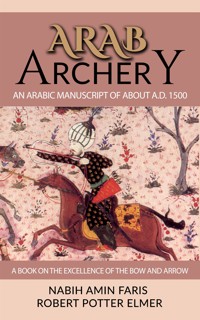
Arab Archery
An Arabic Manuscript of about A.D. 1500
A Book on the Excellence of the Bow and Arrow
Translation by Nabih Amin Faris, Robert Potter Elmer
Edition 2019 by David De Angelis
All rights reserved
PREFACE
THE translation and editing of this manuscript has been a joint enterprise undertaken by two men, one of whom started with great interest in Arabic studies and virtually no knowledge of archery, the other familiar with archery but without special training or experience in the Oriental field. We feel that each of us has helped expand the knowledge and interests of the other, and it is our hope that this book will be read by both kinds of readers, and with similar results.
In the Garrett Collection of Arabic Manuscripts in Princeton University Library is what appears to be a unique manuscript on archery. As works on sports in this collection are not numerous, this one attracted special attention. Faris thought of publishing the work but was dissuaded by his unfamiliarity with archery either in theory or practice. In 1940, however, he wrote an article on the Garrett Collection for the Princeton University Library Chronicle, and in the course of it referred casually to this manuscript. This article fell into the hands of Elmer, whose interest in archery is well known. He was so eager to have the work made available in English that he offered to supply the technical advice if Faris would do the translation.
We set about the task together, following a theoretical division of labor but actually carrying forward what in all truth proved to be a joint enterprise-for instance Elmer’s technical knowledge frequently furnished the key to difficult linguistic problems, while Faris’s reading of Arabic often gave the answer to technical questions that have intrigued and mystified students of archery for many years.
The manuscript itself comprises 353 pages, 19 x 13.5 cm., with a written surface of 13 x 8 cm. The paper is glazed European of the fifteenth century. Unfortunately the identity of the author remains unknown, although we know from references in the body of the manuscript that he was a North African from Morocco.
Almost the only source of detailed knowledge of early English archery is Toxophilus, or the Schole of Shootynge, which was written by Roger Ascham in 1542 and 1543 and was published in 1544. Arab Archery is nearly contemporary with that famous book-probably preceding it by a few years-and may be considered to be on an equal plane of merit. This ancient Arabic manuscript is the only treatise on the archery of the medieval Orient that has been translated into English. It is thorough and authoritative, evidently the work of an expert bowman. A vast amount of information concerning the long-range artillery, by which one eastern empire after another had been won, is here brought forth into full light after having lain hidden for centuries.
It could be used as a textbook on archery today.
NABIH AMIN FARIS
AND
ROBERT POTTER ELMER
I. In the Name of God the Merciful, the Compassionate
THERE is no way unto God but through Him, God alone. May the blessing of God be upon our Lord Muhammad and upon His Family and Companions. Thanks be to God whose bounties upon His creatures are perfect and complete, and whose wisdom is evident in His creation throughout the world, who has made all without any previous pattern, and endued His work with utility; faultless and precious. He has made marksmanship the undoing of the enemy in war and, in raids, the means of victory over the foe; and has promised a high rank in Paradise to him who shoots an arrow in His cause, regardless of whether the archer fells an enemy or misses the mark.
I thank God for granting me mastery over the minute details of archery, and for giving me skill in its difficult technique; for its secrets which He has revealed unto me, and its mysteries which, through His grace, He unveiled to me. With His praise every matter of importance is commenced. And may the blessing of God be upon our Lord, Muhammad, His prophet, for through invoking God’s blessing upon him is every deed deduced and every statement formulated. I also thank God for His benefits and bounties which He grants unto us, even before we beseech His grace. Furthermore I testify that there is no god but God, He alone, no associates has He, and that Muhammad is His servant and apostle: a testimony of one aware of its necessity and cognizant of its obligation.
Holy War is one of the best forms of worship, and is obligatory upon every believer individually, though it has now become incumbent on the whole community collectively. Furthermore, the Holy Koran and the tradition have dwelt upon its excellence, thereby urging every Moslem to seek, through it, the martyr’s crown. The Apostle of God said: “By him who holds in His palm Muhammad’s life, it is my desire to meet my end on the battleground of God, and be brought back to life, and die again, and again, and yet again.” According to another version: “Would that I were given to die on the battleground of God, and be brought back to life, only to die again, and yet again, fighting His battles.” AbuHurayrah was wont to say: “Of every single year, three months belong to God and His cause.” The Prophet also said: “Of all the godly men who desire to be brought back to life, only the martyrs are granted their request.” God also has enjoined us to prepare force against the polytheists in order to strike terror in their hearts, and pointed to us the excellence of the bow and arrow as implements of war. Thus He said: “Make ready against them what force ye can, and strong squadrons whereby ye may strike terror into the enemy of God and your enemy.” In urging that force be made ready against the enemy, God has indicated the importance of drilling and training in the use of all implements of war, in order to acquire skill, gain proficiency, obtain adroitness, and develop facility in their use. Furthermore, the Apostle pointed out that of all the instruments of war, the bow and arrow are the most effective and the greatest.
The Prophet also said: “The hand of man has wielded no weapon which was not excelled by the bow.” Is there anything more excellent than a man who has mastered marksmanship, who picks up his bow and showers the polytheists with his arrows? The crowds fear him, and the brave knights stand in awe before him. Many a weak city has been defended by a single archer, and many an army has been disbanded and scattered with a single arrow. During the battle of Uhud, the Apostle addressed Sa’d ibn-abi-Waqqas, abu-Talhah, and Qatadah ibn-al-Nu`man, who stood by him defending him with their bows and arrows, while most of his Companions fled away “Stand firm; victory shall remain ours so long as ye stand firm.” Indeed this is a great tribute to the bow and arrow and a compliment for their service. He that wields them will most certainly be victorious. How then could a sane Moslem place his confidence in any other weapon, or dare face his adversary with any other instrument of war?
The poet said
Bows, with the strings of which victory is bound;
In praise of their excellence the Scriptures resound.
Said another
If glory be to slay the foe,
’Tis best to use the fastest throw,
And loose the arrow from the bow.
Furthermore, the bow and the arrow are the most effective and devastating of the instruments of war despite the fact that they are the least cumbersome to carry and use. Unfortunately, however, there are very few contemporaries who can use the Arab bow and fewer still who know anything about its methods and technique. For this reason I decided to write a book on marksmanship and the use of the Arab bow. Such a book I had, in fact, written and entitled it Kifayat al-Muqtasid al-Basir fi al-Ramy ‘an al-Qaws al-`Arabiyah bi-al-Sahm al-Tawil w-al-Qasir [The Sufficiency of the Discerning Student: on Shooting with the Arab Bow with the Long Arrow and the Short]. It was, however, too brief, and the need for a detailed and comprehensive work on the subject was still felt. Consequently, I set out to fulfil this need. This book is the result. Verily God is my refuge and my trust.
II. On Holy War and the service of archery therein
HOLY WAR is to expend oneself in the way of God and to honor His Word which He has laid down as a path to Paradise and a highway leading thereto. Said He “Do valiantly in the cause of God as it behooveth you to do for Him.”
It is a duty, incumbent on the community of the believers collectively, to be carried out by some on behalf of the whole community. God said: “The faithful must not march forth all together to wars; and if a part of every band of them march not out, it is that they may instruct themselves in their religion.” In other words, God has enjoined that some should march to battle for His cause, while others stay behind to keep the torch of His law burning. Said God again: “Those believers who sit at home free from trouble, and those who do valiantly in the cause of God with their substance and their persons, shall not be treated alike. God hath assigned to those who contend earnestly with their persons and with their substance a rank above that of those who sit at home. Goodly promises hath He made to all. But God hath assigned the strenuous a rich recompense, above that of those who sit at home: rank of His own bestowal, and forgiveness, and mercy; for God is Indulgent, Merciful.” Furthermore, the Prophet embarked upon his wars and raids with but a few of his followers; he left some behind at home.
Others have maintained that Holy War was a duty obligatory upon every Moslem individually. In support of their position they cited the words of God when He said
“Attack those who associate other gods with God in all, as they attack you in all.” And again: “March ye forth the light and heavy armed, and contend with your substance and your persons in the Way of God. This, if ye know it, will be better for you.” And still again : “War has been prescribed to you, but from it ye are averse.”
At any rate, Holy War is among the best forms of worship and one of the most acceptable works of righteousness before God. Thus He said: “Verily God loveth those who, as though they were a solid wall, do battle for His cause in serried array. O ye who believe! Shall I show you a merchandise that shall deliver you from the sore torment ? Believe in God and in His Apostle, and do valiantly in the cause of God with your wealth and your persons. This, did ye but know it, will be best for you. Your sins He will forgive you, and He will bring you into gardens beneath the shades of which rivers flow; into charming abodes in the gardens of Eden. This shall be the great bliss.” God also said: “And repute not those slain in the path of God to be dead. Nay, alive with their Lord, are they richly sustained; rejoicing in what God of His bounty hath vouchsafed them; filled with joy for those who follow them, but have not overtaken them, that on them nor fear shall come, nor grief; filled with joy at the favors of God, and at His bounty, and that God suffereth not the reward of the faithful to perish.” He also said: “Verily, of the faithful God hath bought their persons and their substance, on condition of Paradise for them in return; on the path of God shall they fight, and slay, and be slain. A promise for this is pledged in the Evangel, and in the Koran, and who is more faithful to his engagement than God? Rejoice, therefore, in the contract that ye have contracted; for this shall be the great bliss.”
The Apostle of God, on being asked concerning the best acts of worship, replied: “Belief in God and Holy War in the cause of God.” He also said: “Compared to Holy War, all the acts of worship put together are like a drop of water in the spacious sea.” And again: “If I should spend the whole night in prayer and fast the entire day, I would not attain the stature of him who spends a day in Holy War.” And again: “He who dies without having taken any part in Holy War, or without ever entertaining such an undertaking in his mind, is guilty of deceit and hypocrisy.”
III. On the excellence of the Arab bow, its use, adoption, the reward of the maker of its arrows, its target, urging the mastery of its technique, the offence of him who discards it after he has learned its use, and the first to use and the first to make it
SAID GOD : “Make ready against them what force ye can.” This was interpreted by the Apostle of God as marksmanship. The learned judge abu-al-Fadl `Iyad, in appraising the different commentaries upon these passages, said that the Apostle of God had once declared: “The hand of man has not reached to an implement of war to which the bow and arrow are not superior.” Said he again: “Use ye the spear and the Arab bow, for with them was your prophet victorious and with their might have ye conquered the earth.”
Anas also related that never has the bow been mentioned before the Apostle of God except he said no weapon excelled it.
The Apostle said on another occasion that Gabriel approached him on the day of the Battle of Badr brandishing an Arab bow. And again when ‘Ali appeared before him carrying an Arab bow, the Apostle exclaimed: “Thus hath Gabriel stood before me. O God, to him who seeketh therewith game for meat, give Thou sustenance, and to him who seeketh therewith Thine aid, give victory, and to him who seeketh therewith livelihood, give maintenance.”
It was also related that whenever the Apostle mounted the pulpit to deliver a speech or a sermon, he used to lean against an Arab bow. It was also reported that he had used his bow until the siyahs1 wore out. It was then taken by Qatadah ibn-al-Nu’man who kept it until it passed on to the Caliphs. It is now in the caliphal treasury along with the Holy Relics. Its sweet scent is noticeable to anyone standing near the Holy Relics, since its grip is redolent with the perspiration of the Prophet’s palm, and will diffuse therefrom like musk until the day of resurrection.
It was reported that the Prophet had three bows. One was backed (al-mu’aqqabah), called “The sweet smelling” (al-rawha’); another was made of the shawha2t wood, called “The white one” (al-bayda’) ; and the third made of the nab` wood, was called “The yellow one” (al-safra’).
When ‘Uqbah ibn-‘Amir died, he left seventy bows, each with its own full quiver.
The Arab bow is that which was sent down to Adam from Paradise and which he used. It was also related that the first to construct the Arab bow and to use it was Abraham. He made a bow for each of his sons, Ishmael and Isaac, both of whom were skillful in its use. The Arab bow was also used by the Prophet Muhammad and by his Companions. It is the same kind of bow that Gabriel carried when he appeared before the Prophet on the day of the Battle of Badr.
Thus it is the duty of every free, adult, and sane Moslem to learn the use of the Arab bow and teach it to his offspring.
IV. On the different kinds of bows and the most desirable of them
Bows are of two kinds: the hand bow and the foot bow. The hand bow is of three varieties: Hijazi3 Arab, composite (masnu‘ah), and Persian, which is also the Turkish. The Arab bow was so
called by Ishmael, the father of all the Arabs, who was the first to introduce archery among them.
The bows of the Hijazi Arabs are also of three kinds:
One is made of a single stave (qadib) ;
another is made of a stave or two staves divided lengthwise; and the third is backed, or reinforced (mu’aqqaba h).
All these three kinds are made of the nab‘, shawhat, and shiryan wood. The method is that of shaving the wood down4. It is held that these three kinds of wood are in reality one, the names of which vary with the locale of growth. That which grows on the mountain top is the nab‘, that which grows on the mountainside is the shiryan, and that which grows at the foot of the mountain is the shawhat.
The bow which is made of a single stave is called qadib; that which is made of a single stave split lengthwise is called filq; and that which is made of two staves split lengthwise is called sharij5.
The reinforced bows6 are those which have the horn of goats placed in the belly and sinew on the back. They are used only by experts or those who live near water.
The second variety of hand bow is the composite (masnu’ah, murakkabah). It is composed of four different materials: wood, horn, sinew, and glue. It has two siyahs [sing.: siyah, dual: siyatan ], and a handle or grip (miqbad) and is similar to the one now in use. It is called composite because of the manner of its construction. It is also described as separated, because of the disconnected nature of its parts before they are put together. Often it is called intermediate (wasitiyah), not after the city of Wasit7, which it antedates, but because it occupies an intermediate position between the Hijazi Arab reinforced bow and the Persian bow.
The third variety of hand bows-the Persian and Turkish-are made in the same way as the Arab composite bow.
They have, however, long siyahs and short arms, the siyahs and arms being almost, if not quite, equal to each other in size.
The central point is either in the middle of the grip or at one third of the grip f rom its top. Such a bow was used by both the Persians and the Turks. The Turks and most of the Persians make this bow heavy, and set it on a grooved stock ‘(majra), which they fit with lock and trigger and to the end affix a stirrup, thus making it a foot bow. Foot bows are of numerous varieties, one of which we have just described as having a lock and trigger and as being used among the Persians. Another foot bow is used by the people of Andalusia. It is, however, of no value because the Prophet has declared it accursed. This has led some learned men to maintain that all bows which are set on a stock are accursed because they resemble the cross in shape. Others maintain that such bows were condemned because they were used by the Persians, who were pagan infidels. The truth of the matter, however, is that such bows are undependable, being heavy, unwieldy, and clumsy. Upon loosing, the stock on which they are set interferes with the string and dissipates the greater part of its force.
V. On the names and nomenclatures of the Arab bows and their different parts
WE HAVE already stated that the Arab bow is either composite or non-composite. The non-composite bows are those of the people of the Hijaz. They make them out of the nab‘, shiryan, or shawhat wood; out of a single stave, one or two staves divided lengthwise, or a stave backed with sinew and lined with horn. The bows may either be round, with round limbs, or flat, with flat limbs.
The composite bow is of elaborate make and careful workmanship. Its construction parallels the make-up of living things. Just as man is made of four component parts (bone, flesh, arteries, and blood) so is the bow made of four component parts. The wood in the bow corresponds to the skeleton in man, the horn to the flesh, the sinews to the arteries, and the glue to the blood. Similarly, a human being has a belly and a back, and so has a bow. And just as a man can bend inward upon his belly without any harm, but may be injured if he bends outward upon his back, so it is with a bow. It can be bent inward upon its belly but will break if it be bent upon its back.




