


45,00 €
Mehr erfahren.
- Herausgeber: L'Erma di Bretschneider
- Kategorie: Geisteswissenschaft
- Sprache: Englisch
No serious study of ancient Roman topography and its monuments is undertaken without consulting the work of Rodolfo Lanciani (1845-1929), the archaeologist and scholar of ancient Rome. His Forma Urbis Romae, a large map published in sections between 1893 and 1901, captures all that was then known of the existence of the built world in the city. His multi-volumed Storia degli Scavi (1902-1913) is a formidable reference work, filled with notices of archaeological finds made in Rome from c. 1000 to 1870. Beginning in c. 1871, Lanciani provided innumerable articles and notes for two primary journals published by the Italian state and Romes municipal government, respectively, Notizie degli Scavi and Bulletino della Commissione archeologica comunale di Roma, on artifacts or buildings being freshly unearthed in Rome. In addition, he wrote English-language books and articles, using the recent discoveries to educate an Anglo-American audience about ancient Roman culture.
Although his life has been fully examined by Domenico Palombi in 2006, a rigorous examination of Lancianis formidable scholarly production has not yet been undertaken. This monograph will do this, positioning some of his fascinations, interpretations, and presentations of ancient Rome within a broad context of historical and cultural events in late 19th- / early 20th-century Rome. It scrutinizes Lancianis published work with the following in mind: the subtle transformations in the practice of archaeology in Italy, the extreme destruction of ancient Rome during the construction of the modern capital, the variable oversight of the bureaucratic archaeological services in Rome, and the heated political discourse over the ownership and display of cultural patrimony in the new nation. In addition, it takes into account that Lanciani's publications significantly contributed and responded to the interests of a nexus of international scholars, archaeologists, collectors, and museum professionals, including those from the United States.
Das E-Book können Sie in Legimi-Apps oder einer beliebigen App lesen, die das folgende Format unterstützen:
Veröffentlichungsjahr: 2021
Ähnliche



















STUDIAARCHAEOLOGICA231
Susan M. Dixon
Archaeology on Shifting Ground:
Rodolfo Lanciani and Rome, 1871–1914
«L’ERMA» di BRETSCHNEIDER
SUSAN M. DIXON
Archaeology on Shifting Ground:
Rodolfo Lanciani and Rome, 1871–1914
© Copyright 2019 «L’ERMA» di BRETSCHNEIDER
Via Marianna Dionigi, 57 00193 - Roma
www.lerma.it
Layout
«L’ERMA» di BRETSCHNEIDER
Copyright © 2019 by «L’ERMA» di BretschneiderAll rights reserved. This book or any portion thereofmay not be reproduced or used in any manner whatsoeverwithout the express written permission of the publisherexcept for the use of brief quotations in a book review.
Printed in Italy
Certificazione qualità
UNI EN ISO 9001:2015
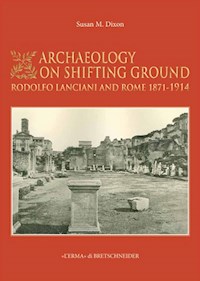
On cover Atrium Vestae, looking East, photograph, from Lanciani,Ancient Rome in the Light of Recent Discoveries (1888), 133.
Susan M. Dixon
Archaeology on Shifting Ground: Rodolfo Lanciani and Rome, 1871–1914 / Dixon Susan M. - «L’ERMA» di BRETSCHNEIDER, 2019 - 180 p. ; ill.; (Studia Archaeologica ; 231)
ISSN 0081-6299
ISBN 978-88-913-1874-9 (cartaceo)
ISBN 978-88-913-1876-3 (digitale)
ISBN 978-88-913-2198-5 (ePub)
CDD 930.1
TABLE OF CONTENTS
Acknowledgements
Introduction
CHAPTER 1: A Career in Archaeology
Beginnings
Portus and Magliana
Pietro Rosa, Sopraintendenza
Giuseppe Fiorelli, Direzione Generale
The Accademia dei Lincei
Commissione Archeologica Comunale
CHAPTER 2: What Was Found: 1868–86
The Capitoline Hill
The Roman Forum
The Palatine Hill
In and Around the Tiber River
Around the Colosseum and the Oppian and Celian Hills
The Eastern Hills
The Servian Wall
Around the Pantheon
The Large Baths of Rome
Ostia and Tivoli
In the region of the Alban Hills and elsewhere
CHAPTER 3: Lanciani and America: 1886–87
Contacts with Americans
“Notes from Rome”
Cicerone
Lecture Tour in America
Travelling
Motivations
Fundraising
Engaging with the Archaeological Institute of America (AIA)
CHAPTER 4: Rome, after America: 1887–90
Houghton Mifflin & Company
Content of Ancient Rome in the Light of Recent Discoveries
The Boston Museum of Fine Arts
Advice on Collecting
Art Institute of Chicago
Dismissal
Claims and Counter-Claims
CHAPTER 5: A Reputation in Flux, post-1890
At the University
Forma Urbis Romae
Storia degli Scavi
More English-language Publications
A Successor in the Forum: Giacomo Boni
Shifting Ground
CHAPTER 6: Rounding out a Career: 1903–1911, and beyond
Displays at the Capitoline Museum
The 1911 Mostra Archeologica
Postscript
APPENDICES
ABBREVIATIONS
BIBLIOGRAPHY
ACKNOWLEDGEMENTS
Two seminal events, both funded by the National Endowment of the Humanities, sparked this investigation of Lanciani and his published work. The first was a Summer Seminar entitled “Archaeology and Ideology,” led by Stephen L. Dyson, the Parks Professor of Classics and SUNY Distinguished Professor at the University of Buffalo, and held at the American Academy in Rome. The other was a summer of research funded by an NEH Stipend, which allowed me to delve deeply into the subject. In addition, research leaves and grants from two institutions, The University of Tulsa and La Salle University in Philadelphia, a former and current employer, helped propel the project forward. I am grateful to these organizations for their support. Some individuals deserve my special thanks. Prof. Dyson, as well as John A. Pinto, the Howard Crosby Butler memorial Professor of Art and Archaeology Emeritus at Princeton University, Nicola Camerlenghi, Associate Professor of Art History at Dartmouth College, and Klare Scarborough, Director and Chief Curator at the La Salle University Art Museum, provided me invaluable encouragement throughout the research.
INTRODUCTION
No serious study of ancient Rome’s topography can be undertaken without consulting some of the vast scholarly production of Rodolfo Lanciani (1845–1929) (Fig. 1). As the city of Rome was upended in the decades after 1871 in order to be shaped into Italy’s new capital, Lanciani was there to identify, record, and interpret the remains of ancient Rome. Most of those remains were only partially or temporarily revealed before their removal or destruction. His desire to capture what was found and what was then often lost was his primary driving force; his secondary was a long-held determination to succeed brilliantly as a way to discredit those who attempted to taint his reputation.
In 1871, Lanciani began his career in the new national archaeological service in Rome and soon thereafter was given major responsibilities. He became director of the excavations of the Roman Forum, whose level from the Capitoline to the Colosseum, and from the Palatine Hill to the adjoining fora, was brought down to its current state. Concurrently, as secretary of the city of Rome’s commission on archaeology, Lanciani oversaw inspections of finds on private and municipal land. Thus, Lanciani had a near complete picture of all recently found evidence of ancient Rome. Well versed in classical literature and trained as an engineer, Lanciani had the right set of skills for the task. During the two decades in which he held these positions, he issued hundreds of publications: short scientific notices in the state’s journal Notizie degli Scavi di Antichità, and longer essays in the city’s Bullettino della Commissione Archeologica Comunale di Roma. Furthermore, as a valued member of the Accademia dei Lincei, he produced well-researched expositions on specific monuments. Among these publications are seminal works, including his studies of the aqueducts, the harbor of Portus, the Servian Wall, and Hadrian’s Villa.
Although after 1890 he was no longer in the archaeological service, he retained a professorship of ancient Roman topography at the Università di Roma, and his publications continued. He was responsible for two major reference works: Forma Urbis Romae (1893–1901), the large map of all that was known of ancient Rome superimposed on a sketchy outline of modern Rome; and Storia degli Scavi (1902–10), a multi-volume collection of notices of archaeological activity in papal Rome, from 1000–1870. Meanwhile, he wrote many articles and books in English. By 1876, “Notes from Rome,” an occasional column, appeared often in the London journal The Athenaeum, and from 1889 until his death, he issued seven books for an American audience. These English-language writings were popular in tone but no less informative about ancient Rome than his works in Italian and today scholars treat them as rigorous sources.
Lanciani’s achievements were herculean in the midst of the tumultuous upheavals of late 19th-century Italy. Rome underwent a sea change in all ways: politically, socially, physically, economically, and culturally. In 1871, the constitutional monarchy unseated the papacy as the political power in Rome and its territories, and indeed, in all of Italy. It established bureaucratic procedures to enact reforms in many areas, including public education, under which the archaeological service fell. Tensions among social groups, including between those loyal to the king and those to the pope, and between those of the old aristocratic families and those of the new bureaucratic classes, infused most workplace situations, including Lanciani’s. Additionally, each new political election brought the potential for a reorganization of the offices in which Lanciani worked.
Fig 1. Rodolfo Lanciani, with a group of women, photograph. Photo credit: The John Rylands Library, The University of Manchester, Album Rome 1883/1894, Capt. J. Douglass Kennedy Collection.
Meanwhile, the city’s topography was altered dramatically. With Rome as the center of national operations, the population grew exponentially. Whole areas of Rome that were once undeveloped fields were turned into residential districts, and modern urban infrastructure was constructed to support them. Ministry headquarters, hospitals, banks, and other large institutional buildings marked their presence in the cityscape. Burgeoning technologies, such as the railroad and electric supply lines, left significant footprints in the city. The ancient seven hills of Rome were reshaped, as some valleys between them were filled in, to accommodate the workings of the new capital.
The practice of archaeology likewise underwent pronounced change. In general, ancient remains were now interpreted with more attention to the material evidence than to the primary texts. New methods of excavating, beyond the rescue archaeology of old, were required. This included deciphering information from the position of an artifact in the earth’s strata and within a broad topographic context. Lanciani was not trained as an archaeologist, and in fact, it was not a profession available in the academic curriculum at the time he entered the field. But he worked alongside those who were eager to use the new methods and to craft training programs for the discipline.
Alongside these transformations were heated cultural and political discussions about who got to own and display the nation’s cultural patrimony. In addition to Lanciani’s many positions, he held the directorship of the state museums and the oversight of new collections at the city’s museum on the Capitoline Hill. Beyond the task of collections management, which was an onerous task given the sheer quantity of objects being unearthed at this time, Lanciani found himself among contentious parties, each staking a claim on the objects. There were state officials planning to build a national museum, city politicians scrambling to expand the Capitoline collections, private landowners aspiring to make a personal profit from artifacts found on their property, impoverished aristocrats hoping to sell their art collections, and foreign collectors and museum professionals dreaming of shipping classical art to their home countries. Despite the strife, however, there were moments of great achievement in Lanciani’s career. He reconstructed and hung the Severan Marble Map fragments in the Capitoline Museum, rearranged the galleries dedicated to the remains of the ancient Roman horti in the same museum, and in particular, designed and realized the Mostra Archeologica, part of the 1911 Esposizione Internazionale, held in the Baths of Diocletian.
Furthermore, even as the state worked to curtail foreign practice of archaeology on Italian soil, foreign attention to what was happening in Rome at this time intensified. Easy travel and communication in the modern age intensified this interest. Lanciani worked at the nexus of an international community of scholars, dilettantes, tourists, antiquities dealers, and museum curators, all of whom showed curiosity about the new information and material goods from Italian finds. There was no restraint on them staking a claim in the discourse surrounding archaeological practice, and at times, on the antiquities it yielded. With his excellent English-language skills, Lanciani had strong connections with the British and the Americans, and made use of them in attempting to further his reputation, something for which he was recriminated by his Italian employer.
Amid such upheavals, Lanciani’s approach to ancient Rome was deemed old-fashioned and incompetent in short order. He was forced to resign his positions in late 1890 for perceived unethical behavior in the archaeological service: providing unofficial access to sites, and dealing antiquities to American museums, even in the age before strong antiquities protection laws. Additionally, some of his methods of operation were deemed not scientific enough, as he was too eager to consult the ancient textual evidence for interpretation of the remains rather than allowing them, and their context, to speak for themselves. (This, of course, one can do in the field of classical archaeology, and not in the study of prehistory.) He was noted for being too positivist, often naïve, in his assumptions about history. We see this best in his insistence of the Alban tribes as the first inhabitants of Rome, or the location of the graves of Sts. Peter and Paul. Some colleagues in the state archaeological service approached his work with skepticism and even ridicule. Some foreigners, like Richard Norton, the director of the American Academy in Rome, did as well, refusing to recommend one of Lanciani’s English-language handbook for students as a source.
This biography provides a narrative of Lanciani’s working life with attention to all these forces. It relies on Domenico Palombi’s 2006 comprehensive biography, Rodolfo Lanciani: l’archeologia a Roma tra l’Ottocento e Novecento, the first monograph on the archaeologist and scholar. Palombi scoured the Italian archives for plentiful evidence of the various phases of the scholar’s career. His account is particularly groundbreaking in treating Lanciani’s years as a university professor and as a dignitary in the Parliament and the Municipal Council. My contribution to the story of Lanciani’s life, in this second biography, is to focus on his scholarly production; I mesh the facts of Lanciani’s tumultuous career to his vast and assorted publications. For example, he published frequently in two very different types of Italian journals, each with different purposes. In the state’s journal, Notizie degli Scavi di Antichità, the monthly entries in the main were highly objective observations of the archaeological discoveries; in the city’s Bullettino della Commissione Archaeologia Comunale di Roma, the essays were longer and allowed for more synthesis of bits of information and thus interpretation. In addition, his English-language “Notes from Rome” were diary-like entries that appeared on an occasional basis in the London Athenaeum. These, along with his books for American audiences, delivered a popularized version of ancient Roman scholarship. They reveal Lanciani’s desire to educate and appeal to British and American citizens, and to communicate to them what he conjectured was relatable or notable about ancient Roman culture. Although the kernel information in all venues might have been the same, Lanciani demonstrated that he knew how to identify and write for a specific audience. This trait, a chameleon-like ability in approaching people, comes through in his writings, as it did in person. Lanciani was extremely gregarious.
The book also aspires to allow Lanciani’s personality to emerge. He was charming and eager to be the center of attention. His tours in the Roman campagna were well attended and remembered, as were his lectures. At the same time, he was socially ambitious. He was not born into an aristocratic family but rather into one that was attendant at the papal court. Nonetheless, he had aspirations to live the courtly life, and eventually married into the class at age 75. Because his social mores were impeccable, he was the johnny-on-the-spot to attend to foreign dignitaries who came to the city to see the ancient Roman sites. For the same reasons, his colleagues, especially those in the state archaeological service, found his behaviors irritating. His ego was large, and his obsequiousness to those in the old-world hierarchy was obvious.
His gregariousness was somewhat at odds with his keen abilities as a researcher. He was superb at collecting and organizing data on ancient Roman topography, and the pursuit of such data drove him to complete large-scale projects. His passion to accrue topographical information was undiminished throughout the tumult in his career, and in the city. The Forma Urbis Romae (1893–1901) the large map of a reconstructed ancient Rome, and the Storia degli Scavi di Roma (1902–10), the collection of historical notices of archaeological discoveries in Rome, demonstrate his steadfastness in amassing vast amounts of information. His fascination in particular was with the ancient city’s infrastructure – its roads, its walls, its aqueducts – on which to hinge the topographic monuments. His methods of gathering data were unwaveringly methodical. He began with the textual sources, then consulted the visual sources – maps and views of ancient Rome throughout the centuries – to which he later added the tangible remains, the archaeological records of late 19th and early 20th Centuries.
Rodolfo Lanciani and his scholarship demands some attention now. Despite the quality and quantity of his accomplishments, they were overlooked after his death, even as his publications were routinely consulted. He resigned his last position, that of university professor, at the age of 77, just months before the March on Rome. Lanciani’s contribution to the field of archaeology was thereafter diminished, overshadowed by the strong personalities among the next generation of archaeologists, those of the Fascist regime (some of whom were Lanciani’s pupils).
Furthermore, in the century between Lanciani’s death and today, some of his many pronouncements or conclusions have been the subject of revision or criticism. I will give just a few examples. Jan Stubbe Østergaard traced Lanciani’s comments on the Licinian Tomb, from different published sources, only to find them frustratingly inconsistent.1 David Karmon takes offense at Lanciani’s attention to gathering up evidence of the destruction of Rome during the Renaissance, as opposed to any of the age’s attempts at preserving the ancient.2 And Katherine von Stackelberg finds Lanciani’s unfavorable comparison of rigidly planned ancient Roman gardens to the “romantic naturalism” of the English garden to impede the appreciation of the former.3
These scholars are correct in taking Lanciani to task. My book, however, aims to give them some framework to understand the nature of his published statements, including the chaos in which archaeological finds were recorded, the desire to preserve that which would be lost, and his predilection for gearing some of his writings to his foreign audience.
Lanciani has been getting more scholarly visibility in the past four decades or so. In this time, Lanicani’s scholarship has been edited or translated, and re-issued frequently. In 1988, Anthony Cubberley collected and edited Lanciani’s English-language journal entries from the London Athenaeum, allowing us to read all the entries from 1875 to 1914 in one place.4 In the early 1970s, Lanciani’s popular English-language books were made available in Italian. Furthermore, efforts to make public Lanciani’s archival materials began in earnest in the early 1990s. To the Vatican Libraries, he had donated sketches and personal notes on major monuments, many accumulated during his employment in the archaeological service. After some wayward notes were found and catalogued with the originals, Marco Buonocore edited and published five volumes of a majority of the items.5 Now, without going to Vatican City, one can see what Lanciani recorded about, e.g., the Servian Wall. After Lanciani’s death, the Biblioteca dell’Istituto di Archeologia e Storia dell’Arte purchased Lanciani’s collection of visual evidence of ancient Rome that was captured by artists, architects, and archaeologists of centuries past, but the inventory was published only in 1991.6 And recently, approximately one third of those prints, drawings and photographs have been digitized and are available online.7 And if that is not enough, a team of scholars from three universities are updating Lanciani’s Forma Urbis Romae with archaeological finds made in the following century, and creating interactive links to the citations related to the illustrated topographical feature.8 Lanciani’s scholarship has never been more accessible.
Those who love the topography of ancient Rome, or who have been engrossed in the pages of one of Lanciani’s texts, will enjoy learning about the man behind the extraordinary scholarship. They will get a fuller sense of this charismatic and ambitious individual, who despite great obstacles in his life and career, left much behind for us to contemplate and to build upon.
CHAPTER 1
A CAREER IN ARCHAEOLOGY
BEGINNINGS
According to Rodolfo Lanciani, his interest in archeology was stirred at a young age. His earliest years were spent in the care of a wet nurse, whose cousin was the famous self-taught geologist and paleontologist, Abate Carlo Rusconi (1814–68).1 Rusconi took the young Lanciani into the local campagna to hunt for fossils.2 These outings awakened Lanciani’s fascination with exploring the earth for old things with rich histories. They also kindled the passion to understand the topography and history of the campagna, a project he would embrace fully in the last decades of his life.
During those early years, Lanciani lived in Montecelio, the land of his ancestors, where the Lancianis had owned property on which stood some remains of Corniculum, the stronghold of Servius Tullius, sixth of the ancient kings of Rome.3 This familial association shaped Lanciani’s desire to elucidate early Rome’s history using material evidence.
As a child, Rodolfo Lanciani was the youngest in his extended family who resided together in a palace on via di Ripetta in Rome, near the Tiber River. His parents, Pietro Lanciani and Lucia Galardi de Jugellis, were both in their mid-40s when he was born. The household also included three adult half-brothers from Pietro’s earlier marriage, some older paternal relations, and his sister Carlotta, five years his senior. Carlotta and Rodolfo remained close all their lives.4
Since the 16th century, Lanciani family members had distinguished themselves, excelling at medicine, jurisprudence, and science, among other professions.5 Rodolfo’s father Pietro was no exception. He was an engineer, and eventually a hydraulic engineer, at the papal court, from 1826 to his death in about 1868. He produced two very important publications on methods of managing the flow of rivers, and specifically the Tiber River.6 Rodolfo as well would conduct intense research on water flows in Rome early in his studies.
Rodolfo followed very closely in his father’s career footsteps. From 1865 to 1868, he studied mathematics, earning credentials as a civil architect in 1867, and as a civil engineer in 1868, from the Scuola speciale degli ingegnieri, at La Sapienza.7 Pietro encouraged him in this pursuit by employing him as a teen to help measure the steep thoroughfares of Montecelio.8 Given the family roots in that hill town, Pietro served as its communal engineer. At Pietro’s death, just as Rodolfo was finishing his schooling, he assumed his father’s position, holding it until 1878 when his responsibilities in Rome became so laborious that they required all his attention.9 Water and earth, rivers and mountains, the art of measuring and the pursuit of ancient objects: these are the things that preoccupied the young Lanciani.
Archaeology was not a profession that Lanciani studied at university, because it had not yet become a sanctioned field of study.10 Prior to his training in civil architecture and engineering at university from 1865–68, he was a well-read classicist who earned a degree in philosophy from the Collegio Romano in 1863. This solid training shaped Lanciani’s archaeological practice as much as his mastery of engineering. He brought to the investigation of the physical remains of ancient Rome an acute understanding of literary sources. Like Poggio Braccolini or other Renaissance humanists,11 he visited many European libraries throughout his life. In them, he sought and found written and visual evidence of ancient through medieval Rome’s topography and monuments.
Family connections also aided Lanciani in his career. He easily found work among his father’s colleagues at the papal court. Count Virginio Vespignani (1802–82), a papal architect and an erstwhile illustrator of archaeological texts, including one of the excavations at Pompei, was his sister’s father-in-law.12 Furthermore, Giovanni Battista de Rossi (1822–94), a papal archaeologist best known for his investigations of the Christian catacombs, mentored Lanciani while he was still a student. De Rossi, referred to as the father of Christian archaeology, compiled three volumes of plans of the catacombs and a corpus of Christian inscriptions.13 In the late 1860s, de Rossi explored the ancient site of Portus, with Lanciani at his side.
PORTUS AND MAGLIANA
Portus was one of the major ports that served ancient Rome, conceived and constructed under the Julio-Claudian emperors. Located on the Tyrennhian coast, just north of Ostia, it was intended to alleviate some of the traffic through the neighboring port. In the post-antique centuries, Portus had been the property of the papacy. In the Renaissance period, it was a site of interest because of the artistic treasure and the reusable building materials it yielded. In Lanciani’s day, the Torlonia family owned the site, after Prince Alessandro, the second prince of Civatelli-Cesi (1800–86), and papal banker, purchased it. It was mined primarily for ancient sculptures and other artifacts to enhance the famous Torlonia collection.14 As part of the process, trenches were opened and then back filled, once the treasure was extracted. Between 1863 and 1867, the papal archaeologist Pietro Ercole Visconti (1803–80) supervised this work. Visconti was a third-generation papal archaeologist, and served as prefect of antiquities under the papacy from 1836 to 1870.15
Under de Rossi’s mentorship, Lanciani published an account of what he believed to be a major find on the site, the Xenodochio, or hospice for early Christian pilgrims mentioned in the letters of St. Jerome.16 Lanciani identified the apsidal wall of the building, located within the confines of ancient Portus and at its southernmost point. As an aside, Lanciani noted that the wall appeared to be that of a basilica or Christian triclinium; in fact, today the building is identified as a Christian basilica.17 He argued that the building was constructed or possibly reconstructed in the first half of the fourth century, and was inhabited until about the end of the ninth century. The bricks it was built from provided evidence for his position, as did the coins, lamps, and other material evidence found on site. He also collected and interpreted the epigraphic evidence, both near the site and elsewhere, including an inscription from a late eighth- / early ninth-century restoration of the building by Pope Leo III (750–815).
In a subsequent essay, Lanciani accounted for the topography of ancient Portus (Fig. 2). It was published in the 1868 issue of Annali dell’Istituto di Correspondenza Archaeologica, the scholarly journal of the eponymous institute.18 This organization was founded in 1823 for the purpose of collecting and disseminating information about archaeological discoveries among scholars from all parts of the world, but most of the scholarship came from France and Prussia.19
In the essay, Lanciani built on the scholarship of de Rossi and Wilhelm Henzen (1816–87), a pre-eminent German expert in Latin epigraphy and philology.20 Because the Portus site had been plundered for centuries and it was therefore difficult to clear and to measure, Lanciani relied heavily on historical documents. Substantial visual evidence of the topography and monuments of Portus was available in the maps and drawings of past centuries. These included the 16th-century maps of Baldasarre Peruzzi and Salvestro Perruzi, Pirro Ligorio, Sebastiano Serlio, Antonio Labacco, and Stefano Dupérac. Lanciani also consulted written descriptions of 19th-century archaeologists Carlo Fea, Antonio Nibby, and Luigi Canina.21 In particular, Lanciani garnered much information from an important written description of the site in a comprehensive 17th-century hydraulic engineering document on the topic of making the Tiber navigable.22
Fig. 2. Ancient Portus, plan, from Lanciani, Ancient Rome in the Light of Recent Discoveries (1888), 245.
In ancient times, Portus was created to supersede Ostia as the more effective port. The efficiency of Portus’ design allowed it to handle the increasing number of ships from Greece and the East in early Imperial times. It was outfitted with two harbors, constructed nearly on axis with one another. The outer basin, built under the emperors Claudius and Nero, was separated from the sea by breakers, and the inner hexagonal basin, constructed under Trajan, could be accessed from it by well-designed manmade canals and islands. In Lanciani’s day, they both had long been filled in with alluvia, and the workings of the connection between the two basins was not clear. Lanciani contributed to the scholarship by demonstrating how a shipping vessel could move from one basin to the other.
Furthermore, Lanciani established the positions of the port’s principal buildings. These include the imperial palace with its sumptuously decorated atria, porticoes, and gardens, as well as the bath, which had originally been located by Antonio Nibby (1792–1839). He also identified the general location of the theater,23 and placed the port’s warehouses on the reconstructive plan, along with their attendant temples and fire stations.
The publication showcased Lanciani’s careful research skills. The essay reveals not just the breadth of his knowledge of historical maps but his command of classical literary sources. He included anecdotes from history to make the ruins come alive, such as the second-century philosopher Aulus Gellius’s tale of Favorinus monitoring a debate on the shores of Ostia, and an account of Augustine attending to his dying mother St. Monica in the city.
Fig. 3. Temple of Dea Dia, reconstruction drawing, from W. Hentzen, Scavi nel Bosco Sacro del Fratelli Arvali (1868), tav. 4. Courtesy of the Getty Research Institute, Los Angeles (85-B24460).
In 1868, working again with Henzen, Lanciani created illustrations of a reconstructed temple of Dea Dia, for the German scholar’s exhaustive essay on the subject (Fig. 3).24 The Brethren of the Arvales, one of the oldest institutions of ancient Rome, built and dedicated the temple to their patron goddess. The group, along with the Vestal Virgins, had been charged with keeping the early rituals of Rome alive. They worshipped Dea Dia, a goddess Henzen believed was related to Ceres, in order to guarantee a good harvest in the young settlement in Rome. Tradition held that the first brethren were the sons of Faustulus, the shepherd who nurtured Romulus and Remus. Always twelve in number, they met at the Regia in the Roman Forum, and once a year travelled to the wooded site along the Tiber River to offer sacrifice to the goddess. The brotherhood became inactive and their rituals fell out of use during the last centuries of the Roman Republic, but were revived in the early Empire under Augustus.
Henzen had discovered a temple dedicated to Dea Dia and other buildings at La Magliana, a site between Rome and Portus. The excavations were conducted at the behest of the king and queen of Prussia, Wilhelm I (1797–1888) and Augusta (1811–90), who had obtained papal permission to excavate there. Henzen found the location of various buildings dating to the late imperial period at the site, including the temple, a bath, and a circus. There were also a considerable number of inscriptions on the site, including fragments of the Acts of the Brethren of the Arvales, which provided invaluable information about this curious religious group with prehistoric origins.
As Lanciani completed his education and made some inroads into a scholarly career, the papal court’s role as custodian of ancient Rome was coming to an end. Indeed, papal Rome was in its last days. Lanciani was likely too young to remember the events of the 1849 battle near Porta San Pancrazio, when the Risorgimento leaders attempted to establish a new Roman Republic. That battle temporarily displaced his father’s employer, Pope Pius IX (reigned 1846–1878) from the city.25 But as a young adult, Rodolfo surely could not have ignored the wave of republican, and thus anti-papal, sentiment in Italy. In 1860, some students at Lanciani’s university demonstrated by refusing to sign a promise of devotion to the papacy, which led to their expulsion.26 Thus, it is unclear if Lanciani was surprised or dismayed when the papal institutions where he would have sought future employment were disempowered in 1871, after Rome was sieged again, this time at the Porta Pia. At this time, Vittorio Emanuele II, the Savoy duke and self-proclaimed King of Italy, claimed the city as the capital of the new unified nation of Italy.27 This momentous event provoked many changes, including efforts to transform the sleepy town into a modern city and the creation of bureaucratic offices to oversee and care for one the city’s most valued assets, the antiquities of Rome.28 Lanciani subsequently was asked to work for the national government in its archaeological service.
PIETRO ROSA, SOPRAINTENDENZA
Lanciani’s first major employment, then, was with the Italian state. In early 1871, he was hired as an inspector of excavations in the office of the Sopraintendenza per gli Scavi di Antichità, part of the Ministry of Public Instruction. Cesare Correnti served as its minister from 1870 to mid-1872. Correnti’s immediate goal was to assume control over all archaeological sites throughout Italy. He planned to do this by segregating the practice of archaeology from the private academies (including the papal academy), and thus taking it out of the hands of those he deemed amateurs. He opined that these amateurs were only interested in building private collections of antiquities. He also wanted to eliminate excavations by foreigners, who for centuries had gained excavation licenses from the various sovereigns of pre-unification Italy, then arranged for antiquities to be exported out of the country. Instead, Correnti wished to wed archaeological practice to public museums, ensuring that archaeological finds made their way into national museums, and were thus used for public instruction.29
The office of Sopraintendenza was established by royal decree soon after the Savoy troops entered Rome. Pietro Rosa, the first and only appointed superintendent, was responsible for setting the agenda for archaeological excavations in Rome and its provinces, and for caring for the goods gained from them. He was obligated to investigate and examine all artifacts found serendipitously on state-owned property (e.g., during construction) in order to identify items valuable for the new nation’s public use. Lastly, he was charged with creating national museums in which the excavated material could be displayed.30
Rosa had trained as a painter and an architect, but because of his abilities as a draftsman, he was recommended in 1861 to oversee excavations of a portion of the Palatine Hill, the Orti Farnesiani. At that time, Napoleon III owned the property.31 The Orti Farnesiani constituted a significant portion of one of the preeminent historical sites in Rome. The Palatine was rich with associations with the founding of Rome; it was believed that Romulus established his colony on this hill. In 1870, the new Italian government recognized that ownership of this site of cultural identity was essential in establishing its authority. Rosa convinced the French to sell the property to the state government. For this service, Rosa was given his office in the national government, and eventually named Senator.32
The Orti Farnesini property had been long abandoned when Rosa first approached it. The messy site had been under the control of the 16th-century Farnese family, who ravaged it in search of building material and antiquities for its collections. Rosa’s investigations were most likely as thorough as the situation could allow. He discovered the location of the Temple of Jupiter Stator, on the slopes of the Capitoline Hill, and teased out its connection to Via Sacra. The tablinium of the palace of the Domitian (the Flavian palace) had been visible for some time, but he uncovered more of the structure, including some of its peristyle and triclinium (Fig. 4). He did not probe as far as the cryptoportus. Rosa also found a nearby nymphaeum, and to the south, a library and a schoolroom. His work on the south/south western side of the hill included isolating the site of Temple of Apollo (although he identified it as the Temple of Jupiter Vincitore), and discovering the House of Livia and the Temple of Mater Matuta (which he referred to as the Auguratorium).33 He worked on the site as far to the southwest as the Scala Caci, coming short of the Casa Romuli.34 In 1870, when the state took ownership of this site, and then expanded it by purchasing or seizing other private property on the Palatine Hill,35 Rosa’s explorations continued mainly to the northeast, towards the Velian Hill.36 He believed he had located the Porta Mugonia, one of the major gates of the Roma Quadrata, thought to be the walls constructed by Romulus.37
Rosa had a rigorous work ethic. He employed a lean crew of nine people, one of whom was a child. Under his management, they worked quickly and efficiently. He spent considerable effort educating the public about his work, and he opened the site to visitors on Thursdays. The excavations were widely popular, and their progress was reported in the newspapers. For the public’s benefit, he did “restorations”— reconstructing columns from marble fragments, and collecting fragments from the site and displaying them as creative “candelabra.” To these creative structures he added signage.38 In what had been the Uccellerie Farnesiniane, he established an on-site museum, the Antiquarium, to display artifacts obtained there; these buildings were torn down in 1882.39
Fig. 4. Palatine Hill, foldout plan, from C.L. Visconti and Lanciani, Guida del Palatino (1873), drawing by Alessandro Zangolini.
The office of the Sopraintendenza did not employ any of the papal archaeologists with experience digging in Rome. These men, including Lanciani’s mentors de Rossi and Visconti, refused to work in the state service, or more accurately, they refused to sign documents of allegiance to the state as terms of employment.40 Upon entering Rome in September 1870, agents of the national government immediately suppressed the pontifical commission on archaeology and shut down its archaeological expeditions. One such site was a property on the Palatine Hill adjacent to where Rosa worked. The tension between Rosa and the old papal archaeologists — especially P.E. Visconti — was thick. But even before 1870, Rosa felt these men had disrespected him by not taking seriously his scholarly interpretation of the finds.41
In Roman society at large in the first decades of the Italian nation, antagonism was great between those who were loyal to the pope and those who were loyal to the constitutional monarchy. As the national government disempowered the papacy in all secular matters, it upset and marginalized Roman Catholics. Estranged Catholics formed a movement against the government, the Black Party. The opposing party, the Whites, supported the new liberal and republican government, voicing resentment for the years the papacy and clergy ruled with authoritarianism and corruption. Pope Pius XI, angered at his treatment in post-unification Italy, and secluded in the Vatican as a prisoner, mandated that the Black Party, and indeed all Roman Catholics, not participate in elections nor engage in service for what was deemed an illegitimate government.42
Well before 1870, the Neapolitan Rosa’s anti-clerical sentiments were well-known. Nonetheless Rosa recommended Lanciani for the civil service position of inspector engineer, despite the fact that Lanciani always identified as a devout Roman Catholic, and had great respect for de Rossi and the other papal archaeologists.43 Rosa and Lanciani had a social connection; both were members of the Alpine Club of Italy, and in 1868 they may have explored Monte Gennaro near Tivoli together.44
In the early years of the nation, new civil servants were expected to be men of high ideals. They were to possess a good work ethic and loyalty to their employer. Yet they had few job protections. Their appointments could vary with changes of ministers, who were appointed by the Prime Minister after every new election. Furthermore, salaries were not standardized by position. Civil servants relied heavily on bonuses and special allowances, doled out by a central administration that was predictably slow.45 There were few rules for tenure, dismissals, and pensions. No bureaucratic infrastructure to deal with internal labor disputes existed at this time.
Trouble between Rosa and Lanciani began with a disagreement about the nature of Lanciani’s position. Beginning in early 1871, Lanciani was paid for ad hoc tasks. The ministry soon decided it needed full-time inspectors, and had solicited nominations for these positions in May of that year. Rosa had submitted Lanciani’s name.46 This salaried position appears not to have been officially offered nor accepted. Lanciani, however, was under the impression that he was performing the tasks of a full-time inspector, and that he deserved a salary for that work. He believed this, he reported, because of the way Rosa spoke to and treated him. In October 1872, when no raise had appeared in Lanciani’s paycheck, he filed suit for back wages and fees against Rosa, representative of the Office of the Superintendent. The suit was messy, given the state’s immature bureaucracy, and took four years to resolve. In the end, Lanciani received only a small portion of the remuneration he sought. By 1875, the government officials were in the process of changing the structure of the Ministry of Public Instruction itself.47
The episode reveals something of Lanciani’s work ethic, as the older Rosa understood it. Rosa felt that Lanciani was a difficult employee and in a letter noted that he considered Lanciani to be lazy, completing tasks on his own schedule, and temperamental, taking offense easily. He frequently misinterpreted things Rosa said, understanding them as sinister remarks.48 Rosa also felt Lanciani disrespected him in public. Rosa revealed that Lanciani quit the position but later returned to it. Upon Lanciani’s return, however, Rosa noted behavior he took to be progressive laziness: refusing to go to an excavation site or to respond to Rosa’s inspection requests, sending other inspectors such as Angelo Pellegrini to do the work.49 Furthermore, Rosa – an indefatigable journal writer – complained that Lanciani left neither drawings, sketches, nor notes of his inspections with the office.50 Lanciani, for his part, claimed he was indeed excavating, overseeing excavations, inspecting finds, and directing restorations throughout the city. He listed the far-flung sites that he had visited, including some on the Palatine Hill, and areas outside the Porta Salaria and Porta Maggiore, on site of the Stazione Centrale and along via Nazionale, and near the church of San Nicolo da Tolentino in the area of the Horti Sallustiani.
The various reports related to the suit characterize Lanciani as thin-skinned, someone who felt his work and expertise were undervalued. They reveal Rosa as combative, and having an unclear understanding of his duties in the new state bureaucracy. Rosa’s manuscripts from his excavations on the Palatine Hill reveal that he was a highly organized, tireless, and detailed administrator. However, he had the tendency to be presumptuous and assume that he was put-upon by others. According to a recent biographer, he professed to be humble but actually exhibited narcissistic behavior. He could be both easily insulted and mercilessly insulting to others.51
Beyond the clash of strong personalities, however, this lawsuit episode tells us something more. Rosa’s critique of Lanciani’s work signals something larger about the changing ethics of archaeological practice. What did the oversight of an archaeological site entail in the new bureaucratic state? Rosa suggested that unsupervised workmen, monitored by an excavation inspector who only visits periodically, can hardly be expected to keep accurate notes about their finds. A more rigorous oversight by professional archeologists was required.
Furthermore, Rosa had criticized the papal archeologists for excavating a sgrotto, i.e., digging a cave or hole into the ground in a haphazard way to retrieve what was hidden in the earth. Rosa employed a type of proto-stratigraphy in which he inserted a tube into the earth in order to ascertain the depth of any remains before planning an excavation strategy.52 Rosa also wanted full control over information from the excavation, a major departure from the standard practice in papal Rome. Under the papacy, the scholar assigned to or associated with the excavation owned the knowledge from the site, and could publish it and present it to their patron, or to fellow scholars at a private academy such as the Accademia dei Lincei. But post 1870, Rosa believed, the material yielded from the work, including sketches of the sites, belonged to the state. This clash of habits marks a sharp growing pain in the discipline of archaeology.




