


Erhalten Sie Zugang zu diesem und mehr als 300000 Büchern ab EUR 5,99 monatlich.
Should I play only one role or should I be authentic? Should I follow adapted or should I be courageous? This book is intended to encourage you to see your own roles through the glasses of authenticity - and vice versa.
Sie lesen das E-Book in den Legimi-Apps auf:
Seitenzahl: 89
Veröffentlichungsjahr: 2018
Das E-Book (TTS) können Sie hören im Abo „Legimi Premium” in Legimi-Apps auf:
Ähnliche













Olaf Cordes
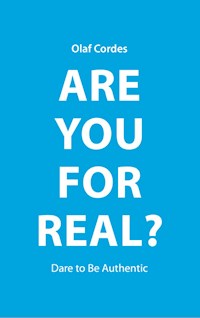
Are You for Real?
Olaf Cordes
Are You for Real?
Dare to Be Authentic
Artwork by Phil Stauffer
www.sindsienochganzecht.dewww.areyouforreal.de
Bibliografische Information der Deutschen NationalbibliothekDie Deutsche Bibliothek verzeichnet diese Publikation in der DeutschenNationalbibliografie; detaillierte bibliografische Informationen sind im Internet über http://dnb.ddb.de abrufbar.
Bibliographic information published by Die Deutsche NationalbibliothekDie Deutsche Bibliothek lists this publication in the Deutsche Nationalbibliografie; detailed bibliographic data are available in the Internet at http://dnb.ddb.de.
2. Auflage 2018© Olaf Cordes, Munich 2018All rights reserved
Editorial Assistance: Anne JacobyCover design and typesetting: Axel Wünsche, Bell MediaTranslation: Jeannette BonnkeArtwork: Phil Stauffer
Sales and distribution: Nova MD GmbH, VachendorfPrint: Sowa Sp. z o.o. | ul. Raszynska 13 | 05-500 Piaseczno, PolskaPrint ISBN 978-3-96443-361-9
eBook ISBN 978-3-96508-440-7
For Johann und Martha
INHALTSVERZEICHNIS
BEFORE THE PERFORMANCE
About Masks, Fake and Freedom
Tense Permanent Laughs
False Fantasy World
A Plea for Living an Authentic Life
How Can I Be Real?
Role Theories? Irrelevant.
Discovering Freedom
Living More Vibrantly
IMITATOR
About Originality and Imitation
Imitation Is an Artform
Learning from the Old
When Imitation Restricts
Encasing Bondage
“An Original”
Post Modernity Doesn’t Care About Originals
Boldly Eccentric
Narcissism, the Exception
Summary
CLOUDS
About Stable Clouds and Self-Fragments
In Between Genius and Kaleidoscope
Today: Everything Is New!
Warning: Misconception!
Back to the Core
Living out Impulses
Summary
NATURE
About Leaving off Make-up and Recycling
Searching for Lost Nature
Entirely Artificially Authentic
Not to Forget: The Body
Somatic Markers
Can We Learn to Be Real?
Self-Care
Summary
PLAIN LANGUAGE
About Straightforwardness, Trimmings and Bullshit
Plain Language Takes Courage
Softening Agents
Cleaning up Language
Speaking Plainly Creates Trust
The Noble Art of Non-Diplomacy
Summary
ACTING
Concerning Spontaneity, Orchestration, Blag
And Everybody Plays Along
Enacted Authenticity
Keeping Your Distance Makes You a Professional
Searching for As-Well-As
Friendship Creates Turnover
Breaking Out of the Performance Hell
Summary
STOP THE THEATRICALS
About Letting Go and Finding
Protective Armour
Learning from the Theatre
So, Are We for Real?
BIBLIOGRAFIE
QUELLENANGABEN
BEFORE THE PERFORMANCE
Actually, I am completely different,I just hardly ever get the chance.
ÖDON VON HORWATH
About Masks, Fake and Freedom
Are you for real? I mean, really authentic? Or do you, like so many, disappear behind a high-gloss polished business mask during the day, a fake empathetic family mask when you get home or a hipster mask when you go out?
And? Does it itch? Admittedly, mine does. On the one hand, though, I like my mask because it portrays me to the world. It shows what I can, want or have to portray. And because it protects me from my own vulnerability. And also, because it protects others from some of my feelings and moods. On the other hand, it annoys me because it shields me so well that my true emotions and thoughts often remain an enigma to others. How about you? Do you also feel an itch on your face? Yes? Where exactly?
If so, then I’m writing this book just for you. And for all of those among you who are sick and tired of pretending to be business starlets or super dads, hipsters or coffee-to-go connoisseurs. Too phoney, sometimes even repulsive. For all those who, between pressing asap-appointments, pressing smart phones, pressing colleagues, pressing clients and more pressing duties, have trouble catching their breath and whose professional screwed-on smile is nothing more than a frozen grimace. For all those who yearn for open spaces, joy, ease, play, love, real feelings and real emotions. For all those who ask themselves: “Am I really serious? Am I really authentic?”
Tense Permanent Laughs
This is not a new question: The Mask Maker is the name of a little play from 1959 by the great French mime artist Marcel Marceau.1 In it, Marceau mimes a person trying on different masks: a thoughtful one, a sad one, a happy one and, finally, a very enthusiastic one. The last mask, mouth wide open and laughing loudly, suddenly sticks to his face and he is unable to remove it. For about three minutes Marceau struggles fiercely with this permanently laughing mask. His body exudes fear, the mask is immovable. By force, he finally rips off the mask from his chin over his forehead – and a totally distraught real face emerges, seemingly hidden before that beneath the laughing one. He then collapses in utter exhaustion.
This pantomime by Marceau brings to the point what I regularly see in my seminars, training and coaching sessions: People who have lost themselves behind their perfect, professional and optimistic success masks. At first, they are devastated, then relieved and finally able to smile at themselves as they stand before me while I provoke them until they realise that there is something foreign – right there in the middle of their face.
False Fantasy World
Paradoxically, many participants want to know exactly how to talk, stand or sit. They are continually looking for more hints, tricks, techniques and tools. Ideally, they would love to have a remedy against the fear of losing control, the fear of behaving incorrectly. Methods and preparations against the persistent discomfort the feel under their skin and in their bodies. They train hard. But they are not getting anywhere.
Because they are going in the wrong direction. By continually perfecting their masks, they cannot find that starting point where they were congruent in themselves and with themselves. Instead, they lose themselves even further in the glossy fantasy world of self-optimisation.
Until they have practically morphed into an artefact. And they convince themselves that this is the way to go! Because it reflects the zeitgeist: A successful person should be a trademark, they say.2 (Funnily enough, the word trade-mark only differs in one letter from the word mask…!) He or she does not want to have to deal with antiquated ballast like authenticity. Authenticity is something for beginners. Roles and role acting are the recipe for success! This is precisely what some authors argue. Like Rainer Niermeyer, for example, who published a book titled Mythos Authentizität (English: Authenticity – a myth).3
A Plea for Living an Authentic Life
Now, when I hear any talk about roles, role playing and acting in connection with companies, management or employment contracts I actually become angry. I passionately oppose anyone who wants to impose the professional deformity of personality as the new norm.
It may be true that some exceptionally successful top executives are highly successful precisely because they manage to flourish in their role and because they have ceased thinking about their own values, the meaning of life or true happiness. According to one study, they don’t even seem to suffer because of this.4 But, it may be just as true, that such findings do not apply to the younger generation. In my experience, a great many members of often-referred-to generation Y are actually quite concerned about it. They have started caring about values such as (self-) responsibility, quality (of life), holism, family and health again. Many young people want to do their own thing – and if their employer doesn’t like it – well, they just quit and go to the next co-working space or even a café with their beanies and their small electronic devices. Is the willingness to completely shine, sink or die with your role finally declining?
Or have we taken it even further? Does our social consensus see role play as old school but is actually looking for more subtle forms, instead of eliminating role play completely? This is Christoph Bartmann’s take on what is happening. He wrote a book about new office life:“Those who don’t perform in some way, are not even there. Things that cannot be shown off are non-existent. Presently, we are all performers, first and foremost self-exposers on the market of visibility. We have to perform in such a way, so we do not look like rule-players.”5
Roles. If it were up to me, I would completely erase the concept of roles. But since the term is used quite frequently when talking about careers, in coaching, training and even by researchers in the fields of sociology, psychology and management, I likely won’t get away with ignoring it completely. On the other hand, I don’t want to do the same – but backwards - as those who discredit authenticity tend to do while at the same time attributing all power to (enacted) roles. Once again: I do not wish to ascribe all importance to authenticity and at the same time blank out roles completely. It is all about finding a new answer to the question:
How Can I Be Real?
Why does this question concern me? Quite often I hear from people taking part in my sessions that life unfortunately always includes a bit of acting. That you have to be an actor, be different or pretend to be able to play in the big league. And this is not completely wrong: A teacher takes on the role of a teacher while he or she is at work. In a family, a dad has the role of being a dad. At the operating table, a surgeon performs in the role of a surgeon.
But professionalization only really succeeds with a generous portion of reflection and self-awareness, coupled with discernment and self-responsibility. And with a capability for rational differentiation: You cannot just act being a surgeon. And acting is not something that you deliver in passing. We might play many roles in life, but we are not actors.
Once again: We are not actors! Personally, I believe acting is a very demanding profession. Exercised by men and women who, for many years, have studied and practised this profession and played on real stages. But the world is not a stage. And a business even less. All the employees and executives are not actors. They are analysts, tax consultants, electricians, sales specialists, medical assistants or board members, maybe lawyers, carpenters, employee representatives, political scientists or insurance brokers.
Not actors.
Even if I give a lecture or an inflated PowerPoint presentation, I am not an actor. Just like I am not a baker because I know how to heat up prebaked croissants which I bought at the discount shop around the corner.Pretty simple, isn’t it?
Role Theories? Irrelevant.
I am aware that we are bound by social conventions and norms, and that these depend on our environment, our profession and the families we grew up in and the ones we live in. Even more: I am aware that assimilating role-expectations contributes significantly to shaping our personality.6 What is more, our living conditions form us in such a way that we continue to stay within these conventions even if we are no longer being observed and are allegedly fiddling with our electronic devices completely authentically.7
Ralf Dahrendorf has put this in a nutshell very nicely in his work Homo Sociologicus – A study on history, significance and critique of the category of the social role (1958), which has become a classic:




