


Erhalten Sie Zugang zu diesem und mehr als 300000 Büchern ab EUR 5,99 monatlich.
- Herausgeber: Seren
- Kategorie: Geisteswissenschaft
- Sprache: Englisch
Five 'lyric essays' exploring the dynamics of performing poetry as a female poet – confronting the implications of being a female on public display, with the connotations of sexual objectification, in a context that traditionally disregards the body. Kim states "With the strides and gains made through the #MeToo movement, I believe the time is right for a book like this to make an impact. As a female poet, I know there is a need for such a book to examine the intersection between writing, performing, feminism and sexism. I wish this book had been written when I first started working as a freelance writer and I've had many conversations with other female poets who have also confirmed my thinking – that female poets are navigating these things regularly, and yet nobody is really writing or talking about them." The book draws on her experiences of writing and performing the poems in her second collection All the Men I Never Married. It is a balance of memoir, academic treatise and poetry, though the author's emphasis is on writing in a popular way and making the subject accessible to a wide audience. To achieve this her models have been Maggie Nelson's Bluets, Claudia Rankine's Citizen and Sarah Ahmed's Living a Feminist Life. The book's subjects include heckling at poetry readings and other interactions; problems with the 'male gaze' and what the 'female gaze' might look like in poetry; 'guilty for being a man': how guilt can be useful if it can bring about change; how writing poetry about sexism can shed add meaning to the term; the objectification of men and women, and 'bad faith' arguments. Are You Judging Me Yet?, by Kim Moore, is a remarkable collection of essays and poetry that explore, as the tagline suggests, everyday sexism. – neverintimate '…Moore's work becomes an even more vital tool in the work being done to challenge everyday sexism. Reading her work is not only a window into her own experiences, but may also act as a means of education, and that's something we all need to see more of.' – Wales Arts Review
Sie lesen das E-Book in den Legimi-Apps auf:
Seitenzahl: 280
Veröffentlichungsjahr: 2023
Das E-Book (TTS) können Sie hören im Abo „Legimi Premium” in Legimi-Apps auf:
Ähnliche
















Are You Judging Me Yet?
Poetry and Everyday Sexism
for Mum and Dad
is the book imprint of
Poetry Wales Press Ltd.
Suite 6, 4 Derwen Road, Bridgend,
Wales, CF31 1LH
www.serenbooks.com
facebook.com/SerenBooks
twitter: @SerenBooks
© Kim Moore 2023
The right of Kim Moore to be identified as the author of this work has been asserted in accordance with the Copyright, Designs and Patents Act, 1988.
ISBN 978-1-78172-687-7
Ebook 978-1-78172-688-4
A CIP record for this title is available from the British Library.
All rights reserved.
No part of this publication may be reproduced, stored in a retrieval system, or transmitted at any time or by any means electronic, mechanical, photocopying, recording or otherwise without the prior permission of the copyright holders.
The publisher works with the financial assistance of the Books Council of Wales.
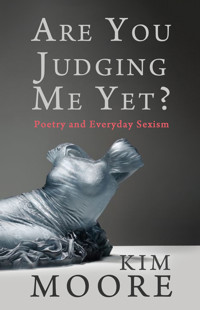
Cover artwork: ‘Reclining Nocturne 1’, 2015, cast glass, 21.5 x 53 x 32.5 inches.
© Karen LaMonte. Photography by Martin Polak.
Printed by Severn, Gloucester.
Contents
Foreword
Map
Desire Lines: Variationson an Introduction
We Are Coming
Yes, I Am Judging You
Not Looking Away: A Poetics of Attention
A Problemwiththe Male Gaze
Mode of Address, Or, Who Are You Talking To?
Guilty For BeingA Man
Between-Us: A Poetics of Perception
Sexismis a Slipperyand Fluid Term
Something in the Telling: A Poetics of Relationality
Lyric Variations (1)
Insidious Trauma: A Biographyof Violence
Lyric Variations (2)
Poemsof Desire: A Modeof Attention
Women’s Imagesof Men – Desire, Vulnerability and the Gaze
An Electric Current: Poems of Wilfulnes
Doing Gender
Intimate Witness: A Poeticsof Watching
The Bodyis the Blindspotof Speech
The Annihilation of Men
What Is Between-Us
Considering Men
To Givean Accountofthe Self
Variations on a Conclusion
Coda:OnWaysof Looking
Reader Checklist
Acknowledgements
Notes
FOREWORD
This book started its life as a PhD thesis at Manchester Metropolitan University, where I worked under the supervision of Professor Michael Symmons Roberts, Dr Nikolai Duffy and Dr Angelica Michelis.
It’s a text that has already undergone a transformation. Part of it is currently living another life as my second collection of poems All the Men I Never Married, published by Seren in 2021. This is its second transformation, as a reader-directed text, consisting of seventeen sections of prose, five groups of poems and two individual poems, one at the beginning of the book and one at the end. Although it can be read in a linear fashion, and will make sense when approached in this way, you are invited to make your way through the book by selecting from several options that appear at the bottom of each section. These choices, or textual signposts will allow you to chart your own desired paths through the text, deciding as you go along what you would like to read next.
Since this text is in conversation with All the Men I Never Married, I hope that readers will want to continue onwards to my poetry collection to read the rest of the poems, but perhaps also to meet the poems they have encountered here in that new context. I’ve always wanted to write a book that sends the reader out from between its pages and into other books, other worlds, and I hope this book does that.
While I hope that readers will make journeys outward from the book, Are You Judging Me Yet? is for me, as its author, a book about what it is like to be a woman, and a poet, and a performer of poetry, in this particular time and place and body I have found myself in, at the very beginning of a millennium.
The young people I work with still experience sexism. A teenage girl told me that a teacher said to her ‘If I’m blushing your skirt’s too short’. What does this tell teenage girls about men and who is responsible for their behaviour? What gives me hope is not that anything has changed since I was a young woman, but that these young women have the language to articulate what is happening to them.
I wanted this book to have a purpose, to add to discussions around feminism and sexism and to talk about how it feels to be a female poet. I wanted to highlight the role lyric poetry can play in such discussions. I wanted to write a playful, angry, sad, thoughtful, transforming, transformative book – and by reading it you are transforming it once again: for that act of faith I give my thanks.
DESIRE LINES: VARIATIONS ON AN INTRODUCTION
1.
If choices are threaded through the body of a text – if the text is not a body – but a landscape – if the text is a landscape – there must be paths – if there is one path – there is always another – if text is a landscape – with paths running through – then reading is a form of travel – if reading is a form of travel – readers must be travellers – some of them will know where they are going – some will be lost –
if text is a landscape – if reading is a form of travel – if readers are travellers – then the text is a journey in itself – if the text is a journey and a landscape – if all landscapes have paths – if each path is a choice – a desire – if this text has its own desires – there are bodies within it – yours and mine – we may find ourselves meeting somewhere inside –
2.
This book aims to create a space for new ways of thinking about sexism and the role it plays in society. When I started writing poems about sexism, back in 2016, there was not much discussion of sexism in UK poetry as a force in and of itself, and certainly no book length considerations of it.
There are of course, many poets writing about related forms of gender-based violence and trauma. Moniza Alvi, Helen Ivory and Pascale Petit have been particularly influential on my thinking. Ivory’s excellent Waiting for Bluebeard examines the impact of domestic violence, using a well-known fairy tale as a lens. Petit’s collections incorporate vivid and surreal descriptions of rainforests and the natural world to reflect on trauma and child abuse, whilst Alvi’s Europa is one of the most beautiful and perfectly poised explorations of post-traumatic stress disorder I’ve ever read.
I wanted to write about everyday sexism, but swiftly came to realise that sexism is not so easily categorised. Often what I thought I was writing about was different to what I ended up with.
In 2015, my first full-length poetry collection The Art of Falling was published by Seren, containing a sequence of seventeen poems called ‘How I Abandoned My Body to His Keeping’ which examine a personal experience of domestic violence.
After ten years of not speaking about what happened, of pretending that nothing happened, the poems were not so much an attempt to tell a story or represent a truth. Instead they became repositories of meaning for me – a way of creating a narrative. However fragmented, however broken that narrative was – by both the passage of time and the strange things our brains do to process traumatic events, I was determined to use the framework of poetry to attempt to contain what had happened to me. I had no interest in a chronological or linear sequence – because the experience was not linear for me. But I did want to resolve it somehow, and decided that the locked box of a sonnet at the end of the sequence would be the perfect form to to do this, and hopefully stop my thoughts returning to the subject again. From the vantage point of over five years later, I see this impulse was a little naïve, but it was what I needed to tell myself to be able to write and finish the sequence.
Violent relationships are marked by the act of transformation. The perpetrator transforms – from loving to violent, and the victim is transformed also. I spent a lot of time reading Ovid’s Metamorphosis to try and understand this. Rape and violence are at the heart of so many of these myths, but so is transformation – both as something forced on someone, but also as a means of survival, a means of escape.
The transformation of the self by another in a violent relationship seems to me to be the most violent thing that can happen, in terms of its long-term, insidious effects. The poems in ‘How I Abandoned My Body To His Keeping’ are full of acts of transformation. Bodies become pillars of smoke, minds become empty tables, hearts become monuments. A man is made smaller and smaller until he is so tiny he becomes pervasive, part of the air needed to breathe. One speaker turns into a bird, another into Europa before she is abducted and raped by Zeus.
The question often asked of people who are in violent relationships – ‘Why do you stay?’ – or if they have managed to escape – ‘Why did you stay so long?’ – has always haunted me, perhaps partly because I kept asking this question of myself. All the Men I Never Married is in part, an attempt to answer this question, building on the work I started in The Art of Falling, as I became convinced that less egregious forms of sexism are in some sense the foundation upon which the worst forms of gendered violence are built.
Living in a body that experiences everyday sexism is like receiving hundreds and hundreds of tiny paper cuts in such a way as to make this seem normal, and how can this not make someone more vulnerable to being in a violent relationship? I began to realise that the answer to the question – ‘Why did you stay?’– can’t just be found in examining what happened, but also in the examination of the political, social and historical conditions that created the possibility of it happening in the first place.
3.
I started to write poems about men, not realising that writing men (plural) was an uncovering of female desire, an admitting to female desire, and that this was risky business, that this uncovering sometimes meant that the sexism that was already in the room, perhaps in hiding, was emboldened to show itself, to speak up.
The female desire I became interested in articulating is characterised by distance and absence, by lack and longing. A female desire found in both the insistence of the gaze, but also its restlessness, a female desire found in the space between two people, a female desire that is not loyal, a female desire that sits back on its haunches and observes, that sometimes steps back behind language when sexism enters the room.
4.
Halfway through my PhD I attended a training session on creative-critical research, which was useful, but did not lift the rising sense of panic I felt when I thought about actually writing my thesis. The lecturer said that if any of the participants would like to meet afterwards for an informal chat about their work, we should email her and she would meet us for a coffee.
So I got in touch and we arranged to meet in the university cafeteria. She asked me what my main methodology was. I remember putting my head in my hands in despair, and replying ‘this is the problem. I’m finding it impossible to stick to one. I’m taking bits from all over the place to say what I want to say. I can’t seem to stop.’ She smiled and said ‘That’s bricolage methodology.’ And in that moment I understood all over again the importance of naming.
N.K. Denzin writes that bricolage is a ‘complex, dense, reflective, collage-like creation that represents the researcher’s images, understandings and interpretations of the world or phenomena under analysis.’1 Bricolage allows me to use disparate paradigms such as feminist theory, lyric theory, film theory and close reading to illuminate my own thinking. D. Weinstein and M.A. Weinstein argue that bricolage allows us to ‘connect the parts to the whole, stressing the meaningful relationships that operate in the situations and social worlds studied.’2
5.
During my research, I performed the poems that I was writing about sexism, and then these performances became part of the research as I reflected on exchanges, reactions and conversations with audience members. This led me to research mode of address in lyric poetry, which led me to Judith Butler and what happens when we address another, when we give an account of ourselves, which led me to thinking about desire, but also trauma. Except this description of the research process is not accurate at all, because these things did not lead to each other in a linear fashion, but instead happened simultaneously, encompassing and touching and brushing up against each other.
Bricolage is both a methodology and a made thing – as Denzin points out, it is a ‘collage-like creation’ that should represent the researcher’s ‘understandings and interpretations of the world’3. I realised that a traditionally structured PhD thesis, separated into a ‘creative’ and ‘critical’ section with chapters would not fit my growing understanding of the complexity of writing lyric poetry about sexism.
Similarly, a traditionally constructed book of essays which did not hold a space for my poetry and the way it has fed into and developed my thinking around the complexity of living in a society where sexism is both dynamic and embedded, would not work, would not be a living, transforming, transformative creature-book in the way I needed it to be.
6.
The reader-directed format of this book takes its inspiration from the Fighting Fantasy adventure series of role-playing gamebooks which were huge favourites of my childhood. These books made the reader a protagonist in the story and gave them agency to make decisions about how they made their way through the text, giving an element of control over the narrative.
The Fighting Fantasy gamebooks had specific rules and a complex system which used dice to establish key factors such as the ‘Strength’, ‘Skill’ and ‘Luck’ of the reader/player. An ‘Adventure Sheet’ at the front of the book allowed the player to record these ongoing figures, with the scores having a huge impact on how the reader made their way through the text and how easily they completed their adventure. These books bend genre, so they exist as both narrative and game. The textual element (to my teenage self at least) is a satisfying and coherent narrative but the existence of both the rules and a right and wrong way of progressing through the text situate them just as firmly in the gaming genre.
Instead of an ‘Adventure Sheet’, I’ve incorporated three different starting points to this book, depending on how the reader most closely identifies – as male, female, or non-binary. These three options are narrow because of practical considerations and I know they will not cover the wide and varied spectrum of how all people identify, but I hope that giving this option at the beginning emphasises that all reading is an act of interpretation, and one that we take part in whilst being situated in our experience of gender (amongst other identities such as class, race, sexuality etc).
Whereas there was a real risk of the protagonist ‘dying’ when reading a Fighting Fantasy gamebook and having to start again, the reader of this book can make their way through the text safely, with nothing more alarming happening than being looped around to re-read a particular text for the second or even third time.
Many Fighting Fantasy books encouraged the reader to make a map to ensure they did not get lost. Some were impossible to finish without drawing a detailed map. Getting lost, getting frustrated and having to start again was part of the process, part of the fun of these books.
I have included a map at the beginning of this book. It’s intended as a visual aid to you, the reader, to show all of the possible paths through and the connections that I’ve made between sections. Instead of a gamesheet, I’ve included a ‘Reader Checklist’ (page 186) at the end of the book that you can use (if you want to) to ensure you haven’t missed anything out.
There are no rules and there’s no right or wrong way of moving through this book – so it’s not a game in the same sense that the Fighting Fantasy gamebooks are. I’ve not incorporated any use of dice or chance elements to direct your movement through the text. However, you are offered choices to allow you to progress, and these choices will take you in different directions – a feature in common with the Fighting Fantasy series.
The Fighting Fantasy gamebooks use the pronoun ‘you’ throughout the text. This unusual mode of address is necessary to directly address the reader and ask them to select a path. It also allows the reader to identify as a character within the book. The choices at the end of each section of text in the Fighting Fantasy gamebooks are also directly addressed to the reader. They use a repetitive structure – they always start with the words ‘If you.’ For example, in Trial of Champions, by Ian Livingstone,one set of choices is ‘If you wish to pick up the silver box, turn to 224. If you would rather climb down the ladder and carry on walking up the tunnel, turn to 361.’
I’ve tried, as much as possible, to replicate this repetitive sentence structure, whilst incorporating playfulness through direct address and questions addressed to readers in the choices at the end of each section of text. Sometimes I ask the reader what they would like to read next, but at other times ask the reader to choose what to read based on their reaction or feeling about what they’ve just read, or based upon their own previous life experiences. In this way, I hope to provoke, encourage and challenge the reader to confront their own connectedness or distance from the text that they have read.
7.
I have included poems grouped in twos and sometimes threes, but always prefaced by a title, or what I think of as a doorway, which indicates to the reader the lens through which to read these poems. For example, one group of poems is called ‘An Electric Current: Poems of Wilfulness’. This title invites the reader to read wilfulness into these poems, or to read them for wilfulness. However, some of these poems could just as easily move into a different grouping. These doorway titles are there to encourage the reader to both move with, and push back against the way the poems have been categorised.
There is a path that can be taken to read only poetry, or only prose, which will create a different reading experience than if the reader passes from one to the other. It’s impossible for me to predict what effect the different reading routes will have on a reader – the only way of knowing that is to give each one a go.
8.
When I first started writing this book, I thought readers would create their own desire path, or desire line through the text. Desire paths are defined by Robert Macfarlane on Twitter in his ‘Word of the Day’ (March 25th, 2018) as ‘paths & tracks made over time by the wishes & feet of walkers, especially those paths that run contrary to design or planning.’ I hoped that these paths of desire would generate new meanings, new interpretations, a new text.
Now I realise the paths of desire are mine, traces of my thinking, my reading. My desire paths weave the creative and the critical together, and then pull them apart. They invite the reader to think about how they can move through a book, and why they move in the way they do.
The easiest path is to read in a linear fashion, from beginning to end. This is the path of least resistance. If a reader chooses to follow a desire path, to move back and forward through these pages, through this text, then they become implicated in the text, through their choice of what to read next, or what not to read. When the reader follows my desire paths, creating their own desire path in turn, they may produce something the writer cannot control. The text becomes what Roland Barthes calls a ‘text of bliss’ – a text that:
imposes a state of loss, the text that discomforts (perhaps to the point of boredom), unsettles the reader’s historical, cultural, psychological assumptions, the consistency of his tastes, values, memories, brings to a crisis his relation with language4
9.
Instead of a desire path, call it a sightline, a line of sight. If what John Berger says is true, that ‘[W]e only see what we look at. To look is an act of choice’5, then by making this choice explicit in the text, readers are forced to confront and question what they choose to look at or not to look at. This shift away from authorial control allows a collaboration to develop between the reader and the text, where the reader actively constructs the texts and narratives rather than passively consumes them.
John Berger argued that ‘[t]he meaning of an image is changed according to what one sees immediately beside it or what comes immediately after it.’6 This book sets out to show that this is also an accurate way of understanding how texts communicate, particularly poetry, where the placing and ordering of poems can be extremely important in the way readers interpret and understand the wider narrative of a collection.
The desire paths through this book, these sightlines, may create a different trajectory and a different landscape for the reader to move through. Think of it as an unfolding, where each sightline, each desire path gives the reader a different view on the one that came before and the one that is to come. Think of it as a circling back round.
10.
If there is no correct way through a text, but only multiple configurations of how that text can be read and experienced, this is a challenge both to the idea of the reader as a passive consumer, and the writer as the importer of knowledge. A text which contains choices within it moves towards an idea of the reader and writer being implicitly connected and bound up with each other and makes this explicit.
Discussing the work of Judith Butler, Sarah Salih writes that:
In this sense, “to live” as Butler defines it, is to live a life politically – in other words, to recognise one’s relation to others, one’s relation to power, and one’s responsibility to strive for a collective, more inclusive future.7
How can the act of reading embody these values? Can texts encourage the reader to think about power – not just through the content they explore, but through the form this content takes? Can the structure of a text encourage a reader to think about and recognise their relation to power as well as their relation to others? If texts embody and enact choice (and with any choice, power is inherent) can this bring both reader and writer closer to what it means to live a political life?
Sarah Salih points out that Butler’s commitment to the ‘withholding of reassuring answers’ in her work is not difficulty for the sake of difficulty or obscurity, but a ‘political mode that is designed to produce a sense of alienation and discomfort in the reader so that newness may enter and alter a defamiliarized world.’8 In an interview with Gary A. Olson and Lynn Worham in 2000 in which Butler discussed the move in academic writing towards what she called ‘radical accessibility’, she argued for ‘an analysis of the kinds of occlusions or concealments that take place when we take ordinary language to be a true indicator of reality as it is and as it must be.’9
Although I am sympathetic to Butler’s viewpoint, and agree with it to a certain extent, I do not see ‘radical accessibility’ as a bad thing, if the word accessibility is opened up and questioned. There are many different ways of making a text accessible, and not all of them have to be about simplifying language or meaning.
In its interweaving of poetry and prose, this book challenges the traditional ways we have of consuming these two genres, turning the act of reading into an active, participatory experience. It makes its own experiments with producing a sense of alienation and discomfort, with bringing newness into the world and defamiliarizing what is known. One of the reasons I chose to write in this format is in my own starting point. The language of both academia and poetry are strange to my family. As well as being the first in my family to go to university, I am also the first to make a living as a freelance writer and poet. The freedom to pass between poetry and prose, to shift from an academic mode to a poetic mode if needed feels like radical accessibility, and it’s something I welcome and embrace.
I hope this book is both radically accessible and alienating, discomforting and recognizable, new and repetitive, all at the same time.
11.
The term ‘defamiliarization’ was first coined by Viktor Shklovksy in 1917. Using Tolstoy as an example, he outlined different strategies used in literature to defamiliarize the text and in doing so enable the reader to see the world differently. These included describing an event as if it is happening for the first time, avoiding the accepted names for something and naming the corresponding parts of other objects instead, changing the form of an object or action without changing its nature, speaking from an unexpected point of view and lastly to see things and describe them as removed from their normal context.10
T. Bennett argued that Shklovsky and other Russian Formalists believed that literature and texts could be used to ‘dislocate our habitual perceptions of the real world so as to make it the object of a renewed attentiveness’11 whilst Daniel P. Gunn states that ‘To produce an effect of defamiliarization, then, an artist must consciously violate the accepted ways of making meanings – whatever they are.’12
The use of desire paths and choices threaded throughout this book and the encouragement to the reader to progress through the text in a non-linear fashion is intended to violate the accepted ways of making meanings. All of these things change the traditional form of a book without making it completely unrecognisable. The conventional and widely accepted way of making meaning from a text, particularly in prose is the reader reading in a chronological and linear fashion, building on their knowledge and frame of reference as they go. The circular nature of this book is both a subversion and a challenge to this way of making meaning.
Another way of utilizing the technique of defamiliarization is to group the poems under headings such as ‘Poems of Desire: A Mode of Attention’ or ‘Insidious Trauma: A Biography of Violence.’ Although best-selling poetry anthologies such as Bloodaxe’s Staying Alive series group poems under thematic sections, it is usually frowned upon for a poet in a single-authored collection to explicitly ‘tell’ the reader what a poem is about, so grouping the poems in this way felt risky.
My aim was to create a doorway into the poems, but also to call into question in the mind of the reader whether the label I assign to the poems is suitable, and to invite readers to think about whether some poems would be better placed elsewhere. The reader will be confronted with the impossibility of saying what a poem is really about, and the possibility that a poem could be about different things, at different times, on different days, or maybe even on different readings within the same day or hour.
I hope that the titles of these small groups of poems function like coloured panes of glass that a reader can use to hold a poem up to a different light.
I return to John Berger. I think about what we choose to look at. I think about looking, and choice, and paying attention. I think about noticing things, which can also be a way of dislocating perceptions, how these titles are a way of drawing the reader’s attention to something – the desire in the poems, the violence in the poems. I think about how when we draw attention to something, its opposite also comes into view, waiting for us to notice it as well.
12.
In Living a Feminist Life, Sara Ahmed points out that ‘noticing becomes a form of political labour’13. When I began to think about sexism, I noticed it more and more. When I began to think about sexism, I remembered more and more of it happening to me and around me. The noticing of sexism began to defamiliarize the world because it was not the world I thought it was. Whereas Shklovsky’s idea of defamilarisation seems to be that literature can make us see the world anew, it was the act of noticing that made me see the world differently. In writing about this, I went back to Shklovsky’s list of the ways of defamiliarizing, and decided to experiment with describing incidents of sexism as they were and removing them, at least partly, from their context. The context I removed was the passing of time – I decided to place each incident next to each other without referencing how much time had passed between them. This allowed me to ‘defamiliarise’ the experience and acts of sexism themselves and understand them as part of a structure, a pattern, a series.
Both sexism and my perception of the world in which I moved through became defamiliarized. As Ahmed explains: ‘[t]he past is magnified when it is no longer shrunk. We make things bigger just by refusing to make things smaller.’14 I place sexism in a poem. It does not make it smaller.
Ahmed also points out that ‘[w]e need structure to give evidence of structure.’15 I can create a micro-structure of a poem to give evidence. I can use the scaffolding of line breaks and words lined up like bricks in a wall. But I can also use the macro structure of a poetry collection to give evidence, which is more like a body than a building. A body of work. A structure to give evidence of structure.
13.
Sara Ahmed wrote that ‘[w]e all have different biographies of violence’16. I am interested in what a biography of violence would look like. How one biography of violence can hide another. Behind the experience of domestic violence, behind this biography, lies another biography of violence, which led me to that place. Ahmed asks ‘[w]hat do we do when these kinds of things happen? Who do we become?’17 To these questions I would add: who do we become when we choose to look, or look away? Who do we become when we speak, or stay silent, or write about the moments we stayed silent?
14.
The knowledge I am drawing from to write this book comes from my own experience of being white, working-class and university-educated. Whilst this concrete experience can and will be used to draw wider conclusions about society and the place of women as an oppressed group, it is important to note that it is impossible to represent all women’s experiences with my own. Each woman’s experience of sexism and female desire is shaped and influenced by race, class, sexuality, education and disability amongst other multiple variables. This book can only hope to shine one light onto this complex and multifaceted experience.
15.
D. Soyini Madison writes that performance ‘illuminates like good theory. It orders the world and lets the world loose’18. I read this and realise that I can’t predict or determine what will happen when I perform poems about sexism and female desire. Sexism might be conjured into the room or, more accurately, uncovered. I realise that I’ve started to welcome this release – that I want to ‘let the world loose.’
In the performing of poetry around sexism and female desire, I realised I needed to approach each performance with a commitment to being ‘challenged, changed, embraced and interrogated in the performance process.’19 This was something I began to aim for, every time I read. Sometimes it happened during the performance. Sometimes it happened afterwards when engaging with audiences and readers. I realised that performing poetry was a dynamic exchange and could lead to transformation and change for all parties involved.
One of the most important goals of effective autoethnography, in both writing and performance is transformation in the researcher/writer and the audience or reader. Using lyric poetry as autoethnographic scholarship and performances of lyric poems as performative autoethnography became an integral and essential part of my practice, allowing me to reflect and create new work from the discourse and reactions that arose in both myself as a researcher, creative writer and performer and from the reader or audience.
If you identify as a woman, turn to ‘Yes, I Am Judging You’ on page 28.
If you identify as a man, turn to ‘We Are Coming’ on page 26.
If you identify as non-binary, or your identity is not covered by these descriptions, turn to ‘Between-Us: A Poetics of Perception’ on page 71.




